
Our readers keep the lights on and my morning glass full of iced black tea. As an Amazon Associate, I earn from qualifying purchases.
Picking a 900 MHz antenna means making a real trade-off between raw directional reach and 360-degree coverage of the mesh. A wrong choice leaves LoRa nodes silent, Helium witnesses flat, or cellular routers stuck on one bar — no amount of tweaking fixes a frequency mismatch or a 50-ohm impedance miss.
I’m Min — the co-founder and writer behind Gadgets Feed. I’ve spent dozens of hours cross-referencing VSWR reports, gain curves, connector types, and real-world user range tests to separate the antennas that actually deliver their dB rating from the ones that waste your mounting time.
This guide breaks down seven of the strongest contenders on the market right now, from budget omnidirectional fiberglass units to premium 16 dBi Yagi arrays, to help you nail the best 900 mhz antenna for your specific deployment scenario.
How To Choose The Best 900 MHz Antenna
Your choice hinges on a few non-negotiable specs: the exact band your device uses, the gain (dBi) that matches your terrain density, and the connector that physically mates to your radio without adapters that add loss. Understand these three levers and you cut through the marketing noise immediately.
Center Frequency vs. Wide-Band Claims
An antenna that claims 860-930 MHz is a compromise at every point. A center-tuned antenna — say, 915 MHz with a VSWR under 1.5 — radiates its full rated gain right where your LoRa or Helium miner actually talks. Wide-band designs trade peak efficiency for coverage breadth, which means you leave dB on the table.
Gain vs. Beamwidth Trade-off
Higher dBi numbers concentrate the radiation pattern into a flatter disc or a narrower beam. An 8 dBi omni is ideal for suburban flat areas where you want distance in all directions. A 16 dBi Yagi is purpose-built for point-to-point links through trees — but its 20-degree beamwidth requires precise aiming. Match gain to your geography, not just the largest number on the box.
Connector Integrity and Cable Loss
N-Male connectors are standard for outdoor fiberglass antennas because they handle weather and maintain 50-ohm impedance better than RP-SMA. Every adapter and every foot of thin RG174 cable costs you 0.5–1 dB. Planning a 20-foot run? Choose an antenna that bundles low-loss LMR200 or better cable, or budget for the upgrade.
Quick Comparison
On smaller screens, swipe sideways to see the full table.
| Model | Category | Best For | Key Spec | Amazon |
|---|---|---|---|---|
| Ubiquiti AMY-9M16 | Premium Yagi | Point-to-point NLOS links | 16 dBi / 902–928 MHz | Amazon |
| Hexa Boost 8dBi | Helium Omni | Helium mining / Meshtastic | 8.3 dBi / center 915 MHz | Amazon |
| eifagur 8dBi LoRa | LoRa Gateway | Outdoor US915 LoRaWAN | 8 dBi / center 915 MHz | Amazon |
| eifagur Dual SMA 10-12dBi | 4G LTE Omni | Cellular router signal boost | 10-12 dBi / 698–2700 MHz | Amazon |
| Tupavco TP514 Yagi | 4G LTE Yagi | Rural cellular data links | 9 dBi / 806–960 MHz | Amazon |
| ZDTECH 7dBi LoRa | LoRa Starter | Entry-level Meshtastic | 7 dBi / 902–928 MHz | Amazon |
| Five Star HDTV | TV Antenna | OTA broadcast TV | VHF/UHF / 75 Ohm | Amazon |
In‑Depth Reviews
1. Ubiquiti AMY-9M16 AirMax Yagi Antenna

This is a true 16 dBi Yagi built for professional point-to-point bridging in the 902–928 MHz ISM band. Its 2×2 MIMO configuration pairs perfectly with a Rocket M900 base station, delivering raw throughput of 130 Mbps through dense foliage — verified by multiple users pushing links over 1,000 feet of trees with signal strengths hitting -56 dBm.
The stainless steel construction makes it extremely rugged and weather-resistant, but that rigidity comes with significant weight. Mounting it demands a sturdy pole rated for the lever arm. Users report needing to reduce transmit power to stay within legal limits because the gain is that effective — excessive power with this antenna can overshoot FCC rules.
For anyone building a reliable non-line-of-sight link between two fixed points, this Yagi outperforms every omnidirectional option in the 900 MHz band by a wide margin. The beamwidth is narrow, so aiming must be precise, but the payoff in range and stability is unmatched in this roundup.
Why it’s great
- Real 16 dBi gain verified through dense tree cover
- Stainless steel build handles extreme weather
- MIMO design enables >100 Mbps raw throughput
Good to know
- Very heavy — requires a strong mounting pole
- Narrow beamwidth demands careful aiming
- Price point is premium; overkill for simple LoRa nodes
2. Hexa Boost 8dBi LoRa Long Range Antenna Kit

This fiberglass omni is center-tuned for 915 MHz with a verified VSWR of 1.12 at resonance — meaning nearly all your transmit power goes into the air rather than heating the antenna. Users running VNA sweeps confirm it outperforms 10 and 12 dBi wide-band neighbors because its narrow-band tuning extracts every dB from the US915 allocation.
At 31.5 inches, the physical length is exactly what physics demands for an 8 dbi omni. The kit includes two mounting brackets and a lightning arrestor, though the supplied N-Male to N-Female arrestor is a basic unit that some users omit in favor of higher-grade surge protection. Helium miners report witness ranges extending to 35–50 km when mounted above 25 feet.
For Meshtastic users, this antenna picks up significantly more nodes than a quarter-wave whip or a 5.8 dbi stick. The 8 dbi radiation pattern is a flat disc that works best when the antenna is mounted clear of obstructions — attic placement works, but roof-top height doubles node discovery.
Why it’s great
- Center-tuned with proven VSWR under 1.2
- Excellent range for Helium and Meshtastic at height
- Includes mounting hardware and lightning arrestor
Good to know
- Cable may be short for tall masts
- Included lightning arrestor is basic quality
- 8 dBi omni pattern needs clear horizon for best results
3. eifagur Waterproof 8dBi LoRa Gateway Antenna

This antenna bundles a 16.4-foot low-loss cable with N-Female to RP-SMA adapter, saving you the hassle of sourcing a separate feedline. Users report excellent initial SWR readings on the 900–930 MHz band straight out of the box, and one Meshtastic operator is reliably hitting nodes 12 miles away with a VSWR of 1.12 at 906 MHz.
The 8 dbi fiberglass design is weatherproof and suited for permanent outdoor mounting. It has been tested successfully on RAK gateways, Bobcat 300 miners, and even repurposed for MeshCore experiments. The long included cable is a real advantage for routing through eaves or conduit without adding adapter losses.
Some users note that the RP-SMA to SMA adapter is required for most standard radios, and this adapter is included but easy to overlook in the packaging. For the price, this kit delivers the full 8 dbi gain without the hidden costs of separate cable purchases.
Why it’s great
- Includes long 16.4 ft low-loss cable
- Verified low VSWR on US915 band
- All-weather fiberglass construction
Good to know
- Adapter needed for most radios (included)
- Not tuned as tightly as the Hexa Boost
- Mounting bracket is basic
4. eifagur Dual SMA 10-12dBi 4G LTE Omni Antenna

This dual-SMA omni covers an enormous 698–2700 MHz bandwidth, making it a universal cellular booster for AT&T, Verizon, and T-Mobile 4G LTE routers. In rural mountain deployments, users have measured a 10 dB improvement in signal strength, translating download speeds from 5–7 Mbps to 12–20 Mbps on an ATT MF279.
The antenna includes two 5-meter RG174 cables with SMA-Male connectors, designed for routers that support MIMO diversity. Installation is straightforward — mount it vertically on a pole at least a few feet above the roofline. Users who installed it at roof-plane level saw zero improvement; height above the metal structure is mandatory.
Some IT professionals reported no measurable gain after mounting at 30 feet, suggesting that local interference or a tower handoff issue negated the benefit. The wide-band design trades peak efficiency for compatibility, so in dense urban areas the gain may be marginal compared to a band-specific antenna.
Why it’s great
- Universal 4G LTE coverage across all major carriers
- Dual SMA MIMO ready for modern routers
- Significant speed gains in rural fringe areas
Good to know
- RG174 cable is high-loss over long runs
- Must be mounted well above roofline to work
- Wide-band design not optimal for narrow LoRa use
5. Tupavco TP514 Yagi Directional Antenna

The TP514 is a log-periodic Yagi covering 806–960 MHz and 1.7–2.5 GHz, purpose-built for pulling in distant cell towers. In rural deployments, users report jumping from 1–2 bars to a consistent 4 bars on AT&T Nighthawk modems, with stable 22+ Mbps down-stream speeds when using two units at 45-degree angles.
The package includes a 2-foot SMA-Male to TS-9 adapter cable, which is convenient for hotspot compatibility but short for most permanent installations. Users transitioning to RG6 coax found the connector transition challenging. The antenna itself is lightweight at 1.76 pounds and includes basic U-bolt hardware.
Some units arrived with scuff marks and missing hardware, indicating inconsistent quality control. For the price, the TP514 delivers genuine signal improvement for rural 4G data users, but expect to budget for better cabling and mounting hardware to realize its full potential.
Why it’s great
- Proven signal improvement in fringe rural areas
- Multi-band covers 800 MHz and 1.7+ GHz
- Log-periodic design offers decent bandwidth
Good to know
- Short included cable requires extension
- Quality control inconsistency on some units
- Connector is SMA Male, not universal for all modems
6. ZDTECH 915MHz LoRa Gateway Antenna
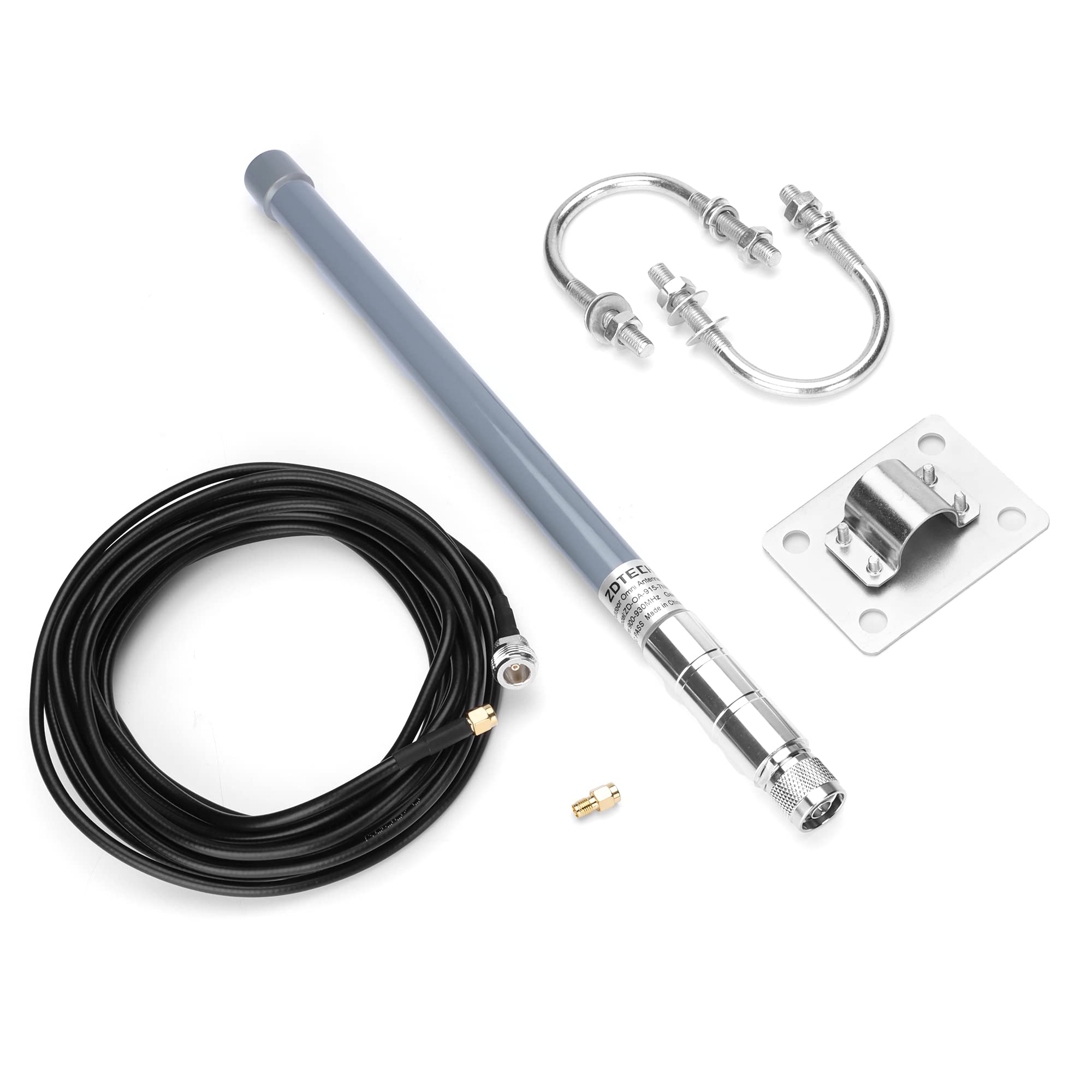
This entry-level 7 dBi fiberglass omni comes with a 20-foot RG58 extension cable and a full set of adapters (N Female to RP-SMA, plus RP-SMA to SMA). For the price, it is one of the most complete kits available, and Meshtastic users confirm it improves range on Heltec V3 nodes significantly over stock quarter-wave whips.
The 915 MHz center frequency is tuned for the US915 LoRa band, and the antenna works with RAK, Bobcat, and generic LoRaWAN gateways. One user reported that the included SMA cable was missing a center pin in their unit, which would damage a radio if connected — always inspect the connector before powering up.
SWR readings land around 1.5–1.6, which is acceptable but not as tight as premium options. For a starter antenna on a Meshtastic node or a test Helium deploy, this kit provides everything needed to get online without buying extra cables or adapters.
Why it’s great
- Complete kit with 20 ft cable and adapters
- Affordable entry point for LoRa and Meshtastic
- Works with all major US915 gateways
Good to know
- SWR is not as tight as premium antennas
- Quality control issues on some connector pins
- Excess sealant on antenna body reported
7. Five Star Outdoor HDTV Antenna

This is the only 75-ohm antenna in the roundup, designed specifically for over-the-air broadcast TV in the VHF (54–216 MHz) and UHF (470–700 MHz) bands — not for LoRa or cellular. At 46 inches long, the extended element design pulls in weak signals from over 45 miles away, with users in Houston scanning 128 channels through building clutter.
The kit includes a J-pole mount, splitter, and 40 feet of coax, making it a true all-in-one solution for cutting cable. Assembly is straightforward but the instructions miss one critical alignment step for the VHF vibrator elements — the screw heads must face the same direction for the elements to sit parallel and maintain impedance.
Installed at 7,300 feet elevation, one user scans 90 channels with 72 coming in crystal clear from 46 miles away. The 200-mile range claim is optimistic in practice — real-world reception depends heavily on line-of-sight and transmitter power — but for strong metro areas, this antenna outperforms most indoor flat panels by a wide margin.
Why it’s great
- Excellent real-world range for VHF and UHF
- Complete kit with mount, splitter, and coax
- ATSC 3.0 ready for next-gen broadcast
Good to know
- 75 Ohm impedance — incompatible with 50 Ohm radios
- Instructions miss VHF element alignment detail
- 200-mile claim is aspirational in most markets
FAQ
Can I use a 900 MHz LoRa antenna for 4G LTE?
Does a longer antenna always mean higher gain?
What connector do I need for a Helium miner?
Why does my antenna work worse indoors than outdoors?
Final Thoughts: The Verdict
For most users, the best 900 mhz antenna winner is the Hexa Boost 8dBi because its center-tuned 915 MHz design delivers verified low VSWR and real 8.3 dBi gain at a price that undercuts premium alternatives while outperforming wide-band options. If you need a point-to-point link through heavy tree cover, grab the Ubiquiti AMY-9M16 for its 16 dBi Yagi performance. And for budget-friendly Meshtastic or LoRa starter deployments, nothing beats the complete kit value of the ZDTECH 7dBi.