
A storm rolls in, the lights flicker, and suddenly your refrigerator stops humming, your sump pump goes silent, and your family’s comfort hangs in the balance. The difference between a minor inconvenience and a full-blown crisis often comes down to one decision: the portable generator sitting in your garage. Choosing the wrong one means hours of fuel-tank babysitting, noisy neighbors, or worse — a freezer full of spoiled food.
I’m Min — the co-founder and writer behind Gadgets Feed. After spending weeks analyzing wattage charts, fuel efficiency curves, decibel ratings, and real-world carbon monoxide safety data across dozens of models, I’ve built this guide to cut through the marketing noise and help you land the right backup generator for home use — one that matches your actual load requirements, not the spec sheet hype.
Every model here was evaluated on starting watts, runtime at half load, fuel flexibility, outlet configuration, and the all-important noise output at typical use distance. Whether you need to keep one fridge running or power your entire home’s essential circuits, the right match is in this list.
How To Choose The Best Backup Generator For Home
Picking the right generator isn’t just about the biggest wattage number. It’s about matching your specific load profile (fridge, lights, well pump, furnace blower, sump pump) to a machine that can handle the start-up surge without bogging down. Ignore the “running watt” rating on the box — starting watts are what actually matter for inductive loads like motor-driven appliances.
Starting Watts vs. Running Watts — The Real Math
A refrigerator might draw 800 watts while running, but its compressor needs 1,800 to 2,200 watts to start. A well pump could spike to 3,000 watts for a split second. Add a furnace blower and a few lights, and you’re easily north of 4,000 starting watts. Always add up the starting watts of every appliance you plan to run simultaneously — then leave a 20% headroom buffer. A generator rated for 4,000 running watts but 5,000 starting watts will handle a typical home’s essential circuits. Anything less and you’ll trip the breaker the moment the well pump kicks on.
Fuel Type: Gasoline, Propane, or Natural Gas?
Gasoline is cheap and widely available — but it degrades after 3 months and requires carburetor maintenance. Propane stores indefinitely and burns cleaner (no gumming), but reduces peak wattage output by about 10% compared to gas. Natural gas is the holy grail for whole-home backup — unlimited runtime as long as the gas line holds — but you’re tied to a stationary connection. Dual-fuel and tri-fuel models give you flexibility: start on propane for storage stability, then switch to gasoline when propane runs out during an extended outage.
Inverter vs. Open-Frame: Clean Power vs. Raw Grunt
Inverter generators produce less than 3% total harmonic distortion (THD), making them safe for laptops, CPAP machines, and modern refrigerator control boards. They’re quieter (52–65 dBA) and more fuel-efficient thanks to variable engine speed. Open-frame generators are louder (68–78 dBA) and produce dirtier power (5–12% THD), but they deliver higher wattage at a lower price point — ideal for running a welder, a well pump, or a 240V AC unit. For home backup where sensitive electronics are involved, an inverter model is almost always the smarter pick unless you have a massive motor load.
Outlet Configuration and Transfer Switch Readiness
A generator’s value depends on how easily it connects to your home. A TT-30R (30-amp RV outlet) runs a 120V inlet box with up to 3,600 watts. An L14-30R (30-amp twist-lock) connects to a transfer switch for 120V/240V split-phase power — enough for a sump pump, well pump, and fridge simultaneously. For full 50-amp whole-home backup, you need an NEMA 14-50R outlet. Many models here include these outlets directly; for others, you’ll need a parallel kit or a separate adapter cord. Always confirm your existing inlet or transfer switch matches the generator’s outlet before buying.
Safety Features: CO Shutdown, Low-Oil Shutdown, and Proper Ventilation
Carbon monoxide poisoning is the single deadliest risk with generators. Every model on this list includes a CO shutdown sensor that kills the engine if CO builds up — but this is a last resort, not a substitute for outdoor-only operation. Low-oil shutdown prevents engine damage when the oil level drops. Automatic voltage regulation (AVR) protects your electronics from voltage spikes. And never overlook the physical layout: generators produce exhaust heat and fumes that must be placed at least 15 feet from windows, doors, and HVAC intakes. A long extension cord rated for the full amperage is often required.
Quick Comparison
On smaller screens, swipe sideways to see the full table.
| Model | Category | Best For | Key Spec | Amazon |
|---|---|---|---|---|
| Westinghouse 13500W Dual Fuel | Premium | Whole-home backup with transfer switch | 10,500 running watts, remote start, 50A outlet | Amazon |
| Champion 15,000W Tri Fuel | Premium | Whole-home on natural gas with heavy AC loads | 15,000 starting watts, 717cc V-Twin, CO Shield | Amazon |
| EcoFlow DELTA Pro Ultra 6144Wh | Premium | Silent whole-home solar + battery backup | 7,200W AC output, 0ms UPS transfer, 90kWh expandable | Amazon |
| DuroMax XP13000HXT | Mid-Range | Tri-fuel flexibility for long outages | 13,000W peak, 500cc OHV, remote start | Amazon |
| EcoFlow DELTA Pro 3 + Dual Fuel | Premium | Hybrid battery + gas/propane for fuel independence | 4,096Wh battery, 3,200W dual fuel gen, auto start/stop | Amazon |
| Anker SOLIX F3800 | Premium | Quiet zero-emission whole-home with solar | 6,000W AC output, 3.84kWh, 240V, 10-year lifespan | Amazon |
| PowerSmart 7000W Open Frame Inverter | Mid-Range | High-wattage inverter for whole-home + sensitive electronics | 7,000W surge, 6,000W rated, 120/240V, electric start | Amazon |
| Champion 4000W Dual Fuel Inverter | Mid-Range | Compact dual-fuel with long propane runtime | 4,000W surge, 3,000W running, 64 dBA, 25 hrs on propane | Amazon |
| WEN DF360iX | Mid-Range | Lightweight dual-fuel RV/light home backup | 3,600W surge, 2,900W running, 49 lbs, CO watchdog | Amazon |
| ERAYAK 4500W Inverter | Budget | Ultra-clean power for sensitive electronics + camping | 4,500W peak, 3,500W rated, 60.5 dBA, 0.2-1.2% THD | Amazon |
| Westinghouse 2550W Inverter | Budget | Ultra-quiet minimal essential power for outages | 2,550W peak, 1,900W rated, 52 dBA, 42.4 lbs | Amazon |
In‑Depth Reviews
1. Westinghouse 13500W Dual Fuel Home Backup Generator
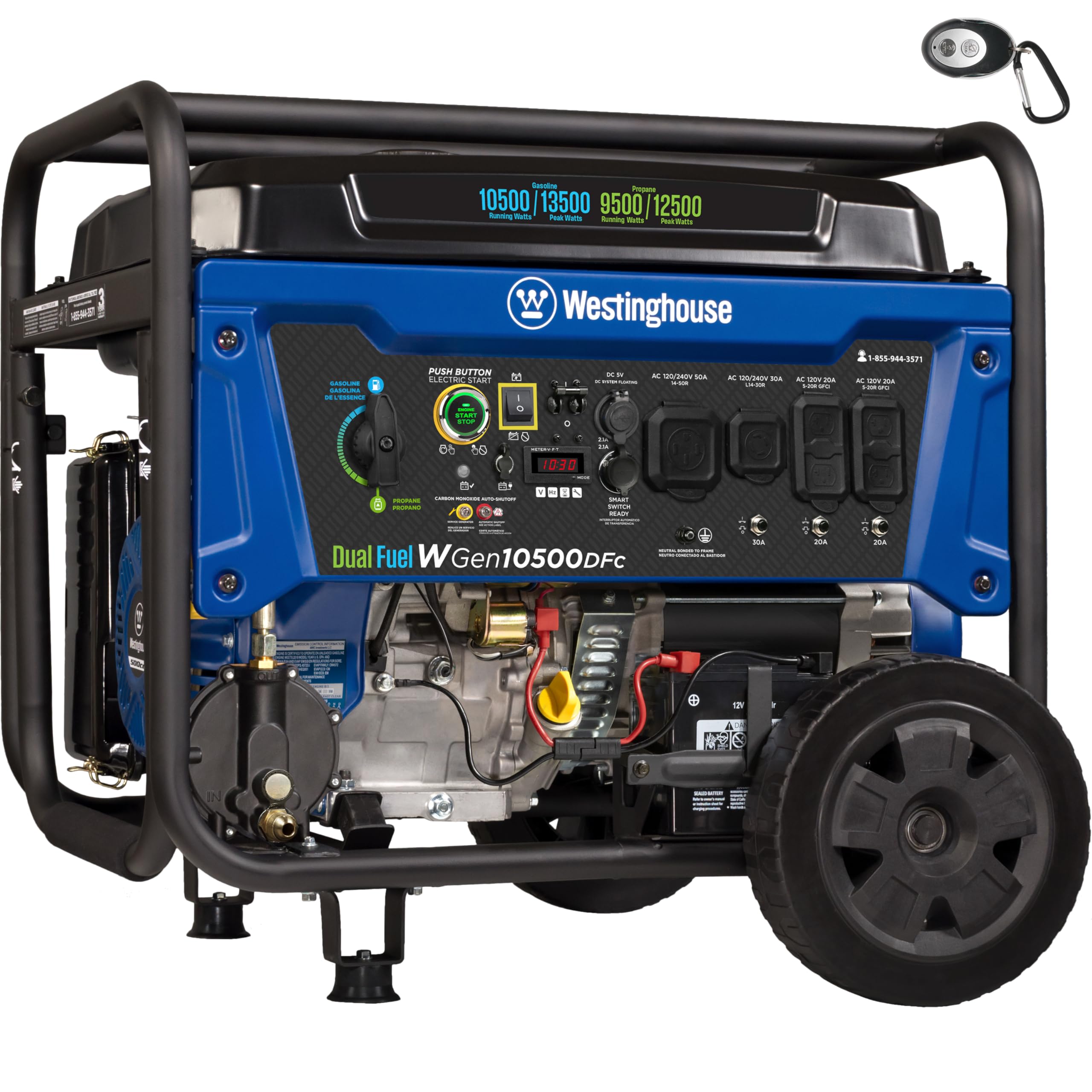
This Westinghouse is the closest thing to a standby generator without the permanent installation cost. Its 500cc cast-iron-sleeve engine delivers 10,500 running watts on gas (9,500 on propane) through a 50-amp RV-ready outlet and a 30-amp L14-30R twist-lock, making it transfer-switch ready out of the box. The remote start key fob means you can fire it up from inside the garage during a storm without stepping into the rain — a feature most similarly priced competitors charge extra for.
On the fuel side, the 9.5-gallon tank provides up to 19 hours of runtime at 50% load, which translates to a full overnight run on a single fill while powering a fridge, furnace blower, lights, and a sump pump. The digital hour meter and fuel gauge let you track maintenance intervals and avoid surprise shutdowns. At 230 pounds, it’s not a carry-around unit, but the wheel kit and folding handle make it manageable on flat ground.
Where this model truly earns its spot is the trifecta of remote start, dual-fuel flexibility, and 50-amp 240V capacity at a price point that undercuts the competitive open-frame units by hundreds of dollars. The CO shutdown sensor and automatic low-oil shutdown add crucial safety layers. If you need whole-home backup — meaning your AC, well pump, and refrigerator all on one machine — this is the one.
Why it’s great
- Remote start key fob included — rare at this price tier
- True 50-amp 240V outlet, ready for transfer switch hookup
- Dual fuel with 19-hour runtime on gasoline
Good to know
- Heavy at 230 pounds — requires space and a dolly for storage
- Open-frame design produces 70+ dBA, not neighborhood-friendly at night
2. Champion 15,000W Tri Fuel Home Backup Generator

The 717cc Milwaukee Series V-Twin engine in this Champion is a beast. It delivers 15,000 starting watts and 12,000 running watts across three fuel types — gasoline, propane, and natural gas — with both the LP and NG hoses included in the box. That means zero additional parts to buy for natural gas hookup, which is a standout value if you want to connect to your existing gas line for indefinite runtime during multi-day outages.
At 78 dBA from 23 feet, this is not a quiet generator. It’s a power-plant sound that neighbors will notice, but the trade-off is the ability to start a 3.5-ton central AC unit (with a soft-start kit) plus run a well pump, refrigerator, and lights simultaneously. Multiple owners report running their entire house for 90-plus hours straight during Hurricane Beryl without a single hiccup, using only natural gas. The battery-included electric start with a toggle switch is far more reliable than the push-button systems found on some competitors.
The Intelligauge monitor shows voltage, hertz, and runtime hours — essential for tracking the 5-hour break-in period and subsequent oil changes. The CO Shield carbon monoxide auto shutoff system meets the latest safety standards. At 331 pounds, this generator demands a permanent spot on a concrete pad or a heavy-duty cart; it’s not portable in the traditional sense. But if your priority is maximum power with tri-fuel redundancy, this Champion is the most capable conventional generator in the sub- range.
Why it’s great
- Tri-fuel with natural gas hose included — no extra cost to hook up
- 717cc V-Twin handles 3.5-ton AC with soft start
- Electric start with reliable toggle switch, not a finicky push button
Good to know
- Very loud at 78 dBA — not viable for quiet neighborhoods at night
- Extremely heavy at 331 pounds — requires a permanent home location
3. EcoFlow DELTA Pro Ultra 6144Wh Power Station

The DELTA Pro Ultra is not a generator in the traditional sense — it’s a whole-home battery system that happens to be portable. Inside the compact 6,144Wh base unit (one inverter, one battery) is a 7,200W 120V/240V AC output that can run a 3-ton central AC unit, an EV charger, and standard household circuits simultaneously. The 0ms UPS transfer time means your electronics never flicker during a grid failure — it switches before the lights even blink.
Scalability is the killer feature here. A single unit provides 6kWh, enough for two days of essential power. Add up to 14 extra batteries for a total of 90kWh, which covers a typical North American home for over 30 days on essential circuits. Recharging takes just 2 hours from a wall outlet, or you can pair it with solar panels for renewable off-grid capability. The EcoFlow app lets you prioritize specific circuits, time-shift loads to avoid peak rates, and monitor real-time usage — turning the battery into a smart energy management hub.
The catch is the price. At this premium tier, you’re paying for zero-emission, silent operation (all fans off for the first 30 minutes below 2,000W), a 10-year LFP battery lifespan, and the freedom from fuel storage. It doesn’t replace a 15,000W conventional generator for running a well pump and full-HVAC simultaneously for weeks — but for everyday backup, overnight use, and sensitive electronics protection, it’s the cleanest solution available. The printed manual issue noted by some users is disappointing for the price, but the hardware and expandability are unmatched in the portable power station space.
Why it’s great
- 7,200W 120/240V output with 0ms UPS — no transfer switch flicker
- Scalable to 90kWh, enough for 30 days of essential power
- Silent operation below 2,000W, ideal for nighttime use
Good to know
- High initial investment — cheaper than a standby generator but not cheap
- No printed manual included; online-only documentation is a pain without power
4. DuroMax XP13000HXT 13,000W Tri Fuel Generator
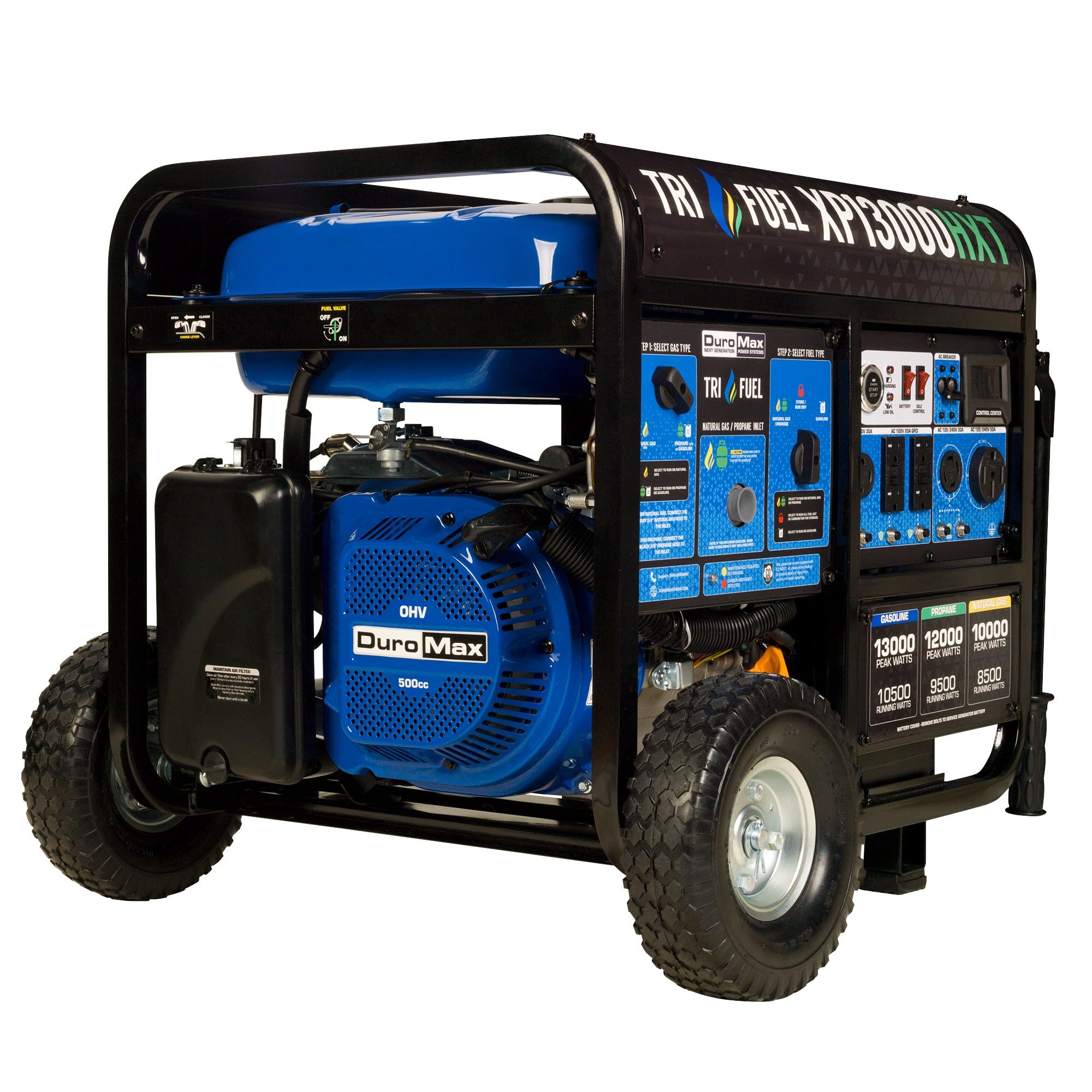
The DuroMax XP13000HXT delivers tri-fuel capability at a price that undercuts the Champion by a wide margin while still offering 13,000 peak watts from a 500cc OHV engine. The front-facing interface lets you switch fuel types in seconds — from gasoline to propane to natural gas — without tools. The included natural gas hose and propane regulator mean you can connect to your home’s gas line immediately, and the push-button start with a remote key fob adds convenience that’s uncommon in this price bracket.
Real-world owners report powering their entire home — four refrigerators, furnace, security cameras, and lights — at 25-30% load on gasoline, achieving 6 hours of runtime on 2.2 gallons. That’s remarkably efficient for a 13,000W unit. The CO Alert sensor automatically shuts down the engine if dangerous carbon monoxide levels accumulate, meeting the latest safety requirements.
The fuel selector knob can be stiff initially, and the engine is moderate-to-loud at around 72 dBA under load — acceptable for emergency backup but not a quiet-neighbor unit. The weight is comparable to the Westinghouse and Champion heavyweights at 240 pounds, so plan for a permanent wheeled location. For budget-conscious buyers who want tri-fuel redundancy without paying the premium V-Twin price, the DuroMax is the strongest value proposition on this list.
Why it’s great
- Tri-fuel with natural gas hose and propane regulator included in box
- Excellent fuel efficiency — 6 hours on 2.2 gallons at 25% load
- Remote start and push-button start at a budget-conscious price
Good to know
- Fuel selector knob is stiff and can be difficult to operate
- Heavy at 240 pounds — requires permanent storage with wheel kit
5. EcoFlow DELTA Pro 3 + 3200W Dual Fuel Generator
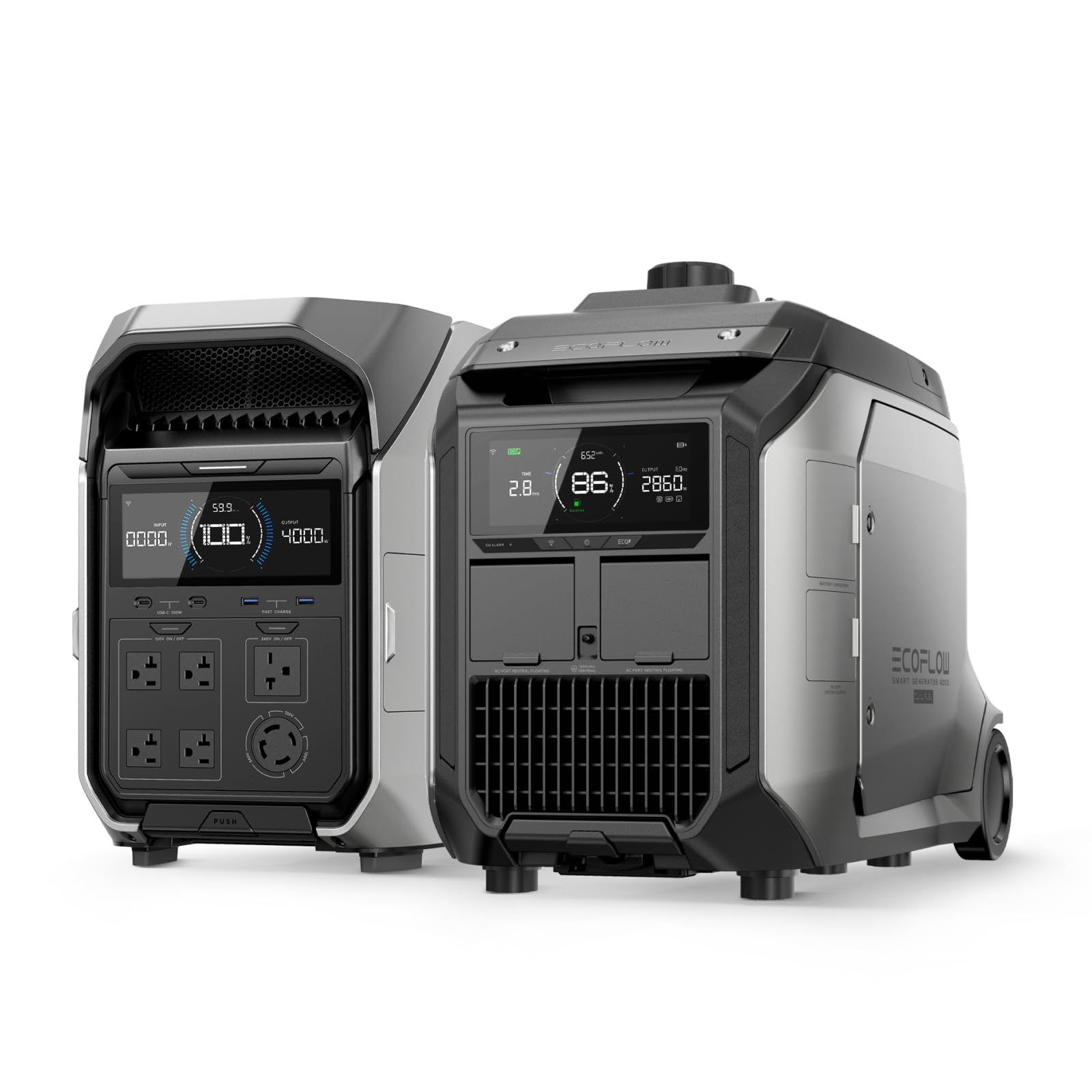
This bundle solves the two biggest problems with pure battery systems: limited runtime and slow recharging. The DELTA Pro 3 provides 4,096Wh of LFP battery capacity, and the dedicated dual-fuel generator (3,200W running on gas, 8,000W total output from a single tank) automatically starts and stops based on your energy demand. When the battery drops below a set threshold, the generator fires up, charges the battery, then shuts off — combining the silence of a battery for most of the day with the extended runtime of gas or propane for multi-day outages.
The smart engine delivers 8kWh of recharge energy from a single gasoline tank, providing about 8 hours of backup at 25% load. Connected to a 20-pound propane tank, you get up to 24kWh of total capacity — enough for three days of essential home circuits. The EcoFlow app gives you real-time monitoring of battery level, generator runtime, CO concentration, and overload alerts, with automatic shutdowns for all critical failures.
This bundle is expensive, but it replaces the need for a separate battery system and a conventional generator. You get silent EMERGENCY power from the battery 90% of the time, with the generator acting as an on-demand fuel extender. The main downside is that the generator is not CARB-approved, so it cannot be shipped to California. And at 83 pounds for the generator alone, plus the battery unit, this is a two-person setup. For those who want the best of both worlds — zero-emission daily backup with indefinite fuel-based runtime — this is the only all-in-one bundle that delivers.
Why it’s great
- Auto start/stop generator pairs with battery for silent daily backup + unlimited fuel runtime
- 24kWh total capacity with a single 20lb propane tank
- App-based real-time monitoring with automated safety shutdowns
Good to know
- Not CARB-approved — cannot be shipped to California
- Very expensive compared to buying battery and generator separately
6. Anker SOLIX F3800 Portable Power Station

The Anker SOLIX F3800 is the rare power station that can both run a 240V well pump and charge your EV directly via a NEMA 14-50 port — no special grounding adapters required. With 6,000W of AC output and a 3.84kWh LFP battery, it’s built around the same InfiniPower technology Anker uses in its high-end UPS systems, promising a 10-year lifespan with daily use. The dual-voltage 120V/240V capability means it handles both standard household circuits and heavy 240V loads like dryers and EV chargers.
Expandability is straightforward: add up to six extra battery packs for a total of 26.9kWh, or stack a second F3800 for 12,000W max AC output. The intelligent remote control via the Anker app lets you monitor power sources, set charging schedules, and optimize load management. The EV-class LFP batteries, impact-resistant design, and smart temperature control system make it one of the most durable portable power stations on the market.
The main trade-off is that you’re trading fuel independence for silence and zero emissions. During a multi-day outage without solar, the F3800 will need recharging from a wall outlet once its 3.84kWh is depleted — which requires grid power. The 132-pound weight is manageable with two people but not a solo carry. For homeowners who already have solar panels or live in areas with short outages (under 12 hours), the F3800 provides silent, fume-free backup that’s superior to any gas generator for sensitive electronics and nighttime use.
Why it’s great
- 6,000W 120/240V output with NEMA 14-50 for direct EV charging
- 10-year LFP battery lifespan with everyday use
- App-based remote monitoring and charging optimization
Good to know
- 3.84kWh capacity is modest — expandable but expensive to add
- Heavy at 132 pounds, requires two people to move safely
7. PowerSmart 7000W Open Frame Inverter Generator
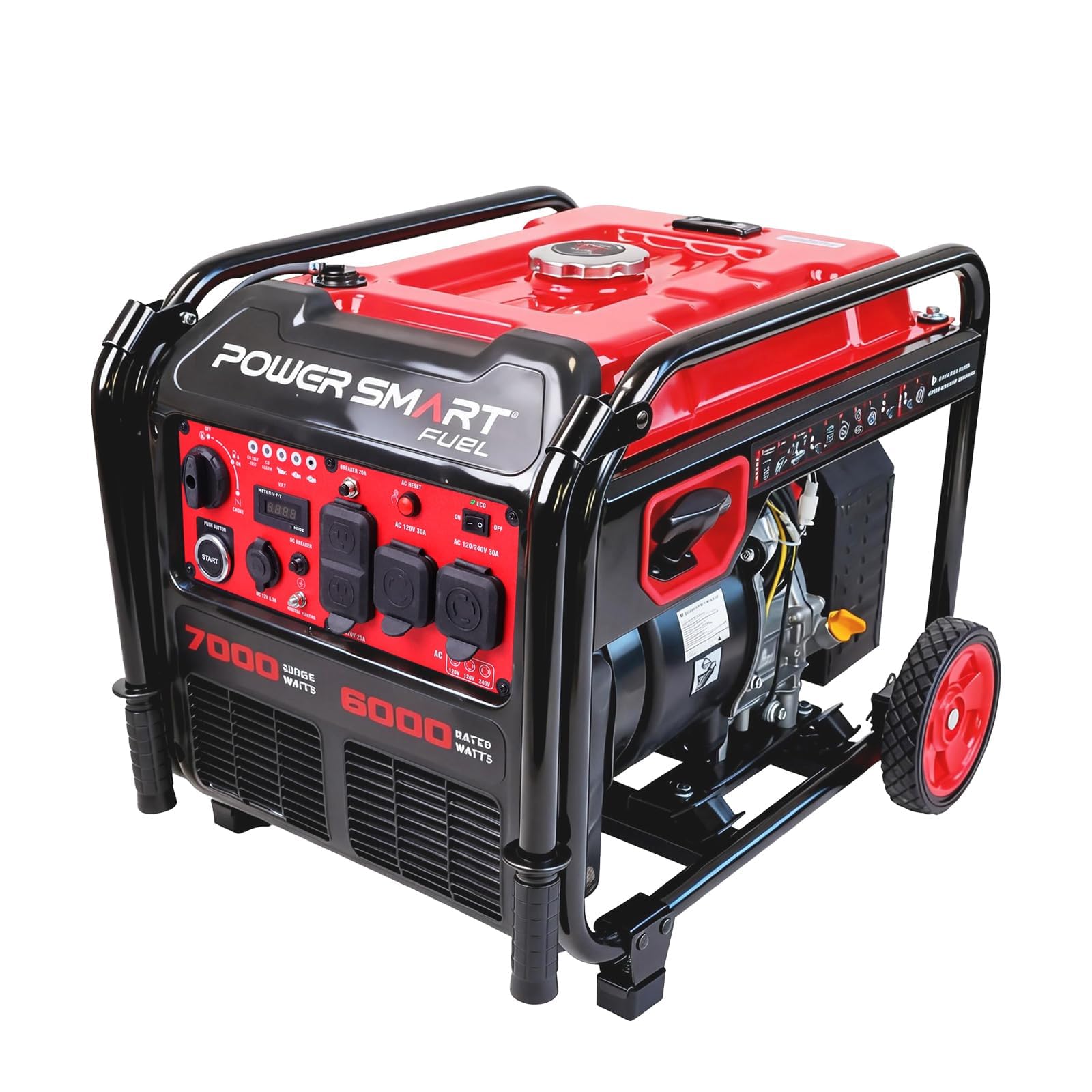
The PowerSmart PS5055C is a rare hybrid: an open-frame generator that uses inverter technology to produce clean sine-wave power (<3% THD). That means it can run your refrigerator, laptop, and whole-home transfer switch safely while still delivering the high wattage (7,000W surge, 6,000W rated) that cheaper open-frame units provide. Most open-frame generators produce 5-12% THD, which can damage sensitive electronics over time — this one doesn’t have that problem.
The dual-voltage selector lets you switch between 120V and 240V operation, so it works with a standard 30-amp inlet box for essential circuits or a 50-amp RV connection for full home backup. The electric push-button start (battery included, with a recoil backup) and the 322cc 4-stroke OHV engine deliver a 6-hour runtime at 50% load on its 3.2-gallon tank. The open-frame design provides superior airflow and cooling compared to enclosed inverters, extending engine life under sustained high loads.
At 113.5 pounds, it’s significantly lighter than the heavy-duty open-frame units from Westinghouse and Champion, making it feasible for one person to wheel into position. The noise level is a moderate 70 dBA at 23 feet — quieter than a traditional open-frame but louder than a pure inverter. Owners report running entire houses (minus 240V dryers and water heaters) with a 30-amp inlet box. The key operational note: always warm up the engine for 10 minutes before connecting high-wattage loads to prevent overload tripping. For the wattage-to-clean-power ratio, this is the most versatile mid-range generator available.
Why it’s great
- Clean inverter power (<3% THD) at 6,000 running watts — rare in open-frame designs
- Dual-voltage 120/240V with electric push-button start
- Lightweight (113.5 lbs) compared to similarly rated open-frame units
Good to know
- Requires 10-minute warm-up before connecting high-wattage loads
- 70 dBA noise is louder than pure inverter models at similar wattage
8. Champion 4000W Dual Fuel RV Ready Inverter

Champion’s 4,000-watt dual-fuel inverter hits the sweet spot for homeowners who need reliable mid-range power without the heavy price tag or bulky footprint. At just 53 pounds and 64 dBA at 23 feet, it’s genuinely portable and surprisingly quiet — quiet enough for suburban neighborhoods where running a generator past 10 PM would normally cause friction. The dual-fuel design runs on gasoline (4,000 surge, 3,000 running) or propane (2,700 running), with the propane runtime extending to a remarkable 25 hours on a single 20-pound tank.
The inverter technology delivers clean power (<3% THD), making it safe for laptops, CPAP machines, and modern refrigerator control boards. The optional parallel kit lets you pair two units for double the output during extended outages. The included TT-30R RV outlet, 20-amp household duplex, and 12V automotive-style outlet cover all the standard home backup connections. The CO Shield auto-shutoff system meets the latest safety standards.
Owner reports consistently highlight how this unit handles two refrigerators and a freezer for 6-12 hours on propane without needing a refill — and without the carburetor maintenance headaches of gasoline-only models. The primary complaint is that some units have failed early (white smoke, loss of power), though Champion’s 3-year warranty and lifetime technical support have generally resolved these cases. For homeowners with smaller essential loads — fridge, freezer, furnace blower, and a few lights — this Champion delivers excellent value with minimal noise and fuel flexibility.
Why it’s great
- Ultra-quiet 64 dBA operation — as quiet as a normal conversation
- 25-hour runtime on a single 20lb propane tank — best in class
- Lightweight at 53 pounds, truly portable for one person
Good to know
- Some units have reported early failure; warranty support is reliable but inconvenient
- Propane runtime is excellent, but gasoline runtime is shorter at ~10 hours
9. WEN DF360iX 3600W Dual Fuel Inverter

The WEN DF360iX is the lightest dual-fuel inverter on this list at just 49 pounds, making it one of the few generators you can comfortably lift into a truck bed or carry to a campsite. Despite the small footprint, it delivers 3,600 surge watts (2,900 running on gas, 2,600 running on propane) with clean power output for sensitive electronics. The digital display shows voltage, frequency, runtime, and load percentage — a feature that even some premium generators at twice the price skip.
Fuel flexibility is handled through a tool-free LPG quick-connector for propane tanks, plus a standard gas cap with a fuel shutoff valve that extends engine life and reduces maintenance. The WEN Watchdog CO Shutdown Sensor automatically kills the engine if dangerous CO levels accumulate, adding a critical safety layer. The parallel capability lets you connect two DF360iX units for double the output when needed. The included TT-30R RV outlet, two 120V 20-amp receptacles, 12V DC outlet, and two USB ports cover the full range of backup needs.
Owners consistently report first-pull starts on both fuel types, low noise levels (comparable to conversation), and enough power to run an RV’s air conditioner (with soft start), a refrigerator, and basic lights simultaneously. The main downside is that the 20-amp household outlets hold plugs loosely — a minor issue that can be solved by replacing the receptacles or using a tight-fitting power cord. For RV owners or homeowners who need a lightweight, portable option for short outages (under 24 hours), the WEN DF360iX is the most portable dual-fuel inverter in its power class.
Why it’s great
- Incredibly light at 49 pounds — easiest to move and store in this class
- Digital display with voltage, frequency, runtime, and load percentage
- Tool-free LPG quick-connector for propane tanks
Good to know
- 20-amp outlets hold plugs loosely — may require replacement or tight cords
- Propane wattage is lower (2,600W running) than some dual-fuel competitors
10. ERAYAK 4500W Portable Inverter Generator

The ERAYAK 4500W inverter is a dark horse that punches well above its price point. With 4,500 peak watts, 3,500 running watts, and an astonishingly low total harmonic distortion of 0.2-1.2% — that’s cleaner power than most premium inverter generators on the market. For anyone powering CPAP machines, laptops, or refrigerators with sensitive electronic control boards, this level of clean power is more important than extra wattage you won’t use.
At just 55 pounds and 60.5 dBA, it’s both lighter and quieter than most competitors in the 3,500-watt range. The Eco Mode dynamically adjusts engine speed to match the load, extending fuel efficiency to 0.21 gallons per hour at 25% load — that’s over 10 hours of runtime on a single 2.5-gallon tank for light loads. The 50-amp parallel capability lets you connect two units for 7,000W rated power. The outlet panel includes a TT-30R RV outlet, two 120V AC outlets, a 12V cigarette lighter port, USB-A, and USB-C — covering every common connection type.
The mixed reviews are the main caution. Some owners report the unit failing after 3-4 uses (pull cord breaking, sudden shutdowns under load), and customer service has been described as unresponsive. When it works, it’s a fantastic budget-friendly inverter; when it fails, the lack of returnability through Amazon adds friction. For budget-conscious buyers who accept the risk and want the cleanest possible power at the lowest weight and noise, the ERAYAK 4500W is a compelling option — just make sure you test it thoroughly within the return window.
Why it’s great
- Ultra-clean power (0.2-1.2% THD) — among the best in any portable inverter
- Extremely quiet at 60.5 dBA and light at 55 pounds
- Fuel-efficient Eco Mode with 0.21 gal/hour at 25% load
Good to know
- Reliability concerns — some units fail early, customer service is inconsistent
- Non-returnable through Amazon in some cases, adds purchase risk
11. Westinghouse 2550W Super Quiet Inverter

The Westinghouse 2550W inverter is designed for minimal essential backup — think keeping one refrigerator running, powering a few lights, and charging devices during a short outage. At 42.4 pounds and 52 dBA, it’s the lightest and quietest generator on this list, quiet enough to run in a suburban backyard without neighbors even noticing. The dual-fuel capability (gas or propane) provides flexibility, and the 30-amp TT-30R RV outlet means it can directly power an RV or a 30-amp home inlet.
Runtimes are impressive for the size: up to 12 hours on the 1.16-gallon gas tank in Economy Mode, and the 3% THD inverter power is safe for modern electronics. The included oil funnel, tool kit, and user’s manual make first-time setup straightforward. The parallel capability lets you connect two units for double the wattage during longer outages. The CO sensor automatically shuts down the engine if dangerous gas levels accumulate.
The trade-offs are clear: at 1,900 running watts, you cannot run a well pump, a central AC unit, or a large window AC alongside other appliances. You can power a fridge (800W running, 2,200W starting), a few LED lights, and a phone charger — but that’s it. Some owners have reported units failing to start after minimal use, and customer support has been slow to respond. For homeowners in apartments, condos, or small houses who just need to keep the fridge cold and a fan running during a 4-6 hour outage, the Westinghouse 2550W is the most portable, quietest, and cheapest reliable option available.
Why it’s great
- Ultra-quiet 52 dBA — barely audible from 20 feet away
- Extremely portable at 42.4 pounds, easy for anyone to carry
- 12-hour runtime on a small gas tank with Economy Mode
Good to know
- Only 1,900 running watts — cannot power a well pump or AC unit
- Some reliability concerns; customer support response times are inconsistent
FAQ
Can I run my central air conditioner with a portable backup generator?
How do I calculate the generator size I really need?
Is propane or gas better for a home backup generator?
Do I need a transfer switch, or can I plug appliances directly into the generator?
How far should a generator be placed from the house?
Final Thoughts: The Verdict
For most users, the backup generator for home winner is the Westinghouse 13500W Dual Fuel because it delivers true 50-amp whole-home power with remote start, dual-fuel flexibility, and a price that undercuts the competition. If you want natural gas capability for indefinite backup during multi-day outages, grab the Champion 15,000W Tri Fuel. And for silent, zero-emission backup with solar integration and 240V output for EV charging, nothing beats the EcoFlow DELTA Pro Ultra.