
AA NiMH rechargeable batteries solve a simple but relentless problem: the constant cycle of buying, using, and tossing alkaline cells that die fast in high-drain gadgets like game controllers, camera flashes, and wireless mice. Switching to NiMH chemistry means consistent 1.2V output across the charge curve, zero memory-effect degradation, and the ability to reuse a single cell hundreds of times before it retires.
I’m Min — the co-founder and writer behind Gadgets Feed. This guide was built by analyzing actual capacity test results, self-discharge retention data, cycle-life ratings, and hundreds of verified customer measurements across seven of the most popular AA NiMH packs on the market right now.
Whether you’re stocking a photography kit or powering a household full of toys and remotes, finding the right best aa nimh batteries comes down to matching real-world capacity, cycle longevity, and self-discharge performance to your specific devices.
How To Choose The Best AA NiMH Batteries
The rechargeable AA battery market is crowded with capacity ratings, cycle counts, and self-discharge promises that don’t always match real-world performance. Focusing on three core metrics — real capacity, low self-discharge retention, and cycle-life durability — will steer you toward cells that actually deliver on their specs.
Tested Capacity vs. Advertised mAh
A 2800mAh sticker means little if independent testing reveals the cell delivers 2,200mAh under a moderate 500mA load. Serious buyers check third-party discharge tests at 500mA or 1A to verify actual capacity. Higher mAh ratings often come from thinner internal separators, which can reduce long-term reliability. A 2000mAh cell that consistently delivers 1,900mAh is often better than a 2800mAh cell that hits only 2,300mAh in practice.
Low Self-Discharge (LSD) Performance
LSD NiMH batteries retain 70 to 80 percent of their charge after one to three years of storage. This matters for emergency flashlights, remote controls, and devices used infrequently. Panasonic eneloop sets the benchmark with 70% retention after 10 years — a spec no other brand has matched. Cheaper cells may lose 30% in six months, rendering them useless when you need them most.
Cycle-Life Ratings and Real Durability
Manufacturers claim anywhere from 800 to 2,100 charge cycles. In practice, cycle life depends on charging discipline — using a smart NiMH charger with independent channel monitoring and delta-V cutoff preserves cells far longer than cheap timer-based chargers. Higher cycle ratings (2,100 for eneloop) reflect better internal chemistry and separator quality, not just marketing optimism.
Quick Comparison
On smaller screens, swipe sideways to see the full table.
| Model | Category | Best For | Key Spec | Amazon |
|---|---|---|---|---|
| Panasonic Eneloop 6-Pack | Premium | Long-term reliability and low self-discharge | 2,100 cycles, 70% charge after 10 years | Amazon |
| Panasonic Eneloop 10-Pack | Premium | Heavy multi-device households | 2,100 cycles, 2,000mAh minimum | Amazon |
| Bonai AA & AAA Combo | Mid-Range | All-in-one kit with charger included | 1,200 cycles, 16-bay smart charger | Amazon |
| KOSHARE 8AA + Charger | Mid-Range | Type-C charging convenience | 800 cycles, 8-slot magnetic charger | Amazon |
| NICEBATT 16-Pack | Mid-Range | High-capacity for moderate drain devices | 2,800mAh rated, 80% retention after 2 years | Amazon |
| Granicell 16-Pack | Budget | Economical bulk pack for light household use | 2,800mAh rated, 1,300 cycles claimed | Amazon |
| Amazon Basics 16-Pack | Budget | Ultra budget for toys and clocks | 2,000mAh, 1,000 cycles, 80% after 2 years | Amazon |
In‑Depth Reviews
1. Panasonic Eneloop BK-3MCCA6BA 6-Pack

Panasonic eneloop AA cells are the benchmark against which all other NiMH batteries are measured. Rated for 2,100 recharge cycles — the highest in the consumer NiMH market — these pre-charged, solar-factory-charged cells deliver a typical 2,100mAh and a minimum 2,000mAh, with actual capacity tests from buyers showing consistent 1,900-2,050mAh output under moderate loads. The real standout is the low self-discharge performance: eneloop retains 70% of its charge after a decade of storage, a spec unmatched by any competitor in this roundup.
Built in Japan with tight manufacturing tolerances, these cells weigh a consistent 27 grams each and maintain remarkably flat discharge curves under 500mA and 1A loads, making them ideal for high-drain electronics like digital camera flash units, Xbox controllers, and wireless mice. Users report over a month of daily-use runtime in a Panasonic razor and years of reliable service across dozens of devices without any capacity fade. The 6-pack format is perfect for households that need a core set of dependable cells for priority gear.
The main consideration is upfront cost per cell, which runs higher than budget alternatives. However, when you factor in the 2,100-cycle lifespan and decade-long charge retention, the total cost per use is lower than any disposable or cheaper rechargeable option. Slow charging with an eneloop-branded or high-quality smart charger is recommended to maximize cycle life — avoid fast chargers lacking delta-V detection.
Why it’s great
- Industry-leading 2,100 recharge cycles with consistent capacity output
- 10-year 70% charge retention is unmatched for emergency and low-use storage
- Made in Japan with tight weight and capacity matching across cells
Good to know
- Higher per-cell cost than budget 16-packs from generic brands
- Only a 6-pack — heavier users may need the 10-pack or additional sets
2. Panasonic Eneloop BK-3MCCA10FA 10-Pack

The 10-pack eneloop variant is effectively the same exceptional cell as the 6-pack but scaled for households or photographers managing multiple high-drain devices simultaneously. Each battery carries the same 2,100-cycle rating, pre-charged solar-factory condition, and the legendary 70% retention after 10 years. Users who have been running eneloop cells for half a decade report zero leaking, zero capacity fade, and consistent voltage delivery from cycle one through cycle 500-plus.
Independent buyer tests confirm these cells charge to an average of 2,130mAh after activation cycles, with a standard deviation under 30mAh — remarkable consistency for mass-produced NiMH. The ten-cell count is the sweet spot for powering a pair of camera flashes, a gaming headset, wireless controllers, and a flashlight set without needing to shuffle batteries between devices. The storage case included in the packaging keeps cells organized and terminals protected.
The trade-off is straightforward: this is the most expensive entry on the list per battery. Yet the cost-per-cycle analysis heavily favors eneloop — a single cell can be recharged more than 2,000 times, meaning a 10-pack set could theoretically replace over 20,000 disposable AA batteries over its lifetime. For photography enthusiasts and serious gamers who chew through batteries weekly, this pack pays for itself within months.
Why it’s great
- Ten-cell bulk format at the same premium quality as the 6-pack
- Extreme 2,100-cycle lifespan dramatically lowers long-term cost
- Solar pre-charged and ready — no initial conditioning required
Good to know
- Highest upfront investment of any product reviewed here
- Charger not included; requires a quality NiMH smart charger
3. Bonai Rechargeable AA & AAA Batteries with Charger
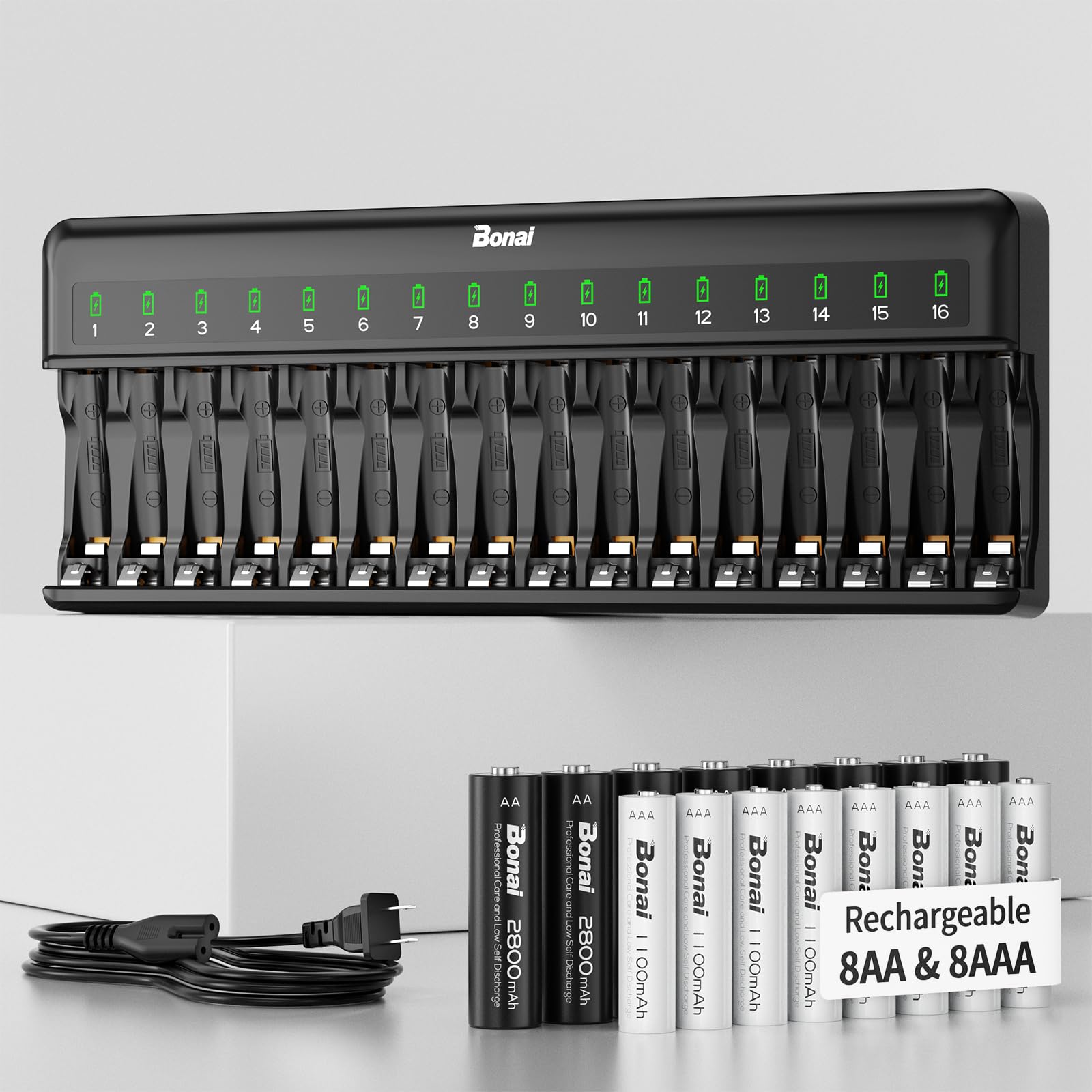
Bonai’s kit takes a different approach by bundling eight 2,800mAh AA cells and eight 1,100mAh AAA cells with a 16-bay smart charger that handles both sizes simultaneously. The charger features independent channel monitoring, delta-V cutoff to prevent overcharging, and LED indicators that show red for charging, green for full, and flashing red for defects. This eliminates the need to pair batteries or wait for a full set — you can charge one, five, or sixteen cells at once with mixed sizes.
The AA cells are rated for 1,200 recharge cycles with low self-discharge technology that maintains usable power for up to one year in storage. However, third-party buyer testing reveals actual capacity falls between 2,200mAh and 2,300mAh under a moderate 500mA load — roughly 79-82% of the advertised 2,800mAh. This is a common discrepancy in the high-capacity NiMH segment, but it means the cells perform closer to standard 2,200mAh cells than the premium 2,800mAh tier.
The charger itself is the real value here — 16 individual slots with smart monitoring at this price point is rare. Users in high-turnover environments (paranormal research equipment, event radios, large toy collections) appreciate being able to charge a full arsenal overnight. The two-year battery capacity warranty and 12-month charger warranty add peace of mind. Note that the charger’s LEDs remain lit even without batteries installed, which some users find distracting in dark environments.
Why it’s great
- Includes a genuine 16-bay smart charger with independent channel monitoring
- Mixed AA and AAA charging with delta-V cutoff for safety
- Eight AA and eight AAA cells cover both form factors in one purchase
Good to know
- AA cells test at 2,200-2,300mAh real-world capacity, below the 2,800mAh claim
- Charger LEDs stay on constantly — no off switch for dark rooms
4. KOSHARE Rechargeable AA Batteries with Charger
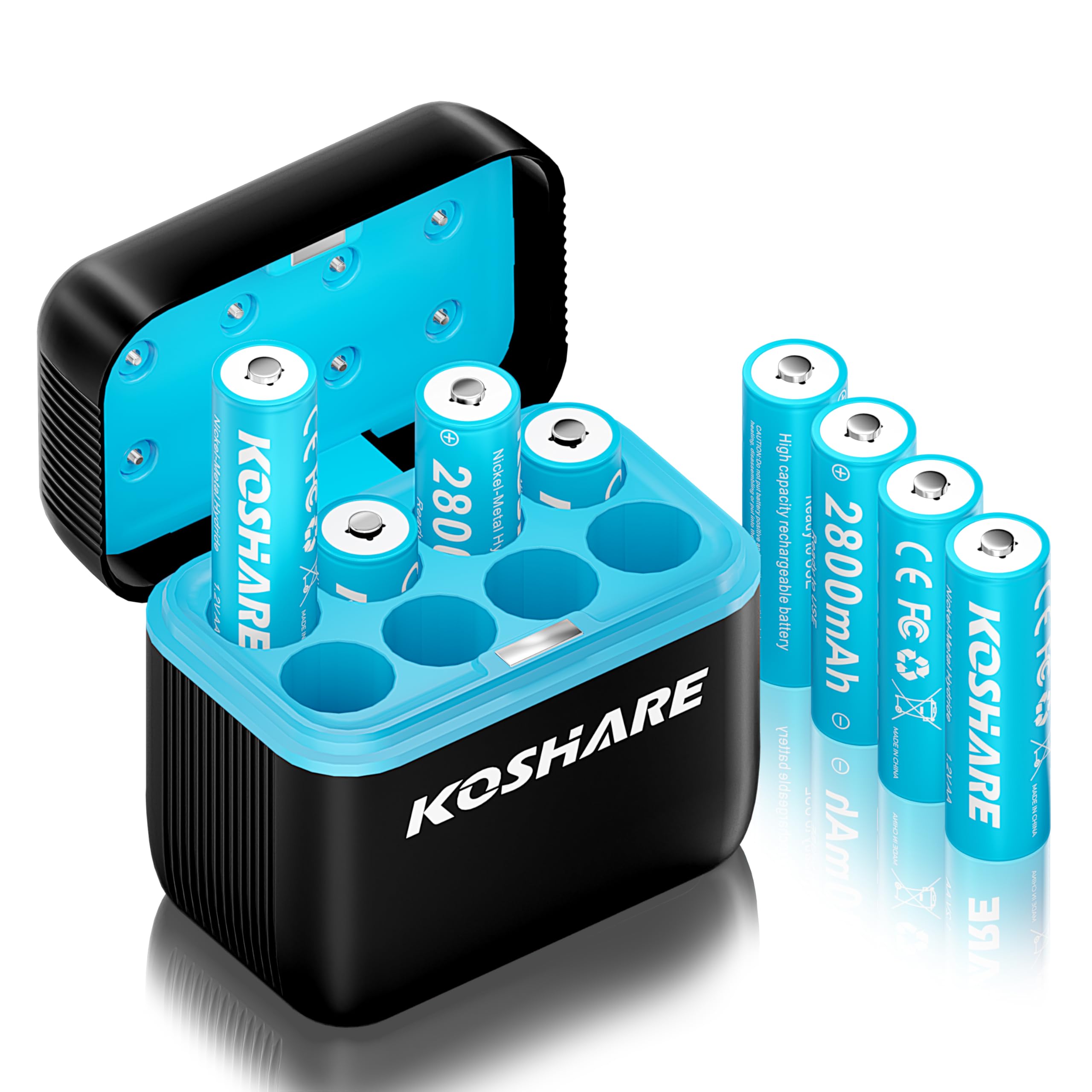
KOSHARE enters the mid-range space with a clever integrated charging solution: an 8-slot NiMH charger that uses a magnetic design to hold and charge batteries simultaneously, powered via a Type-C cable. The eight included AA cells are rated at 2,800mAh with a 1.2V nominal output and claim 800 recharge cycles. The charger supports any combination of 1-8 batteries with smart LED indicators — red for charging, green for full, flashing red for errors or temperature anomalies.
Users report that the pre-charged cells (shipped at roughly 70% capacity) work straight out of the box for moderate-drain devices like TV remotes and LED string lights, with runtimes of 12-18 hours per charge in continuous use scenarios. The 800-cycle rating is lower than eneloop’s 2,100 but still represents a significant cost saving over disposable cells — roughly 800 fewer alkaline batteries sent to landfill per cell over its lifetime. The Type-C charging input is a welcome modern touch for travelers who carry only one cable.
The primary limitation is the charger’s compatibility: KOSHARE’s NiMH charger only accepts KOSHARE-branded NiMH batteries, according to the manufacturer’s warnings, and cannot charge lithium cells or other chemistries. Some buyers noted that the actual capacity under load tests closer to 2,400mAh than the advertised 2,800mAh, consistent with other high-capacity NiMH products. For households that want a self-contained system with minimal cable clutter, this is a solid option.
Why it’s great
- Type-C powered charger simplifies cable management and travel
- Magnetic charger design holds batteries securely during charging and storage
- Smart LED indicators with overcharge protection for safe overnight charging
Good to know
- Charger is limited to KOSHARE NiMH cells only — not universal
- 800-cycle rating is less than half of premium eneloop cells
5. NICEBATT Rechargeable AA Batteries 16-Pack
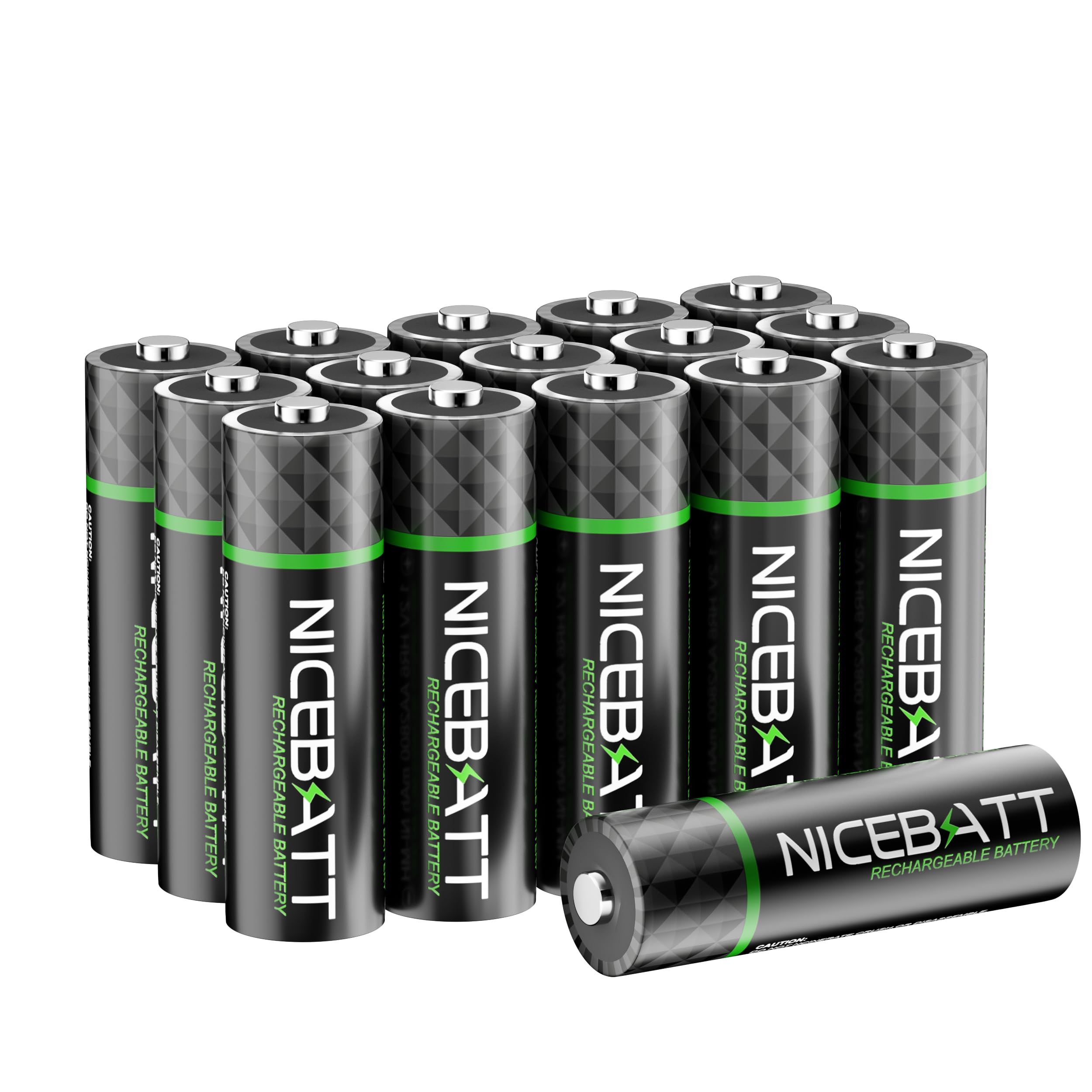
NICEBATT targets the high-capacity segment with a 16-pack of 2,800mAh rated AA cells. The batteries claim 1,200 recharge cycles and 80% capacity retention after two years of storage, making them a candidate for moderate-use households. Independent buyer testing with a 500mA discharge load measured actual capacity at 2,350-2,400mAh — about 84-86% of the rated spec. Under a lighter 140mA load, real-world capacity likely approaches the 2,800mAh claim more closely, which aligns with low-drain applications.
User feedback highlights consistent performance in Quest 2 VR controllers, with cells lasting several months of light use before needing recharging. The batteries arrive in transport safety mode at roughly 70% charge, and the manufacturer recommends cycling them 2-3 times to reach full activation. The 16-count format provides enough backup cells to run a large household without rotating batteries daily. The two-year warranty is a confidence marker for a lesser-known brand in this space.
The main concerns are the gap between rated and tested capacity, and some units arriving with inconsistent self-discharge levels directly from the factory — a few cells in a batch may show lower voltage than others, potentially causing imbalance in multi-cell devices. As with all high-capacity NiMH cells, charging with a smart charger that includes independent channel voltage monitoring is essential to maintain cell matching over the long term.
Why it’s great
- 16-pack provides a generous supply for large households or workshops
- 2,800mAh rated capacity with 1,200-cycle claim offers decent longevity
- Two-year warranty adds protection for a mid-market brand
Good to know
- Actual capacity tests at 2,350-2,400mAh under 500mA load
- Factory self-discharge varies between individual cells in the same pack
6. Granicell AA Rechargeable Batteries 16-Pack
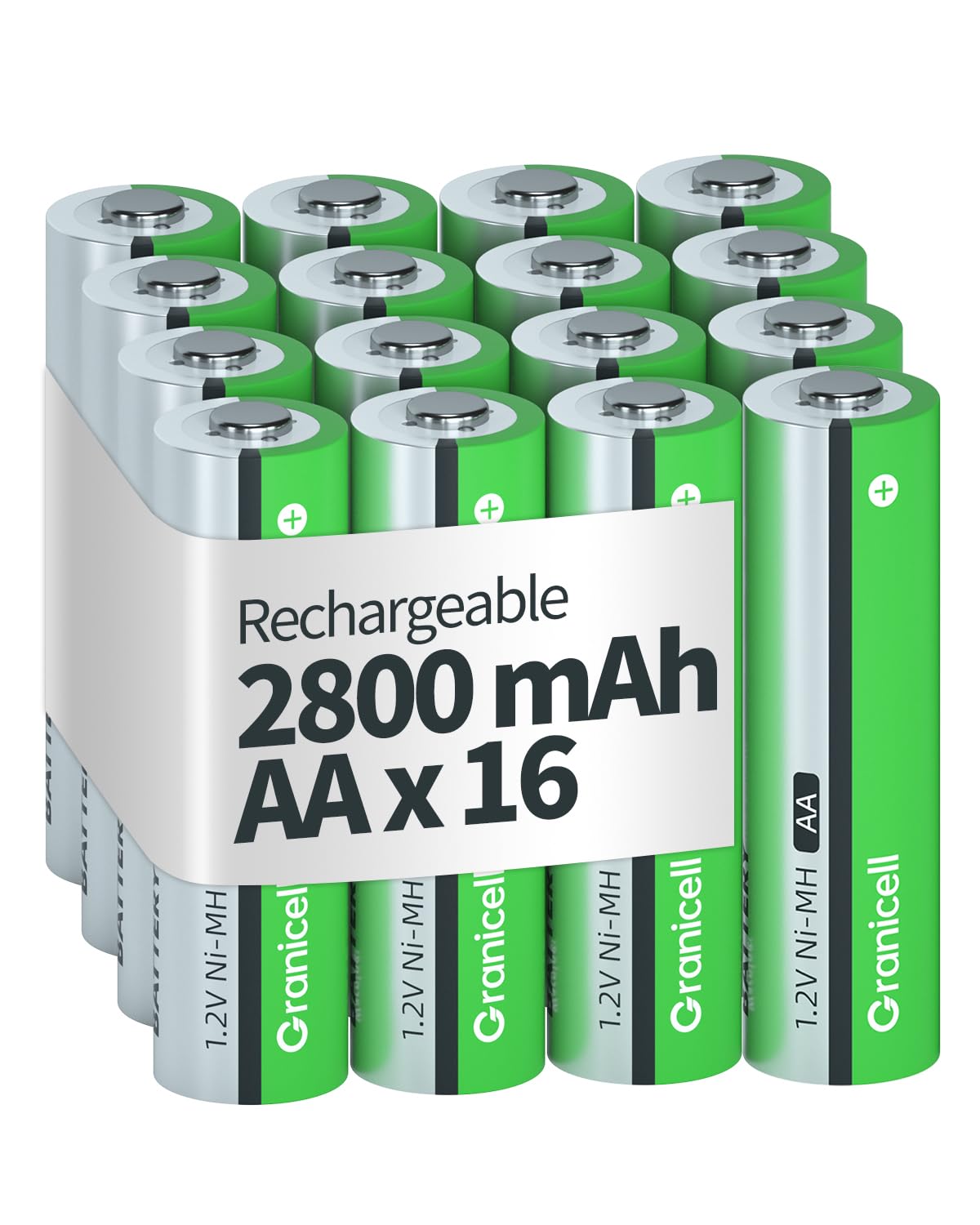
Granicell offers a 16-pack of 2,800mAh rated AA cells at a highly competitive price point, with a claimed 1,300 recharge cycles and 80% capacity retention after three years of non-use. The batteries are pre-charged using solar power at the factory and are marketed as passing six professional safety tests for overcharge, short-circuit, and temperature stability. For budget-conscious buyers looking to convert a large household to rechargeables, the upfront cost per cell is among the lowest in this roundup.
Buyer experiences are generally positive for light-to-moderate household devices — TV remotes, clocks, children’s toys, and basic LED flashlights. Users report that the batteries meet expectations for standard use, though some caution that the long-term cycle durability is unproven compared to established brands. One buyer mistakenly ordered NiMH instead of lithium cells and noted that the charger correctly detected the incompatibility, suggesting the cells interact well with smart chargers that check chemistry.
The primary limitation is the lack of long-term user data — these cells are relatively new to the market, and real-world degradation patterns after 100+ cycles remain unknown. The manufacturer’s warranty is vague (“contact us freely for any questions”) rather than a defined replacement policy. For buyers who prioritize absolute lowest-cost entry into NiMH reusability and aren’t cycling cells heavily, the Granicell pack is a functional choice.
Why it’s great
- Lowest per-cell cost in this guide — ideal for bulk household adoption
- Claims 80% charge retention after 3 years, decent for emergency storage
- Pre-charged with solar energy and passes six safety certifications
Good to know
- Long-term cycle durability is unverified — newer product with limited aging data
- Warranty is informal and may require direct contact rather than automated support
7. Amazon Basics 16-Pack Rechargeable AA NiMH

Amazon Basics rechargeable AA cells are the most recognizable budget entry in the NiMH space, offering 2,000mAh capacity and a 1,000-cycle rating in a 16-pack format. Independent testing from multiple buyers confirms these cells deliver 1,890-1,920mAh out of the box — roughly 95% of the rated capacity — with a remarkably consistent weight of 27 grams across the pack. After a few activation cycles, actual charged capacity averages 2,130mAh, exceeding the rated spec. The low self-discharge claim of 80% retention after two years aligns with real-world performance, with users measuring only 0.03V voltage drop after 48 hours of storage.
These cells perform admirably in medium-drain devices like night lights, ambient LED fixtures, and children’s toys, where one user reported 24+ hours of continuous runtime. The 16-count format means you can dedicate four cells to a TV remote, four to a flashlight kit, four to wireless peripherals, and four spares without buying multiple packs. Amazon’s own compatibility warnings are thorough — they advise against mixing chemistries, capacities, or charge levels, which is good practice for any NiMH system.
The main drawback is the 2,000mAh capacity, which is lower than the 2,800mAh offerings from NICEBATT and Granicell. Users running high-drain devices like camera flashes or professional-grade gaming controllers may find runtime shorter than they’re used to with 1.5V lithium disposables. Additionally, some users report that stored cells lose charge over weeks rather than months, requiring a refresh charge before use in urgent scenarios. For the price, though, these are the most reliably tested budget cells available.
Why it’s great
- Proven 95% capacity delivery at 1,900mAh out of the box from multiple testers
- Lowest cost-per-cell among reliable, well-tested NiMH options
- Consistent weight and discharge profiles — good cell matching in multi-cell devices
Good to know
- 2,000mAh capacity is lower than premium high-capacity competitors
- Self-discharge may require recharging before use after weeks of storage
FAQ
Can I use 1.2V NiMH batteries in devices designed for 1.5V alkalines?
Why do my NiMH batteries get hot during charging?
How many times can I really recharge NiMH AA batteries before they stop working?
Final Thoughts: The Verdict
For most users, the best aa nimh batteries winner is the Panasonic Eneloop 6-Pack because the combination of 2,100-cycle durability, decade-long charge retention, and genuine 2,000mAh minimum capacity makes it the most reliable cell for both high-drain and standby use. If you want a complete system with charger included, grab the Bonai AA & AAA Combo for its versatile 16-bay smart charger and dual form-factor coverage. And for budget-conscious bulk buyers, nothing beats the Amazon Basics 16-Pack for its well-tested consistency and unbeatable cost-per-cell value.