
The promise of free, over-the-air HDTV is seductive — but the reality of an Amplified Television Antenna often involves pixelation, dropped channels, and the frustration of repositioning a paper-thin sheet of plastic to catch a signal that just won’t lock. The difference between a living room filled with crystal-clear local news and sports and a screen full of static comes down to the amplifier’s noise figure, the antenna’s frequency response (VHF vs. UHF), and how well the design handles multi-path interference from your neighbor’s new metal roof.
I’m Min — the co-founder and writer behind Gadgets Feed. After analyzing the technical specifications, customer review patterns, and real-world performance data of dozens of models across all price tiers, I’ve separated the units that actually deliver a stable signal from those that rely on inflated mileage claims and marketing buzzwords.
Whether you are cutting the cord or setting up a backup for stormy weather, you need a unit that reliably pulls in local broadcast towers without constant adjustment. This guide breaks down the seven best-performing options on the market today to help you find the very best amplified television antenna for your specific location and setup.
How To Choose The Best Amplified Television Antenna
Selecting the right antenna is not about picking the highest number on the box. It is about matching the antenna’s design, amplifier quality, and frequency support to your specific home geography, local tower layout, and interior construction materials. Ignoring these factors leads to endless adjustment and poor reception.
Range & Amplifier Gain (dB vs. Real-World Miles)
Manufacturers love to print “200 Mile Range” on the packaging, but this number is measured in ideal, unobstructed, line-of-sight conditions. Real-world performance is often cut in half or more by trees, hills, and building materials. The amplifier’s gain, measured in dB, tells a more honest story. A unit with 20-30 dB of gain can compensate for signal loss over long cable runs, but too much gain in a strong signal area can overload the tuner and cause dropouts. Look for a model with variable or toggleable amplification, like the Jolt Switch on the ClearStream Eclipse.
VHF vs. UHF Frequency Support
Not all antennas handle both VHF (channels 2-13) and UHF (channels 14-36) equally. Many modern flat indoor designs are optimized for UHF, which means you might miss critical local broadcasters like major network affiliates (NBC, ABC, CBS) that still broadcast on VHF frequencies. If your local towers are a mix of both bands, a Yagi antenna or a specifically designed multi-element unit will provide more reliable coverage across the spectrum.
Indoor vs. Outdoor Mounting & Construction
An outdoor or attic installation nearly always yields better range and stability than an indoor window placement. Outdoor units need robust weather sealing against moisture and UV degradation, plus a sturdy mounting system to withstand wind. Indoor units rely on paintable finishes and low-profile designs, but their reception is susceptible to interference from metal studs, wiring, foil-backed insulation, and even CFL light bulbs. Match the antenna’s construction to your installation location or risk water damage or signal loss.
Quick Comparison
On smaller screens, swipe sideways to see the full table.
| Model | Category | Best For | Key Spec | Amazon |
|---|---|---|---|---|
| Five Star Yagi (200 Mile) | Premium Yagi | Long-distance rural reception | 200 miles / VHF+UHF / ATSC 3.0 | Amazon |
| Antennas Direct ClearStream Eclipse | Premium Indoor | Paper-thin design for windows | 50+ miles / 18 dB Jolt Switch / 0.04″ thick | Amazon |
| Five Star Outdoor (200 Mile) | Mid-Range Outdoor | Attic/roof mount with dual output | 200 miles / 46″ elements / ATSC 3.0 | Amazon |
| WA-2608 (360° Rotating) | Motorized Outdoor | Multi-tower directional tuning | 150 miles / 360° remote rotation / 2 TVs | Amazon |
| 1byone Omni-Directional | All-Direction Outdoor | Simple setup / RV use | 100+ miles / Smart pass amp / 4G LTE filter | Amazon |
| PBD Outdoor Yagi | Budget Yagi | First-time outdoor install | 120 miles / built-in amp / 40 ft RG6 | Amazon |
| RCA ANT1360E Flat | Entry-Level Indoor | Budget cord-cutting starter | 40 miles / dual-stage amp / 360° design | Amazon |
In‑Depth Reviews
1. Five Star Outdoor TV Antenna 200 Miles (Upgraded Yagi)

This Yagi antenna earns the top spot because of its high-gain, directional design that focuses reception on a single transmitter, minimizing interference from other directions. The innovative folding structure allows the receiving elements to collapse for easy storage and transport, a rare feature for an outdoor unit rated for 200-mile range.
Real-world testing shows it consistently pulls in 19 to 22 crystal-clear local channels at 18 feet of elevation, even in areas predicted to have weak reception. The click-and-lock assembly requires zero tools, and the included mounting pole is longer than most competitors, at 20 inches, providing better clearance for clear signal path.
Some users report that the plastic connection between the front base and elements can be a weak point for VHF strength in wooded areas, and the 200-mile claim should be discounted by at least 50% for realistic expectations. But for its build quality and ATSC 3.0 future-proofing, it is the best heavy-duty directional pick for rural users.
Why it’s great
- High-gain Yagi design delivers strong VHF and UHF reception in challenging terrain
- Collapsible folding structure simplifies storage and seasonal removal
- Tool-free click-and-lock assembly saves significant installation time
Good to know
- 200-mile range claim is unrealistic; expect 40-60 miles in typical conditions
- Plastic connector between base and elements may degrade VHF performance in heavy foliage
- Not ideal for attic installation if surrounded by dense trees
2. Antennas Direct ClearStream Eclipse Amplified
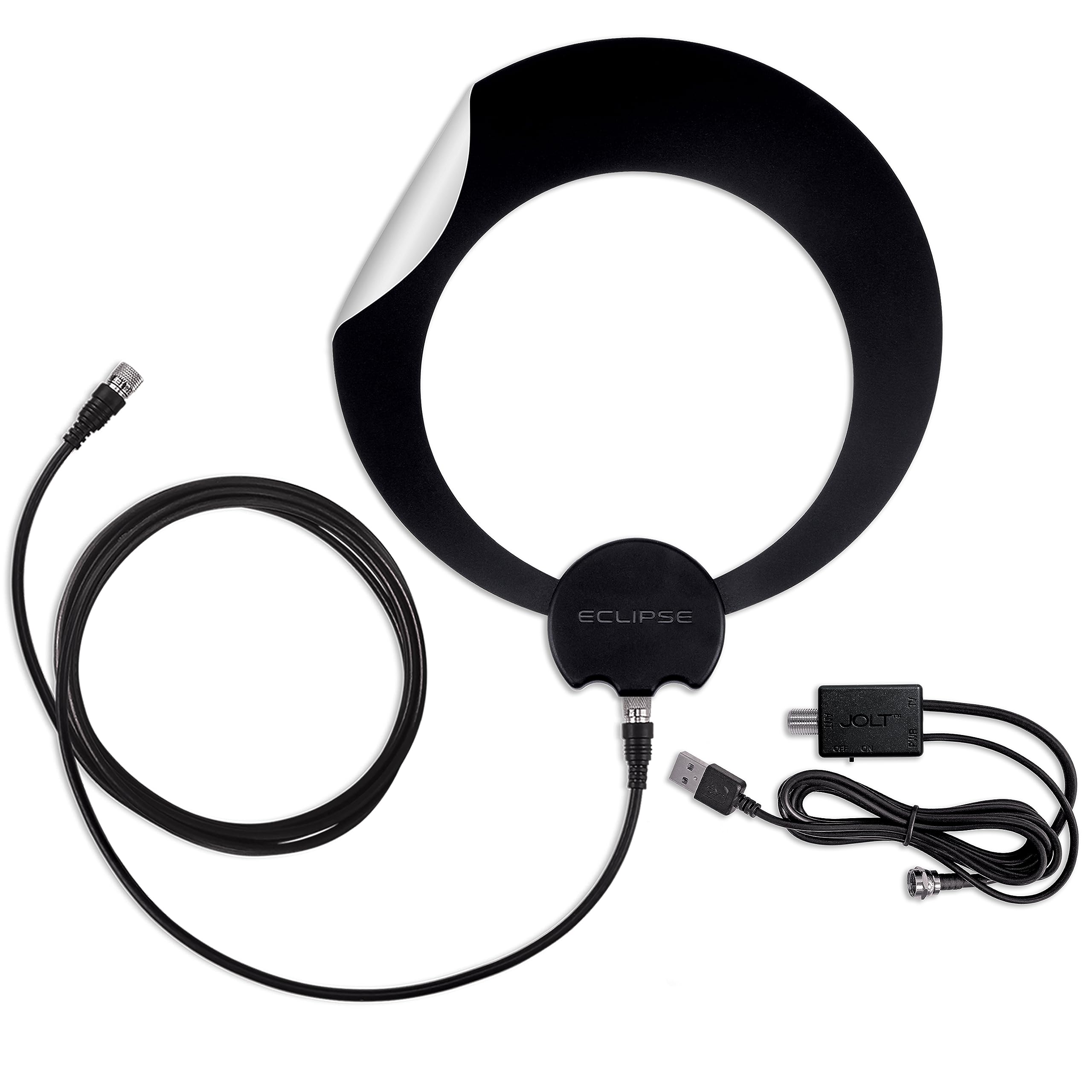
The ClearStream Eclipse is the best premium indoor option for those who refuse to sacrifice aesthetics for performance. Its reversible, paintable design is just 0.04 inches thick, making it virtually invisible on a window or wall, yet its patented loop element and 18 dB Jolt Switch amplifier deliver reception up to 50+ miles from broadcast towers.
The inline amplifier can be toggled on and off in real-time — a critical feature for strong signal areas where over-amplification causes overload. Multiple users report capturing between 29 and 59 channels after fine-tuning placement, with excellent HD quality for both UHF and VHF stations.
The trade-off is the flimsy feel of the ultra-thin material when handling, and the real-world range is closer to 10-30 miles for reliable, non-pixelated reception. It also relies on a USB power adapter, which can be inconvenient if your TV’s USB port doesn’t provide enough current.
Why it’s great
- Ultra-thin reversible design is paintable to match any room decor
- Jolt Switch amplifier allows toggling gain to prevent signal overload
- Multi-directional UHF element provides strong reception from both sides
Good to know
- 40-mile range claim is optimistic; reliable reception often within 20 miles
- Thin plastic material feels delicate during installation
- Requires a powered USB port or wall adapter for the amplifier
3. Five Star Outdoor HDTV Antenna (200 Mile)

This Five Star model is an excellent mid-range outdoor unit, especially for attic installations, where clearance is tight. Its extended 46-inch length provides longer receiving elements than many competitors, which translates to more stable signal capture on VHF frequencies that typically require larger surface area.
Users reliably report 25 to 30+ channels from 25 to 40 miles away, even when mounted in an attic with off-axis tower signals. The included J-pole and mounting bracket make assembly straightforward, and its compatibility with ATSC 3.0 ensures it will handle NextGen TV broadcasts as they roll out.
Some reviewers note that the included mounting pole is not robust enough for long-term outdoor exposure in high winds, and VHF interference from CFL lamps inside the home can degrade channels 7, 9, and 11. It is best suited for attics or protected eaves rather than open roof installation.
Why it’s great
- Extended 46-inch elements improve VHF signal locking
- ATSC 3.0 ready for future-proof cord cutting
- Excellent value for attic mounting with good signal strength
Good to know
- Included mounting pole is too weak for exposed outdoor use
- VHF channels can be disrupted by household CFL light bulbs
- Foil radiant barrier in attics reduces VHF reception by 3-4 dB
4. WA-2608 Digital Amplified Outdoor HD TV Antenna

The WA-2608 solves the most frustrating problem of directional antennas: the need to physically climb onto the roof to reposition it. Its built-in 360-degree motor, controlled by a wireless remote, lets you rotate the antenna from inside your living room to lock onto towers in different directions.
This model also supports dual TV output directly without requiring a splitter, making it perfect for households with multiple televisions. Users report picking up 50 to 60 stations with clear picture quality when the motor is properly aligned, and the included 60-foot RG6 coaxial cable gives ample slack for installation.
The motor mechanism can be a point of failure if the internal wires come loose from the control board during shipping, and customer support responsiveness is inconsistent. If the motor stops working, it reverts to a manual antenna that requires manual adjustment, negating its primary selling point.
Why it’s great
- Wireless remote control allows 360° rotation for precise tower targeting
- Supports two TVs simultaneously without an extra splitter
- Includes 60-foot RG6 cable and mounting pole for complete installation
Good to know
- Motor can fail due to loose wires; customer support varies
- Rotating mechanism adds mechanical complexity over fixed antennas
- Heavier than standard fixed antennas, requiring sturdy mounting
5. 1byone Outdoor TV Antenna (100+ Miles)

The 1byone Omni-Directional antenna is the set-and-forget solution for users who don’t want to aim or rotate. Its Smart pass amplifier technology automatically adjusts gain to compensate for changing weather, providing more reliable signal strength on rainy or windy days compared to fixed-gain designs.
The built-in 4G LTE filter is a standout feature, eliminating interference from nearby cellular towers that can wipe out specific UHF channels. It is also designed for versatility, with mounting options for home, RV, attic, and marine use. Users report pulling in 28 to 60 channels after optimizing placement, with many finding success simply placing it in a south-facing window indoors.
The main durability concern is weather sealing — after two years of outdoor exposure, some units have been found to fill with water, corroding the preamp and RF connector. It also supports only one TV output directly, requiring a splitter for additional sets.
Why it’s great
- Omni-directional design eliminates the need for aiming or rotating
- Built-in 4G LTE filter blocks cellular signal interference
- Smart pass amplifier adjusts gain dynamically for weather stability
Good to know
- Not fully waterproof; may require sealing for long-term outdoor use
- Only supports one TV output; a splitter reduces signal strength
- Maximum range claim of 100+ miles is optimistic in typical conditions
6. PBD Outdoor Digital Amplified Yagi HDTV Antenna

The PBD Yagi is an entry-level outdoor antenna that balances affordability with decent performance. It comes mostly pre-assembled and requires no tools for minor assembly, making it accessible for first-time cord-cutters. The built-in high gain and low noise amplifier helps pull in signals up to 120 miles, though real-world reception is typically around 30-50 miles.
Users in rural areas with tall pine trees report receiving up to 26 stations with 76% signal strength when mounted on a porch 15 feet up. The 40-foot RG6 coaxial cable is sufficient for most installations, and its weather-resistant construction with lightning protection adds durability for the price.
Its biggest weakness is performance consistency in marginal conditions. At 12 miles with heavy foliage, some users report it receives zero channels where a more expensive antenna from Stellar Labs got 75% signal strength. The amplifier is also prone to damage from lightning strikes, and replacement can be costly.
Why it’s great
- Excellent value for entry-level Yagi performance under ideal conditions
- Pre-assembled design with no tools required for quick installation
- Weather-resistant construction with lightning protection
Good to know
- Performs poorly in heavy foliage or at distances beyond 30 miles
- Amplifier can be damaged by electrical surges or lightning
- Limited customer support compared to premium brands
7. RCA Amplified Indoor Flat HDTV Antenna (ANT1360E)

The RCA ANT1360E is the most popular entry-level flat antenna for good reason: its 360° multi-directional design eliminates the need for constant adjustment, and the dual-stage amplifier with auto gain control provides steady reception up to 40 miles. It supports 4K/8K and 1080p broadcasts, and the included easel stand lets you position it on a shelf or wall.
Users in dense metro areas like San Francisco report getting all local channels within 7 miles of the tower in under 5 minutes of setup. The 15-foot coax cable is generous for finding the ideal window placement, and the paintable design helps it blend into the environment.
The primary limitation is its range — the 40-mile claim is realistic for open areas, but in practice, most users achieve reliable reception only within 20-30 miles. It also lacks VHF support, meaning some local broadcasters on channels 2-13 may not come in clearly. Buyers in fringe reception areas should look at outdoor models instead.
Why it’s great
- 360° multi-directional design offers easy, adjustment-free setup
- Dual-stage amplifier with auto gain control for stable reception
- Paintable slim profile with easel stand for versatile placement
Good to know
- Reception drops off significantly beyond 20-30 miles
- Weak VHF support may miss some local broadcast channels
- Plastic build feels less durable than pricier alternatives
FAQ
How do I know if I need VHF or UHF reception for my area?
Can I use an amplified antenna if I live very close to broadcast towers?
What is the difference between an omnidirectional and a directional Yagi antenna?
Can I install an outdoor antenna in my attic instead of on the roof?
Final Thoughts: The Verdict
For most users, the winner for the best amplified television antenna overall is the Five Star Upgraded Yagi (200 Mile) because its directional high-gain design delivers the strongest, most reliable signal for rural and suburban users, while its folding structure and ATSC 3.0 compatibility provide future-proof flexibility. If you want a paper-thin indoor antenna that blends into your room decor without sacrificing performance, grab the Antennas Direct ClearStream Eclipse with its Jolt Switch amplifier. And for the simplest, no-aiming-required experience in an urban setting with nearby towers, nothing beats the set-and-forget convenience of the 1byone Omni-Directional antenna.