
A seized compressor or a burning odor from your air conditioning system usually traces back to one thing: degraded, wrong-viscosity, or contaminated lubricant. The oil inside the closed loop has to handle extreme temperature swings, resist moisture absorption, and maintain film strength under high discharge pressure — get it wrong and you are looking at a full pump replacement.
I’m Min — the co-founder and writer behind Gadgets Feed. I spend hundreds of hours each quarter cross-referencing OEM specifications, customer longevity reports, and chemical formulation data to cut through the marketing noise on consumable automotive components.
Whether you’re servicing a home air compressor or recharging an automotive AC system after a seal replacement, selecting the right lubricant is a non-negotiable step. This guide helps you pick the best ac oil for compressor based on viscosity grade, synthetic vs. conventional base stock, and real-world thermal performance.
How To Choose The Best AC Oil For Compressor
The single most common mistake buyers make is assuming all “compressor oil” is interchangeable. Automotive AC compressors require PAG (Polyalkylene Glycol) oils with very specific viscosity ratings—usually PAG 46 or PAG 100 depending on refrigerant type. Stationary air compressors use ISO 100 (equivalent to SAE 30) non-detergent mineral or synthetic oils. Pouring the wrong base chemistry into a system can chemically attack seals, reduce lubrication, and void your compressor warranty in under 50 operating hours.
Viscosity Grade Is Everything
For R-134a automotive AC systems, PAG 46 is the standard — it offers the right flow characteristics at both low evaporator temperatures and high discharge pressures. R-1234yf systems typically require PAG 46 or PAG 100 depending on the compressor manufacturer. For stationary piston and screw compressors, ISO 100 (SAE 30 non-detergent) provides the necessary film strength at operating temperatures between 140°F and 200°F. Using a detergent motor oil (SAE 30 with additives) can cause foaming and carbon deposits inside the pump.
Synthetic vs. Mineral Base Stock
Synthetic compressor oils offer significantly better thermal stability — they resist oxidation at high temperatures and maintain viscosity across a wider range. A full synthetic like the TRIAX Kompressor can reduce operating temperature by roughly 30°F compared to conventional petroleum-based oil, which directly translates to reduced component wear and longer intervals between changes. Mineral oils are adequate for low-duty-cycle compressors but degrade faster when the compressor runs continuously for hours.
Additives and UV Dye
For automotive AC work, oil that includes a UV dye (like the TSI Supercool P46-32D) is a major advantage — it lets you shine a UV light over connections after installation to spot slow leaks immediately. Anti-wear agents and friction modifiers help extend the life of the compressor bearings and swash plate. Always check that the oil is labeled “non-detergent” for air compressor use — detergents can suspend contaminants rather than allowing them to settle in the sump, leading to recirculation of debris.
Quick Comparison
On smaller screens, swipe sideways to see the full table.
| Model | Category | Best For | Key Spec | Amazon |
|---|---|---|---|---|
| TSI Supercool P46-8 | PAG 46 | Compact automotive PAG refill | 8 fl. oz., PAG 46 viscosity | Amazon |
| TRIAX Kompressor ISO 100 | Synthetic ISO 100 | High-temp industrial air compressors | 1 quart, full synthetic, 20,000-hr service life | Amazon |
| UAC RO 0900B | PAG 46 | OE replacement for Chevy/GMC AC systems | 8 fl. oz., R-134A PAG 46 oil | Amazon |
| Four Seasons 59007 | PAG 46 | Universal automotive AC service | 8 fl. oz., PAG 46 viscosity | Amazon |
| Milton 1002 | Conventional ISO 100 | Fleet and plant compressor maintenance | 1 gallon, petroleum-based ISO 100 | Amazon |
| DEWALT D55001 | Synthetic SAE 30 | Premium upgrade for reciprocating compressors | 1 quart, full synthetic SAE 30 (ISO 100) | Amazon |
| TSI Supercool P46-32D | PAG 46 with UV Dye | Automotive AC with integrated leak detection | 32 fl. oz., PAG 46 with UV dye | Amazon |
In‑Depth Reviews
5. Milton 1002 High Performance Conventional Air Compressor Oil ISO-100

Milton’s 1002 delivers a gallon of conventional ISO 100 (SAE 30 non-detergent) compressor oil at a cost per ounce that makes it the obvious choice for anyone maintaining multiple stationary compressors. It is the same formulation used in fleet and plant maintenance environments — proven to resist foaming and oxidation over extended drain intervals in piston and reciprocating pumps.
Multiple customer reports note that compressors run cooler after switching from generic hydraulic oils to this Milton blend. The PET container has a wide mouth and a tamper-evident seal, though you will want a funnel — the gallon jug does not come with a measured pour spout. The oil is petroleum-based rather than synthetic, so it is best suited for moderate duty cycles rather than continuous industrial operation above 200°F.
For a home workshop with a single two-stage compressor that runs intermittently, this gallon will last through several oil changes. The value is hard to beat when compared to quart-sized synthetic options that cost nearly as much per bottle.
Why it’s great
- Best cost-per-ounce in the conventional ISO 100 category
- Proven non-detergent formula reduces foaming in piston pumps
- Users report measurable temperature drops after switching from generic oils
Good to know
- Petroleum base degrades faster under continuous high-load operation vs. synthetics
- No built-in measuring spout — a funnel is required for accurate filling
2. TRIAX Kompressor ISO 100 SAE 30 Full Synthetic
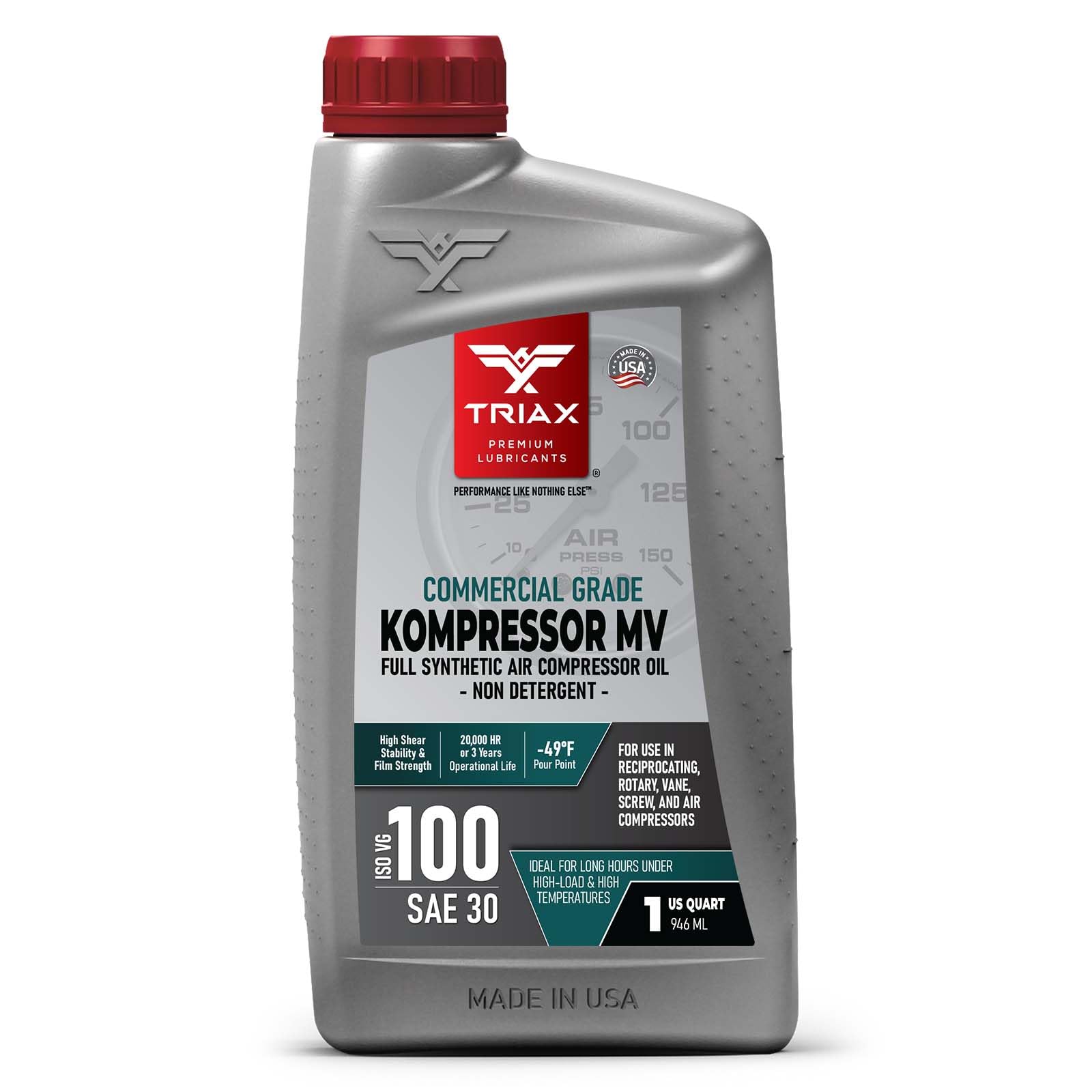
The TRIAX Kompressor is a full synthetic ISO 100 (SAE 30) oil engineered for rotary screw, vane, and reciprocating compressors. It claims a service life of over 20,000 hours — roughly 2.5 years of continuous 24/7 operation — due to its high-temperature film strength that prevents metal-to-metal contact even when discharge temperatures exceed 200°F.
Customer feedback consistently highlights a 30°F drop in operating temperature versus conventional mineral oils. On a 5 HP Ingersoll Rand two-stage compressor, the oil also reduced vibration and noise. The viscosity holds steady from -49°F to over 140°F ambient, so there is no need to swap grades between summer and winter operation in unheated garages.
This oil is compatible with all major compressor brands (Ingersoll Rand, Atlas Copco, Quincy, DeWalt, Sullair) and the bottle uses a collapsible pour-spout that makes filling a crankcase reservoir mess-free. For shop owners who want to stretch oil change intervals without sacrificing pump protection, this is the benchmark.
Why it’s great
- True multi-viscosity synthetic maintains film strength across a 190°F temperature range
- Rated for 20,000+ hours of service life under normal conditions
- Collapsible pour-spout eliminates spill risk during refills
Good to know
- Higher upfront cost per quart compared to conventional oils
- Not recommended for oxygen or LNG compressor systems
6. DEWALT Compressor Oil (D55001)

DEWALT’s D55001 is a full synthetic SAE 30 (ISO 100) non-detergent oil that targets reciprocating piston compressors. Multiple users report that switching from conventional 20W or 40W mineral oils to this synthetic reduces start-up current draw (the compressor cycles on more easily in cold weather) and noticeably lowers noise and vibration during the pump-up cycle.
One detailed review described using this oil in a Craftsman 27-gallon compressor that previously ran hot enough to trigger thermal overload after 45 minutes of continuous use. After the swap, the compressor ran for 2.5 hours straight without tripping, and the oil still looked clean when drained. The blue tint makes it easy to see the oil level in a plastic sight glass.
This is a premium-priced quart — roughly double the per-ounce cost of the TRIAX. However, for compressors that see heavy use in cold climates (Minnesota winter startup testing was cited), the cold-flow properties of this synthetic provide a real advantage over conventional alternatives.
Why it’s great
- Full synthetic dramatically reduces noise and vibration in piston compressors
- Blue-tinted oil simplifies level checks through sight glasses
- Excellent cold-weather flow characteristics for winter operation
Good to know
- Higher per-ounce cost than comparable synthetic options
- May require an early change if switching from mineral-based oil to clear accumulated deposits
3. Universal Air Conditioner RO 0900B Refrigerant Oil

The UAC RO 0900B is an OE-replacement PAG 46 oil designed primarily for Chevrolet and GMC AC systems (R-134a), though its universal compatibility makes it usable across many domestic and import vehicles. The 8-ounce bottle is enough for a single compressor replacement or seal rebuild — most automotive AC compressors hold between 4 and 8 ounces of oil in the crankcase.
Customer reports indicate it works well for Silverado and Suburban AC service. The oil is clear with no UV dye, which is fine if you already have a separate leak detection tool or plan to use a dye injector. The bottle has a simple screw cap with a pull-out spout, though the spout is short — a small funnel helps avoid spills during injection.
At this price point, it is a competent PAG 46 oil that meets OEM viscosity specifications without any premium additives. For the DIYer who just needs to recharge oil after replacing an evaporator or condenser, it gets the job done cleanly.
Why it’s great
- OE-spec PAG 46 oil for Chevy/GMC and universal AC systems
- Adequate 8-ounce quantity for a single compressor rebuild
- Competitive price for a brand-name PAG oil
Good to know
- No UV dye included — requires separate leak detection method
- Short pour spout may need a funnel for clean transfer
1. TSI Supercool P46-8 PAG 46 Without Dye
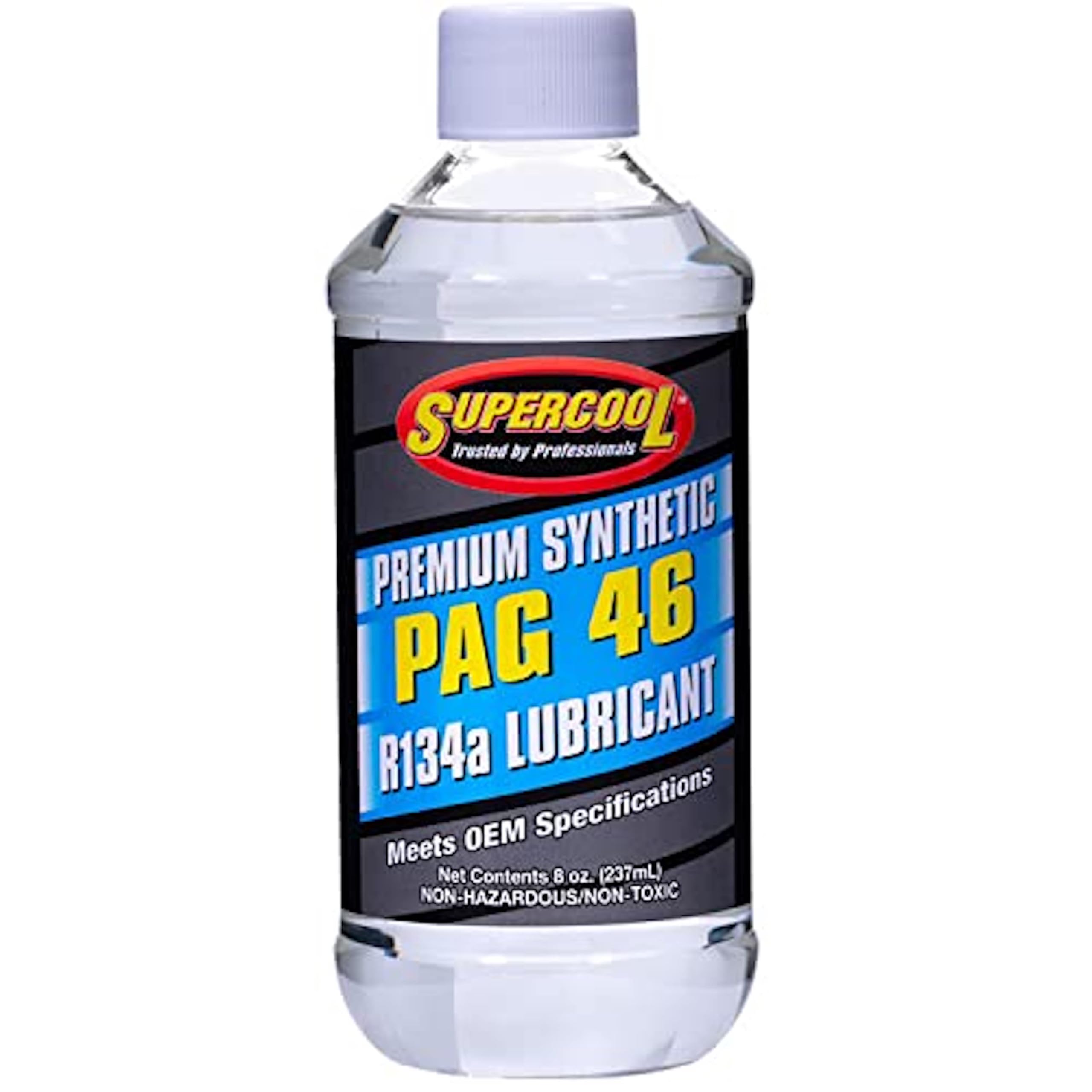
TSI Supercool’s P46-8 is PAG 46 oil in a simple 8-ounce bottle without UV dye. This is the correct viscosity for most R-134a automotive compressors, including Honda, Toyota, and Nissan systems. One customer reported achieving a 44°F vent temperature on a 2006 Honda Odyssey after replacing the compressor and adding this oil — right at the target spec for a properly charged R-134a system.
The oil is manufactured in the United States and carries a 1-year warranty. The bottle uses a needle-tip spout that fits into most compressor suction and discharge ports without requiring a hose adapter. The lack of dye keeps the oil clear, which is preferred when the system already has dye installed or when you want to avoid staining components during service.
This is a straightforward, no-frills PAG 46 oil that matches OE specifications for compressors that call for PAG 46 viscosity. For someone who just needs the correct weight oil for a seal kit or compressor swap, this is a reliable option at a fair per-ounce cost.
Why it’s great
- Direct OE-spec PAG 46 viscosity for R-134a systems
- Needle-tip spout fits standard AC service ports without adapters
- U.S.-manufactured with a 1-year warranty
Good to know
- 8-ounce bottle is small — confirm your system’s total oil capacity before buying
- No UV dye included, so leak detection requires separate dye injection
4. Four Seasons 59007 Premium Oil Bottle

The Four Seasons 59007 is an 8-ounce bottle of PAG 46 oil sold under the Four Seasons name, though some customers have received bottles labeled “Temp Select.” The oil is universally compatible with R-134a AC systems and is commonly used for Honda CR-V and Toyota Camry compressor rebuilds — multiple verified reviews from CR-V owners confirm successful operation after adding this oil.
This is a basic PAG oil with no added UV dye and no friction modifiers. For a straightforward oil recharge after an evaporator or condenser replacement, it works as expected. Some customers noted the label was slightly distorted by oil exposure on arrival, but the bottle seal was intact. The pour spout is shorter than the TSI Supercool needle tip, so a small funnel is useful.
At this price point, it is the most budget-friendly PAG 46 option in this lineup. It lacks the anti-wear additives and dye of the premium options, but for one-off DIY AC service where you know the system already has adequate leak protection, it is a perfectly functional choice.
Why it’s great
- Lowest cost in the PAG 46 category — ideal for budget-conscious DIY service
- Proven compatibility with Honda CR-V and other popular imports
- Universal fit for all R-134a systems requiring PAG 46
Good to know
- May be rebranded as Temp Select — packaging consistency varies
- No UV dye or anti-wear additives found in premium PAG oils
7. TSI Supercool P46-32D PAG 46 with UV Dye

The TSI Supercool P46-32D is PAG 46 oil with integrated UV dye, packaged in a 32-ounce bottle — enough for multiple AC service jobs or a system that requires a larger total oil charge. The UV dye is a critical feature for professional and serious DIY mechanics: after charging the system and running the compressor, a UV light reveals any leaks at O-rings, Schrader valves, or the compressor shaft seal immediately.
The formulation includes anti-wear agents and friction modifiers that enhance compressor efficiency and reduce wear on the swash plate and bearings. Antioxidants help prevent sludge and varnish formation, which can clog the expansion valve over time. The flash point is rated at 442°F, providing a generous safety margin for high-discharge-temperature operation.
This 32-ounce bottle is more expensive upfront, but the per-ounce cost is actually lower than buying multiple 8-ounce bottles of premium PAG 46. For a shop that services multiple vehicles or a single owner who wants UV leak detection built into the oil, this is the most practical PAG 46 option available.
Why it’s great
- Integrated UV dye enables instant leak detection with UV light
- Anti-wear agents and friction modifiers extend compressor lifespan
- 32-ounce bottle provides the best per-ounce value among premium PAG oils
Good to know
- Higher upfront cost may be excessive for a single compressor service
- UV dye can stain components — clean spills immediately
FAQ
Can I use PAG 46 oil in my stationary air compressor?
How do I know if my compressor needs PAG 46 or PAG 100?
What does “non-detergent” mean for compressor oil?
Final Thoughts: The Verdict
For most users, the best ac oil for compressor winner is the TRIAX Kompressor ISO 100 because it combines full synthetic thermal stability, a proven 20,000-hour service life, and universal compatibility across major stationary compressor brands at a fair mid-range price. If you need PAG 46 for automotive AC work, grab the TSI Supercool P46-32D for its built-in UV leak detection and anti-wear additives. And if you are just topping off a home air compressor on a budget, nothing beats the Milton 1002 gallon jug for cost-effective conventional ISO 100 oil.