
A dreadnought is the blue-collar beast of the acoustic world—big shoulders, a wide waist, and a voice that fills a room without asking permission. If you are shopping for one, you already know you want projection, low-end punch, and a body that sits confidently against your torso. The problem is separating marketing specs from actual build quality, especially when the price tags range from entry-level bundles to heirloom-grade mahogany.
I’m Min — the co-founder and writer behind Gadgets Feed. Sorting the resonance of a solid Sitka spruce top from a laminated one, and the sustain of a bone nut from a plastic alternative, takes hours of cross-referencing build diagrams, wood species data, and hundreds of verified owner experiences.
This guide dissects nine dreadnoughts across the entire value spectrum so you can match your budget to your ear. Let’s find your best acoustic dreadnought guitar without the dealer pitch.
How To Choose The Best Acoustic Dreadnought Guitar
A dreadnought’s slab-sided body was originally built to cut through a band, and that same architecture makes it the most versatile acoustic platform for everything from flatpicking bluegrass to strumming campfire chords. Three decisions will define your experience: the top wood, the bracing pattern, and the neck profile.
Solid Top vs. Laminate Construction
A solid spruce or mahogany top vibrates freely and opens up over years of play, developing richer overtones. Laminated tops are two or more thin layers pressed together—stiffer, more durable against humidity swings, but limited in dynamic range. Entry-level dreadnoughts often use a solid top on a laminate body to save cost while preserving tone where it matters most.
Neck Profile and String Action
Dreadnoughts historically carry a wider nut (1.69” to 1.75”) that gives fingerpickers more room but challenges small hands on barre chords. A C-shaped profile fills the palm evenly; a V-shape pushes the thumb into a classical grip. Action—the height of the strings above the frets—should be low enough to avoid hand fatigue but high enough to prevent fret buzz under strong strumming.
Electronics (Acoustic-Electric vs. Pure Acoustic)
If you plan to plug into a PA or an amp, an acoustic-electric model saves you the hassle of an external pickup installation. Most systems in this category use a piezoelectric undersaddle pickup paired with a preamp that offers bass, mid, treble, and sometimes a notch filter. Pure acoustic guitars are lighter and simpler, but require a soundhole pickup or microphone for live amplification.
Quick Comparison
On smaller screens, swipe sideways to see the full table.
| Model | Category | Best For | Key Spec | Amazon |
|---|---|---|---|---|
| Yamaha FG830 | Premium Mid-Range | Solid Rosewood Resonance | Solid Sitka Spruce top, Rosewood back/sides | Amazon |
| Martin D-15M | Premium | All-Mahogany Vintage Tone | Solid Mahogany top, back, sides | Amazon |
| Fender CD-60S | Mid-Range | All-Mahogany Warmth | Mahogany top, back, sides; scalloped X-bracing | Amazon |
| Ibanez AW54 | Mid-Range | Solid Mahogany Top Value | Solid Mahogany top, Rosewood fingerboard | Amazon |
| Yamaha FG800J | Mid-Range | Beginner Solid Top Clarity | Solid Spruce top, Nato/Mahogany body | Amazon |
| Martin DX Johnny Cash | Premium | Signature Style & Plugged In | HPL construction, Fishman MX electronics | Amazon |
| Fender FA-125CE | Mid-Range | Cutaway Acoustic-Electric Starter | Laminate Spruce top, FE-A2 electronics | Amazon |
| Vangoa Acoustic Electric | Budget | Full Kit with 4-Band EQ | Spruce top, Mahogany body, built-in pickup | Amazon |
| Vangoa 41″ Acoustic | Budget | Complete Beginner Bundle | Spruce top, Sapele body, 18:1 tuners | Amazon |
In‑Depth Reviews
1. Yamaha FG830 Solid Top Acoustic Guitar, Autumn Burst

The FG830 is the dreadnought that convinces experienced players they don’t need to spend four figures. Its solid Sitka spruce top paired with rosewood back and sides delivers a harmonic complexity that laminate guitars simply cannot generate—clear trebles, a defined midrange, and a low end that owners describe as “a cannon.” The die-cast tuners and scalloped X-bracing keep everything stable, even when you dig into aggressive flatpicking.
Out of the box, the action is serviceable, though several owners note that a truss rod adjustment improves the low-E clearance for a faster feel. The Autumn Burst finish is a genuine head-turner, and the rosewood fingerboard adds a smooth gliding surface for slides and bends. At this price point, the FG830 competes directly with instruments costing 50% more.
The trade-off is that the factory setup sometimes leaves the saddle a touch high, and the fret ends can feel slightly sharp—two issues a quick setup from a local tech solves. Still, no other dreadnought in this tier offers the same build-to-sound ratio, making it the smart pick for players who want serious tonal headroom without a mortgage payment.
Why it’s great
- Rosewood body yields deep, complex harmonics
- Scalloped bracing gives excellent dynamic range
- Solid Sitka top opens up beautifully with age
Good to know
- Factory action may need a truss rod tweak
- Fret edges sometimes require light filing
- No electronics for live amplification
2. Martin D-15M Acoustic Guitar

The D-15M is Martin’s working musician’s dreadnought—bookmatched solid mahogany top, back, and sides with a satin finish that lets the wood breathe. The result is a warm, woody voice with a compressed midrange that sits perfectly in a mix, unlike the shimmering overtones of a rosewood box. Owners routinely compare it favorably to guitars costing twice as much, praising its immediate response and balanced string-to-string clarity.
With a low-oval neck profile and a 1.69-inch nut, the D-15M feels more accessible than many dreadnoughts, especially for players who switch between strumming and fingerpicking. The satin mahogany neck is fast and grippy without being sticky, and the rosewood bridge anchors the strings with authority. The included gig bag is serviceable, but most buyers opt for a hard case given the instrument’s investment value.
There are no electronics here—this is a pure acoustic statement. The all-solid construction means it is more sensitive to humidity than laminate models, so a case humidifier is recommended. But if you want the reference standard for a mahogany dreadnought that ages like a vintage bourbon, the D-15M is the one.
Why it’s great
- All-solid mahogany produces rich, warm tone
- Low-oval neck is comfortable for extended play
- Satin finish reduces feedback in live settings
Good to know
- No pickup system included
- Humidity-sensitive all-solid construction
- Action may benefit from a pro setup
3. Fender CD-60S Dreadnought Acoustic Guitar

The CD-60S is proof that Fender knows how to build a dreadnought that punches above its price tag. All-mahogany construction—top, back, and sides—gives it a focused, earthy tone with a pronounced low-end thump, ideal for country, folk, and bluegrass chord work. The scalloped X-bracing allows the top to vibrate freely, producing more volume than you would expect from a guitar at this level.
The chrome die-cast tuners are smooth and hold pitch reliably, and the walnut fingerboard feels polished under the fingers. Setup consistency is the CD-60S’s strongest asset—owners report near-perfect intonation and action straight from the box, with minimal need for adjustment. The gloss finish is attractive but shows fingerprints quickly.
The CD-60S does not include electronics, so you will need an external pickup for stage use. The dreadnought body is also substantial—players with smaller torsos may find the lower bout a tight fit. But as a pure acoustic instrument that delivers rich, mahogany warmth at a mid-range price, it is hard to beat.
Why it’s great
- All-mahogany body delivers warm, woody sound
- Scalloped bracing adds surprising volume
- Excellent factory setup and intonation
Good to know
- No pickup or preamp included
- Large body may not suit smaller players
- Gloss finish is prone to smudging
4. Ibanez AW54 Open Pore Natural

The AW54 is Ibanez’s answer to players who want a solid mahogany top on a dreadnought without paying Martin prices. The open-pore natural finish lets the wood grain show through and reduces weight compared to thick gloss coatings, which helps the top resonate freely. The rosewood fingerboard and bridge add a touch of familiar warmth, while the mahogany back and sides round out the tonal profile.
Owners consistently report excellent intonation right out of the box, even after cross-country shipping and altitude changes. The nyatoh neck is stable and resists warping, and the C-profile fills the hand naturally for both cowboy chords and barre shapes. The sound is full and balanced—not overly bright, but with enough clarity for articulate fingerpicking.
The open-pore finish is less protective than a gloss coat, so it can absorb oils and moisture more easily—a minor trade-off for better acoustic performance. There are no electronics, and the included accessory list is minimal (guitar only). Still, the AW54 delivers a solid-top experience that rivals guitars at twice the price.
Why it’s great
- Solid mahogany top with open-pore resonance
- Stable nyatoh neck resists warping
- Well-balanced tone for strumming and fingerstyle
Good to know
- Open-pore finish needs more care
- No gig bag or accessories included
- Not amplified (acoustic only)
5. Yamaha FG800J Solid Top Acoustic Guitar

The FG800J is the guitar that Yamaha has perfected over decades—a dreadnought that offers a solid spruce top and a level of quality control that most entry-level brands cannot touch. The nato and mahogany back and sides produce a warm, full-bodied tone with a bold low-end projection that makes strumming feel authoritative. The dreadnought size gives large-handed players ample room, and the rosewood fingerboard offers a smooth, consistent feel.
Yamaha’s reputation for reliability shines here: the die-cast tuners hold tune through practice sessions, the action is playable out of the box, and the intonation is accurate across the entire fretboard. Beginners benefit from the bright, balanced sound that makes mistakes easier to hear and correct, while experienced players appreciate the FG800J as a worry-free camp or travel guitar.
The FG800J is a pure acoustic, so you will need an external solution for amplification. The nato neck is a bit thicker than some modern C-profiles, which may slow down players with smaller hands. But for sheer dreadnought value per dollar, the FG800J sets the benchmark that every other entry-level guitar is measured against.
Why it’s great
- Solid spruce top with bright, balanced projection
- Renowned Yamaha quality control and consistency
- Comfortable dreadnought size for larger hands
Good to know
- No pickup system for live play
- Nato neck profile may feel slightly thick
- Basic hardware without frills
6. Martin DX Johnny Cash Signature Edition

The Johnny Cash Signature Edition trades traditional wood for high-pressure laminate (HPL) and black birch, delivering a durable, weather-resistant dreadnought that sounds far better than its composite materials suggest. The Fishman MX pickup system captures the voice of the guitar with clarity, making it a plug-and-play workhorse for church, coffeehouse, or open-mic stages. The Richlite fingerboard is smooth and stable, and the Jett Black finish is unmistakably Cash.
Owners report a traditional dreadnought feel with a surprising amount of projection and sustain—the HPL top is stiff, so it resists feedback and responds predictably under heavy strumming. The strap button is stored in the gig bag envelope rather than pre-installed, a small inconvenience that reflects the budget-conscious construction approach. Once set up, the intonation and playability are excellent, especially for the price.
The HPL construction makes this one of the most durable travel dreadnoughts available—it shrugs off humidity and temperature changes that would crack a solid-wood box. But the trade-off is that the tonal complexity will never match an all-solid guitar. If you need a signature look, built-in electronics, and road-ready durability, this is your pick.
Why it’s great
- Durable HPL construction resists climate damage
- Fishman MX electronics sound natural amplified
- Signature Johnny Cash aesthetic stands out
Good to know
- HPL top lacks the warmth of solid wood
- Strap button not pre-installed
- No truss rod for neck adjustment
7. Fender FA-125CE Dreadnought Cutaway Acoustic-Electric
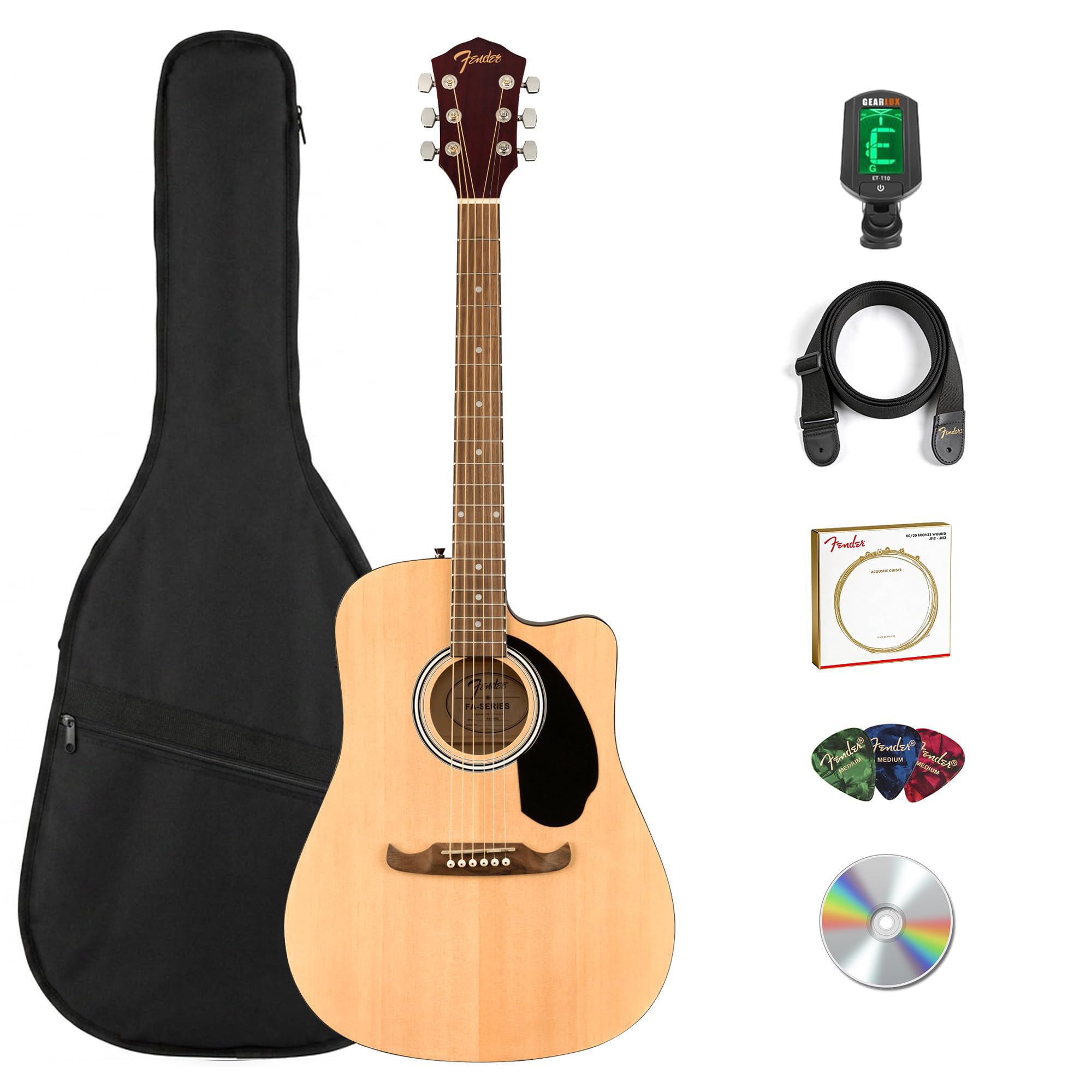
The FA-125CE is Fender’s most accessible acoustic-electric dreadnought, built around a laminate spruce top with basswood back and sides that produce a balanced, serviceable tone. The cutaway design gives easy access to the highest frets, and the FE-A2 preamp with built-in tuner makes plugging in straightforward—no external tuner required. The included bundle (gig bag, strap, picks, spare strings, and instructional DVD) adds value for a first-time buyer.
The nato C-shaped neck is comfortable for beginner hands, and the rosewood fingerboard offers a familiar feel. Owners note that the factory strings are often not ideal—swapping to a set of phosphor bronze strings dramatically improves the sound. The feedback resistance when plugged in is solid, and the clean tone works well for acoustic pop and folk styles.
The laminate construction limits the dynamic ceiling compared to solid-top alternatives, and the basswood back can sound slightly boxy if pushed hard. The trim on the pickguard and binding feels a bit basic. Still, for a player who wants one guitar that does double duty as a practice instrument and a stage-ready acoustic-electric, the FA-125CE delivers a complete package at a friendly price.
Why it’s great
- Cutaway design provides upper-fret access
- FE-A2 electronics with built-in tuner
- Complete starter bundle saves accessory costs
Good to know
- Laminate top limits tonal complexity
- Factory strings should be upgraded
- Basswood back can sound boxy when loud
8. Vangoa Acoustic Electric Guitar Bundle (Matte Black)

The Vangoa acoustic-electric budget bundle redefines what entry-level players can expect. The spruce top with mahogany back and sides produces a balanced, bright voice that translates well through the built-in piezoelectric pickup and a 4-band EQ with volume control, bass, middle, treble, and a presence knob. The matte black finish is striking and hides fingerprints, and the C-profile neck makes barre chords accessible even for beginners.
Almost every owner praises the complete kit: gig bag, clip-on tuner, capo, strap, picks, polishing cloth, and amplifier cable. The 18:1 ratio sealed tuners hold pitch well, and the cutaway design allows lead work up the neck. The bundled accessories are functional—the tuner is accurate enough for practice, and the picks offer varying thicknesses for experimentation.
The plastic nut and saddle are the first upgrades experienced players make—replacing them with bone or Tusq improves sustain and clarity. The matte finish, while beautiful, can scuff more easily than gloss. But as a do-everything bundle that costs less than many standalone guitars, the Vangoa acoustic-electric is a remarkable value for beginners and casual performers.
Why it’s great
- 4-band EQ gives good tonal control on stage
- Complete accessory bundle saves hundreds
- Cutaway body enables high-fret access
Good to know
- Plastic nut and saddle should be upgraded
- Matte finish can scratch more easily
- Gig bag is adequate but not heavy-duty
9. Vangoa 41″ Acoustic Guitar Bundle (Black)
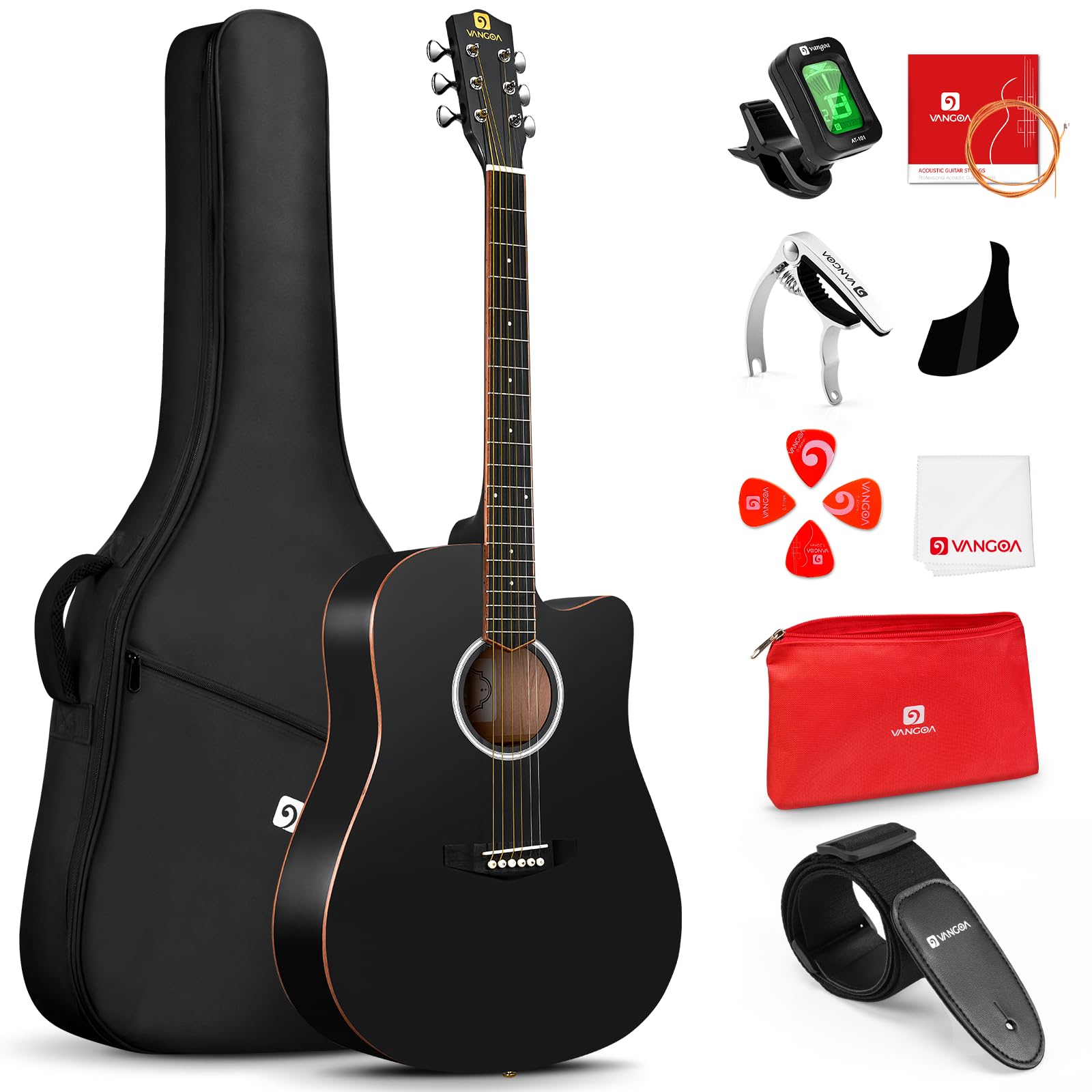
The Vangoa 41-inch dreadnought bundle is the simplest entry point into the category, offering a spruce top with sapele back and sides at a price point that undercuts almost everything else. Despite the low entry cost, the build is surprisingly solid—the 18:1 ratio tuners provide smooth, precise tuning, and the high-density bone nut and saddle give the guitar better resonance than the price suggests. The X-bracing is hand-cut, a detail usually reserved for far more expensive instruments.
The bundle includes everything a first-time buyer needs: a padded gig bag with 10mm thick padding, metal capo, clip-on tuner, spare strings, picks, strap, polishing cloth, and even an amplifier cable. Owners consistently praise the “well-balanced” tone and the oval C-shape neck, which fits the palm naturally and reduces fatigue during long practice sessions. The built-in dual-action truss rod allows for action adjustments as the guitar settles.
The biggest area for improvement is the engineered wood fingerboard—it works fine but lacks the smoothness of rosewood. The gig bag is functional but not built for heavy travel. For a first guitar that lets a player learn without financial strain, this bundle is a thoughtful, complete package that punches above its weight class.
Why it’s great
- High-density bone nut improves resonance and sustain
- 18:1 tuners offer precise, stable tuning
- Extensive accessory kit covers all basics
Good to know
- Engineered wood fingerboard lacks premium feel
- Single-box packaging risks shipping damage
- Gig bag padding is adequate, not heavy-duty
FAQ
What is the real difference between a solid top and a laminate top in a dreadnought?
Should I buy an acoustic dreadnought or an acoustic-electric dreadnought as my first guitar?
Why do some dreadnoughts have a cutaway and others don’t?
Final Thoughts: The Verdict
For most players, the best acoustic dreadnought guitar is the Yamaha FG830 because its solid Sitka spruce and rosewood body delivers the most tonal complexity per dollar in the entire mid-range. If you want an all-mahogany workhorse with a vintage voice, grab the Martin D-15M. And for a fully loaded acoustic-electric bundle that leaves nothing to buy later, the Vangoa Acoustic Electric is the smartest entry-level pick.