
The acoustic electric guitar amp is a different beast from its electric counterpart. You don’t want coloration; you want a transparent, full-range system that faithfully reproduces the natural timbre of your dreadnought, parlor, or jumbo while handling vocal duties without feedback. Finding the right one means balancing wattage, battery portability, onboard effects quality, and channel count against your real-world performance scenarios.
I’m Min — the co-founder and writer behind Gadgets Feed. I’ve spent hundreds of hours analyzing frequency response curves, battery discharge cycles, and DSP algorithm quality across the sub- acoustic amp market to separate the true workhorses from the marketing fluff. This guide helps you match an amp to your actual needs, from patio jams to coffee shop gigs.
Whether you need a busking-ready portable or a premium stage tool, this guide to the best acoustic electric guitar amp covers nine worthy contenders built for clean, natural sound.
How To Choose The Best Acoustic Electric Guitar Amp
An acoustic-electric guitar amp must deliver a flat, transparent frequency response to avoid the mid-forward honk or high-end fizz that plagues many budget solid-state designs. The wrong choice leaves your guitar sounding thin, boxy, or harsh, while the right one makes your instrument’s natural voice bloom with clarity and depth.
Wattage and Speaker Configuration
Wattage translates to clean headroom, not just loudness. A 20-watt stereo amp driving dual 4-inch speakers works for solo practice and quiet living-room sessions, but you’ll push it into distortion at the 50-person coffee shop show. For small-to-medium venues, look for 40 to 60 watts from a single 6.5-inch or 8-inch driver — that’s the sweet spot where you get enough low-end thump and vocal intelligibility without needing a PA tap. Higher wattage also means the amp stays clean when you hit hard, which preserves the transient snap of your fingerpicking or strumming.
Channel Count and Input Flexibility
If you sing while you play, a two-channel amp is non-negotiable. The instrument channel should offer a 3-band EQ — bass, mid, treble — to dial out the piezo quack or boost the woody warmth of a mahogany back. The mic channel ideally includes its own reverb control and, for serious vocalists, 48V phantom power for condenser microphones. Some premium models also embed independent chorus, delay, or harmony effects on separate channels, giving you a full mini-PA in one box without external pedals.
Portability, Battery Life, and Connectors
Busking and outdoor gigs demand a rechargeable lithium battery that delivers at least four hours of moderate-volume runtime. Check the weight: a 7-pound amp like the Roland Mobile-AC is backpack-friendly, while a 24-pound Fishman Loudbox Mini BT stays put on stage but stays home for subway performances. Don’t overlook the importance of a balanced XLR DI output for feeding front-of-house systems, a dedicated headphone jack for silent practice, and Bluetooth 5.0 for streaming backing tracks — these features turn a dedicated practice tool into a versatile performance hub.
Quick Comparison
On smaller screens, swipe sideways to see the full table.
| Model | Category | Best For | Key Spec | Amazon |
|---|---|---|---|---|
| Fishman Loudbox Mini BT | Premium | Club gigs with vocal + guitar | 60W, 1×6.5″ + feedback suppression | Amazon |
| Boss ACS Live | Premium | Vocal harmony + pro features | 60W, Acoustic Resonance + harmony | Amazon |
| Coolmusic BP80 | Premium | Small band PA with 6 inputs | 100W, 8” woofer + 3” tweeter | Amazon |
| Fender Acoustasonic 40 | Mid-Range | Restaurant / duo acoustic sets | 40W, dual 6.5″ whizzer cones | Amazon |
| Coolmusic BP40D | Mid-Range | Versatile solo act with 6 channels | 80W, 48V phantom, rechargeable | Amazon |
| Yamaha THR5A | Mid-Range | Desktop practice + recording | 10W, tube + mic modeling | Amazon |
| Roland Mobile-AC | Mid-Range | Ultra-portable busking / lap steel | 5W stereo (2.5+2.5), 15-hr AA | Amazon |
| JOYO AC-20S | Budget-Friendly | Stereo practice + USB-C recording | 20W stereo, dual 4″ speakers | Amazon |
| COOLMUSIC BP-MINI | Budget-Friendly | Entry-level portable / small jam | 30W, 6.5″, 5-8hr rechargeable | Amazon |
In‑Depth Reviews
1. Fishman Loudbox Mini BT

The Fishman Loudbox Mini BT delivers a genuinely transparent acoustic tone across both its instrument and vocal channels. Sixty watts into a single 6.5-inch driver with a tweeter provides ample clean headroom for a medium-sized room, and the built-in anti-feedback notch filter lets you push stage volume without that dreaded resonant howl. The Bluetooth pairing is immediate, and the aux input accepts backing tracks without muddying your guitar signal.
Users consistently praise its ability to make a nylon-string classical guitar sound open and natural, which few amps under manage. The XLR line outputs let you send a balanced signal to the house PA while the onboard reverb and chorus give your vocal and guitar paths independent depth control. At just over 24 pounds, it’s portable enough for gig bags but still substantial enough to feel roadworthy.
The main trade-off is the single 6.5-inch driver — you won’t get the chest-thumping low end of an 8-inch or dual-speaker design, and the tweeter can sound slightly forward at higher volumes if you don’t dial back the treble pot. Still, for the combination of sound clarity, effects quality, and feedback suppression, this is the benchmark that other acoustic combos are measured against.
Why it’s great
- Exceptional clarity and natural acoustic tone
- Effective feedback suppression for loud stages
- Independent reverb on both instrument and mic channels
Good to know
- Single 6.5″ driver limits low-end punch
- Heavier than compact busking amps at 24 lbs
2. Boss ACS Live 60W Combo Amplifier

The Boss ACS Live stands alone in its class because it actively improves your input signal rather than just amplifying it. The Acoustic Resonance engine analyzes the signal from a piezo-equipped stage guitar and restores the natural body resonance that undersaddle pickups strip away — a genuine sonic benefit that transforms a cheap acoustic-electric into something that sounds like a miked-up dreadnought. The harmony function automatically detects the key of your guitar chord and generates two- or three-part vocal harmonies that track surprisingly well in real time.
Both the guitar and mic channels offer independent reverb, plus a dedicated delay/echo on the vocal side and a lush chorus on the guitar side. The 60-watt power section drives a custom 8-inch speaker that delivers more low-end authority than the Fishman Mini BT, making it suitable for solo shows where your amp is the sole sound source. The looper, while basic, adds a practical tool for layering guitar parts during practice.
On the downside, the looper memory is short and lacks undo functionality, and the harmonizer algorithm, though impressive, can’t match the depth of a dedicated vocal processor. At nearly 27 pounds, it’s the heaviest option here, and the price positions it firmly in premium territory. But if you want vocal harmonies and acoustic tone restoration in one box, no other amp matches this feature density.
Why it’s great
- Acoustic Resonance restores natural body tone to piezo pickups
- Real-time vocal harmony from guitar chord analysis
- Independent reverb on both channels with dedicated delay/echo
Good to know
- Heavier (27 lbs) and bulkier than most acoustic combos
- Looper is basic with no undo and limited recording time
3. Coolmusic BP80

The Coolmusic BP80 packs a 100-watt punch into a portable cabinet with an 8-inch woofer and a 3-inch tweeter, delivering a full-range frequency response that rivals dedicated PA systems. Its six-input capability — four instrument channels and two auxiliary inputs — means a solo musician can run a guitar, two microphones, and a backing-track source simultaneously without external mixers. The two independent channels each get their own 3-band EQ, giving you precise control to carve out your guitar tone and vocal presence separately.
Built-in 48V phantom power makes it compatible with condenser microphones, lifting its utility for professional vocals far beyond what most combos offer. The internal rechargeable battery runs 6 to 8 hours at moderate volume, and the Bluetooth 5.0 streaming handles backing tracks without latency. Users report that the sound quality, especially the clear highs and defined low end, competes with brands costing two to three times more in the small-venue context.
The drawbacks are few but real: the onboard reverb is serviceable but not studio-grade, and some units show minor build-quality inconsistencies in the cabinet corners. The 100-watt maximum output can overwhelm a small room at half gain if you’re not careful, so dialing in the master volume thoughtfully is essential. For musicians who need a battery-powered mini PA that doubles as a guitar amp, this delivers disproportionate value.
Why it’s great
- 100W with 8″ woofer for real low-end authority
- 6 inputs with phantom power for condenser mics
- Long battery life (6-8 hours) and Bluetooth streaming
Good to know
- Reverb quality is decent but not lush
- Minor build consistency concerns reported
4. Fender Acoustasonic 40

The Fender Acoustasonic 40 carries the heritage of the brand’s legendary Acoustasonic series in a lighter, more affordable package. Two 6.5-inch full-range speakers with whizzer cones produce an impressively wide dispersion pattern that fills a room evenly — a major advantage over single-driver combos in loud restaurant or coffee shop environments. The 40-watt output is enough to project cleanly over a moderate crowd without pushing into breakup, and the classic Brown/Wheat aesthetic adds vintage stage presence.
Both channels use combination XLR/quarter-inch inputs, making it dead simple to plug in a Shure SM58 and a Martin acoustic-electric without adapters. The built-in reverb is warm and musical, and the lightweight 5-ply plywood cabinet resonates with a natural acoustic character rather than the sterile plastic tonality of many budget combos. Users consistently note that it sounds substantially larger than its physical footprint suggests — at just 17 inches wide and under 20 pounds, it’s easy to carry to every gig.
The most notable omission for serious players is the lack of a dedicated chorus or delay effect, which means you’ll need external pedals if you want modulation. Some initial units also had reports of a hiss floor and a thumping power-off transient, though later production runs seem to have addressed these. If you want a no-frills, clean-sounding acoustic amp that handles guitar and vocals with true Fender quality, this is a strong choice.
Why it’s great
- Dual 6.5″ whizzer-cone speakers for wide dispersion
- Classic tone and lightweight plywood cabinet
- Combination XLR/1/4″ inputs on both channels
Good to know
- No built-in chorus or delay effects
- Early units had hiss/thump issues
5. Coolmusic BP40D

The Coolmusic BP40D sits between the BP Mini and BP80 in the lineup, offering 80 watts of clean power with a six-input design that includes 48V phantom power for condenser microphones. The 3-band EQ on each channel lets you shape your guitar and vocal tones independently — a feature that’s rare at this tier. The built-in reverb, chorus, and delay effects give you three distinct textures without needing a pedalboard, and the Bluetooth connectivity handles backing track streaming with its own independent volume control.
Battery life is a strong point here: real-world reports consistently show 6 hours of runtime at moderate volume, and the 5-hour recharge cycle means you can bring it back to full between gigs. The wooden cabinet construction gives it a warmer resonance than the all-plastic alternatives, and the DI output allows seamless connection to house sound systems. Users especially appreciate the dedicated headphone output for late-night practice without disturbing neighbors.
On the critical side, the EQ for the Bluetooth and aux input channels is notably absent — you get a flat signal from streaming sources that can sound thin compared to the instrument path. A few users also note that the reverb algorithm is not as nuanced as dedicated DSP units. Still, for the solo musician who wants one battery-powered box to handle a guitar, a condenser mic, and backing tracks, this is a compelling package.
Why it’s great
- 80W output with independent 3-band EQ per channel
- Phantom power for professional condenser mics
- Long 6-hour battery life and DI output
Good to know
- No EQ for Bluetooth or auxiliary input channels
- Built-in reverb is decent but not studio-quality
6. Yamaha THR5A

The Yamaha THR5A takes a completely different approach: instead of a loud stage amp, it’s a desktop modeling amplifier that emulates classic studio microphones — condenser, dynamic, and tube — applied to your acoustic-electric guitar signal. This gives you a recorded-in-the-studio sound right from your practice bench, with three mic models that dramatically change the character of your guitar’s output. The 10-watt stereo power section is modest but perfectly suited for bedroom sessions, quiet apartment practice, and small-group songwriting.
Five built-in effects — reverb, delay, chorus, compression, and an enhancement algorithm — allow deep tone sculpting without menus or external pedals. The onboard Cubase AI production software turns the amp into a direct recording interface via USB, making it a legitimate tool for song demos and home production. Users report that the Hall reverb model is particularly excellent, adding spaciousness without clouding the transient attack of fingerpicked passages.
The key limitation is sheer volume: 10 watts won’t cut it for a gig with a drummer or a noisy coffee shop, and it runs on six AA batteries rather than an integrated lithium pack, which adds recurring costs. The enclosure, while beautiful, is nonreplaceable in terms of battery technology. For serious home practice and recording, however, this is the most inspiring acoustic amp on the list.
Why it’s great
- Unique mic modeling for studio-quality acoustic tone
- USB recording interface with Cubase AI software
- Excellent Hall reverb and compression effects
Good to know
- 10W is insufficient for live performance
- Uses AA batteries (rechargeables recommended)
7. Roland Mobile-AC

The Roland Mobile-AC remains a cult favorite for a reason: it’s a true ultra-portable acoustic amp that runs for up to 15 hours on six AA batteries, making it the ultimate companion for extended busking sessions, camping trips, or street performances where power outlets are nonexistent. The 5-watt stereo configuration (2.5 watts per channel) is deliberately modest, but the internal DSP voicing is optimized specifically for acoustic guitars — delivering a warm, feedback-resistant tone that belies its tiny dimensions.
The amp weighs just 7 pounds and fits inside a standard backpack, which makes it trivial to take anywhere. Two independent input channels handle a guitar and a microphone, with a shared reverb and a particularly musical chorus effect that lap steel players adore. Users consistently report that it’s completely quiet when idle — no hiss, no hum — and astonishingly resistant to the acoustic feedback that plagues more powerful amps in tight spaces.
The trade-offs are significant for gigging musicians: there’s no phantom power, so you’re limited to dynamic mics with a quarter-inch adapter (no XLR), and the 5-watt output simply cannot compete with even a modest crowd noise. The bright cosmetic finish is also prone to scratching with regular handling. For the busker, the lap steel player, or the singer-songwriter who values extreme portability above all else, this is the definitive choice.
Why it’s great
- Extremely portable at 7 lbs with backpack fit
- 15-hour battery life on AA batteries
- Feedback-resistant and silent operation
Good to know
- 5W output too quiet for most gigs
- No XLR input, requires 1/4″ adapter for mics
8. JOYO AC-20S
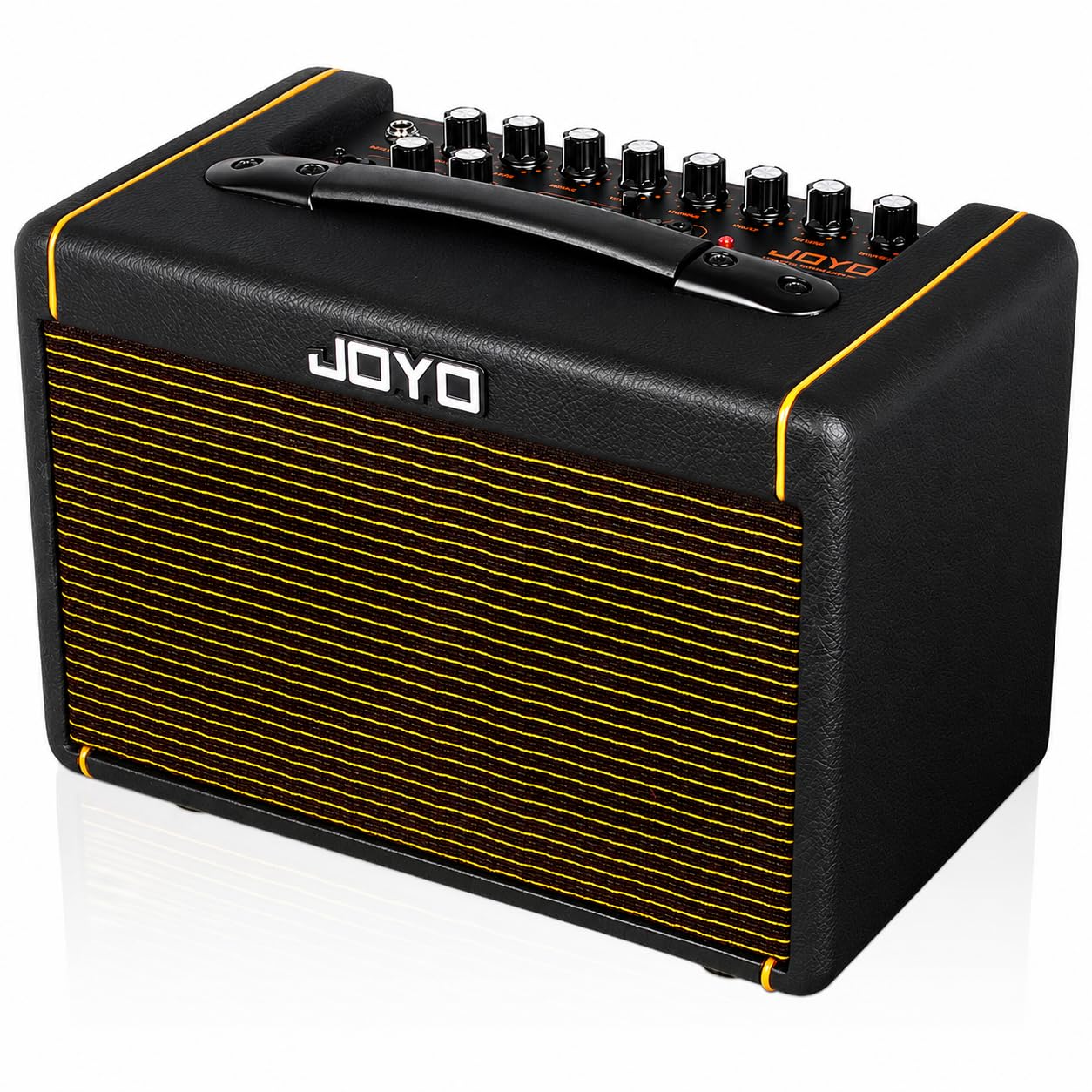
The JOYO AC-20S enters the market as a stereo acoustic combo that trades raw power for practical features. Two 4-inch speakers driven by 20 watts of stereo amplification create a genuinely wide soundstage that sounds far more immersive than mono practice amps at the same price. The three DSP effects — chorus, delay, and reverb — can be used individually or stacked, giving you a surprisingly flexible palette for shaping your tone without any pedalboard investment.
The standout feature here is the USB-C recording output that supports OTG live streaming direct to a phone or computer — a first for this price tier. The dedicated mic channel with its own reverb control is optimized for dynamic microphones, and the lithium battery delivers 3 to 6 hours of runtime depending on volume. The analog control layout — simple knobs with no menus — makes it immediately intuitive even for players who hate digital interfaces.
Where the AC-20S shows its budget roots is in the low-end response: the 4-inch drivers simply cannot reproduce the satisfying thump of a 6.5-inch or 8-inch speaker, making it best suited for fingerpicking and light strumming rather than heavy rhythm work. The chorus effect is widely described as unusable, and the lack of an XLR line-out restricts its stage integration. For the price-conscious player who wants a stereo practice amp with recording features, this is a compelling entry point.
Why it’s great
- Stereo dual 4″ speakers for wide soundstage
- USB-C OTG direct recording to phone/PC
- Intuitive analog controls with three DSP effects
Good to know
- Weak low-end due to 4″ drivers
- No XLR output and poor chorus effect
9. COOLMUSIC BP-MINI

The COOLMUSIC BP-MINI is the entry-level workhorse that proves you don’t need to spend much to get functional acoustic amplification. A 30-watt amplifier driving a single 6.5-inch speaker produces enough clean volume for bedroom practice, small apartment jam sessions, and backyard gatherings of a dozen people. The two-channel design lets you plug in a guitar and a microphone simultaneously, with separate bass and treble controls on the mic channel for basic vocal shaping.
The rechargeable lithium battery is the real star here: 5 to 8 hours of runtime means you can play through an entire afternoon without hunting for an outlet, and the USB-C charging (though no wall adapter is included) is convenient. Bluetooth streaming has its own volume control, allowing you to blend backing tracks with your live instrument signal. The wooden cabinet construction gives it a warmer resonance than the all-plastic competition, and the 3-year replacement warranty is exceptional for a product in this tier.
The compromises are predictable: the chorus and reverb effects are basic and lack the depth of the Fishman or Boss offerings, and the amp distorts noticeably when you push the master past 70 percent in an attempt to fill a loud room. There is no XLR output, no phantom power, and no dedicated mid EQ band. For a beginner acoustic-electric player, a practice tool, or a backup amp for emergency gigs, the BP-MINI delivers stunning value for its price.
Why it’s great
- Great battery life (5-8 hours) with USB-C charging
- Two channels with separate vocal EQ
- Exceptional 3-year replacement warranty
Good to know
- Distorts at high volume (above 70%)
- Basic effects, no XLR output, no phantom power
FAQ
Can I use a regular electric guitar amp for my acoustic-electric guitar?
How many watts do I need for a coffee shop gig with vocals?
What is phantom power and do I need it on an acoustic amp?
Does Bluetooth in an acoustic amp add noticeable latency?
How important is feedback suppression in an acoustic guitar amp?
Final Thoughts: The Verdict
For most users, the best acoustic electric guitar amp winner is the Fishman Loudbox Mini BT because it delivers exceptional sound clarity, effective feedback suppression, and independent reverb on two channels at a price that undercuts its premium competitors while outperforming the mid-range pack. If you need vocal harmonies and Acoustic Resonance tone restoration, grab the Boss ACS Live. And for extreme budget-conscious buyers who want a battery-powered portable with real 30-watt punch, nothing beats the COOLMUSIC BP-MINI for its combination of price, features, and build quality.