
If your engine has rolled past 75,000 miles, the ticking, the burning oil, and the loss of power are not “normal old age”—they are signs of microscopic wear and failing seals that a good additive can actually fix. The six additives here use three different approaches (ceramic-metal coatings, seal reconditioners, and carbon cleaners) to revive tired engines, and picking the wrong one wastes your money and leaves the noise right where it started.
I’m Min — the co-founder and writer behind Gadgets Feed. This guide is built by comparing the manufacturers’ published specifications and the patterns across verified customer reviews, so you get each pick’s real strengths and trade-offs instead of marketing spin.
The right formula depends on whether your engine needs metal restoration, leak repair, or carbon removal, and we break down exactly which job each one handles best. best additive for high mileage engines.
How To Choose The Best Additive For High Mileage Engines
A high-mileage engine faces three distinct problems: metal-on-metal wear that drops compression and creates noise, rubber seals that harden and leak oil, and carbon sludge that clogs rings, lifters, and phasers. The best additive for you is the one that targets your engine’s specific symptom — no single bottle fixes all three.
Identify Your Engine’s Dominant Problem
Listen for the sound. A rhythmic tick or knock usually points to worn lifters, bearings, or cylinder walls — you want a ceramic-metal coating additive like the XADO EX120 that builds a new surface on the metal. If you see puddles or smell burning oil, your seals are failing, and a seal-restoring additive like the XADO ATOMEX is the right call. If your engine smokes, burns oil, or feels sluggish, carbon deposits are likely restricting piston rings — a cleaning additive such as the ATS 505 CRO that dissolves sludge is your move.
Understand the Three Additive Types
Ceramic-metal coating additives (XADO EX120, XADO Highway, TriboTEX) work by depositing a thin, hard layer on worn metal surfaces. This physically fills in scratches and restores clearances — think of it as resurfacing from the inside. They are ideal for high-mileage engines but take multiple treatments for full effect. Seal reconditioners (XADO ATOMEX) use chemical softeners to revive hardened rubber gaskets and O-rings. They do nothing for metal wear. Carbon cleaners (ATS 505 CRO) use detergents and solvents to dissolve the baked-on sludge that sticks piston rings, fills oil control valves, and blocks screens. They are a one-time treatment, not a permanent maintenance additive.
Check the Treatment Volume and Cycle
Additives come in wildly different package sizes — an 8 ml syringe like the XADO EX120 treats a full engine over three applications, while a 64-ounce bottle of Lucas stabilizer replaces one quart of oil at every change. Match the product’s volume to your engine’s oil capacity (typically 4 to 10 quarts) and decide whether you want a one-time fix or an every-change habit. Syringe-based treatments require you to follow a three-stage process with specific mileage intervals between doses; pour-in bottles simply mix with your oil and circulate.
Quick Comparison
On smaller screens, swipe sideways to see the full table.
| Model | Category | Best For | Key Spec | Amazon |
|---|---|---|---|---|
| XADO EX120 | Ceramic-Metal | Rebuilding worn metal | 8 ml syringe — 60k-mile coating | Amazon |
| XADO ATOMEX | Seal Restorer | Stopping oil leaks | 250 ml — 10.5 oz bottle | Amazon |
| XADO Highway | Metal Conditioner | High-load driving wear | 7.5 fl oz — RF 5.5 revitalizant | Amazon |
| LUCAS 10118 | Oil Stabilizer | Every-oil-change friction reduction | 64 fl oz (2-pack) — 1.92 lbs | Amazon |
| ATS 505 CRO | Carbon Cleaner | Freeing stuck rings & lifters | 12 oz — cleaning treatment | Amazon |
| TriboTEX Small | Nano-Coating | Small engines & high-mileage cars | 1000 ml — diamond-like coating | Amazon |
In‑Depth Reviews
1. XADO EX120 Motor Oil Additive

The 8 ml syringe of XADO EX120 delivers a ceramic-metal coating that rebuilds worn metal surfaces from the inside, making it the top pick for high-mileage engines with wear-related noise and compression loss. For a 2001 Silverado with 340,000 miles, buyers report the lifter noise went silent immediately and the truck felt like it had more power.
Each treatment lasts up to 60,000 miles, so a full three-syringe cycle (8 ml each) protects your engine for well over 100,000 miles. The coating also restores oil pressure to its nominal value. A 20-year mechanic noted it even silenced a howling rear-end and torque converter noise — not just engine ticks. The XADO EX120 contains just 8 milliliters total, a 500x smaller liquid volume than the Lucas 64-ounce pack, but that tiny amount is concentrated enough to treat a full 10-quart oil system.
The catch is the three-stage treatment process: you apply one syringe, drive a specific mileage interval, then repeat. It is not a pour-and-forget product. For engines with wear-related noise and compression loss, however, that small effort delivers results no simple stabilizer can match. This is the one to buy if you want to rebuild metal wear from within, not just quiet a noise temporarily.
Why it’s great
- Rebuilds worn metal with a ceramic coating that lasts 60k miles
- Cures lifter ticks, compression issues, transmission chatter, and rear-end noise
- Restores oil pressure and improves acceleration immediately
Good to know
- Requires a 3-stage treatment process over specific mileage intervals
- Only works for wear-related problems, not broken or damaged parts
2. XADO ATOMEX Oil Additive Stop Leak

Where the XADO EX120 builds metal, the XADO ATOMEX works on the other half of the high-mileage problem — hardened rubber seals. This 250 ml (10.5 ounces) bottle is 31 times larger by volume than the EX120 syringe because seal restoration requires a full oil-system dose. Owners mention it eliminated 1 quart of oil loss every few hundred miles on a Hyundai Santa Fe 4-cylinder after just 200 miles, with no leaks found and no smoke from the exhaust.
The chemical formula restores elasticity to dried-out rubber gaskets and O-rings. That is the root cause of most rear-main-seal leaks and valve-cover drips. One reviewer on a 2017 F-150 3.5 EcoBoost found it stopped turbo coolant line leaks for two full years. Unlike carbon cleaners that dissolve sludge or stabilizers that thicken oil, the ATOMEX directly softens the seal material so it swells back to its original shape and seals again.
If your engine drips oil but runs fine with no ticking or power loss, the ATOMEX is the correct fix. It is lighter than the ATS Chemical 505 by 0.7 ounces (10.5 oz vs 11.2 oz), but that difference comes from a different formulation focus — this is a pure seal restorer with no carbon-cleaning detergent. Pick this over the EX120 if your symptom is a puddle on the driveway, not a tick under the hood. The engine-nurse who treats leaks first, then wear, buys this one.
Where it shines
- Eliminated oil leaks in as little as 100-200 miles
- Restores elasticity to rubber seals, gaskets, and O-rings permanently
- Universal compatibility with auto, motorcycle, and marine engines
Worth noting
- Does nothing for metal wear, noise, or carbon deposits
- May take up to 180 miles for the seal to fully swell and stop the leak
3. XADO Highway Oil Additive

If you drive long highway miles at sustained high RPMs, the XADO Highway is built specifically for that abuse — it uses a third-generation revitalizant with an RF (Revitalization Factor) of 5.5, a rating that tells you how aggressively it compensates for active wear under continuous high load. Think of it as the EX120’s older sibling designed for engines that never get a break: delivery vans, long-commute sedans, and trucks that haul.
The 7.5 fluid ounce bottle is a direct pour-in treatment — no multi-stage syringe process — and it boosts oil system pressure to keep lubrication flowing to parts under heat stress. Customers note the engine runs quieter and smoother, and one noted they noticed a decrease in oil consumption and that their oil stayed clean longer. It also improves the lubricating properties of any motor oil, so it works with conventional, synthetic, and blends.
The standout spec is the RF 5.5 rating itself — this is a measurable claim that the additive creates an active protective layer against loads and overheating. If you mostly drive city streets and short trips, the EX120’s concentrated syringe gives you better per-dollar metal restoration. But for sustained highway duty, the Highway formula’s load-specific design is the smarter fit. This one is for the road warrior who lives at highway speeds, not the stop-and-go commuter.
What stands out
- Engineered for high-speed, high-load driving with RF 5.5 protection
- Simple pour-in bottle — no multi-step process
- Reduces oil consumption and keeps oil cleaner longer
The trade-offs
- Le$$ expensive than some competitors but still premium-priced
- Best used as ongoing maintenance, not a one-time quick fix
4. LUCAS Oil 10118 High Mileage Oil Stabilizer (Pack of 2)

The single number that matters most for a stabilizer is how much you need to add at every oil change, and the Lucas 10118 solves that by giving you 64 fluid ounces across two cans — enough to replace one full quart of oil per change for four changes. That quart-for-quart substitution is the key: you remove a quart of oil and pour in a quart of stabilizer, creating a thick, clingy coating that reduces friction and eliminates dry starts.
The downside is that this is a maintainer, not a restorer. Lucas does not rebuild metal or soften seals — it is a 100% petroleum product that works by being thicker than motor oil, so it stays on metal surfaces after the engine shuts off. Reviewers point out using it across a 1998 Ford F-250 with 179,000 miles, a 2014 Mazda CX-5 with 140,000 miles, and even a 2017 Smart 453 with just 39,000 miles, all with quieter operation.
On a price-to-volume basis, this is the most economical way to treat every single oil change for your entire fleet. If you have multiple high-mileage vehicles and want a consistent friction-reduction habit without worrying about treatment cycles, the Lucas two-pack delivers exactly that. You are buying convenience and volume, not high-tech metal surgery. This is the fleet manager’s choice for consistent, low-effort protection across multiple vehicles.
The upsides
- Replaces one quart of oil to reduce friction at every change
- Works in any engine — verified in gas, diesel, and even Smart cars
- Eliminates dry starts by clinging to metal surfaces after shutdown
Keep in mind
- Does not rebuild worn metal, soften seals, or clean carbon deposits
- Adds thickness to oil, which may not suit all engine clearances
5. ATS Chemical 505 CRO Oil System Treatment
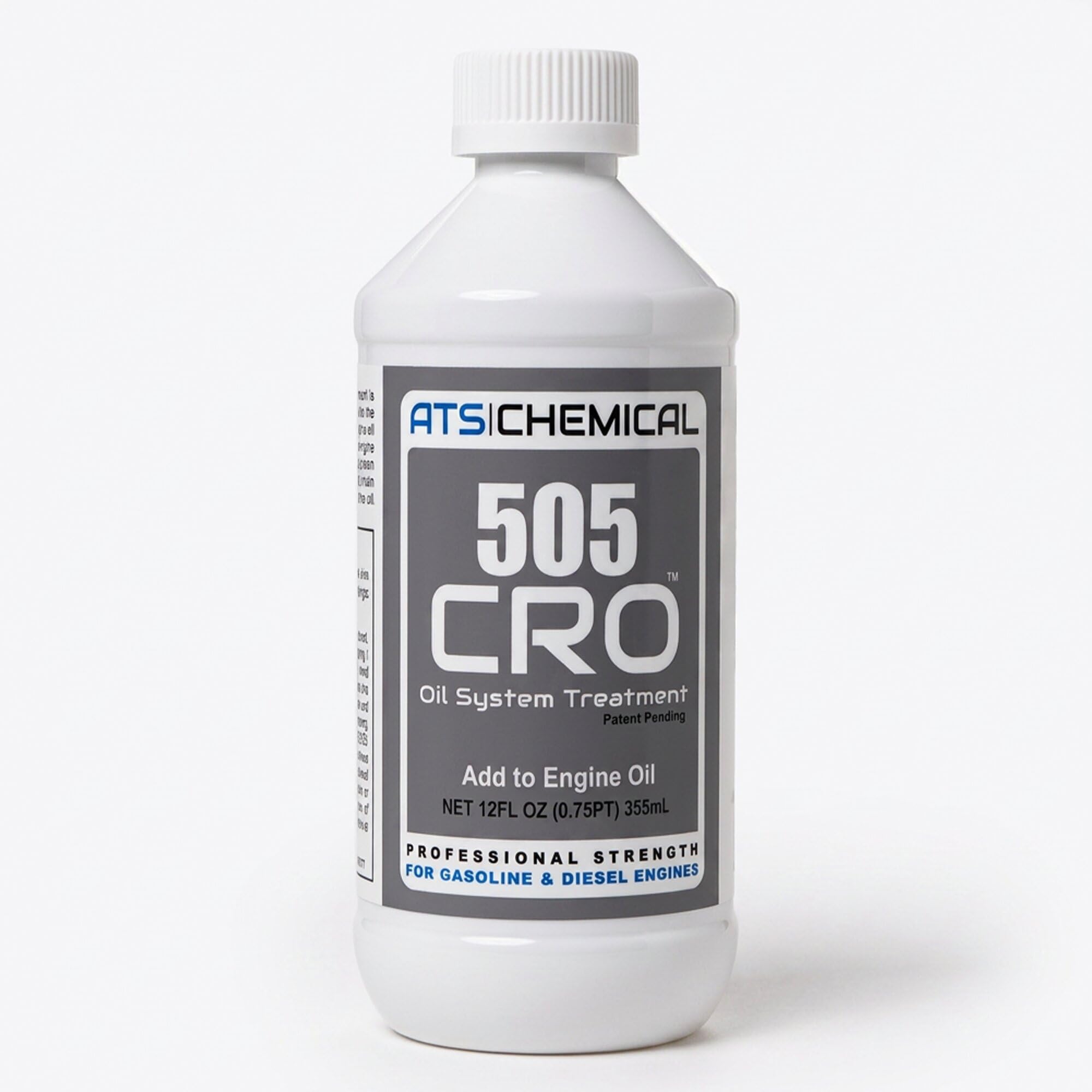
What you actually get at this lower price is 11.2 ounces of concentrated carbon-cleaning solvent — 0.7 ounces heavier than the XADO ATOMEX — designed to attack baked-on sludge that sticks piston rings, lifters, cam phasers, and oil control valves. A buyer added it to a 2016 Jeep Cherokee with 330,000 miles, let the engine idle and soak overnight, and the drained oil came out pitch black, indicating the treatment removed decades of carbon deposits.
What you give up is any metal restoration or seal softening — the ATS 505 CRO is purely a cleaner. The 12-ounce bottle is a one-time treatment, not something you add at every oil change: you pour it in, run the engine at 2,000–2,200 RPM for 15 minutes, then change the oil. One reviewer on a 1995 Mazda Miata with 197,000 miles said it unstuck carboned oil rings that had resisted other methods, stopping the engine from burning a quart every 2,000 miles.
For the price, you get the most aggressive chemical cleaning available in a pour-in bottle. If your high-mileage engine burns oil, smokes, or feels sluggish because of carbon buildup (not metal wear or seal leaks), the ATS 505 CRO is the most direct answer. It is a one-and-done reset, not a maintenance habit. Skip this if your oil drips or your engine knocks — those are different problems entirely. This is the perfect budget buy for the owner who needs a single aggressive carbon-cleaning treatment, not ongoing additives.
Why we’d pick it
- Effectively cleans carbon deposits from rings, lifters, phasers, and screens
- Visible results — drained oil turns pitch black after one treatment
- Saved engines with stuck oil rings that other products failed to fix
A few caveats
- Bottle cap has two layers making it tricky to open
- One-time cleaning treatment, not an ongoing additive for every oil change
6. TriboTEX Small Oil Additive Engine Treatment

The TriboTEX Small is perfect for the owner of a small engine — a motorcycle, lawn mower, generator, or a 4-cylinder passenger car — who wants the most scientifically advanced wear reversal available, backed by development with the U.S. Department of Energy, NASA, and the National Science Foundation. Its synthetic nanoparticles build a diamond-like carbon coating on bearings to reverse wear, using a carbon-based gel that works on gas and diesel engines of all sizes, including motorcycles and small equipment, distinct from the ceramic-metal coating used by the XADO EX120.
For the price, you get a 1000 ml bottle that treats one small engine or one passenger car with a 4-cylinder engine. A buyer on a 2005 Honda Civic with 230,000 miles reported the engine quieted, a valve tick disappeared, and highway MPG jumped from 32–33 to 36.5–38.5 — an estimated savings over the 40,000-mile product life. Another reviewer said it worked miracles on a lawn mower, making it start easier and ride smoother.
The honest limit is the price per treatment — this is the most expensive single-dose additive here, and the small size means you need to buy the larger version for V6 or V8 engines. But the NASA-backed technology and the diamond-like coating result give it a durability edge that makes it a strong choice if you want the absolute latest material science protecting your high-mileage engine.
Strong points
- Developed with NASA and the Department of Energy for advanced wear reversal
- Builds a diamond-like carbon coating on bearings and metal surfaces
- Eliminates valve tick, improves MPG by up to 6 mpg highway
Before you buy
- Premium-priced — the most expensive single-dose additive here
- Small size treats only 4-cylinder and small engines; larger engines need more
Understanding the Specs
Ceramic-Metal vs. Carbon Cleaning — Why the Chemistry Matters
A ceramic-metal coating additive (like the XADO EX120) works by using friction heat to fuse a thin layer of metal-ceramic onto worn surfaces. It literally fills in the scratches and restores the original clearance between moving parts. A carbon cleaner (like the ATS 505 CRO) works opposite — it dissolves the carbon sludge that is already taking up space. If you add a carbon cleaner to an engine that needs metal restoration, you will clean off some varnish but the knocking will remain. Match the chemistry to the symptom: noise and power loss = ceramic-metal; oil burning and smoking = carbon cleaner; drips and puddles = seal restorer.
Treatment Volume and the Syringe-to-Bottle Trade-Off
Additives come in volumes that range from 8 milliliters (one XADO EX120 syringe) to 64 fluid ounces (the Lucas two-pack). A syringe means the additive is concentrated enough that a tiny amount treats the whole engine — you follow a three-stage cycle to build the coating over time. A large bottle means the product is diluted and you replace a full quart of oil with it at every change. The small-syringe approach is cheaper per treatment but requires discipline; the large-bottle approach is easier to remember but costs you a quart of oil capacity every change. Neither is better — your choice depends on whether you want a one-time rebuild (syringe) or an ongoing maintenance habit (bottle).
FAQ
Can I use a ceramic-metal additive and a carbon cleaner together in the same oil change?
How do I know if my high-mileage engine needs a seal restorer versus a metal-coating additive?
Is it safe to use these additives in a brand-new engine or one under warranty?
Final Thoughts: The Verdict
If you want one dependable pick, the additive for high mileage engines winner is the XADO EX120 because it actually rebuilds worn metal with a ceramic coating that lasts 60,000 miles — it addresses the root cause of ticking and power loss, not just the symptoms. If you have visible oil leaks rather than engine noise, grab the XADO ATOMEX for its proven seal-restoring chemistry. And for carbon-clogged engines that burn oil or smoke, the standout is the ATS 505 CRO for a single-treatment reset.