
Standard solar panels demand flat, rigid surfaces. But your RV, van, or boat roof is curved, and your tent or backpack is anything but flat. That gap is exactly what bendable solar panels are designed to fill — they conform to the surface instead of the other way around, delivering power where rigid glass panels simply cannot go.
I’m Min — the co-founder and writer behind Gadgets Feed. I’ve spent countless hours analyzing the raw technical specs, conversion efficiencies, and real-world output data of bendable and flexible solar panels to build this guide around what actually works off-grid.
Whether you are outfitting a van roof or packing a survival kit, this guide cuts through the marketing to find the best bendable solar panels for your specific mounting surface and power budget.
How To Choose The Best Bendable Solar Panels
A bendable solar panel is not a single product type — it is a trade-off between how much power you need (watts), where you need to put it (curved or portable), and how the panel handles weather over years of use. Three factors separate the winners from the weak.
Cell Type & Efficiency
The vast majority of high-performing bendable panels use monocrystalline silicon cells. Efficiency ratings range from 21% to 25%. A 25% N-type cell panel, like the HQST 200W or Renogy 200W portable, captures measurably more energy in low-light or overcast conditions than older 9BB panels hovering around 22%. More efficiency means you need less surface area to hit your target wattage, which matters on a small van roof.
Flexibility vs. Durability
Semi-flexible panels rated for permanent adhesive mounting (like the Renogy 100W flexible) use a thin polymer laminate that can bend to a radius of roughly 30 inches. Portable foldable panels use a rigid hinge design between segments, so they pack flat but do not bend across their full surface. For curved roofs, choose semi-flexible. For portable use with kickstands, choose foldable. Mixing them up is the most common mistake buyers make.
Connector & Controller Requirements
Portable panels with USB ports and integrated smart IC chips (FlexSolar, Anker Solix) can charge devices directly. Semi-flexible panels with MC4 connectors (Renogy, HQST) require a charge controller between the panel and your battery bank. If you are charging a power station, check that the incoming voltage from the panel does not exceed the station’s maximum input voltage — exceeding it can damage the internal controller.
Quick Comparison
On smaller screens, swipe sideways to see the full table.
| Model | Category | Best For | Key Spec | Amazon |
|---|---|---|---|---|
| Renogy 100W Flexible | Semi-Flexible | Curved RV & Van Roofs | 100W, 0.08 inch thick, 22% efficiency | Amazon |
| HQST 200W Portable | Foldable | High-Efficiency Portable Charging | 200W, 25% N-Type cells, IP67 | Amazon |
| Renogy 200W Portable | Foldable | Multi-Device Off-Grid Power | 200W, 45W USB-C, 25% efficiency | Amazon |
| EBL 100W Portable | Foldable | Power Station Charging Kit | 100W, 23% efficiency, 45° kickstand | Amazon |
| FlexSolar 60W Portable | Foldable | Compact Emergency & Camping Backup | 60W, PD 60W USB-C, IP65 | Amazon |
| Goal Zero Nomad 20 | Foldable | Ultralight Backpacking & Kits | 20W, 2.25 lbs, 8mm + USB | Amazon |
| Anker Solix PS30 | Foldable | Lightweight Phone & Tablet Charging | 30W, 2.2 lbs, IP65 | Amazon |
In‑Depth Reviews
1. Renogy Flexible Solar Panel 100 Watt

The Renogy 100W flexible panel is the benchmark for semi-flexible solar on curved surfaces. At just 0.08 inches thick and weighing 4 pounds, it is roughly 95% thinner and 70% lighter than rigid panels of the same wattage. The polymer lamination allows the panel to conform to RV roofs, van tops, and boat decks with a bend radius tight enough for most real-world curves.
Real-world output from multiple owners shows consistent 80–90W in direct sun, with one user running two panels in series to achieve 175W total after three years of continuous van use. The panel uses 22% efficient monocrystalline cells with an MC4 output, so it requires an external charge controller — but that also means it integrates cleanly with most solar generator setups and 12V battery systems.
Renogy backs this panel with a five-year material and workmanship warranty, and the ETFE-coated surface handles UV exposure and weather well. It is rated for wind loads up to 2400 Pa and snow loads up to 5400 Pa, making it a rugged choice for permanent adhesive mounting on uneven or curved surfaces where glass panels simply do not fit.
Why it’s great
- Ultrathin 0.08-inch profile bends to curved surfaces easily
- Weighs only 4 pounds for a full 100W of output
- Five-year warranty and proven three-year durability in real van builds
Good to know
- Requires an external charge controller (not included)
- Surface must be cleaned thoroughly for strong adhesive mounting tape
2. HQST 200W Ultra-Light Portable Solar Panel
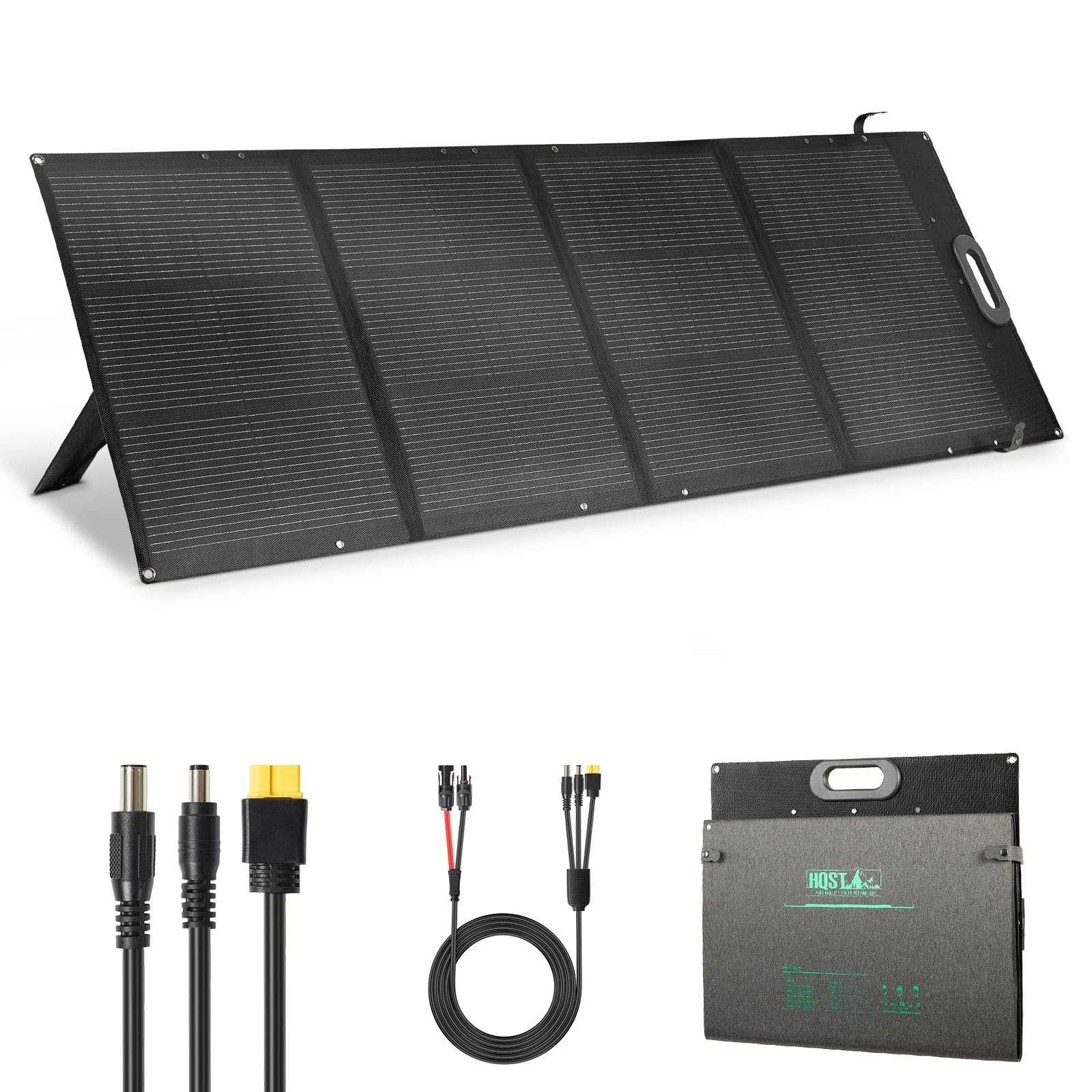
The HQST 200W portable panel uses 16BB N-Type cells that push conversion efficiency to 25%, measurably higher than the industry-standard 22–23%. In practical terms, that extra efficiency means the panel captures usable power earlier in the morning and later in the afternoon, and it performs noticeably better under partial cloud cover than panels using older 9BB cell architectures.
Weight is a standout feature here — at roughly 37% lighter than comparable 200W foldable panels, you can carry it one-handed without strain. It folds down to just 1.97 inches thick and includes two adjustable kickstands with a 40–60 degree range, so you can angle it toward the sun rather than leaving it flat. The included 4.9-foot 3-in-1 adapter cable (XT60, DC7909, DC5521) covers most popular power stations from Jackery and EcoFlow to BLUETTI and Anker.
The IP67 rating is a real step up from the more common IP65 — it is fully dust-tight and can handle immersion in up to one meter of water for 30 minutes. The fully laminated construction eliminates stitched seams where water typically seeps into lower-end foldable panels. Backed by a 12-month warranty plus lifetime technical support.
Why it’s great
- 25% N-Type cells for class-leading low-light performance
- IP67 waterproof rating — far tougher than typical IP65 foldables
- Ultra-light design at 11 pounds cuts carried weight significantly
Good to know
- Folded dimensions are larger than backpacks may accommodate
- Multiple panels require careful voltage matching for series connection
3. Renogy 200W Portable Solar Panel
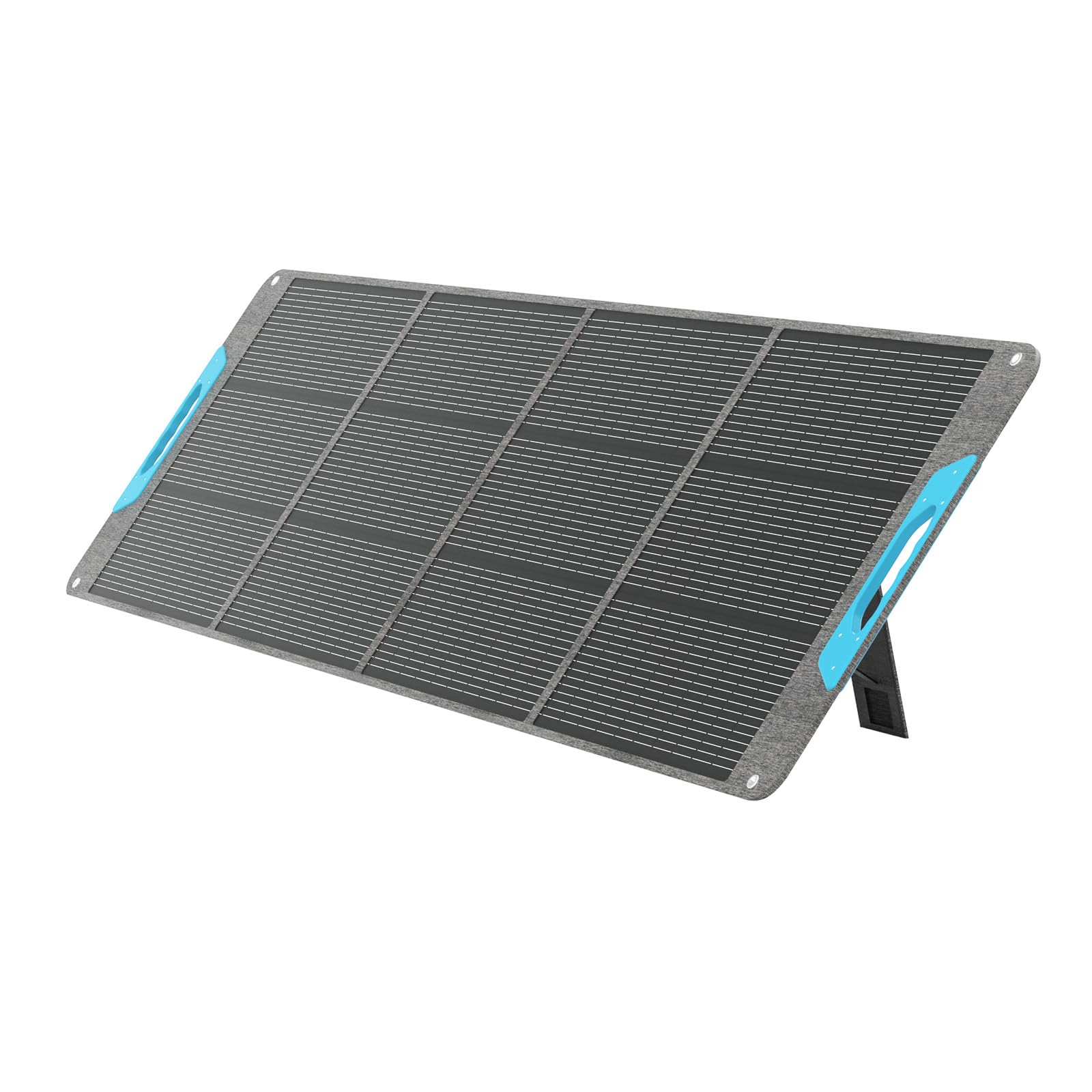
Renogy’s 200W E.Flex portable panel matches the HQST on cell efficiency (25% from 16BB N-Type cells) but adds native USB-C PD output at 45W, plus two USB-A ports. That means you can charge a laptop directly from the panel while simultaneously topping off a power station via the MC4 output — no external adapter needed for smaller devices.
The magnetic closure system is a thoughtful detail that replaces the typical snap or Velcro straps found on cheaper foldable panels. At 13.89 pounds, it is not the lightest 200W panel on this list, but the quad-fold design packs down to 23.72 x 22.99 x 1.97 inches, and the four kickstands offer three angle positions (40, 50, and 60 degrees). Ground studs and reinforced grommets keep the panel stable in moderate wind.
User reviews report exceeding rated output in strong Florida sunlight — one reviewer measured 469W from two panels in parallel and 579W in series. The 2-year material and workmanship warranty plus UL 61730 certification provide peace of mind that the panel meets recognized safety standards for electrical and fire risk.
Why it’s great
- Built-in 45W USB-C PD charges laptops without an extra brick
- Magnetic closure system is faster and more durable than Velcro
- UL 61730 certified for safety compliance
Good to know
- Heavier than the HQST 200W at 13.89 pounds
- Travel bag is functional but basic for the price tier
4. EBL Solar Panel 100W Portable
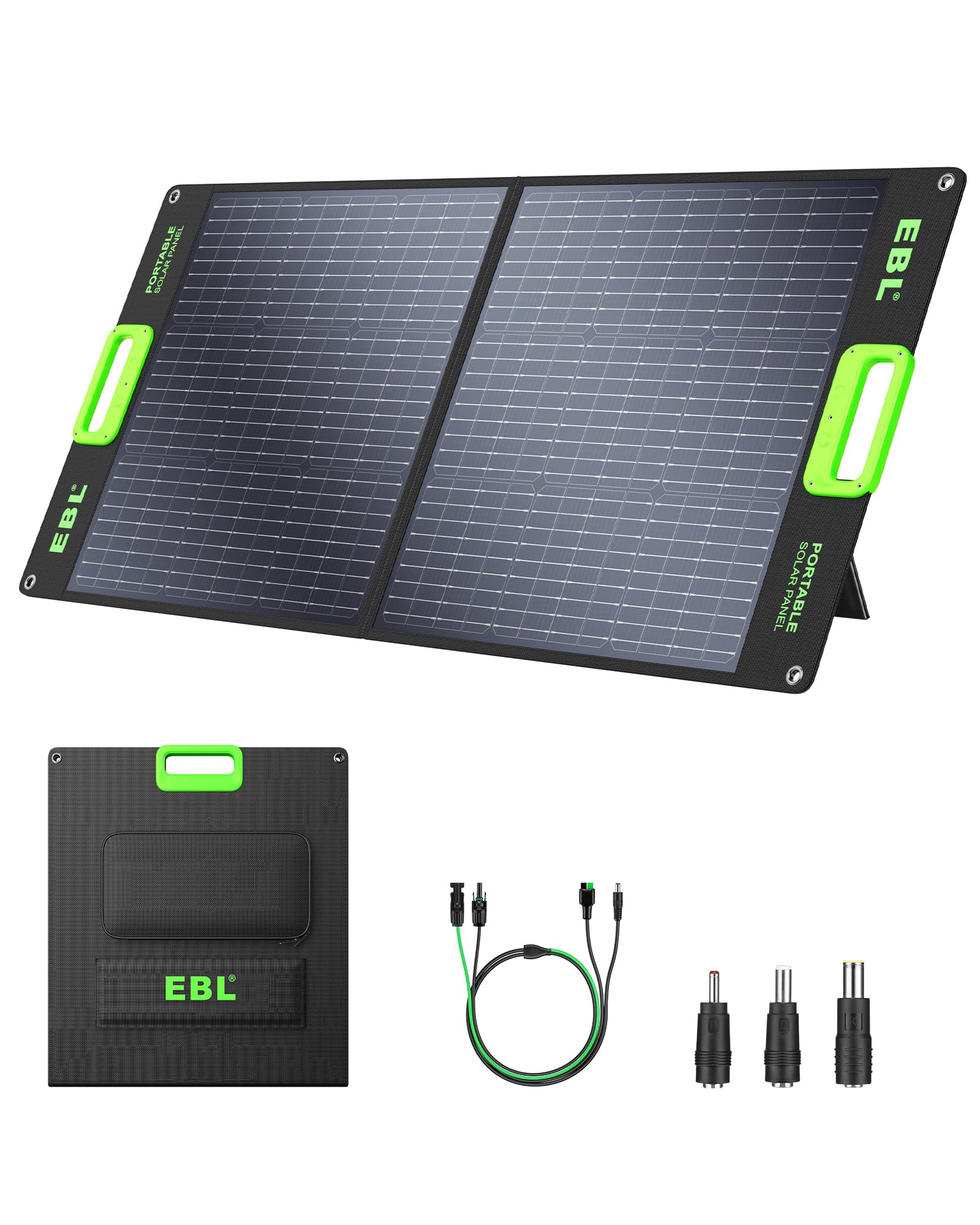
The EBL 100W portable panel delivers strong real-world output relative to its mid-range position. While the theoretical maximum is 100W, multiple users report peak readings between 65W and 80W in direct sun, with one reviewer achieving a full charge of a 448Wh battery in about three hours. The 23% monocrystalline cells fall just behind the N-type panels in efficiency but still represent solid performance for the wattage.
The integrated kickstand locks at a 45-degree angle, which EBL claims captures 20% more sunlight than flat-laying the panel. The magnetic handle makes folding and storing clean and quick. The panel includes a generous adapter kit with MC4-to-Anderson, MC4-to-DC5521, and three barrel adapter sizes, so compatibility with oddball power station inputs is better than most competitors.
IP65 water resistance means it can handle rain splashes but should not be left in a downpour or submerged. The laminated ETFE construction is a step above cheaper PET-coated panels in terms of UV resistance and light transmission. One reviewer experienced a connectivity issue with a Jackery 300, but the seller provided a replacement adapter — customer support responsiveness appears solid.
Why it’s great
- Comprehensive adapter kit covers most power stations out of the box
- 45-degree kickstand improves capture angle over flat panels
- Magnetic handle for tidy folding and carrying
Good to know
- Real-world wattage typically peaks around 65–80W, not 100W
- IP65 rating limits exposure to splashes only, not immersion
5. [Upgraded] FlexSolar 60W Portable Solar Panel

The FlexSolar 60W panel punches above its size with a full PD 60W USB-C port, which is enough to charge most USB-C laptops at full speed — something rare at this wattage level. It also includes a QC2.0 15W port, a QC3.0 18W port, and a DC5521 barrel output (20–28V, 60W max), giving you four simultaneous charging paths for phones, tablets, battery packs, and small power stations.
Weighing 6.4 pounds and folding to 13.8 x 9.1 x 2.2 inches, the six-panel design unfolds to a 33.8 x 28.1-inch surface for solar harvesting. The smart IC chip automatically detects connected devices and adjusts current to deliver the fastest possible charge. Users confirmed that it charges a 300Wh power station at about 35W in full sun, adding roughly 10% charge every 40 minutes — perfectly adequate for overnight camping top-offs.
The ETFE-coated A+ monocrystalline cells achieve 24% efficiency, and the IP65 rating protects against rain and dust. One caution: the junction box is not waterproof, so the panel should be stored dry. For the price, it is hard to beat for a compact emergency kit or a small camping setup where weight and packed size matter more than raw wattage.
Why it’s great
- 60W PD USB-C charges laptops at full speed directly
- Four output ports for multi-device charging simultaneously
- Compact foldable design fits easily in a car trunk or backpack
Good to know
- Peak output requires direct, unobstructed sunlight (30–40W on cloudy days)
- Junction box is not waterproof — protect from rain exposure
6. Goal Zero Nomad 20

Goal Zero’s Nomad 20 is the dedicated ultralight option for backpackers and emergency kit builders who prioritize packed size over bulk wattage. Folding down to 11.5 x 7.4 x 1.25 inches and weighing just 2.25 pounds, it disappears into a daypack. The 20W panel output is sufficient to recharge smartphones, USB battery banks, and small USB devices over the course of a day.
The panel includes both a built-in 8mm charging cable (compatible with Goal Zero’s Yeti and Sherpa power stations) and a standard USB-A port. In strong tropical sun, users reported charging an iPhone from empty to roughly 60% in two hours, though performance dropped significantly under cloud cover. The 180-degree adjustable kickstand is small but functional for propping the panel at a decent angle on uneven ground.
It is engineered by Goal Zero’s US-based team, which has over 50 years of combined solar experience. The one-year manufacturer warranty is shorter than some competitors, but the US-based support team is responsive based on user feedback. For ultralight backpacking where every ounce counts and you only need to top off communication devices, the Nomad 20 is a proven, reliable piece of kit.
Why it’s great
- Ultra-compact folded size fits in a backpack easily at just over 2 pounds
- Built-in 8mm cable connects directly to Goal Zero power stations
- Proven durability for thru-hiking and emergency preparedness
Good to know
- 20W output is slow for charging larger devices like laptops
- One-year warranty is shorter than several competitors
7. Anker Solix PS30 Solar Panel

The Anker Solix PS30 is a 30W foldable panel built around Anker’s reputation for reliable, user-friendly portable power. It weighs just 2.2 pounds and folds to 10.7 x 8.8 x 1.7 inches — roughly the size of a small laptop. The USB-A and USB-C ports allow charging two devices at once, and the 15W USB-C output is well-matched for phones and power banks.
IP65 weather resistance means you can use it in light rain or dusty conditions without worry. Two included carabiners let you clip the panel to a backpack or tent while hiking so it charges on the move. User reviews confirm it can charge a phone from 15% to full in about 1.5 hours in good sun, though the panel’s 30W output is not sufficient for power station charging without significant time investment.
The main trade-off at this wattage range is that the Solix PS30 is best suited for small device top-offs rather than running heavy off-grid gear. Some users noted the hinge design can pinch small cables, and the foam inlays could be more refined. However, for a lightweight, grab-and-go solution for smartphone and battery pack charging during day hikes, it delivers exactly what Anker promises — reliable, simple solar backup.
Why it’s great
- Lightweight 2.2-pound build is effortless to carry on day hikes
- Anker quality and support — reliable brand in portable power
- Carabiners allow on-the-go charging while attached to a backpack
Good to know
- 30W output is too low for charging most power stations
- Hinges can pinch small cables if not carefully routed
FAQ
Can I walk on a bendable solar panel?
How much bend is too much for a flexible panel?
Do I need a charge controller with a portable foldable panel?
Final Thoughts: The Verdict
For most users, the best bendable solar panels winner is the Renogy 100W Flexible Panel because it balances real-world durability, a proven track record on curved van and RV roofs, and a thickness that is nearly invisible when mounted. If you want maximum portable power and built-in laptop charging, grab the Renogy 200W Portable. And for ultralight backpacking where every ounce counts, nothing beats the Goal Zero Nomad 20.