
Our readers keep the lights on and my morning glass full of iced black tea. As an Amazon Associate, I earn from qualifying purchases.
Specs are compiled from manufacturer listings and verified buyer reviews and can change over time — please confirm the key details on the product page before buying.
For a permanent bond that holds metal to metal, the real question isn’t which glue is strongest — it’s which one you can actually get to set right, in the time you have, on the surface you are facing. You need a product that resists heat, vibration, and moisture, because a broken bracket, a cracked radiator, or a stripped thread won’t wait for a second attempt. This guide breaks down five picks that are each formulated for metal-to-metal bonding, so you can match the cure speed, working time, and strength to your exact repair.
I’m Min — the founder and writer behind Gadgets Feed. This guide is built by comparing the manufacturers’ published specifications and the patterns across verified customer reviews, so you get each pick’s real strengths and trade-offs instead of marketing spin.
Whether you are patching a cast-iron engine block or reattaching a furniture leg, we have sorted the top-tier options to give you a clear look at the very best adhesives for metal to metal that deliver real holding power without guesswork.
Quick Picks
- J-B Weld SteelStik, 1 Hour Cure, Steel Reinforced Epoxy Putty Stick – 2 Pack, Dark Grey (8267-2) — Best Overall
- AOJEL Metal Epoxy Repair System S300, 2-Part Cold Weld, 1.69 oz — Premium Pick
- Mastercool 90935 Alum Bond Aluminum Repair Compound, 7.2 oz — Best for Aluminum
- RNVVHY Heavy Duty Metal Glue, Waterproof Epoxy Casting Adhesive, 2.3 oz — Best Versatile
- Cerca de Metal Glue, Heavy Duty Waterproof Epoxy Adhesive, 1.6 oz — Budget Champion
How To Choose The Best Adhesives For Metal To Metal
Not every metal glue works the same way. The right choice depends on three things: the kind of metal you are bonding, the stress the joint will face, and the time you have to finish the job. Here is what to check before you buy.
Cure Speed and Working Time
Fast-setting putties like J-B Weld SteelStik set in five minutes and cure in one hour — ideal for a quick patch where you can hold or clamp the part. Liquid epoxies that need 24 hours to fully cure, on the other hand, give you a much longer window to align pieces, fill a large gap, or build thickness on a vertical surface. If you are repairing a threaded hole or a crack that needs perfect positioning, a slow-cure epoxy is safer because you are not racing the clock.
Strength and Temperature Resistance
Tensile strength (measured in PSI) tells you how much pulling force the bond can take before it breaks. For non-structural repairs like a decorative fence, 3,500 PSI is plenty. For a load-bearing bracket or an engine part, look for a product with a higher tensile rating and heat resistance above 250°F so the bond does not soften under constant warmth or vibration.
Surface Prep and Compatibility
Every metal glue requires a clean, roughened surface to grip. Oily, painted, or smooth metal will not hold well unless you sand it down to bare material. Also check that the adhesive is formulated for your specific metal — some epoxies are aluminum-filled for castings, while general-purpose ones work across steel, iron, copper, and brass.
Quick Comparison
On smaller screens, swipe sideways to see the full table.
| Model | Best For | Tensile Strength | Full Cure Time | Heat Resistance | Amazon |
|---|---|---|---|---|---|
| J-B Weld SteelStik 2-Pack | Quick steel-reinforced putty repairs | 4,000 PSI | 1 Hour | Up to 350°F (continuous) | Amazon |
| RNVVHY Heavy Duty Metal Glue | Wet or oily metal surface repairs | — | 24 Hours | -65°F to 548°F | Amazon |
| Cerca de Metal Glue | Fast-tack household metal fixes | — | 24 Hours | — | Amazon |
| AOJEL Metal Epoxy S300 | Structural rigid metal repairs | — | 12-24 Hours | 392°F | Amazon |
| Mastercool Alum Bond 90935 | Aluminum casting & radiator repair | 3,500 PSI | 12-24 Hours | 250°F | Amazon |
In‑Depth Reviews
1. J-B Weld SteelStik, 1 Hour Cure, Steel Reinforced Epoxy Putty Stick – 2 Pack, Dark Grey (8267-2)

The putty stick you mix in your hand delivers a same-day 4,000 PSI bond.
This is the pick for anyone who needs a metal repair done the same day. J-B Weld SteelStik is a hand-mixable two-part epoxy putty that sets in just five minutes and fully cures in one hour, while many full-cure epoxies take 24 hours. You knead the grey putty between your fingers, press it into place, and you are done waiting before lunch. The bond reaches a tensile strength of 4,000 PSI, and it resists continuous heat up to 350°F (176°C) and intermittent spikes to 450°F (232°C), so it holds on engine parts, exhaust areas, and hot water pipes.
Because the putty is steel-reinforced and non-rusting, it can be molded, shaped, sanded, drilled, and tapped after curing — meaning you can thread a screw into it or machine it down flush. Unlike the liquid epoxies below, there is no syringe or mixing nozzle; you simply tear off what you need and save the rest. Buyers report it works on iron, stainless steel, copper, brass, aluminum, and even fiberglass. One reviewer used it to “tighten a wallered seat mount,” drilling and reaming it after the hour cure.
The catch is speed itself: the putty sets extremely fast. You have about five minutes to apply it after kneading, so you need to have your surfaces prepped and aligned before you start mixing. It is not ideal for large-area fills or repairs where you need to reposition parts over several minutes — for those, a slow-curing liquid epoxy like the AOJEL below is a better match.
The case for it: The one-hour full cure time, versus 24 hours for most competitors, means you can finish a repair in a single afternoon, not the next day.
The downside: The five-minute set window is tight — you need to work fast and have everything ready before you knead the putty.
Best for: Quick, load-bearing metal patches where you want to drill or tap the cured bond the same day — engine brackets, threaded holes, pipe repairs.
Skip if: You need a long working time for multi-part alignment, or you are filling a large crack that requires slow, careful buildup.
2. AOJEL Metal Epoxy Repair System S300, 2-Part Cold Weld, 1.69 oz
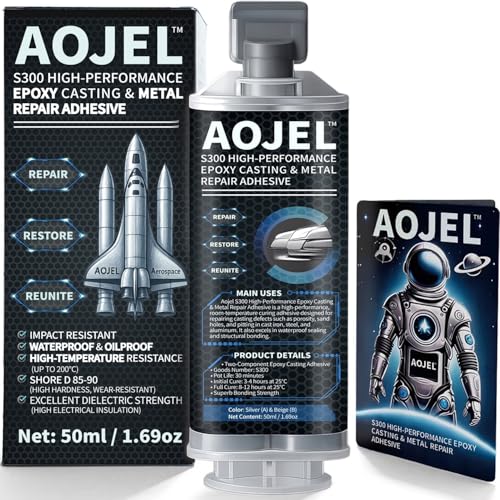
The controlled cold-weld for repairs that cannot be rushed.
If you have ever mixed a fast-setting epoxy only to have it harden before you finished aligning the parts, this pick is your solution. The AOJEL S300 gives you up to 30 minutes of working time at 77°F — far longer than the five-minute window of the J-B Weld putty above — so you can position a bracket, clamp a casting, or fill a vertical gap without panic. It is a two-part cold-weld style epoxy made specifically for rigid metal repairs on aluminum, steel, stainless steel, cast iron, and cast aluminum, and it cures into a hard body that you can drill, sand, file, and paint after 12 to 24 hours.
Unlike the thinner liquid epoxies on this list, the S300 is designed to build thickness. The maker advises spreading it beyond the crack line and building enough material so the cured epoxy becomes a solid repair body rather than just a surface skim. After full cure, it handles exposure to moisture, routine oil, workshop heat, and vibration — it is waterproof and resists heat up to 392°F. A reviewer who used it to fix a cracked crankcase on a 2003 Honda 450 Foreman noted that “heat and vibrations don’t hurt it,” and appreciated the slow cure because a persistent oil leak required three applications to seal completely.
The trade-off is that the syringe plungers can be tricky to get even pressure on both sides, especially for small amounts. A few buyers mention that dispensing equal parts from the dual syringe takes practice at first. And like all full-cure epoxies, you must wait the full 24 hours before loading or drilling the repair.
Why it’s great
- 30-minute working time gives you real control for alignment, clamping, and gap-filling without rushing.
- Withstands heat up to 392°F and resists oil and moisture, so it holds in engine-bay and workshop conditions.
Good to know
- The dual syringe plungers can dispense unevenly — squeeze a test amount until both colors flow together before applying to the repair.
- Full cure takes 12 to 24 hours, so you need patience before drilling, sanding, or loading the joint.
Best for: Structural rigid metal repairs — cracked castings, aluminum housings, steel frames, stripped bolt holes — where you need time to position and clamp before the epoxy sets.
Skip if: You want a same-day cure; the one-hour cure of the J-B Weld putty is much faster for quick patches.
3. Mastercool 90935 Alum Bond Aluminum Repair Compound, 7.2 oz
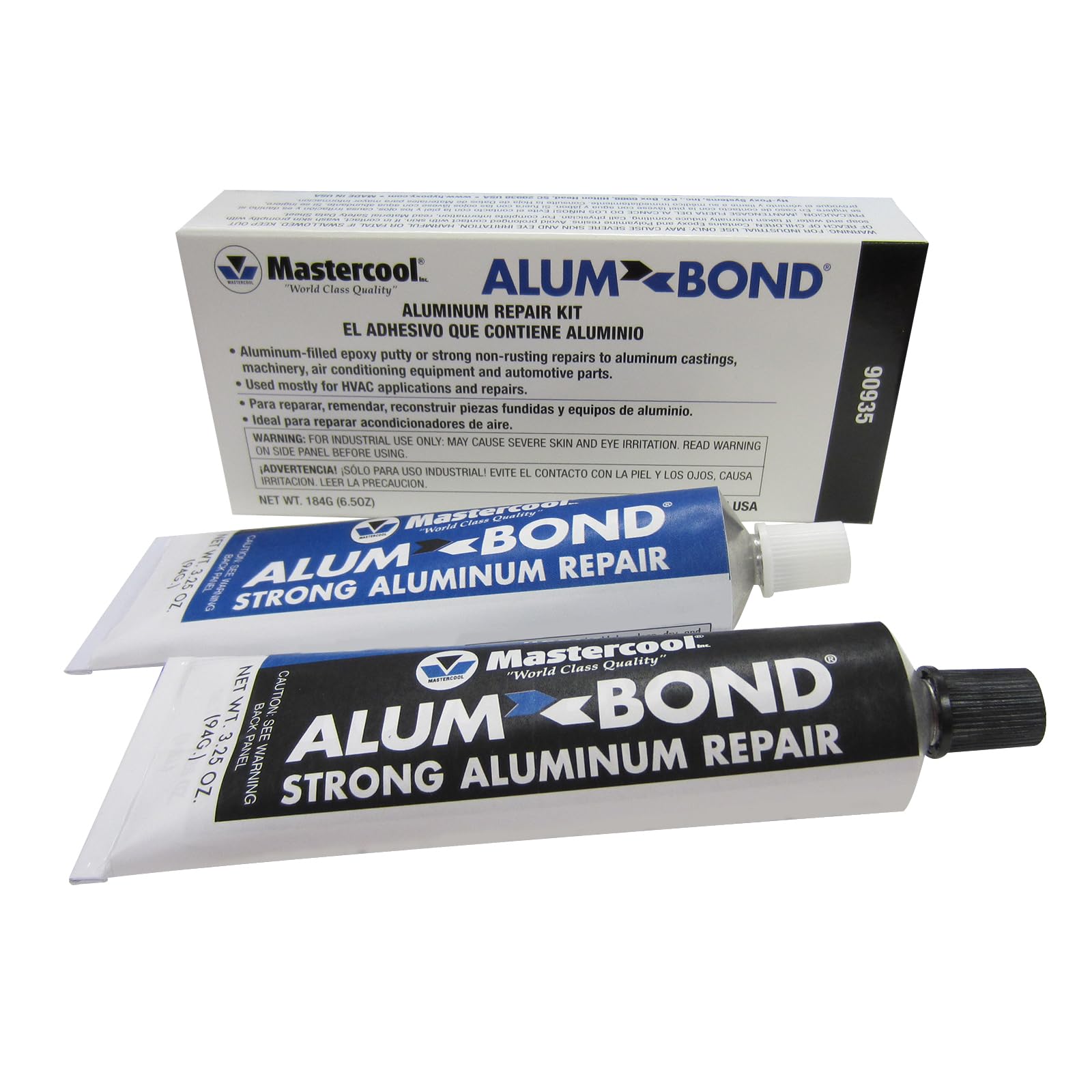
The aluminum-specific compound that machines like real metal.
When a weld is not practical but the repair has to endure constant heat, moisture, and vibration — like a radiator, an engine block, or an HVAC part — this aluminum-filled epoxy beats general-purpose metal glues on its native territory. Mastercool Alum Bond is a professional-grade compound loaded with a high concentration of aluminum particles, giving it a compressive strength of roughly 8,600 PSI and a tensile strength of 3,500 PSI. That puts it in the same strength class as the J-B Weld putty above (4,000 PSI tensile), but with the added benefit of matching the thermal expansion of aluminum parts, so the bond is less likely to crack when the engine heats and cools.
Its thick, non-sag paste stays put on vertical and overhead surfaces — a real advantage over runny liquid epoxies when you are filling a hole in the side of a radiator or a crack in an upward-facing casting. After a full cure, you can drill, tap, sand, and machine it with standard metalworking tools, restoring the original threads or shape instead of replacing the entire component. One reviewer used the entire kit to patch multiple holes and cracks in an aluminum boat, confident the repair would not leak. Another buyer called it “kind of like a JB Weld for aluminum but a little bit stouter.”
The limitation is temperature resistance: Alum Bond is rated up to 250°F (121°C), which is lower than the AOJEL’s 392°F and the J-B Weld’s 350°F. For exhaust manifolds, turbo housings, or brake components, you will need the higher heat rating of one of those picks.
The case for it: Its high aluminum content makes it machinable after cure and matches the thermal expansion of aluminum parts, so the bond holds through heating and cooling cycles without cracking.
One limitation: It handles only up to 250°F — skip it for exhaust, turbo, or brake-area repairs and choose the AOJEL or J-B Weld instead.
Best for: Permanent repairs on aluminum radiators, engine blocks, castings, tanks, HVAC components, and boat hulls where you need a machinable, matching-metal bond.
Skip if: Your repair will see sustained heat above 250°F — the AOJEL at 392°F is the safer choice for engine-exhaust areas.
4. RNVVHY Heavy Duty Metal Glue, Waterproof Epoxy Casting Adhesive, 2.3 oz
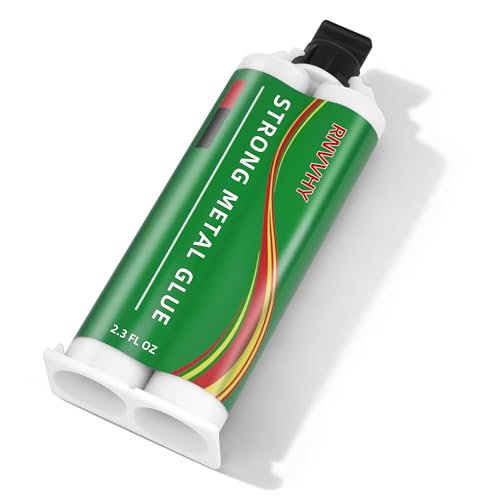
The wide-temperature waterproof glue for metal and beyond.
This liquid epoxy stands out for the sheer breadth of materials it bonds and the extreme temperature range it survives. The RNVVHY Heavy Duty Metal Glue works on metal, aluminum, copper, iron, stainless steel, wood, plastic, and glass — so you can grab one tube for repairs that mix metal with other materials. It is formulated as a two-component epoxy in a 1:1 fixed-ratio syringe, and the maker says it stays stable from -65°F to 548°F (-54°C to 287°C), making it the widest temperature window on this list by a significant margin.
The glue sets in roughly five minutes and requires a full 24-hour cure before it reaches maximum strength. Once cured, it is waterproof, chemical-resistant, and impact-resistant, so it holds up on fuel tanks, water pipes, radiators, and outdoor fences. Owners mention it bonds quickly and holds extremely well — one reviewer noted it “works on metal better than anything I’ve tried before.” Unlike the putty-style J-B Weld, this is a liquid that you dispense and mix, so it flows into cracks and threads more easily for a thorough fill.
The compromise is that the consistency is on the runny side, and a few users struggled to get the epoxy out of the container at all — one called it “impossible to get out of container” and said it dried before it could be applied. For vertical surfaces or overhead repairs, a non-sag paste like the Mastercool Alum Bond or a putty like the J-B Weld would be much less messy.
Why it’s great
- Extreme temperature range of -65°F to 548°F covers freezer ducts, engine parts, and hot-water pipes in one product.
- Bonds metal to wood, plastic, and glass — not just metal-to-metal — so it is one tube for multi-material repairs.
Good to know
- Some customers note the container makes dispensing difficult, especially if the epoxy has thickened slightly during storage.
- The runny liquid consistency will drip off vertical overhead surfaces — use a putty or non-sag paste for those jobs.
Best for: Multi-material repairs where a metal part needs to bond to wood, plastic, or glass, and for repairs exposed to extreme cold or heat.
Skip if: You need to fill a vertical crack without dripping — choose the J-B Weld putty or Mastercool Alum Bond for non-sag application.
5. Cerca de Metal Glue, Heavy Duty Waterproof Epoxy Adhesive, 1.6 oz

The entry-level glue that punches above its price.
For small household repairs where you do not want to invest in a premium kit, this Cerca de Metal Glue offers a practical middle ground. Unlike traditional epoxy resins, this one has added metal powder that boosts adhesion and hardness while retaining a degree of toughness so the cured bond does not shatter under light impact. It is a liquid epoxy dispensed from a 1:1 ratio pusher, and it reaches an initial set in about ten minutes — longer than the five-minute putties, giving you a bit more time to wiggle parts into alignment.
The bond reaches usable strength after 12 hours and a full cure in 24 hours, and the maker says it resists both high and low temperatures as well as water and oil. It bonds metal, aluminum, steel, stainless steel, ceramics, glass, and many plastics, making it a decent all-rounder for garage and workshop drawers. One buyer used it to “fix a broken wire on a metal wall decoration instantly” and reported it worked quickly and perfectly. Another reviewer called it a “handy kit to have in the garage.”
The realistic limitation is that the cured bond, while strong for light duty tasks, is not rated with the same published tensile strength numbers as the J-B Weld (4,000 PSI) or the Mastercool Alum Bond (3,500 PSI). For load-bearing engine brackets or stressed structural joints, either of those picks provides verifiable strength specs you can trust. This one is best kept for decorative metal items, small brackets, and non-stress repairs.
The case for it: The metal-powder enriched formula adds hardness and toughness without the premium price tag, and the 10-minute initial set gives you more working time than fast putties.
The drawback: No published tensile strength figure, so for load-critical repairs you are better off with the J-B Weld or Mastercool, which give you verifiable PSI ratings.
Best for: Light-duty household metal repairs — fixing a wire, patching a fence, mending a small bracket — where price matters and extreme strength is not needed.
Skip if: You are repairing a load-bearing engine part, a stressed bracket, or anything that needs a guaranteed PSI rating like the 4,000 PSI J-B Weld provides.
Understanding the Specs
Tensile Strength (PSI)
Tensile strength is the amount of pulling force a cured bond can take before it snaps, measured in pounds per square inch. A higher number means the glue can hold heavier parts under tension without failing. For non-structural repairs like a fence or decoration, 3,500 to 4,000 PSI is plenty. For engine brackets, castings, or load-bearing frames, look for a published tensile rating so you know the glue is certified to hold that weight.
Full Cure Time vs. Set Time
Set time is how long the glue stays workable before it becomes too stiff to move. Full cure time is how long you must wait before the bond reaches its maximum strength and can be drilled, sanded, or loaded. Fast-setting putties (five-minute set, one-hour cure) are great for quick patches but leave no room for error. Liquid epoxies (ten-to-thirty-minute set, 12-to-24-hour cure) give you time to align parts but require patience before the repair is ready for use.
Heat Resistance (°F)
This tells you the maximum continuous temperature the cured epoxy can withstand without softening or breaking down. For engine blocks, radiators, and exhaust-adjacent parts, choose a glue rated at 350°F or above. For general household and auto repairs, 250°F is usually sufficient. A lower heat rating means the bond may fail near a hot manifold or a boiler pipe.
Waterproof and Chemical Resistance
A waterproof rating means the cured epoxy will not dissolve or weaken when exposed to moisture, rain, or immersion. Chemical resistance protects the bond against oil, hydraulic fluid, gasoline, and solvents. If you are repairing a fuel tank, a radiator, or a boat hull, make sure the glue is explicitly listed as waterproof and chemical-resistant — standard indoor epoxies may soften or swell when wet.
FAQ
What is the strongest glue for metal to metal bonding?
Can I use metal glue on aluminum?
How long does metal epoxy take to cure completely?
Will metal glue hold on a vertical surface without dripping?
Can I drill and tap into cured metal epoxy?
Is metal glue waterproof for outdoor use?
What temperature can metal epoxy withstand before failing?
Can I use metal glue on plastic or wood along with metal?
Final Thoughts: The Verdict
For most buyers, the adhesives for metal to metal winner is the J-B Weld SteelStik 2-Pack because it combines a fast one-hour cure, a proven 4,000 PSI tensile strength, and the versatility of a hand-mixable putty that can be drilled and tapped the same day. If you need a long working time for a complex alignment or a heat-resistant structural bond, grab the AOJEL S300 Metal Epoxy. And for aluminum-specific repairs like radiators and castings where you want the bond to machine like real metal, the standout is the Mastercool Alum Bond.
How We Picked
We do not accept paid placement, and we did not hands-on test every unit. Instead, we match each pick to a real buyer and use-case by comparing the manufacturers’ published specifications against the patterns in verified customer reviews — so you get each pick’s real strengths and trade-offs instead of marketing copy.
Sources & Methodology
Specifications: manufacturer listings and product documentation. Review insights: verified customer reviews, as of July 2026. Pricing: not shown on this page (it changes often); check the current price via the retailer link.
As an Amazon Associate, Gadgets Feed earns from qualifying purchases. This does not affect which products we feature.