
Our readers keep the lights on and my morning glass full of iced black tea. As an Amazon Associate, I earn from qualifying purchases.
Specs are compiled from manufacturer listings and verified buyer reviews and can change over time — please confirm the key details on the product page before buying.
Your biggest worry when you pick a generator for your camper isn’t watts or outlets—it’s the noise. You want power to run your air conditioner and coffee maker, but you don’t want to be the person drowning out the campfire or waking up the whole RV park at sunrise. The best camper generator gives you quiet enough operation, enough wattage for your appliances, and a size you can actually lift into your truck bed.
I’m Min — the founder and writer behind Gadgets Feed. This guide is built by comparing the manufacturers’ published specifications and the patterns across verified customer reviews, so you get each pick’s real strengths and trade-offs instead of marketing spin.
Whether you need a lightweight companion for weekend trips or a dual-fuel workhorse for extended boondocking (camping without hookups), this roundup narrows down your choices to the best camper generator for your real needs.
Quick Picks
- Westinghouse 2550 Peak Watt Super Quiet & Lightweight Portable Inverter Generator — Best Overall
- Champion Power Equipment 4000-Watt RV Ready Portable Inverter Generator — High Power
- WEN Quiet and Lightweight 3600-Watt Dual Fuel RV-Ready Portable Inverter Generator (DF360iX) — Safety First
- Pulsar PGD40ISCO Ultra Light Quiet 4000W Portable Gas Inverter Generator — Great Value
- WEN 3600-Watt Portable Inverter Generator, RV-Ready, Quiet and Lightweight with Fuel Shut Off (56360i) — Compact Power
- Oxseryn 2800-Watts Portable Inverter Generator — Budget Entry
- PowerSmart 3800W Portable Inverter Generator — Mid-Range Workhorse
- Honda EU2200i 2200 Watt Inverter Generator — Premium Pick
How To Choose The Best Camper Generator
Picking the right generator for your camper depends on three things: how much power you need, how quiet it has to be, and how much weight you are willing to haul. Here is what to look at before you buy.
Running watts vs. starting watts
Every generator has two numbers: the running (or rated) watts it can produce continuously, and the starting (or peak) watts it can handle for a few seconds to get a motor like your RV air conditioner going. Your camper’s total running load (lights, fridge, furnace fan, battery charger) must stay under the generator’s running watt rating. The single biggest load — typically your air conditioner — must not exceed the generator’s starting watt rating. Check your AC’s label for its “locked rotor amps” to be sure.
Inverter technology is non-negotiable
A camper generator must be an inverter model. Inverter generators produce “clean” electricity with less than 3% total harmonic distortion (THD) — that means the power is smooth enough for sensitive electronics like laptops, phones, and your camper’s converter/charger. Conventional generators often output rough power that can fry those devices. Inverters are also quieter and more fuel-efficient because the engine adjusts its speed to match the load.
Noise level matters more than you think
Most campgrounds and RV parks enforce strict noise limits, often around 60-65 decibels. A generator rated at 58-64 dBA from 23 feet is conversation-quiet and will keep you on good terms with your neighbors. Anything louder is essentially an open-frame construction generator that belongs at a job site, not a campsite.
Fuel type and runtime
Gasoline is the most common fuel, but dual-fuel models that also run on propane give you flexibility (propane stores indefinitely and burns cleaner). Look at the run time on a full tank at 25% or 50% load — that is the realistic number you will experience when running your fridge, lights, and occasional AC. Economy mode (ECO mode) helps extend runtime by letting the engine idle down when demand is low.
Quick Comparison
On smaller screens, swipe sideways to see the full table.
| Model | Best For | Running Watts | Weight | Noise (dBA) | Amazon |
|---|---|---|---|---|---|
| Westinghouse 2550 | Top Overall / Dual-Fuel | 1900W | 43.2 lbs | 52 dBA | Amazon |
| Champion 4000-Watt | High Power / Lightweight | 3000W | 48.1 lbs | 64 dBA | Amazon |
| WEN DF360iX | Dual-Fuel / Safety | 2900W (gas) | 49 lbs | Comparable to conversation | Amazon |
| Pulsar PGD40ISCO | Value / High Watts | 3200W | 47.3 lbs | 59 dBA | Amazon |
| WEN 56360i | Budget Reliable | 2900W | 46 lbs | Quiet | Amazon |
| Oxseryn 2800W | Budget Travel | 2000W | 40 lbs | Under 58 dBA | Amazon |
| PowerSmart 3800W | Mid-Range Power | 3200W | 52 lbs | 59 dBA | Amazon |
| Honda EU2200i | Premium Reliability | 2200W | 51 lbs | 48-57 dBA | Amazon |
In‑Depth Reviews
1. Westinghouse 2550 Peak Watt Super Quiet & Lightweight Portable Inverter Generator

This dual-fuel generator runs 12 hours without waking up the campground, making it the most versatile pick.
What earns this the top spot is its fuel choice and extreme quiet. You can run it on gasoline or propane — propane stores forever without degrading, so you can stash a tank for emergencies. At just 52 dBA (quieter than a normal conversation), you will barely notice it running beside your camper. It puts out 2550 peak watts and 1900 running watts — enough for a small RV air conditioner, fridge, and lights — and the RV-ready TT-30R outlet (a standard 30-amp RV plug) lets you plug your camper directly in without a dogbone adapter. Buyers report it runs about 12 hours per gallon on economy mode, versus the PowerSmart 3800W’s 4.5 hours at 50% load.
It weighs 43.2 lbs and comes with oil, a funnel, a tool kit, and a propane hose included in the box — so you can start using it immediately. The 3-year warranty and nationwide customer service network add a layer of confidence that some budget brands lack.
The catch: its 1900 running watts are lower than larger units. If you have a 15,000 BTU air conditioner or want to run multiple heavy appliances at once, you will need a 3000W+ model. Also, one reviewer noted a defective unit that failed to start on either fuel, though Amazon’s return process resolved it.
Why it’s great
- Runs on both gasoline and propane — dual-fuel flexibility
- Only 52 dBA, quieter than a normal conversation
- Up to 12 hours of runtime on a 1.16 gallon gas tank with economy mode
- RV-ready TT-30R outlet included
Good to know
- 1900 running watts may not handle a large RV AC and microwave at the same time
- Quality control issues reported by a small number of buyers
- No storage compartment for the included funnel and tool kit
Best for: Campers who want dual-fuel flexibility and whisper-quiet overnight operation.
Skip if: You need more than 1900 running watts to power a large RV air conditioner plus other heavy loads simultaneously.
2. Champion Power Equipment 4000-Watt RV Ready Portable Inverter Generator

One of the lightest 4000-watt inverters, this Champion starts a 15,000 BTU AC without straining your back at 48.1 lbs.
This Champion delivers 4000 starting watts and 3000 running watts, which is enough to start a 15,000 BTU RV air conditioner plus run your fridge, lights, and TV comfortably. One reviewer ran a 15k BTU AC plus lights and a fridge for 24 hours on 5 gallons of gas. Weighing just 48.1 lbs, it is lighter than the PowerSmart 3800W at 52 lbs, so it hits a balance for power-to-portability.
It operates at 64 dBA from 23 feet, conversation-level but louder than the Westinghouse’s 52 dBA. It includes a CO Shield carbon monoxide auto shutoff system (a sensor that kills the engine if CO builds up), a TT-30R RV outlet, a 120V 20A household duplex outlet, and a 12V automotive-style port. It is parallel-ready, so you can connect a second Champion unit to double your output for larger setups.
The 3-year limited warranty and free lifetime technical support from Champion are a strong safety net. One buyer mentioned that a 15k BTU AC bogged it down a little, suggesting a slightly larger unit for heavy AC users.
Why it’s great
- 3000 running watts handles most RV AC units and appliances
- Under 49 lbs is unusually light for this power output
- CO Shield auto shutoff adds essential safety
- Parallel ready for doubling power
Good to know
- 64 dBA is louder than the quietest options (52-59 dBA)
- Gasoline only — no dual-fuel option
- Cases of factory defects reported, though Amazon resolves quickly
Best for: RV owners with larger air conditioners who want high power in a lightweight, portable package.
Skip if: You need whisper-quiet operation or the flexibility to run on propane.
3. WEN Quiet and Lightweight 3600-Watt Dual Fuel RV-Ready Portable Inverter Generator (DF360iX)

This dual-fuel generator has a built-in CO watchdog that shuts it off if fumes get dangerous — confidence for tight campsites.
This WEN runs on gasoline and propane, giving you the choice of whichever fuel is more convenient. On gasoline it delivers 3600 surge watts and 2900 rated watts; on propane it delivers 3500 surge watts and 2600 rated watts — you lose only 300 watts when switching to propane. Its 149cc engine is the same size as the WEN 56360i, but with added dual-fuel capability. It also has the WEN Watchdog CO Shutdown Sensor, which automatically turns the generator off if carbon monoxide levels become dangerous — critical if you camp near your camper’s windows or vents.
Owners mention it is extremely quiet at 50% load or less, and the control panel displays volts, frequency, runtime, load percentage, and fuel level — so you always know what is happening. One reviewer powered a fridge, freezer, lights, computer, AC, and coffee maker totaling 2600 watts without issues. The fuel shut-off feature helps extend engine life by draining the carburetor before storage.
The downside: some customers note that the two 20A outlets hold plugs loosely, which could be annoying when using high-draw devices.
Why it’s great
- Dual-fuel (gas and propane) for flexible fuel sourcing
- CO Watchdog auto-shutoff for safety
- Control panel shows volts, frequency, runtime, load, and fuel level
- Fuel shut-off extends engine lifespan
Good to know
- 20A outlets may hold plugs loosely
- 49 lbs is a bit heavier than the single-fuel WEN model
- Propane output is 300 watts less than gasoline output
Best for: Campers who want the flexibility of propane and the safety of a built-in CO sensor.
Skip if: You are on a tight budget and don’t need dual-fuel capability.
4. Pulsar PGD40ISCO Ultra Light Quiet 4000W Portable Gas Inverter Generator

A lightweight 4000-watt inverter that gives you more power per dollar than the Champion, but with less runtime.
The Pulsar provides 4000 peak watts and 3200 running watts from a 145cc engine, making it one of the highest-value options for campers who need serious power without paying a premium. It weighs only 47.3 lbs — lighter than the PowerSmart 3800W’s 52 lbs — and it is rated at 59 dBA, noticeably quieter than the Champion’s 64 dBA. Reviewers point out it reliably handles a 13,500 BTU RV air conditioner (with a soft start, a device that reduces the AC’s initial power draw) and many have logged over 300-400 hours without major issues. One reviewer with 410 hours over three summers says it requires frequent oil changes and ethanol-free gas, but that is standard for any small engine.
The 1-gallon fuel tank gives you about 4 hours of run time at half load, which is shorter than the Westinghouse’s 12 hours but typical for a 4000-watt class machine. It is parallel ready, so you can pair two units for even more power. It is designed for RV use, sensitive electronics, and air conditioning units up to 13,500 BTU.
One practical drawback: it does not come with wheels, so moving it across rough terrain is harder than models with built-in wheels. And its noise, while low, is noticeably louder than the quietest models like the Honda or Westinghouse.
Why it’s great
- 3200 running watts at a competitive price
- Weighs just 47.3 lbs — light for its power class
- 59 dBA is quieter than many similarly powered models
- Parallel ready for doubling output
Good to know
- No wheels included — manual carry on uneven terrain
- 1-gallon tank gives only 4 hours runtime at half load
- Not the quietest option; louder than premium quiet models
Best for: Budget-conscious campers who need 4000 peak watts for a mid-size RV AC.
Skip if: You need extended runtime beyond 4 hours or whisper-quiet operation.
5. WEN 3600-Watt Portable Inverter Generator, RV-Ready, Quiet and Lightweight with Fuel Shut Off (56360i)

At 46 pounds, this gasoline-only WEN is one of the lightest 3600-watt generators, and shoppers say it starts every time.
This WEN packs a 149cc engine — the same size as the more expensive dual-fuel model — but runs on gasoline only. It delivers 3600 surge watts and 2900 rated watts, enough to power a 13,000 BTU RV air conditioner without struggling. Buyers confirm it runs an air conditioner easily, with fuel consumption around 4 hours on a tank on a hot day. One reviewer ran a camp trailer entirely on this generator, calling it the best-performing generator they have owned.
The fuel shut-off feature lets you run the carburetor dry before storage, which prevents gumming and extends the engine’s lifespan. The generator includes two 120V three-prong outlets, one TT-30R RV receptacle, one 12V DC receptacle, and two 5V USB ports. It also comes with a 3-year warranty.
The trade-off: it is gasoline-only, so you don’t get fuel flexibility. Some buyers have reported defective units from the start, resolved through Amazon’s return process. Also, there is no CO shutoff sensor, so you must be extra careful about where you operate it.
Why it’s great
- Weighs only 46 lbs — easy to carry and store
- 2900 running watts handles 13,000 BTU ACs
- Fuel shut-off extends engine life by preventing carburetor gumming
- TT-30R RV receptacle included
Good to know
- Gasoline only — no propane option
- No CO shutoff sensor
- Some reports of defective units from the start
Best for: Campers who prioritize light weight and compact storage over fuel flexibility.
Skip if: You want dual-fuel capability or a built-in CO safety shutoff.
6. Oxseryn 2800-Watts Portable Inverter Generator
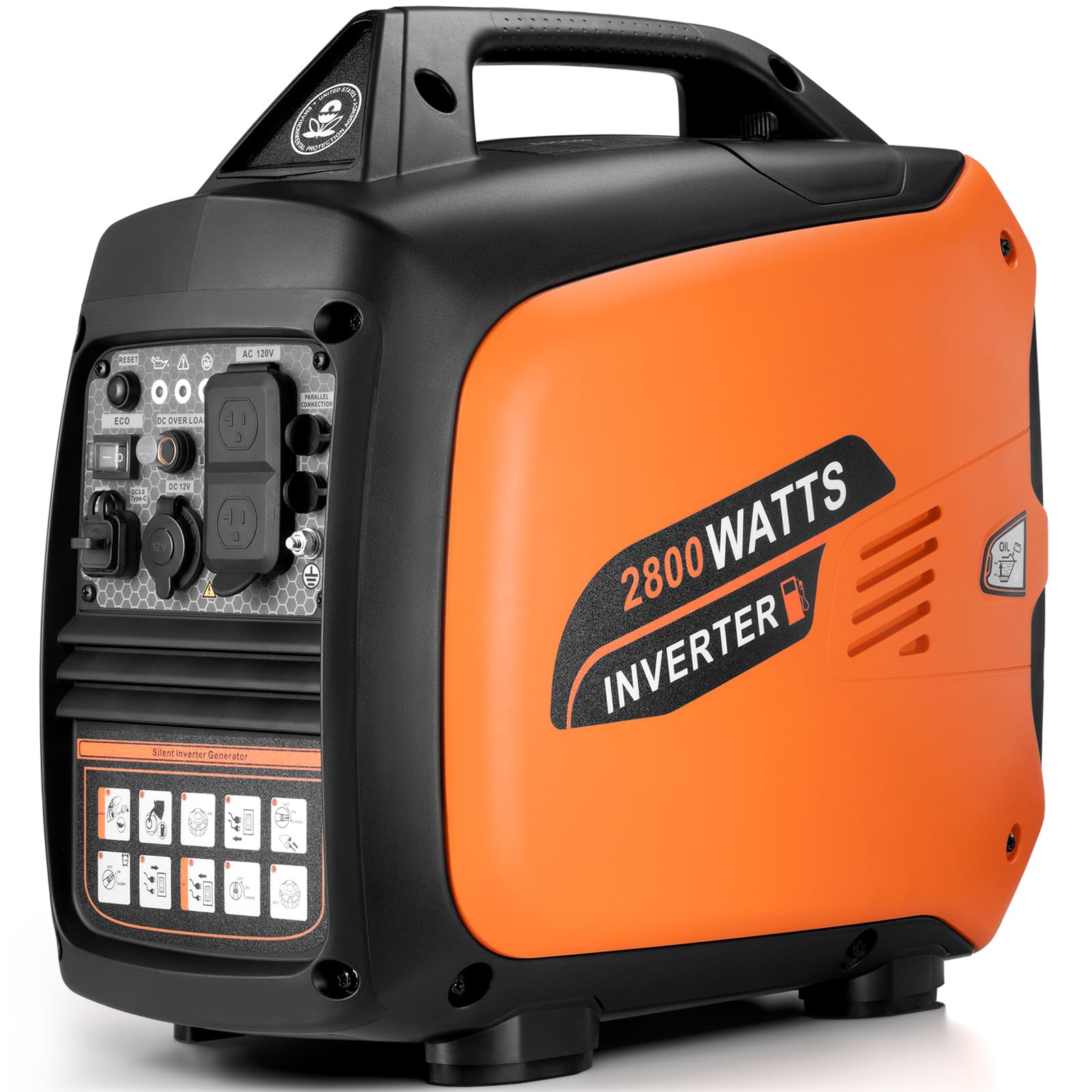
At 40 lbs, this is the lightest generator on the list — and buyers report it runs about 9.3 hours per tank at full power.
This Oxseryn is powered by a 79.8cc 4-stroke OHV engine — notably smaller than the WEN’s 149cc — and delivers 2800 peak watts and 2000 running watts. That is enough for a small RV fridge, lights, TV, and an 8000 BTU air conditioner, but not for a large AC or a microwave alongside other loads. Owners mention it ran 9.3 hours on one tank at full power during break-in. Another reviewer noted it runs about 4+ hours on 0.5 gallons of gas in economical use.
It produces less than 3% THD (total harmonic distortion), so it is safe for sensitive electronics like phones and laptops. The noise level is under 58 dBA from 23 feet — very quiet for a budget model. It includes two 120V AC ports, one 12V DC port, one USB port, and one Type-C port. The ECO mode helps save fuel when running light loads.
One limitation: there is no oil included, and the dipstick is hard to read. Some buyers found excessive metal shavings in the oil during the first few changes. The side panel must be removed to check the oil level, which is a minor hassle compared to models with a dedicated oil cap.
Why it’s great
- Only 40 lbs — the lightest option in the roundup
- Under 58 dBA is very quiet for a budget generator
- Runs up to 9.3 hours on one tank at full power per buyer reports
- Includes USB and Type-C ports for device charging
Good to know
- No oil included in the box
- Metal shavings in oil during break-in reported by some buyers
- Side panel must be removed to check oil level
Best for: Budget-minded campers with a small RV who need the lightest possible generator.
Skip if: You need to power a 15,000 BTU AC or run multiple heavy appliances at once.
7. PowerSmart 3800W Portable Inverter Generator
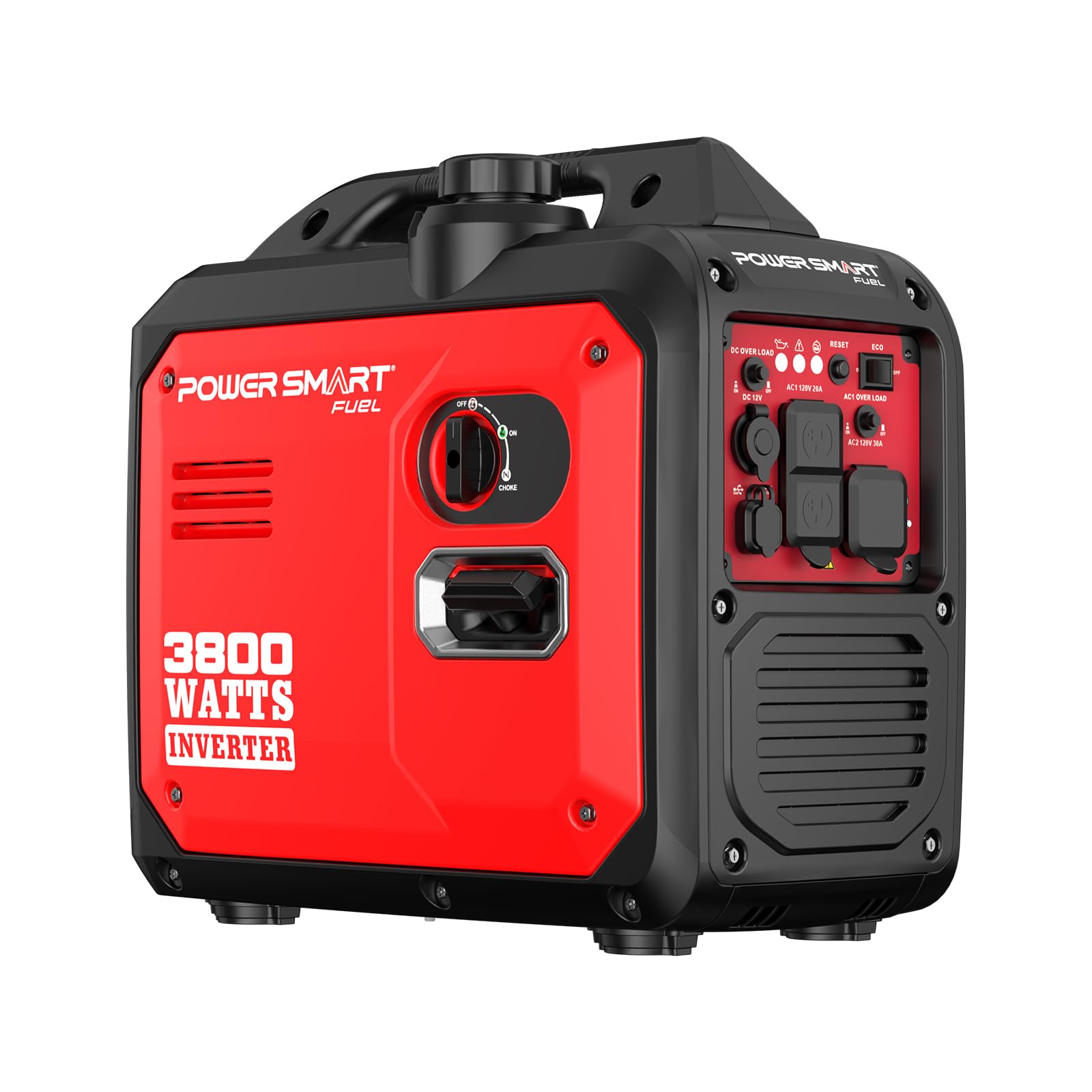
With 3200 rated watts, this generator delivers 3200 rated watts versus the Westinghouse 2550’s 1900 running watts and can be doubled by pairing two units.
The PowerSmart pumps out 3800 starting watts and 3200 rated watts from a 143cc engine. It operates at 59 dBA from 23 feet, quiet enough for most campgrounds but not as stealthy as the Westinghouse’s 52 dBA. The 1.19-gallon fuel tank provides up to 4.5 hours of runtime at 50% load, and customers note the tank runs about 6.5 hours with two fans running. It is parallel ready, so you can connect two units to double your power — a nice option if you start small and later need more juice.
One reviewer living off-grid uses this as their sole power source, saying it handles varying loads (lights, TV, AC) perfectly. Another notes it is inaudible inside with the door closed, running 24+ hours continuously while powering 12 outlets including fans, fridge, water cooler, TV, modem, AC, and a laptop at just one-third capacity.
At 52 lbs, it is heavier than the Champion (48.1 lbs) and the Pulsar (47.3 lbs), which is noticeable if you move it frequently. It also lacks a fuel shut-off valve, though reviewers point out it runs briefly after shutoff to clear the carburetor.
Why it’s great
- 3200 running watts handles most RV appliances and tools
- 59 dBA is quiet for a generator in this power class
- Parallel ready for expanding power output later
- No assembly needed — starts on the first pull from the start
Good to know
- 52 lbs is heavier than comparable 4000W models
- No fuel shut-off valve
- 4.5-hour runtime at 50% load is shorter than some competitors
Best for: Campers who want high wattage and the option to parallel two generators for even more power.
Skip if: You need extended overnight runtime or a lighter unit for frequent carrying.
8. Honda EU2200i 2200 Watt Inverter Generator
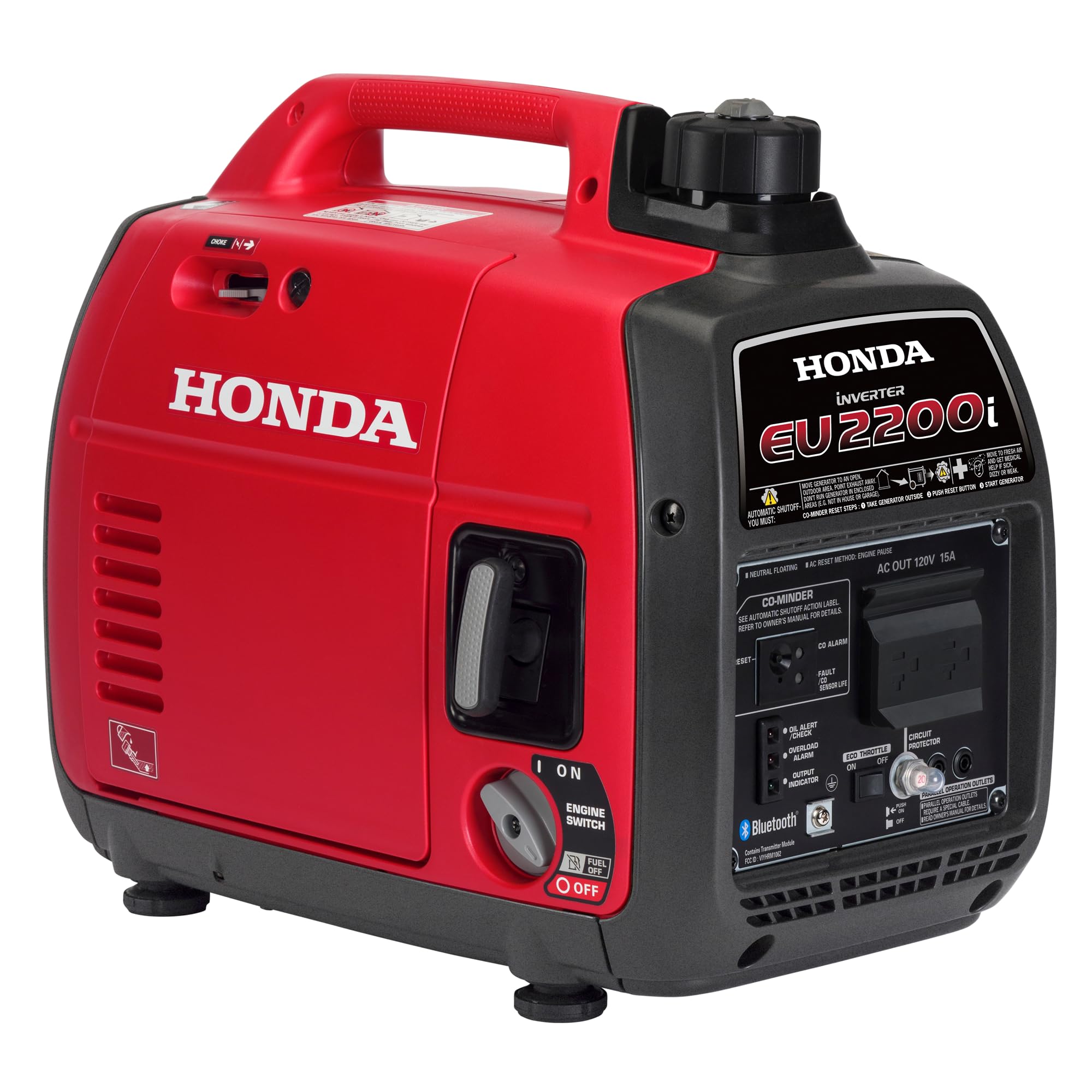
The quietest generator in the lineup at just 48 dBA — and it lets you start and stop it from your phone via Bluetooth.
The Honda EU2200i is the most refined camper generator you can buy. It operates at just 48 to 57 dBA — so quiet that shoppers say it runs all night without disturbing neighbors. It delivers 2200 peak watts and 1800 running watts from a 121cc engine, and its Eco Throttle System adjusts engine speed to match the load, providing 3.2 to 8.1 hours of runtime on a 0.95-gallon tank. That is enough for basics like a fridge, router, lights, and phone charging — the core loads most campers need during an overnight stay.
What sets the Honda apart is its exclusive My Generator smartphone app with Bluetooth capability. You can start, stop, and monitor the generator wirelessly from your phone, and it sends service reminders so you never miss an oil change. The built-in CO-MINDER (a carbon monoxide sensor) continuously monitors CO levels and automatically shuts the generator down if they become dangerous. Buyers consistently praise its reliability and clean power output, with one calling it “cleaner power than the grid” and safe for sensitive electronics like computers and CPAP machines.
The biggest catch is the price — it is the most expensive option here by a wide margin. And at 51 lbs, it is heavier than its power output would suggest (the 40 lb Oxseryn is much lighter). The 12V output is unregulated (19-27 VDC, 3-8 Amps), so you should use the AC output for charging batteries.
Why it’s great
- Quietest operation on the list at just 48 dBA
- Bluetooth app for remote start, stop, and monitoring
- CO-MINDER auto shutoff for safety
- Honda reliability backed by a 3-year residential warranty
Good to know
- Premium price — significantly more expensive than comparable wattage options
- Heavier than some competitors at 51 lbs
- 12V output is unregulated — use AC output for battery charging
Best for: Campers who demand the quietest operation and want remote control via a smartphone app.
Skip if: You need more than 1800 running watts or are on a strict budget.
Understanding the Specs
Running Watts vs. Starting Watts
Every generator lists two power numbers. Running watts (also called rated watts) is the power it can produce continuously hour after hour — this is the number you match to your total camper load. Starting watts (peak or surge watts) is the extra burst of power for a few seconds to start motors in appliances like air conditioners and refrigerators. If your AC has a high starting current, a generator with a high surge rating is essential. You will see this difference on the Champion 4000W (3000 running, 4000 starting) versus the Oxseryn 2800W (2000 running, 2800 starting).
THD (Total Harmonic Distortion)
THD measures how “clean” the electricity is. Inverter generators like all the models here produce less than 3% THD, which is safe for sensitive electronics like phones, laptops, and your camper’s battery charger. Conventional generators often output 6-12% THD, which can cause buzzing, overheating, or damage to sensitive devices. You will see “<3% THD” in product specs — that is the number to trust.
dBA (Decibel Rating)
Decibels measure sound level, and the “A” weighting approximates human hearing. Every 10 dBA increase sounds about twice as loud to your ears. A 52 dBA generator (Westinghouse 2550) is noticeably quieter than a 64 dBA generator (Champion 4000W). Most campgrounds have noise limits around 60-65 dBA, so a generator rated at 58-60 dBA is generally acceptable for quiet hours.
ECO Mode
ECO mode (economy mode) lets the generator’s engine automatically idle down when you are using only a small load — like lights and a fridge at night. This saves fuel, extends runtime, and reduces noise. When a heavy load kicks on (like your AC compressor), the engine automatically speeds back up. Almost all the generators on this list have ECO mode, but the Westinghouse and Honda are especially praised for their fuel efficiency in ECO mode.
FAQ
What size camper generator do I need for my RV air conditioner?
Is dual fuel worth it for a camper generator?
Can I run a camper generator all night?
What is the quietest camper generator?
How do I calculate the total wattage my camper needs?
What is parallel capability on a camper generator?
How often should I change the oil in a camper generator?
Will a 2000-watt generator run my camper refrigerator?
What does “THD less than 3%” mean for my electronics?
How do I store a camper generator for the winter?
Final Thoughts: The Verdict
If you want one dependable pick, the best camper generator winner is the Westinghouse 2550 because it combines dual-fuel flexibility, whisper-quiet 52 dBA operation, and an outstanding 12-hour runtime in a lightweight 43.2 lb package. If you want the raw power to run a 15,000 BTU RV air conditioner without worry, grab the Champion 4000-Watt. And for the ultimate in quiet operation, reliability, and smart features like Bluetooth control, the Honda EU2200i remains the gold standard for serious campers who value peace and dependability above all else.
How We Picked
We do not accept paid placement, and we did not hands-on test every unit. Instead, we match each pick to a real buyer and use-case by comparing the manufacturers’ published specifications against the patterns in verified customer reviews — so you get each pick’s real strengths and trade-offs instead of marketing copy.
Sources & Methodology
Specifications: manufacturer listings and product documentation. Review insights: verified customer reviews, as of July 2026. Pricing: not shown on this page (it changes often); check the current price via the retailer link.
As an Amazon Associate, Gadgets Feed earns from qualifying purchases. This does not affect which products we feature.