
An adjustable DC power supply is the non-negotiable centerpiece of any serious electronics bench, giving you clean, regulated DC voltage and current for testing circuits, charging batteries, and powering prototypes without the noise or risk of a generic wall wart. The difference between a project that works reliably and one that glitches mysteriously often comes down to the quality of the power feeding it.
I’m Min — the co-founder and writer behind Gadgets Feed. I’ve spent hundreds of hours cross-referencing datasheets, ripple specs, and real user experiences across dozens of models to isolate the power supplies that deliver true lab-grade stability without emptying your wallet.
After analyzing output accuracy, protection features, and build quality across the entire range, this guide ranks the best adjustable dc power supply from entry-level to full-featured programmable units for any electronics project.
How To Choose The Best Adjustable DC Power Supply
Picking the right bench power supply comes down to matching its voltage ceiling, current capacity, and output purity to the types of circuits you regularly work on. Over-spec on voltage you never use and you pay for resolution you don’t need; under-spec on current and your supply shuts off mid-test.
Voltage and Current Range
The first decision is your maximum voltage and current requirements. A 30V/10A supply covers most hobbyist needs — Arduino projects, radio gear, and automotive sensors all sit well within this window. If you work with 48V battery packs or EV cells, a 60V model is mandatory, but those typically trade down to 5A max output at the top end. Match your highest expected voltage first, then confirm the current rating at that voltage won’t clip your load.
Linear vs. Switching Regulation
Linear supplies use a heavy transformer to drop voltage, producing almost zero output ripple — typically under 5mV — making them the gold standard for audio amplifiers, precision analog sensors, and RF circuits. Switching supplies run cooler and weigh half as much, but their high-frequency ripple (often 20-50mV) can inject noise into sensitive loads. For general digital work and battery charging, a quality switching supply is perfectly adequate. For any analog or low-noise application, step up to a linear design.
Output Resolution and Display Precision
A 4-digit LED display showing 0.01V and 0.001A resolution is far more useful than a 3-digit display when you need to set a precise current limit for Li-ion balancing. Look for supplies with separate coarse and fine adjustment knobs, or better yet, encoder-based controls that let you dial in 10mV steps without overshooting. A real-time wattage readout (V × A = W) is a bonus that saves mental math when powering unknown loads.
Protection and Safety Features
Over-voltage protection (OVP), over-current protection (OCP), and over-power protection (OPP) are non-negotiable when you’re prototyping circuits that could short unexpectedly. An output enable/disable button lets you set voltage before connecting the load, eliminating inrush spikes. Grounding terminals and reverse-polarity protection add another layer of safety, especially when charging batteries with exposed terminals.
Quick Comparison
On smaller screens, swipe sideways to see the full table.
| Model | Category | Best For | Key Spec | Amazon |
|---|---|---|---|---|
| Siglent SPD3303X-E | Linear Triple Output | Professional Lab Testing & Automation | 2 × 32V/3.2A + 5V/3.2A, 1mV/1mA resolution | Amazon |
| KORAD KA3005D | Linear Single Output | Low-Noise Analog & Audio Work | 30V/5A, 1mV/1mA resolution, 4 memory presets | Amazon |
| HANMATEK HM310T | Programmable Switching | PC-Controlled Sequence Testing | 30V/10A, 10mV/1mA resolution, USB/Modbus | Amazon |
| Jesverty SPS-3010C | Switching w/ USB-C | Battery Charging & General Bench Work | 32V/10A, encoder knobs, 20W USB-C & USB-A | Amazon |
| Jesverty SPS-6005 | High-Voltage Switching | 48V LiFePO4 Battery Balancing & Charging | 60V/5A, 300W max, 4-digit V/A/W display | Amazon |
| HYELEC HY50-06A | Switching Compact | Space-Constrained Benches & Mobile Repair | 50V/6A, 4-digit display, 3 memory slots, USB | Amazon |
| Pyramid PSV150 | Linear Fixed-Voltage | Ham Radio Base Station Power & Heavy Loads | 13.8V/12A, linear regulated, cooling fan | Amazon |
In‑Depth Reviews
1. Siglent Technologies SPD3303X-E Triple Output Power Supply
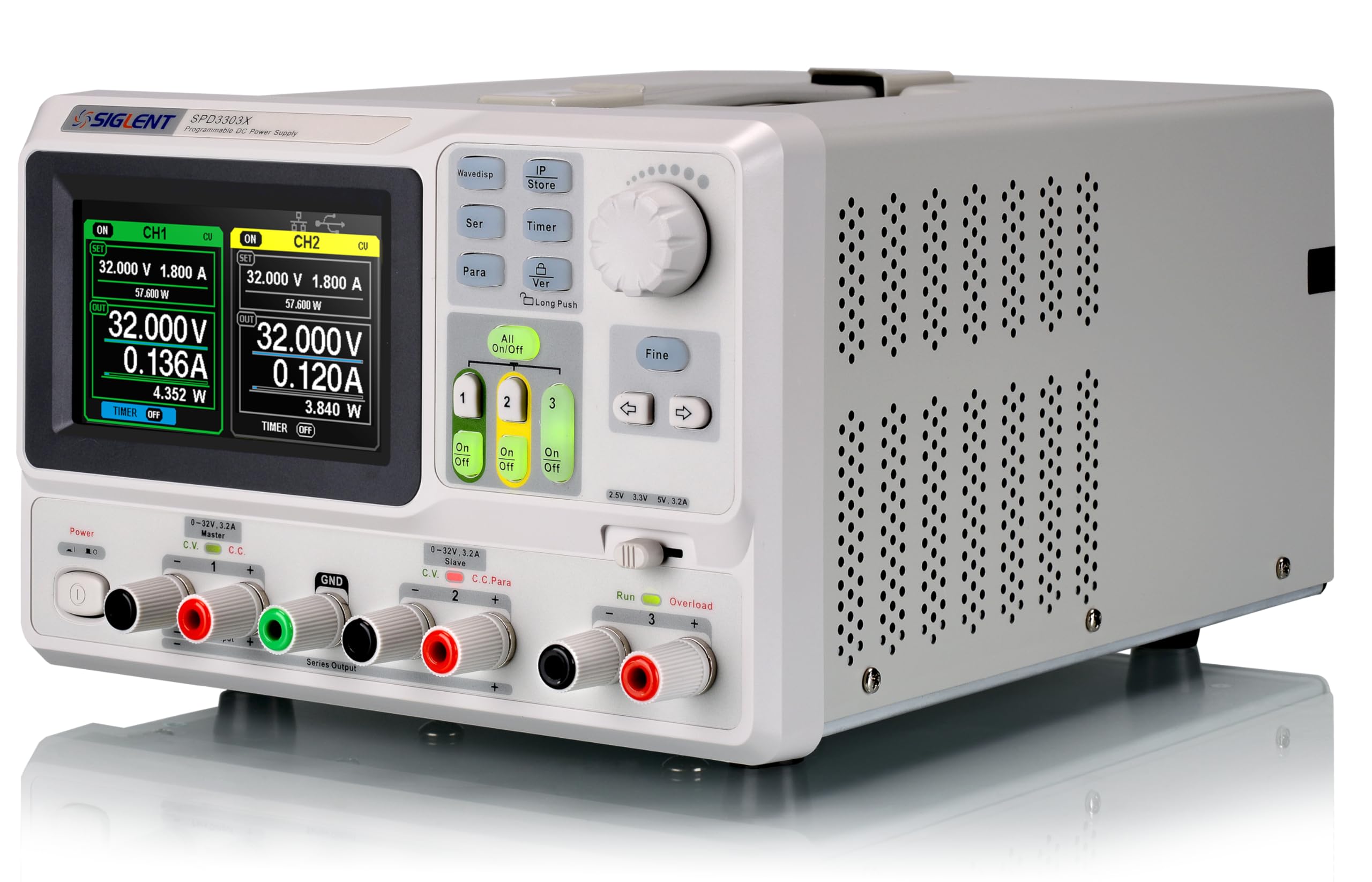
The Siglent SPD3303X-E stands apart from everything else on this list because it packs two fully independent, isolated 32V/3.2A linear-regulated outputs plus a third fixed 2.5V/3.3V/5V rail — all inside a single chassis with 1mV and 1mA resolution. The linear topology keeps ripple below 1mV RMS, which is critical when you’re powering op-amp circuits or precision ADC reference voltages that would drift on switching noise.
The intelligence baked into this unit goes beyond raw specs. Series mode lets you combine channels for up to 60V, parallel mode doubles current to 6.4A, and the timing output function automates production-line testing sequences. The front-panel trending graph shows voltage and current over time without needing an external oscilloscope, and the Ethernet/USB connectivity works seamlessly with Python scripts for automated data logging.
Build quality matches the feature set — the chassis is heavy steel supporting 17.6 pounds of transformer and heatsink, and the variable-speed fan stays silent at low loads. The included test leads are short at 1 meter, and the banana plugs feel slightly undersized for BNC adapters, but those are minor gripes against a power supply that delivers lab-grade accuracy (under 0.016% voltage error) at a fraction of the cost of Tektronix or Keysight equivalents.
Why it’s great
- Dual independent linear outputs with 1mV/1mA resolution deliver laboratory-grade accuracy for sensitive analog circuits.
- Timing output, serial/parallel modes, and trending graphs provide automation capabilities usually found on + supplies.
- Ethernet and USB connectivity with Modbus support enables fully automated test sequences from a PC or Raspberry Pi.
Good to know
- The third fixed output lacks current limiting and display, limiting its usefulness for precision charging tasks.
- Weighs over 17 pounds and occupies significant bench space — not a portable or space-saving option.
- Firmware updates require a Windows tool; the included Windows software has known stability issues reported by multiple users.
2. KORAD KA3005D Precision Variable Adjustable 30V 5A DC Linear Power Supply

Its 30V/5A output is powered by a genuine linear transformer topology that keeps residual AC ripple to whisper-quiet levels — users regularly report under 1mV of noise when measured against a Keysight DMM. That matters far more than peak current when you’re debugging a phono preamp or validating a 16-bit DAC circuit.
The front-panel controls are deliberate and responsive. A single encoder knob adjusts both voltage and current, with dedicated buttons for coarse vs. fine stepping and direct mode selection between constant voltage and constant current. The four memory recall buttons let you save frequently used profiles — 12V/1A for automotive sensors, 5V/2A for digital logic, 3.3V/0.5A for low-power MCUs — recallable instantly without redialing. The backlit 4-digit display reads down to 1mV resolution with a stable, non-flickering readout even under heavy loads.
Durability is a hallmark here. Multiple users report units running 24/7 for two years straight without a single glitch or drift. The output enable button prevents voltage spikes on connection, and the over-voltage/over-current protection kicks in reliably during accidental shorts. The trade-off is weight — at 10 pounds, it’s not bench-portable, and the linear design runs warm under sustained 5A loads, though the variable-speed fan handles thermals well. For clean power without the programming complexity of a fully digital unit, the KA3005D remains the default recommendation.
Why it’s great
- Linear regulation produces exceptionally low output ripple — under 1mV — essential for audio amplifiers and precision analog sensors.
- Four memory presets save frequently used voltage/current combinations for instant recall without manual readjustment.
- Proven long-term reliability with users reporting years of continuous 24/7 operation without accuracy drift.
Good to know
- Heavy 10-pound construction and linear transformer waste some energy as heat, requiring adequate ventilation.
- Single output limits simultaneous testing of circuits requiring different voltage rails.
- The fine-adjustment encoder mechanism has a unique stepping behavior that takes some getting used to.
3. HANMATEK HM310T Programmable DC Power Supply 0-30V 0-10A

The HANMATEK HM310T crosses the line from manual power supply into programmable territory without asking for a lab-grade budget. Its 30V/10A output is switching-regulated, but the real story is the rear-panel USB interface that supports Modbus RTU protocol — letting you script voltage sweeps, current-limiting profiles, and timed output sequences directly from a PC. Six quick-storage parameter groups let you save entire test configurations for instant recall.
The front panel shows voltage, current, power, and elapsed time simultaneously on a bright 4-digit display. The resolution hits 10mV and 1mA, sufficient for most digital and battery work, though not quite at the 1mV level of linear units. The built-in OVP, OCP, OPP, and OTP protections are fully adjustable, meaning you can set an over-voltage threshold of exactly 28.5V for a 6S Li-ion pack and trust the supply to cut out before damage occurs. The dual USB-A ports on the front provide 5V/1.5A each — handy for powering an Arduino or Raspberry Pi during development.
The bundled PC software is the weakest link — Norton flags it, it’s in Chinese by default, and the interface is clunky. However, you don’t need it. The HM310T responds to standard Modbus commands over a virtual COM port, so you can write clean Python scripts using minimal libraries. A few users reported early units failing or arriving with the wrong AC voltage variant, but the current firmware revision (V6.2+) seems to have stabilized the hardware. For automated ATE-style testing on a budget, this is the supply to beat.
Why it’s great
- USB/Modbus programmability allows automated voltage sweeps and timed output sequences without expensive GPIB equipment.
- Adjustable OVP, OCP, and OPP thresholds can be set independently for each memory slot, enabling safe battery charging workflows.
- 10A output at 30V delivers 300W total capacity, enough for automotive modules, LED strips, and high-power hobby servos.
Good to know
- The bundled PC software is low-quality and triggers antivirus flags; Modbus scripting via Python is the recommended route.
- Switching regulation produces higher ripple than linear supplies, making it less suitable for ultra-low-noise analog applications.
- Quality control varies — a small number of units arrive defective and require replacement through customer service.
4. Jesverty SPS-3010C DC Power Supply Variable 0-32V 0-10A
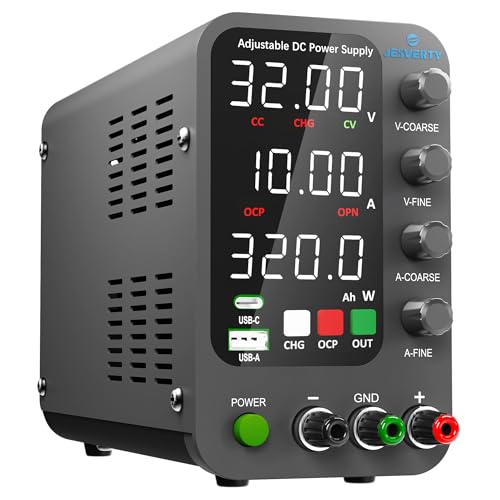
Jesverty’s SPS-3010C delivers the most feature-dense package in the sub- switching supply space, starting with its encoder-based coarse and fine adjustment system. Instead of fighting with cheap potentiometers that drift with temperature, the dual-encoder knobs let you set voltage before the decimal point with one dial and after it with the other — achieving 0.01V and 0.001A resolution without the frustration of overshooting. The 4-digit LED display is bright and readable from across the bench.
The standout addition is the intelligent battery charging mode, activated by the CHG button. The supply monitors accumulated charge in milliamp-hours (mAh) and automatically terminates charging when the battery reaches its target voltage, preventing overcharging of LiPo, LiFePO4, and SLA chemistries. The rear-panel 20W USB-C and USB-A ports are independently powered and fast-charge compatible — ideal for topping off a phone or running a Raspberry Pi without occupying the main output. The unit also includes a user-configurable OPN function that auto-starts the output on power-up, skipping the OUTPUT button press.
At only 2.5 pounds and measuring 7.1 × 3.6 × 6.2 inches, it frees up significant bench space compared to linear supplies. The downside is that the included test leads are thin and lightweight — you’ll want to replace them with 14AWG silicone leads for any sustained 10A draw. A few users report a slow voltage bleed-down after the output is disabled (taking over a minute to hit zero), which is worth knowing if you’re connecting sensitive components immediately after power-down. For the price, the feature-to-dollar ratio is unmatched.
Why it’s great
- Dual encoder knobs for coarse and fine adjustment provide 0.01V/0.001A resolution without the drift of analog potentiometers.
- Intelligent battery charging mode with mAh tracking and auto-termination protects LiPo, LiFePO4, and SLA batteries from overcharging.
- 20W USB-C and USB-A fast-charge ports eliminate the need for a separate phone charger on your workbench.
Good to know
- The bundled test leads are underrated for 10A continuous current — upgrade to thicker silicone leads for heavy loads.
- Output voltage drains slowly after disable, taking over 60 seconds to decay to zero, which can affect sensitive circuits.
- The plastic casing feels less robust than metal-chassis linear supplies, though it’s fine for stationary bench use.
5. Jesverty SPS-6005 DC Power Supply Variable 0-60V 0-5A
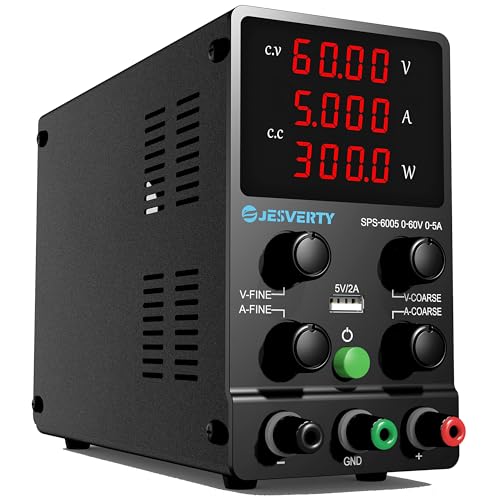
The Jesverty SPS-6005 is the same compact platform as the SPS-3010C but optimised for high-voltage applications — delivering 0-60V at up to 5A with a total power ceiling of 300W. This voltage ceiling opens up use cases the 30V units can’t touch: top-balancing 48V LiFePO4 battery banks, charging electric scooter packs, powering 48V PoE injectors, or driving automotive injector test benches. The 4-digit LED displays voltage, current, and wattage simultaneously, so you always know the exact power being delivered.
The constant-voltage and constant-current crossover point is adjustable and switches automatically as the load changes, with the front-panel LEDs clearly indicating which mode is active. This is vital when charging high-voltage series packs — you set a strict current limit (say, 500mA) and voltage ceiling (58.4V for a 16S LiFePO4), and the supply handles the rest. Users report accuracy within 0.02V of a calibrated DMM at 58V, which is impressive for a switching supply at this price tier. The temperature-regulated fan only spins up under heavy load, keeping the bench quiet during light work.
The main compromise is the adjustment system. Instead of the encoder-based fine/coarse knobs on the SPS-3010C, the SPS-6005 uses analog potentiometers that are touchy and require patience to dial in exact values — particularly at 0.1V steps near the voltage ceiling. The included test leads are again undersized for 5A continuous current, so factor in -15 for replacement leads. For anyone regularly working with battery voltages above 36V, the trade-off between fiddly controls and high-voltage capability is well worth it.
Why it’s great
- 60V output ceiling at 5A enables top-balancing 48V LiFePO4 batteries, powering 48V LED strips, and testing automotive modules.
- Simultaneous voltage, current, and wattage display on a bright 4-digit LED eliminates mental math during load testing.
- Automatic CV/CC mode switching with clear LED indicators makes battery charging workflows straightforward and safe.
Good to know
- Analog potentiometer knobs are touchy and lack the precision of encoder-based systems, especially for fine voltage tuning.
- The stock test leads are inadequate for 5A continuous use; upgrading to heavier-gauge leads is strongly recommended.
- Build quality is the same lightweight plastic construction as the SPS-3010C, though the internal cooling is adequate for 300W.
6. HYELEC HY50-06A Variable DC Power Supply 0-50V 0-6A

The HYELEC HY50-06A carves out a unique position by offering 50V output at 6A in a package that weighs just 2.71 pounds — making it the lightest high-voltage option in this lineup. The 50V ceiling covers 12S Li-ion packs and most 48V telecom equipment, while the 6A current capacity at lower voltages provides 150W total output. The 4-digit LED display shows readings with 0.01V and 0.001A precision, with a stable readout that doesn’t jump around under load — a common problem with cheaper switching supplies.
HYELEC opted for a code-type potentiometer with a dedicated coarse and fine adjustment switch, which works better than standard pots but still lacks the tactile precision of the encoder knobs on the Jesverty units. Three memory slots (M1/M2/M3) let you save and recall voltage/current presets, and the 5V/2A USB-A port on the front handles phone charging or powering a Raspberry Pi during development. The output enable/disable switch is a welcome safety feature — you can set your target voltage and current limit with the output off, then enable it once your load is securely connected.
The compact size comes with a real limitation: the plastic enclosure dissipates heat adequately for normal 2-3A operation, but sustained 6A draws push the internal temperature higher than a metal chassis would handle. A 72-hour full-load burn-in test at the factory is reassuring, but the fan is audible under load. The input voltage is fixed at 110V AC only — there’s no 220V option — so check your shop’s wiring before buying. For the price and weight, it’s an excellent travel-friendly supply for field repairs or small apartment workshops where every cubic inch matters.
Why it’s great
- Lightweight 2.71-pound design with a small footprint makes it ideal for mobile techs and space-limited workbenches.
- 50V output at 6A covers 12S Li-ion packs, 48V LED installations, and most automotive and telecom testing scenarios.
- Three memory slots for voltage/current presets speed up repetitive testing workflows without manual redialing.
Good to know
- Plastic chassis runs warm during sustained 6A draws; adequate cooling requires keeping the rear fan vent unobstructed.
- Fixed 110V AC input only — not compatible with 220V mains without an external step-down transformer.
- Control knobs use a code-type potentiometer that lacks the fine stepping precision of encoder-based systems.
7. Pyramid PSV150 Universal Compact Bench Power Supply 13.8V 12A

The Pyramid PSV150 is a different breed from the other supplies here — it’s a fixed 13.8V linear-regulated unit designed primarily for powering 12V amateur radio transceivers, CB radios, and car audio test benches rather than general lab work. The 12A continuous current rating is the highest in this lineup, and because it’s linear-regulated, the output is clean enough to run a 50W ham radio base station without introducing hiss or RF hash into the audio chain. The metal chassis and built-in cooling fan handle the thermal load from the linear regulator with ease.
Connection options include universal screw terminals for permanent wire connections, a front-panel cigarette lighter socket for mobile radio accessories, and a USB-A port for charging phones or GPS units. The 115/230V AC input switch makes it usable worldwide with the right power cord, and the overload/short-circuit protection is genuinely fast — users report it tripping before connected equipment can be damaged. At 165.6W max output, it’s not a high-voltage supply, but for anyone working exclusively with 12V automotive, marine, or radio systems, the current capacity is unmatched.
The obvious limitation is the fixed 13.8V output — you can’t adjust it to 5V for digital logic or 24V for truck electronics. The amperage is not variable either; it delivers up to 12A as the load demands. The form factor is compact for a linear supply at this current rating, but it still weighs more than switching units due to the transformer. For its intended audience — ham radio operators and automotive techs — it’s a purpose-built workhorse. For general electronics prototyping, you’ll want one of the variable supplies above it in this list.
Why it’s great
- Linear regulation at 13.8V delivers exceptionally clean DC with minimal ripple, essential for noise-free amateur radio operation.
- 12A continuous current capacity powers high-draw 12V loads like 50W transceivers, car audio test benches, and LED arrays.
- Screw terminals, cigarette lighter socket, and USB port provide flexible connectivity for mobile and fixed installations.
Good to know
- Fixed 13.8V output with no voltage adjustment makes it unsuitable for general electronics work requiring 3.3V, 5V, 24V, or other common rails.
- Linear design generates noticeable heat under sustained 12A loads; the cooling fan runs audibly during heavy use.
- No digital display — you need an external multimeter to monitor exact voltage and current delivery.
FAQ
What does 10mV and 1mA resolution mean on a power supply display?
Can I use a switching power supply for charging lithium batteries?
What does linear regulation mean and why does it matter for noise?
Final Thoughts: The Verdict
For most users, the adjustable dc power supply winner is the KORAD KA3005D because its linear regulation delivers the cleanest output at a price that doesn’t require a lab equipment budget, while the four memory presets and intuitive single-knob control make daily bench work efficient. If you need programmable automation and USB connectivity, grab the HANMATEK HM310T. And for high-voltage battery work up to 60V, nothing beats the Jesverty SPS-6005 for its compact size and wattage display.