
Cell service vanishes the moment the trail gets good, leaving groups scattered across ridgelines and valleys with zero way to coordinate a meeting point or call for help. Backcountry radios are the only lifeline that works when the screen says “No Service,” yet choosing the wrong one means dealing with garbled audio, dead batteries by midday, or a radio that shatters on the first rock fall.
I’m Min — the co-founder and writer behind Gadgets Feed. I’ve logged over a thousand hours researching two-way comms, cross-referencing FCC power limits, battery capacities, and IP ratings so you don’t have to guess which radio survives a backcountry weekend.
Whether you’re skiing couloirs, running ridgelines on a mountain bike, or coordinating a multi‑car off‑road convoy, the right handheld determines whether your trip runs smoothly or falls apart at the first blind corner. This guide breaks down the best backcountry radios for every adventure style and budget.
How To Choose The Best Backcountry Radios
Picking the right radio for the backcountry comes down to understanding the terrain you’ll be in, the size of your group, and how much battery you actually need before a recharge. Below are the three factors that separate a reliable backcountry tool from a gadget that stays in the glove box.
Power Output and Range Expectations
Backcountry radios sold in the US top out at 2 watts on FRS (license-free) and up to 5 watts on GMRS (requires a FCC license). More watts mean more signal punch through dense trees, over ridges, and into canyons — but range claims of 35+ miles are only achievable in perfect line-of-sight over open water. Real-world backcountry range is typically 1 to 5 miles depending on foliage and elevation changes. For serious off-trail use, a 5-watt GMRS model like the Midland GXT67 is the clear advantage when the terrain gets technical.
Battery Life in Cold Conditions
Lithium-ion batteries lose capacity rapidly below freezing. A radio that claims 18 hours at room temperature might die in 6 hours on a snowy ridgeline. Look for models with cold-optimized battery chemistry or replaceable battery packs — the Rocky Talkie Mountain Radio is specifically tuned for multi-day winter use, and the BCA BC Link Mini uses an 1800 mAh pack that holds up well in sub-zero temps. Avoid AAA-powered units for primary backcountry use unless you enjoy changing batteries with frozen fingers.
Durability and Weather Resistance
An IP67 rating means the radio is dust-tight and can survive submersion in 1 meter of water for 30 minutes — the minimum standard for a backcountry radio you trust in a creek crossing or whiteout. Shatterproof displays and rubberized armor (like the Rocky Talkie’s TPU shell) protect against drops on talus or rock slabs. If you ski, snowmobile, or packraft, a floating IP67 radio (Gaswei G2Pro+) adds a layer of safety that a non-floating unit simply can’t match.
Quick Comparison
On smaller screens, swipe sideways to see the full table.
| Model | Category | Best For | Key Spec | Amazon |
|---|---|---|---|---|
| Midland GXT67 Pro | 5W GMRS | Overlanding & technical trails | 5 Watts / IP67 / Repeater-capable | Amazon |
| Rocky Talkie Mountain Radio | 2W FRS | Winter multi-day trips | 4-day battery / IP56 / Climbing carabiner | Amazon |
| Garmin Rino 700 | 5W GMRS + GPS | Navigation + communication combo | GPS/GLONASS / 20-mi range / Texting | Amazon |
| BCA BC Link 2.0 | 2W FRS | Avalanche safety & ski touring | 80-hour battery / Glove-friendly button | Amazon |
| BCA BC Link Mini | 2W FRS | Compact snow sport carry | 1800 mAh / USB-C / 18-hour battery | Amazon |
| Gaswei G2Pro+ 4-Pack | 2W FRS | Wet environments & group kits | IP67 / Floating / NOAA weather alert | Amazon |
| SAMCOM FPCN30A 6-Pack | 5W UHF | Large group / worksite crossover | 5 Watts / 1500 mAh / 6-pack | Amazon |
| Midland T290VP4 | 2W GMRS | Value-priced family outings | 36 channels / NOAA scan / eVOX | Amazon |
| Rugged Radios GMR2 Plus | GMRS | Affordable off-road entry point | Safety Orange shell / 22 channels | Amazon |
In‑Depth Reviews
1. Midland GXT67 Pro 5-Watt GMRS

The Midland GXT67 Pro delivers the full 5-watt legal limit on GMRS, giving it a decisive edge when you’re trying to talk through a canyon or across a valley floor where lesser 2-watt units fall silent. Its fully sealed IP67 chassis means you can wash mud off in the sink or drop it in a creek without blinking — the integrated battery door is a single solid piece, not the flimsy latch found on cheaper radios.
Repeater capability extends range by dozens of miles if a repeater is within range, and the backlit display with oversized buttons works seamlessly with gloved hands on a cold trail. The included desktop charger, DC/AC adapters, and hard travel case make it a complete expedition kit out of the box.
The fixed antenna limits aftermarket upgrades, but for a grab-and-go unit that pairs perfectly with Midland’s MXT series mobile radios for vehicle spotting, the GXT67 Pro is the most versatile high-power handheld in this lineup.
Why it’s great
- Full 5-watt GMRS power with repeater support
- IP67 dust/water sealed chassis
- Excellent battery life (4+ days on a charge)
Good to know
- Fixed antenna cannot be swapped for a high-gain option
- Requires GMRS license (covers whole family)
2. Rocky Talkie Mountain Radio
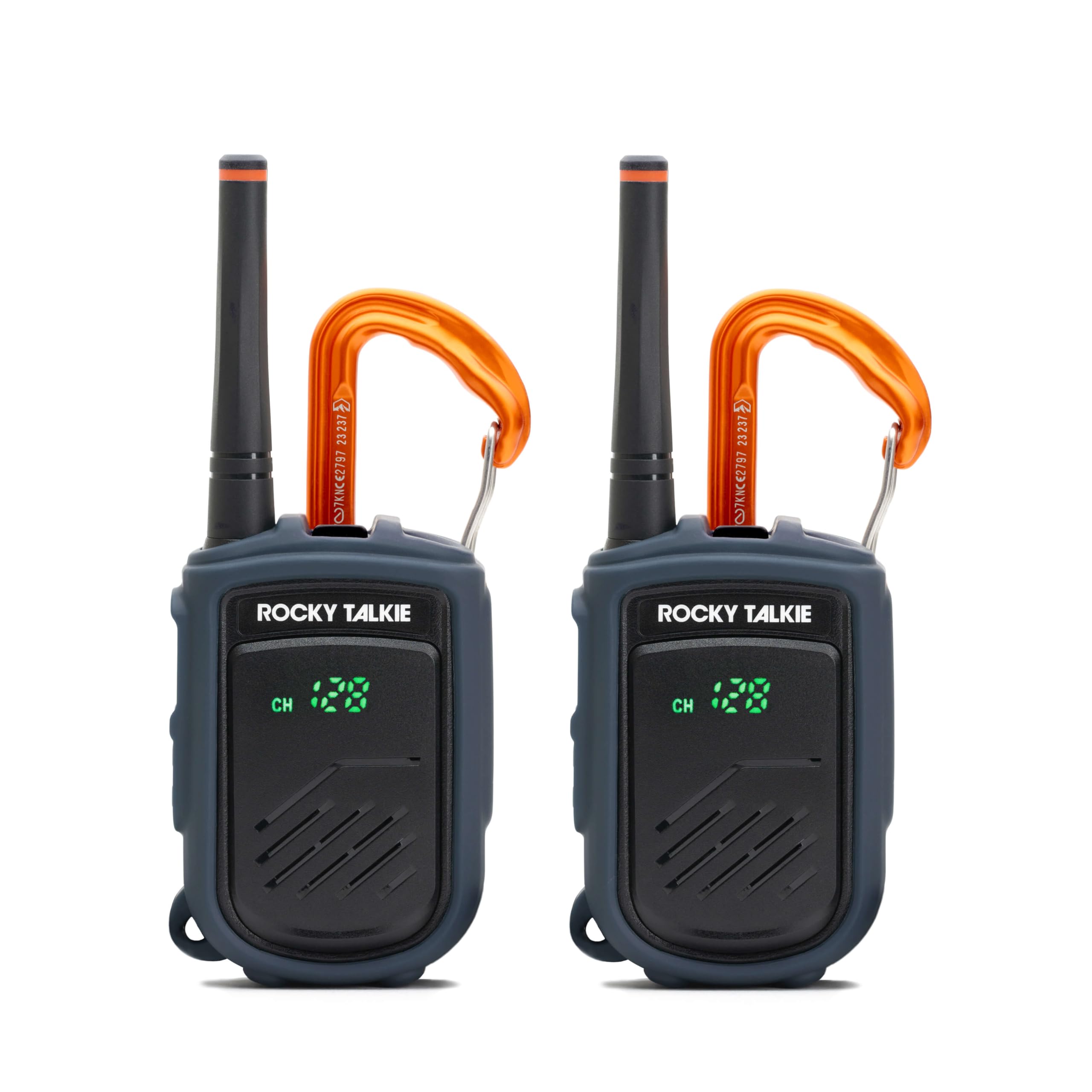
Built by climbers for climbers, the Rocky Talkie Mountain Radio is designed around a 1550 mAh lithium-ion pack that delivers over four days of battery life even in below-freezing conditions — a spec most radios can’t touch. The shatterproof LED screen and thick thermoplastic rubber housing absorb impacts that would crack a standard radio, and the integrated climbing-rated carabiner and metal-reinforced leash mean you can clip it to a harness or backpack strap without worrying about a plastic clip snapping.
The 2-watt FRS output is the legal maximum for license-free use, and real-world range in mountainous terrain sits around 1 to 5 miles depending on line-of-sight. The interface is refreshingly simple — five buttons and no menus — so you never have to fumble through settings with frozen fingers.
Sub-channel privacy codes (128 channels total) let you keep chatter clean on busy peaks, and the IP56 rating handles snow, splashes, and rain without hesitation. It’s the go-to for ski touring, alpine climbing, and any trip where ounces and reliability both matter.
Why it’s great
- Four-day battery in real winter conditions
- Shatterproof display with TPU armor
- Climbing-rated carabiner and leash included
Good to know
- 2-watt FRS only (no GMRS license option)
- No NOAA weather alert built in
3. Garmin Rino 700

The Garmin Rino 700 is the only unit on this list that packs a full 5-watt GMRS radio and a handheld GPS navigator into one rugged package. The high-sensitivity GPS and GLONASS receiver locks onto satellites faster in deep canyons and under heavy tree cover, and the position-reporting feature displays the locations of other Rino users on the same channel — a huge safety advantage for dispersed groups.
Voice and unit-to-unit text messaging work up to 20 miles line-of-sight, and the built-in base map provides basic navigation without needing a phone. The rechargeable lithium-ion battery lasts about 13 hours under mixed use, which is shorter than dedicated radios, but the trade-off is having a full GPS unit that also handles comms.
The monochrome 128 x 160 pixel display feels dated by modern standards, and the mapping is limited to major roads and highways unless you load custom maps. For backcountry users who want one device for navigation and communication, the Rino 700 is unmatched, but it’s not a pure radio specialist.
Why it’s great
- 5-watt GMRS plus GPS/GLONASS in one device
- Position sharing shows other Rino users on your map
- Unit-to-unit text messaging for silent communication
Good to know
- No color screen; base map lacks detail for off-trail use
- Battery life (13 hours) is shorter than dedicated radios
4. BCA BC Link 2.0

The BCA BC Link 2.0 was purpose-built for avalanche terrain, which means its 80-hour battery life on a set of AAs (or rechargeable pack) is no gimmick — it genuinely lasts multiple ski tours without worry. The 2-watt FRS output meets the new FCC power limits, and the usable line-of-sight range of roughly 6 miles is honest for alpine environments where treeline is sparse and ridges define the radio horizon.
The interface is glove-friendly with a large volume knob and positive tactile buttons, and the ability to monitor two channels simultaneously means you can keep one ear on the group and one on a shared safety frequency. The unit is lightweight at 12 ounces and clips securely to a pack strap or beacon harness.
The micro USB charging port is a step behind USB-C, and you’ll need a separate handset for clear audio on a helmet, which adds to the overall cost. For dedicated backcountry skiers and snowmobilers who prioritize battery endurance and snow survival, the BC Link 2.0 remains a trusted standard.
Why it’s great
- 80-hour battery life ideal for multi-day trips
- Dual-watch mode for two channels at once
- Lightweight and designed for cold-weather operation
Good to know
- Micro USB charging (not USB-C)
- Requires optional handset for helmet-mounted clarity
5. BCA BC Link Mini

The BCA BC Link Mini is a more portable sibling to the BC Link 2.0, swapping the AA flexibility for a built-in 1800 mAh rechargeable pack with USB-C charging — a welcome upgrade for 2024. The 18-hour advertised battery life holds up well in actual winter use, and the compact form factor clips easily onto a backpack sternum strap without bouncing around on a descent.
The 2-watt FRS output provides the same reliable communication as the full-size BC Link, and the dual-channel monitoring keeps you tuned into both your group and a secondary safety channel. The chunky button layout works well with thick gloves, and the IP-rated housing sheds snow and rain without complaint.
The non-rotating belt clip and the inability to disable the second receive channel are minor annoyances, and there’s no jack for an external lapel mic. For skiers and snowboarders who want a streamlined, modern rechargeable radio without the bulk, the BC Link Mini is a strong contender that doesn’t sacrifice range or durability.
Why it’s great
- USB-C charging with strong cold-weather battery life
- Compact, pack-friendly design with glove-friendly buttons
- Dual-channel monitoring for group safety
Good to know
- No external mic/earpiece jack
- Belt clip does not rotate for multi-angle attachment
6. Gaswei G2Pro+ (4-Pack)
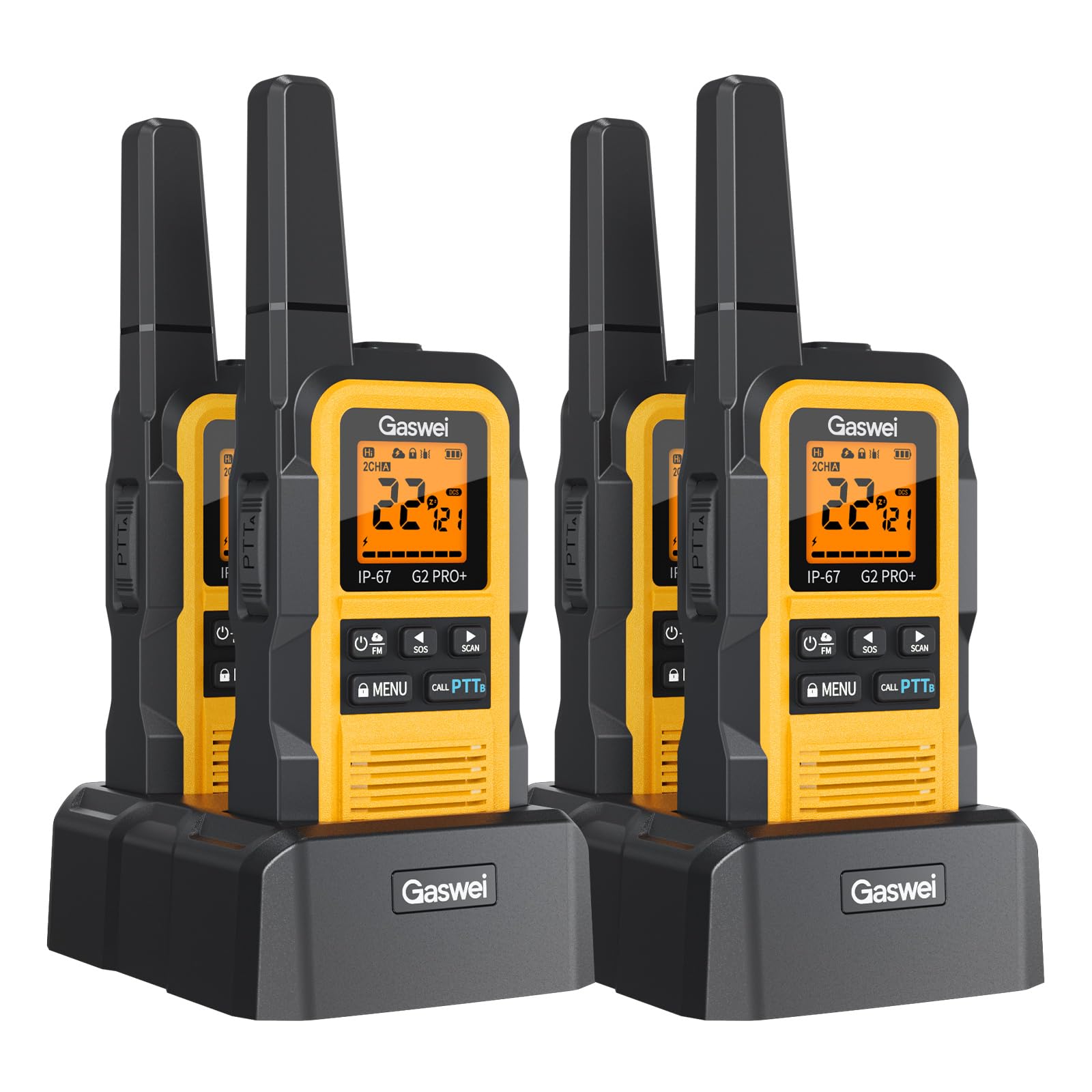
The Gaswei G2Pro+ stands alone in this lineup with its IP67 rating and floating design — drop it in a river or lake and it bobs on the surface instead of sinking to the bottom. That makes it the obvious choice for packrafting, canoe trips, and any backcountry route that crosses significant water. The 2-watt FRS output gives you typical backcountry range, and the NOAA weather alert automatically locks onto the strongest channel to warn of incoming storms.
The dual PTT buttons let you toggle between two groups without switching menus, which is useful for larger outings where you have both a lead and a sweep team. The 100-hour standby battery life means the radios sit ready all week, and the included multi-unit charger keeps the whole pack topped up.
The yellow shell is highly visible if dropped in brush or snow, and the shock-resistant casing handles 2-meter drops onto rock. For pure backcountry value in a four-pack with floating peace of mind, the G2Pro+ is an unbeatable deal.
Why it’s great
- Floating IP67 design — won’t sink in water
- Four-pack ready for groups straight out of the box
- NOAA weather alert and FM radio built in
Good to know
- 2-watt FRS only (no GMRS repeater option)
- Bulkier than alpine-specific models like the BC Link Mini
7. SAMCOM FPCN30A (6-Pack)

The SAMCOM FPCN30A delivers 5 watts on UHF (406-470 MHz) with a Part 90 certification, making it a professional-grade LMR radio that operates in the same spectrum as business band radios. In a backcountry context, this power punches through dense tree cover and across broad valleys, and the 1500 mAh battery provides a full day of continuous use with hours of standby left over.
The six-pack format with individual drop-in chargers and earpieces makes it ideal for large guiding operations, SAR teams, or group expeditions where everyone needs reliable comms. The One-Key GROUP call broadcasts to all radios even when they’re on different channels, which is a handy safety feature for keeping scattered team members connected.
Programming the FPCN30A requires a cable and software (the unit arrives with generic frequencies that may need to be changed), and the 6.7-inch antenna adds noticeable length. For groups that need maximum power and a multi-unit kit rather than a pair of alpine-friendly handhelds, this is the most capable option.
Why it’s great
- 5-watt UHF output for strong signal penetration
- Six complete units with chargers and earpieces
- One-Key GROUP call reaches all units at once
Good to know
- Requires programming cable and software to change frequencies
- Not IP-rated for submersion; splash-resistant only
8. Midland T290VP4
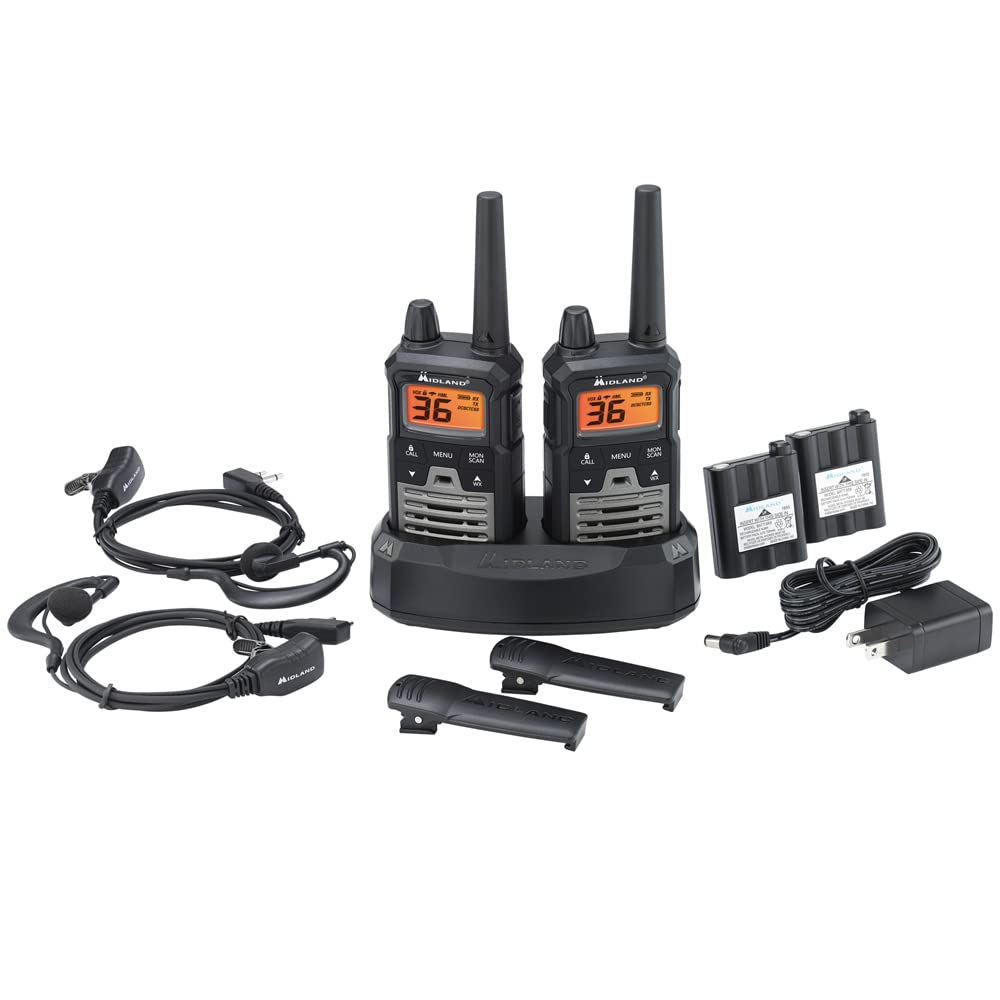
The Midland T290VP4 punches above its price with a 2-watt GMRS output that significantly outperforms the 0.5-watt FRS radios commonly found at big-box stores. Users consistently report 1.5 to 2 miles of clear communication in obstructed terrain, and the 36-channel lineup with 121 CTCSS privacy codes keeps your group’s chatter private even in busy areas.
The NOAA weather scan automatically locks onto the strongest weather channel in your area and sounds an alert when severe conditions are detected — a critical feature for a backcountry radio at this price point. The eVOX hands-free operation is handy when your hands are full with trekking poles or a paddle, and the flush button design prevents accidental transmissions inside a pack.
The main trade-off is battery life: the T290VP4 uses 6 AAA batteries per radio, which is expensive and wasteful over long trips, and the stock batteries don’t last a full day of continuous use. For short weekend hikes and family car-camping outings where you won’t be transmitting constantly, it’s the best value entry point into GMRS.
Why it’s great
- 2-watt GMRS power for excellent range at this price
- NOAA weather scan with automatic alert
- Compact, lightweight design with eVOX hands-free
Good to know
- Runs on 6 AAA batteries; not rechargeable out of the box
- Battery life is limited under heavy transmit use
9. Rugged Radios GMR2 Plus
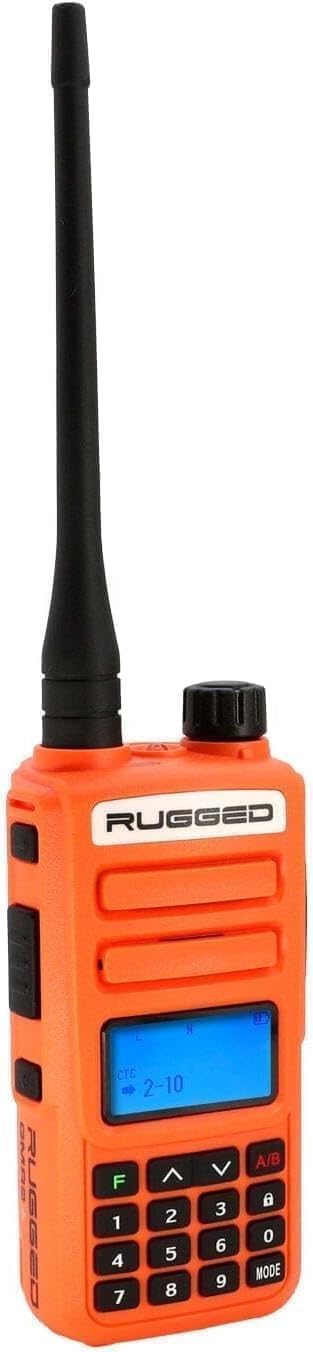
The Rugged Radios GMR2 Plus is built for the off-road and overlanding crowd, and its safety orange shell makes it easy to spot when it’s dropped on a dusty trail or in tall grass. The 22 GMRS channels plus 121 privacy codes provide reliable communication for convoys and basecamp coordination, and the included rechargeable battery removes the recurring cost of disposables.
The optimized transmitter and tuned antenna deliver better range than its 3-mile advertised spec suggests — real-world reports from Jeep and overlanding forums indicate solid performance across moderate canyon terrain and through moderate forest cover. The built-in flashlight and FM radio add convenience for camp use, and the intuitive button layout requires no manual page-flipping.
Battery life in heavy use is merely average, and the plastic chassis lacks the impact resistance of premium competition. For budget-conscious off-roaders who need a reliable second radio for occasional spotting or comms, the GMR2 Plus is a perfectly capable entry point that leaves room to upgrade later.
Why it’s great
- High-visibility safety orange shell for trail recovery
- Rechargeable with solid GMRS channel support
- Built-in flashlight and FM radio for camp utility
Good to know
- Average battery life under continuous use
- Plastic housing not as rugged as premium competition
FAQ
Do I need a license to use a backcountry radio?
How far will a backcountry radio actually reach in the mountains?
Can I use GMRS radios with my friends who have FRS radios?
Final Thoughts: The Verdict
For most users, the best backcountry radios winner is the Midland GXT67 Pro because its 5-watt GMRS output, IP67 durability, and repeater capability make it the most capable all-around handheld for any scenario. If you want a dedicated winter companion with exceptional battery life, grab the Rocky Talkie Mountain Radio. And for those who need navigation and communication in one rugged package, nothing beats the Garmin Rino 700.