
A sudden cardiac arrest (SCA) on school grounds doesn’t wait for the nurse to arrive — the first few minutes belong to teachers, coaches, and staff who may have zero medical training. The right AED training equipment bridges that gap, turning bystanders into first responders before emergency services reach the building. But a training kit that doesn’t reflect real school conditions — cramped hallways, diverse student body sizes, non-medical users — is a liability dressed up as preparedness.
I’m Min — the co-founder and writer behind Gadgets Feed. I’ve spent countless hours analyzing the technical specifications, AHA compliance standards, and real-world classroom logistics that separate a useful training AED setup from one that collects dust in a closet.
This guide cuts through the marketing noise to identify the best aed for schools — equipment built for repeated use, clear feedback, and the specific demands of educational environments where every training minute matters.
How To Choose The Best AED Training Equipment for Schools
Not all CPR and AED training kits are created equal when you’re outfitting a school. Budget constraints, frequency of use, and the need for equipment that survives dozens of training sessions per semester all factor into the decision. Here are the critical differentiators.
Compression Feedback Technology
A manikin without compression feedback leaves students guessing. Look for manikins with visible lights or audible clicks that indicate correct depth (at least 2 inches for adults) and proper recoil. Kits like the Prestan line with feedback indicators let trainees self-correct in real time, making every practice repetition effective.
AED Trainer Scenario Versatility
The AED trainer unit itself must simulate real defibrillator use — voice prompts, pad placement, shock analysis — without delivering an actual shock. The best AED UltraTrainers come pre-loaded with multiple scenarios (adult SCA, pediatric, no-shock advised) and allow firmware updates as resuscitation guidelines evolve. This keeps your curriculum current without replacing hardware.
Manikin Count and Diversity
A school needs enough manikins for a full class rotation. A 4:1 student-to-manikin ratio is the practical minimum for skills practice. Diversity in skin tone representation matters for building inclusive training environments, and having both adult and infant manikins ensures your staff can respond to any age group on campus.
Portability and Storage
School CPR training rarely happens in a dedicated simulation lab. Your kit must move between classrooms, gyms, and auditoriums. A wheeled carryall bag saves backs and time. Look for kits that pack compactly without sacrificing equipment count — the MCR Medical wheeled carryall designs excel here.
Durability and Warranty
School equipment takes abuse. Manikins that crack after a few dozen compressions waste money. Prestan manikins are built with reinforced shoulder pins and durable ABS plastic that withstand high-volume training. A 3-year warranty is the standard for professional-grade kits, signaling confidence from the manufacturer.
Quick Comparison
On smaller screens, swipe sideways to see the full table.
| Model | Category | Best For | Key Spec | Amazon |
|---|---|---|---|---|
| Philips HeartStart OnSite | Actual AED | Real emergency deployment | SMART Analysis + Quick Shock in 8 seconds | Amazon |
| Prestan Take2 Kit (PP-FM-600M-MS) | Training Kit | Small group / mobile instruction | 2 Adults, 2 Infants, 2 AED Trainers | Amazon |
| MCR Medical Prestan K404M-CA | Comprehensive Kit | Full classroom rotation | 4 Adults, 4 Infants, 4 AED Trainers, Wheeled Bags | Amazon |
| MCR Medical K404M-MSDS-CA | Diversity Kit | Inclusive training environment | 4 Med & Dark Tone Adults, 4 Med & Dark Tone Infants | Amazon |
| MCR Medical Prestan K404M-MSDS | Diversity + Feedback | Advanced skill assessment | Diversity manikins + feedback + 4 AED Trainers | Amazon |
| Prestan Take2 Starter Kit | Budget Training | Small school / starter program | 2 Adults, 2 Infants, 2 AED Trainers, No Bag | Amazon |
In‑Depth Reviews
1. MCR Medical Prestan CPR Adult Manikin 4-Pack w. Feedback, Infant 4-Pack, AED UltraTrainers, Wheeled Carryall (K404M-CA)
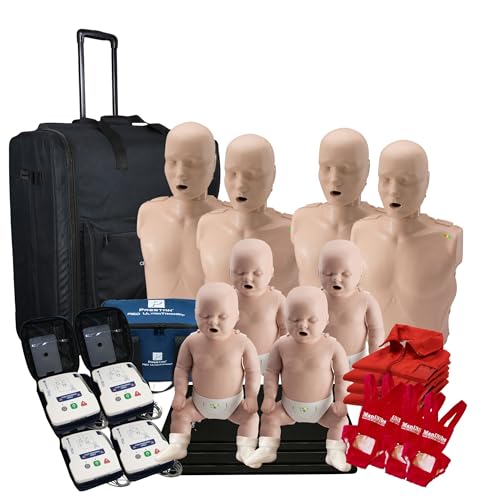
This is the kit that serious school training programs graduate to. It delivers eight manikins — four adult, four infant — all with compression feedback indicators that light up when the trainee hits the correct depth. That means a single instructor can supervise a full rotation of 16–20 students without hands-on corrections, because the manikins provide real-time visual confirmation of correct technique. The four included Prestan AED UltraTrainers are pre-programmed with multiple rescue scenarios, letting students practice pad placement and shock sequencing without needing a separate tablet or instructor to trigger the simulation.
The wheeled carryall bag is a practical game-changer for schools that don’t have a dedicated simulation lab. At 42.5 pounds fully loaded, dragging this kit down a hallway is far more feasible than carrying it. The bag organizes the manikins, AED trainers, kneeling mats, and ManiVests into one compact unit. AHA BLS instructors consistently report that the manikins withstand repeated use better than competitive models — the reinforced shoulder pins and ABS plastic bodies survive the aggressive compressions typical of high school training sessions.
One thing to note: the lung bags inside the manikins can feel slightly stiff initially and may require a larger air volume to inflate than some training scenarios anticipate. A few users also mention that the carryall, while wheeled, could be more spacious — packing everything requires deliberate arrangement. But for a school aiming to train 30–40 staff members across multiple shifts per semester, the throughput this kit enables justifies the investment.
Why it’s great
- Compression feedback lights on every adult and infant manikin eliminate guesswork for trainees
- Wheeled carryall makes transport between classrooms and gyms practical
- Four AED UltraTrainers support simultaneous small-group scenario practice
Good to know
- Lung bags can feel stiff and require firm breaths to inflate consistently
- Wheeled carryall is slightly undersized for all accessories packed together
2. MCR Medical Prestan Diversity Adult Manikin 4-Pack w. Feedback, Infant 4-Pack, AED UltraTrainers, Wheeled Carryall (K404M-MSDS-CA)
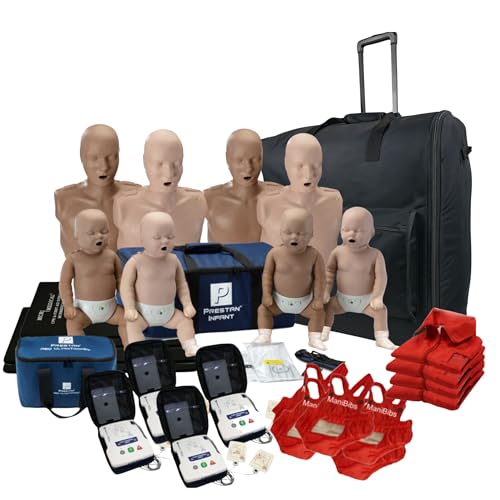
Identical in structure to the K404M-CA but with a critical difference: the manikins come in both medium and dark skin tones. For schools committed to inclusive training environments, this matters beyond optics. Studies show that trainees better retain skills when they can emotionally connect with the simulation, and representation in training aids plays a measurable role. The four adult and four infant manikins are split evenly — two adults in medium tone, two in dark tone, and the same for infants — ensuring every trainee sees themselves in the scenario.
Beyond skin tone diversity, this kit retains all the functional depth of its sibling. The feedback mechanism on each manikin lights up when compressions hit the AHA-recommended 2-inch depth, and the AED UltraTrainers run through five pre-loaded rescue scenarios in both English and Spanish. The wheeled carryall (28.75 x 14.75 x 25.75 inches) fits the full kit including kneeling mats and ManiVests. AHA instructors who teach large, diverse student bodies find this kit makes their classroom discussions about equity in emergency response more concrete.
The trade-off is that this kit shares the same minor drawbacks — the wheeled bag can feel cramped, and the lung bags require a bit more breath volume than natural ventilations. A few users have reported that manikins occasionally attract dust and lint, requiring a wipe-down between sessions. But for a school district with a formal diversity and inclusion policy, this kit checks a box that no other training set in this comparison does.
Why it’s great
- Medium and dark tone manikins support inclusive training environments
- Identical feedback and scenario quality to the best-in-class K404M-CA
- AED trainers pre-loaded with 5 scenarios in English and Spanish
Good to know
- Lung bags need firm breaths; not ideal for subtle ventilation training
- Manikin surfaces attract dust and lint between uses
3. Prestan CPR Manikin Diversity Kit, 4-Pack Adult and 4-Pack Infant w. Feedback, AED UltraTrainers (K404M-MSDS)
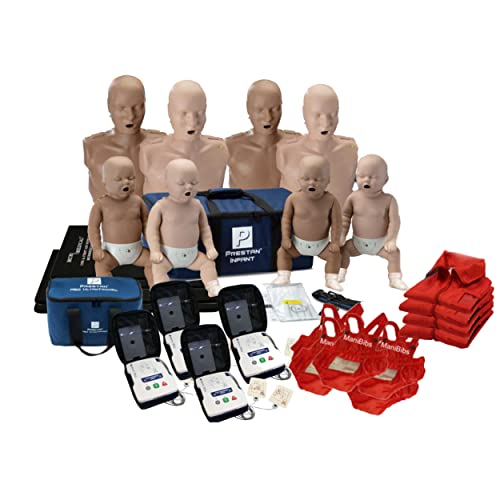
This kit strips away the wheeled carryall to deliver the same core training hardware at a lower entry point. You get the same four adult manikins (split between medium and dark tones), four infant manikins (ditto), and four Prestan AED UltraTrainers. The feedback technology is identical — compression depth lights on each manikin, plus the AED trainers’ voice prompts and scenario switching. For a school that already has sturdy storage totes or a dedicated CPR closet, paying extra for a branded wheeled bag doesn’t make sense, and this kit lets you put that budget toward replacement lung bags or training pads instead.
MCR Medical bundles this with face shields, lung bags, kneeling mats, ManiVests, and ManiBibs — the same accessory set as the more expensive kits, just excluding the wheeled carryall. The 3-year warranty still applies, and the manikins are AHA-compliant. Schools that already own rolling carts can transfer this kit directly into their existing transport solution. The feedback mechanism remains the standout feature: trainees learn to self-correct because they see the light fail when compressions are too shallow.
Quality control has been slightly more variable on this SKU than on the K404M-CA. A handful of reports mention shoulder pins on adult manikins popping open during rescue breaths, and one user noted the AED trainer pads deteriorated faster than expected. Prestan’s warranty support has been responsive in resolving these issues, but the inconsistency is worth considering if you’re buying for a large district where multiple kits will be in simultaneous use. For a single school program, the savings outweigh the occasional QC hiccup.
Why it’s great
- Same core hardware as premium kits at a leaner price point
- Skin tone diversity included without upcharge on manikins
- Comprehensive accessory bundle (mats, vests, bibs) for immediate deployment
Good to know
- No wheeled carryall — requires separate transport solution
- Intermittent QC reports: shoulder pin failures and pad deterioration
4. Philips HeartStart OnSite AED Defibrillator, Slim Carry Case (M5066A-C02)
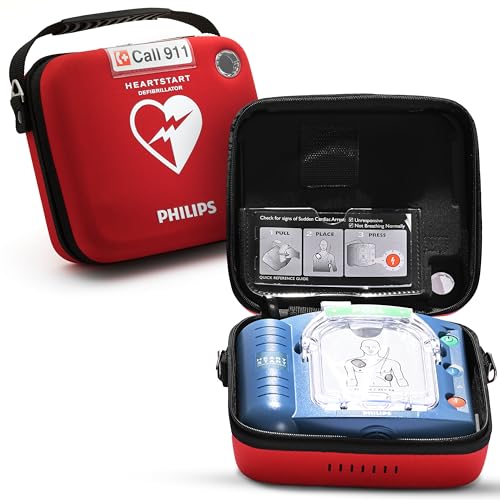
This is not a training simulator — it is the actual device that delivers a shock in a real cardiac arrest. Every school should have at least one operational AED on the wall, and the Philips HeartStart OnSite is the most widely deployed public-access defibrillator in the world. Its value to a school isn’t just the life-saving capability; it’s the same user interface that your staff trains on. When teachers practice with Prestan AED trainers that follow the same pad placement and voice prompt logic, the transfer to this real unit is seamless.
The OnSite performs daily, weekly, and monthly self-tests, so you never have to manually calibrate or check battery levels. The SMART Analysis algorithm evaluates the victim’s heart rhythm and only advises a shock if one is needed — making it safe for untrained bystanders to use. The Quick Shock feature delivers a shock within 8 seconds of analysis, and the voice prompts then guide the user through post-shock CPR. The slim carry case weighs just 5.34 pounds and stores the device, one pre-installed battery, and one set of SMART Pads Cartridge.
The 8-year warranty on the AED itself and 4-year warranty on the battery covers the typical life cycle of a school’s emergency equipment. The pads are warrantied until their expiration date. One limitation: the OnSite only speaks English in its voice prompts, which could be a barrier for schools with significant non-English-speaking staff. Philips sells an Infant/Child Pads Cartridge separately for pediatric use, and the device auto-detects which pads are installed to adjust energy delivery. For schools equipping a campus with an actual AED to complement their training program, this is the gold standard.
Why it’s great
- Self-tests daily so staff never worry about maintenance
- Quick Shock delivers therapy within 8 seconds of analysis
- 8-year device warranty and 4-year battery warranty
Good to know
- Voice prompts are English-only
- Infant/Child training pads cartridge sold separately
5. Prestan Take2 CPR Manikin Trainer Kit with Feedback (2-Adult, 2-Infant, & 2-UltraTrainers)

For smaller schools or programs just establishing their CPR training capability, this 6-piece kit hits the sweet spot between capacity and portability. Two adult manikins and two infant manikins (all with feedback indicators) plus two AED UltraTrainers fit inside a customized carry bag, making this the most practical option for a traveling instructor who visits multiple school buildings. The mat includes face shields and lung bags for 20 adult and 20 infant sessions, so you’re ready to run drills immediately upon unboxing.
The kit is AHA-compliant and carries a 3-year warranty, the same as the larger Prestan sets. The manikins produce an audible click when compression depth is correct — a useful sensory cue for noisy gymnasium environments where visual feedback lights might be hard to see. The AED UltraTrainers are pre-loaded with five scenarios and are firmware-upgradable when guidelines change, ensuring your training stays current without buying new hardware. EMTs and CPR instructors frequently note these manikins outlast competitive brands under heavy use.
The carry bag lacks wheels, which is the most common complaint among mobile instructors. At full kit weight, dragging it by the handles becomes tiring between buildings. The bag itself is compact (23 x 26 x 23 inches), which is a trade-off: it’s easy to store but requires careful packing to fit everything. The Take2 name references the two-minute setup time, which instructors confirm is accurate. For a single-classroom deployment where portability means fitting in a car trunk, this is the perfect size.
Why it’s great
- Audible click confirms correct compression depth in noisy environments
- Firmware-upgradable AED trainers adapt to evolving AHA guidelines
- Compact bag stores easily in small school offices or cars
Good to know
- Carry bag lacks wheels — heavy to transport long distances
- Bag is a tight fit when packing all accessories
6. Prestan Take2 CPR Manikin Trainer Kit (PP-FM-600M-MS)
This is the same core product as the Take2 kit above but configured as the most entry-level option for schools with minimal training budgets. The manikins still provide compression feedback lights and audible clicks, and the two AED UltraTrainers run the same five scenarios. The difference is in the accessory count — you get 20 adult face shields and lung bags instead of 20, but the base kit is identical. For a school that only needs to train a small staff of 10–15 people annually, this avoids overpaying for capacity that will never be used.
The manikins are the same durable Prestan design that AHA instructors prefer. The feedback mechanism teaches proper compression depth without requiring an instructor to bend over and watch each student’s hands. The AED UltraTrainers include both English and Spanish voice prompts, a practical feature for diverse school staffs. The 3-year warranty covers the manikins and AED trainers, and replacement lung bags are inexpensive and widely available on Amazon.
The limitation is scale. With only two adult and two infant manikins, a class of 20 students would spend most of their time waiting for a turn. Schools with multiple periods of CPR training per day will find themselves bottlenecked. The carry bag, as with the other Take2 kit, lacks wheels. But for an after-school club, a small private school, or a rural district with limited enrollment numbers, this kit provides professional-grade training tools at the leanest possible investment.
Why it’s great
- Professional-grade manikins with feedback at the lowest entry cost
- AED trainers include bilingual (English/Spanish) voice prompts
- 3-year warranty covers the entire kit
Good to know
- Only 2 adult and 2 infant manikins — slow for large classes
- No wheels on the carry bag; heavy for frequent transport
FAQ
Do my school’s AED trainers need to match the brand of our real AED?
How many manikins does my school realistically need for a class of 30?
Do AED trainer pads deteriorate over time like real AED pads?
Final Thoughts: The Verdict
For most users, the aed for schools winner is the MCR Medical Prestan K404M-CA because it balances eight manikins with feedback, four AED UltraTrainers, and a wheeled carryall — the exact specifications a full classroom rotation demands without unnecessary extras. If you need inclusive skin tone representation in your training materials, grab the MCR Medical Prestan K404M-MSDS-CA. And for a small school with a limited training calendar, nothing beats the compact portability of the Prestan Take2 Kit.