
An amplifier is the heart of any stereo system, taking the weak signal from a turntable, TV, or phone and giving it the current needed to drive passive speakers. But when your budget is a primary concern, the market floods you with inflated wattage claims and confusing feature lists that make it nearly impossible to separate real performance from marketing hype. This guide exists to cut through that noise and focus on the measurable specs that actually matter.
I’m Min — the co-founder and writer behind Gadgets Feed. I’ve spent countless hours analyzing the technical specifications, real-world customer feedback, and price-to-performance ratios of dozens of integrated stereo amplifiers to find the units that deliver clean, reliable power without breaking your budget.
After filtering through the inflated peak-power claims and build-quality shortcomings, I’ve identified the models that offer genuine hi-fi sound for a sensible investment. This is the definitive guide to finding the best affordable amplifier for your home system.
How To Choose The Best Affordable Amplifier
Selecting the right budget-friendly amplifier comes down to understanding a few key technical specs and how they apply to your listening space. You need to look past the marketing to find the real performance.
RMS Power vs. Peak Power
Always check the RMS (Root Mean Square) wattage rating per channel. This is the continuous power the amplifier can deliver without distortion. Peak power figures (like 1000W) are momentary bursts and often unrealistic. An amp with 50W RMS per channel is far more useful than one claiming 500W peak with only 20W RMS. Your speakers will sound cleaner and last longer with honest RMS ratings.
Inputs, Outputs, and DAC Connectivity
Consider your sources. Do you need a built-in DAC for a TV optical connection, a phono preamp for a turntable, or just standard RCA inputs for a phone or computer? A versatile amplifier like the Fosi Audio MC331 or AIYIMA A80 offers multiple digital inputs (optical, coaxial, USB) alongside Bluetooth, eliminating the need for external converters. For karaoke or live events, dual microphone inputs with echo control become a priority, as seen on the Donner and Pyle models.
Amplifier Topology: Class D vs. A/B
Class D amplifiers are compact, efficient, and run cool, making them ideal for modern desktop or small-shelf setups. Many budget Class D units now use chips like the TPA3255 to deliver impressive power with low distortion. Hybrid tube amplifiers, like the Dayton Audio HTA100, use a tube preamp stage for warmth and a solid-state Class A/B output stage for power. These offer a different sonic character but are typically larger and heavier.
Quick Comparison
On smaller screens, swipe sideways to see the full table.
| Model | Category | Best For | Key Spec | Amazon |
|---|---|---|---|---|
| AIYIMA A80 | Class D DAC | Pure Hi-Fi Desktop | ESS9038Q2M DAC + TPA3255 | Amazon |
| AMPAPA D1 | Class D DAC | Compact 2.1 System | 600W Peak / HPF & Pre-Out | Amazon |
| Dayton Audio HTA100 | Hybrid Tube | Warm Vintage Sound | 50W RMS x 2 (Class A/B) | Amazon |
| Fosi Audio MC331 | Tube DAC | Tone Control Flexibility | 105W x 2 @ 4Ω / VU Meter | Amazon |
| Rockville RPA5 | Pro Power | PA & Large Room Setup | 200W RMS x 2 @ 4Ω | Amazon |
| Rockville RPA9 | Pro Power | High-SPL Venues | 3000W Peak / Bridgeable | Amazon |
| Donner Stereo Receiver | Multi-Function | Karaoke & Parties | 4-Ch / 2 Mic Inputs with Echo | Amazon |
| LONPOO 615B | Class D Basic | Simple Stereo Setup | 200W Peak / Multiple Digital Inputs | Amazon |
| Pyle PDA77BU | Multi-Function | Budget Home | 800W Peak / Bluetooth 5.0 | Amazon |
In‑Depth Reviews
1. AIYIMA A80
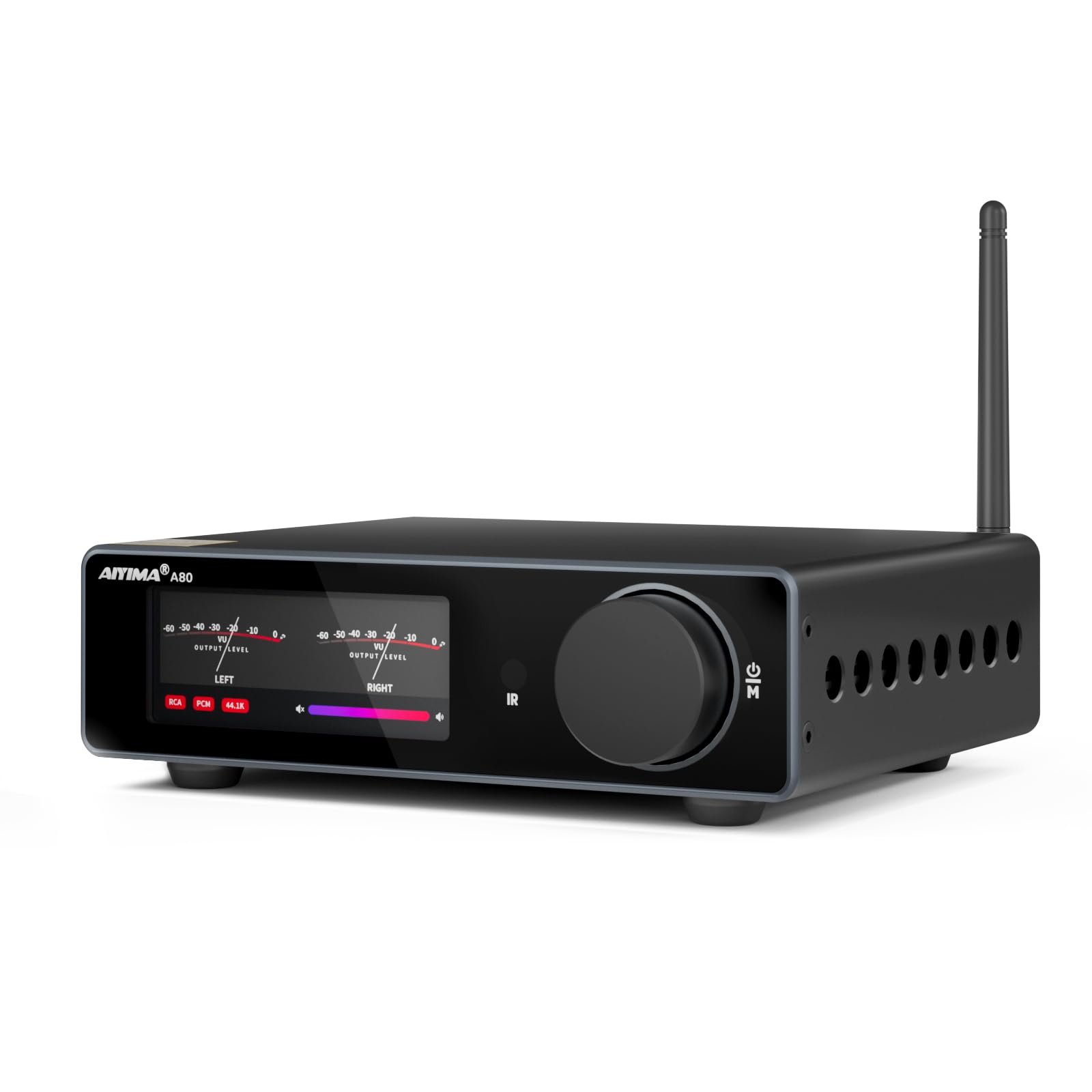
The A80 sets a new standard for budget-friendly hi-fi by pairing a studio-grade ES9038Q2M DAC chip with the powerful TPA3255 Class D amplifier. It supports high-resolution audio up to DSD512 and PCM, delivering a total harmonic distortion (THD) as low as 0.006% and a SINAD of 109dB. This combination of specifications is typically found in gear costing several times more, making it a phenomenal value for the critical listener.
Connectivity is exceptionally robust for a compact unit. It includes TRS balanced inputs to eliminate ground loop noise and hiss, plus USB, optical, coaxial, and Bluetooth 5.0 inputs. The digital VU meter display is both stylish and informative, showing input status in real time. The A80 also features a tone control and a 12V trigger input for seamless integration into a larger automated system.
User feedback consistently praises its clean, detailed sound profile and ability to drive demanding speakers like the Martin Logan Motion 15i or JBL Studio 530 with authority. The GaN-based 48V/5A power supply runs cool, and the build quality feels substantial for its size.
Why it’s great
- Exceptional DAC/Amp combo for the price with ultra-low distortion specs.
- Versatile inputs including professional TRS balanced and USB-C.
- Compact, sturdy metal build with an attractive digital VU screen.
Good to know
- Real-world wattage is lower than peak claims, especially with 4Ω low-sensitivity speakers.
- Runs warm under high load; adequate ventilation is necessary.
2. AMPAPA D1
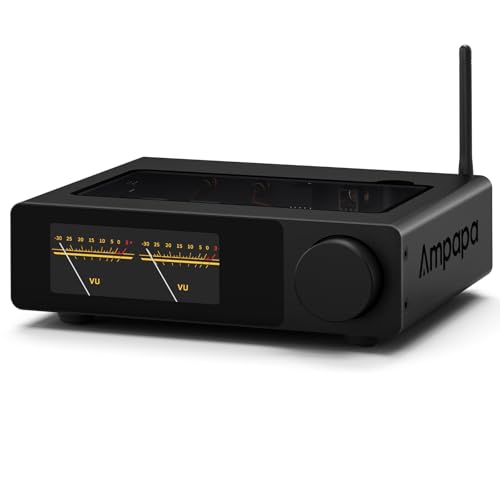
The D1 is a feature-packed Class D amplifier born from a collaboration between Ampapa and Douk Audio. It builds on the well-regarded Douk Audio A5 platform, adding a vibrant OLED screen with multiple VU meter styles, TRS balanced inputs, and Bluetooth 5.2. The core of the system is the TPA3255 chip, which, when paired with the included GaN 48V/5A adapter and PFFB technology, provides clean, load-independent power.
For users building a 2.1 system, the D1 is a standout choice. It includes a fully adjustable high-pass filter (HPF) from 30 to 200Hz, which removes low frequencies from the main speaker output. This lets bookshelf speakers focus on mids and highs without strain. The full-range subwoofer pre-out sends the bass signal to an active sub. The pluggable NE5532 op-amps also allow for easy tonal upgrades without soldering.
Owners report that the 80W per channel into 8Ω is more than sufficient for clean near-field listening. The auto-standby feature after five minutes of no signal is a minor annoyance for some, as it requires the remote to wake the unit. The build quality is excellent, with a glass top panel for viewing the op-amps and adjustable internal RGB lighting that adds a modern touch to a desktop setup.
Why it’s great
- Excellent 2.1 system builder with dedicated HPF and sub pre-out.
- Beautiful customizable OLED VU meter and upgradable op-amps.
- Compact, high-quality metal chassis with PFFB technology.
Good to know
- Auto-standby timer cannot be disabled, requiring remote to reactivate.
- Stock tubes on some units may fail early and need replacement.
3. Dayton Audio HTA100

If a warm, vintage aesthetic with a touch of tube glow appeals to you, the Dayton Audio HTA100 is hard to beat. This integrated amplifier uses a hybrid topology—a vacuum tube pre-amplifier stage driving a Class A/B solid-state output stage. It delivers a genuine 50 watts RMS per channel of clean power into 8 ohms, which is a very honest and usable rating for a wide range of bookshelf and tower speakers.
The HTA100 is incredibly versatile for a tube amp at this price. It features a built-in phono preamp for turntables, a USB DAC for computers, a front-panel headphone jack, and Bluetooth 5.0. The front panel VU meters are a classic design touch that add to the listening experience. The bass and treble knobs allow for fine-tuning the sound to your preference and room acoustics.
User consensus highlights its powerful, warm sound character that breathes new life into recordings, especially jazz and acoustic music. The soundstage and instrument separation are notably good. The remote control is functional but sluggish, a common complaint. The HTA100 is the ideal choice for someone who wants genuine tube sound character, a built-in phono stage, and the power to drive demanding speakers without needing a second mortgage.
Why it’s great
- Authentic hybrid tube warmth with genuine 50W RMS of clean power.
- Versatile inputs include phono, USB, Bluetooth, and RCA.
- Beautiful classic design with working front panel VU meters.
Good to know
- Remote control is sluggish and feels cheap compared to the amp’s build quality.
- Bluetooth connectivity can occasionally drop signal.
4. Fosi Audio MC331
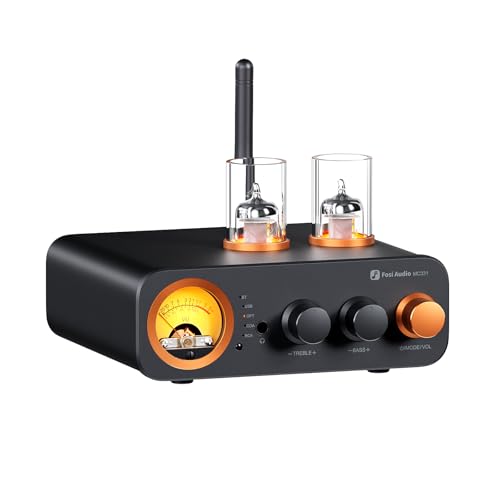
The Fosi Audio MC331 is a compact tube integrated amplifier that offers a surprising feature set for its size. It packs a DAC, a 105W x 2 @ 4Ω Class D amplifier, a tube preamp stage, and a retro VU meter into a small aluminum chassis. The 5725W vacuum tubes add a subtle, warm harmonic character to the sound, especially noticeable after a 15 to 20-second warm-up period.
Input flexibility is a strong suit, with Bluetooth, USB, coaxial, optical, and RCA options. A unique benefit is the user-replaceable tube design and the inclusion of a remote control that lets you adjust bass, treble, and input selection from your listening position. This level of tone control is uncommon in small form-factor amps. It also includes a pre-out for adding a subwoofer and a 3.5mm headphone jack for private listening.
Real-world performance is impressive, with owners noting it drives vintage BOSE 201 speakers in a 900 sq ft room with full-range sound. The primary downsides are that the stock vacuum tubes can fail within a few days (replacement tubes cost around ) and the remote control has a noticeable 2-second latency requiring direct line-of-sight. Prepare to replace the tubes immediately for optimal performance and reliability.
Why it’s great
- Feature-packed with replaceable tubes, VU meter, and tone controls.
- Solid all-metal build with a modern vintage aesthetic.
- Excellent power output and connectivity for a desktop or shelf unit.
Good to know
- Stock vacuum tubes are prone to early failure; budget for immediate replacement.
- Remote control has significant latency and needs line-of-sight.
5. Rockville RPA5

The Rockville RPA5 is a professional-grade power amplifier designed for high-output applications like DJ sets, live sound, and large home theaters. It delivers a genuine 200W RMS per channel into 4 ohms (400W RMS bridged into 8 ohms), offering real, usable power for demanding, low-sensitivity speakers. The 2U rack-mountable chassis is built for road use and heavy installations.
This amplifier prioritizes functionality over aesthetic frills. It features combo XLR/1/4-inch and RCA inputs, along with banana, Speakon, and XLR direct outputs. A built-in crossover allows for high-pass or low-pass filtering, making it great for driving subwoofers or full-range PA cabinets. The front panel includes clipping LEDs for each channel and level controls to prevent distortion.
User feedback is overwhelmingly positive on its value, with many noting its clean, clear sound and reliable build quality. The dual cooling fans are the main point of contention. While they keep the unit cool, they are audibly loud and not suited for quiet listening rooms. Many users position the amp in a closet or remote rack to mitigate the noise. It remains a top-tier choice for powering a system in a workshop, church, or dedicated party space.
Why it’s great
- Honest 200W RMS per channel for serious volume and headroom.
- Professional connectivity with XLR, Speakon, and a built-in crossover.
- Rugged rack-mountable build ideal for active use.
Good to know
- Cooling fans are noisy and not suitable for quiet listening rooms.
- Authentic RMS power is lower than advertised peak power.
6. Rockville RPA9

For those who need even more headroom than the RPA5, the Rockville RPA9 steps up the power significantly. It boasts a peak power of 3000W and an RMS rating of 800W (which real-world tests suggest is closer to 200W RMS per channel cleanly). This still makes it a formidable amplifier for driving large PA speakers and subs in medium to large venues. Its heavy-duty construction and rack ears ensure it can handle the wear and tear of transport.
Connectivity is identical to the RPA5, with XLR, 1/4-inch, and RCA inputs, plus Speakon and banana outputs. The front-panel controls are clear and intuitive, with LED indicators for power and signal. The dual cooling fan system is essential for its power level but, similar to the RPA5, it generates a significant amount of fan noise. This makes it a poor fit for a quiet living room but an excellent choice for a band practice space or pro audio rig.
Owners generally agree that the sound quality is clear and powerful for the price, though the wattage is often overrated. A common recommendation is to buy it for its build quality and functional features but to consider it a high-power 200W RMS amplifier rather than an 800W RMS unit. It works exceptionally well when paired with an external mixer and is a budget-friendly workhouse for semi-professional and professional sound reinforcement.
Why it’s great
- Massive power output suitable for loud, large-space applications.
- Rugged, durable build designed for road use and rack mounting.
- Good sound clarity and adequate connectivity for pro gear.
Good to know
- RMS power output is significantly lower than the peak wattage claims.
- Fan noise is high and should be managed for quieter environments.
7. Donner Stereo Receiver

The Donner stereo receiver is a specialized unit designed for karaoke, parties, and multi-zone home audio. Its standout feature is the four independent amplifier channels, each with its own volume knob, allowing you to control up to four groups of 8-ohm speakers separately. This is incredibly useful for setting up speakers in different rooms or for bi-amping a specific setup. The peak power claim of 1000W is for all channels; real-world RMS is a modest 25W x 4.
The karaoke focus is evident in the dual 1/4-inch microphone inputs with independent controls for echo and a “Talk Over” function that automatically lowers the music volume for clear announcements. Input options are generous: Bluetooth 5.0, USB, FM radio, optical, coaxial, and two pairs of RCA inputs. The remote control offers full control over treble, midrange, bass, and echo settings across any input mode, which is a rare convenience.
User sentiment is mixed. Many praise its loud output and ease of use for kitchen and party setups. However, several users note it struggles to drive demanding tower speakers and lacks adequate bass control. The confusing 4-channel configuration (requiring careful speaker wiring) and poor FM reception are other common complaints. For primary home theater with large speakers, this is a poor choice. For a casual party rig with efficient speakers, it is a solid, affordable option.
Why it’s great
- Unique 4-channel independent control for multi-room speaker setups.
- Excellent karaoke features with dual mic inputs, echo, and talkover.
- Versatile input selection including optical and coaxial for TV.
Good to know
- Low real-world RMS power at 25W x 4; struggles with hard-to-drive speakers.
- Lack of bass authority and confusing channel wiring diagram.
8. LONPOO 615B
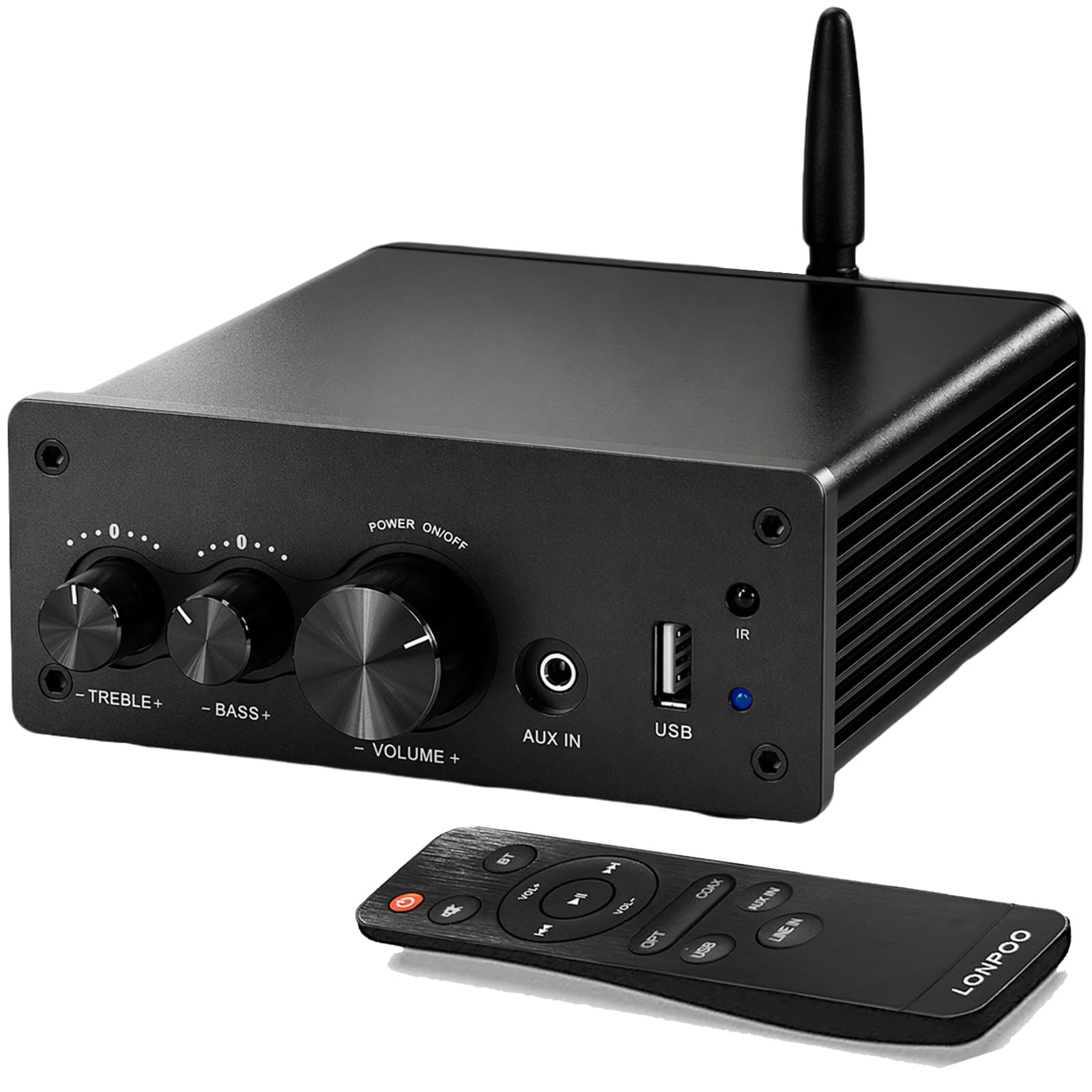
The LONPOO 615B is a bare-bones, entry-level Class D amplifier that focuses on simplicity and price. It advertises 200W peak power, but customer measurements suggest a more realistic output of around 35W RMS into 8 ohms. This is still enough juice to drive a pair of bookshelf speakers at moderate volumes in a desk or small room setup. Its compact form factor (aluminum, plastic, and steel) is easy to tuck onto a shelf.
Input selection is surprisingly modern for such a budget-friendly unit. It includes an optical port, coaxial jack, USB playback from a flash drive, and a standard Aux-in. This makes it easy to connect to a TV or computer without needing a separate DAC. The included remote control provides basic functionality for volume and input switching, a rare find at this price.
User reviews provide a clear picture of its capabilities and limitations. The stereo separation is clear for the price, and the bass/treble controls are functional. The most significant issue reported is a brief audio lag (missing the first half-second of audio) when starting a new song. This is characteristic of many low-cost Bluetooth receivers. It also runs warm. The LONPOO 615B is a reliable, no-frills option for those on a strict budget who need basic, functional amplification.
Why it’s great
- Very affordable entry point with digital inputs (Optical, Coaxial).
- Compact size saves space on a desk or small shelf.
- Includes a remote control for convenience.
Good to know
- Audio lag (0.5 sec) at the start of songs can be distracting.
- Real-world output is much lower than the advertised peak wattage.
9. Pyle PDA77BU

The Pyle PDA77BU is a high-value, multi-functional stereo receiver aimed at the budget-conscious home user. It is not a hi-fi component, but it offers an impressive array of features for its low cost. The 800W peak power output is a marketing number, but the unit is loud enough for casual listening, TV audio, and small parties. It effectively drives four speakers in a multi-room or 4-channel setup.
Its feature list includes Bluetooth 5.0, USB and SD card MP3 playback, and an FM radio tuner. The dual 1/4-inch microphone jacks with independent volume, reverb, and delay controls make it a functional karaoke machine for the family room. The front panel control center is intuitive, with a digital LED display and a remote control for full functionality. Inputs are standard RCA and 3.5mm.
User feedback is consistent: it is a great value for the price. It works perfectly for a home office upgrade, replacing an old receiver with modern Bluetooth capability. The main issue reported is that the Bluetooth connection can occasionally skip when reconnecting to a smart TV, requiring a re-pair. Sound quality is good for its class, but users with higher-end speakers note a lack of deep bass authority. For the price, the Pyle is a functional and flexible budget champion for general home audio and karaoke.
Why it’s great
- Extremely feature-rich for the price with Bluetooth, FM, and karaoke support.
- Powerful enough for home office, TV, and casual party use.
- Dual mic inputs with reverb and delay for karaoke.
Good to know
- Bluetooth reconnection can be glitchy with some smart TVs.
- Bass performance is limited; does not excel with high-end speakers.
FAQ
Can I use a Class D amplifier with my old vinyl turntable?
What is the difference between 2-channel and 4-channel home amplifiers?
Do I need a DAC in my amplifier for better sound from my TV?
Final Thoughts: The Verdict
For most users, the best affordable amplifier winner is the AIYIMA A80 because it combines a studio-grade ESS9038Q2M DAC with a powerful TPA3255 amp, delivering hi-fi sound quality that competes with gear many times its price. If you want a true 2.1 system with an adjustable crossover and a fun display, grab the AMPAPA D1. And for warm, classic tube sound with a built-in phono stage, nothing beats the Dayton Audio HTA100.