
A flip screen is non-negotiable when you’re the talent and the camera operator simultaneously. But slapping a rotating LCD on a mediocre sensor doesn’t automatically make it a good tool — you still need solid autofocus, usable low-light performance, and a lens that won’t make you look like you’re filming from a different zip code. The real challenge is finding a camera that nails all three without blowing your budget.
I’m Min — the co-founder and writer behind Gadgets Feed. I’ve spent hundreds of hours analyzing sensor types, video compression standards, autofocus algorithms, and lens ecosystems to separate genuinely capable flip-screen cameras from overpriced compromises.
Whether you’re starting a YouTube channel, live-streaming, or just want reliable selfie video, this roundup of the best affordable digital camera with flip screen covers every serious contender from budget-friendly mirrorless bodies to pocketable all-in-one powerhouses.
How To Choose The Best Affordable Digital Camera With Flip Screen
Not every flip-screen camera is built the same. Some tilt up but block the tripod mount. Others articulate fully sideways but add bulk. Before you click buy, match the camera’s strengths to your specific shooting scenario — whether that’s desk-bound streaming, handheld vlogging, or travel photography.
Sensor Size Determines Low-Light and Depth of Field
A 1-inch sensor (like the Sony ZV-1 series) delivers a strong balance of portability and image quality — enough background blur for talking-head videos without the weight of a larger system. APS-C sensors (Canon EOS R50, Sony a6400, Nikon Z 30) offer better low-light performance and more natural defocus, but require bigger lenses. Micro Four Thirds (Panasonic G85) gives you deep stabilization but a smaller surface area, meaning you’ll need faster lenses to match APS-C low-light output.
Articulating vs Tilting Screens
A side-articulating screen (ZV-1F, EOS R50, ZV-1) flips out fully so the screen faces forward without being blocked by a microphone or hot-shoe accessory. A tilt-only screen (a6400) flips up 180 degrees but blocks the tripod socket and makes external mic placement awkward. For vlogging with a wireless mic or cage, always prefer a fully articulating screen.
Autofocus and Stabilization Matter More Than Resolution
4K resolution is table stakes now — what separates a usable camera from a frustrating one is whether the autofocus locks onto your eye reliably while you move and whether the stabilization keeps the footage watchable without a gimbal. Phase-detect AF with eye-tracking (Sony, Canon, Nikon) performs far better than contrast-detect systems in variable lighting. In-body stabilization (Panasonic G85, DJI Osmo Pocket 3) removes the need for a tripod in most walk-and-talk scenarios.
Quick Comparison
On smaller screens, swipe sideways to see the full table.
| Model | Category | Best For | Key Spec | Amazon |
|---|---|---|---|---|
| Sony ZV-1F | Compact | Ultra-wide selfie vlogging | 20mm f/2.0, 1-inch sensor | Amazon |
| DJI Osmo Pocket 3 | Gimbal | Ultra-stable 4K/120p on the move | 1-inch CMOS, 3-axis stabilization | Amazon |
| Canon EOS R50 V | Mirrorless | Interchangeable lens video creation | 24.2MP APS-C, Dual Pixel AF II | Amazon |
| Panasonic LUMIX G85 | Mirrorless | Hybrid photo/video with IBIS | 16MP MFT, 5-axis IBIS + OIS | Amazon |
| Nikon Z 30 | Mirrorless | Plug-and-play streaming and vlogging | 20.9MP APS-C, 4K uncropped | Amazon |
| Canon PowerShot SX740 HS | Point & Shoot | Super-telephoto reach in a pocket | 40x optical zoom, 20.3MP | Amazon |
| Sony ZV-1 | Compact | All-in-one vlogging with cinematic bokeh | 24-70mm f/1.8-2.8, 1-inch sensor | Amazon |
| Canon EOS R50 Kit | Mirrorless | Sharp 4K oversampled with great AF | 24.2MP APS-C, 4K 30p uncropped | Amazon |
| Sony Alpha a6400 | Mirrorless | Speed demon AF for action and street | 24.2MP APS-C, 425 phase-detect points | Amazon |
In‑Depth Reviews
1. Sony ZV-1F Vlog Camera

The ZV-1F is Sony’s most approachable vlogging camera, built around a 20mm f/2.0 ultra-wide lens that keeps your entire face — and enough background — in the frame even at arm’s length. The 1-inch sensor delivers noticeably better low-light performance than a smartphone, while the side-articulating touchscreen makes self-framing trivial. Sony’s Eye AF and product showcase mode are genuinely useful for creators switching between talking and demonstrating objects.
Video quality tops out at 4K/30p with no log profile, but the built-in directional 3-capsule microphone with a windscreen captures clean audio without extra gear for most indoor shoots. The body is lightweight enough to hold for extended recording sessions, and the USB-C charging means you can top up from a power bank in the field.
The main compromises are the lack of a headphone jack and a battery life around 45 minutes of continuous recording. Serious creators will want spare batteries or an external power solution. There’s also no image stabilization, so handheld footage with movement will show shake. For talking-head or tripod-based vlogging, none of that matters — and the ZV-1F’s price makes it the most complete affordable entry point.
Why it’s great
- Ultra-wide 20mm f/2.0 lens captures everything in selfie mode
- Side-articulating screen doesn’t block accessories
- Excellent built-in mic with included windscreen
Good to know
- Battery lasts ~45 minutes; buy spares
- No in-body stabilization for walking shots
- No headphone jack for audio monitoring
2. DJI Osmo Pocket 3 Creator Combo

The Osmo Pocket 3 squeezes a 1-inch CMOS sensor and a 3-axis mechanical gimbal into a form factor smaller than most energy bars. The 2-inch rotatable touchscreen flips for horizontal or vertical framing instantly, making it ideal for cross-platform creators. Recording tops out at 4K/120fps, and the gimbal delivers gimbal-level smoothness whether you’re walking, running, or panning — something no fixed-lens compact can match without an external stabilizer.
ActiveTrack 6.0 keeps you centered in the frame while moving, and the Creator Combo adds a DJI Mic 2 transmitter, wide-angle lens, battery handle, mini tripod, and carrying bag — a complete mobile studio out of the box. The battery handle extends recording time significantly, and the main unit charges via USB-C PD. D-Log M and 10-bit color depth give post-production flexibility that’s rare at this price.
The fixed lens (20mm equivalent f/2.0) limits creative flexibility compared to interchangeable lens cameras, and the small screen can make manual focus adjustments fiddly. The Pocket 3 is also pricier than entry-level compacts. But if smooth, gimbal-free 4K footage is your priority in a pocket-ready package, no flip-screen camera this side of comes close.
Why it’s great
- 3-axis mechanical gimbal for impossibly smooth footage
- Rotatable screen for instant portrait/landscape switch
- Creator Combo includes wireless mic, tripod, and battery handle
Good to know
- Fixed 20mm lens; no zoom or telephoto
- Small screen makes manual adjustments tight
- Premium price for a fixed-lens system
3. Canon EOS R50 V Mirrorless Camera
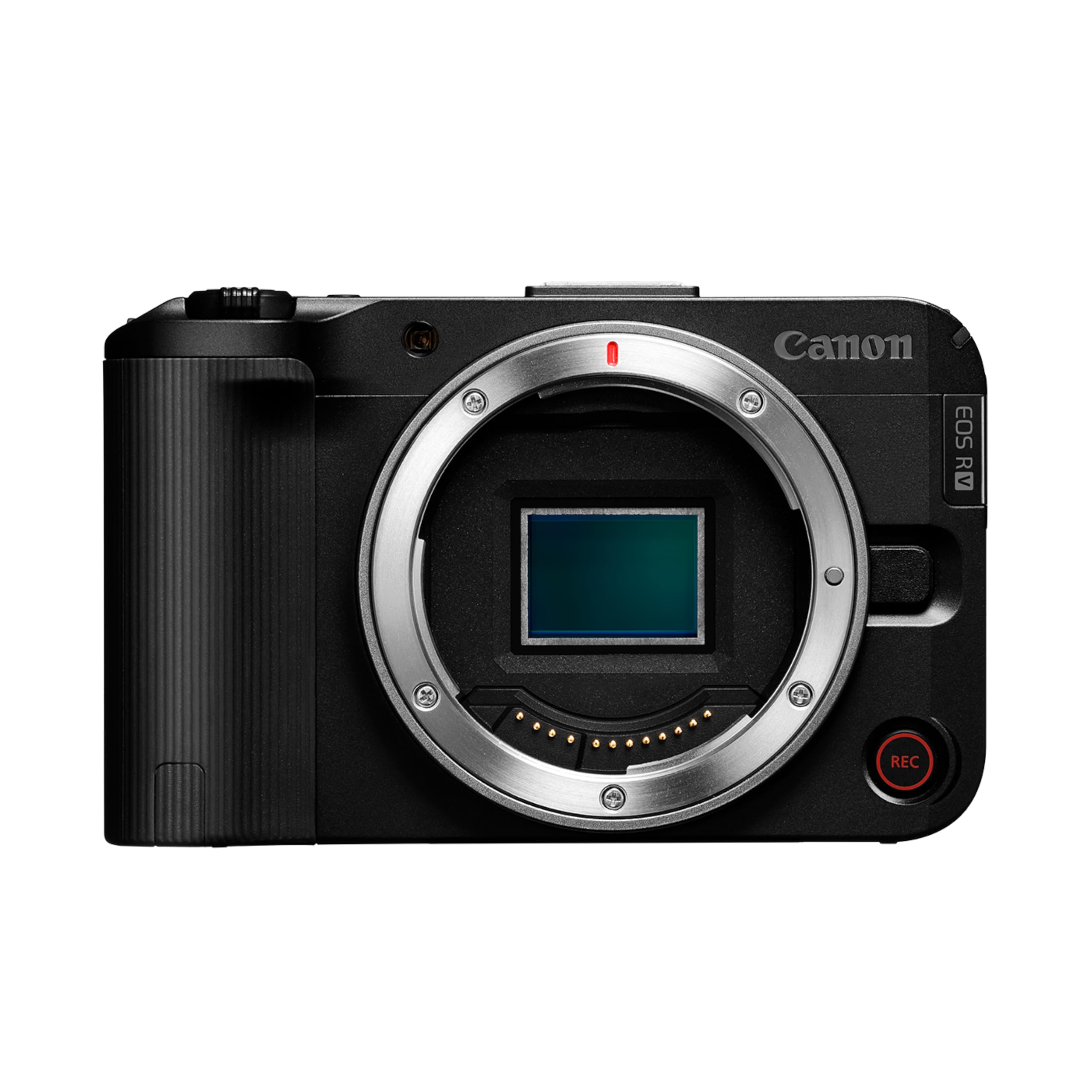
The EOS R50 V is Canon’s first V-series body, designed exclusively for video-first creators. It drops the viewfinder to keep weight and size minimal, but keeps the 24.2MP APS-C sensor and DIGIC X processor that powers its more expensive siblings. The fully articulating touchscreen flips out to the side, and a vertical video tripod mount lets you shoot portrait orientation without using a L-bracket.
Video recording reaches 4K/30p full-width (downsampled from 6K) and 4K/60p with a crop. Dual Pixel CMOS AF II delivers the same subject-tracking reliability as Canon’s pro RF bodies, including register people priority and animal/vehicle detection. Slow & Fast mode gives in-camera creative frame-rate control. C-Log3 and 10-bit 4:2:2 output via HDMI are available for color grading.
The body-only nature means you need to budget for an RF lens — the RF-S 18-45mm f/4.5-6.3 kit lens keeps cost reasonable but limits low-light performance. There’s no built-in flash and no headphone jack. The battery life feels better than older Canon mirrorless models, but all-day shooting still requires a spare. As a video-first interchangeable-lens camera, the R50 V offers the best AF and image quality at its price point.
Why it’s great
- 6K oversampled 4K with excellent sharpness
- Industry-leading Dual Pixel AF with subject detection
- Compact, lightweight body with vertical tripod mount
Good to know
- Body only; lens sold separately
- No viewfinder and no headphone jack
- Kit lens is slow; invest in faster RF glass for low light
4. Panasonic LUMIX G85 4K Camera

The G85 remains a powerhouse value years after launch because Panasonic packed pro-level stabilization into an affordable Micro Four Thirds body. The 5-axis in-body image stabilization works in concert with the kit lens’ Power O.I.S. to deliver handheld 4K video that looks tripod-mounted — a rare capability at this tier. The 16MP sensor with no low-pass filter resolves more detail than the spec suggests, and the splash-resistant magnesium-alloy build gives you weather sealing that entry-level APS-C rivals often lack.
The 3-inch tilt-touch LCD tilts up and down but doesn’t swing sideways, so external mic placement requires care. The electronic viewfinder is sharp and useful for shooting in bright sun. 4K Photo mode lets you extract 8MP frames from video, and Post Focus lets you change the focus point after capture. The included 12-60mm Power O.I.S. lens covers a useful wide-to-short-telephoto range that works for vlogging, travel, and documentary work.
The main trade-off is the Micro Four Thirds sensor — it won’t match APS-C or full-frame for shallow depth of field or extreme low-light noise performance. Autofocus in 4K video can hunt in low-contrast scenes, and there’s no headphone jack. Battery life is modest. But for handheld work where stabilization is everything, the G85 with kit lens is the most capable all-in-one under this ceiling.
Why it’s great
- Exceptional 5-axis IBIS makes handheld video smooth
- Weather-sealed magnesium body for outdoor use
- Excellent kit lens range (12-60mm) with OIS
Good to know
- MFT sensor limits bokeh and low-light vs APS-C
- AF hunts in low light during 4K recording
- Screen tilts but doesn’t flip sideways
5. Nikon Z 30 with 16-50mm Lens

Nikon’s smallest Z-series camera sheds the viewfinder and an internal flash to create a dedicated content creation tool that prioritizes video and live streaming. The Z 30’s flip-out touchscreen faces forward cleanly, and the red REC light on the top makes it obvious when you’re recording. The kit lens — a 16-50mm f/3.5-6.3 VR — adds stabilization and covers wide-angle selfies to moderate close-ups.
The 20.9MP APS-C sensor delivers sharp 4K video with excellent color science straight out of camera. Autofocus uses Nikon’s hybrid phase/contrast system with eye tracking for people and pets, and it’s fast and reliable in most conditions. For streaming, the Z 30 acts as a plug-and-play UVC/UAC webcam over USB-C at smooth Full HD 60p, with constant power over the same cable — no dummy battery needed.
There’s no viewfinder, which can disorient photographers used to composing through an EVF. The 16-50mm kit lens is versatile but slow at the telephoto end, limiting bokeh. Battery life is adequate for short sessions, but all-day streaming or extended vlogging demands a USB power bank. The Z 30 is the best choice if your primary use case is live streaming or short-form video where Nikon’s color science and webcam simplicity matter more than raw specs.
Why it’s great
- True plug-and-play webcam over USB-C with unlimited recording
- Excellent Nikon color science and skin tones
- Compact and light with built-in lens stabilization
Good to know
- No viewfinder — composing relies entirely on the LCD
- Kit lens is slow at telephoto end (f/6.3)
- Battery requires USB power for extended streaming
6. Canon PowerShot SX740 HS

The SX740 HS packs a staggering 40x optical zoom (24-960mm equivalent) into a body that fits in a jacket pocket — the only camera on this list that can shoot a bird across a field and then flip the screen 180 degrees for a selfie. The 20.3MP CMOS sensor and DIGIC 8 processor handle 4K video and 4K time-lapse movies. The 3-inch tilt-type LCD flips up 180 degrees for self-filming, though it tilts rather than fully articulates, so a hot-shoe mic will block the screen when flipped.
Zoom Framing Assist is a genuine innovation: when you zoom in to 40x and lose your subject, pressing the button pulls the zoom back temporarily so you can relocate, then snaps back. Optical image stabilization helps keep telephoto shots steady, though you’ll want a tripod or monopod for the long end. Continuous shooting hits 7.4 fps with AF or 10 fps with AF lock.
The small 1/2.3-inch sensor is the main limitation. Low-light performance falls behind 1-inch or APS-C cameras, and image quality at high ISO gets soft quickly. There’s no viewfinder, and the LCD can be hard to see in bright sunlight. Autofocus uses contrast detection only, which is slower and less reliable than phase-detect systems.
Why it’s great
- 40x optical zoom (24-960mm) in a pocketable body
- Zoom Framing Assist is genuinely helpful at telephoto range
- 4K time-lapse movie mode built in
Good to know
- Small sensor limits low-light quality significantly
- No phase-detect AF; contrast detection hunts
- Tilting screen rather than fully articulating
7. Sony ZV-1 Digital Camera

The original ZV-1 defined the modern vlogging compact category. Its 24-70mm f/1.8-2.8 Zeiss Vario-Sonnar T lens provides a real zoom range — not just a fixed ultra-wide — giving you the framing flexibility the ZV-1F lacks. The 20.1MP stacked 1-inch Exmor RS sensor with DRAM delivers excellent dynamic range and fast readout speeds. The side flip-out 3-inch touchscreen works cleanly with microphones and accessories.
Video features include 4K HDR (HLG), S-Log2/3 for color grading, and a defocused background bokeh switch that blurs the background instantly for a more cinematic talking-head look. Product Showcase mode smoothly transitions focus from your face to an object you hold up. The built-in directional microphone with a supplied windscreen captures usable on-camera audio, and the 3.5mm mic jack allows external upgrades. Image stabilization suppresses walking shake better than the ZV-1F.
The ZV-1 runs hot during extended 4K recording and can overheat in warm environments. Battery life with the NP-BX1 is short (~45 minutes recording), so a USB-C dummy battery is standard for desk setups like streaming or product reviews. The 24mm wide end is not as wide as the ZV-1F’s 20mm, so close-up selfies require a longer arm. The ZV-1 remains the more fully-featured compact for creators who want zoom control and pro video outputs in a fixed-lens body.
Why it’s great
- Zoom lens (24-70mm) provides real framing flexibility
- S-Log3/2 and HLG for color grading in post
- Product Showcase mode and background defocus switch
Good to know
- Overheats during extended 4K recording in warm rooms
- Small battery requires external power for all-day use
- 24mm wide end not as expansive as ZV-1F’s 20mm
8. Canon EOS R50 with RF-S 18-45mm Lens

The standard EOS R50 kit pairs the same 24.2MP APS-C sensor and DIGIC X processor as the R50 V with a compact RF-S 18-45mm f/4.5-6.3 STM lens. The key difference is the addition of a 2.36-million-dot OLED electronic viewfinder, which the V model omits — making this the better pick if you also shoot stills or need to compose in bright sunlight. The vari-angle touchscreen flips out sideways and rotates for selfie framing, tripod-free.
6K oversampled uncropped 4K/30p video delivers sharp footage with accurate colors and Canon’s well-regarded skin-tone reproduction. Dual Pixel CMOS AF II covers the full sensor area with 651 AF zones and supports auto-detection of people, animals, and vehicles. Continuous shooting reaches 15 fps with the electronic shutter, making it surprisingly capable for action photography. The built-in flash provides fill light for stills that the R50 V lacks.
The RF-S 18-45mm kit lens is compact and fine for daylight shooting but slow — f/6.3 at the telephoto end limits depth of field and low-light performance. Upgrading to the RF 16mm f/2.8 or RF 50mm f/1.8 unlocks the camera’s real potential. The small grip can feel cramped with larger lenses, and the single card slot limits backup. It’s the best hybrid option if you want a viewfinder for photography alongside vlogging capability.
Why it’s great
- Includes EVF for sunny-day composition and stills
- 6K oversampled 4K video with excellent sharpness
- Fast burst shooting (15 fps) for action
Good to know
- Kit lens is slow; budget for faster RF glass
- Small grip feels cramped with heavier lenses
- Single SD card slot with no backup
9. Sony Alpha a6400 Mirrorless Camera

The a6400 is the oldest camera in this lineup, but it still sets the standard for autofocus speed at this tier. Sony’s 0.02-second acquisition with 425 phase-detection points covering 84% of the sensor is genuinely faster and more sticky than many cameras released years later. Real-time Eye AF for humans and animals keeps subjects locked even when they move unpredictably. The 24.2MP APS-C sensor produces sharp, natural-color stills and oversampled 4K video.
The flip-up 180-degree touchscreen tilts upward for selfie framing, but it’s a tilt mechanism — not a side articulation — so it blocks the hot shoe and makes external microphone placement awkward without a cage or L-bracket. The body is compact and lightweight, perfect for street photography or an everyday carry. The E-mount ecosystem offers the widest lens selection of any mirrorless system, with affordable third-party glass from Tamron, Sigma, and Samyang.
Key downsides include the lack of in-body stabilization, so you’ll rely on OSS lenses for steady handheld video. The 4K 30p mode has a significant crop (1.5x) compared to full-frame cameras, with rolling shutter that’s noticeable in panning shots. The touchscreen is only for focus-point selection, not full menu navigation. The a6400 is still a brilliant camera for stills and studio-style video, but its age shows in the screen mechanism and stabilization gap compared to newer competitors.
Why it’s great
- Blazing-fast 0.02s AF with real-time eye tracking
- Huge E-mount lens ecosystem with affordable third-party options
- Compact, durable body with DSLR-beating image quality
Good to know
- No in-body stabilization; steady video needs OSS lenses
- Flip-up screen blocks hot shoe for mic attachment
- 4K rolling shutter is noticeable and no headphone jack
FAQ
What is the difference between a tilting screen and an articulating screen for vlogging?
Can I use an affordable flip-screen camera as a webcam for live streaming?
Do I need in-body image stabilization (IBIS) for handheld vlogging?
Final Thoughts: The Verdict
For most users, the best affordable digital camera with flip screen winner is the Sony ZV-1F because its 20mm f/2.0 ultra-wide lens, side-articulating screen, and excellent built-in audio make it the most complete selfie-vlogging package at its price. If you need gimbal-smooth footage without carrying extra gear, grab the DJI Osmo Pocket 3 Creator Combo. And for interchangeable-lens versatility with pro-grade autofocus, nothing beats the Canon EOS R50 V.