
A runner’s arch isn’t just a curve—it’s a natural shock absorber that collapses under repetitive pounding, sending stress up through the shins, knees, and hips. The wrong insole leaves the foot unsupported mid-strike, turning every mile into a battle against fatigue and injury.
I’m Min — the co-founder and writer behind Gadgets Feed. My analysis of this category focuses on how arch height, heel-cup depth, and material density interact to control pronation and return energy during the gait cycle, helping you avoid common running injuries like plantar fasciitis and shin splints.
After sorting through dozens of foot-scanning technologies and podiatrist-backed designs, I’ve narrowed the field to seven contenders that deliver real structural support for the runner’s foot. This guide to the best arch support insoles for running breaks down what actually works under load.
How To Choose The Best Arch Support Insoles For Running
Not every insole is designed to handle the repeated impact of a heel strike at a 9-minute-mile pace. Runners need three things: a dynamic arch that matches their foot type, a heel cup deep enough to lock the calcaneus in place, and a base material that doesn’t pack out after 300 miles. Ignoring any of these invites overpronation, plantar fascia strain, or energy loss mid-stride.
Match the Arch Profile to Your Foot Type
Low-arch runners (flat feet) need a firm medial post to prevent the foot from rolling inward excessively. High-arch runners require a shock-absorbing heel pad and a flexible arch bridge that doesn’t poke the midfoot. Medium-arch runners can often use a neutral profile, but the best insoles offer three distinct arch heights so you can dial in the fit without needing custom orthotics.
Heel Cup Depth and Decoupling
A deep, decoupled heel cup wraps around the calcaneus and prevents lateral wobble during the landing phase. If the cup is too shallow, the heel shifts inside the shoe, reducing stability and increasing the risk of ankle sprains. Look for a cup depth of at least 8–10 mm in the rearfoot area for running-specific insoles.
Material Density and Mileage Lifespan
Polyurethane foams and closed-cell EVA provide the best energy return and compression resistance over 400–500 miles. Open-cell foams like standard memory foam feel soft initially but lose support within 100 miles. Carbon-fiber reinforcements add stiffness for overpronators without adding weight, but they reduce forefoot flexibility for midfoot strikers.
Quick Comparison
On smaller screens, swipe sideways to see the full table.
| Model | Category | Best For | Key Spec | Amazon |
|---|---|---|---|---|
| PowerStep Pinnacle | Orthotic | Plantar fasciitis relief, daily trainers | Dual-layer cushioning, no trimming needed | Amazon |
| Move Game Day Performance | Athletic | High-impact sports, jump-heavy activities | Composite heel, reactive stability | Amazon |
| CURREX ActivePro | Activity-Specific | Multi-sport, high-intensity lateral movement | 3 arch profiles, deep decoupled heel cup | Amazon |
| CURREX RunPro | Running-Specific | Long-distance road running, zero-drop shoes | 3 arch profiles, zero heel drop, 4.96 oz | Amazon |
| Superfeet Run Cushion Low Arch | Trim-to-Fit | Low arches, moderate pronation control | Adaptive Comfort Technology, moisture-wick top | Amazon |
| Carbon Fiber Insole by TEGA | Carbon-Fiber | Overpronation, shock absorption, explosive movements | Gel heel pad, memory foam top, carbon-fiber layer | Amazon |
| Aetrex Speed Orthotic | Premium Performance | High arches, pronation correction, long-distance walking | Aerocell PU base, .2165” thickness, Exofoam top | Amazon |
In‑Depth Reviews
1. PowerStep Pinnacle Insoles

The PowerStep Pinnacle is a podiatrist-recommended full-length orthotic that delivers moderate pronation control through a semi-rigid arch shell and dual-layer cushioning. The top layer uses a soft polyester foam that reduces shear forces, while the base layer provides structural support without overwhelming the foot. Users report significant plantar fasciitis relief and reduced lower back pain after a short break-in period, with many noting that the arch contour doesn’t crowd the midfoot the way some rigid orthotics do. At 5.6 ounces per pair, these carry minimal weight penalty for long runs or all-day wear.
The no-trimming design simplifies fitting—you order by shoe size, and the insole drops directly into sneakers, boots, or casual footwear. The 30-day money-back guarantee reduces the risk of a poor match. Reviewers consistently rate this as the first insole that actually calmed chronic plantar fasciitis, with one user reporting 65% pain reduction after ten days. The heel posting is firm enough for moderate overpronation but not so stiff that it causes discomfort during high-mileage days.
While the arch shape works well for medium- to high-arch feet, runners with very flat feet may find the support too aggressive at first. The moderate pronation control is a deliberate compromise—it stabilizes without locking the foot into an unnatural position. For daily trainers and recovery runs, this is the most balanced option in the arch support insoles for running category.
Why it’s great
- Immediately reduces plantar fasciitis pain and lower back strain.
- Drop-in sizing eliminates guesswork and trimming.
- Dual-layer foam balances cushioning with arch rigidity.
Good to know
- May press uncomfortably on very flat arches.
- Heel posting can feel firm for ultra-long distances.
2. Move Game Day Performance Insoles

Co-founded by NBA All-Pro Damian Lillard, the Move Game Day insole is built for the multi-directional demands of basketball, volleyball, and running. The composite heel insert absorbs high-impact landings while a reactive stability plate returns energy during toe-off, making it one of the more versatile insoles for athletes who mix court time with road miles. Reviewers mention that it eliminated chronic shin splints after five years of struggle, with one runner able to complete a pain-free mile immediately after switching from worn-out New Balance 1080s.
The molded forefoot design conforms to the shoe’s internal shape, reducing slippage during lateral cuts. At 4.23 ounces, it’s lighter than most orthotics, and the no-cut sizing means you don’t need to trim the insole—just drop it in. The arch support targets plantar fasciitis, flat feet, and bunions, with several users replacing pricey custom orthotics with this option. For runners under 30 with healthy joints, this is an excellent high-activity choice.
However, heavier or older runners (particularly those over 200 pounds with existing ankle or knee injuries) may find the heel cushioning insufficient for high-mileage training. One 45-year-old reviewer noted that the shock absorption ranked below several competitor insoles during long walks. The Game Day excels in short, explosive sessions rather than marathon-distance comfort.
Why it’s great
- Composite heel absorbs high-impact shock during jumps and sprints.
- Zero trimming required; drop-in fit works for most athletic shoes.
- Multiple users report elimination of shin splints.
Good to know
- Heel cushioning may be too firm for runners over 200 lbs.
- Forefoot feels less cushioned for heel-strikers on long runs.
3. CURREX ActivePro Insoles

The CURREX ActivePro is designed for multi-sport athletes who transition between basketball, volleyball, dance, and running. The key innovation is the three-profile arch system (low, medium, high), ensuring you don’t get stuck with a one-size-fits-all contour that misaligns your foot. The deep decoupled heel cup wraps and locks the calcaneus, reducing lateral heel slippage during quick direction changes. Runners with flat feet reported that the low-profile version eliminated foot fatigue during 13.5-hour hospital shifts while also preventing morning foot soreness.
At 4.64 ounces, the ActivePro is lightweight enough for speed work, and the breathable foam top layer manages moisture well during sweaty sessions. The targeted cushioning in the heel and toe absorbs shock exactly where the foot needs it most during high-intensity movement. Users with high arches noted that the blue (high-arch) profile provided exceptional support without the bulk of rigid orthotics, maintaining proper alignment during lateral cuts.
Where the ActivePro falls short is for runners who need extreme pronation control—the flexible anatomic support is intentionally less rigid than traditional orthotics, which means it offers less correction for severe overpronation. Additionally, the insoles are recommended for replacement after 500 miles or 12 months, which is slightly shorter than some competitors. For runners who also play court sports, this is the most adaptable platform available.
Why it’s great
- Three arch profiles allow precise fit for low, medium, and high arches.
- Decoupled heel cup eliminates lateral wobble during landing.
- Breathable foam top reduces moisture buildup.
Good to know
- Flexible support limits correction for severe overpronators.
- Needs replacement after 500 miles or 12 months.
4. CURREX RunPro Insoles
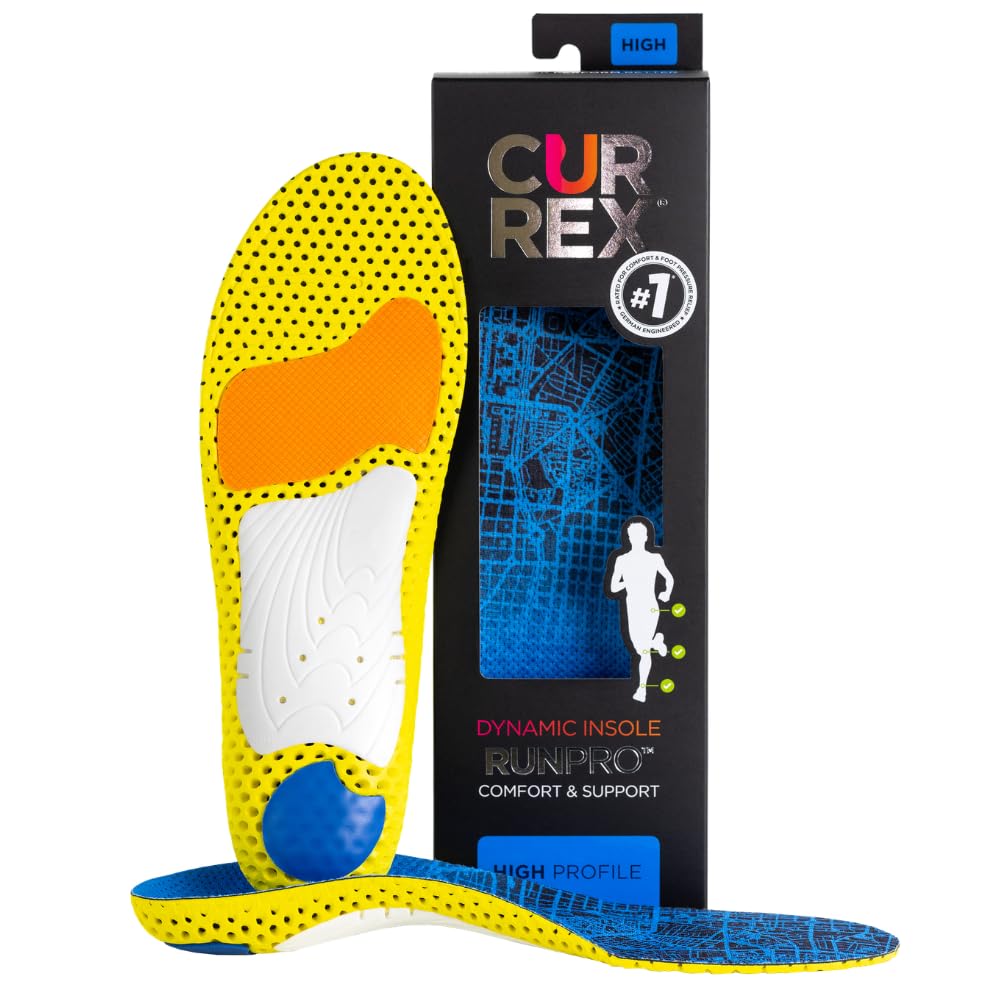
The CURREX RunPro is engineered specifically for running, with a zero-heel-drop design that maintains the natural foot position preferred by midfoot and forefoot strikers. The 3D Dynamic Arch Technology uses a decoupled heel cup that follows the natural flex point of the foot, allowing the insole to bend with the gait rather than fighting it. Rebound cushioning and controlled power transmission deliver faster regeneration during long runs, and users report that it rivals custom orthotics for arch support and padding density.
At 4.96 ounces, the RunPro is slightly heavier than the ActivePro, but the trade-off is a more durable polyurethane base that holds its shape after 500+ miles. The three arch profiles (low, medium, high) let you dial in the support level, and the trim-to-fit design means you can customize the length. Runners with high arches praised the blue profile for preventing shin splints and reducing foot fatigue during long-distance training. Many users noted that the RunPro outperforms store-brand insoles from major running retailers.
The main drawback is the price point, which sits near the top of the mid-range tier. The trim-to-fit process requires careful cutting to avoid compromising the heel cup geometry. Several users mentioned a break-in period of about 10–15 miles before the arch support felt fully dialed. For dedicated road runners who log 30+ miles per week, the RunPro is the most running-specific option on this list.
Why it’s great
- Zero heel drop preserves natural running gait.
- Three arch profiles provide custom-like fit for any foot type.
- Durable polyurethane base lasts 500+ miles.
Good to know
- Requires careful trimming to avoid altering heel cup geometry.
- Break-in period of 10–15 miles recommended.
5. Superfeet Run Cushion Low Arch Insoles

The Superfeet Run Cushion (formerly the Superfeet ADAPT series) is specifically tuned for runners with low arches who need moderate pronation control. The Adaptive Comfort Technology uses a flexible arch shape that moves with the foot during heel-to-toe turnover, rather than fighting the natural pronation cycle. Users have reported that these insoles eliminated hip flexor pain and outer hip strain after just one day of walking, with one runner able to restart exercise after failed attempts with cheaper drugstore brands.
The moisture-wicking top cover is a standout feature for runners who sweat heavily, keeping the foot dry and reducing odor. At 4.83 ounces, the Run Cushion is light enough for speed work, and the trim-to-fit design lets you size up if you’re between sizes—always cut smaller than you think. Reviewers consistently rate this as superior to Valsole and Dr. Scholl’s alternatives for low-arch support, with many noting that it provides comparable support to custom orthotics.
The primary downside is that the arch support is explicitly designed for low arches—users with medium or high arches should look at the Run Comfort or Run Support models instead. Some runners experienced a mild burning sensation on the sole during the first few walks, though this typically subsided after 10–15 miles. For flat-footed runners who prioritize a natural foot strike, the Run Cushion is a precise tool rather than a generalist insole.
Why it’s great
- Specifically calibrated for low arches and moderate pronation.
- Adaptive Comfort Technology flexes with the foot naturally.
- Moisture-wick top cover reduces odor during sweaty runs.
Good to know
- Unsuitable for medium or high arches; only comes in low arch profile.
- Minor sole burning sensation may occur during break-in.
6. Carbon Fiber Insole by TEGA DESIGN
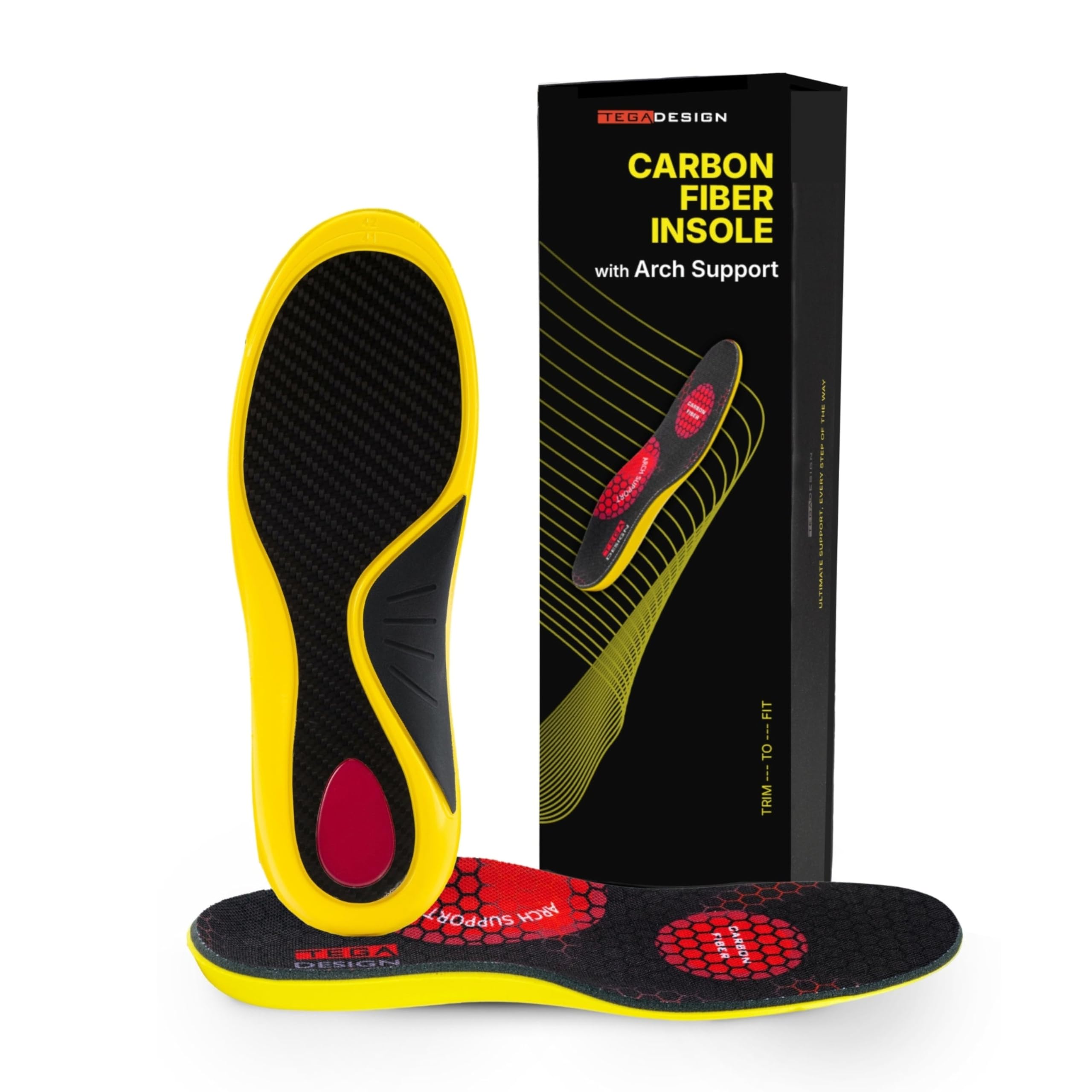
The TEGA DESIGN Carbon Fiber Insole is a high-end option that uses a genuine carbon-fiber layer to provide stiff arch support without adding bulk. The carbon fiber stops at about 60–75% of the insole length, leaving the forefoot flexible for natural toe-off while the reinforced arch prevents overpronation during the stance phase. A gel pad under the heel absorbs impact, and the memory foam top layer adds plushness for all-day wear. Reviewers have described the sensation as “springy” and “elevating,” with several athletes noting improved quickness and vertical responsiveness.
At 11.36 ounces per pair, these are the heaviest insoles on this list, but the weight is concentrated in the carbon-fiber layer, which sits low in the shoe stack and doesn’t feel cumbersome during movement. The breathable fabric top prevents moisture buildup, and the trim-to-fit design allows customization. Users with wide feet (4E width) reported that the insole accommodates their foot shape well, and those suffering from heel pain and leg tightness saw significant relief within days.
The main trade-off is the forefoot flexibility limitation—the carbon fiber doesn’t extend the full length, which means the exposed toe area can irritate arthritis-prone joints during the bending phase. Additionally, the rigid arch may feel too aggressive for runners with medium arches who aren’t overpronators. For those with flat feet or a history of plantar fasciitis who want maximum stability, this is the stiffest platform available.
Why it’s great
- Carbon-fiber layer provides industry-leading arch stiffness.
- Gel heel pad absorbs high-impact shock effectively.
- Memory foam top layer adds all-day comfort.
Good to know
- Forefoot area lacks carbon-fiber support; may irritate arthritic toes.
- Heavy design at 11.36 ounces per pair.
7. Aetrex Women’s Speed Orthotic

The Aetrex Speed Orthotic is a premium, podiatrist-designed insole that prioritizes energy return through an Aerocell polyurethane base and a super-lightweight Exofoam top layer. The arch placement is set slightly further back than most insoles—a deliberate design choice backed by research to relieve heel and arch pain associated with plantar fasciitis. Users report that this orthotic makes every pair of sneakers feel like a custom fit, with one reviewer noting that it feels like “gold” for high arches.
At just 0.2165 inches thick, the Speed Orthotic is one of the thinnest performance insoles on the market, making it ideal for shoes with tight internal volume. The mesh fabric top cover breathes well during long runs, and the sturdy gel construction provides excellent support for moderate pronation without feeling hard underfoot. Runners with high arches consistently rate this as their go-to for both running and walking, with many finding that it improves alignment and reduces knee pain.
The primary limitation is the unisex sizing panel that leans toward women’s fit—male runners with wide feet may find the width restrictive. Additionally, the premium price point places it at the top of the budget, although users note that the durability justifies the investment. For high-arch runners who want a low-profile, high-energy-return insole that doesn’t crowd the toe box, this is the most refined option available.
Why it’s great
- Extremely low profile (0.2165”) fits tight athletic shoes.
- Aerocell PU base delivers high energy return during toe-off.
- Backed by podiatrist research for heel and arch pain relief.
Good to know
- Women’s-fit sizing may feel narrow for men with wide feet.
- Premium price point requires a higher upfront investment.
FAQ
Do I need low, medium, or high arch insoles for running?
How often should I replace running-specific insoles?
Can I use carbon-fiber insoles for daily training?
What does “decoupled heel cup” mean for runners?
Final Thoughts: The Verdict
For most runners, the best arch support insoles for running winner is the PowerStep Pinnacle because it combines podiatrist-recommended pronation control with dual-layer cushioning that works for daily trainers and recovery days without requiring trimming. If you want the most versatile multi-sport option, grab the CURREX ActivePro for its three arch profiles and deep decoupled heel cup. And for dedicated long-distance runners who prefer a zero-drop, running-specific platform, nothing beats the CURREX RunPro.