
Our readers keep the lights on and my morning glass full of iced black tea. As an Amazon Associate, I earn from qualifying purchases.
Specs are compiled from manufacturer listings and verified buyer reviews and can change over time — please confirm the key details on the product page before buying.
You do not need to spend thousands to spot a water leak behind drywall or an overheating circuit breaker. A capable affordable infrared camera, built around a solid sensor and paired with a clear screen, puts professional-grade heat vision into your hands for a few hundred dollars — as long as you pick the one that actually fits your specific job.
I’m Min — the founder and writer behind Gadgets Feed. This guide is built by comparing the manufacturers’ published specifications and the patterns across verified customer reviews, so you get each pick’s real strengths and trade-offs instead of marketing spin.
Whether you are checking insulation gaps, tracing HVAC ducts, or scanning a fuse box for hot spots, the right camera pays for itself once you match resolution and battery life to your job.
How To Choose The Best Affordable Infrared Camera
Every inexpensive thermal imager trades off pixel count, battery life, or lens quality. Knowing where to compromise separates a tool you use monthly from one you regret buying.
IR Resolution and Super-Resolution
The sensor’s native pixel count (such as 96×96, 160×120, or 256×192) determines the raw detail in each frame. A higher native pixel count lets you identify small heat signatures, like a loose wire behind a wall plate, from a greater distance. Many cameras now include a software boost — called TISR (Thermal Image Super Resolution) or Live Super Resolution — that mathematically sharpens the image, sometimes nearly doubling the effective output (for example, 256×192 up to 512×384). That extra clarity matters when tracing a slow leak inside a pipe.
Temperature Range and Accuracy
Most affordable models cover at least -4°F to 572°F, which handles household electrical panels, baseboard heaters, and HVAC ducts. A wider extension up to 1022°F helps if you monitor industrial gear or exhaust manifolds. Accuracy is usually quoted as ±2% or ±3.6°F; this is largely consistent across modern cameras and is rarely the deciding factor unless you need laboratory-grade readings.
Battery Life and Storage
A typical lithium-ion battery powers a handheld imager for 4 to 8 hours of continuous use. Models that use a phone as the screen (USB-C dongles) draw power from the phone, so they never run out of their own battery. Built-in storage from 8GB to 64GB saves you from hunting for a memory card, but an SD card slot lets you swap cards between devices.
Durability and Ergonomics
Look for an IP54 rating (protection against dust and splashing water) and a drop-test spec (usually 2 meters or 6.6 feet) if you take the camera into construction sites or damp basements. A 3.5-inch touchscreen is easier to read than a 2.8-inch display, but a compact dongle that plugs into your phone is far more portable. A built-in laser pointer and LED flashlight help you confirm what you are measuring in a dark crawl space.
Quick Comparison
On smaller screens, swipe sideways to see the full table.
| Model | Best For | IR Resolution (Native) | Battery Life | Display Size | Amazon |
|---|---|---|---|---|---|
| TOPDON TC004 | Best Overall | 256×192 | 8-hour | 3.5″ | $299.00$369.00Amazon |
| Thermal Master Thor 002 | Premium Pick | 256×192 | 10.5-hour | 3.5″ | $399.00Amazon |
| FOXWELL RT280 PRO | Top Performer | 256×192 | — | 2.8″ | $312.00$349.00Amazon |
| HIKMICRO E1L | Most Versatile | 160×120 | 8-hour | 2.4″ | $299.00Amazon |
| TOPDON TC002C Duo | Compact Pick | 256×192 | Phone-powered | Phone screen | $229.99$319.00Amazon |
| FLIR TG165-X | Best Value | 4,800-pixel | — | LCD | $299.00$379.00Amazon |
| Klein Tools TI250 | Budget Champion | 19,200-pixel | — | Display | $314.38$349.99Amazon |
| HP96 | Entry-Level | 96×96 | — | 3.5″ | $209.99$239.49PrimeAmazon |
| FLIR C3-X | Compact Favorite | 128×96 | — | Display | $454.58Amazon |
In‑Depth Reviews
1. TOPDON TC004 3.5″ Thermal Imaging Camera
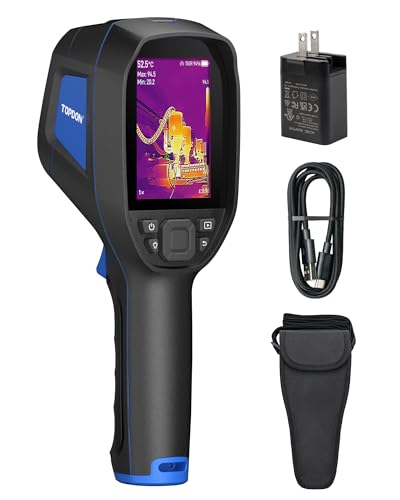
The handheld that marries a crisp 256×192 sensor with long-running power and a generous 3.5-inch screen.
You see subtle temperature differences clearly because the TC004 uses TISR (Thermal Image Super Resolution) technology to sharpen its native 256×192 infrared resolution up to 512×384. A reviewer who called it the “best thermal camera used” highlighted the long battery life and the high resolution that “captures slight temp differences” — a concrete benefit when scanning a boiler or tracing a draft around a window frame.
The built-in 64GB storage holds thousands of images and video clips without needing a separate card, and the red laser pointer helps you confirm exactly which pipe or wire you are measuring. It also includes an LED light for working in dark crawl spaces, and the IP54 dust/water protection plus 2-meter drop resistance means you are not worrying about it breaking on a job site.
A common catch owners mention is that the free PC analysis software comes inside a RAR archive (a compressed file format) that requires a separate tool to extract, a step not obvious from the product page. One reviewer noted a “hidden cost: requires yearly WinZip to extract analysis software from RAR files,” so budget for that if you plan to analyze images on a Windows computer. Still, the combination of 512×384 TISR output, 8-hour runtime, and generous onboard storage makes this the most balanced pick for homeowners and electricians alike.
What Stands Out
- Native 256×192 IR sensor boosted to 512×384 via TISR
- 64GB built-in storage, no SD card needed
- Laser pointer and LED light for precise targeting
Heads-Up
- PC analysis software packed in a RAR archive, extraction not obvious
- Manual is mostly non-English according to one reviewer
Reach for this if: you need a standalone handheld with enough detail and storage to inspect a whole house in one session without recharging.
Look elsewhere if: you prefer a pocketable phone dongle or you rely on Mac-based PC analysis — the software appears Windows-only.
2. Thermal Master Handheld Thermal Camera, Thor 002
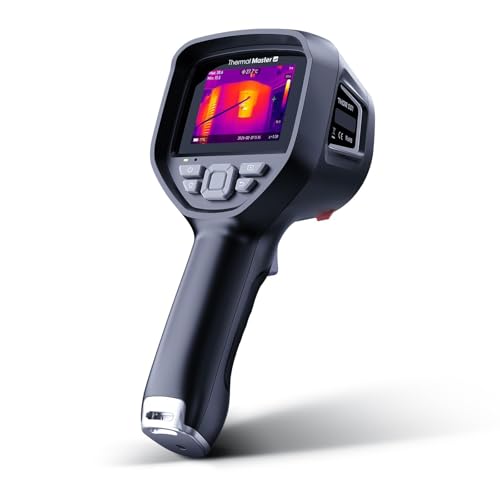
A 10.5-hour battery and a 640×480 IPS screen that make extended inspections feel easy.
This unit stands out for its exceptionally long runtime — a 5000mAh lithium battery that powers the camera for up to 10.5 hours and supports 18W fast charging, so you can scan an entire commercial building on a single charge. The 3.5-inch 640×480 IPS (In-Plane Switching) display is noticeably crisp, and the X³IR technology upscales the native 256×192 sensor to 512×384 for sharper heat signatures.
You get a 2MP visible-light camera, a laser pointer, and a 4.3mm lens that extends detection range by 34.4% compared to a standard lens, plus 4X digital zoom for looking at distant hot spots. It also offers 8GB of RAM and 32GB of internal storage, along with WiFi pairing to a smartphone or tablet for remote viewing. A reviewer who previously owned a FLIR said “I’ve had a Flir for years and have had constant issues with clarity, app crashing and battery issues. I purchased this unit and am very impressed with its quality, features, clarity.”
The primary trade-off is that a few owners experienced a power-on failure after several months — one reviewer found that holding the power and play buttons for 10 seconds fixed the issue, and the seller later offered a 2-year warranty replacement. It is also heavier than a compact dongle, so weigh that against the sheer runtime if you carry your gear all day.
Long-haul star: You get a 10.5-hour battery, a 640×480 IPS screen, and 512×384 boosted resolution — ideal for professionals who need one camera to last the whole shift.
The caution: A few buyers report an intermittent boot issue that a hard reset resolves, and customer support responsiveness varied initially.
3. FOXWELL RT280 PRO Thermal Camera
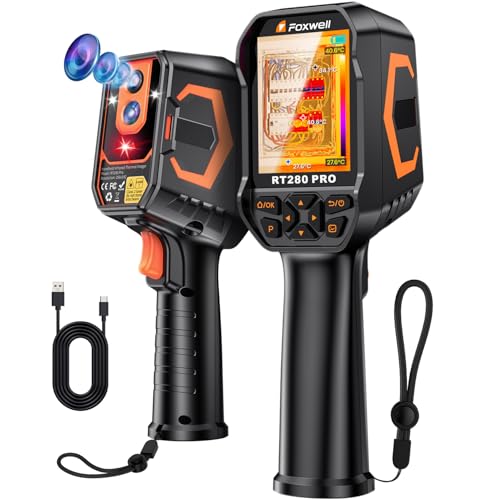
A field-ready imager that survives 6.6-foot drops and then delivers sharp 512×384 boosted images.
The RT280 PRO handles the bumps and splashes of real construction work — it is rated IP54 (dust-protected and splash-proof) and can survive a 6.6-foot drop, so you are not panicking if it slips off a ladder. Its 2.8-inch LCD screen may be smaller than the 3.5-inch panels on other picks, but the TISR technology elevates the effective thermal resolution from 256×192 to 512×384, and the 56°x42° field of view covers a wide area during a single sweep.
It measures from –4°F to 1022°F with ±3.6°F / ±2% accuracy and automatically tracks the highest, lowest, and central temperature points, with high/low alarms that give you an audible or visual alert when something crosses your set threshold. You also get 9 color palettes, a laser pointer, and an LED light. Owners mention it is “comparable to + cameras” for home inspections and that the screen refresh rate is not as laggy as other units in its class.
The included PC analysis software supports 2D and 3D thermal imaging and automated report generation, but it only works on Windows — not Mac. A reviewer noted the image could be “a bit crisper,” but overall the consensus is that it delivers strong value versus much pricier competitors. Given its drop rating, wide temperature range, and boosted resolution, this suits electricians and HVAC techs who work in tough environments.
Built Tough
- 6.6-foot drop test and IP54 rating
- 512×384 TISR for sharp details
- High/low temperature alarms with audible alerts
Compact Screen
- 2.8-inch display is smaller than typical 3.5-inch competitors
- PC analysis software is Windows-only
Your pick if: you work on job sites where drops and dust are common and you need a wide temperature range up to 1022°F.
skip it if: a large on-screen image is a priority or you rely on a Mac for post-inspection analysis.
4. HIKMICRO E1L Thermal Imaging Camera
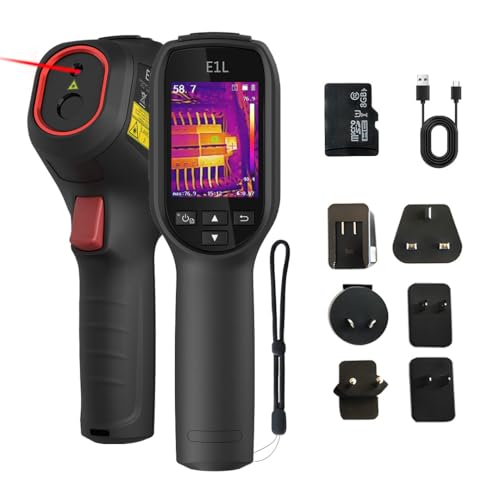
A lightweight 350-gram imager with a wide temperature range and professional-grade PC software included.
The E1L uses a native 160×120 IR sensor — already a step above the 96×96 sensors found on entry-level models — and its large 240×320 display gives you a clear view of live and captured images. It spans a temperature range from -4°F to 1022°F, significantly wider than many standard models that cap at 752°F, so you can inspect both household electrical panels and industrial machinery with the same tool.
It ships with an 8GB removable memory card that can hold over 100,000 radiometric images (images that store temperature data for each pixel), and the free HIKMICRO Analyzer software for Windows lets you perform 3D plotting, batch analysis, and custom report generation. A reviewer noted it is “accurate and sees temp change super well for identifying leaks and wet areas.” The camera also has a laser pointer, four color palettes (White Hot, Black Hot, Rainbow, Ironbow), and an IP54 rating with 2-meter drop resistance. The 3-year warranty on the device and 10-year warranty on the thermal sensor add long-term confidence.
One owner mentioned the battery needs to charge while the camera is on for 8-10 hours to fully condition it, and another pointed out that charge retention can drop between uses if you leave it idle for weeks. The 160×120 sensor is fine for home diagnostics, but it cannot match the native 256×192 detail of the higher-tier picks on this list.
Versatile workhorse: The E1L pairs a wide -4°F to 1022°F range with professional PC analysis software, making it a strong choice for anyone who wants to generate detailed reports without paying extra for software licenses.
One caveat: The 160×120 sensor is a middle ground — good enough for insulation and electrical checks but not as sharp as 256×192 units for tiny heat signatures.
5. TOPDON TC002C Duo Thermal Camera

A 1.1-ounce USB-C dongle that turns any smartphone into a 256×192 thermal imager.
At just 1.1 ounces (30g) and measuring 2.8″ x 1.7″ x 0.55″, this camera plugs directly into a USB-C iPhone, iPad, or Android device — no battery to charge, no separate screen to carry. The native 256×192 IR sensor uses TISR technology to boost effective output up to 512×384, and the 25Hz refresh rate keeps the live feed smooth when you are scanning a moving target. One buyer mentioned it “quickly found hot water leak under house,” which saved them significant repair costs.
The temperature range spans -4°F to 1022°F with ±2°C or 2% accuracy, and the TopInfrared app offers an AI mode with 200 free queries for automated anomaly detection. The Duo feature blends thermal and visible-light images so you overlay heat patterns on a real-world photo, making it easier to mark a leak location. The build is anodized aluminum, and it includes a padded case with multiple cables (USB-C/Lightning and USB-A/USB-C). Reviewers praise the near-field image quality, saying it “surpasses FLIR Scout II 640” in the 1-3 meter range.
The main downside is that the USB-C connection feels looser than a fixed housing — one owner reported it “breaks easily” if bumped while plugged in. It also lacks autofocus, so you need to hold the phone steady at the correct distance. Since it draws power from your phone, heavy use will drain your phone battery faster than usual.
Pocket-Sized Power
- Only 1.1 oz, no separate battery needed
- 256×192 sensor boosted to 512×384 via TISR
- Durable anodized aluminum build
Phone-Dependent
- USB-C connector feels loose in some phones
- No autofocus; requires steady hand
- Drains phone battery during use
Ideal for: homeowners and DIYers who want a pocketable thermal camera they can pull out with their phone and use immediately without charging anything.
Not ideal for: professionals who need a dedicated screen and rugged standalone body for all-day field work.
6. FLIR TG165-X Thermal Imaging Camera
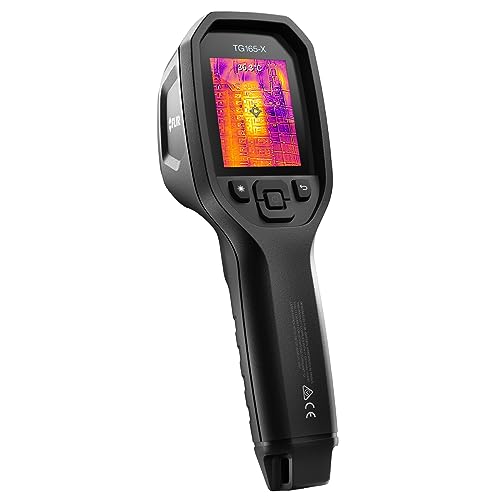
A commercial-grade FLIR with patented MSX overlay that embosses visual details onto the thermal image.
The TG165-X packs a 4,800-pixel IR detector and a temperature range from -13°F to 572°F (-25°C to 300°C), enclosed in a rugged body rated IP54 with a drop-tested design. What makes it stand out is FLIR’s patented MSX (Multi-Spectral Dynamic Imaging) technology, which takes the visible-light camera’s detail and lays it over the thermal image — so you see the numbers on a breaker panel clearly while also reading the heat signature.
The Bullseye laser pointer shows the measurement area’s exact size, and the camera is very compact at 0.87 pounds. Reviewers love it for finding cold/hot spots, wiring issues, water pipes, and insulation gaps. One owner called it the “best hand held thermal image I have used for under ” and said FLIR “has always been top notch.” Battery life and ease of use get consistent praise, with owners saying it works great right from the start. FLIR backs it with a 2-10 year warranty — 2 years parts and labor on the camera and 10 years on the detector.
The 4,800-pixel sensor is lower resolution than the 160×120 or 256×192 sensors on other picks here, so you will not see as much fine detail when you zoom in on a small heat spot. A few users mentioned occasional freezes that a button reset fixes. At this price point, you are paying for the FLIR brand reputation and the helpful MSX overlay rather than raw pixel count.
Reliable brand, smart overlay: If you want a FLIR name with MSX visual detail and a 10-year detector warranty, this is the most affordable entry into that ecosystem.
Resolution caveat: The 4,800-pixel detector is lower than most competitors at this price, and the occasional freeze requires a hard reset.
7. Klein Tools TI250 Rechargeable Thermal Imaging Camera

A compact diagnostic tool from a trusted brand that helps you cut energy waste at home.
The TI250 displays over 19,200 pixels (a 160×120 equivalent sensor) and lets you set high and low temperature alarms from -4°F to 752°F. It also gives you adjustable emissivity (a material’s ability to emit infrared radiation) from 0.01 to 0.99, which helps you get accurate readings on different surfaces like painted drywall, bare copper pipes, or chrome fixtures. One customer observed that the TI250 helped cut their home electricity consumption from 8,000 kWh to 5,500 kWh in one year after finding severe heat loss from recessed lights.
You get three selectable color palettes to highlight shifting hot spots, and images save via USB-C for later review. The rechargeable lithium-ion battery and compact 8.6-ounce body make it easy to carry around the house, and the intuitive operation gets you scanning within minutes. Owners appreciate how effectively it spots swamp cooler issues, air leaks, and equipment hot spots — one user even uses it to find cold spots in freeze-dried food.
This model cannot match the native resolution of 256×192 sensors, so tiny details like a single loose wire in a crowded junction box can be harder to pick out. The display shows the temperature range across the whole frame; if the scene is uniform in temperature, the screen appears as a single color, which can confuse new users. For basic energy audits and general home troubleshooting, though, the TI250 delivers reliable results without the learning curve.
Energy Detective
- Adjustable emissivity for accurate readings on different materials
- Compact at 8.6 oz with rechargeable battery
- Temperature alarms help catch hot spots fast
Limited Detail
- 19,200-pixel sensor is low compared to 256×192 competitors
- Uniform-temperature scenes appear as one color, can confuse beginners
Best for: homeowners focused on energy efficiency who want a simple, dependable camera from a brand they already trust for tools.
Not for: anyone who needs to zoom in on tiny electronic components or requires fine thermal detail across a wide distance.
8. HP96 Thermal Imaging Camera

A budget-friendly 3.5-inch touchscreen imager that uses deep learning to point out water leaks and insulation gaps.
The HP96 runs on a native 96×96 infrared sensor, which is the lowest native resolution in this lineup, and uses a Live Super Resolution algorithm to boost the viewing image up to 240×240. While that 96×96 base means you will see far fewer details than a 256×192 sensor, the camera’s unique IntellFault technology (powered by deep learning, a form of AI) automatically detects water leaks and insulation gaps, which makes a beginner’s first thermal inspection much simpler. The 3.5-inch touchscreen uses an intuitive phone-type interface with swipe-down controls for the LED flashlight, brightness, and color palettes.
It features a 50° field of view for broad-area scanning, and it automatically tracks the maximum, minimum, and center temperature points with custom threshold alerts. The dual-camera setup blends a 96×96 IR sensor with a 640×480 visible-light camera across five imaging modes: Thermal, Visual, Fusion, PIP, and Blending. Customers note it is a “great mid-tier thermal camera” for insulation, electrical, and water leak checks, adding that the seller is responsive and replaced a dead-on-arrival unit promptly.
The 96×96 native sensor is the biggest limitation here — a 2.7x gap versus the 256×192 resolution of the TOPDON TC002C Duo, and a 2.1x gap in super resolution (240×240 vs 512×384). It will catch big problems like a missing insulation patch or a hot electrical junction, but tiny temperature differences (like a slow pipe leak) can be harder to see. The 50mK thermal sensitivity (the smallest temperature difference it can detect, measured in millikelvin) is decent but not as fine as the 40mK sensors on some competitors.
Good starting point: If you are new to thermal imaging and want a standalone touchscreen camera with AI-assisted leak detection, the HP96 offers the simplest path to finding major heat and moisture issues around the house.
Resolution trade-off: The 96×96 sensor is the lowest in this guide, so fine details and small temperature swings will be less visible compared to 256×192 models.
9. FLIR C3-X Compact Thermal Imaging Camera
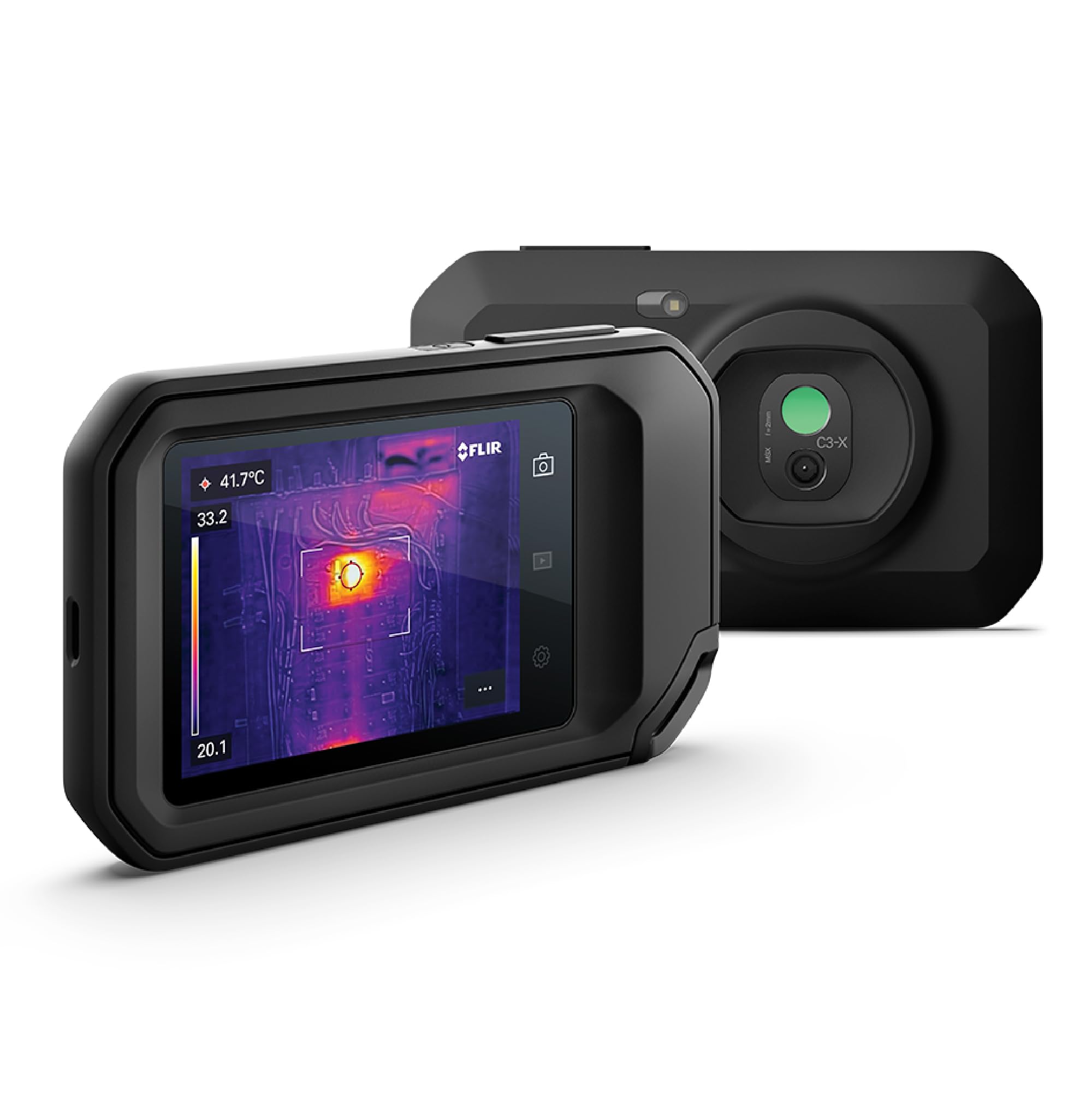
A pocketable 6.72-ounce FLIR that uploads thermal images directly to the cloud over WiFi.
The C3-X delivers 128×96 true thermal imaging (12,288 pixels) and runs FLIR’s patented MSX (Multi-Spectral Dynamic Imaging) technology, which embosses visual details from the built-in camera onto the thermal image for a sharper, easier-to-read picture. At just 6.72 ounces, it is genuinely pocket-sized and fits into any tool pouch. The key differentiator here is FLIR Ignite cloud connectivity — you can upload images directly over WiFi without fumbling with cables, then create and email professional reports from any browser.
Its temperature range goes from -4°F to 572°F, and it includes a touchscreen for basic image editing on the camera itself. The 2-10 year warranty (2 years parts and labor, 10 years on the detector) gives you long-term assurance that this investment is protected. One reviewer called it “fast, reliable” and noted it is a good choice for home inspectors who need to document findings quickly. The FLIR brand carries weight for professionals who trust its detector quality.
The 128×96 resolution sits between the 96×96 and 160×120 sensors — adequate for spotting a warm circuit breaker or missing pipe insulation, but not detailed enough for finding a single hot transistor on a circuit board. The C3-X also lacks a laser pointer for spot measurement, which reviewers flagged as a drawback for precise HVAC troubleshooting. One owner reported intermittent failure where the screen showed unusable patterns, though the camera later started working again on its own. The battery life is also less than some competitors.
Cloud Connected
- WiFi upload via FLIR Ignite for instant report generation
- Compact at 6.72 oz, easily pocketable
- 10-year detector warranty from FLIR
Low Resolution
- 128×96 sensor is lower than most 160×120 or 256×192 competitors
- No laser pointer for spot temperature measurement
- Some owners reported intermittent display issues
Choose this for: home inspectors or property managers who need cloud-based sharing and a tiny camera body that disappears into a shirt pocket.
Skip it for: detailed electrical diagnostics or anyone who wants a laser-guided spot measurement — look for a model with a visible laser pointer instead.
Understanding the Specs
IR Resolution and Super-Resolution
Your camera’s native infrared sensor size (96×96, 160×120, or 256×192) sets the raw detail it can see. More pixels mean you can spot smaller hot spots from farther away. Super-resolution technologies like TISR (Thermal Image Super Resolution), MSX (Multi-Spectral Dynamic Imaging), or Live Super Resolution use software algorithms to sharpen and upscale the output — for example, a 256×192 sensor can produce a 512×384 final image. The native pixel count still limits the underlying detail, but a good boost algorithm makes fine cracks and thin pipes more visible during real-time scanning.
Temperature Range and Thermal Sensitivity
A wider range (like -4°F to 1022°F) covers both frozen pipes and industrial exhaust, while a budget-friendly range (-4°F to 572°F) handles home HVAC and electrical panels just fine. Thermal sensitivity, measured in mK (milli-Kelvin, or thousandths of a degree), tells you the smallest temperature difference the sensor can detect. A 40mK rating means it shows a 0.04°C shift — enough to spot a slow water leak behind a wall. Sensitivity below 50mK is the balance for most residential and light commercial inspections.
Refresh Rate (Frame Rate)
Measured in Hz (hertz, or frames per second), this tells you how many thermal images the camera captures per second. A 25Hz refresh rate gives you a smooth, nearly lag-free feed when you sweep the camera across a room — useful for finding drafts or tracing pipes. Lower rates (like 9Hz) cause the image to stutter when you move quickly, which can mask transient hot spots. All the cameras in this guide use 25Hz, which is the standard for professional-grade affordable thermal imaging.
IP Rating and Drop Resistance
The IP (Ingress Protection) rating uses two digits: the first (5 or 6) indicates dust protection, and the second (4) means it resists splashing water from any direction. An IP54 camera handles rain, mud splashes, and dusty crawl spaces. Drop resistance (usually 2 meters or 6.6 feet) tells you how far the camera can fall onto concrete without damage. If you work on ladders, in attics, or around heavy equipment, prioritize a model that has both IP54 and a verified drop test rating.
FAQ
Can an affordable infrared camera see through walls?
What is the smallest temperature difference an affordable thermal camera can detect?
Will a 96×96 IR sensor be good enough for home inspections?
How do I transfer thermal images to my computer for analysis?
Do I need a thermal camera with a laser pointer?
What does the IP54 rating mean for a thermal camera?
Is a phone-attached thermal camera as good as a standalone handheld?
How long do thermal camera batteries typically last?
What is emissivity and why would I adjust it?
Which affordable infrared camera is best for finding water leaks?
Final Thoughts: The Verdict
Across the board, the affordable infrared camera winner is the TOPDON TC004 because it pairs a 256×192 native sensor boosted to 512×384 with a 3.5-inch screen, 64GB storage, an 8-hour battery, and a laser pointer — all in a rugged, IP54-rated body that handles real job-site conditions. If you want a pocketable phone dongle with the same sensor core, grab the {“@context”: “https://schema.org”, “@graph”: [{“@type”: “BreadcrumbList”, “itemListElement”: [{“@type”: “ListItem”, “position”: 1, “name”: “Home”, “item”: “https://gadgetsfeed.com/”}, {“@type”: “ListItem”, “position”: 2, “name”: “9 Best Affordable Infrared Camera”, “item”: “https://gadgetsfeed.com/best-affordable-infrared-camera/”}]}, {“@type”: “Article”, “headline”: “9 Best Affordable Infrared Camera”, “about”: “Best Affordable Infrared Camera”, “datePublished”: “2026-07-02”, “dateModified”: “2026-07-02”, “mainEntityOfPage”: {“@type”: “WebPage”, “@id”: “https://gadgetsfeed.com/best-affordable-infrared-camera/”}, “inLanguage”: “en-US”, “speakable”: {“@type”: “SpeakableSpecification”, “cssSelector”: [“section#faq summary”, “.gdfe-faq-answer”, “section#how-to-choose”]}, “author”: {“@type”: “Person”, “name”: “Min”, “description”: “This guide is built by comparing the manufacturers’ published specifications and the patterns across verified customer reviews, so you get each pick’s real strengths and trade-offs instead of marketing spin.”, “jobTitle”: “Writer & Editor”}, “publisher”: {“@type”: “Organization”, “name”: “Gadgets Feed”, “url”: “https://gadgetsfeed.com/”}}, {“@type”: “ItemList”, “name”: “9 Best Affordable Infrared Camera”, “url”: “https://gadgetsfeed.com/best-affordable-infrared-camera/”, “numberOfItems”: 9, “itemListElement”: [{“@type”: “ListItem”, “position”: 1, “name”: “TOPDON TC004 3.5\” Thermal Imaging Camera”, “url”: “https://gadgetsfeed.com/best-affordable-infrared-camera/#product-1”}, {“@type”: “ListItem”, “position”: 2, “name”: “Thermal Master Handheld Thermal Camera, Thor 002”, “url”: “https://gadgetsfeed.com/best-affordable-infrared-camera/#product-2”}, {“@type”: “ListItem”, “position”: 3, “name”: “FOXWELL RT280 PRO Thermal Camera”, “url”: “https://gadgetsfeed.com/best-affordable-infrared-camera/#product-3”}, {“@type”: “ListItem”, “position”: 4, “name”: “HIKMICRO E1L Thermal Imaging Camera”, “url”: “https://gadgetsfeed.com/best-affordable-infrared-camera/#product-4”}, {“@type”: “ListItem”, “position”: 5, “name”: “TOPDON TC002C Duo Thermal Camera”, “url”: “https://gadgetsfeed.com/best-affordable-infrared-camera/#product-5”}, {“@type”: “ListItem”, “position”: 6, “name”: “FLIR TG165-X Thermal Imaging Camera”, “url”: “https://gadgetsfeed.com/best-affordable-infrared-camera/#product-6”}, {“@type”: “ListItem”, “position”: 7, “name”: “Klein Tools TI250 Rechargeable Thermal Imaging Camera”, “url”: “https://gadgetsfeed.com/best-affordable-infrared-camera/#product-7”}, {“@type”: “ListItem”, “position”: 8, “name”: “HP96 Thermal Imaging Camera”, “url”: “https://gadgetsfeed.com/best-affordable-infrared-camera/#product-8”}, {“@type”: “ListItem”, “position”: 9, “name”: “FLIR C3-X Compact Thermal Imaging Camera”, “url”: “https://gadgetsfeed.com/best-affordable-infrared-camera/#product-9”}]}, {“@type”: “FAQPage”, “mainEntity”: [{“@type”: “Question”, “name”: “Can an affordable infrared camera see through walls?”, “acceptedAnswer”: {“@type”: “Answer”, “text”: “No, thermal cameras cannot see through solid walls. They measure the surface temperature of the wall itself. If a pipe leak or insulation gap exists behind the wall, it changes the wall’s surface temperature — and the camera shows that temperature difference. You see the symptom, not the pipe.”}}, {“@type”: “Question”, “name”: “What is the smallest temperature difference an affordable thermal camera can detect?”, “acceptedAnswer”: {“@type”: “Answer”, “text”: “Most models in this guide have a thermal sensitivity below 50mK (0.05°C). The HIKMICRO E1L, for example, specifies sensitivity under 40mK, which means it can detect a 0.04°C difference — enough to notice a slow-drip water leak or a slightly overheating wire before it becomes dangerous.”}}, {“@type”: “Question”, “name”: “Will a 96×96 IR sensor be good enough for home inspections?”, “acceptedAnswer”: {“@type”: “Answer”, “text”: “Yes, for basic home inspections like finding missing insulation, warm circuit breakers, or drafty windows, a 96×96 sensor works. But you lose fine detail — a 256×192 sensor shows the outline of individual studs and pipes more clearly from the same distance. If you plan to use the camera regularly, the step to 160×120 or higher is worth it.”}}, {“@type”: “Question”, “name”: “How do I transfer thermal images to my computer for analysis?”, “acceptedAnswer”: {“@type”: “Answer”, “text”: “Most standalone handheld cameras use a USB cable (often USB-C) or a removable microSD card. The FLIR C3-X goes a step further with direct WiFi upload to FLIR Ignite cloud storage. The TOPDON TC004 includes a built-in 64GB drive you connect via USB. Check that the included PC software works with your operating system — some are Windows-only.”}}, {“@type”: “Question”, “name”: “Do I need a thermal camera with a laser pointer?”, “acceptedAnswer”: {“@type”: “Answer”, “text”: “A laser pointer helps you confirm the exact spot you are measuring by projecting a visible dot on the surface. This is valuable for electrical panels where you need to match a specific breaker or fuse with its thermal reading. Without a laser, you have to guess the center of the hot spot. The FLIR C3-X lacks a laser pointer, which some professional reviewers noted as a limitation.”}}, {“@type”: “Question”, “name”: “What does the IP54 rating mean for a thermal camera?”, “acceptedAnswer”: {“@type”: “Answer”, “text”: “The first digit (5) means the camera is dust-protected — dust can enter but not enough to interfere with operation. The second digit (4) means it resists splashing water from any direction, so rain or a splash from a wet pipe will not harm it. It is not waterproof for submersion, but it handles typical job-site conditions.”}}, {“@type”: “Question”, “name”: “Is a phone-attached thermal camera as good as a standalone handheld?”, “acceptedAnswer”: {“@type”: “Answer”, “text”: “A high-quality phone dongle like the TOPDON TC002C Duo can match or exceed the sensor quality of a standalone camera (256×192 native, 512×384 boosted) while being far more portable. The trade-off is that it depends on your phone’s battery and screen, and the USB-C connection can be a weak point physically. Standalone cameras are more rugged and always ready without draining your phone battery.”}}, {“@type”: “Question”, “name”: “How long do thermal camera batteries typically last?”, “acceptedAnswer”: {“@type”: “Answer”, “text”: “Battery life varies widely. The TOPDON TC004 offers 8-hour continuous operation, and the Thermal Master Thor 002 runs for up to 10.5 hours on its 5000mAh battery. USB-C dongles like the TOPDON TC002C Duo have no battery — they draw power from your phone. Always check the listed battery life in the specs before choosing, especially if you plan to use the camera for long inspection days.”}}, {“@type”: “Question”, “name”: “What is emissivity and why would I adjust it?”, “acceptedAnswer”: {“@type”: “Answer”, “text”: “Emissivity is a material’s ability to emit infrared radiation. Shiny surfaces like chrome or polished copper reflect heat and give false readings unless you adjust the camera’s emissivity setting to match the material. The Klein TI250 lets you set emissivity from 0.01 to 0.99, so you can get accurate temperature readings on painted walls (high emissivity) versus bare metal (low emissivity). Most cameras in this guide include this feature.”}}, {“@type”: “Question”, “name”: “Which affordable infrared camera is best for finding water leaks?”, “acceptedAnswer”: {“@type”: “Answer”, “text”: “The HP96 stands out here because its IntellFault technology uses deep learning to automatically detect water leaks and insulation gaps — making it nearly point-and-shoot for leak detection. The TOPDON TC004 and TC002C Duo both pack 256×192 sensors that show the cooler wet patch clearly against the warmer dry wall. The FLIR TG165-X with MSX overlay helps you see the visual detail of the wall alongside the thermal data.”}}]}]}
Product prices and availability are accurate as of the date/time indicated and are subject to change. Any price and availability information displayed on Amazon at the time of purchase will apply to the purchase of this product. As an Amazon Associate I earn from qualifying purchases.
CERTAIN CONTENT THAT APPEARS ON THIS SITE COMES FROM AMAZON. THIS CONTENT IS PROVIDED "AS IS" AND IS SUBJECT TO CHANGE OR REMOVAL AT ANY TIME.
Amazon and the Amazon logo are trademarks of Amazon.com, Inc. or its affiliates.