
Our readers keep the lights on and my morning glass full of iced black tea. As an Amazon Associate, I earn from qualifying purchases.
Specs are compiled from manufacturer listings and verified buyer reviews and can change over time — please confirm the key details on the product page before buying.
Picking the wrong one means fishing a dead robot out with a pole, scrubbing a scum ring by hand, and watching it bump around missing half the pool. The difference between a good AI pool cleaner and a frustrating one is its navigation: does it map your pool, recognize debris, and scrub the waterline, or just random-bounce until the battery dies? This guide breaks down the top AI-driven models so you pick the one that gives you back your weekends instead of creating more chores.
I’m Min — the founder and writer behind Gadgets Feed. This guide is built by comparing the manufacturers’ published specifications and the patterns across verified customer reviews, so you get each pick’s real strengths and trade-offs instead of marketing spin.
You will find only models with genuine AI navigation — sensors, cameras, or LiDAR — that actually learn your pool layout, target debris directly, and manage their own cleaning routes for a truly hands-off experience, making this the definitive roundup of the best ai pool cleaner options available right now.
Our Picks at a Glance

How To Choose The Best AI Pool Cleaner
Not every robot that calls itself smart actually thinks. Some just random-bounce until the battery gives out. Here is what separates a genuinely intelligent cleaner from one that just looks the part.
Navigation Technology: The Brain of the Robot
The navigation system is the single most important spec. A basic model uses bump sensors and a random pattern — it will eventually cover the floor, but it wastes time and battery re-treading spots it already cleaned. A cleaner with AI or smart navigation uses gyroscopes, accelerometers, and sometimes cameras or LiDAR (Light Detection and Ranging — a laser-based mapping system that scans your pool in 3D). This lets the robot build a map of your pool, track where it has been, and plan a systematic route. The result is faster cleaning and total coverage without the overlap.
Battery Capacity and Runtime
If your pool is larger than about 1,000 square feet, runtime matters. Battery energy is measured in watt-hours (Wh) — a higher number means more cleaning time. A 112Wh battery might run a standard cleaner for 2-3 hours, while a 230Wh battery can push runtime past 5 hours. Some cleaners also offer an Eco mode that reduces suction to stretch the battery further, useful for daily maintenance between deep cleans. Make sure the advertised runtime is for the mode you will actually use — standard mode is often half the Eco number.
Filtration Quality and Debris Capacity
The filter is what actually cleans your water. Single-layer filters catch leaves and twigs but let fine sand and dust pass through. A dual-layer setup — typically one coarse 180-micron layer (catches visible debris) and one ultra-fine 3-micron layer (catches particles invisible to the eye) — gives you crisp water. The filter basket capacity, measured in liters, tells you how often you must empty it. A 3.5L basket works for a small pool, while a 5L or 6L basket reduces maintenance for larger pools.
Cleaning Coverage: Floor, Walls, and Waterline
A basic robot only cleans the floor. A capable AI model climbs walls and scrubs the waterline — the scum line at the surface where oils and sunscreen collect. Some models now perform horizontal waterline scrubbing, moving sideways while climbing to reach above the water surface. Check if the robot can handle shallow areas (platforms, tanning ledges) and if it has sensors to avoid getting stuck on drains or steps. The more zones it can clean, the less you have to scrub by hand.
Quick Comparison
| Model | Best For | Battery (Wh) | Max Runtime | Filtration | Amazon |
|---|---|---|---|---|---|
| Aiper Scuba S1 2026★ Best Overall | Budget-friendly smart navigation | 112 Wh | 270 min (Eco) | Dual-layer (3µm + 180µm) | Amazon |
| Beatbot Sora 30Top Performer | Large pool coverage & suction power | 10,000 mAh (216Wh) | 300 min | 5L capacity | Amazon |
| MOVA Diver A10Edge Master | Edge precision & wall climbing | 160 Wh | 240 min | 3.5L basket | Amazon |
| WYBOT C2 | Compact size & dual filtration | 99 Wh | 180 min (Standard) | 180µm + 10µm ultra-fine | Amazon |
| Aiper Scuba S3 | Waterline scrubbing & smart parking | 149.76 Wh | 240 min (Eco) | Dual-layer (3µm + 180µm) | Amazon |
| Aiper Scuba V3 AI | AI vision & wireless dock | 149.76 Wh | ~180 min | MicroMesh multi-layer | Amazon |
| iGarden K-AI Series | Dual-camera vision & touch screen | 192 Wh | 300 min | 180µm + 50µm dual-layer | Amazon |
| Chasing L1 Ultra | LiDAR mapping & precision navigation | 237.6 Wh | 300 min (Eco) | 4.1L basket | Amazon |
| BUBLUE Bubot 800P Gen2 | Corded reliability for constant use | — (corded) | Unlimited (corded) | Dual 3L baskets | Amazon |
| Beatbot AquaSense 2 Pro | 5-in-1 cleaning & massive battery | 266.76 Wh | 660 min (surface) | Dual-layer (150µm) | Amazon |
In‑Depth Reviews
1. (2026 Upgrade) Aiper Scuba S1
Our pick — over 4★ from 800+ verified ratings; the strongest balance of quality and price.
A sensor-packed brain that plans its route so you don’t have to.
The Scuba S1 is Aiper’s answer to the buyer who wants genuine smart navigation without stepping up to a camera-based system. Its 11 high-precision sensors feed data to dual-path algorithms that create a WavePath cleaning pattern, designed to cover the pool systematically with minimal overlap — no random bouncing. It adapts in real time as it reads the pool layout, so it does not waste battery re-treading spots it already cleaned. The cleaner covers four zones: floor, walls, waterline, and shallow areas above 12 inches deep.
You get two battery modes for flexibility. In Eco mode it runs up to 270 minutes for light daily maintenance, while standard modes (Auto, Floor, Wall, Scheduled) deliver up to 180 minutes of deeper cleaning. A 112Wh lithium battery powers it. Owners mention that a typical 30-foot by 16-foot pool takes about two hours to clean on standard mode. The dual-layer filtration uses a 3-micron ultra-fine filter paired with a 180-micron standard filter — one reviewer noted it picked up fine dirt invisible to the eye, with filters coming out very dirty after just one hour. The Caterpillar Treads system gives it strong wall-climbing grip.
The smart-entry angle: The Scuba S1 brings genuine path-planning AI and dual-layer filtration at a very accessible price point, making it the logical pick for buyers who want intelligence but not the premium of camera or LiDAR systems.
Best for: the pool owner who wants proven smart navigation with strong wall climbing and ultra-fine filtration — without the cost of a camera system.
Look elsewhere if: your pool is a custom shape with many angles — some reviewers noted coverage gaps on narrow lap pools.
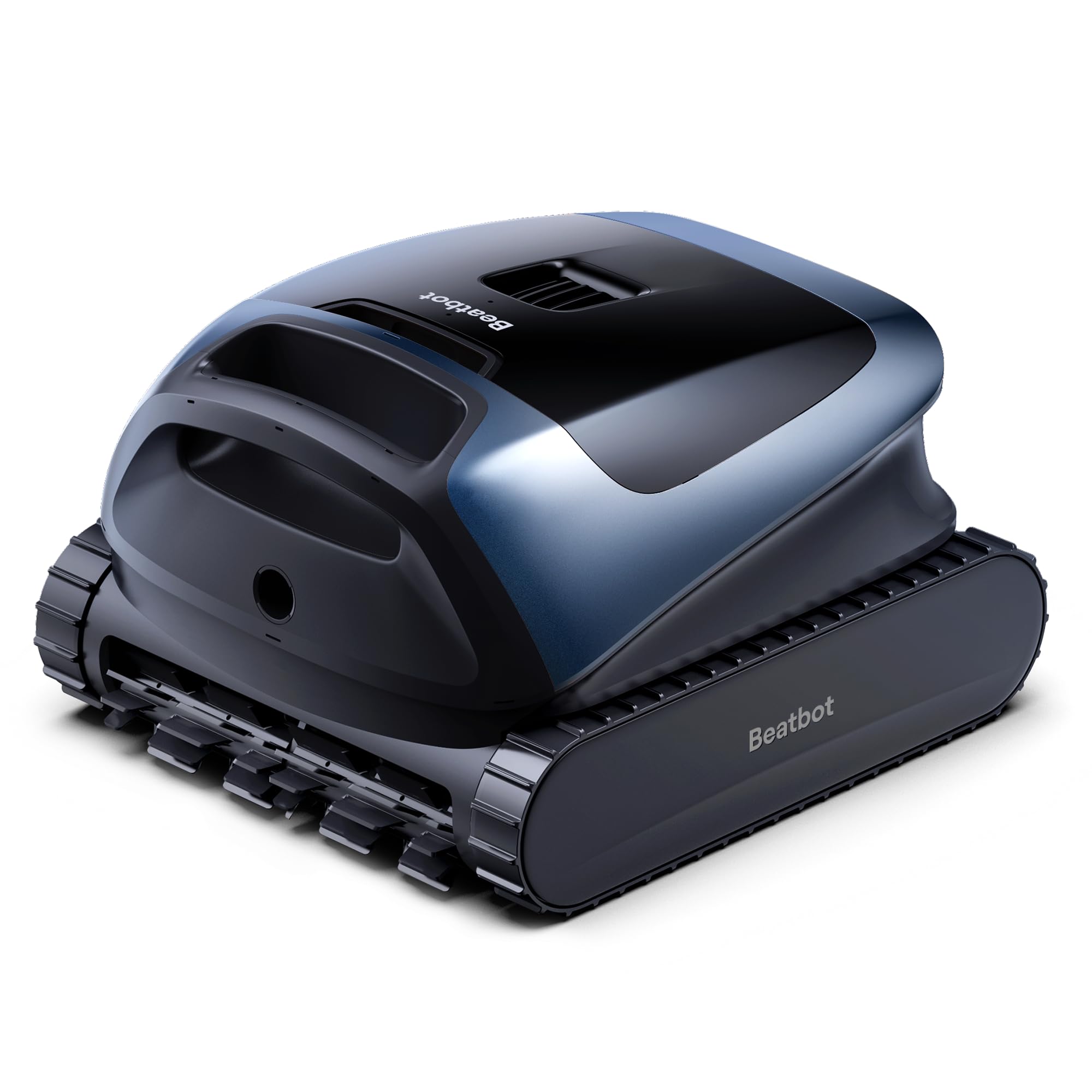
2. Beatbot Sora 30
The heavy-lifter that swallows a whole oak tree’s worth of leaves in one pass.
This cordless robot is built for owners of large pools — it covers up to 3,229 square feet per charge. You get the luxury of not pulling it out mid-cycle because the battery ran dry. The 10,000 mAh power cell delivers up to 300 minutes of continuous floor cleaning, a full 25% longer than the 240-minute MOVA Diver A10. Buyers report that after a standard 180-minute cleaning cycle, the battery still reads 55%, giving you confidence it will finish even irregularly shaped pools.
The suction is the headline here: 6,800 GPH (gallons per hour) powered by a HydroBalance structure that grabs heavy debris like wet leaves in a single pass without clogging the works. It also cleans four zones — floor, walls, waterline, and platform — and uses ultrasonic sensors to handle shallow areas as shallow as 8 inches deep, so your tanning ledge stays spotless. The smart parking feature means it automatically rises to the water surface when finished or when the battery drops below 12%, releasing internal water for easy lifting. You do not need to fish it out with a pole.
The smart-power combo: The Beatbot Sora 30 combines the longest floor-cleaning runtime in this lineup with industry-leading suction, making it the most capable do-it-all unit for large or heavy-debris pools.
Reach for this if: you have a pool over 2,000 square feet, get tired of emptying small baskets mid-cycle, and want a cleaner that handles everything from silt to branches.
Consider another option if: your pool is small or standard shape — you would pay for battery and suction you do not need.
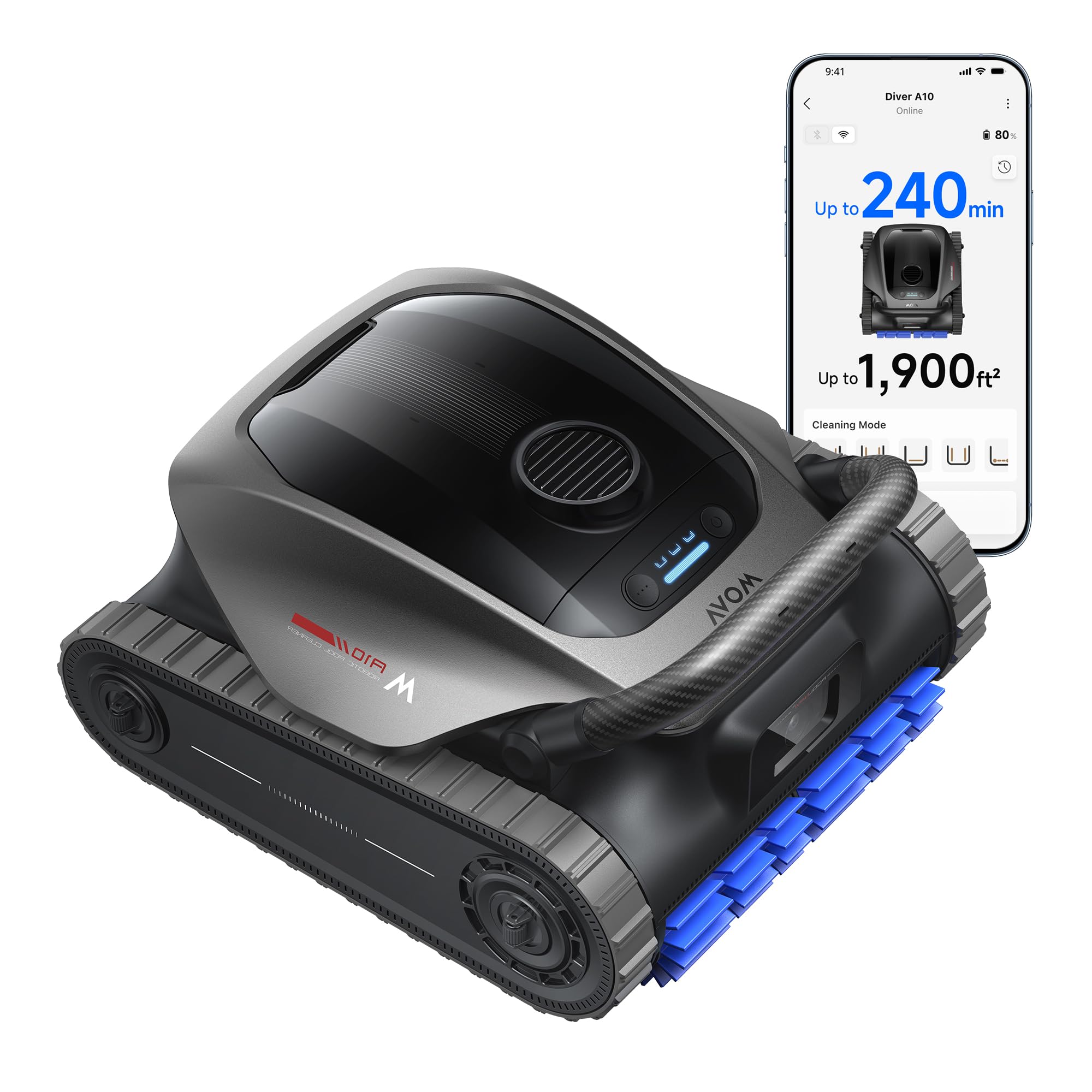
3. MOVA Diver A10
The wall-crawler that scrubs your waterline twice so you don’t have to.
The MOVA Diver A10 tackles a problem many cleaners ignore: the fine line where water meets tile. Its Double-Pass Waterline Scrubbing system runs along the waterline twice in a single cycle, lifting oils and sunscreen residue up to 2 inches above the water surface — meaning you scrub that scum ring far less often. The AI-driven EdgePulse technology uses four magnetically-coupled guidance wheels and dual digital Hall-effect sensors to maintain constant alignment with the pool contours, so it follows curved walls and steps closely.
Under the hood, three brushless motors generate 6,000 GPH of suction. The 160Wh battery provides up to 240 minutes of runtime, covering pools up to 1,938 square feet — that is a 62% larger energy capacity than the 99Wh WYBOT C2, giving you significantly more cleaning time per charge. The cleaner offers 8 modes controlled via the MOVAhome App, including a tanning ledge mode that still occasionally needs software refinement, per buyer feedback. One buyer mentioned the optional 3-micron filter traps the finest sediment, and they especially liked the auto-parking feature that lets you grab it without a pole. At 1,000 grams, the battery is the heaviest in its tier, which is the trade-off for that extended runtime.
Waterline specialist: The Diver A10 leads on edge-cleaning precision with its dual-pass scrubbing and AI contour-following, making it the top choice if your pool’s waterline scum is your biggest weekly headache.
Reach for this if: your waterline needs constant scrubbing, your pool has curved walls or ledges, and you want a long runtime for a medium-to-large pool.
Consider another option if: reliability is your top concern — a minority of buyers reported unit failures within weeks.
4. WYBOT C2
The nimble little robot that fits tight spaces and still filters fine.
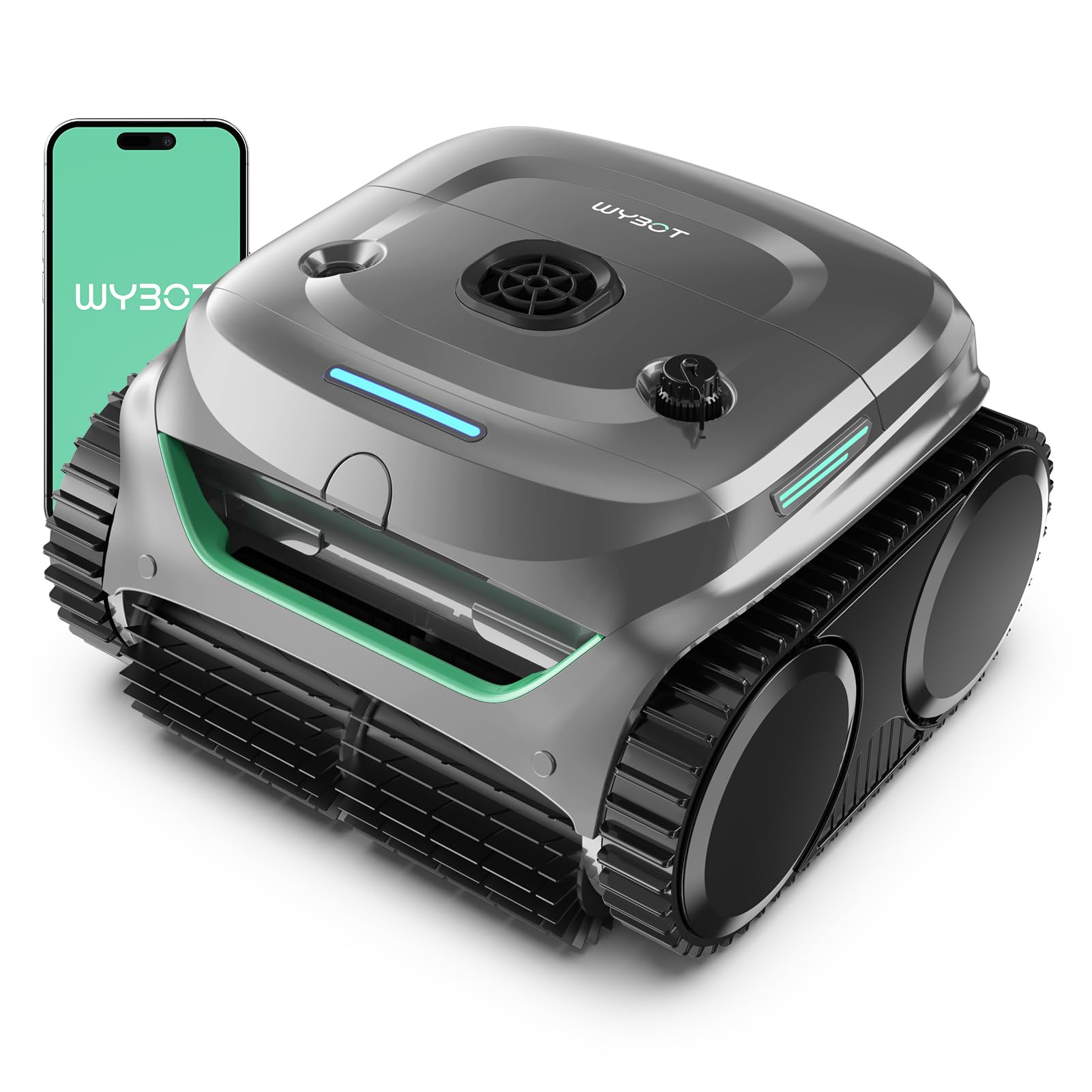
The WYBOT C2 is engineered for pools where dimensions are tighter — its 14.2-inch by 14.2-inch footprint is 13% smaller than the 16-inch by 15-inch MOVA Diver A10, so it squeezes into narrower steps and tighter corners. Despite its compact size, it delivers 3,792 GPH suction and uses dual scrubbing brushes to lift leaves, algae, and sand from floors, walls, and the waterline. The dual-layer filtration system pairs a 180-micron coarse layer with a very fine 10-micron ultra-fine layer, so it catches dirt from large debris down to dust particles that would normally cloud the water.
The 99Wh battery gives you two runtime options: customers note 3 hours in Eco mode and 2 hours in regular mode. That is less capacity than the larger models, but the trade-off is a remarkably light 440-gram battery weight — less than half the 1,000-gram battery in the MOVA Diver A10 — making the C2 noticeably easier to lift out of the pool. The app gives you 8 cleaning modes, 6 path-planning options, and 4 scheduled cycle timers. One owner reported it does a good job getting into corners and expects a 3-5 year lifespan from its rugged build. It handles in-ground and above-ground pools up to 2,260 square feet.
The featherweight find: The WYBOT C2 proves you do not need a massive battery to get smart navigation and fine filtration — its light build and compact shape are ideal for smaller pools or anyone who struggles to hoist a heavy robot out of the water.
Best for: above-ground pools, compact in-ground pools under 2,000 square feet, and buyers who prioritize easy lifting over marathon runtime.
Consider another option if: you have a very large pool and cannot tolerate a mid-cycle recharge.
5. Aiper Scuba S3
The sideways-scrubbing specialist that attacks the scum ring from a new angle.
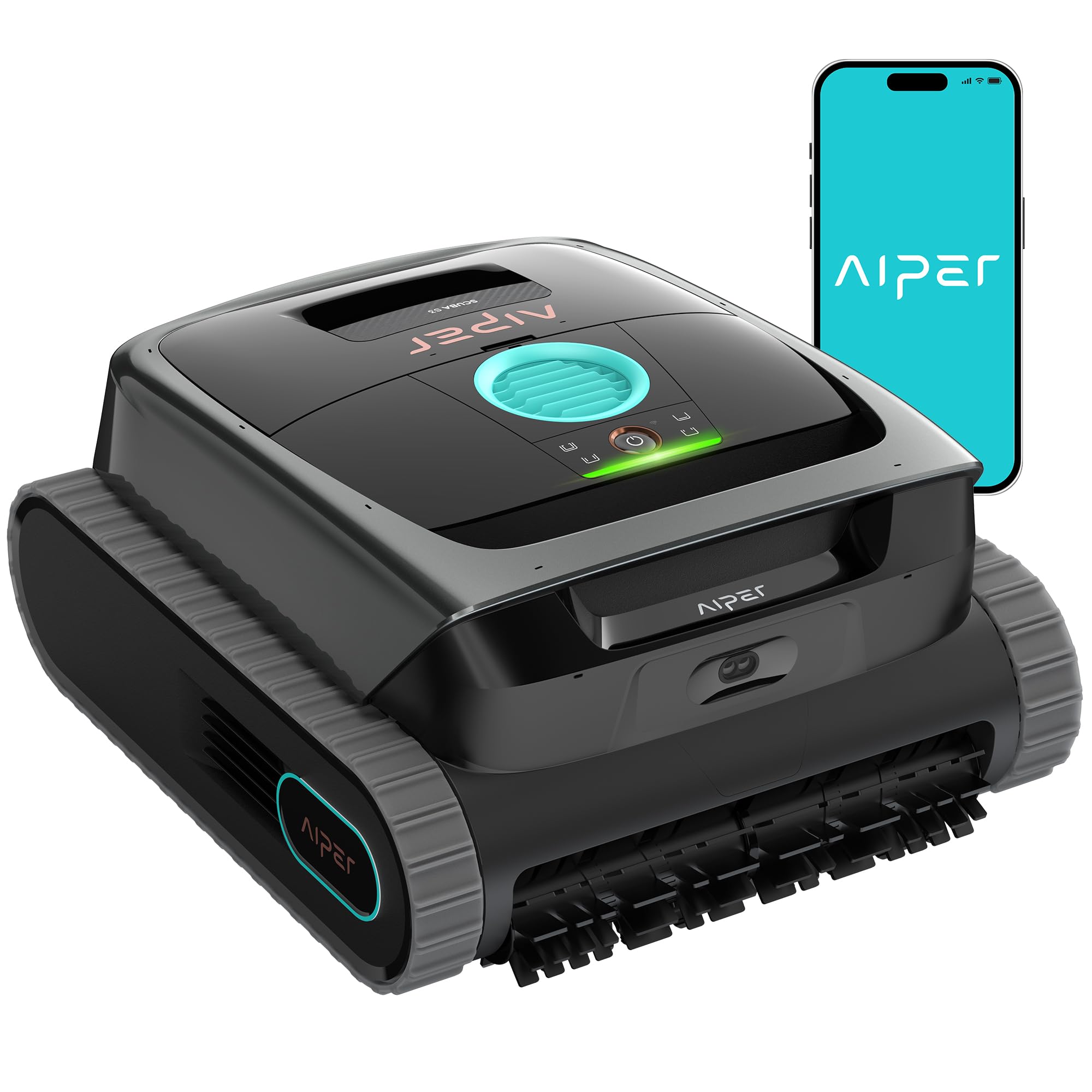
The Scuba S3 upgrades the standard wall-climbing formula by adding horizontal waterline scrubbing. While most robots climb straight up and down, the S3 moves sideways in one direction to scrub the waterline, reaching a full 5 centimeters above the water surface. This motion specifically removes the stubborn scum ring — sunscreen film, pollen, and body oils — that ordinary cleaners leave behind. It complements this with a smart navigation system that uses an intelligent sensor to follow an organized pattern based on your pool’s shape, so you get systematic coverage on the floor as well.
The 149.76Wh battery provides up to 240 minutes of runtime in ECO mode, with standard modes offering plenty of time for a full deep clean. When the job is done, the robot automatically rises to the waterline and parks itself, sending an instant notification to your phone — you never guess if it finished. Reviewers point out that it picked up yellow algae and fine debris that manual vacuuming merely stirred around, and that the filter is very easy to clean. One reviewer who replaced a Polaris 280 found the results “far superior” on a large freeform pool with ledges, steps, and zero-depth entry. The dual-layer filtration (3-micron ultra-fine plus 180-micron standard) is the same proven setup from the Scuba line.
The waterline weapon: The Scuba S3’s unique horizontal scrub motion is a standout for eliminating the persistent scum ring., while its smart parking and app alerts keep the experience fully hands-off.
Reach for this if: the greasy waterline film is your biggest frustration and you want a robot that actively works to eliminate it rather than just bumping along the wall.
Look elsewhere if: your pool has a very complex shape — some buyers found the wall-climbing pattern less effective on kidney-shaped pools with tight curves.
6. Aiper Scuba V3 AI Vision
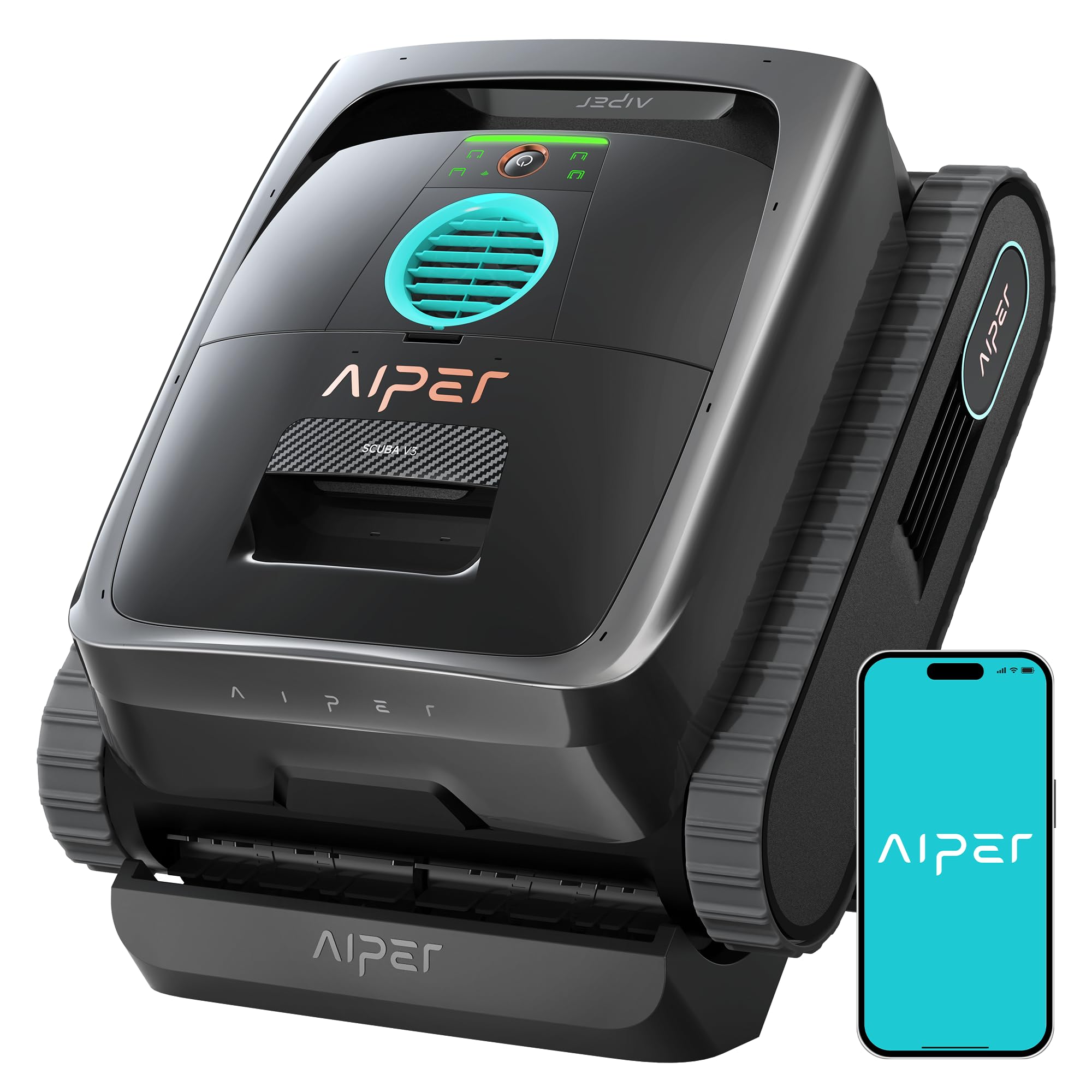
A camera eye that spots a leaf at 20 feet and swims straight to it.
The Scuba V3 is Aiper’s first true AI vision robot. Its single front-facing camera detects over 20 different types of debris — leaves, bugs, acorns, sand patches — and navigates directly to them instead of relying on a random or patterned path. The AI Patrol System claims to clean up to ten times faster than traditional methods for floor debris because it goes straight to the dirt. The data is processed entirely on the device, so nothing gets stored or uploaded; it is TÜV certified for data privacy protection, meaning your pool layout stays on the robot.
The 149.76Wh battery, shared with the Scuba S3, delivers approximately three hours of floor-focused runtime. Buyers with rectangular vinyl-lined pools report spotless results with the AI first targeting visible debris then switching to a systematic full-cleaning pattern. The wall climbing works without issues. The biggest practical upgrade here is the included Wireless Charging Dock — you place the robot on it and it charges without plugging cables in, and the dock stores the robot neatly when not in use. The MicroMesh Multi-Layer Filtration combines a 180-micron debris filter with a 3-micron ultra-fine layer. One reviewer who upgraded from a Seagull Pro found the AI vision had “no noticeable impact” on speed for large dirt, but appreciated the long battery life and easy retrieval.
See-and-clean approach: The Scuba V3 offers true debris recognition, letting a camera guide the robot straight to pollution — a meaningful step forward from sensor-only navigation, backed by a wireless dock that removes the last bit of chore from pool maintenance.
Best for: the tech-forward buyer who wants a robot that actually sees its target, values data privacy, and appreciates the convenience of a wireless charging dock that doubles as storage.
Consider another option if: you have a kidney-shaped or irregular pool — some reviewers found the wall-climbing strategy less effective on curved walls.
7. iGarden K-AI Series

Two cameras and a 3D memory — it maps every corner before it cleans.
The iGarden K-AI Series steps up the intelligence game with dual AI cameras that construct a real-time 3D map of your entire pool. It identifies boundaries, obstacles, slopes, water lines, and visible debris before it even starts moving. The robot then plans an tune 3D S-shaped cleaning path — no random patterns, no skipped sections. It moves section by section, as confirmed by buyers who noted it covered the entire bottom methodically with no missed spots.
For suction, the Turbo 200% Mode unleashes up to 22,000 LPH (liters per hour), enough to pull hair, leaves, sand, pebbles, and twigs in seconds. The dual-layered filtration uses a 180-micron coarse layer and a 50-micron fine layer, which goes beyond visible debris to trap microscopic particles like fine sand, skin flakes, and pet dander. The 192Wh battery provides extended runtime for large pools, and the robot features a full 4-liter debris capacity. One distinctive touch is the full touch-screen panel — a smooth surface that avoids the physical button failures common with sand and grit. The app offers lifetime OTA updates, so the software can improve over time.
Mapping authority: The iGarden K-AI’s dual-camera 3D mapping creates a methodical section-by-section cleaning plan that leaves fewer gaps than any sensor-only system, backed by Turbo Mode suction that swallows debris instantly.
Reach for this if: you want the most advanced path planning available — a robot that maps, remembers, and cleans section by section without random patterns — and appreciate a touch-screen interface that resists debris.
Consider another option if: you need app control while the robot is underwater — the app only works on land due to no underwater signal.
8. Chasing L1 Ultra AI & LiDAR
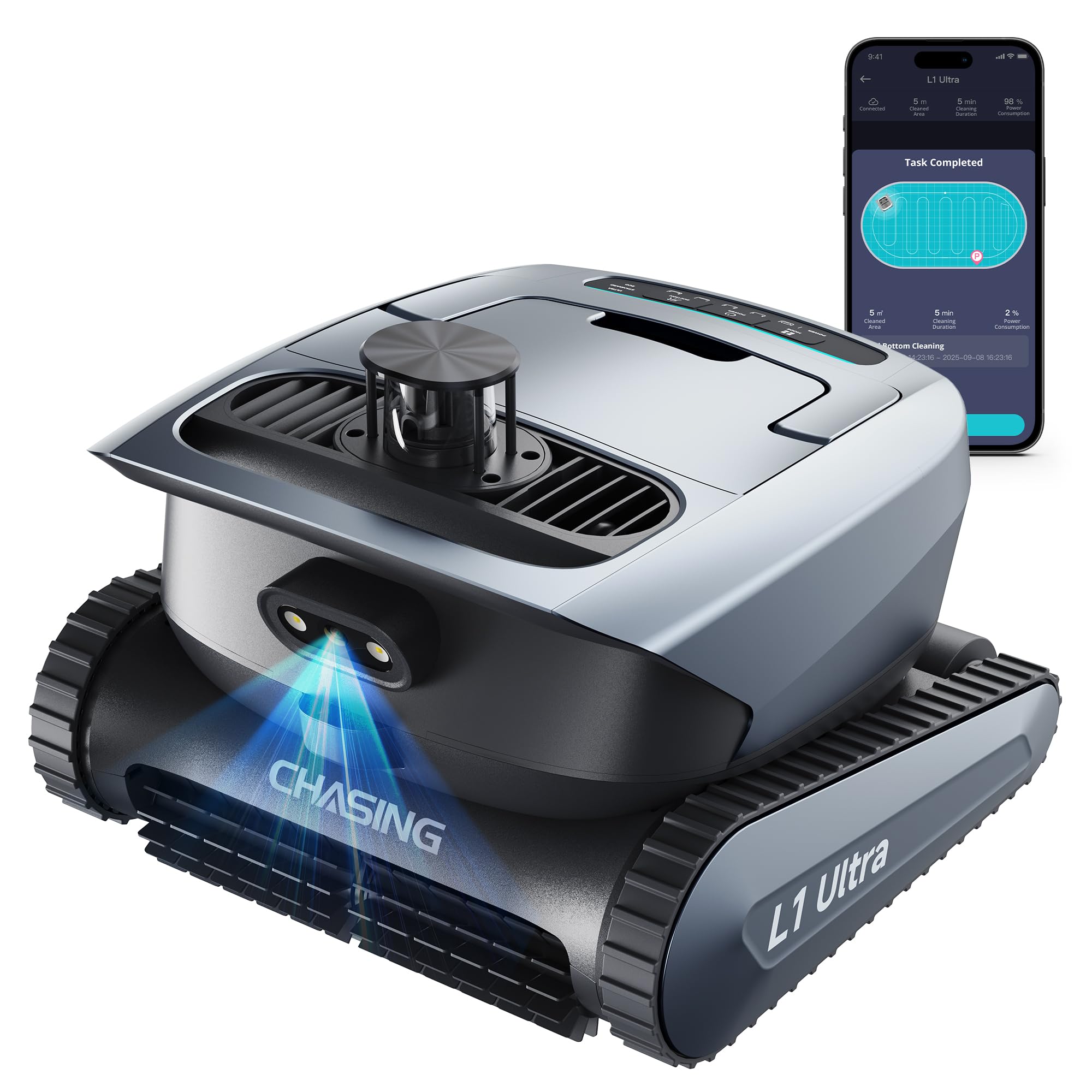
A laser-mapping brain that builds an invisible grid of your pool in real time.
The L1 Ultra introduces LiDAR to the pool cleaning world — a rotating 360-degree laser that scans your pool to build a precise 3D map of the floor, walls, steps, and slopes. Combined with AI visual recognition, it can detect specific debris types (leaves, sand, silt) and adjust its path to target them. This dual-intelligence system means the robot knows not just where it is, but what it is looking at. The HydroCurve algorithm allows it to adapt to steps and changing depths automatically, handling high-end inground pools with complex geometry.
Its dual-pump motors generate 8,880 GPH of suction, and you can choose from three suction modes (ECO, Standard, Ultra) depending on how much debris you are dealing with. The 237.6Wh battery provides up to 5 hours of runtime in ECO mode — the most endurance in this lineup, with a 62% larger energy content than the 149.76Wh Aiper models. The robot returns to its wireless charging dock when finished, so you never plug cables in. Shoppers say quick charging (under 2 hours) and that it cleans a 36-foot by 18-foot pool in about 2 hours. The large 4.1L filter basket reduces how often you must empty it. The CHASING GO3 App provides visual tracking of the robot’s real-time path and coverage. One reviewer summed it up: it maps the pool, targets dirt via AI and LiDAR, and also has preset cleaning patterns — a top-tier combination.
The LiDAR benchmark: The Chasing L1 Ultra sets a new standard for navigation fidelity — 360-degree laser mapping plus AI debris recognition — and pairs it with the largest battery in this guide for marathon cleaning sessions.
Best for: the pool owner who treats their pool like a serious investment and wants the most advanced navigation, longest battery, and wireless charging — a premium experience for a premium pool.
Consider another option if: you have an above-ground pool — at 22 pounds and heavier when wet with water, retrieval can be difficult without a pool deck.
9. BUBLUE Bubot 800P Gen2
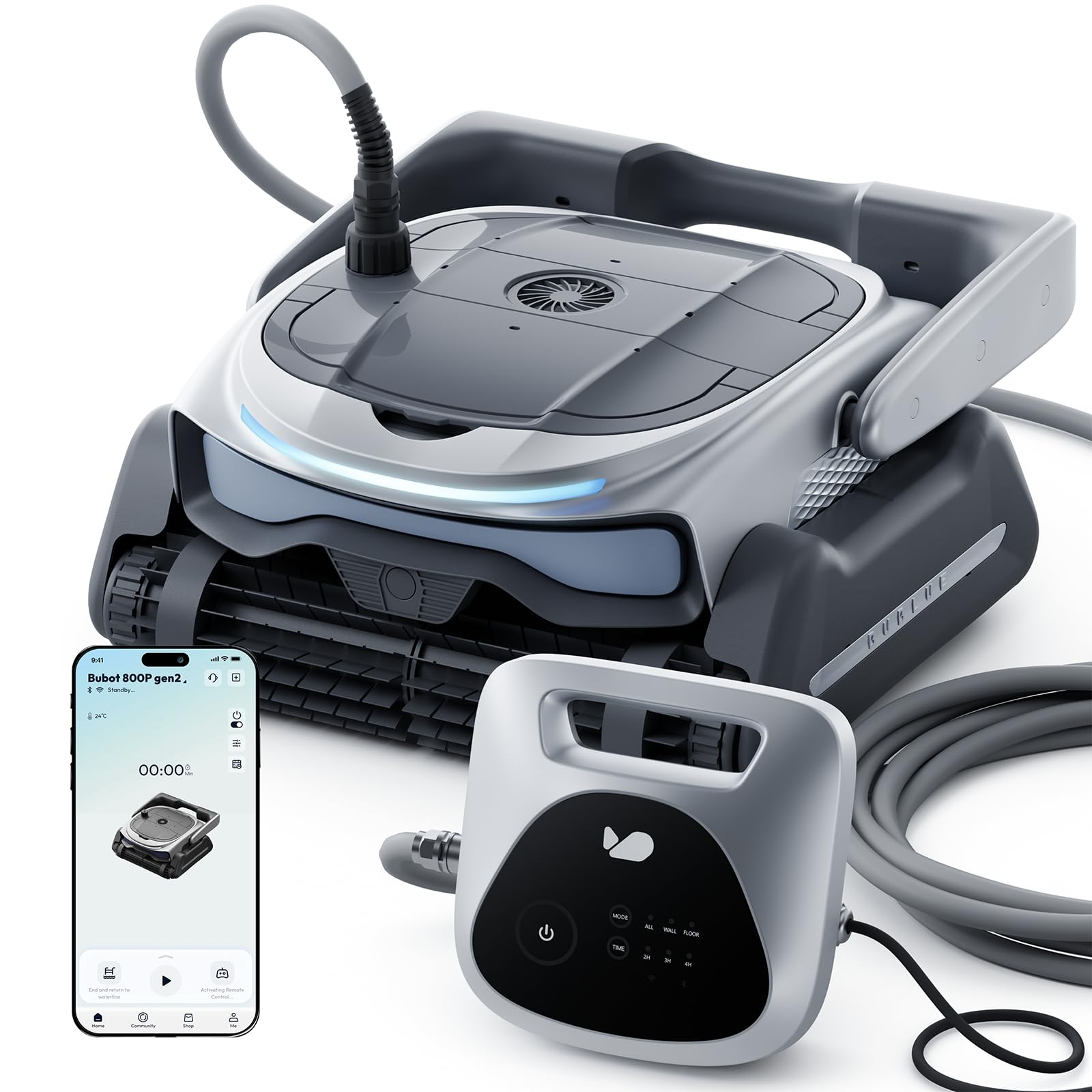
The always-on worker that never stops to recharge — ever.
The Bubot 800P Gen2 takes a different path from the cordless competition. It is powered by a continuous 28V power source, meaning it never runs out of battery mid-cycle and you never wait for a recharge. The new TangleEase Technology is designed to prevent the cord from wrapping around obstacles, addressing the main complaint about corded robots. This is the pick for anyone who just wants the cleaner to run as long as it takes, whether that is 3 hours or 10.
For cleaning intelligence, it uses Bluesonic Path Navigation, an AI-driven system that maps your pool for maximum coverage and auto-adjusts its path when it detects obstacles. Despite being corded, it offers app control via Bluetooth or WiFi for scheduling and mode selection, plus a unique Remote Control Car Mode that lets you steer the cleaner manually for spot-cleaning a specific area. The 150-watt three-axis motor and dual suction ports generate powerful debris pickup. The dual 3L filter baskets (6 liters total capacity) give you plenty of room before emptying is needed. Buyers report strong suction, good wall and step climbing, and excellent customer support that sent a free replacement filter. The cleaner is built with UV-resistant materials and comes with a 2-year warranty.
The Never-Quit Advantage
- Unlimited runtime — no battery anxiety
- 6L total filter capacity, less frequent emptying
- TangleEase cord tech reduces wrapping
The Cord Trade-Off
- Must manage a cord around the pool
- Requires a nearby outdoor outlet
Reach for this if: your number one frustration with cordless cleaners is the battery running out before the job is done — the Bubot gives you unlimited runtime with smart-enough navigation to avoid tangles.
Look elsewhere if: you do not have an outdoor outlet near your pool or absolutely hate dealing with any cord at all.
10. Beatbot AquaSense 2 Pro
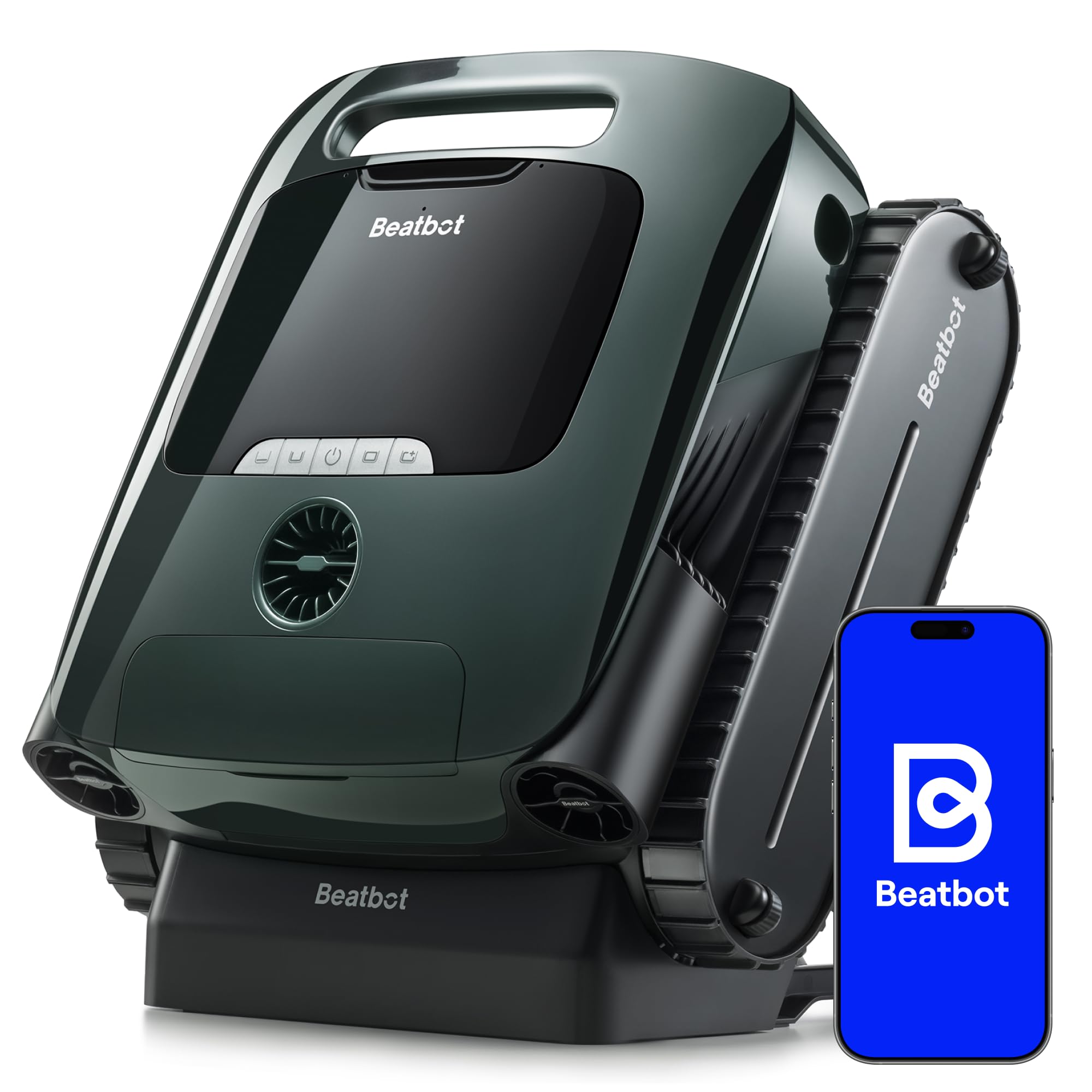
The all-in-one flagship that scrubs, clarifies, and skims without asking for help.
The AquaSense 2 Pro is Beatbot’s top-tier machine, and it does something no other cleaner in this guide attempts: it handles five jobs — floor cleaning, wall climbing, waterline scrubbing, water clarification, and surface skimming — all in a single device. The water clarification system uses natural, skin-safe recycled crab-shell agents to clear up to 99,000 gallons four times faster than traditional clarifiers. The surface skimming function lets you use the app to navigate the cleaner across the pool surface, pinpoint floating debris, and send it to the edge for pickup — without getting your hands wet.
Its 266.76Wh battery is the largest capacity in this roundup, delivering up to 11 hours of surface cleaning and 5 hours for floors or walls, covering pools up to 3,875 square feet on a single charge. The CleverNav technology uses a 4-core CPU and 22 sensors to tune cleaning paths in S/N patterns, navigating obstacles systematically. The dual-layer filter captures debris down to 150 microns with an anti-blockage design. The robot parks itself at the water edge when finished and uses SmartDrain to release internal water for lighter retrieval. The build quality uses UV and heat-resistant automotive-grade IMR coating, backed by 15 certifications and 200+ tests, and comes with a 3-year full replacement warranty — not repairs, full replacement. Some buyers found the robot effective at removing acorns, pollen, and leaves, and noted the fine filter picks up sand. The catch is weight: at 26.6 pounds dry, it is the heaviest in the lineup, and buyers with back issues reported difficulty lifting it out of the pool.
The do-everything flagship: The AquaSense 2 Pro uniquely combines surface skimming and water clarification with floor-to-wall cleaning, making it the only truly all-in-one solution for buyers who want total pool care from a single device.
Best for: the owner of a very large pool who wants one machine to handle everything — cleaning, skimming, clarifying — and values a 3-year full replacement warranty over a lower price.
Consider another option if: you have physical limitations or a raised above-ground pool — the 26.6-pound dry weight makes retrieval genuinely difficult for some users.
Understanding the Specs
Watt-Hours (Wh) — The True Battery Measure
A watt-hour tells you the total energy a battery can hold. Standard AA batteries store about 3 Wh. A 100 Wh pool cleaner battery holds about 33 times that. Higher watt-hours mean longer runtime, but also heavier batteries. The WYBOT C2 uses a 99 Wh battery for light weight. The Chasing L1 Ultra uses 237.6 Wh for marathon sessions. Check this number, not just “minutes” — it lets you compare across brands directly.
GPH vs. LPH — Suction Power
Gallons per hour (GPH) and liters per hour (LPH) measure how much water the robot can pull through its filter. 6,800 GPH equals about 25,741 LPH. Higher suction picks up heavier debris faster — important if your pool collects acorns, wet leaves, or sand. For light dust and pollen, lower suction paired with fine filtration is often sufficient and extends battery life.
Micron Ratings on Filters
A micron is one-millionth of a meter. For reference, a human hair is about 70 microns thick. A 180-micron filter catches leaves and twigs. A 3-micron filter catches fine dust and sand invisible to the eye. Dual-layer systems combine a coarse layer (180µm) with an ultra-fine layer (3µm or 10µm) so the robot handles both in one pass. Single-layer filters leave fine particles suspended in your water.
LiDAR vs. Camera vs. Sensors
These are the three levels of navigation intelligence. Sensor-based cleaners use gyroscopes and accelerometers (motion trackers) to estimate position — they follow a pattern but cannot “see”. Camera-based cleaners (Aiper Scuba V3, iGarden K-AI) use visual recognition to spot debris and pool boundaries — they know what is in front of them. LiDAR (Chasing L1 Ultra) uses a rotating laser to build a precise 3D map — it knows exactly where every wall, step, and slope is before it starts moving.
FAQ
How does an AI pool cleaner differ from a regular robotic pool cleaner?
What battery size do I need for my pool?
Will an AI pool cleaner work with an above-ground pool?
How often should I empty the filter basket?
Can an AI cleaner handle steps and tanning ledges?
How long does the cleaning cycle typically take?
What does “waterline scrubbing” actually mean?
Is a corded or cordless AI pool cleaner better?
Do these robots work with saltwater pools?
How long do AI pool cleaners typically last before needing replacement?
Final Thoughts: The Verdict
For most
Final Thoughts: The Verdict
For most buyers, the best ai pool cleaner is the Beatbot Sora 30 because it pairs the longest floor-cleaning runtime with massive 6,800 GPH suction that handles everything from fine silt to heavy wet leaves in a single pass across a 3,229 square foot pool. If you want the most advanced navigation available — a robot that builds a precise 3D map of your pool using LiDAR and targets dirt with AI vision — grab the Chasing L1 Ultra. And for a complete, no-compromise solution that also skims the surface and clarifies the water, the Beatbot AquaSense 2 Pro handles every chore with a massive 266.76 Wh battery and a 3-year full replacement warranty.
How We Picked
We do not accept paid placement. Every pick is matched to a real buyer and a real use-case; we do not hands-on test units.
Sources & Methodology
Specifications: manufacturer listings and product documentation. Review insights: verified customer reviews, as of July 2026. Pricing: not shown on this page (it changes often); check the current price via the retailer link.
As an Amazon Associate, Gadgets Feed earns from qualifying purchases. This does not affect which products we feature.