
A door alarm sensor does only one thing—detect a magnetic break and scream—but the difference between a reliable silent guard and a false-alarm nuisance comes down to trigger gap tolerance, decibel output, and wireless protocol. Whether you are securing a child’s bedroom, a storefront entrance, or a remote shed gate, the right sensor stops threats at the threshold rather than adding noise to your life.
I’m Min — the co-founder and writer behind Gadgets Feed. I’ve spent countless hours comparing trigger distances, battery chemistries, and latency loops across dozens of contact sensor configurations to find the models that actually deliver consistent detection without phantom alerts.
After analyzing seven distinct alarm door sensor models spanning standalone magnetic types to smart-home-integrated options, I’ve built a clear picture of what matters in a best alarm door sensor. The key factors are trigger range in inches, alarm loudness in decibels, wireless range for remote monitoring, and power source longevity.
How To Choose The Best Alarm Door Sensor
Selecting the right alarm door sensor means matching three variables to your specific door environment: the physical trigger tolerance, the alarm loudness that covers your space, and the connectivity model that fits your home architecture. A 0.5-inch trigger gap works fine for a flush bedroom door but fails on an uneven metal gate. Here is how to filter the options.
Trigger Gap and Magnet Alignment Tolerance
The magnetic reed switch inside every contact sensor activates when the magnet leaves its detection zone. Cheaper sensors demand perfect alignment within 0.4 inches, while premium units tolerate gaps up to 1 inch. Measure your door frame depth and any irregular molding before choosing. A sensor with 0.78-inch trigger tolerance handles misaligned doors and seasonal wood expansion far better than a strict 0.4-inch model.
Decibel Output and Audible Coverage
Standalone alarms typically rate between 65 dB and 120 dB. A 65 dB alarm sounds like a conversation—audible in the next room but easily missed behind closed doors. A 120 dB alarm matches a smoke detector’s intensity and carries through an entire floor. If the sensor is meant to alert a distant caregiver or startle an intruder, target 100 dB or higher.
Wireless Connectivity and Hub Dependency
Basic door alarms operate entirely locally—battery, magnet, piezo buzzer, no network required. Smart sensors send notifications to your phone but depend on a hub (Philips Hue Bridge, Ring Alarm Base Station, YoLink Hub) and sometimes a monthly subscription for alert history. For perimeter gates or sheds far from the house, long-range protocols like LoRa (1,320-foot range) beat the typical 500-foot Wi-Fi extender.
Quick Comparison
On smaller screens, swipe sideways to see the full table.
| Model | Category | Best For | Key Spec | Amazon |
|---|---|---|---|---|
| Ring Alarm Contact Sensor 2-Pack | Smart Sensor | Whole-home integration | CR2032 battery, 3-year life | Amazon |
| Philips Personal Security Window and Door Alarm 4-Pack | Standalone Alarm | Maximum loudness (120 dB) | 120 dB alarm, LR44 batteries | Amazon |
| YOLINK LoRa Smart Outdoor Contact Sensor | Outdoor Long Range | Remote gates and sheds | 1,320-foot range, LoRa radio | Amazon |
| Philips Hue Secure Smart Contact Sensor | Smart Light Automation | Hue ecosystem users | CR2 battery, 3-year life | Amazon |
| SECRUI Wireless Door Chime | Chime + Alarm | Business or office entry alerts | 500-foot range, 32 chimes | Amazon |
| TECKNET Door Alarm 3-Pack | Compact Standalone | Travel and multi-point coverage | 0.78-inch trigger gap, 65 dB | Amazon |
| Rinetiy Window Alarm Sensor 8-Pack | Bulk Coverage | Whole-house coverage on a budget | 120 dB, AG13 batteries | Amazon |
In‑Depth Reviews
1. Ring Alarm Contact Sensor 2-Pack

The Ring Contact Sensor’s 2nd Gen design shrinks the footprint while adding a battery-door protector that prevents the CR2032 from dislodging during vibration—a real issue on the first generation. Installation takes under two minutes with the peel-and-stick adhesive, and the sensor reliably detects door openings with a 1-inch gap tolerance that accommodates warped frames without false alarms.
Pairing requires the Ring Alarm Base Station, and instant mobile alerts demand a Ring Protect subscription, which adds ongoing cost for notification history and video recording. The slim profile (barely thicker than a quarter) fits on narrow window frames and metal doors where bulkier standalone alarms cannot mount cleanly.
The battery life claim of three years holds up in real-world use, and the tamper switch triggers a notification if someone pries the sensor off the frame. For users already inside the Ring ecosystem, this sensor delivers the tightest integration—arming and disarming alongside the base station keypad without manual toggling.
Why it’s great
- Extremely consistent detection with generous 1-inch gap tolerance
- Tamper-resistant battery cover and slim form factor
Good to know
- Requires Ring Alarm Base Station and a Protect subscription for full features
- Metal door frames may need a wooden spacer to avoid false tamper alerts
2. Philips Personal Security Window and Door Alarm 4-Pack
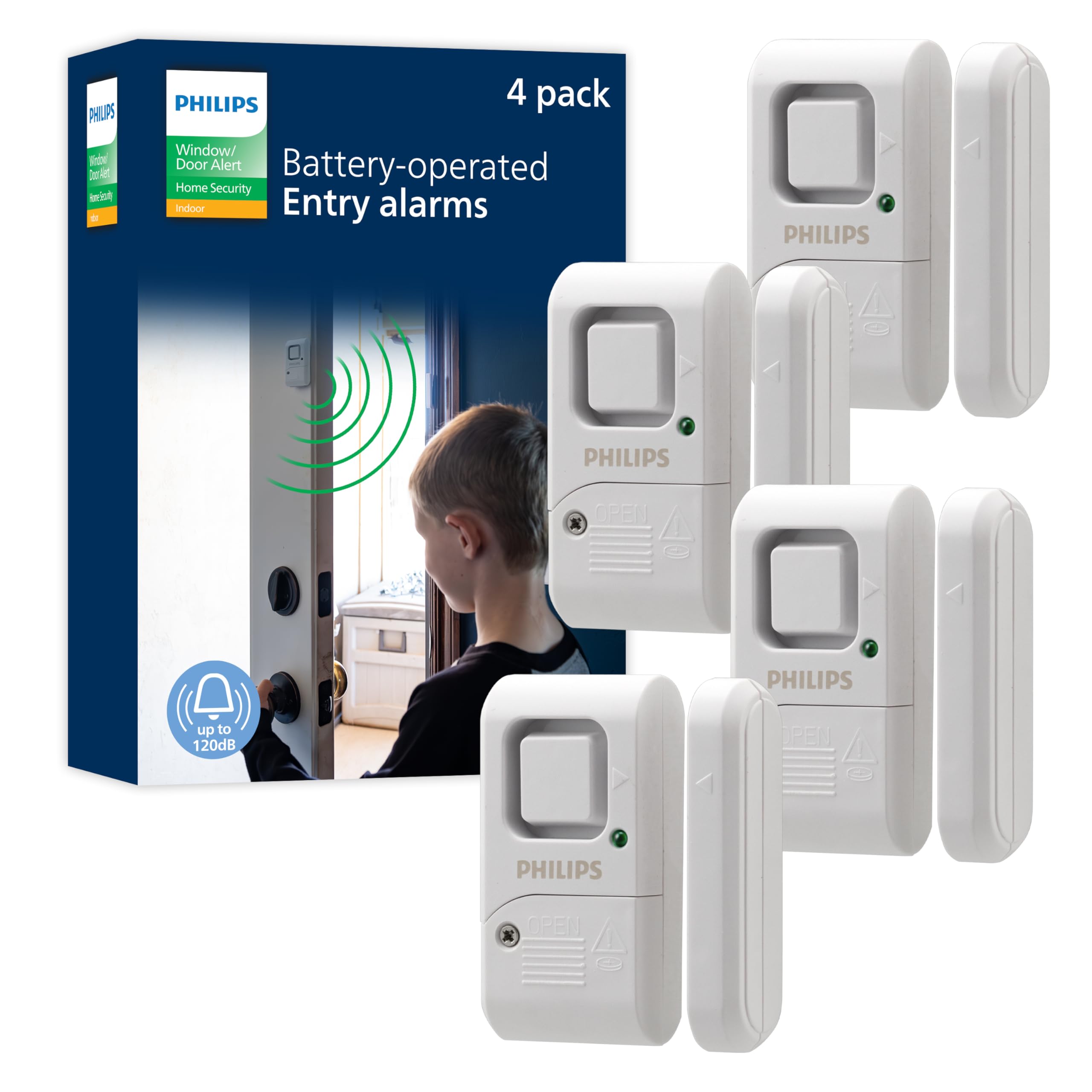
Philips packs four standalone alarm sensors that each hit 120 dB—equivalent to a jackhammer at close range. There is no hub, no app, and no subscription: the three-position switch selects Off, Chime (doorbell-style), or Alarm (continuous high-pitch siren until the door is closed). The magnetic trigger gap is tight at 0.5 inches, meaning the magnet and sensor must be within half an inch to arm correctly.
Each unit runs on four included LR44 button cells with a low-battery indicator LED. The 120 dB output makes this sensor effective for alerting someone across a two-story house or startling a potential intruder, but there is no volume adjustment—the sound is aggressive and cannot be softened for nighttime use. The included double-sided tape holds well on clean surfaces, though some users prefer stronger adhesive putty for textured molding.
For a no-nonsense, no-wire, no-subscription door alarm that just works, this Philips set delivers confidence through pure loudness. The four-pack covers front door, back door, and two windows at a single purchase, making it the most straightforward entry point for basic perimeter protection.
Why it’s great
- Ear-splitting 120 dB siren requires zero setup or network
- Four sensors in one box for whole-perimeter coverage
Good to know
- Fixed 0.5-inch trigger gap is less tolerant of misaligned doors
- No volume control—alarm is always at maximum intensity
3. YOLINK LoRa Smart Outdoor Contact Sensor

The YOLINK sensor breaks the 500-foot barrier by using LoRa radio technology to achieve a rated 1,320 feet (quarter-mile) of open-space range. This makes it the only sensor on this list suitable for detached garages, barn doors, pool gates, and driveway entry points that are out of Wi-Fi range. The outdoor-rated enclosure handles rain and temperature swings without issue.
A YOLINK Hub (sold separately) is mandatory, but the sensor does not require a monthly subscription for push alerts, email, or SMS notifications—a distinct advantage over subscription-locked systems. The two AA batteries claim five-plus years of standby life, and users report the battery indicator remaining full after nine months of daily use. The sensor also supports device-to-device pairing with YOLINK sirens, so the alarm sounds locally even if the internet goes down.
Installation is straightforward but requires you to snip the reed switch if wiring to a relay or external magnetic switch. The included wires are short at one foot, so mounting flexibility is slightly constrained. For property owners who need to monitor a gate 800 feet from the house, this sensor is the only viable solution in this lineup.
Why it’s great
- Unmatched 1,320-foot wireless range for remote structures
- No subscription required for app and email alerts
Good to know
- Requires YOLINK Hub—adds to initial cost
- Short wiring limits placement options for external magnetic switches
4. Philips Hue Secure Smart Contact Sensor
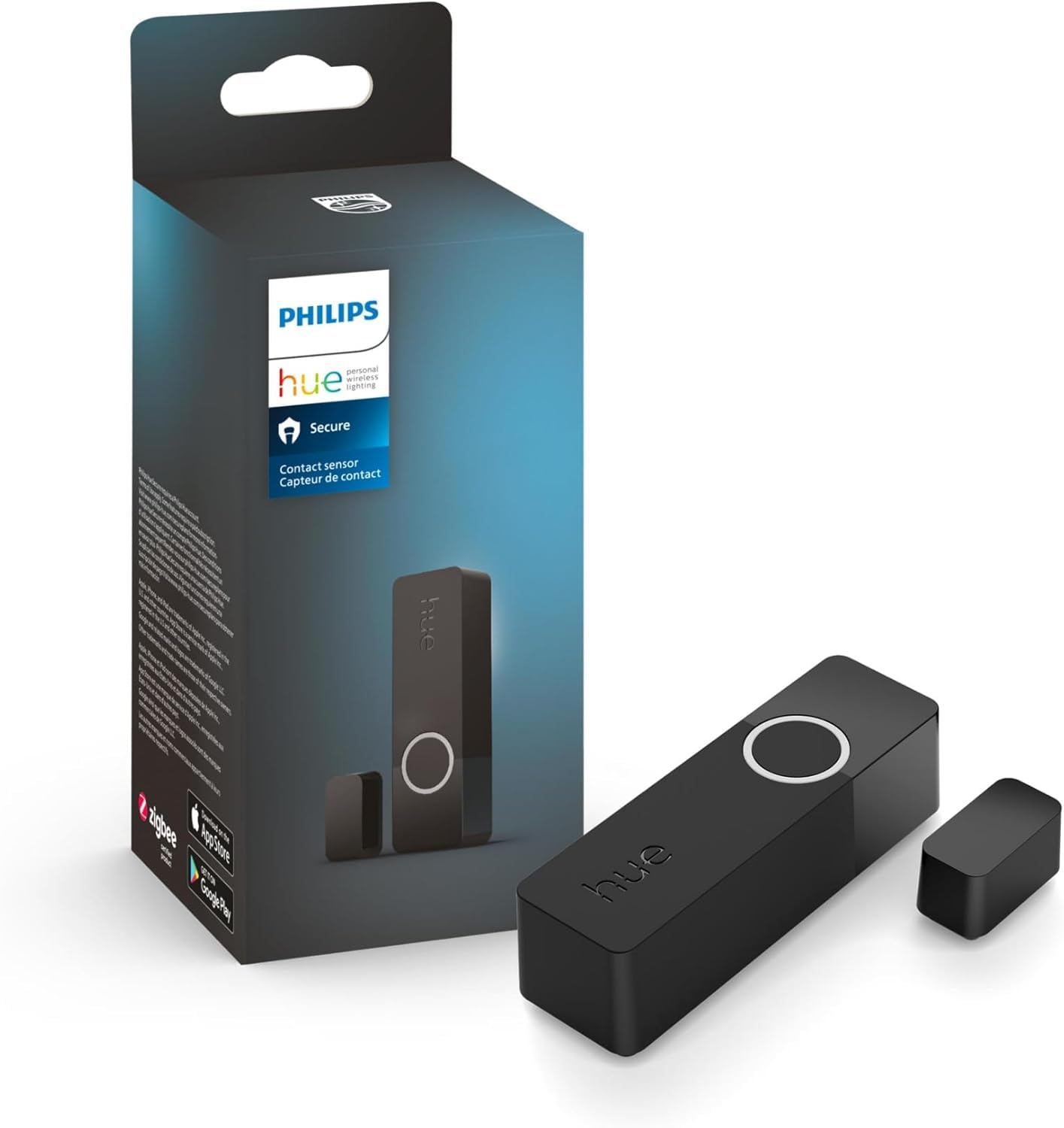
The Hue Secure Contact Sensor is built exclusively for the Philips Hue ecosystem—it requires a Hue Bridge to function. Its standout capability is light automation: opening the door can trigger hallway lights, closet lights, or any Hue bulb to turn on instantly. The sensor also sends real-time push notifications to your phone when armed, with a three-year estimated battery life from a single CR2 cell.
The physical design is compact (2.8 by 0.9 by 0.8 inches) with a clean black finish that blends into dark door frames. Pairing takes seconds inside the Hue app, and the sensor supports Apple HomeKit for voice control and automation beyond Hue’s own rules.
The biggest limitation is scope: the sensor does nothing without the Hue Bridge, and there is no local siren—the alert relies on your phone or automated lighting. For users who already own Hue lights and want the door to literally light up when opened, this sensor delivers a polished, integrated experience that standalone alarms cannot match.
Why it’s great
- Seamless light automation with Hue ecosystem—door opens, lights turn on
- Apple HomeKit compatible for advanced voice or scene control
Good to know
- Requires Hue Bridge; no standalone alarm functionality
- 0.5-inch trigger gap requires careful alignment
5. SECRUI Wireless Door Chime

The SECRUI system separates the sensor from the receiver—the magnetic sensor sticks to the door frame while the receiver plugs into any indoor wall outlet and plays one of 32 preloaded ringtones. This design is ideal for retail stores and offices where a polite chime (rather than an ear-piercing alarm) announces customer entries. The maximum range of 500 feet in open air covers most commercial floor plans.
Volume is adjustable through the receiver, and you can assign different chimes to different sensors to distinguish the front door from the back door. The sensor uses a standard contact reed switch with a reasonable gap tolerance, and the double-sided tape mount works on both wood and metal frames. The receiver is compact enough to not block adjacent outlets.
There is no alarm mode—only chime—so this is not a security deterrent against intruders. It is a notification tool. The sensor runs on AA batteries (included) while the receiver stays plugged in. For a small business owner who needs to hear when a customer walks in without startling them with a 120 dB blast, this is the right tool.
Why it’s great
- 32 distinct ringtones with adjustable volume for different zones
- 500-foot range covers large offices and retail spaces
Good to know
- Chime-only design does not produce an intruder alarm siren
- Receiver requires a power outlet—a potential placement limitation
6. TECKNET Door Alarm 3-Pack

The TECKNET alarm distinguishes itself with a 0.78-inch trigger gap—significantly more forgiving than the 0.4- to 0.5-inch standard. This means it reliably detects door opening on installations where the magnet cannot be placed perfectly parallel to the sensor, such as on uneven molding or slightly sagging doors. Each unit has a three-position switch for Off, Chime, and Alarm, plus three volume levels for the chime tone.
At 65 dB maximum, the alarm is more conversational than startling—audible in adjacent rooms but unlikely to wake a deep sleeper on the opposite floor. The compact white body (4.96 by 4.33 by 0.79 inches) is lightweight enough for travel; the product explicitly markets itself as a hotel door companion for solo travelers. Each unit runs on AAA batteries (not included), and battery life depends on usage frequency.
The 36-month warranty (with registration) adds peace of mind, though the 65 dB output limits its use as a serious security deterrent. For parents monitoring a curious toddler’s bedroom door or travelers wanting a second layer of alert in a hotel room, the TECKNET sensor delivers reliable detection without the deafening blast of higher-decibel units.
Why it’s great
- Wide 0.78-inch trigger gap handles imperfect door alignment
- Compact size and three-pack are ideal for travel and multi-zone coverage
Good to know
- 65 dB output is modest—easily missed behind closed doors
- AAA batteries not included in the package
7. Rinetiy Window Alarm Sensor 8-Pack

The Rinetiy eight-pack delivers 120 dB per sensor at a per-unit cost that undercuts everything else in this list. Each unit is a standalone magnetic alarm with a three-position switch (Off, Chime, Alarm) and runs on three included AG13 button cell batteries. The chime mode plays a pleasant doorbell tone once upon opening, while the alarm mode blasts a continuous 120 dB siren until the door is closed.
The trigger gap is tight at 0.4 inches—the most restrictive in this lineup—so precise alignment is mandatory. The double-sided adhesive is strong enough that repositioning often damages the tape. The small form factor (3 by 1.5 by 0.5 inches) fits inconspicuously on window sashes and cabinet doors, making this pack ideal for covering every entry point in a home on a single purchase.
Battery replacement requires a screwdriver to access the compartment, which prevents accidental battery loss but adds friction during changeover. The 800-foot audible range claim is theoretical—in practice, the 120 dB siren is clearly heard throughout a standard three-bedroom home. For buyers who need maximum coverage at minimum upfront cost, the Rinetiy eight-pack is the clear choice.
Why it’s great
- Eight sensors with 120 dB output for whole-home coverage at a low per-unit cost
- Simple Off/Chime/Alarm switch requires no app or hub
Good to know
- 0.4-inch trigger gap demands precise magnet alignment
- Secure screw-type battery door makes replacement less convenient
FAQ
Can a smart alarm door sensor work without a subscription?
Is a 65 dB alarm loud enough for home security?
How do I mount a door sensor on an uneven or metal frame?
Why does my door sensor keep beeping randomly?
Final Thoughts: The Verdict
For most users, the best alarm door sensor winner is the Ring Alarm Contact Sensor 2-Pack because it combines the most reliable detection range (1-inch gap tolerance) with seamless smart-home integration for users who already own Ring equipment. If you want maximum loudness with zero subscription or hub, grab the Philips Personal Security 4-Pack for its 120 dB siren. And for remote property monitoring, nothing beats the YOLINK LoRa Outdoor Sensor, which reaches a quarter mile without a monthly fee.