
The single biggest waste in most households isn’t food or electricity — it’s the steady stream of alkaline batteries tossed into the trash after a single use. A specialized charger designed for chemistry types beyond just NiMH can breathe life back into those “dead” alkalines, often reviving them to 90% or more of their original capacity. This isn’t a gimmick; it’s a real technology that changes the economics of powering remote controls, wireless mics, wall clocks, and kids’ toys.
I’m Min — the co-founder and writer behind Gadgets Feed. My research into the charging profiles of alkaline cells versus NiMH and NiCd chemistries reveals that most universal chargers on the market either lack the correct voltage curve or outright refuse to charge non-rechargeable chemistries, which makes finding a truly capable unit surprisingly tricky.
Whether you’re managing a fleet of devices for a small business or just tired of buying packs of AAs every month, finding the best alkaline battery charger for your needs comes down to understanding independent slot control, safety certifications, and which cell sizes matter most to your daily routine.
How To Choose The Best Alkaline Battery Charger
Before you buy, understand that charging alkaline batteries is fundamentally different from charging NiMH cells. Alkaline chemistry is more sensitive to overcharging and can leak or rupture if pushed too hard. A good charger must include precise voltage monitoring and a smart cutoff mechanism to stop the charge before the cell reaches unsafe levels.
Independent Slot Architecture
Most cheap chargers link all slots to a single charging circuit. That means a half-empty battery and a full one get treated identically, leading to overcharging and shortened cell life. Look for a charger where each bay operates independently, using its own microcontroller to monitor voltage and cut off when that specific cell is full. This is non-negotiable for alkaline batteries.
Safety Certifications
UL or FCC certification is a strong signal that the charger has passed independent testing for fire and electrical hazard risks. Because alkaline cells are not designed for recharging by default, the margin for error is thinner. A charger with certified protection circuits — overcharge, overcurrent, short circuit, and reverse polarity detection — is worth the extra upfront expense.
LCD Status Display
A screen that shows individual cell voltage, charge progress, and battery health removes the guesswork. You can see exactly when a battery is done and whether a cell is too degraded to accept a charge. This is especially useful when reviving old alkalines, as their internal resistance varies wildly. A simple blinking LED is insufficient.
Supported Cell Sizes
Confirm the charger handles the form factors you actually use. AA and AAA are universal, but if you rely on C, D, 9V, or even N cells for specific devices, a model that supports all of them without separate adapters or fiddly spring mechanisms will save you daily frustration. Some chargers also handle 26650 Li-ion cells, which adds versatility but doesn’t affect alkaline support.
Quick Comparison
On smaller screens, swipe sideways to see the full table.
| Model | Category | Best For | Key Spec | Amazon |
|---|---|---|---|---|
| MaximalPower FC999 | Premium | Alkaline & NiMH multi-size | 8-bit RISC processor, per-bay timer | Amazon |
| Energizer CHFC | Premium | Brand reliability & family use | Auto-adjust contacts, 5 sizes | Amazon |
| MIEKLALE 20+2 Bay | Mid-Range | High-volume AA/AAA charging | 22 independent slots, LCD display | Amazon |
| Popular Mechanics 5-in-1 | Mid-Range | Disposable alkaline revival | Built-in battery tester, 5 slot | Amazon |
| MaximalPower 6-Bay LCD | Mid-Range | 9V & Li-ion enthusiasts | Adjustable current 0.5A, refresh mode | Amazon |
| Shitanchao Universal 4-Slot | Budget | Budget entry with LCD readout | 4 independent slots, auto detection | Amazon |
| Koshore Universal Rapid | Budget | Overcharge protection focus | UL & FCC certified, fireproof shell | Amazon |
In‑Depth Reviews
1. MaximalPower FC999 Universal Charger Station

The FC999 stands out for its combination of a built-in battery tester and an 8-bit microprocessor that monitors each charging bay individually via advanced RISC architecture. This level of per-cell intelligence is rare at its tier and directly addresses the biggest risk of charging alkaline cells: uneven voltage causing one battery to overcharge while another under-charges. The sliding spring-loaded negative pole makes inserting odd-sized cells like C and D batteries effortless without forcing connections.
Real-world testing shows it successfully revives standard alkaline AAs from around 1.2V to a usable 1.5V range, and the integrated LCD screen provides real-time voltage and charge status per slot. Users report that the alkaline setting works particularly well on low-drain devices like TV remotes and weather stations, where even a partial recharge extends battery life by weeks. The built-in tester also checks button cells (3V), adding utility beyond just charging.
One caveat: the FC999 requires prompt removal of batteries once the LCD shows “OK” status. Leaving cells in the charger after completion increases leakage risk, which can damage the contact wiring over time. This is a chemistry-specific behavior rather than a design flaw, but it means the charger demands a bit more attention than a simple drop-and-forget unit.
Why it’s great
- Per-bay independent timers prevent overcharging of mixed chemistry batches
- Built-in tester works with alkaline, NiMH, and button cell batteries
- Sliding negative pole accommodates AA through D cells without adapters
Good to know
- Batteries must be removed promptly after charging to avoid leakage damage
- Alkaline charge may not reach full 1.5V of a new cell
2. Energizer CHFC Family Battery Charger

The Energizer CHFC is a no-compromise family-grade charger that handles AA, AAA, C, D, and 9V batteries with a simple auto-adjusting contact mechanism. Its microcomputer-controlled charging algorithm trickle-charges near the peak and automatically shuts off, preventing the overcharge damage that plagues less sophisticated designs. The LCD display clearly shows each battery’s progress and flags disposable batteries as “BAD” without attempting to force a charge that could cause leakage.
User feedback consistently highlights that batteries charged on the CHFC last roughly twice as long as batteries charged on generic or Duracell-branded units. The charger reaches full capacity on most cells within three to seven hours depending on size, and it can simultaneously charge a mixed batch of four to eight batteries. The auto-shutoff feature is particularly important for C and D cells, which have higher capacities and take longer to complete.
The spring-loaded contacts are the weakest structural point — several users report springs detaching internally after a few months of use, causing intermittent connection issues. While the charger performs excellently when intact, the build quality of the sliding contacts does not match the quality of the charging electronics. The 100V AC input also requires a US-standard outlet, which may be inconvenient for international users.
Why it’s great
- Trickle-charge algorithm extends battery life beyond most competitors
- Handles five battery sizes with auto-adjusting contacts, no adapters needed
- Safely detects and rejects non-rechargeable cells without damage
Good to know
- Spring contacts can detach internally after extended use
- C battery capacity limited to 2500mAh maximum
3. MIEKLALE 20+2 Bay Smart Charger
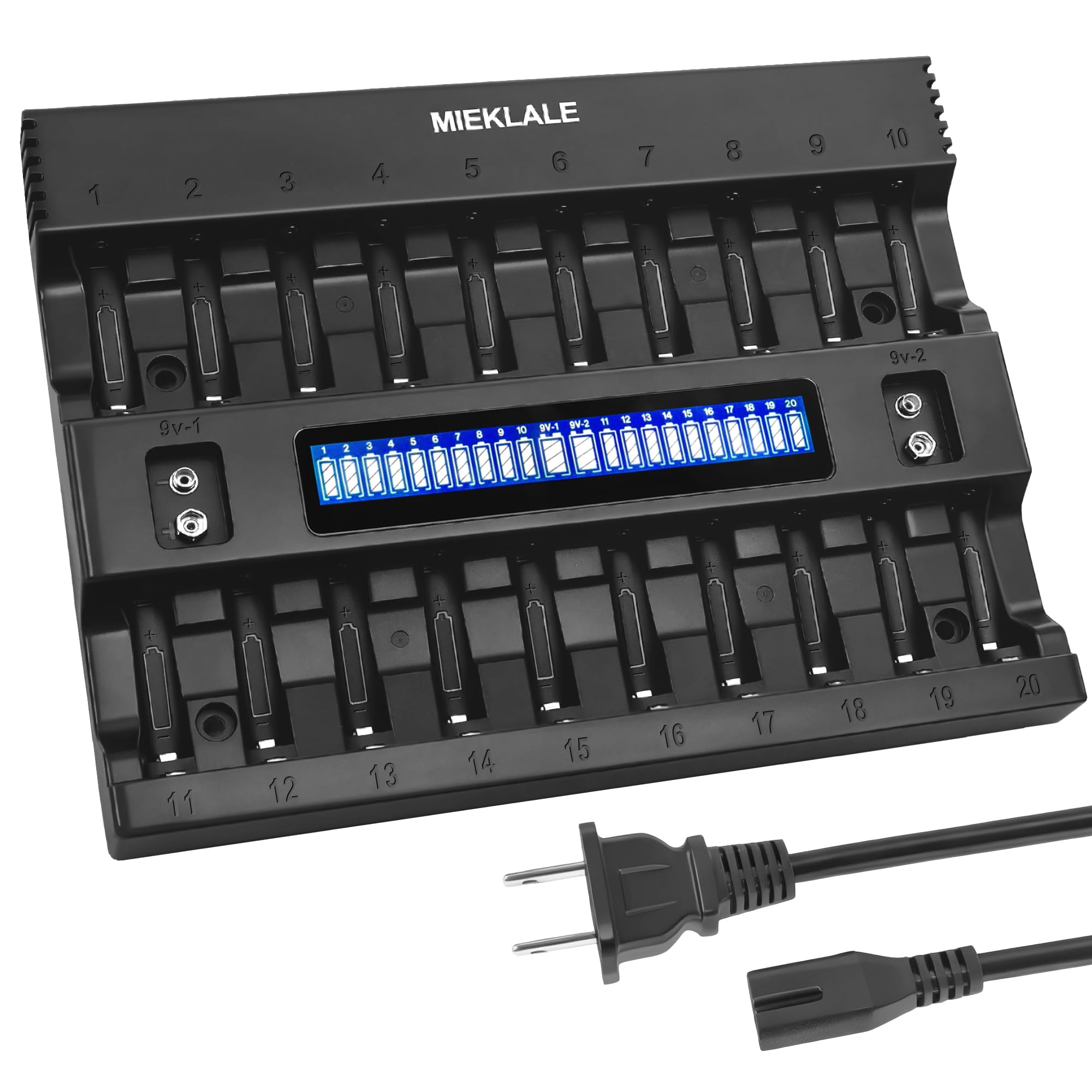
The MIEKLALE is the solution for anyone who burns through AA and AAA batteries in bulk — think wireless microphones for a church, walkie-talkies for crew communication, or in-ear monitor packs for a band. Its 20+2 architecture provides twenty slots for AA/AAA cells and two dedicated slots for 9V batteries, all operating independently so you can charge any combination of one to twenty-two batteries without worrying about mismatched voltages between slots.
The vibrant LCD screen shows the charging status of each battery in real time, with a crisp display that makes it easy to spot a slow-charging cell from across the room. Users report charging all twenty AAA batteries to full capacity successfully, with the batteries still going strong after multiple cycles. The intelligent protection circuit covers overcharge, overcurrent, overvoltage, overheating, and short circuit, which is critical when charging this many cells simultaneously.
The charger does not support 3.7V lithium batteries or 1.5V lithium AA/AAA cells, so it is strictly a NiMH/NiCd/9V solution. The user manual is poorly written and calls for 220V input, though the unit actually runs on 110V, which creates confusion about the correct power source. A flashing battery icon with no documented meaning is also a concern for safety-conscious buyers.
Why it’s great
- 22 independent slots allow charging any combination of AA/AAA/9V simultaneously
- Smart LCD display provides clear real-time status for every battery
- Excellent value for high-volume users like churches and production crews
Good to know
- Does not charge 1.5V lithium AA/AAA or 3.7V lithium batteries
- Poorly written manual creates confusion about input voltage requirements
4. Popular Mechanics 5-in-1 Battery Recharger

The Popular Mechanics 5-in-1 recharger is one of the few units with a patented circuit design that explicitly supports charging standard alkaline batteries alongside NiMH, NiCd, Titanium, and RAM chemistries. It handles seven cell sizes — AAA, AA, C, D, N, 6V, and 9V — with a mix-and-match capability for up to four batteries at a time (though 9V and 6V cells must be charged on their own). The built-in battery tester helps you determine which cells are worth the effort before committing to a charge cycle.
Users report successful revival of Duracell alkaline AAs from 25% to 100% charge, with the charger’s automatic overcharge protection stopping further charging once the cell is full. The slower charge rate is actually a safety feature — lower voltage prevents the heat buildup that causes alkaline leakage. For high-drain devices like Roku remotes and wireless mice, this translates to significant savings compared to buying new packs every few weeks.
The plastic cover is fragile — several users report it breaking within the first month of normal use. While the charger itself continues to function, the exposed internals feel less secure. Additionally, regular 1.5V alkaline batteries from brands like Duracell only charge to about 1.2V, which may not be sufficient for some high-drain devices that require the full 1.5V to operate.
Why it’s great
- Patented circuit supports standard alkaline chemistry, not just rechargeable cells
- Built-in tester helps identify usable batteries before charging
- Handles seven cell sizes including N and 6V batteries
Good to know
- Plastic housing cover is prone to breaking within the first month
- Alkaline batteries only charge to about 1.2V, not the full 1.5V
5. MaximalPower 6-Bay LCD Smart Charger
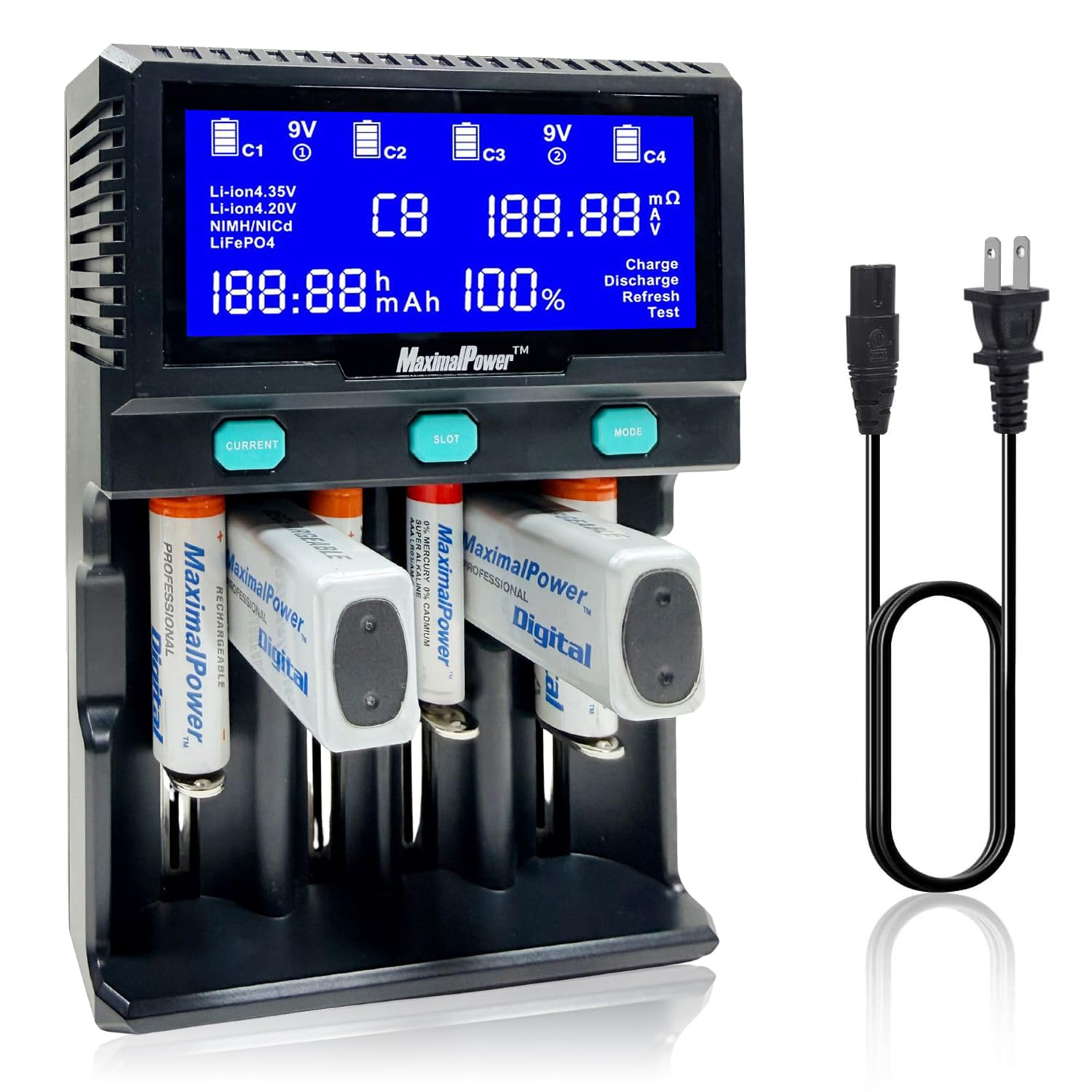
The MaximalPower 6-bay charger extends beyond alkaline and NiMH into Li-ion and LiFePO4 support, making it the most versatile chemistry handler in this lineup. Its four universal bays accept AA, AAA, C, D, and 26650 cells, while two dedicated 9V bays handle that specific form factor. The full LCD display shows battery type, voltage, current, present capacity, power percentage, and charge time for each cell, giving you complete granular control over the charging process.
The fourth bay includes an exclusive test and refresh function that can discharge and measure battery capacity, then recondition cells that have developed voltage depression or memory effect. Users confirm that the default 0.5A current keeps batteries cool during charging — a stark contrast to cheaper chargers that cook cells at higher currents. The adjustable current lets you match the charge rate to the battery’s mAh rating, preserving long-term capacity on expensive NiMH and Li-ion cells.
The slots are not ideally shaped for AA/AAA batteries — they feel loose and unstable without included plastic shells. Several users note that the batteries can wobble during insertion, making contact unreliable. The power connector also looks mismatched to the charger port, causing hesitation during first-time setup. While the electronics are excellent, the physical design for smaller cells needs improvement.
Why it’s great
- Supports multiple chemistries including Li-ion, LiFePO4, NiMH, NiCd, and alkaline
- Adjustable charging current preserves battery health across different mAh ratings
- Bay 4 exclusive test/refresh function reconditions aging cells
Good to know
- AA/AAA slots are loose and may need separate shells for stability
- Power connector design looks mismatched, causing setup confusion
6. Shitanchao Universal 4-Slot Charger
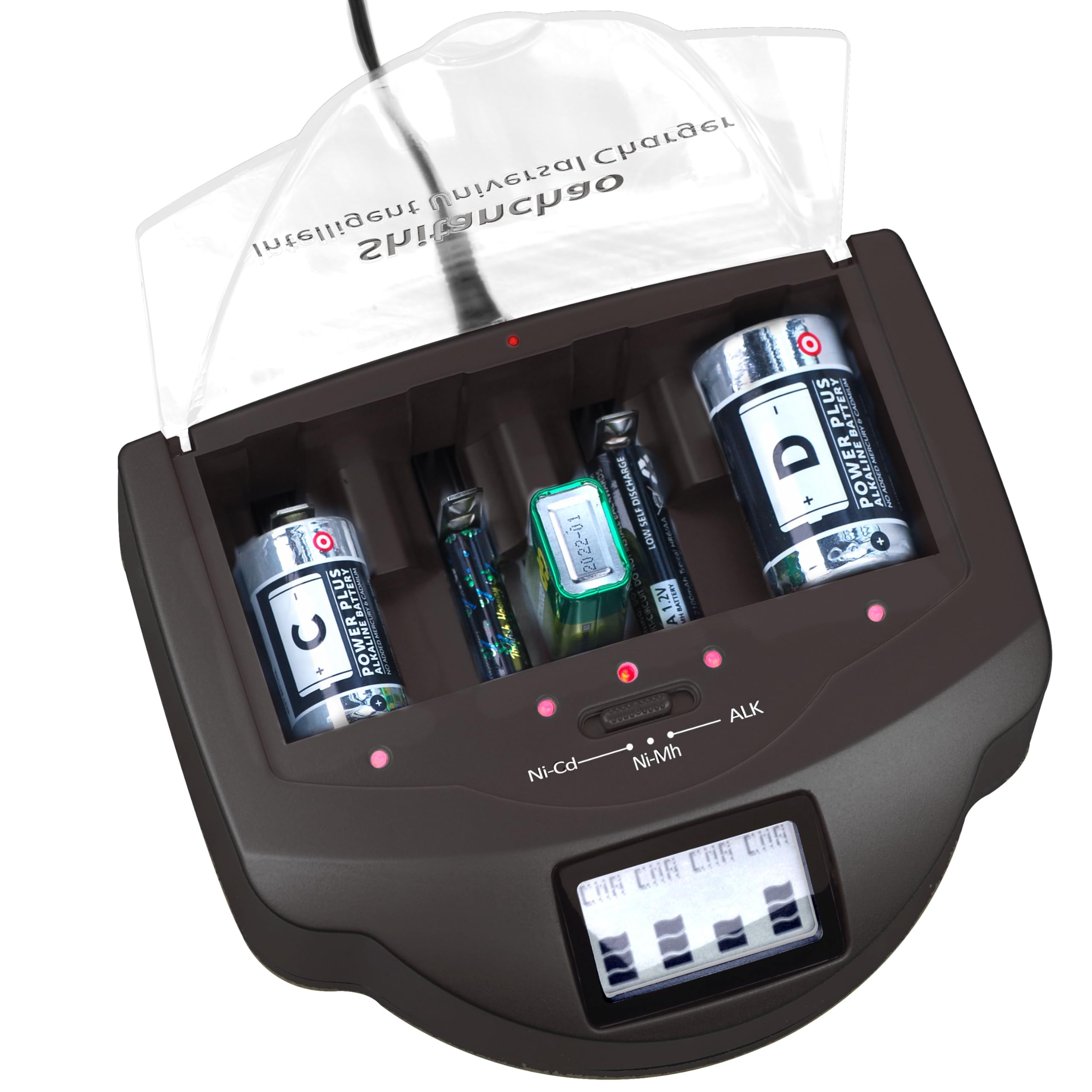
The Shitanchao charger breaks the budget mold by offering an LCD display and four independent slots at a very accessible price point. It automatically detects battery chemistry — NiMH, NiCd, or alkaline — and adjusts the charging profile accordingly, then displays the progress on a built-in screen that shows each battery’s status individually. The auto-detection feature works well in practice, reviving near-dead alkaline AAs from 1.2V to 1.5V in about two hours.
Versatility is the standout strength: the charger handles AA, AAA, C, D, and 9V cells with a smart detection system that prevents you from accidentally damaging non-rechargeable chemistries. Users report that the unit has survived six months of rough daily use without performance degradation, and the safety features including overcharge and temperature monitoring provide peace of mind during extended charging sessions. The 12V output voltage is higher than most competitors.
The independent slots are not truly independent — they require batteries of the same type to be charged together, and you must power off the unit to switch between chemistries. One unit experienced a display failure after ten minutes of use, with the screen flickering intermittently before partially recovering. The 1-month warranty is also notably shorter than competitors, reflecting the budget positioning.
Why it’s great
- LCD display per slot provides clear individual charge status
- Auto-chemistry detection handles NiMH, NiCd, and alkaline without manual settings
- Revives near-dead alkaline cells to usable voltage quickly
Good to know
- Not true independent slots — must batch same types together
- Display failure reported in some units within first hours of use
7. Koshore Universal Rapid Charger
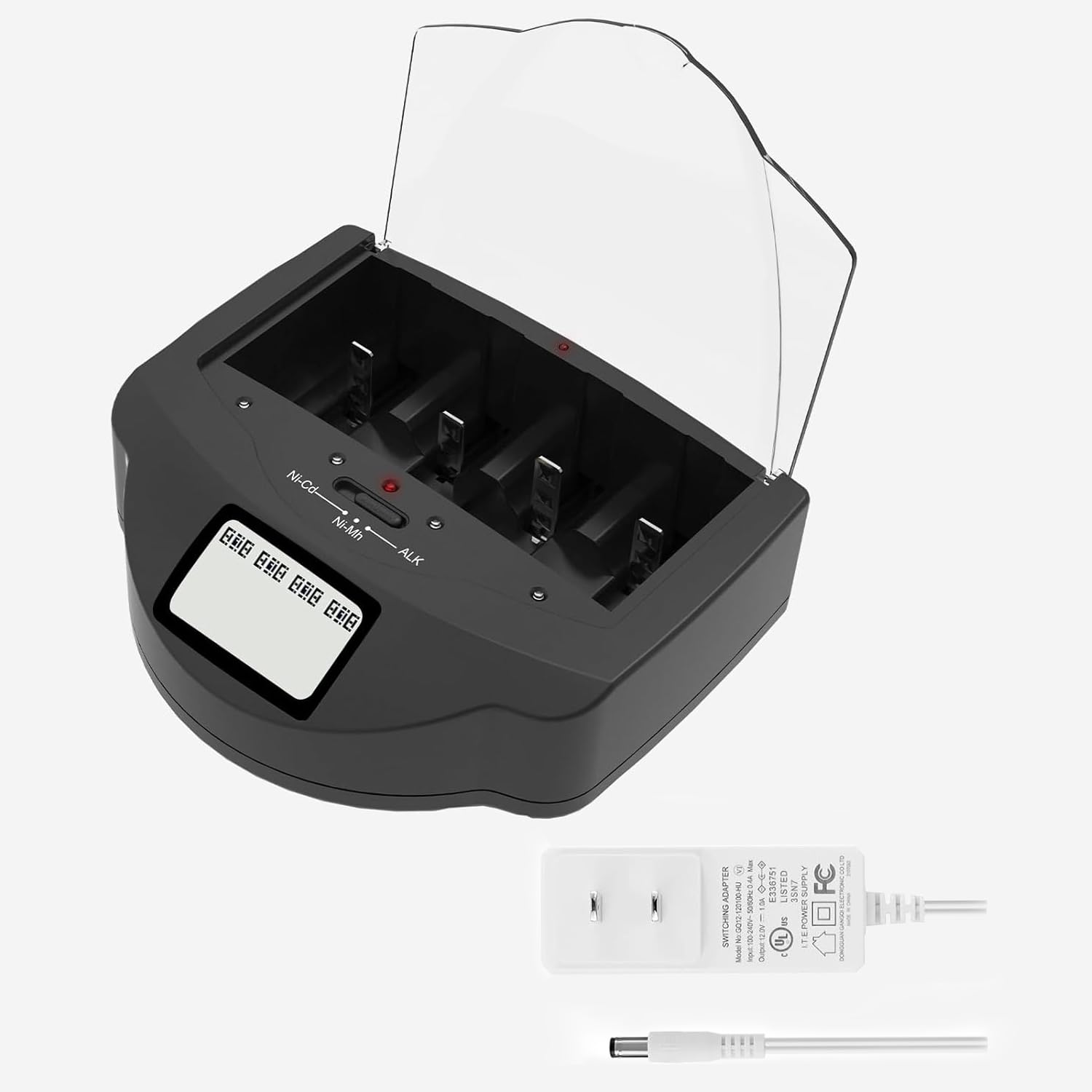
The Koshore Universal Rapid Charger prioritizes safety above all else, shipping with both UL and FCC certifications and a fireproof PC/ABS plastic shell that won’t sustain combustion in the event of a cell failure. Its four independent charging slots accept AA, AAA, C, D, and 9V cells across NiMH, NiCd, and alkaline chemistries, with an LCD display that clearly shows battery type and charging status. The protection circuit guards against overcharge, over-discharge, overheating, and sudden current fluctuations.
Users who replaced a 20-year-old charger with this unit report consistent, reliable performance across hundreds of charge cycles. The independent slots allow mixing different battery sizes and chemistries simultaneously without issue. The fireproof casing is a rare feature at any price point and provides genuine peace of mind when charging multiple alkaline cells overnight, as leakage is always a risk with that chemistry.
The instructions are poorly written to the point of being a safety concern — they warn about damage if the mode button is switched while the charger is plugged in, suggesting a design vulnerability. Battery orientation is counterintuitive (positive contact faces down), which increases the risk of reverse polarity insertion. There is no physical on/off switch, requiring the user to unplug the unit to stop a charge cycle, which feels incomplete.
Why it’s great
- UL and FCC certified with fireproof PC/ABS housing for genuine safety
- Independent slots allow mixing different sizes and chemistries
- Proven reliable over months of daily use across multiple charge cycles
Good to know
- No physical on/off switch — must unplug to stop charging
- Battery orientation is non-intuitive with positive terminal facing down
FAQ
Can I safely charge any alkaline battery in a universal charger?
How many times can I recharge an alkaline battery before it dies?
Will charging alkaline batteries in a smart charger make them last as long as NiMH?
What does the LCD display actually show during an alkaline charge cycle?
Final Thoughts: The Verdict
For most users, the alkaline battery charger winner is the MaximalPower FC999 because its 8-bit microprocessor and per-bay independent timers offer the precision needed to safely charge alkaline cells while also handling NiMH, NiCd, and even button cells. If you need high-volume charging for wireless mics or production equipment, grab the MIEKLALE 20+2 Bay. And for premium safety certifications and fireproof construction, nothing beats the Koshore Universal Rapid Charger.