
Our readers keep the lights on and my morning glass full of iced black tea. As an Amazon Associate, I earn from qualifying purchases.
The promise of energy independence often collapses under the weight of mismatched components—a controller that can’t handle your panel array, an inverter that browns out the moment a well pump kicks on. An all-in-one solar charge controller inverter eliminates that compatibility headache by merging MPPT solar charging, battery management, and pure sine wave AC output into a single unit. These are the systems that turn a pile of panels and batteries into a reliable home, cabin, or backup power station that actually works when you need it.
I’m Min — the co-founder and writer behind Gadgets Feed. I’ve spent hundreds of hours researching and cross-referencing technical specifications for solar equipment, comparing MPPT efficiency curves, surge handling capabilities, and real-world battery compatibility across dozens of models to find the units that truly deliver on their rated specs.
Whether you are outfitting a workshop, a remote cabin, or a whole-home backup system, the right unit balances continuous wattage, MPPT efficiency, and battery voltage architecture. selecting the best all in one solar charge controller inverter means matching your load demands to a unit with proven surge capacity and smart hybrid power management.
How To Choose The Best All In One Solar Charge Controller Inverter
Choosing the right hybrid solar inverter is about matching the unit’s electrical architecture to your actual energy use. The three most common mistakes are underestimating surge loads, mismatching battery voltage to the inverter’s DC input, and over-paneling a controller that can’t handle the open-circuit voltage of a cold winter day.
Match Your Battery Bank Voltage First
The inverter’s DC input voltage determines which battery bank you need. 24-volt units like the VEVOR 3000W are great for smaller cabins or RV setups where four 6V batteries in series are practical. For anything above 3000W continuous, 48-volt systems are the standard, offering lower current draw, thinner cable runs, and better efficiency. A 48V inverter like the ECO-WORTHY 5000W runs cooler and supports much higher PV input wattage.
Surge Capacity is the Real Performance Test
Continuous power ratings are easy to find, but the peak surge rating tells you whether the inverter can start motors. Refrigerators, well pumps, and air conditioners all draw three to seven times their running wattage during startup. Look for a unit that can handle at least double its rated continuous output for several seconds. The SUMRY 4000W, for example, offers an 8000W peak, making it a strong choice for a home with a fridge and a few lights—or a small pool pump.
MPPT Voltage Range Determines Your Solar Array Design
The MPPT controller’s input voltage range dictates how many solar panels you can wire in series. A unit with a 60-500VDC range, like the 3600W hybrid from Busbyr, lets you build a high-voltage string (reducing wire gauge and voltage drop) while still operating efficiently in low light. Units with a wider MPPT range harvest more energy at dawn and dusk, which is where the real daily yield gains happen.
Quick Comparison
On smaller screens, swipe sideways to see the full table.
| Model | Category | Best For | Key Spec | Amazon |
|---|---|---|---|---|
| SUMRY 4000W | Mid-Range | Home/Workshop backup | 140A MPPT, 8000W peak | $379.99Amazon |
| VEVOR 3000W | Mid-Range | RV/Small cabin | 100A MPPT, WiFi monitor | $309.90Amazon |
| ECO-WORTHY 5000W | Premium | Whole-home backup | 100A MPPT, UL1741, Parallel | Amazon |
| POWLAND 12000W | Premium | Large home / Commercial | Dual 200A MPPT, 99.9% eff. | Amazon |
| Aninerel 12000W | Premium | Whole-home / Off-grid | Dual MPPT, 220A charging | Amazon |
| SUNGOLDPOWER 10000W | Premium | Whole-home / High power | Dual MPPT, 200A charging | Amazon |
| 3600W Hybrid (Busbyr) | Value | Entry-level / Backup | 120A MPPT, 7200W peak | Amazon |
| EF ECOFLOW DELTA 3 MAX | Portable | RV / Camping / Portable | 2400W output, X-Boost 3400W | Amazon |
| VEVOR 6000W 48V | Value | Home backup / Cabin | 120A MPPT, 94% efficiency | Amazon |
In‑Depth Reviews
1. SUMRY 4000W Hybrid Solar Inverter
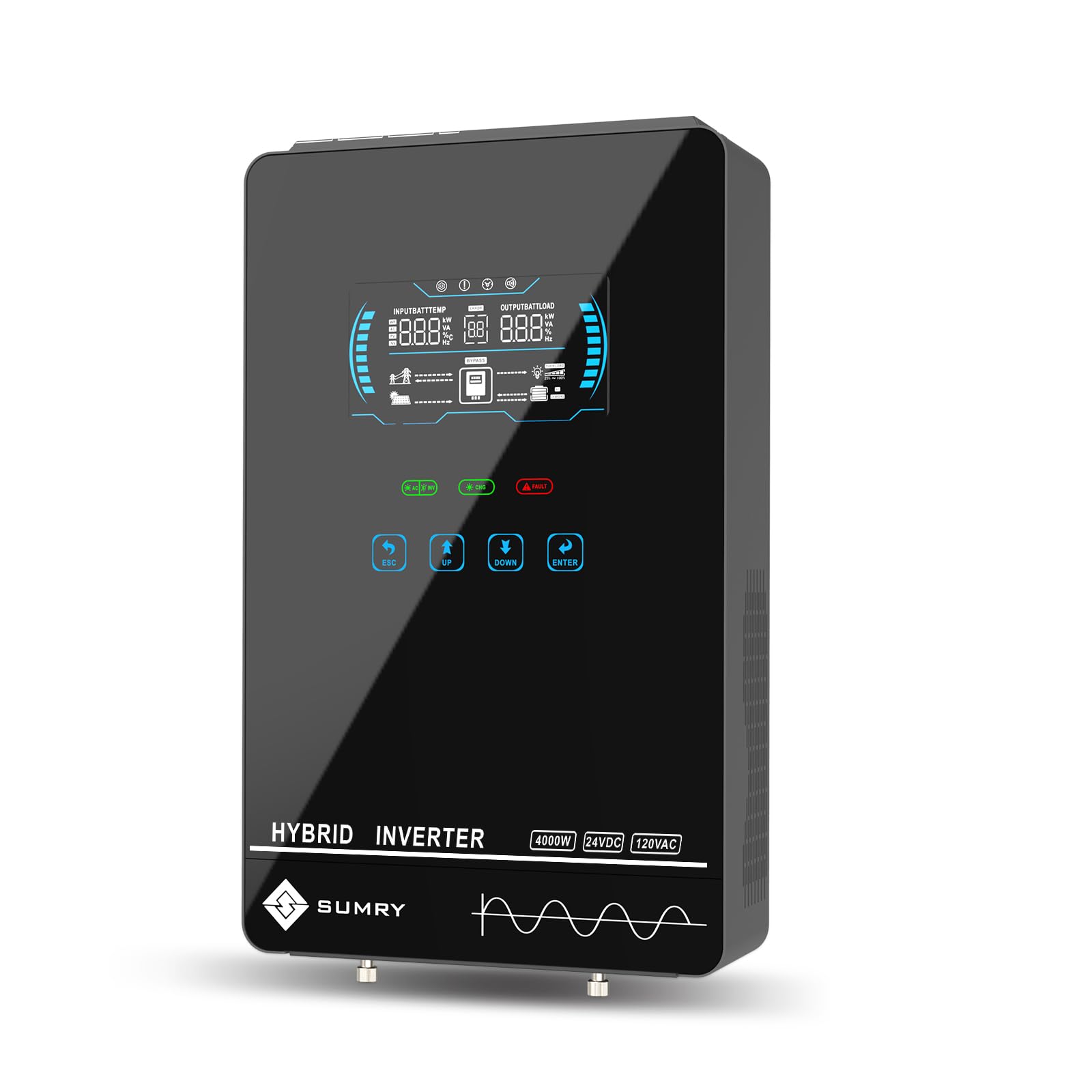
The SUMRY 4000W hits the sweet spot for most off-grid homes and workshops. Its 140A MPPT charge controller accepts up to 5600W of PV at 350VDC, converting at up to 98% efficiency according to the manufacturer. That translates to real-world performance: one reviewer runs a 1.5HP pool filter pump entirely on six 335W panels without any battery connected, with the inverter seamlessly adding grid power only when solar dips. The 8000W peak surge handles motor startup easily, and the 24V input keeps battery wiring manageable for medium-sized banks.
The tempered glass cover with a large 6.25-inch LCD display is more than aesthetic—it makes real-time system data, from PV voltage to load wattage, legible without squinting. Touch buttons eliminate the finicky membrane switches found on cheaper units. SUMRY supports battery-less daytime operation, so you can run loads directly off solar panels when the sun is up, though you’ll want a 24V battery bank for overnight power or cloudy days.
This unit works with AGM, Gel, Lead-Acid, Lithium-ion, and LiFePO4 batteries, giving you flexibility to start with a basic lead-acid bank and upgrade to lithium later. Three cooling fans keep the inverter from thermal throttling during continuous high-load use. The 98% peak conversion efficiency means less heat wasted and more energy pushed into your batteries or loads.
Why it’s great
- 140A MPPT with up to 98% efficiency, supports PV input up to 5600W
- Tempered glass front panel with large, clear LCD and responsive touch buttons
- Battery-less daytime operation mode saves on system cost
Good to know
- Rated for 120V output only—not suitable for 240V well pumps or large AC units
- 24V input requires a four-battery series configuration for optimal storage
2. VEVOR 3000W Hybrid Solar Inverter

VEVOR’s 3000W unit brings smart monitoring to the mid-range tier with a built-in WiFi module—a feature typically reserved for premium inverters. The accompanying app lets you track system status, adjust charging modes (Solar Only, Mains Only, or hybrid), and configure output priority (UTL, SOL, SBU, SUB) without touching the inverter’s physical buttons. Note that the app refreshes data every five minutes, not in real time, so it’s better for daily trend checks than instant load monitoring. The 100A MPPT controller maxes out at 4000W of solar input with a 60-500VDC range, making it compatible with both low-voltage and high-voltage panel strings.
On the power side, this 24V inverter outputs 3000W continuous pure sine wave at 110/120V AC, with verified real-world performance handling 3000W continuously before hitting its overload cutoff. One reviewer ran it 24/7 for weeks without issues, powering a 15A table saw and 12A shop vac simultaneously—a testament to its solid build. The 2-in-1 design merges the inverter and controller into a single unit that weighs 15.2 pounds, small enough for RV compartments or utility closets.
VEVOR includes a lithium-battery activation function, which is crucial for waking up dormant LiFePO4 or NMC battery management systems. The inverter also supports fast AC passthrough, allowing utility power to flow directly to loads while the MPPT charges the battery bank. Some users note the absence of a ground terminal on the outlet side and reversed arrow keys on the front panel, but these quirks don’t affect core performance.
Why it’s great
- Built-in WiFi module for remote system monitoring and mode switching
- Lithium battery activation function—vital for LiFePO4 and NMC BMS compatibility
- Verified to run 3000W continuous loads, including power tools and appliances
Good to know
- App updates every 5 minutes, not suitable for real-time monitoring
- No ground terminal on the AC outlet side—check local code for bonding requirements
3. ECO-WORTHY 5000W 48V Solar Inverter

The ECO-WORTHY 5000W inverter separates itself from the pack with UL1741 certification and an architecture designed for parallel expansion. You can stack up to six units for a combined 30kW output, supporting single-phase or separate-phase configurations. A single inverter delivers 5000W continuous (10,000W peak) at 120V, and when two or more units are connected, the system can output 120V, 208V, or 240V split-phase—critical for running standard household panel loads like an electric water heater or a central air conditioner. The 100A MPPT handles PV input from 120V to 500V DC, and the hybrid charger pulls up to 100A from both solar and AC sources simultaneously.
One user replaced a loud EG4 3000W with this unit and reported significantly quieter operation and better MPPT tracking. The 48V DC input keeps current draw lower than 24V equivalents, reducing heat and copper losses in longer cable runs. Timed charging schedules let you program the inverter to charge batteries from the grid during off-peak hours and discharge stored solar energy during peak rate windows, directly lowering your electricity bill. The LCD display shows all system parameters, and the WiFi module enables remote monitoring, though some users find the app setup finicky.
Installation requires professional electrical experience—this is not a plug-and-play unit. The inverter’s 21-inch length and 46-pound weight demand solid mounting and careful cable management. One reviewer experienced a breaker trip early on but the unit performed flawlessly afterward. It’s important to note that the split-phase output only activates with two or more inverters in parallel, so a single unit remains 120V only.
Why it’s great
- UL1741 certified and parallel-able up to 6 units for 30kW total power
- Timed charge/discharge scheduling to optimize solar usage and reduce electricity costs
- Quieter operation than competing 3000W inverters, with superior MPPT tracking
Good to know
- Single unit is 120V only—requires two or more for split-phase output
- WiFi app setup is known to be challenging; some users report missing dongles
4. POWLAND 12000W Hybrid Solar Inverter
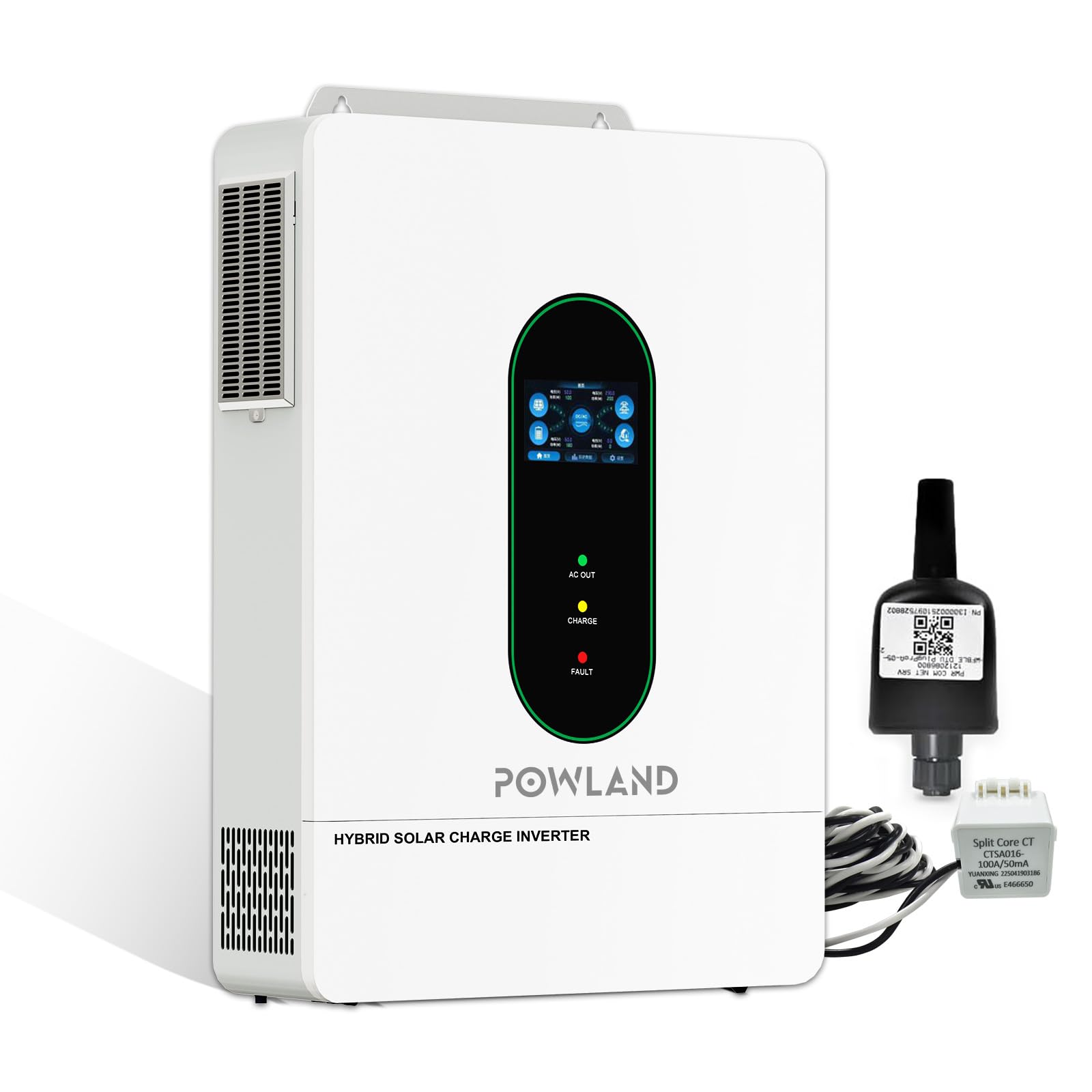
The POWLAND 12000W is a beast of an inverter, built for homes that need to run heavy loads like central air conditioning, electric ovens, and well pumps simultaneously. It operates on 48V DC and outputs split-phase 120V/240V AC, matching standard US residential electrical panels. The dual 200A MPPT controllers capture up to 99.9% solar harvesting efficiency according to the manufacturer, and generate up to 15% more power during low-light dawn/dusk conditions compared to single-MPPT designs. The unit accepts a massive PV input range of 90-500VDC, allowing for high-voltage solar strings that minimize wire losses over long runs from a ground-mounted array.
A standout feature is the battery-free design mode, which feeds excess solar energy directly to your home loads or back to the grid (with an optional CT sensor for anti-backflow). This alone can cut battery costs by up to 40%, making it a compelling choice for someone who wants grid-tied solar savings without committing to a full battery bank yet. The IP65 weatherproof casing means it can be installed in semi-outdoor locations like a carport or covered patio, though full exposure to rain isn’t recommended. The unit operates at only 45dB thanks to dual quiet fans—significantly quieter than many competitors’ 55-60dB fan noise.
Parallel stacking of up to six units yields a theoretical 72kW of total output capacity, future-proofing your system for expansion. Users confirm the unit handles high-power breakers and survives miswiring errors, but the setup is not beginner-friendly. An OLED display and intuitive LED status lights provide real-time system information. Some buyers have reported receiving units with missing WiFi modules or signs of use, so inspect the package immediately upon delivery.
Why it’s great
- Dual 200A MPPT controllers with 99.9% claimed solar harvesting efficiency
- Battery-free grid-tie mode reduces upfront battery costs significantly
- IP65 weatherproof enclosure allows semi-outdoor installation
Good to know
- Setup is complex—requires strong electrical knowledge and high-rated breakers
- Some units have arrived with missing WiFi modules or signs of prior use
5. Aninerel 12000W Solar Hybrid Inverter
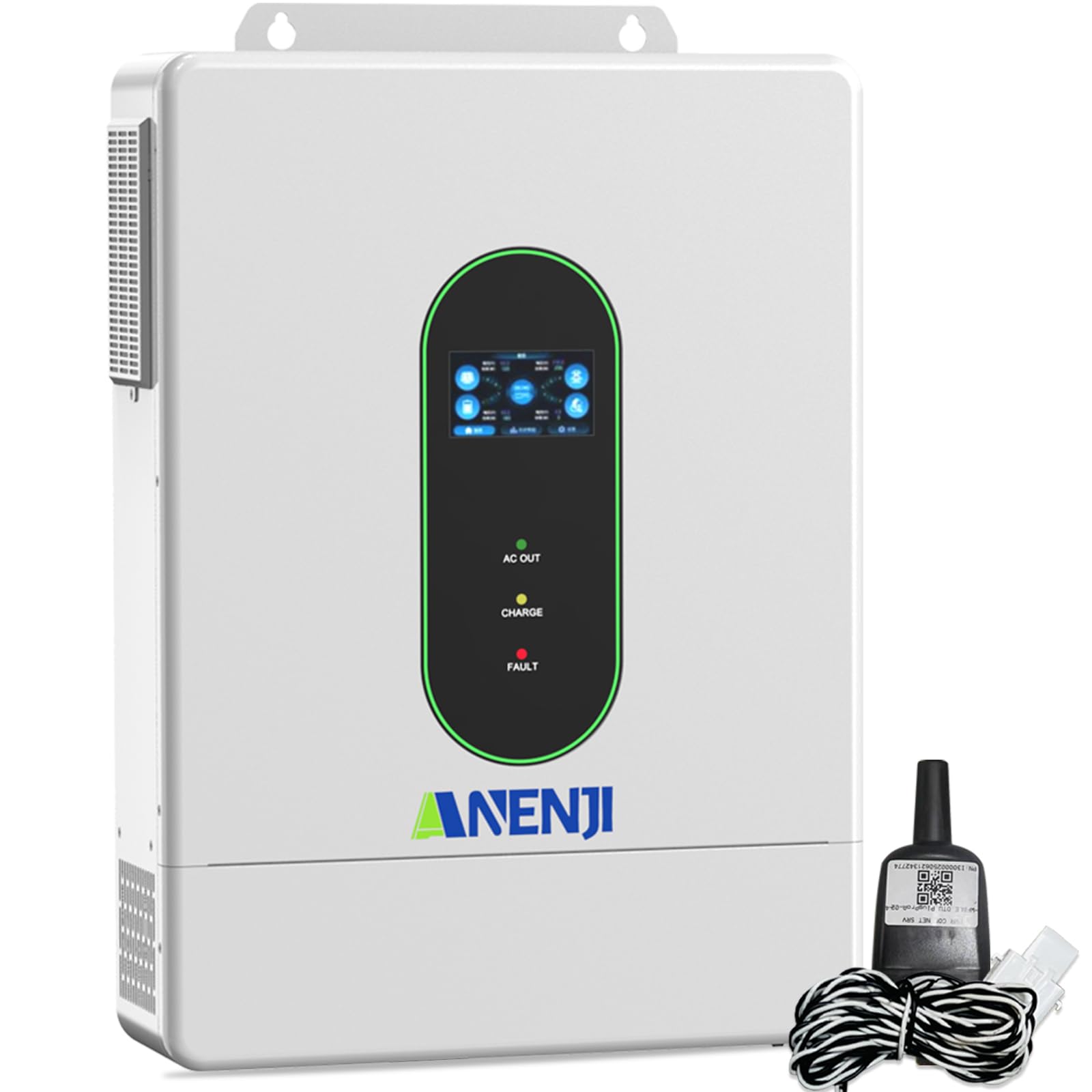
The Aninerel 12000W inverter differentiates itself with dual independent MPPT trackers and a 220A battery charging current—enough to recharge a large 48V lithium bank from empty to full in a single sunny day. The unit converts 48V DC to 120V single-phase or 240V split-phase AC, and its dual MPPT design supports two independent PV arrays, enabling east-west facing panels or ground-mount plus rooftop combos. Each MPPT input handles up to 6000W (12,000W total PV) with a 500VDC limit, so you can wire high-voltage strings with thinner, less expensive copper wire. The 24,000W peak surge capacity handles large central AC compressors and shop machinery without a hiccup.
The OLED touchscreen is notably responsive and provides a high-definition display of all system parameters, from per-string PV voltage to battery SOC and load consumption. One user confirmed it pumps 10-11 kW from solar panels under midday sun, feeding a whole house including two 12,000 BTU inverter air conditioners. The unit supports parallel connection of up to six inverters for a combined 72kW output, and can also be configured for 208V three-phase output with three units. The IP65 dustproof enclosure protects against humidity and dust, though direct rain exposure is still not advisable.
Users highlight the quiet variable-speed cooling system, which stays silent under light loads and only ramps up fans during extended high-power operation. The Aninerel is UL1741 certified, a critical safety and UL listing for grid-tied installations and insurance compliance. Some users note that the DC cable terminal connections are tight against the bottom metal, requiring careful wire management. The WiFi-enabled model allows remote monitoring via a dedicated app.
Why it’s great
- Dual MPPT for independent PV strings—ideal for east-west or roof-plus-ground arrays
- 220A battery charging current recharges large banks quickly
- UL1741 certified with IP65 enclosure and responsive OLED touchscreen
Good to know
- DC terminal connections are tight against the bottom chassis—plan wiring carefully
- OLED touchscreen interface, while excellent, requires bright-light protection for direct sun installs
6. SUNGOLDPOWER 10000W 48V Solar Inverter

The SUNGOLDPOWER 10kW inverter stands out for its incredible configurability. With 68 adjustable parameters, you can fine-tune everything from AC input voltage ranges to battery charge profiles and timer-based charge/discharge scheduling. A user running three units in parallel reported the precise scheduling feature allowed them to charge their battery bank and EV overnight during off-peak rates, then run the entire house on solar and stored energy during peak hours—maximizing the return on investment. The two MPPT controllers accept up to 10kW of solar total (5kW each) with a 500VDC open-circuit voltage limit, and they simplify wiring when panels are split between different roof orientations.
The unit handles serious loads: one reviewer runs a 5hp 80-gallon air compressor, central AC, and multiple refrigerators seamlessly. The 200A battery charging current works with 48V AGM, Gel, Flooded, Lithium, and LiFePO4 batteries, plus a User Mode for custom voltage profiles. When paired with SunGoldPower batteries, it supports CAN, USB, and RS485 communication for integrated BMS monitoring. The inverter also features battery-free operation, though for a 10kW system you’ll want at least some storage to absorb excess solar production.
A weakness reported by multiple users is the bundled SolarMan app, which lacks remote parameter adjustment and provides only basic statistics. Some have paired this inverter with a third-party solution like Solar-Assistant.io on a Raspberry Pi for full logging and control. The inverter’s 53.5-pound weight and 25-inch length require a sturdy wall mount. Despite the app limitation, users overwhelmingly praise the hardware performance and value at its price point.
Why it’s great
- 68 adjustable parameters for granular system optimization and timer scheduling
- Dual MPPT inputs simplify wiring for panels on different roof planes
- Handles heavy loads like 5hp compressors and central AC with seamless grid switching
Good to know
- Stock SolarMan app is limited—consider Solar-Assistant.io for full remote control
- Large and heavy (53.5 lbs, 25″ wide)—requires ample wall space and sturdy mounting
7. 3600W Hybrid Solar Inverter (Busbyr)
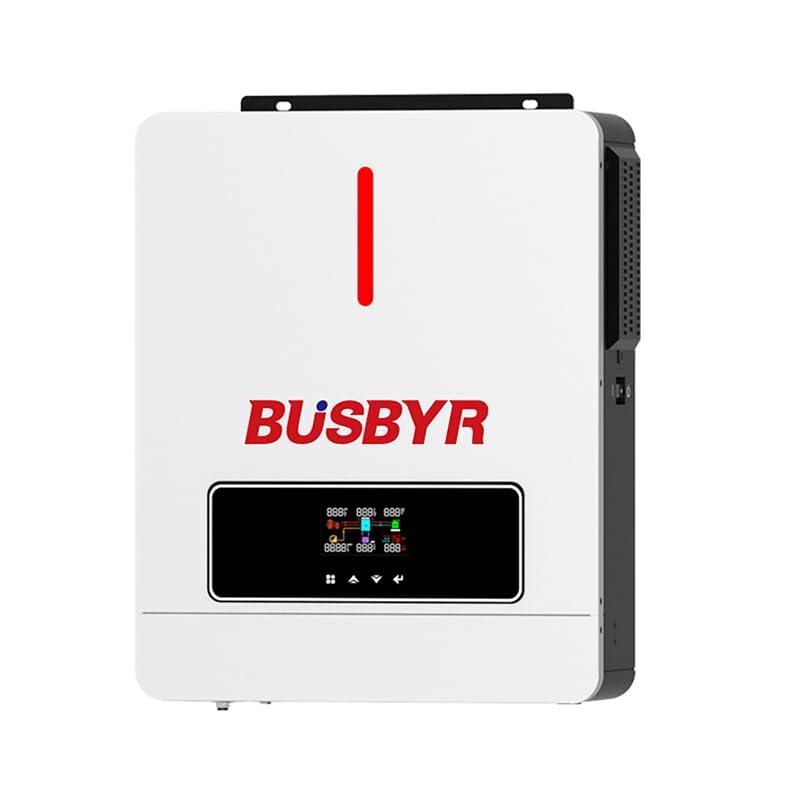
The 3600W Busbyr hybrid inverter punches above its tier with a 120A MPPT controller that accepts up to 4200W of solar input across a 60-500VDC range—matching the MPPT specs of inverters costing significantly more. Its 7200W peak surge provides enough overhead to start a refrigerator, a few lights, and a small well pump simultaneously, making it a compelling option for a small cabin or emergency backup system. The unit supports battery-less solar-only operation, so you can run loads directly from panels during the day without investing in a battery bank upfront. One user reported it works with their setup running on six months without issues.
Compatibility extends to AGM, Gel, Lead-Acid, Lithium, and LiFePO4 batteries, and the LCD display provides real-time system status including PV voltage, battery charge current, and load wattage. The built-in 100A battery charger means it can recharge from shore power or generator when solar is insufficient. The 24V DC input is standard for mid-range systems, keeping component costs reasonable while supporting sufficient power for a typical off-grid small home.
The biggest concern with this unit is inconsistent quality control. While multiple five-star reviews confirm reliable operation over months, a verified one-star report describes two successive units failing—one with an internal DC short that blew a battery fuse, and a replacement that showed visible PCB burn damage and scorch marks after months of use. This is not common across reviews but is worth noting for buyers who need absolute reliability. The brand’s support team required extensive documentation for warranty processing.
Why it’s great
- 120A MPPT with 60-500VDC range and 4200W PV input capacity—impressive for the entry-level tier
- Battery-less daytime operation mode saves initial system cost
- Compact 19.4-pound weight makes installation easier than heavier competition
Good to know
- Quality control reports of PCB burn damage and battery short incidents exist
- Warranty support requires extensive documentation and troubleshooting
8. EF ECOFLOW DELTA 3 MAX with 220W Solar Panel
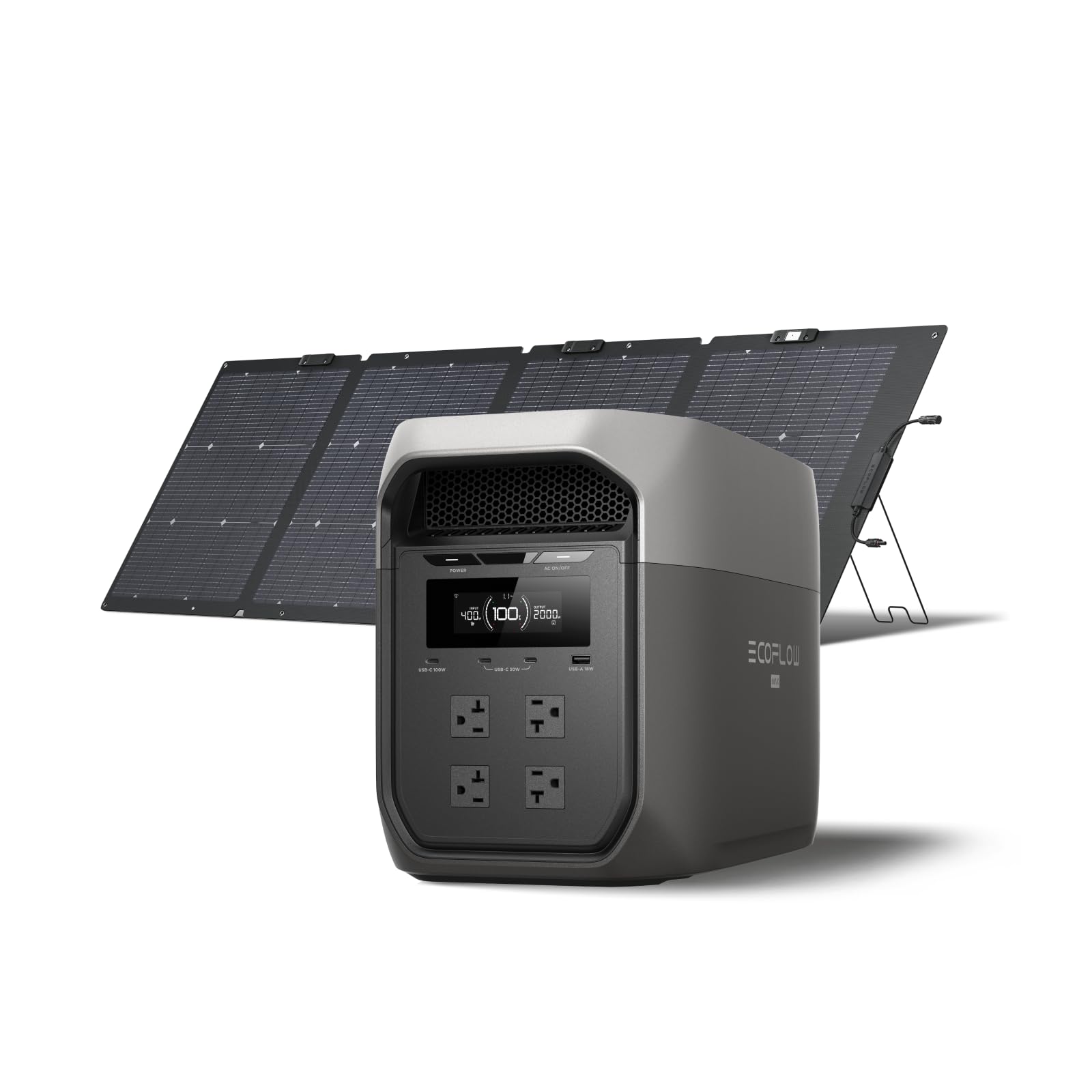
The EF ECOFLOW DELTA 3 MAX takes a different approach to the solar charge controller inverter concept by bundling a 2400W pure sine wave inverter, a high-voltage MPPT controller, and a 2048Wh LiFePO4 battery into one portable enclosure. The X-Boost mode pushes continuous output to 3400W, allowing it to power a microwave, air fryer, or circular saw—loads that would normally exceed its 2400W base rating. The MPPT controller accepts up to 1000W of solar input, and with the included 220W bifacial panel, you can recharge the internal battery from 0% to 80% in just over an hour via wall AC, or in about 6-8 hours of decent sun. The 10ms UPS transfer time keeps sensitive electronics like computers and medical devices online during grid flickers or power outages without interruption.
At under 45 pounds, the DELTA 3 MAX is designed for mobility—carry it from the house to the RV to the campsite. The internal LiFePO4 chemistry supports 1500-2000 charge cycles (roughly 10 years of daily use), and the 5-year warranty covers the entire unit. The built-in handles and relatively compact footprint make it ideal for RVers, weekend campers, and apartment dwellers who can’t install a permanent solar system. The included 220W bifacial solar panel captures light from both sides, delivering up to 175W from the rear side in optimal reflective conditions, effectively boosting harvest in open environments like a campsite or backyard.
The trade-off is that this is a closed system—you cannot swap the internal battery for a larger one, and the solar input is not expandable beyond 1000W on this unit. The DELTA 3 Max+ model adds expansion capabilities, but the base model is capped. For permanent whole-home backup, a traditional hybrid inverter with external batteries will offer more scale. But for portable power that includes MPPT charging, pure sine wave output, and silent operation, this is the most refined option available.
Why it’s great
- All-in-one system with integrated 2048Wh LiFePO4 battery and 2400W inverter
- X-Boost delivers 3400W surge for high-demand appliances like microwaves and saws
- 10ms UPS transfer time protects sensitive electronics during power outages
Good to know
- Internal battery is not user-replaceable—capacity is capped at 2048Wh
- Solar input limited to 1000W; no parallel panel expansion on this model
9. VEVOR 6000W 48V Solar Inverter

The VEVOR 6000W inverter brings 48V architecture and 120A MPPT charging to a price point that undercuts most competitors in this power class. Operating on 48V DC and outputting 220/230V AC single phase, this unit is ideal for homes and cabins in regions that use 220V as standard. The 120A MPPT supports up to 6500W of solar input with a 60-500VDC range, and its claimed 94% conversion efficiency is respectable for this class. The built-in WiFi module lets you adjust charging priorities (Solar Only, Mains Only, hybrid) and output modes (UTL, SOL, SBU, SUB) remotely via app.
The unit is designed for 48V battery systems and supports lithium, lead-acid, and custom battery profiles, with a lithium activation function for waking dormant BMS-protected batteries. The inverter’s white enclosure measures 17.72 inches tall and weighs just under 20 pounds, making it relatively manageable for a 6000W unit. Multi-stage protections cover over-temperature, over-current, over-voltage, under-voltage, short circuit, and overload conditions.
Real-world feedback is mixed. One user praises it as excellent quality for the price, while another reports the MPPT failing to track properly below 200V and barely maintaining float charge on a LiFePO4 battery. A separate concern is that the 220/230V AC input requires a step-down transformer for 120V US applications—this unit is primarily designed for 220V regions unless you reconfigure your incoming service. The interface buttons are reported as reversed in direction compared to expectations, though the functionality remains unaffected.
Why it’s great
- 120A MPPT with 94% efficiency and 6500W PV input capacity for a 48V 6000W unit
- Built-in WiFi for remote monitoring and mode configuration
- Lithium battery activation function for LiFePO4 and NMC BMS compatibility
Good to know
- Output is 220/230V AC single phase—requires step-down transformer for 120V US applications
- MPPT tracking may struggle below 200V PV input on some units
FAQ
Can I run an all-in-one inverter without batteries?
What battery voltage should I choose for my system?
What does split-phase output mean for my home wiring?
Final Thoughts: The Verdict
For most users, the best all in one solar charge controller inverter winner is the SUMRY 4000W because its 140A MPPT, 8000W peak surge, and battery-less operation mode cover the widest range of off-grid and backup scenarios without demanding a premium price. If you want a 48V system with UL certification and parallel expansion for whole-house power, grab the ECO-WORTHY 5000W. And for portable all-in-one power with integrated battery storage, nothing beats the EF ECOFLOW DELTA 3 MAX.
Product prices and availability are accurate as of the date/time indicated and are subject to change. Any price and availability information displayed on Amazon at the time of purchase will apply to the purchase of this product. As an Amazon Associate I earn from qualifying purchases.
CERTAIN CONTENT THAT APPEARS ON THIS SITE COMES FROM AMAZON. THIS CONTENT IS PROVIDED "AS IS" AND IS SUBJECT TO CHANGE OR REMOVAL AT ANY TIME.
Amazon and the Amazon logo are trademarks of Amazon.com, Inc. or its affiliates.