
Our readers keep the lights on and my morning glass full of iced black tea. As an Amazon Associate, I earn from qualifying purchases.
A flickering, snowy, or completely lost video feed mid-flight is the single fastest way to turn a thrilling FPV session into a search-and-rescue mission for a downed quad. The difference between a clean feed and a broken one often comes down to a single, often-overlooked component: the antenna on your goggles and your VTX. Choosing the wrong one means leaving range, penetration, and signal clarity on the table.
I’m Min — the co-founder and writer behind Gadgets Feed. I’ve spent countless hours analyzing radiation patterns, VSWR curves, and axial ratio data to separate the analog FPV antennas that genuinely extend your link budget from those that just look the part on a shelf.
After combing through technical specs and hundreds of real-world user reports, I’ve narrowed the field to the options that deliver measurable signal improvements. This guide covers the best analog fpv antenna choices for every flying style, from tight freestyle gaps to pushing the limits of long-range cruising.
How To Choose The Best Analog FPV Antenna
Selecting an analog FPV antenna is not a one-size-fits-all decision. The best choice depends on your flying environment, your receiver setup, and whether you prioritize close-range agility or maximum distance. Here are the critical factors to evaluate.
Polarization — RHCP vs. LHCP vs. Linear
Circular polarization (RHCP or LHCP) is the standard for FPV because it rejects multipath interference and maintains a stable signal as your quad banks and rolls. Most pilots standardize on RHCP for both the VTX and the goggles. Mixing RHCP and LHCP results in a 20-30 dB signal loss, so consistency across your entire fleet is key. Linear antennas like the classic dipole are cheaper but drastically less forgiving in a high-vibration, constantly-orienting flight environment.
Gain and Radiation Pattern
Gain, measured in dBi, describes how an antenna focuses its energy. A 2.6 dBi omnidirectional antenna (like a typical lollipop) broadcasts in a donut shape, ideal for close-to-medium range flying where the quad is at various angles. A 14 dBi directional patch antenna narrows that beam into a cone, buying you miles of range at the cost of needing to point the antenna toward the aircraft. For diversity goggle setups, one omni and one patch is the classic winning combination.
Connector Types and Impedance
The connector is a mechanical detail that has huge performance implications. SMA and RP-SMA are the most common on analog gear. A standard impedance for all FPV antennas is 50 Ohms — a mismatch here causes reflected power that can damage your VTX and cripple range. Always verify the connector gender on your goggles and VTX before buying, and never power a VTX without an antenna attached to avoid immediate burn-out.
Quick Comparison
On smaller screens, swipe sideways to see the full table.
| Model | Category | Best For | Key Spec | Amazon |
|---|---|---|---|---|
| Triple Feed Patch Array | Directional Patch | Maximum long-range reception | 14 dBi gain / 7-element array | Amazon |
| Rush Cherry 2 | Omnidirectional | Ultra-light racing builds | VSWR below 1.3 / 30% smaller v1 | Amazon |
| Foxeer Lollipop 4+ | Omnidirectional | Durable bashing & freestyle | 2.6 dBi / 98% radiation efficiency | Amazon |
| Lumenier Double AXII 2 | Omnidirectional | Versatile mid-range cruising | Dual-element stacked design / 50 Ohm | Amazon |
| SoloGood Rush Tank + Cherry | Combo VTX + Antenna | Clean racing stack install | MMCX connector / 4.46g VTX weight | Amazon |
| Black Mamba 2000mW | High-Power VTX | Extreme long-range with SMA antenna | 2000 mW output / 8-9 km range | Amazon |
| FrSky ADV GPS Sensor | GPS Module | Telemetry and antenna sync | -164 dBm sensitivity / 10 Hz update | Amazon |
In‑Depth Reviews
1. Triple Feed Patch Array High Gain Long-Range Receiver Patch Antenna 5.8G 14dBi

The Triple Feed Patch Array is a directional receiving antenna that uses a seven-element patch design to concentrate radiated energy into a tight main lobe. With a stated 14 dBi of gain, this antenna dramatically extends the usable range of a diversity goggle system, and real-world reports confirm 4+ mile video links on moderate 400 mW VTX power. The coupled-patch feed network keeps side lobes very low, meaning it rejects off-angle interference better than cheaper patch antennas.
Because the beamwidth is intentionally narrow, this antenna demands conscious aiming toward the aircraft. It is not a set-and-forget goggle antenna for freestyle; it belongs on a ground station or a tripod where the pilot can track the quad. The included storage case is a thoughtful addition for protecting the precise array during transport. Multiple reviews highlight consistent long-range performance and excellent customer support from GepRC when connector issues arise.
For pilots who fly out to the limits of their VTX and want every possible dB of reception, this patch array is a genuine tool, not a marketing gimmick. The axial ratio remains strong off-boresight, which is rare for a high-gain array. Pair it with a good omni on the other diversity port for a complete link budget solution.
Why it’s great
- Packs 14 dBi gain into a reasonably compact patch footprint
- Very low side lobes concentrate energy where it matters
- Comes with a protective hard storage case
Good to know
- Narrow beamwidth makes it unsuitable for freestyle proximity flying
- Requires a terminator on the unused SMA port to function correctly
2. Rush Cherry2 FPV 5.8G Antenna IPEX UFL RHCP LDS
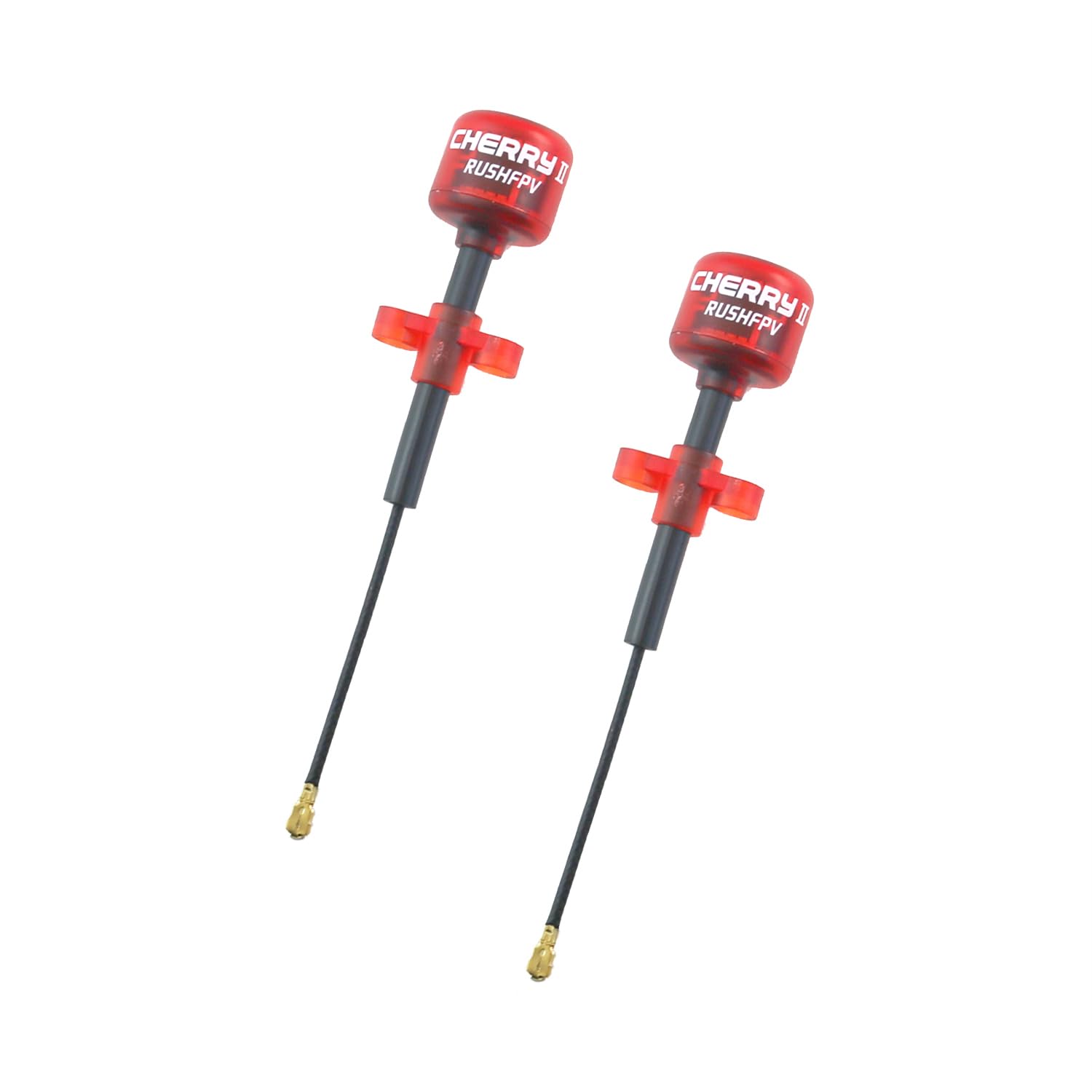
The Rush Cherry2 is a second-generation omnidirectional antenna built around LDS (Laser Direct Structuring) metalization for consistent element geometry across every unit. Its VSWR rating below 1.3 means the VTX sees a very clean load, minimizing heat buildup and maximizing radiated power — a critical spec for high-power VTX setups. Weighing roughly 2 grams and measuring 30% smaller than the original Cherry, it is practically invisible on a micro or whoop build.
Reviewers consistently report that this antenna delivers performance on par with premium options like the AXII line at a fraction of the price. The wide operating frequency range keeps parameters stable across all 5.8 GHz bands, which is essential for race events where multiple pilots occupy nearby channels. The red spacer ring serves a functional role in keeping the antenna vertical, ensuring consistent horizontal polarization.
For pilots building ultralight 75 mm whoops or competitive 5-inch racers who cannot afford extra gram weight, the Cherry2 is a top-tier choice. It sacrifices absolute peak gain for a more uniform, omnidirectional radiation field that handles sharp banking without dropouts. If you prioritize a clean install and reliable signal at medium range, this antenna earns its reputation.
Why it’s great
- LDS manufacturing ensures unit-to-unit consistency
- Very low VSWR reduces VTX heating and power waste
- Extremely light and compact for micro builds
Good to know
- IPEX/UFL connector requires a pigtail for standard SMA goggle ports
- Not the highest absolute gain for extreme long-range
3. Foxeer Lollipop 4 Plus 2.6dBi 5.8GHz RHCP (2-Pack)

The Foxeer Lollipop 4 Plus is the latest iteration of a well-known omni antenna line, delivering a modest 2.6 dBi gain with outstanding mechanical resilience. The PC+ABS material and iRoot reinforcement allow the radiating element to be bent at extreme angles without snapping, making this one of the toughest antennas for the inevitable crash impact. With a specified 98% radiation efficiency and a center-frequency VSWR of 1.07, the Lollipop 4 Plus wastes almost no power as heat.
The two-pack format immediately solves the common problem of equipping both a VTX and a goggle diversity port with the same antenna type. The RP-SMA connector variant is a direct fit for most Eachine and Skyzone goggles. User reports consistently note that this antenna provides a visible improvement over stock lollipops and generic rubber ducks, with better penetration through trees and buildings.
Where the Lollipop 4 Plus truly shines is in the rough-and-tumble of freestyle and proximity flying. Its flexibility means you are less likely to snap the antenna on a hard landing. For pilots who want a durable, high-efficiency omni that performs well in the 100-300 meter sweet spot, this two-pack represents excellent value.
Why it’s great
- Nearly unbreakable build — bends rather than breaks on impact
- Very high radiation efficiency (98%) with low VSWR
- Two antennas in one package for VTX and goggle use
Good to know
- 2.6 dBi gain is moderate — not a long-range specialist
- Maximum rated range of 300 meters is conservative
4. Lumenier Double AXII 2 Long Range 5.8GHz Antenna (RHCP)

The Lumenier Double AXII 2 uses a unique stacked dual-element design to effectively double the gain of a standard omni antenna without transitioning to a highly directional pattern. This gives pilots a meaningful range extension — users report “longer, cleaner range” — while retaining the forgiving radiation pattern of an omnidirectional antenna. The 50 Ohm impedance ensures seamless integration with standard FPV VTX and goggle receiver modules.
At 18 grams, it is noticeably heavier than a lollipop-style antenna, which may be a consideration for ultralight builds but is negligible for most 5-inch and larger platforms. The build quality is excellent, with the reinforced base and durable SMA connector designed to withstand repeated plugging cycles. Some users note that it performs particularly well on analog receivers, but may not offer the same advantage in HDZero digital mode compared to purpose-built digital antenna kits.
For the pilot who wants a single omni antenna that can handle everything from park freestyle to moderate long-range (1-3 km), the Double AXII 2 is a strong contender. Its dual-element design is a legitimate engineering approach to increasing aperture, and the performance matches the premium branding. Consider it a reference-grade omni for analog FPV.
Why it’s great
- Dual-element stack provides real range improvement over single omni designs
- Maintains an omnidirectional pattern despite higher gain
- Premium build quality with robust SMA base
Good to know
- Heavier than simple lollipop antennas (18 g)
- Some users report lower performance than a pagoda for extreme range
5. SoloGood Rush Tank FPV VTX 800mW with Rush Cherry Antenna

The SoloGood Rush Tank combo pairs a compact 20×20 mm VTX with a matched Rush Cherry antenna, delivering a turnkey solution for clean builds. The VTX itself uses a full-metal shell and a redesigned power filter that keeps video clean even with aggressive throttle punches. The included Cherry antenna uses an MMCX elbow connector, which keeps the antenna profile low and reduces strain on the VTX port during crashes.
PIT mode reduces output power to a whisper, allowing ground testing without flooding the band. The VTX covers 48 channels across the 5.8 GHz spectrum and provides clearly indicated power levels from 25 mW up to 800 mW. The Cherry antenna has been described by users as “on par with an AXII” in terms of signal quality, making this VTX-antenna pairing coherent and well-tuned out of the box.
For pilots building a race quad or a clean freestyle stack who want to avoid compatibility guesswork, this bundle simplifies the electronics layout. The combination of a reliable, interference-resistant VTX and a proven omni antenna covers all the essentials in one purchase. Installation is straightforward, and the PIT mode is genuinely useful for bench setup.
Why it’s great
- VTX and antenna are matched for optimal impedance and performance
- Compact 20×20 mm VTX fits tight racing stacks
- PIT mode enables safe ground testing without transmission
Good to know
- MMCX connector is less common — adapters may be needed for some goggles
- Reported quality control issues with VTX LED durability
6. Flysight Black Mamba 5.8Ghz FPV Video Transmitter 2000mW

The Flysight Black Mamba is a standalone 2000 mW VTX that pairs its high-power output with a standard SMA antenna connector, making it a popular choice for fixed-wing and long-range multirotor builds. The 5.8 GHz 40-channel module is designed to transmit up to 8-9 km in open terrain. The built-in cooling fan and metal cover help manage the substantial heat generated at full power, which is essential for sustained long-range missions.
Wiring requires attention — the included instructions have historically swapped the video and audio wire assignments. Connecting by color alone results in a blank feed. Once wired correctly, the VTX delivers strong, clean signal that punches through multi-kilometer distances. The high-brightness LED display makes channel and band selection easy even in direct sunlight.
This VTX is best suited for ground stations or larger aircraft where the extra weight (52 g) is not a penalty. It is also critical to always power the VTX with an antenna attached — the warning label is there for a reason, as several user reports confirm damage from operating without a load. For pilots building a long-range platform who need raw power, the Black Mamba delivers.
Why it’s great
- High 2000 mW output for maximum range potential
- Built-in fan and heatsink manage thermal load
- Standard SMA connector fits most omni and patch antennas
Good to know
- Video and audio wires are swapped from the documented color scheme
- Must never be powered without an antenna to avoid immediate damage
7. FrSky ADV GPS Sensor – FBUS & S.Port Compatible

While the FrSky ADV GPS sensor is not a traditional FPV antenna, its built-in patch antenna directly impacts telemetry reliability for pilots using FrSky ETHOS and FBUS systems. The sensor delivers position, altitude, and speed data at a 10 Hz update rate with a cold-start fix time of 30 seconds. The integrated patch antenna provides -164 dBm sensitivity, which is crucial for maintaining a lock even in high-EMI environments near the VTX and motor wires.
The FBUS protocol integration reduces wiring complexity by using a single line for sensor and receiver communication. UTC time sync ensures telemetry logs are timestamped accurately, which is valuable for post-flight analysis of video feeds and RTH behavior. The compact metal-and-plastic housing mounts easily on 3D-printed or carbon frames.
For the FPV pilot who flies long-range missions and relies on RTH failsafe, a clean GPS lock is non-negotiable. The ADV sensor’s high-gain patch antenna and precise position accuracy (2.5 m CEP) make it a compatible partner in the overall RF ecosystem of a long-range build. It provides the positional data backbone that complements a high-performance video antenna setup.
Why it’s great
- High sensitivity (-164 dBm) for quick, reliable satellite lock
- FBUS protocol reduces wiring clutter in the stack
- 10 Hz update rate enables smooth position telemetry
Good to know
- Requires a FBUS-compatible receiver for single-wire integration
- Not an analog video antenna — serves a specific GPS telemetry role
FAQ
Can I mix an RHCP omni with an LHCP patch on one goggle?
Does a higher dBi patch always give better long-range video?
Final Thoughts: The Verdict
For most users, the best analog fpv antenna winner is the Triple Feed Patch Array because it offers the highest gain (14 dBi) for pilots serious about extending their video range without switching to digital. If you want a durable, flexible omni for freestyle and proximity flying, grab the Foxeer Lollipop 4 Plus two-pack. And for a clean, lightweight racing setup with a matched antenna, nothing beats the SoloGood Rush Tank VTX with Cherry antenna.
Product prices and availability are accurate as of the date/time indicated and are subject to change. Any price and availability information displayed on Amazon at the time of purchase will apply to the purchase of this product. As an Amazon Associate I earn from qualifying purchases.
CERTAIN CONTENT THAT APPEARS ON THIS SITE COMES FROM AMAZON. THIS CONTENT IS PROVIDED "AS IS" AND IS SUBJECT TO CHANGE OR REMOVAL AT ANY TIME.
Amazon and the Amazon logo are trademarks of Amazon.com, Inc. or its affiliates.