
A mangled thread on an all-thread rod means a nut that won’t start, a fitting that won’t seat, and a trip back to the hardware store. An all-thread cutter solves this by shearing rod cleanly, leaving a burr-free end that accepts a nut by hand — no filing, no angle grinder sparks, no swearing.
I’m Min — the co-founder and writer behind Gadgets Feed. After hundreds of hours combing through customer tests, spec sheets, and real-world torque comparisons on threaded rod cutters, bolt cutters, and rethreading kits, I’ve narrowed down the seven best performers for 2025.
Whether you are a contractor running conduit or a farmer patching fence, choosing the right tool means the difference between a clean cut and a ruined rod. This guide cuts through the noise to help you find the absolute best all-thread cutter for your workshop and your budget.
How To Choose The Best All-Thread Cutter
An all-thread cutter isn’t just a set of jaws with handles. The wrong tool can leave you with deformed threads, half-cut rods, or a busted blade. Here are the three specs that separate a keeper from a frustration.
Blade Hardness and Edge Geometry
Hardened alloy steel jaws with a Rockwell hardness of HRC 58–62 are the sweet spot. Softer blades dull after a dozen cuts on Grade 5 rod; brittle blades chip. Look for induction-hardened edges — they hold a sharp line through hundreds of cuts on 3/8-inch all-thread.
Cutting Capacity vs. Rod Grade
Not all cutters can handle hardened steel or stainless threaded rod. Check the spec: a cutter rated for 5/16-inch hard metal (HRC < 48) is different from one rated for 3/8-inch soft metal (HRC < 19). For standard all-thread (Grade 2 or 5), a mid-range rated jaw is sufficient. For hardened bolts or stainless, step up to a premium or compound-action model.
Compound Action vs. Manual Leverage
Manual bolt cutters rely on raw arm strength and a long handle to multiply force. Compound-action cutters use an internal cam or linkage that doubles the clamping pressure with the same hand squeeze. For frequent cuts on 1/2-inch rod, compound action saves serious hand fatigue. For occasional 1/4-inch cuts, a standard lever design is fine.
Quick Comparison
On smaller screens, swipe sideways to see the full table.
| Model | Category | Best For | Key Spec | Amazon |
|---|---|---|---|---|
| DEWALT DCS350B | Cordless Power | High-volume threaded rod cuts | Clean burr-free cuts on 1/4″–1/2″ rod | Amazon |
| RYOBI 18V ONE+ Bolt Cutter | Cordless Power | Quick bolt and chain cuts (low hand strain) | 18V cordless; cuts bolt seals in seconds | Amazon |
| RIDGID 14223 S24 | Heavy-Duty Manual | Cutting hardened steel and chain | 7/16″ soft / 5/16″ hard metal capacity | Amazon |
| Crescent H.K. Porter 0190MCP | Compound Action Manual | Heavy farm & fence work | Double compound cutting action | Amazon |
| KNIPEX CoBolt 7102200 | Compact Manual | Cutting hard wire and small bolts in tight spaces | 8-inch length; cuts up to 0.4 cm | Amazon |
| Lang Tools 2584 Metric Restorer Set | Thread Repair | Cleaning & restoring damaged threads on bolts | 7 die sizes M6 through M12 | Amazon |
| WORKPRO 24-Inch Bolt Cutter | Value Manual | Budget-friendly cutting of padlocks and soft metals | Cuts up to 3/8-inch (11mm) soft metal | Amazon |
In‑Depth Reviews
1. DEWALT DCS350B 20V MAX* Cordless Threaded Rod Cutter
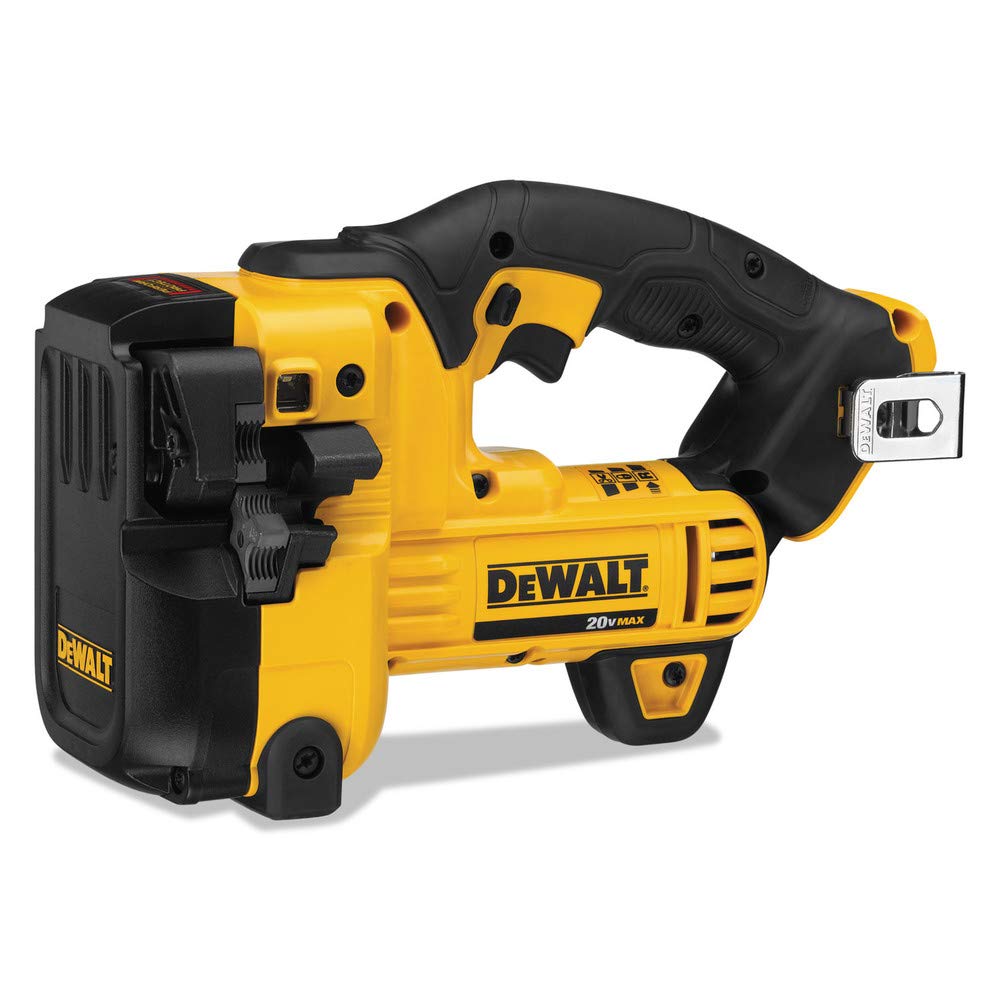
The DEWALT DCS350B is the only tool here designed exclusively for cutting threaded rod — and it shows. It handles 1/4-inch, 3/8-inch, and 1/2-inch mild steel course threaded rod plus stainless steel variants, producing a burr-free end that accepts a nut by hand without any filing or chasing. The rotating four-sided cutter head extends blade life significantly since you simply rotate to a fresh edge when one dulls.
The LED work light illuminates the cutting zone, and onboard wrench storage means you never misplace the tool needed to swap heads. At 9 pounds, it is heavier than manual cutters, but for any job involving 50 to 100+ cuts on all-thread, the time savings and consistent results make the weight irrelevant. One user reported 120 clean cuts on 3/8-inch rebar in a single session with no performance drop.
This is a bare-tool (no battery or charger), so factor in your existing 20V MAX system. The motor is geared for high-torque, low-speed shearing, which eats batteries faster than a drill — keep a spare charged. If your daily work involves threading rod, this is the productivity king.
Why it’s great
- Produces factory-clean, burr-free threads every cut
- Rotating four-sided cutter head quadruples blade life
- Onboard wrench storage and LED work light
Good to know
- Sold as tool only — no battery or charger included
- 9-pound weight is heavy for overhead or one-handed use
2. RYOBI 18V ONE+ Bolt Cutter (P592)

The RYOBI P592 brings cordless convenience to bolt cutting without the DEWALT price tag. It uses a geared motor to shear through bolt seals, padlocks, chain, nails, and threaded rod with a clean cut that requires minimal cleanup. Users report cutting body seals on trucks with ease and getting over two years of blade life before needing a replacement.
It runs on the 18V ONE+ platform, meaning one battery powers over 300 Ryobi tools — convenient if you are already invested. The tool is compact enough to fit in a truck tool bag, and the trigger-actuated cutting action saves hand grip compared to squeezing a manual cutter 50 times in a row. Battery life on a single charge lasts an entire work week for moderate use.
It is slower than a manual cutter for a single cut, and the jaws are not rated for carbide-hardened locks — it will struggle with high-security padlocks requiring diamond-grade cutting. But for standard all-thread trimming and general metal demolition, it is a fun, effective tool that saves your hands.
Why it’s great
- Cordless convenience with trigger-actuated cutting
- Compact enough for truck storage
- Excellent battery life for light-to-moderate weekly use
Good to know
- Slower than manual cutters for a single cut
- Jaws not suitable for hardened/ carbide-grade locks
3. RIDGID 14223 Model S24 Bolt Cutter, 24-Inch

The RIDGID S24 is the manual cutter that pros reach for when they need to cut through tow chain, heat-treated rod, or reinforcing bar. Its hardened alloy steel jaws with a center-cut design handle 7/16-inch soft metals, 3/8-inch medium metals, and 5/16-inch hard metals — a tiered capacity chart that tells you exactly what it can do without guesswork.
The one-step internal cam mechanism keeps the blades precisely aligned through hundreds of cuts, so you do not get the frustrating “blades don’t meet” issue that plagues cheaper cutters. Users describe cutting through chain “like butter” and note that the tool spoils you for other brands. The 24-inch length provides excellent leverage while remaining manageable for ground-level fence work.
RIDGID backs it with a full lifetime warranty — if it ever fails due to defects, they repair or replace it free. That warranty alone justifies the premium over budget cutters. If you need a tool that will still be cutting cleanly for your grandkids, this is the one.
Why it’s great
- Full lifetime warranty — buy once, never rebuy
- Precise blade alignment via internal cam mechanism
- Cuts through hardened chain and rebar effortlessly
Good to know
- Heavy — over 6 pounds for the 24-inch model
- Best on larger/stiff items; thin wire may slip between blades
4. Crescent H.K. Porter 24″ PowerPivot Center Cut Bolt Cutter (0190MCP)

The H.K. Porter name carries weight in the cutting world, and the 0190MCP lives up to it with its PowerPivot double compound action. This design multiplies your hand force significantly, making it possible to cut through 316 stainless steel 3/8-inch quick links (rated at 95 Rockwell) with reasonable effort — though the cut produces a loud SNAP sound that will make bystanders jump.
The induction-hardened center cut blades resist wear, and the entire tool is heat-treated for long life. Users regularly employ it to cut fallen fence line and shape hog panels into manageable lengths for scrap metal runs or fruit tree cages. It eliminates the need to drag an angle grinder out to the field for chain and thick wire.
The trade-off is the blades are designed for larger, stiff materials — they do not meet fully at the tip, so thin, loose wire can bend instead of cut. Keep this in mind if your primary need is snipping baling wire or thin gauge fence ties. For heavy farm and demolition cutting, it is a worthy upgrade from standard lever cutters.
Why it’s great
- Double compound action multiplies cutting force
- Induction-hardened blades resist wear over hundreds of cuts
- Cuts stainless steel quick links at 95 Rockwell
Good to know
- Blades don’t meet at the tip — struggles with thin wire
- Heavy-duty build adds weight for carry
5. KNIPEX CoBolt Compact Bolt Cutter (7102200), 8-Inch

When you need to cut heavier gauge ferrous wire, stainless steel, treble hooks, or small bolts in tight spaces, the KNIPEX CoBolt is the answer. At just 8 inches long, it fits in a tool pouch or drawer easily, but don’t let the size fool you — its precision-ground jaws cut through material that would ruin standard diagonal cutters.
The multi-component ergonomic grip is comfortable for extended use, and the tool is made in Germany with the fit and finish tradesmen expect. Users call it “the last pair of cutters you will ever buy” and report using it for floral arrangements all the way up to cutting farmers’ wire fencing. The jaw gap is only 0.4 cm (roughly 5/32-inch), so it cannot handle 1/2-inch rod — but for everyday small-diameter cutting, it is unmatched.
If your work involves a mix of electrical, automotive, and general fabrication tasks requiring frequent small cuts, the CoBolt is a permanent addition to your everyday carry tools. It is not a substitute for a 24-inch bolt cutter, but it handles the small stuff that big cutters cannot reach.
Why it’s great
- Fits in tight spaces where full-size cutters cannot go
- Cuts hard stainless steel and ferrous wire cleanly
- German-made with long-lasting precision edge
Good to know
- Small jaw gap — not for rods over 5/32-inch
- Not suitable for cutting padlocks or chain
6. Lang Tools 2584 15-Piece Metric Thread Restorer Set

A cutter that shears rod is only half the battle — sometimes you need to restore a damaged thread rather than shorten the rod. The Lang Tools 2584 covers seven metric sizes (M6 through M12) with both taps and dies, plus a thread restorer file with eight pitch options from 0.75 to 3.00 mm. It is purpose-built for cleaning rusted, cross-threaded, or gunked-up threads on bolts and studs.
Users on rust-belt cars report hand-threading the chasers onto rear strut studs with Tap Magic, then turning with a wrench to remove rust and allow nuts to thread fully by hand afterward. The die head design includes a nut-shaped outer body, so you can turn it with a standard socket or wrench in tight spaces where a die stock would not fit. The set is made in the USA, which adds confidence in thread accuracy.
The plastic case is the weak point — it is large, does not close tightly, and is not storage-friendly (users store the set in a ziplock bag). For shop use, discard the case and organize the chasers in a drawer. If you work on metric equipment and frequently encounter damaged threads, this set pays for itself after the first salvage.
Why it’s great
- Restores threads on bolts and studs where cutting isn’t an option
- Nut-shaped dies allow use with a wrench/socket in tight spots
- Made in the USA with accurate metric pitches
Good to know
- Plastic case is bulky and does not latch securely
- Covers metric only — no SAE sizes included
7. WORKPRO 24-Inch Bolt Cutter

The WORKPRO 24-inch bolt cutter offers entry-level performance at a price that leaves room in the budget for other tools. It is forged from chrome-vanadium steel with powder-coated jaws, using a classic lever-fulcrum design to cut padlocks, soft metal, bolts, rods, rivets, and chain. Cutting capacity is 3/8-inch (11mm) for materials with hardness HRC ≤ 19, and 5/16-inch (8mm) for materials up to HRC < 48.
The bi-material anti-slip grips provide decent comfort, and the tool is solid enough for farm use — one user reports cutting massive staples and old fencing on a farm and finding it worth the money. It cut through a rusted padlock easily on first use, and multiple users confirm the quality-to-price ratio is strong.
The limitation becomes apparent on hardened steel: one user found it barely cut through a seized Master lock 1590D (hardened boron steel), recommended a longer-armed model for that application. For standard all-thread and soft steel hardware, it is perfectly adequate. For tougher jobs, you will want to step up to the RIDGID or H.K. Porter.
Why it’s great
- Affordable entry point for occasional cutting tasks
- Chrome-vanadium steel construction resists rust
- Comfortable bi-material grips reduce hand fatigue
Good to know
- Leverage is limited — struggles on hardened steel locks
- Best suited for soft metals and standard all-thread rod
FAQ
Can I use a standard bolt cutter on threaded rod?
What is the difference between cutting and rethreading?
How do I prevent the blades on my bolt cutter from going out of alignment?
Final Thoughts: The Verdict
For most users, the best all-thread cutter winner is the DEWALT DCS350B because it produces burr-free threads on rod every time, making nut installation effortless. If you need cordless convenience for less, grab the RYOBI 18V ONE+ Bolt Cutter. And for raw manual power that will last a lifetime with no batteries to charge, nothing beats the RIDGID 14223 S24.