
A sim racing cockpit built from aluminum profile is the single biggest upgrade a serious driver can make—it transfers every Newton-meter of force feedback directly into your hands instead of letting it dissolve into frame flex. The difference between a wobbly tube stand and a rigid T-slot extrusion rig is the difference between guessing and knowing exactly where the rear axle is. That measurable rigidity is what separates a toy from a training tool.
I’m Min — the co-founder and writer behind Gadgets Feed. I’ve spent hundreds of hours analyzing aluminum extrusion profiles, corner bracket designs, T-nut compatibility, and load ratings across dozens of sim rigs to pinpoint the exact structure that delivers zero perceptible flex under high-torque direct-drive wheels and load-cell pedals.
This guide breaks down the genuine structural differences between 8040 and 160-profile cockpits so you can confidently pick the best aluminum profile sim racing cockpit that matches your torque demands and budget.
How To Choose The Best Aluminum Profile Sim Racing Cockpit
An aluminum profile cockpit is a multi-year purchase that directly determines how much force feedback detail reaches your hands and how consistently you can brake. Three critical decisions—extrusion size, joint hardware, and adjustability range—will define your experience more than any brand name or marketing claim.
Extrusion Cross-Section: 8040 vs 12040 vs 16040
The first two digits of an extrusion size (80, 120, 160) represent its width in millimeters. A 40x80mm profile (8040) supports most consumer direct-drive wheels up to roughly 15 Nm with minimal flex when properly braced. Once you cross into 20+ Nm torque or add high-end load-cell pedals requiring 60+ kgf, stepping up to 40x120mm or 40x160mm profiles eliminates the micro-twist that can still occur in 8040 frames under extreme loads. Heavier extrusions also add mass that dampens vibration, but they increase total rig weight by 30 to 50 pounds.
Corner Brackets and Joining Method
A rig is only as stiff as its joints. Look for cast aluminum or thick stamped-steel corner brackets with at least four bolts per connection. Some budget profile rigs use thin L-brackets that allow the frame to twist diagonally under hard braking. The best designs use 6mm or thicker brackets and include gusset plates at stress points like the pedal deck and wheel mount uprights. T-nut quality also matters—standard 8-slot T-nuts let you buy accessories from any manufacturer, while proprietary T-nuts lock you into a single ecosystem.
Adjustability vs Simplicity Tradeoff
Profile rigs offer infinite adjustability through slots and T-nuts, but that flexibility comes at the cost of setup time. A cockpit with dedicated sliding rails for the seat and pre-cut wheel plate holes assembles faster and repositions more easily than a fully DIY extrusion frame that requires loosening a dozen bolts for every adjustment. Decide how often you’ll swap between GT and F1 positions before choosing between a multi-position frame and a dedicated fixed geometry rig.
Quick Comparison
On smaller screens, swipe sideways to see the full table.
| Model | Category | Best For | Key Spec | Amazon |
|---|---|---|---|---|
| Next Level Racing F-GT Elite 160 | Premium | High-torque DD and motion rigs | 160x40mm base profile | Amazon |
| Next Level Racing GTElite Lite | Premium | Plug-and-play GT cockpit | 2080 profile, pre-machined holes | Amazon |
| Anman Triple Monitor Cockpit | Mid-Range | Triple-screen immersion on a budget | 4080 profile with support bar | Amazon |
| Marada 8040 with Monitor Stand | Mid-Range | Value 80/20 rig with integrated monitor mount | 8040 profile, VESA 75-400mm | Amazon |
| Likeem Elite Series | Mid-Range | Tall drivers needing adjustable height | 120/40 profile, reclining seat | Amazon |
| ARES WING 8040 | Mid-Range | Adjustable F1/GT seating | 8040 base, 8.7″ seat slide | Amazon |
| Marada 8040 Cockpit (Seat Only) | Mid-Range | Budget zero-flex profile rig | 8040 profile, infinite adjustment | Amazon |
| Anman 8040 Profile Stand | Mid-Range | Entry-level aluminum upgrade from tube stands | 8040 extrusion, stepless adjustment | Amazon |
| Dardoo Triple Monitor Cockpit | Mid-Range | Triple 32″ monitor support on a steel frame | 50mm steel tubes, vertical column | Amazon |
| RACGTING Foldable Aluminum Cockpit | Budget | Space-saving foldable profile rig | 70% aluminum alloy, 180kg load | Amazon |
| DIWANGUS F1 Cockpit | Budget | Entry-level F1 driving position | Q235 steel frame, VESA 200×200 | Amazon |
In‑Depth Reviews
1. Next Level Racing F-GT Elite 160 Wheel Plate Edition (NLR-E025)

The F-GT Elite 160 uses 40x160mm base profiles and 40x120mm uprights—the thickest extrusions on this list—combined with 6mm powder-coated steel brackets and custom shoulder bolts to achieve true zero-flex under the strongest consumer direct-drive wheels and motion platforms. Pre-machined holes for wheel plates and pedal decks reduce assembly guesswork, while the multi-position design accommodates Formula through truck seating angles without changing the base structure.
Five verified owners confirm the rig handles an Alpha Evo Pro and G923 without any perceptible flex, with assembly averaging two to five hours depending on experience. The trade-off is weight—the frame alone is 140 pounds, and fully loaded the rig exceeds 300 pounds, which makes moving it a two-person job. Proprietary T-slot nuts lock you into NLR’s accessory ecosystem unless you source alternatives.
For sim racers running 15+ Nm wheelbases, load-cell pedals above 60 kgf, or planning to add motion actuators, this is the only cockpit on the list that guarantees long-term rigidity without a future upgrade. Buy once, never chase flex again.
Why it’s great
- 160x40mm profile eliminates all flex under 20+ Nm torque
- Pre-machined holes streamline assembly compared to DIY extrusion
- Multi-position ergonomics cover F1, GT, and truck driving styles
Good to know
- Proprietary T-nuts limit third-party accessory compatibility
- Assembly requires two people for heavy profile sections
- Wheel plate adjustment is tedious compared to sliding-rail systems
2. Next Level Racing GTElite Lite Racing Simulator Cockpit (NLR-E028)

The GTElite Lite uses a 2080 aluminum profile—thinner than the 160-profile in the F-GT Elite but still significantly stiffer than any tubular steel stand. Where it wins is convenience: pre-machined precision holes mean you assemble with standard tools rather than threading spring T-nuts into slots, cutting build time to roughly three hours even for first-timers. The included flex-free seat slider system and height-adjustable shock-absorption feet make it easy to dial in a consistent GT position.
NLR includes a Buttkicker Gamer 2 adapter, cable management clips, and a tool kit holder—small additions that add up to a cleaner setup. The 2080 rails accept standard T-nuts, so adding a shifter mount or keyboard tray is straightforward. Proprietary T-nuts on the upright sections still complicate accessory expansion compared to full open-slot systems, but the overall package is the most complete out-of-box experience among premium rigs.
This is the best choice for racers who want a dead-simple assembly process and a rigid GT-focused cockpit without the four-hour build and proprietary concerns of the F-GT Elite. It supports up to roughly 10 Nm wheelbases comfortably.
Why it’s great
- Pre-drilled holes eliminate T-nut alignment frustration
- Flex-free seat slider system with quick-adjust handles
- Includes Buttkicker adapter, cable clips, and tool holder
Good to know
- Some proprietary T-nuts complicate third-party accessory use
- 2080 profile is less rigid than 160-profile under extreme loads
- GT-only position limits F1 driving posture options
3. Anman Aluminum Profile Sim Racing Cockpit with Triple Monitor Mount
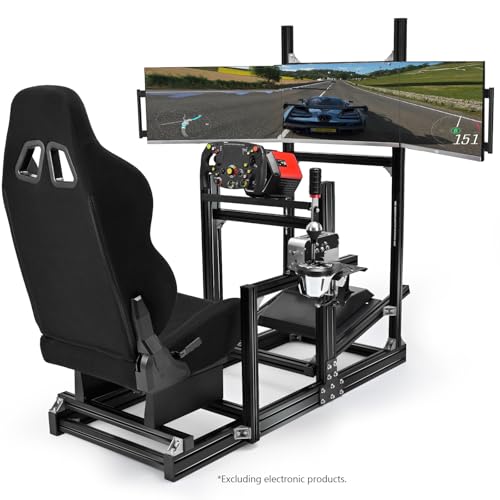
Anman’s triple-monitor cockpit uses 4080 aluminum extrusions with an added support bar at the wheel-mount position—a reinforcement detail that stiffens the critical load path under high-torque wheels. The integrated triple monitor stand supports 24” to 32” screens and allows independent angle and height adjustment for each display, creating a seamless panoramic view without separate monitor arms. The included seat uses a dual-track slider with adjustable recline and breathable fabric.
Owners report zero flex under an 8 Nm Fanatec CSL DD and load-cell pedals, with a five-hour solo assembly that benefits from clear slot labeling. The monitor uprights have slight rock if intentionally pushed, but in normal use the frame stays planted. The seat fabric feels basic and adjustments require loosening multiple bolts, which is typical for budget profile rigs in this class.
For sim racers targeting an immersive triple-screen setup without spending + on a name-brand frame, this is the best value proposition on the list. The 4080 profile handles mid-range direct-drive torque without the premium price.
Why it’s great
- Triple monitor stand integrated into the frame saves floor space
- Reinforced support bar at wheel mount minimizes flex
- 4080 profile provides solid rigidity for mid-range DD wheels
Good to know
- Monitor uprights have slight side-to-side rocking
- Seat fabric feels inexpensive compared to premium rigs
- Adjustments require loosening multiple bolts each time
4. Marada Aluminum Profile Sim Racing Cockpit With Monitor Stand
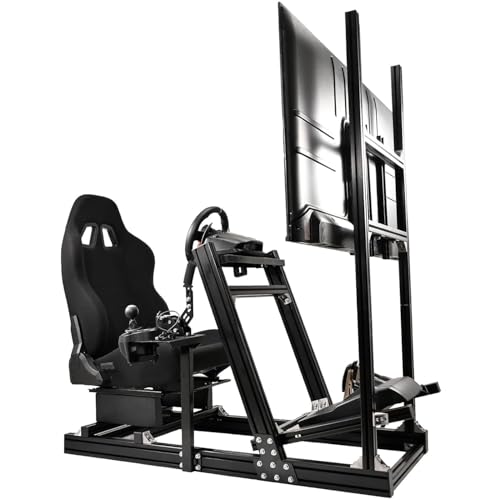
Marada’s monitor-equipped cockpit uses a full 8040 aluminum extrusion frame with a dedicated TV bracket that supports VESA patterns from 75x75mm up to 400x200mm and displays from 24” to 70”. The seat reclines from 90 to 180 degrees, and the steering wheel plate offers stepless height and angle adjustment. The pedal deck tilts independently, and the shifter mount swaps to either side of the chassis.
Customer feedback confirms the rig supports a Moza R9 and CRP2 pedals with no frame flex, though the pedal plate only aligns four of eight mounting holes for CRP2 pedals without drilling. Assembly is the most time-consuming among competitor kits at this price—unlabeled parts and sparse instructions push build time past four hours. The seat recliner mechanism has slight play under hard braking, but the extrusion itself remains locked tight.
This is the right choice if you need a single-purchase rig that includes a sturdy monitor mount and handles up to 10 Nm direct-drive wheels. Expect to invest a full afternoon in assembly, but the resulting rigidity beats anything in the tubular-steel category.
Why it’s great
- Full 8040 profile frame with no perceptible flex at 10 Nm
- Monitor bracket supports up to 70″ displays with broad VESA coverage
- Shifter mount swaps sides for left or right hand use
Good to know
- Assembly instructions lack detail and part labeling
- Seat recliner mechanism has slight lateral play
- Some pedal brands require drilling for full bolt alignment
5. Likeem Racing Simulator Cockpit Stand with Elite Series Seats

The Likeem cockpit uses a 120/40 profile—essentially three 40x40mm extrusions joined side by side for a base that is 120mm wide—providing a larger foundation surface than standard 8040 frames. The Elite Series seat uses high-rebound foam with full PVC leather covering and reclines from 90 to 150 degrees. The adjustable-height pedal mount and steering wheel uprights accommodate taller drivers who find most rigs too low or cramped.
Owners at 6’2” and 240-270 lbs report the seat fits well without the tight squeeze common in bucket-style rigs. The wheel base mount uses thin metal brackets that may require replacement for heavy direct-drive setups, and the seat sits high enough that some users removed the seat lifts entirely. The frame is solid with zero vibration transfer at 8 Nm, and the open extrusion slots accept standard T-nuts for DIY add-ons.
This is the strongest option for larger sim racers who prioritize seat size and adjustable height over absolute extrusion thickness. The 120/40 base is less torsionally stiff than a 160-profile, but for mid-range wheelbases it provides a solid, wobble-free platform.
Why it’s great
- Wide 120mm base profile increases stability surface area
- Large seat fits taller and wider drivers comfortably
- Adjustable height pedal and wheel deck for custom ergonomics
Good to know
- Wheel mount brackets are thin and may need upgrading
- Seat sits high; seat lifts may need removal for lower position
- Side and front wheel mount incompatible with some Fanatec DD bases
6. ARES WING Racing Simulator Cockpit with Racing Seat
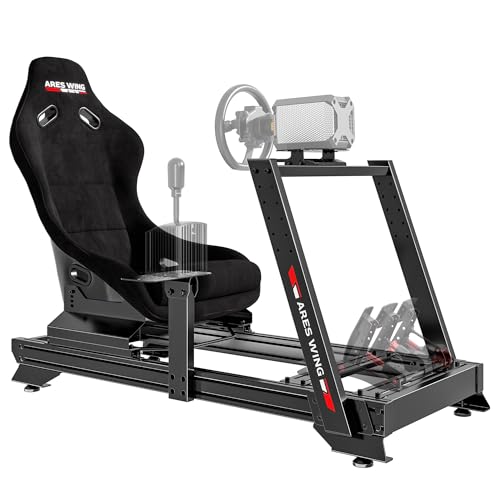
ARES WING packs exceptional adjustability into a standard 8040 aluminum frame: the seat slides 8.7 inches forward and backward, tilts plus or minus 6 degrees, the steering wheel plate offers -8 to 32 degrees of tilt across six height settings, and the pedal angle ranges from 8 to 53 degrees. The frameless design allows open access for extended legs and multiple driving positions. The seat has a 287-pound weight capacity with a skin-friendly fabric cover.
Early owners confirm the frame handles an 8 Nm Logitech RS50 and RS pedals without any flex, noting the aluminum profile feels comparable to much more expensive name-brand rigs. The pedal plate uses slot-based adjustment that requires careful measurement and re-tightening—not a quick-swap system. The clamp-style side mounting plate only comes on one side, so full HOTAS flight sim configurations require additional hardware.
If you need a highly configurable cockpit that supports both GT and near-F1 seating positions without paying premium brand prices, this is the sweet spot. The adjustability range covers most body types from roughly 5’5” to 6’4”.
Why it’s great
- 8.7″ seat travel and 40° wheel tilt range cover most body types
- 8040 frame is rock solid for 8-12 Nm direct-drive setups
- Universal T-nut channels accept standard 8-slot accessories
Good to know
- Pedal adjustment requires careful measurement and re-tightening
- HOTAS flight sim rig needs additional side plate purchase
- Assembly is detailed and takes several hours
7. Marada Aluminum Profile Racing Simulator Cockpit with Seat
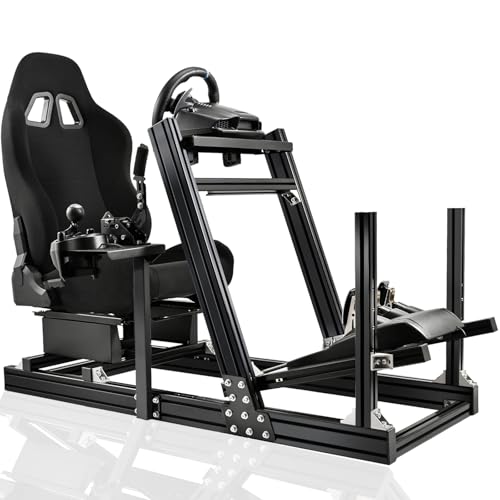
Marada’s 8040 cockpit—sold without a monitor mount—focuses all its cost on the profile frame and seat. The 40x80mm extrusion rails provide infinite adjustability through sliding T-nuts for the wheel plate, pedal deck, and seat position, supporting F1, truck, and off-road driving modes by sliding components to different positions along the channels. The seat uses a double-track sliding rail with adjustable recline and breathable fabric covering.
Verified buyers report the frame handles an 8 Nm Fanatec CSL DD with zero flex, though the seat recliner mechanism has some play under heavy braking and the seat itself lacks lumbar support. Assembly is a multi-hour process with small, somewhat confusing instructions. The shifter mount has a slight wobble by itself, but once bolted to the extrusion rail it stabilizes.
For sim racers on a strict budget who refuse to compromise on frame rigidity, this is the cheapest entry point into a genuine 8040 profile cockpit. Plan to add a lumbar cushion and allocate five hours for first-time assembly.
Why it’s great
- Genuine 8040 profile frame at the lowest entry price
- Infinite adjustment slots support multiple driving styles
- Double-track seat rail provides smooth front-back travel
Good to know
- Assembly instructions are small and hard to follow
- Seat recliner has flex under heavy braking force
- Seat lacks built-in lumbar support for long sessions
8. Anman GT/F1 Sim Racing Cockpit 8040 Aluminium Profile Stand
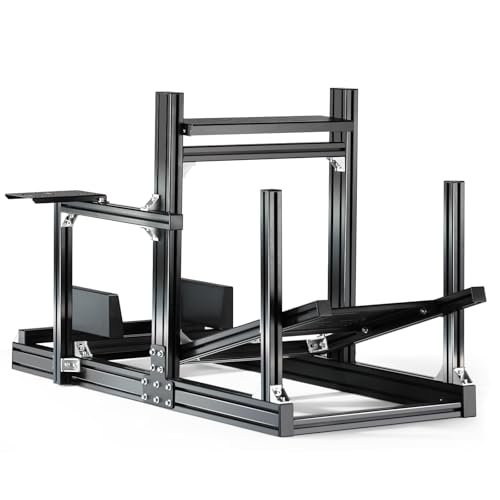
Anman’s 8040 profile stand is sold as a pure frame—no seat included—giving buyers the flexibility to mount their own car seat, a used Recaro, or a dedicated bucket. The 80x40mm extrusions feature anti-oxidation treatment and reinforced cast aluminum corner brackets with M8 bolts throughout. The quick-lock adjustment system allows one-person fine-tuning of wheel distance, pedal angle, and shifter position after initial setup.
Reviewers confirm the frame supports an Asetek Forte wheelbase at 12-14 Nm and pedals requiring 55 kgf with zero flex—impressive rigidity for a sub- frame. Assembly takes six to seven hours due to vague instructions, and the frame needs re-tightening after two to three sessions as the T-nuts settle. Pedal plate drilling may be necessary for non-standard bolt patterns, but the frame itself is future-proof for motion actuator add-ons.
This is the best path for DIY builders who already own a seat or want to use a real automotive seat. The frame rigidity matches rigs costing twice as much, and the standard 8-slot channels accept any aftermarket profile accessory.
Why it’s great
- Zero flex tested with 12-14 Nm wheelbases and 55 kgf pedal force
- Standard T-nut channels accept universal profile accessories
- Frame-only design allows custom seat installation
Good to know
- Assembly instructions are poorly translated and vague
- Requires re-tightening after initial settling period
- Pedal plate may need drilling for non-standard patterns
9. Dardoo Racing Simulator Cockpit with Triple Monitor Stand
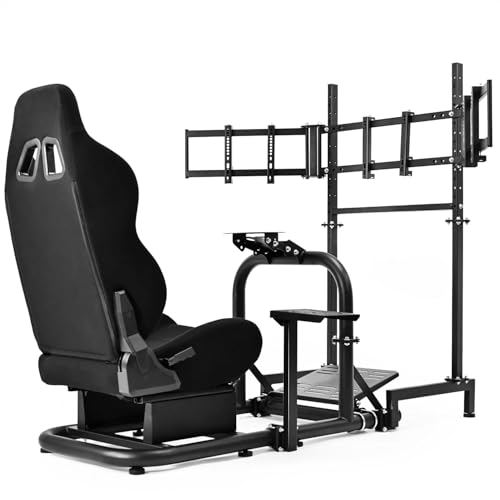
Dardoo uses a different approach than the profile-rig competition: a vertical column design built from 50mm thickened steel tubes rather than aluminum extrusion. The structure supports up to three 32” monitors on adjustable arms with independent angle and height control. The seat uses slow-rebound memory sponge with breathable cloth covering and a dual-lock dual-rail sliding system. The wheel deck and pedal mount both adjust for tilt and distance.
Owners report the rig has zero wobble with a Moza R5 and that the monitor arms stay level without sagging for single-screen use, though the right monitor arm has slight droop under heavier triple-screen loads over time. Assembly is easier than extrusion rigs due to fewer components, but paint chips and scratches on some shipped units suggest quality control varies. The memory foam seat is comfortable initially but some owners found it lacking support after months of regular use.
This is a strong pick for sim racers who prioritize quick assembly and triple-screen immersion over upgradeability. The steel tube frame is stiff but not expandable with standard profile accessories—what you buy is what you get.
Why it’s great
- Triple 32″ monitor support with independent adjustment arms
- Faster assembly than aluminum extrusion rigs
- Memory foam seat provides good initial comfort
Good to know
- Steel tube frame is not expandable with profile accessories
- Quality control varies; some units arrive with paint chips
- Right monitor arm may sag under heavy triple-screen loads
10. RACGTING Aluminum Racing Simulator Cockpit with TV Mount
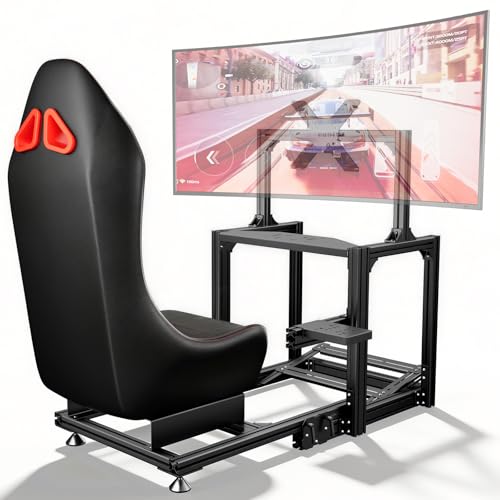
RACGTING’s cockpit uses a 70% aluminum alloy frame—not solid extrusion—with a foldable design that reduces its footprint when not in use, addressing a genuine pain point for sim racers in apartments or shared game rooms. The integrated TV mount supports VESA patterns from 75x75mm to 200x200mm. The seat includes adjustable recline and sliders, and the wheel deck and pedal plate adjust for multiple body types.
Early users confirm stability with a Moza R5 entry-level direct-drive wheel, though the connection point between the seat section and main frame shows visible bending under load-cell pedals. The “aluminum profile” label is technically accurate for some structural elements, but the frame relies heavily on thinner sheet metal brackets rather than full T-slot extrusions. Assembly is straightforward with clear labeling.
This works best as a starter cockpit for players using gear-driven wheels or low-torque direct-drive (under 5 Nm) who need a foldable solution. Anyone planning to upgrade to high-torque equipment will outgrow this frame quickly.
Why it’s great
- Foldable design saves floor space in tight rooms
- Integrated TV mount creates a complete setup in one package
- Lightweight and easy to move compared to extrusion rigs
Good to know
- Frame flexes at seat connection under load-cell pedals
- Thin metal brackets reduce overall rigidity
- Not suitable for high-torque direct-drive wheelbases
11. DIWANGUS Sim Racing Cockpit with Monitor Mount
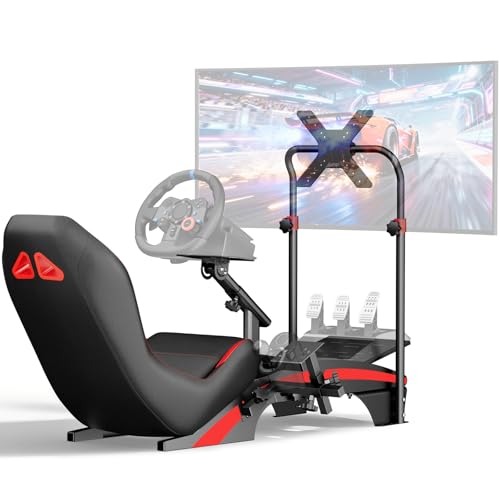
DIWANGUS delivers an F1-style seating position—legs-up, back-reclined—in a Q235 steel frame with an integrated VESA monitor mount supporting 75x75mm up to 200x200mm patterns. The seat uses soft sponge leather padding with a bucket-style shape that places the driver in a low, laid-back posture. The included non-slip floor mat protects flooring and adds stability. All major wheel and pedal brands from Logitech G29 to Fanatec DD2 and Moza R25 are listed as compatible.
Customers confirm the frame is solid for the price class and handles a Logitech G920 without sliding, though the bucket seat is tight for wider users and difficult to exit. The pedal mount uses knobs that are hard to adjust once set, and the center-post design makes entry and exit a chore. Assembly takes roughly 30 minutes with two people, and the packaging is described as compact but heavy at 68 pounds.
This is a dedicated F1-position cockpit for beginners on a strict budget who prioritize ergonomic posture over frame rigidity. It cannot match the stiffness of a true profile rig, but it delivers an authentic Formula seating angle that most entry-level cockpits ignore.
Why it’s great
- Genuine F1 driving position at an entry-level price
- Integrated VESA monitor mount supports up to 55″ TVs
- Includes floor mat to protect flooring and reduce sliding
Good to know
- Bucket seat is narrow and hard to enter or exit
- Center-post design limits leg room during entry/exit
- Pedal mount knobs are hard to access for adjustments
FAQ
Is 8040 aluminum profile strong enough for a 12 Nm direct-drive wheel?
Can I mount a real car seat on an aluminum profile sim cockpit?
What is the real difference between a tubular steel rig and an aluminum profile rig?
How much weight can a 8040 aluminum profile sim cockpit support?
Can I add motion actuators to an 8040 profile rig later?
Final Thoughts: The Verdict
For most users, the best aluminum profile sim racing cockpit winner is the Next Level Racing F-GT Elite 160 because its 160x40mm extrusion and multi-position design handle any consumer direct-drive wheel with zero flex while supporting future motion platform upgrades. If you want a simpler GT-focused build with pre-drilled holes and a faster assembly, grab the Next Level Racing GTElite Lite. And for the best value in a full package including triple monitor support, nothing beats the Anman Aluminum Profile Cockpit with Triple Monitor Stand.