
Our readers keep the lights on and my morning glass full of iced black tea. As an Amazon Associate, I earn from qualifying purchases.
Aluminum TIG welding is a demanding craft—one where the oxide layer, heat input, and filler control separate a clean stack of dimes from a contaminated mess. Buying an aluminum TIG welder means choosing between square-wave AC topology, pulse frequency ranges, and duty cycles that determine whether you weld thin sheet or structural plate. This guide breaks down every critical parameter so you buy the machine that matches your actual weld schedule, not just the listing hype.
I’m Min — the co-founder and writer behind Gadgets Feed. I’ve spent hundreds of hours analyzing inverter topologies, arc stability profiles, and real-world user feedback across the entire AC/DC TIG spectrum to map exactly how each welder performs when the aluminum oxide demands clean amperage control.
Whether you are a hobbyist fabricator or a shop owner looking to expand capability, finding the best aluminum tig welder means matching AC balance range, pulse adjustability, and duty cycle to your specific material thickness and workflow.
How To Choose The Best Aluminum TIG Welder
Selecting the right AC/DC TIG welder for aluminum means moving past the single-number amp rating. You need to evaluate waveform shaping, duty cycle at real amperage levels, and how much direct control the interface gives you over the puddle. Missteps here cause porosity, arc wandering, and expensive rework.
AC Balance and Cleaning Action
Aluminum’s tenacious oxide layer melts at roughly 3700°F, far above the base metal. The AC cycle’s electrode-positive (EP) phase scrubs that oxide away. AC balance, expressed as a percentage of EP time (30–40% is common), controls how much cleaning you get versus how hot the tungsten runs. Units with adjustable balance—from about 20% up to 80%—let you reduce cleaning on clean material to preserve tungsten tip life and increase penetration.
Pulse Capability and Thin Material Control
Pulse frequency (measured in Hz) switches between a high peak amperage and a lower background amperage. Low-frequency pulse (0.5–5 Hz) lets the puddle cool between pulses, giving you rhythmic bead stacking. High-frequency pulse (100–500 Hz) constricts the arc column for better directional control on thin sheet. Welders offering both AC and DC pulse provide the most versatility across material gauges.
Duty Cycle and Thermal Management
Duty cycle defines how long you can weld at a given amperage before the machine must cool down. A 60% duty cycle at 150A means 6 minutes of arc time out of every 10. For thick aluminum sections where you run near the machine’s maximum output, a higher duty cycle prevents thermal shutdown mid-pass. Also note whether the cooling fan runs continuously or only on demand—continuous fans pull in dust and shorten component life in shop environments.
Foot Pedal Compatibility and Amperage Control
Real-time amperage adjustment via a foot pedal separates hobbyist-grade aluminum welding from professional results. The pedal allows you to start hot to break the oxide layer, then feather the current back to avoid blowing through the root. Ensure the welder you choose either includes a pedal or has a compatible remote jack—some budget units omit this port entirely, forcing you to weld fixed-amp or use less precise hand controls.
Quick Comparison
On smaller screens, swipe sideways to see the full table.
| Model | Category | Best For | Key Spec | Amazon |
|---|---|---|---|---|
| TOOLIOM TL-MCT520 | 6-in-1 Multi | Multiprocess versatility | 200A TIG, 50A Plasma | Amazon |
| LOTOS TIG200ACDC | Classic Square Wave | Budget AC/DC TIG | 10–200A AC/DC, 37 lb machine |
Amazon |
| ARCCAPTAIN MIG205 Pro | 6-in-1 MIG/TIG | Portable MIG with spool gun | 205A MIG, Synergic Mode | Amazon |
| YESWELDER TIG-200P ACDC | Pulsed AC/DC TIG | Budget pulse TIG | Square/Triangle/Sine waves | Amazon |
| AHP AlphaTIG 203Xi | Mid-Range AC/DC | High duty cycle at 155A | 100% duty cycle @ 155A | Amazon |
| ARCCAPTAIN TIG200PACDC | 7-in-1 Quality TIG | Versatile TIG with pulse | Triangle/Square waveforms | Amazon |
| Weldpro TIG200-KT26 | 5-in-1 AC/DC TIG | Precision with premium torch | CK17 Flex torch included | Amazon |
| Everlast PowerTIG 200DV | Premium AC/DC TIG | Low-amp AC start @ 20A | 5A DC / 20A AC start min | Amazon |
| Everlast PowerTIG 210EXT | Advanced Pulse TIG | AC advanced pulse, 9-program memory |
3 AC waveforms, 210A | Amazon |
| Lincoln Square Wave® 205 | Premium Brand TIG | Brand reliability, simple UI | 200A AC/DC, 30A adapter | Amazon |
| Everlast PowerTIG 255EXT | Pro-Level TIG | Max amperage & memory presets | 255A, 4 waveforms, 9 presets | Amazon |
In‑Depth Reviews
1. TOOLIOM MIG/TIG/CUT/Stick/Flux MIG/Spool Gun Welder 6 in 1
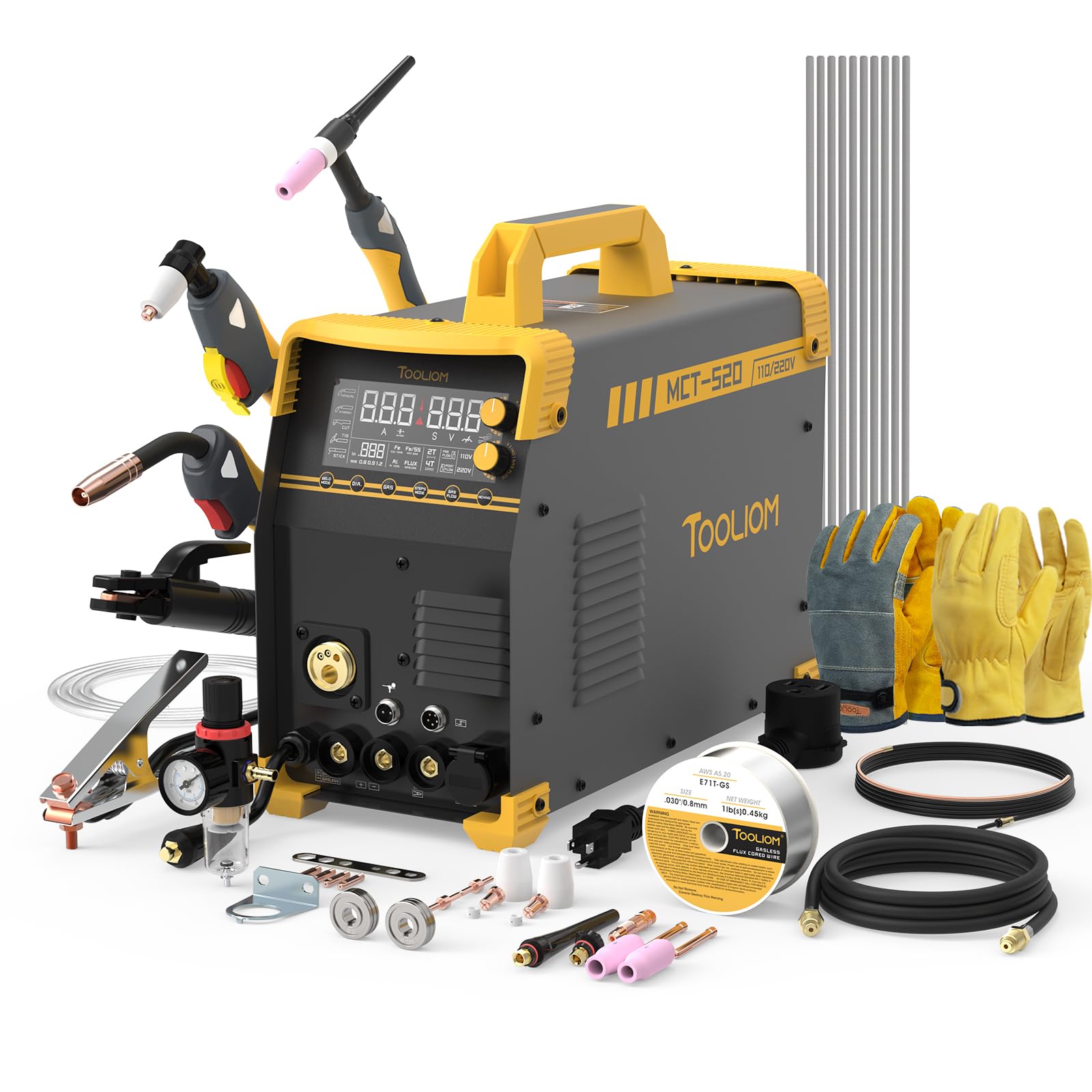
The TOOLIOM TL-MCT520 packs six processes into a 47.9-pound chassis: MIG, flux core, spool gun, plasma cutter, TIG, and stick. For the aluminum fabricator, the spool gun compatibility and HF TIG start at up to 200A are the headline acts. The machine includes a synergic MIG mode that auto-adjusts voltage against wire speed—a genuine time-saver when swapping between steel and aluminum on the same job.
The plasma cutter side runs 20–50A, delivering clean 5/16″ cuts on 110V and 10 mm on 220V, which makes this a true single-station repair bay solution. The digital panel gives real-time current feedback, and the built-in safety shield monitors over-current, over-voltage, and over-heating automatically. Users report consistent arc quality on TIG aluminum after dialing in balance settings, and the included gloves and flux wire lower the initial setup cost.
One trade-off: this is not a dedicated TIG machine. If your work is 100% aluminum TIG, a purpose-built AC/DC unit with full pulse control will give you finer parameter adjustability. But if you need a do-everything workshop tool that includes aluminum-capable TIG and plasma, this delivers far above its class.
Why it’s great
- Six processes in one unit—includes plasma cutter for sheet metal prep.
- Synergic MIG mode simplifies aluminum wire feed setup.
- HF TIG start provides non-contact arc initiation for clean tungsten.
Good to know
- No dedicated pulse TIG functions; pulse is absent from the TIG side.
- Spool gun sold separately, adding to baseline cost for aluminum MIG.
2. LOTOS TIG200ACDC 200A AC/DC Aluminum Tig Welder

The LOTOS TIG200ACDC is a veteran of the budget AC/DC TIG category, using a square-wave inverter to deliver 10–200A on both AC and DC. It includes a foot pedal for real-time amperage control and an argon regulator out of the box—accessories that many entry-level machines force you to purchase separately. The HF start hand torch lets you initiate the arc without touching the workpiece, preserving tungsten condition on aluminum where contamination ruins the weld.
Users consistently report that this unit handles stick welding well with 6010 and 7018 electrodes, and the DC TIG side produces clean welds on mild and stainless steel. On aluminum, the AC balance is adjustable via a “Clearance Effect” control (essentially EN/EP ratio), though the labeling is non-standard. Experienced owners note that the pulse function and variable AC frequency are absent—you get basic square-wave aluminum TIG without the advanced shaping found on pricier machines.
The machine weighs 37 pounds and is dual voltage, but switching between TIG and stick modes requires a power cycle. The foot pedal cord is long (roughly 25 feet) which helps in large workshops, but the included torch assembly benefits from an early upgrade to a gas lens kit for better gas coverage on aluminum. This is a solid pick if your budget is tight and you need a capable AC/DC platform to learn on.
Why it’s great
- Includes foot pedal and argon regulator—reduces immediate accessory spend.
- Proven square-wave AC output for reliable aluminum oxide cleaning.
- Good stick welding performance for a combined unit.
Good to know
- No pulse function; no variable AC frequency control for puddle tuning.
- Control labeling is non-standard and documentation is sparse.
3. ARCCAPTAIN iControl MIG205 Pro 6 in 1 Welder
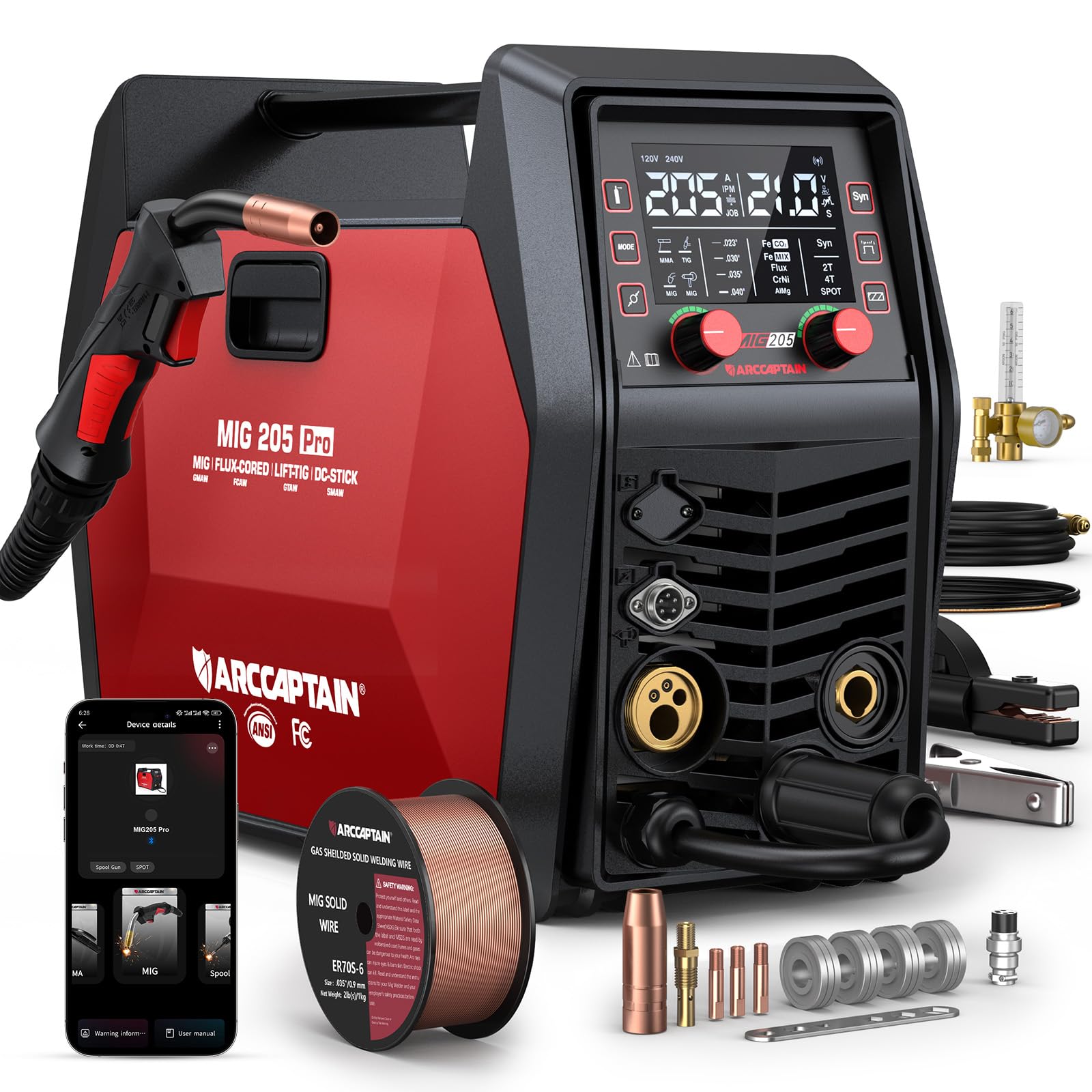
The ARCCAPTAIN MIG205 Pro is primarily a MIG welder that also supports lift TIG and spool gun aluminum welding—making it a strong candidate if your aluminum workflow leans toward MIG with a spool gun rather than foot-pedal TIG. The 205A output runs on both 120V and 240V, and the synergic mode automatically maps voltage to wire speed, which helps beginners avoid cold lap or burn-through on aluminum.
This unit weighs only 10 pounds, a fraction of most AC/DC TIG machines. The APP control allows remote adjustment of parameters like inductance and burn-back time, a unique feature for a machine in this price bracket. The wire feed motor is rated at 40W and reaches 640 IPM, sufficient for .030″ and .035″ aluminum wire feeding through a spool gun (sold separately).
The key limitation for TIG purists is the lift-start arc initiation: it lacks high-frequency start, making it less convenient for aluminum TIG where you want to dab filler without scratching the workpiece. Also, the included accessories do not cover the spool gun or a lift TIG torch, so plan accordingly. This machine excels if your primary work is MIG steel and you want occasional aluminum capability.
Why it’s great
- Ultra-lightweight 10-pound design makes it truly portable.
- Synergic MIG mode and APP control simplify parameter management.
- Adjustable inductance and burn-back for fine-tuning the arc.
Good to know
- Lift-start TIG only; no high-frequency arc start for non-contact ignition.
- Spool gun and lift TIG torch sold separately.
4. YESWELDER 200A AC/DC Aluminum Tig Welder with Pulse
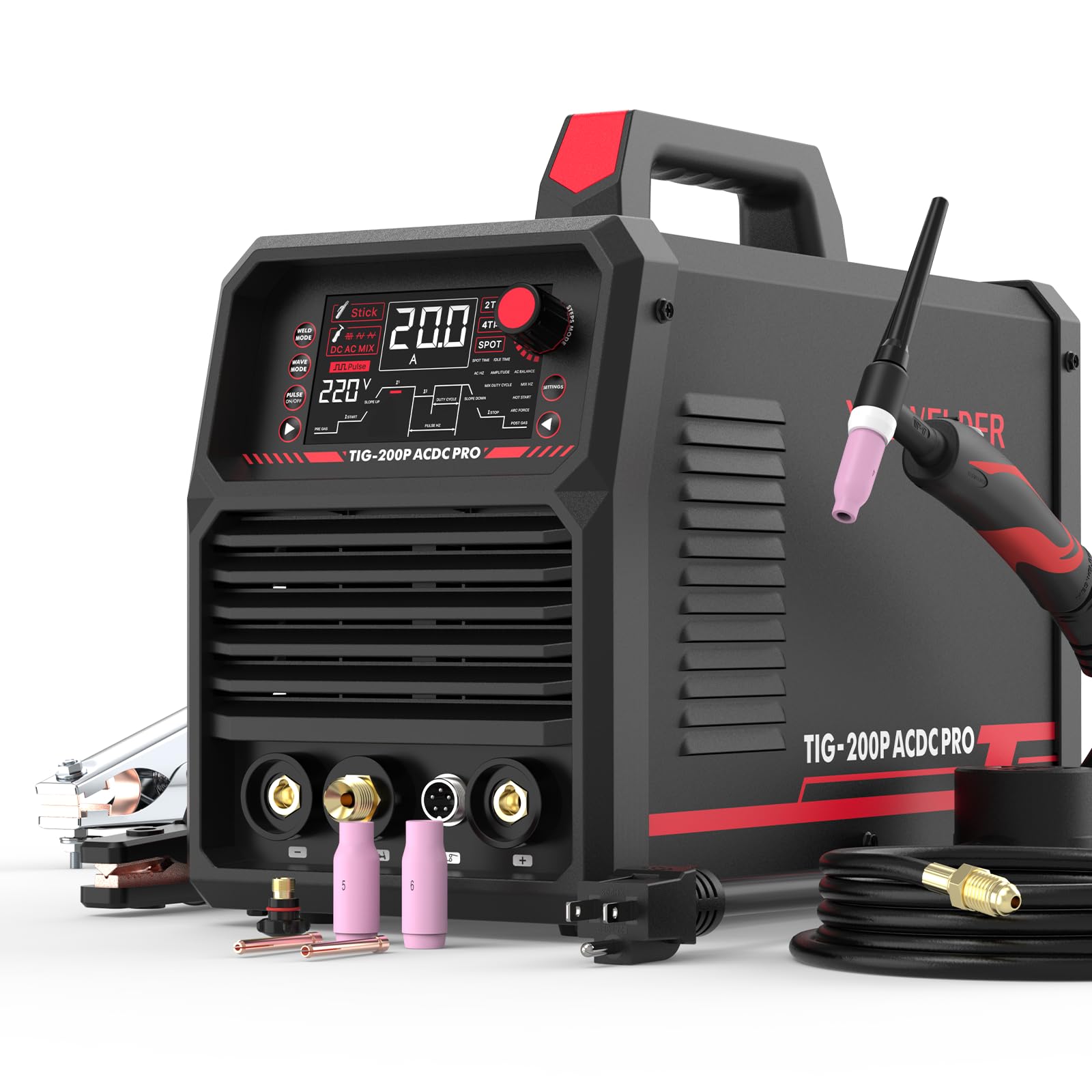
The YESWELDER TIG-200P ACDC brings software-controlled square, triangle, and sine wave AC/DC inversion to the sub- range. This waveform selection directly impacts aluminum welding: triangle wave reduces heat input for thin sections, while square wave maximizes oxide cleaning. The 7-in-1 modes include AC pulse and DC pulse TIG alongside a spot welding function, giving you dedicated tools for tacking and stitch welding aluminum sheet.
The large LED display shows real-time amperage and parameters, and the auto-memory function saves your last settings across power cycles—a genuine convenience if you switch back and forth between steel DC and aluminum AC jobs. The unit weighs only 31 pounds and auto-detects 110V or 220V input without a manual switch. Users note that the HF start works reliably on aluminum after adjusting the spark gap to 0.8 mm, a detail omitted from the manual.
Build quality is a concern at this price tier: one report described internal failure after minimal use. The foot pedal is not included—you must source a 5-pin compatible unit separately. If you are handy with basic troubleshooting and want a feature-packed AC/DC pulse machine to learn on, this is a high-value option, but be prepared to check the internal connections upon arrival.
Why it’s great
- Three AC waveform options (square, triangle, sine) for puddle tuning.
- Auto-memory saves settings between sessions—useful for alternating jobs.
- Lightweight 31 lb build with auto-sensing dual voltage input.
Good to know
- Foot pedal not included; requires a 5-pin XS12 connector type.
- Reports of quality control variance; inspect spark gap before use.
5. AHP AlphaTIG 203Xi Amp IGBT AC DC Tig/Stick Welder

The AHP AlphaTIG 203Xi stands out for its duty cycle: 100% at 155 amps means you can weld continuously without thermal shutdown, a huge advantage for production runs on aluminum. The 2024 model includes HV Start, an electronic solid-state simulation of high-frequency start that eliminates the physical spark gap adjustment needed on earlier versions. The unit outputs up to 200A AC/DC and includes a Nova foot pedal with a 25-foot cord for remote amperage control.
Users praise the stick welding side as one of the best in its class, with smooth arc starts on 6011, 6013, and 7018 rods. The TIG side handles aluminum up to 1/4″ in a single pass and supports adjustable AC frequency to widen or tighten the etch band. The included Rotaflex torch is light and flexible, reducing fatigue on long weld sequences. The only weak point is the ground clamp, which users commonly replace with a heavy-duty unit.
The machine weighs 69 pounds, making it less portable than compact inverter units, but the trade-off is rugged construction and the superior duty cycle. The 3-year warranty offers peace of mind that budget units lack. If you regularly weld aluminum for extended periods or run thick sections near the machine’s ceiling, this is one of the best mid-range investments available.
Why it’s great
- 100% duty cycle at 155A allows non-stop aluminum welding.
- 2024 HV Start eliminates physical spark gap tuning.
- Excellent stick performance and flexible torch design.
Good to know
- Heavier build at 69 lb; less suited for frequent job-site transport.
- Ground clamp and torch consumables benefit from aftermarket upgrades.
6. ARCCAPTAIN TIG Welder AC/DC 200Amp with Pulse 7 in 1

The ARCCAPTAIN TIG200PACDC is a dedicated 7-in-1 TIG machine offering AC TIG, DC TIG, AC Pulse, DC Pulse, AC Pulse Square, AC Pulse Triangular, and Stick modes. The triangular wave setting is a genuine asset for thin aluminum: it drops effective heat input, reducing distortion and burn-through on material as thin as 0.5 mm. Square wave gives maximum cleaning action when the oxide layer is heavy.
The large LED screen displays all adjustable parameters—pre-flow, initial current, up-slope, peak, base, down-slope, crater, post-flow, AC balance, and pulse frequency. This level of programmability is rare in the sub- bracket. The machine weighs 42.7 pounds and uses a 5-pin XS12 foot pedal connector (pedal sold separately). Users consistently report that the arc is stable and quiet, and that the pulse function makes thin-gauge aluminum welding significantly easier.
The main drawback is the foot pedal connector standard: the XS12 aviation plug is less common than the standard 5-pin Dinse, so sourcing a replacement pedal requires care. Additionally, the included ground clamp has been reported to overheat at sustained 90–140 amp draws, so upgrading to a higher-amp clamp is recommended for heavier work. Otherwise, this is the most feature-dense AC/DC TIG machine in its price class.
Why it’s great
- Triangular AC waveform reduces heat input for thin aluminum sheet.
- Full digital parameter control including pulse and slope functions.
- On-demand fan keeps dust out of the inverter when idle.
Good to know
- Foot pedal uses XS12 connector—less standard than 5-pin Dinse.
- Ground clamp needs upgrading for sustained high-amp aluminum work.
7. Weldpro 200A AC/DC TIG Welder with Pulse 5 in 1
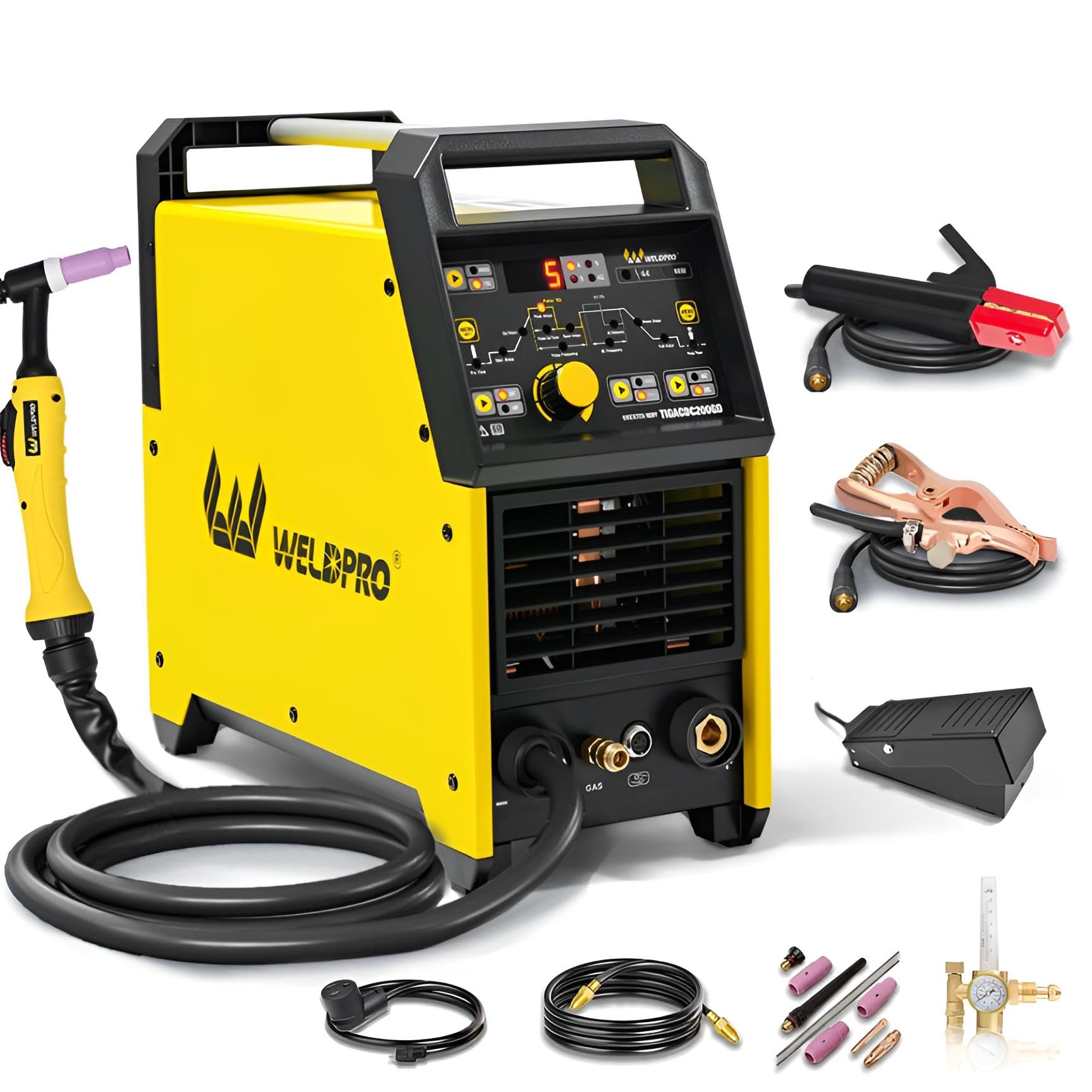
The Weldpro TIG200-KT26 ships with a CK17 flex torch, a widely respected consumable that tracks smaller than rigid torches and provides superior gas coverage on tight joint access. The 200A AC/DC inverter offers five modes: HF AC TIG, DC TIG, AC Pulse, DC Pulse, and Stick. The pulse frequency range spans 0.5–200 Hz, and the user can adjust peak amperage, up-slope, down-slope, and 2T/4T trigger modes directly from the front panel.
The included rocker foot pedal provides smooth amperage ramp from minimum to maximum, with no dead spots in the travel. Users report that the arc initiation is clean and consistent on both 16 ga and 18 ga stainless, and the AC balance control handles aluminum cleaning action on dirty or anodized material. The digital display is high-contrast and readable in bright workshop conditions.
Build quality is a step above entry-level units: the chassis feels solid, and the cooling fan runs quietly. However, the gas hose torch gets hot during extended aluminum beads—pulse or stitch techniques help manage torch temperature. The included work clamp is fine for light tubing but struggles with flat bar over 3/4″. This is a polished mid-premium machine that feels closer to a shop-grade unit than a hobbyist tool.
Why it’s great
- CK17 flex torch provides superior gas coverage and joint access.
- Rocker foot pedal gives smooth, linear amperage control.
- Full adjustable pulse, slope, and 2T/4T modes for precision welding.
Good to know
- Torch heats up during extended continuous aluminum beads.
- Ground clamp is adequate for light welding but less effective on thick stock.
8. Everlast PowerTIG 200DV 200amp Pulse ACDC Welder

The Everlast PowerTIG 200DV starts as low as 5 amps on DC and 20 amps on AC, making it one of the gentlest machines on thin aluminum foil or heat-sensitive castings. The lift-start function is available for environments where HF interference is a concern. The 200DV runs on both 120V and 240V, and the fan-on-demand feature keeps the interior dust-free when the machine is idle, extending inverter lifespan.
Users report that the pulse function works well on aluminum, helping to control the puddle on vertical or out-of-position welds. The pre-flow and post-flow gas controls allow precise shielding gas timing, and the adjustable arc force (DIG) on stick mode improves start reliability on rusty or painted material. At 60 pounds, it is heavier than the average 200A inverter but the build quality reflects the additional weight.
The included torch and ground clamp are functional but not premium—most owners upgrade the torch to a flex head within the first few months. The interface is straightforward but lacks the graphical menu system of the higher-tier Everlast models. This is a reliable workhorse for the serious hobbyist or small shop that wants a reputable brand without paying for features they don’t need.
Why it’s great
- Exceptionally low 5A DC start ideal for thin and heat-sensitive materials.
- Fan-on-demand reduces dust ingestion in dirty workshop environments.
- Lift-start option for locations sensitive to HF interference.
Good to know
- Included torch and clamp are entry-level; many users upgrade these.
- Heavier chassis than comparably powered units.
9. Everlast PowerTIG 210EXT 210Amp Ac Dc Tig Stick Pulse Welder

The Everlast PowerTIG 210EXT adds a full advanced-pulse feature for both AC and DC, plus a dedicated Advanced Pulse mode for AC that is designed for thin aluminum—increasing travel speed while reducing warpage. The user can choose between Triangular, Advanced Square, and Soft Square waveforms, each altering the arc’s heat profile. The 9-program memory stores your favorite settings for repeatable weld schedules, a huge time saver when switching between different joints or materials.
Professional fabricators praise its performance on 1/4″ aluminum, noting that it falls slightly short of a Miller Dynasty but costs roughly a third of the price. The 120V capability means you can practice at home without a dedicated 240V circuit, though max output is reduced. The interface uses a flowchart menu system that reduces confusion, especially helpful for users new to TIG adjustments.
One known issue: the supplied gas whip has been reported to deteriorate over time, causing leaks. Replacing it with a standard aftermarket hose solves the issue. The unit is also heavy (60 pounds) and lacks a built-in water cooler, so plan for breaks or stitch welding during long aluminum beads. This is the clear choice for the serious enthusiast who wants near-professional waveform control without the professional price tag.
Why it’s great
- Three AC waveform options plus advanced pulse for thin aluminum.
- 9-program memory saves and recalls complex weld parameters.
- Flowchart interface reduces confusion during setup.
Good to know
- Gas whip may require early replacement to prevent leaks.
- No built-in water cooler; plan for thermal limits on long beads.
10. Lincoln Electric Square Wave® 205 TIG Welder K5613-1
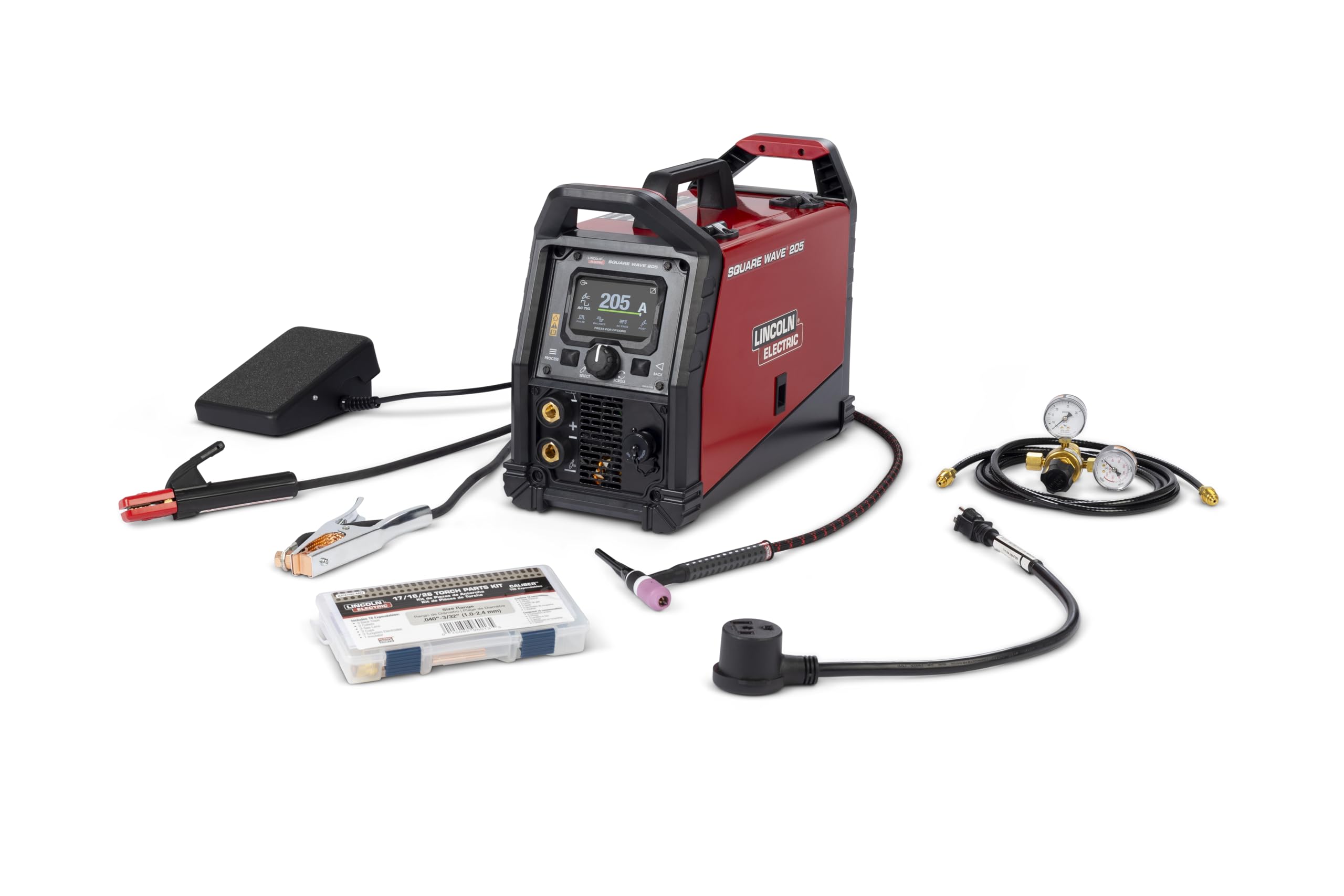
The Lincoln Electric Square Wave 205 is a brand-new (2025) entry from the company that defined the TIG market. It is built for the hobbyist, maker, and small fabricator who wants Lincoln reliability in a portable package without the commercial price of the Precision TIG series. The unit provides AC and DC TIG plus stick welding, with auto-set modes that intelligently match parameters to material thickness and joint configuration.
Users report that the high-frequency starts are crisp and reliable on both aluminum and steel. The controls are simple—Lincoln prioritized ease of use over deep programmability—yet the machine still allows advanced users to override the auto-settings for fine-tuning. The included 30-amp to 110V adapter lets it run on household power, though full output requires 240V. The built-in handles make it easy to move around a garage or shop.
The Square Wave 205 does not offer the extensive pulse adjustability or multi-waveform selection of the Everlast 210EXT. It is a straightforward, high-quality machine that focuses on consistent arc performance rather than feature count. If you value brand legacy, resale value, and a weld quality that justifies the price, this is a clean choice. The fan is audible but ramps down when idle, keeping noise manageable.
Why it’s great
- Lincoln reliability and resale value in an accessible price bracket.
- Auto-set modes simplify parameter selection for new TIG welders.
- Includes 110V adapter for flexible home or shop power options.
Good to know
- Fewer advanced pulse and waveform controls than comparable-priced units.
- Fan is audible during operation, though it ramps down at idle.
11. Everlast PowerTIG 255EXT Digital AC/DC TIG Stick Pulse Welder

The Everlast PowerTIG 255EXT is the most powerful machine on this list, delivering 255 amps AC/DC with four selectable AC waveforms: Sine, Triangular, Soft Square, and Advanced Square Wave. Its 10 Hz pulse mode is designed to improve weld bead appearance and penetration on thicker aluminum sections. The unit starts at 3 amps DC and 5 amps AC, providing fine control all the way down to thin-gauge work.
The 9-program memory allows you to store entire weld schedules, including waveform type, balance, frequency, and pulse parameters. The 4T mode is useful for long out-of-position aluminum fillets where you need both hands free to dab and stabilize. The VRD (Voltage Reduction Device) function reduces shock risk during stick welding, a safety feature absent from most units in this segment. The 6010 stick capability means you can run cellulose electrodes for root passes on pipe work.
At 85 pounds, this is a shop-floor machine—not casually portable. The fan runs continuously and is audible, though the trade-off is consistent cooling on long aluminum runs. The unit does not include a water cooler, so for full 255A continuous welding on aluminum, external water cooling is recommended. The cost is significant, but compared to a Miller Dynasty 280, the Everlast delivers roughly 80% of the performance at 40% of the price.
Why it’s great
- 255A max output handles thick aluminum in single passes.
- Four AC waveforms and 9-program memory for repeatability.
- VRD and 6010 stick capability add professional functionality.
Good to know
- 85 lb weight limits portability to shop use only.
- External water cooler recommended for continuous 255A aluminum welding.
FAQ
Can I TIG weld aluminum with a DC-only machine?
What is the difference between square wave and sine wave AC for aluminum?
Do I need a foot pedal for aluminum TIG welding?
What does pulse frequency do for aluminum welding?
How do I know if my welder needs a separate argon regulator?
Final Thoughts: The Verdict
For most users, the best aluminum tig welder winner is the TOOLIOM 6-in-1 because it combines 200A AC TIG, plasma cutting, and spool gun MIG in a single 47.9-pound package—true workshop versatility without sacrificing aluminum TIG capability. If you want maximum thin-sheet pulse control and waveform shaping, grab the ARCCAPTAIN TIG200PACDC. And for extended production aluminum welding with a 100% duty cycle, nothing beats the AHP AlphaTIG 203Xi.