
Your first contact on 20 meters with a wire antenna strung between two trees is the moment every amateur radio operator chases. Whether you are building a go-kit for emergency preparedness, setting up a permanent base station, or going portable for Parks on the Air (POTA), the right radio kit determines whether that contact is a scratchy whisper or a solid 59 report. Vague specifications and marketing hype make choosing between a 5W QRP transceiver and a 50W mobile rig far more confusing than it needs to be.
I’m Min — the co-founder and writer behind Gadgets Feed. I have spent hundreds of hours combing through FCC filings, comparing SDR architectures, and cross-referencing real-world user reports from HF bands to UHF repeaters to identify which kits genuinely deliver on their specifications.
This guide breaks down nine of the most compelling options currently on the market, covering everything from entry-level handhelds to premium HF transceivers, so you can confidently choose the best amateur radio kits for your license class and operating style.
How To Choose The Best Amateur Radio Kit
Every amateur radio kit represents a trade-off between frequency coverage, output power, receiver performance, and portability. Before you click “buy”, you need to map your license privileges (Technician, General, or Extra class) to the bands you actually want to operate on. A VHF/UHF mobile rig is useless for 40-meter DX, just as a 5W QRP HF transceiver will struggle to hit a distant repeater on 2 meters.
Power Output and Antenna Budget
Output power is the single most misunderstood spec. A 50W mobile rig into a compromised quarter-wave whip on a vehicle often performs worse than a 5W QRP radio feeding a half-wave dipole at 30 feet. The “power” you need is directly tied to the antenna you can deploy. Beginners fixate on wattage; experienced operators fixate on the antenna system. If you cannot erect a resonant antenna, a premium high-power kit is wasted money.
Receiver Architecture: SDR vs. Traditional Superheterodyne
Software-defined radio (SDR) front ends offer features like band-scope waterfalls, adjustable filter bandwidths, and noise reduction that analog rigs cannot match at the same price point. However, early SDR implementations sometimes suffer from overload in strong RF environments. Traditional superheterodyne receivers tend to handle adjacent-channel interference more cleanly. The Xiegu G90 and Malahit tr usdx use SDR; the Retevis HS4 uses a traditional analog chain — each choice has consequences for how you hear the band.
Licensing and Band Restrictions
Not every kit in this list is legal to transmit on without the correct license. The Baofeng UV-5R and Radioddity DB50 can operate on GMRS frequencies under part 95, but only if you hold a GMRS license or use them exclusively on amateur bands under a Technician-class call sign. The QRP HF radios like the Xiegu G106 and the Malahit tr usdx are strictly for licensed amateur operators on 80 through 10 meter bands. Check your local regulations before transmitting on any frequency.
Quick Comparison
On smaller screens, swipe sideways to see the full table.
| Model | Category | Best For | Key Spec | Amazon |
|---|---|---|---|---|
| Xiegu G90 | HF SDR Transceiver | Portable POTA / Base HF | 20W output, built-in ATU | Amazon |
| Radioddity DB50 | Dual-Band Mobile | High-power VHF/UHF mobile | 50W output, detachable faceplate | Amazon |
| Xiegu G106 | HF QRP SDR | Digital modes (FT8 / JS8Call) | 5W output, 3.5-29.7 MHz | Amazon |
| Retevis HS4 | 10 Meter Mobile | 10m contest / base station | SSB/CW/FM 28.0-29.7 MHz | Amazon |
| Anytone AT-778UV | Dual-Band Mobile Kit | Beginner mobile / starter kit | 25W VHF/UHF, 200 channels | Amazon |
| Nooelec NESDR Smart HF Bundle | SDR Receiver Bundle | HF / VHF/UHF spectrum exploration | 100 kHz-1.7 GHz, Ham It Up v1.3 | Amazon |
| Malahit tr usdx transceiver | QRP HF SDR Transceiver | CW / FT8 ultra-portable | ~4W, 80-20m bands, built-in keyer | Amazon |
| Baofeng UV-5R 8W 2-Pack | Portable Handheld Kit | Group / emergency / repeater access | 8W VHF/UHF, 3800mAh battery | Amazon |
| QYT KT-8900R | Tri-Band Mobile | Budget mobile / new ham user | 25W dual watch, 0.9 lb | Amazon |
In‑Depth Reviews
1. Xiegu G90 HF Radio Transceiver

The Xiegu G90 sits in a unique sweet spot: 20 watts of output power, a built-in wide-range automatic antenna tuner, and a 48kHz color spectrum display with waterfall — all in a package that weighs just 3.5 pounds. The ATU is the standout feature here because it will match almost any random-length wire or end-fed you throw at it in the field, saving you from carrying a separate tuner. The SDR front end gives you a clean, real-time view of the band, making it far easier to spot a clear frequency during a contest or find that weak DX station on 40 meters.
On the air, the G90 delivers excellent audio reports on SSB, and the 20-watt output (which typically measures closer to 18W on digital modes) is enough to work the world on CW and FT8 with a decent antenna. The detachable display unit is a thoughtful touch for portable setups where you want the screen accessible but the radio body stashed in a pack. Many operators report making DX contacts on 20 meters with the G90 running barefoot into a dipole at 30 feet — a testament to the receiver sensitivity and the tuner’s ability to squeeze every bit of performance from a compromised field antenna.
The learning curve is real. The menu system is dense, and beginners will need to spend time with the manual to understand the quick-mode functions. Some units have firmware quirks that require updates, and the radio lacks a dedicated hardware volume knob, which can be annoying during a fast QSO. The warranty is void if you remove any part of the case without authorization, so modifications are not an option. Despite these flaws, the G90 remains the most versatile HF transceiver under many premium models for the portable operator who values an integrated ATU and spectrum display.
Why it’s great
- Built-in automatic antenna tuner eliminates the need for a separate ATU in the field
- 48kHz color spectrum display and waterfall provide excellent band awareness
- 20W output is ideal for POTA, SOTA, and base operations with a resonant antenna
Good to know
- Menu-driven interface has a steep learning curve for first-time HF users
- Hardware volume control is absent; all adjustments are through the menu
- Some units require firmware updates to resolve stability issues
2. Radioddity DB50 Dual Band Mobile Radio

The Radioddity DB50 packs a genuine 50-watt output into a chassis with a detachable front panel — a combination rarely seen at this price tier. The high power is not just a number on the box; it translates into reliable repeater access at distances exceeding 50 miles in open terrain, and the detachable faceplate allows you to mount the radio body under a seat while the control head sits on the dashboard. Dual-band, dual-display, dual-watch operation means you can monitor UHF and VHF simultaneously, which is invaluable during a multi-group event or when listening for calls on both 2-meter and 70cm repeaters.
Channel capacity is listed at 758, but unlocking that full count requires using the Radioddity CPS software — out of the box, Chirp support is advertised but the current firmware only reads and writes the first 35 channels. The free programming cable is included, and the software works reliably once you accept that Chirp compatibility is incomplete. On transmit, audio reports are strong and clear, with adjustable mic gain available through the software. The fanless cooling design relies on a large heat sink, and users report no overheating even during extended rag-chews on high power.
The manual is sparse, and the front-panel programming process requires patience. The power cable lacks a fused cigarette-lighter plug, so you will need to strip wires or buy an adapter for mobile use. Some units have shipped with a faulty microphone; Radioddity customer support has handled replacements promptly. For the operator who needs 50 watts of clean VHF/UHF power in a compact, install-flexible format, the DB50 delivers performance that rivals Yaesu and Icom models costing significantly more.
Why it’s great
- 50W output provides reliable long-range communication on both VHF and UHF bands
- Detachable front panel makes installation flexible in nearly any vehicle
- Excellent audio reports with adjustable mic gain via Radioddity software
Good to know
- Chirp support is incomplete; the full 758 channels require Radioddity CPS software
- Manual is minimal and front-panel programming has a steep learning curve
- No cigarette lighter power adapter included; you must strip or adapt the power cable
3. Xiegu G106 SDR HF Transceiver

The Xiegu G106 is the smallest HF SDR transceiver in this list, designed specifically for the digital-mode operator who wants to run FT8, JS8Call, or WSPR from a backpack. The receiver covers 3.5 to 29.7 MHz continuously, and the 5-watt output (which can peak around 8W on some bands) is sufficient for reliable FT8 QSOs when paired with a good antenna and the right propagation conditions. The SDR architecture gives the G106 a clean, stable I/Q output that interfaces seamlessly with WSJT-X using the Icom 7100 emulation setting.
Build quality is surprisingly high for the price point — the machined aluminum chassis feels comparable to Japanese entry-level gear. The included microphone with a built-in speaker is functional, though the headphone jack is on the microphone body rather than the radio, which forces a dangling cable. Firmware updates are essential: many users report that units shipped with firmware earlier than version 1.3 struggle with audio dropout on digital modes, and upgrading to 1.4 resolves the issue entirely. The 18-month warranty from Radioddity is a meaningful safety net.
This radio is not a general-purpose SSB contest machine. There is no SWR meter, no adjustable AGC, and no DSP filtering. The G106 is a single-purpose tool for the digital-mode enthusiast who values portability and reliability over feature breadth. For CW and QRP SSB on 40 meters, it works well with a Z-tuner and a 40m dipole. The lack of a built-in tuner means you must bring your own if your antenna is not resonant, which is a fair trade-off given the compact size.
Why it’s great
- Highly portable at 1.6 pounds with continuous HF coverage from 3.5 to 29.7 MHz
- Stable SDR I/Q output works reliably with WSJT-X for FT8 and JS8Call
- Solid aluminum chassis and 18-month warranty exceed expectations at this price
Good to know
- Headphone jack is located on the microphone, not the radio body
- No built-in SWR meter, ATU, or adjustable AGC — requires external gear for non-resonant antennas
- Firmware updates are mandatory for stable digital mode operation
4. Retevis Ailunce HS4 10 Meter Radio
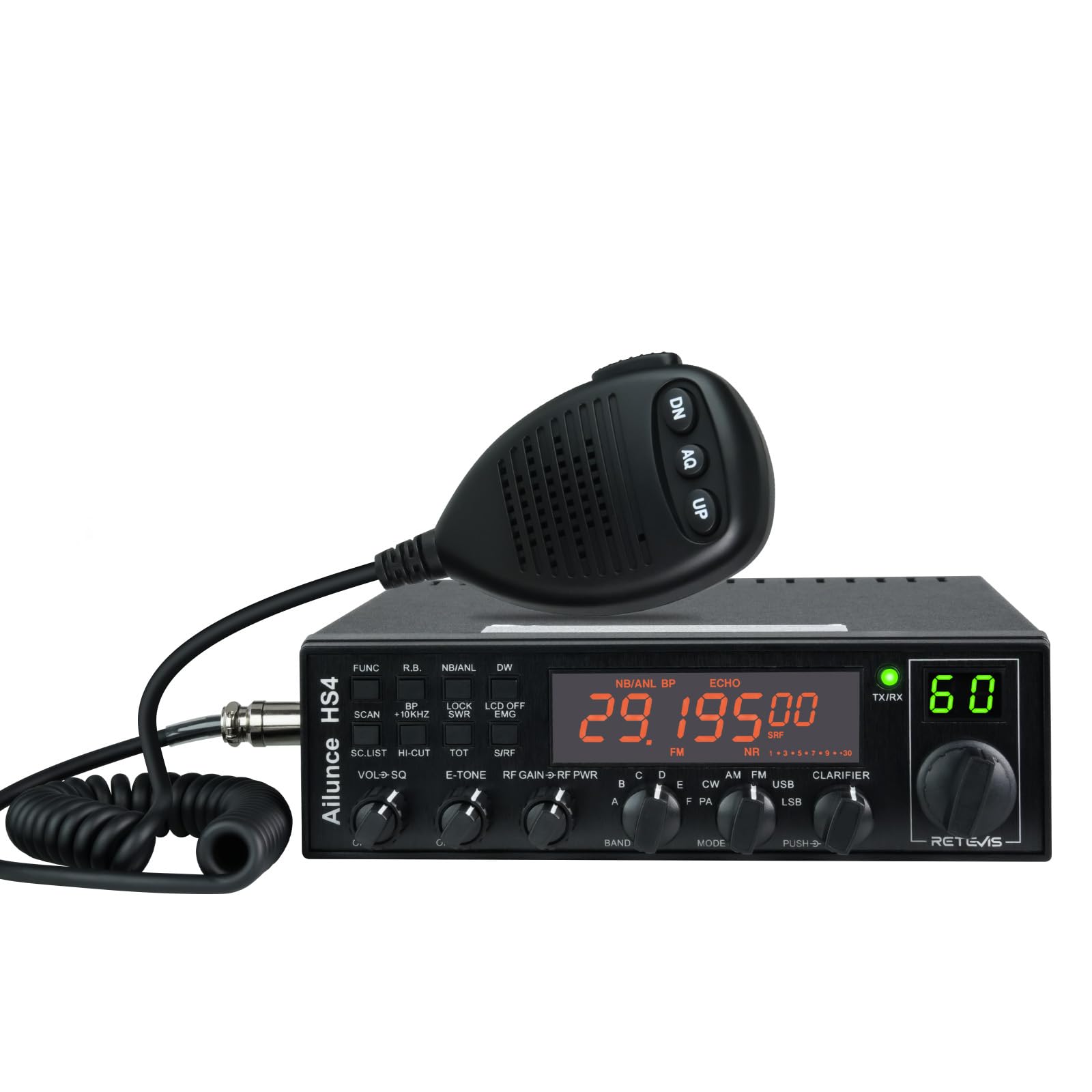
The Retevis Ailunce HS4 is a dedicated 10-meter radio that punches well above its weight class. It delivers a stock 38-40 watts on SSB with a stable 13.8V supply, which is enough to work skip propagation on 10 meters during solar maximum conditions — and we are in one right now. The radio supports six operating modes: PA, AM, FM, USB, LSB, and CW, making it one of the most versatile single-band transceivers available. The large LCD display with backlit faceplate lettering is easy to read at a glance, and the VFO knob with selectable step values allows precise frequency tuning.
On the bench, the HS4 shares its architecture with the Anytone 5555plus and the LT-5558A, which means a proven design with a mature receiver front end. The DSP-based noise reduction is genuinely effective at pulling weak signals out of the noise, and the squelch functions well across all modes. CTCSS and DCS encoding are available for repeater access, though 10-meter FM repeaters are rare compared to 2 meters. The built-in SWR protection circuit shuts down the transmitter if the antenna match exceeds safe limits, protecting the final amplifier from damage.
The stock microphone is acceptable, but upgrading to a larger dynamic element like the Workday DEG-03 noticeably improves transmitted audio quality. The radio is heavy at 3.3 pounds and designed for base or mobile installation with a proper heat sink — no fan, so adequate air circulation is required. CW operators will find the external keyer interface works well, and the dual-watch function lets you monitor two frequencies simultaneously. For the 10-meter enthusiast or the operator wanting a dedicated band radio that covers 11 meters with a simple modification, the HS4 represents exceptional value.
Why it’s great
- Full-power SSB output of 38-40W with stable 13.8V operation
- Excellent receiver with effective DSP noise reduction and clean audio
- Six-mode support (SSB, CW, AM, FM, PA) with CTCSS/DCS for repeater access
Good to know
- Heavy at 3.3 pounds and requires good airflow for fanless cooling
- Stock microphone audio is merely acceptable; an aftermarket element improves it noticeably
- Limited to 10 meters only — not a wideband HF solution
5. Anytone AT-778UV Amateur Mobile Radio
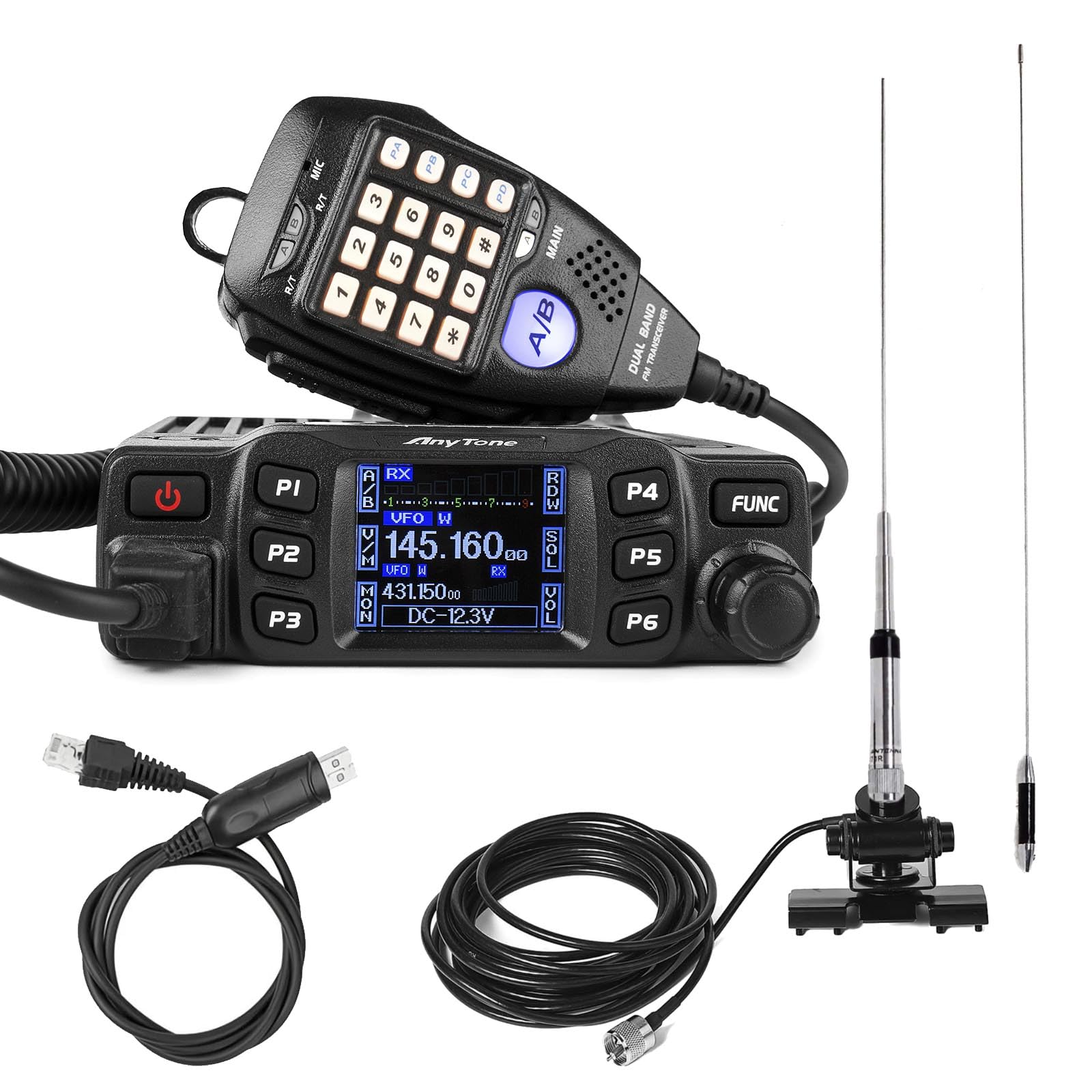
The Anytone AT-778UV is marketed as a starter kit, and it lives up to that promise by including not just the mobile transceiver but also a 38-inch 770R car antenna, mounting bracket, power cable with fuse, and microphone — everything you need except a license to get on the air. The radio runs 25W on high power, with selectable 15W and 5W options for closer-range communication. The 200-channel memory with CTCSS and DCS privacy codes makes it easy to program your favorite local repeaters and simplex frequencies.
VOX (voice-activated transmission) is built in, which is a rare feature in entry-level mobile rigs. It works reliably for hands-free operation, which is genuinely useful for mobile driving when you do not want to reach for the PTT button. The radio uses Chirp-compatible programming, and the native Windows software also allows mic gain adjustment, which is a nice touch for tuning transmit audio. The fanless design keeps the radio silent, and the heat sink is adequate for typical 25W operation without overheating.
The manual is poorly written, and the function key layout takes time to learn — there is no dedicated volume or squelch knob; you hold down a button and rotate the encoder to adjust either, which is distracting while driving. The included car antenna is a budget-grade mag-mount, adequate for local repeaters but not for long-range simplex. For the new Technician-class licensee who wants a complete mobile setup without piecing together components, the AT-778UV kit saves time and money, though you will eventually want to upgrade the antenna for better performance.
Why it’s great
- Complete starter kit with transceiver, antenna, power cable, and microphone included
- VOX hands-free operation works reliably for mobile use
- Chirp-compatible and supports mic gain adjustment via software
Good to know
- Manual is poorly written and the function key layout requires practice
- No dedicated volume or squelch knob — adjustments require button-encoder combos
- Included antenna is entry-level; expect to upgrade for better range
6. Nooelec NESDR Smart HF Bundle

The Nooelec NESDR Smart HF Bundle is the most versatile receiver kit in this list. It covers from 100 kHz (below the AM broadcast band) all the way up to 1.7 GHz, using the Ham It Up v1.3 upconverter to bring HF signals into the RTL-SDR tuning range without the lossy direct-sampling hack that cheaper dongles use. The result is a vastly better HF experience: you retain full gain control, avoid the DC spike centered on the middle of the band, and can hear weak signals on 80 meters that would be buried in noise with a bare RTL-SDR.
The bundle includes an NESDR SMArt RTL-SDR, the Ham It Up in a custom black aluminum enclosure, a balun for longwire and dipole antennas, three small antennas, and all necessary adapters. Setup requires installing drivers via Zadig, entering a frequency offset of -125,000,000 Hz in your SDR software, and selecting the correct gain settings — an hour-long project for a determined beginner. Once running, the receiver quality is genuinely impressive for the price, and the ability to decode everything from aviation VHF to NOAA weather satellites to FT8 on HF makes this an educational powerhouse.
The upconverter runs warm, which is normal, but extending the USB cable rather than the antenna coax avoids signal loss. The included antennas are short and intended for local stronger signals; serious HF listening requires a proper longwire or dipole. Nooelec offers a full 2-year warranty and 24/7 support, which is rare for SDR gear. This kit is not a transceiver — it is a receiver only — but for the operator who wants to explore the entire RF spectrum before committing to an expensive HF transceiver, it is the best learning tool available.
Why it’s great
- Genuine upconverter design for HF reception, not a lossy direct-sampling hack
- Covers 100 kHz to 1.7 GHz, unlocking AM, shortwave, VHF/UHF, and satellite reception
- 2-year warranty and 24/7 support from Nooelec provide peace of mind
Good to know
- Receive-only; does not transmit — requires a separate transceiver for ham operation
- Setup involves driver installation and a specific frequency offset that confuses first-timers
- Included antennas are only suitable for strong local signals
7. Malahit tr usdx transceiver
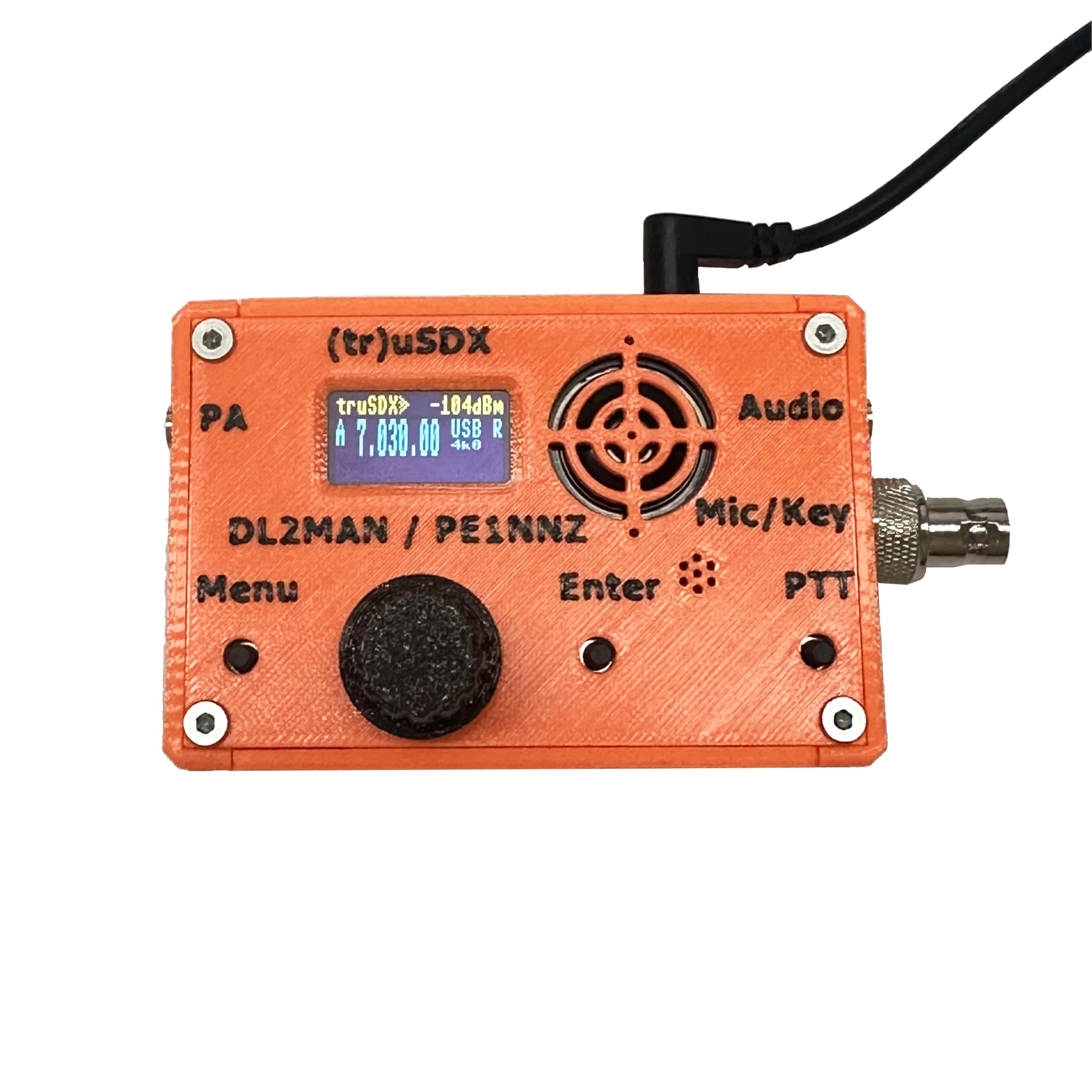
The Malahit tr usdx is a marvel of miniaturization: a 5-band QRP SDR transceiver covering 80, 60, 40, 30, and 20 meters, assembled in a 3D-printed orange case, weighing just 230 grams. It fits in a jacket pocket. The radio is built around a 1.2 version mainboard with a pre-programmed bootloader and firmware already loaded — you can pull it out of the box, connect a battery or USB power, and start tuning immediately. The built-in CW keyer and Morse decoder make it a life-changing tool for the CW operator who wants to work POTA or SOTA with zero setup time.
On transmit, output is around 4 watts, which is genuine QRP territory. The receiver is surprisingly sensitive and selective, with adjustable filters that are easy to configure through the menu. The spectrum display is available in the beta firmware version (which is recommended for most users), while the official firmware strips the display for a simpler interface. FT8 and WSPR are functional via USB connection to a computer, but users report instability on macOS with 12V power; a clean USB power source is essential for digital modes. The morse decoder and memory keyer are accurate and responsive.
The speaker audio is thin — earphones are virtually required for comfortable listening. Frequency calibration out of the box may be off by a few hundred Hertz, requiring a simple adjustment. The lack of 10 and 15 meter coverage is a notable gap, especially during solar maximum when those bands are open. The tr usdx is not a general-purpose radio; it is a specialist tool for the CW and digital-mode operator who prioritizes extreme portability over band coverage and power output. For that niche, nothing else at this price delivers this capability in this form factor.
Why it’s great
- Ultra-compact at 230g and pocket-sized for true portable operation
- Built-in CW keyer and Morse decoder work accurately out of the box
- Five-band HF coverage (80-20m) with a sensitive SDR receiver front end
Good to know
- Speaker audio is poor; earphones are required for comfortable listening
- No 10m or 15m band coverage — a significant gap during solar maximum
- FT8/WSPR operation requires stable USB power and can be unstable on macOS
8. Baofeng UV-5R 8W 2-Pack
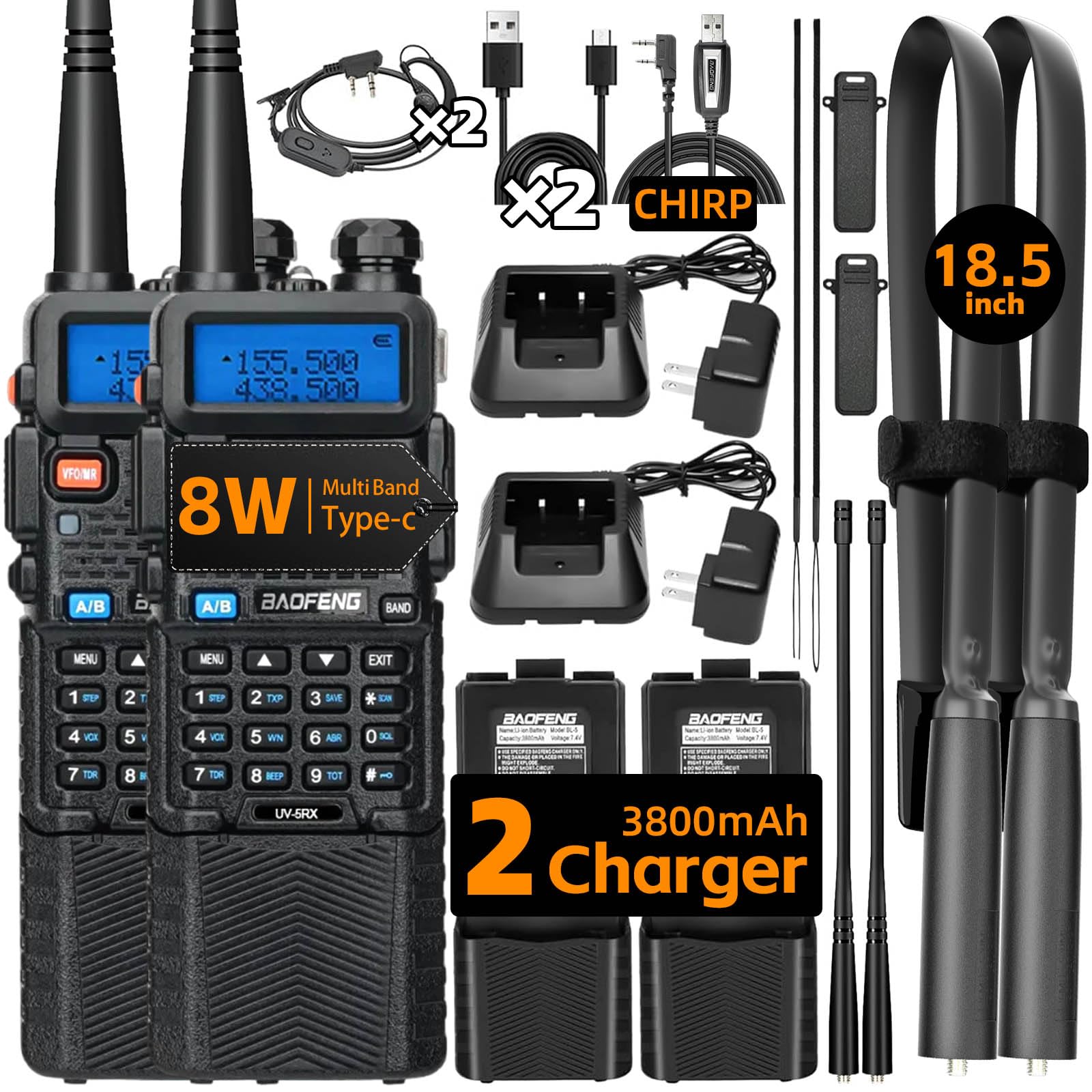
The Baofeng UV-5R is the most well-known amateur radio handheld in the world, and this 2-pack kit upgrades the formula with an 8-watt power variant, a 3800mAh battery, a programming cable, tactical antenna, and noise-isolating earpieces. The extended battery provides up to five days of standby time, which makes this kit a legitimate option for emergency preparedness and group camping trips where charging may be infrequent. True dual-band, dual-display operation on VHF (136-174 MHz) and UHF (400-480 MHz) covers 2-meter and 70cm amateur bands as well as GMRS frequencies when used with the appropriate license.
The included programming cable and USB charging cable are genuine quality-of-life upgrades. You can program all 128 channels via CHIRP in minutes, and the USB-C charging on the extended battery works with power banks, car adapters, or laptops — no need to carry the drop-in charger. The tactical antenna improves signal strength noticeably compared to the standard rubber duck, but it is also longer and less convenient for pocket carry. The bundle includes two radios, two earpieces, two antennas, two batteries, and two charge bases, making it truly ready for a pair of operators.
The UV-5R has known limitations: the receiver can be prone to front-end overload in strong RF environments, creating phantom signals on nearby frequencies. The user interface is dense with abbreviations, and the manual is not helpful. Some versions of this kit have had GMRS frequencies locked out, despite the advertising suggesting otherwise. For the licensed amateur operator who needs a reliable, inexpensive pair of radios for simplex communications within a few miles, this kit delivers unbeatable value. Unlicensed users should note that transmitting on amateur frequencies without a license is illegal.
Why it’s great
- Two complete radios with 3800mAh batteries, programming cable, and earpieces included
- USB-C charging on the battery pack allows in-field charging from power banks
- 8W transmit power provides better range than the standard 5W UV-5R models
Good to know
- Receiver can suffer from front-end overload and intermod in strong RF environments
- GMRS frequency availability varies by unit revision despite marketing claims
- Transmitting on amateur frequencies requires a valid FCC license
9. QYT KT-8900R 25W Tri-Band Mobile

The QYT KT-8900R is the smallest and lightest mobile radio in this guide at under one pound, making it an ideal candidate for a go-kit, a small vehicle, or even a base station where desk space is tight. It offers tri-band coverage on 2 meters, 1.25 meters, and 70 centimeters, which is a genuine advantage for operators who want access to the 220 MHz band without buying a separate radio. The 25-watt output on VHF and 20 watts on UHF is sufficient for local repeater work and simplex communication within a few miles.
The radio includes CTCSS, DCS, 5-tone, and 2-tone signaling, along with DTMF encoding for remote control applications. The included programming cable works with CHIRP on Windows, and the software is free — a plug-and-play solution if you follow the instructions. The dual-watch function lets you monitor two frequencies, and the dual-standby mode keeps both channels active. The volume knob is highly sensitive, transitioning from silent to loud with a small rotation, which some users find convenient and others find annoying.
Build quality is where the budget price shows. The included mounting bracket screws may not fit properly, and the front panel programming can be frustrating because the lockout channel function is not intuitive. One significant complaint from users is that the radio is actually dual-band and not tri-band, despite the labeling — the 1.25-meter band reception is present but transmit capability on that band is questionable with some units. The FCC certification is legitimate, which is more than some competitors can claim. For the price, the KT-8900R is a functional, compact mobile radio that gets you on three bands with minimal investment, provided you accept the compromises in build consistency.
Why it’s great
- Extremely compact at 3.86 x 1.38 x 4.65 inches and under one pound
- Tri-band coverage includes 1.25 meters (220 MHz) in addition to 2m and 70cm
- CHIRP-compatible programming cable included for easy computer setup
Good to know
- Build quality inconsistencies with bracket screws and fit of components
- Tri-band claim is disputed — some units do not transmit reliably on 1.25 meters
- Volume knob is highly sensitive and front-panel programming is unintuitive
FAQ
Do I need an FCC license to use any of these radios on transmit?
What is the difference between 5W QRP and 50W mobile power in real-world use?
Which kit is best for digital modes like FT8 and JS8Call?
Can I use a mobile radio as a base station at home?
What is Chirp programming and why does it matter?
Final Thoughts: The Verdict
For most users, the best amateur radio kits winner is the Xiegu G90 because its 20W output, built-in ATU, and 48kHz spectrum display give you the most versatile HF experience without jumping to 100W class pricing. If you want a high-power VHF/UHF mobile with a detachable faceplate, grab the Radioddity DB50. And for the ultra-portable CW or digital mode operator who needs to fit everything in a jacket pocket, nothing beats the Malahit tr usdx transceiver.