
Mounting a camera to your helmet changes every ride, climb, or shift into a documented first-person narrative—but the wrong camera leaves you with shaky footage, a dead battery before the action starts, or a rig that catches the wind like a sail. The difference between a crisp, stable record of your perspective and a garbled mess often comes down to one sensor, one mount compatibility, and one stabilization algorithm.
I’m Min — the co-founder and writer behind Gadgets Feed. After spending dozens of hours cross-referencing sensor sizes, battery endurance curves, mounting systems, waterproofing ratings, and real-world stabilization performance across the current helmet-mountable action camera market, I’ve broken down exactly which cameras handle the specific demands of head-mounted recording and which specs actually matter.
Whether you ride a motorcycle, race downhill on two wheels, or document emergency calls on the fireground, the best camera for helmet needs to balance secure mounting, reliable battery life, and footage that your audience can actually watch without getting dizzy.
How To Choose The Best Camera For Helmet
Not every action camera works well on a helmet. The physics of head-mounted recording — rapid head movement, constant vibration, limited space, and exposure to weather — demands specific engineering choices that general-purpose cameras skip. Here are the factors that separate a useful helmet cam from a frustrating one.
Stabilization: The Difference Between Watchable and Nauseating
Helmet footage inherits every head turn, every road bump, every footstep vibration. Without aggressive electronic image stabilization (EIS), the result is unwatchable. Look for cameras with at least RockSteady-grade stabilization or 360-degree Horizon Lock, which keeps the horizon level regardless of how much you rotate your head. Cameras relying solely on optical stabilization will struggle with the high-frequency vibrations typical of motorcycle handlebars or bicycle helmets.
Mount Compatibility and Secure Attachment
Fire helmets, motorcycle helmets, bicycle helmets, and hard hats all use different brim shapes and shell curves. A camera that ships with a specific brim mount (like Fire Cam’s US-style fire helmet mount) may not attach securely to a sleek downhill MTB full-face. Look for packages that include curved adhesive mounts, quick-release adapter mounts, and the option to purchase third-party chin mounts or side mounts. Weight also matters — a camera over 150 grams can cause neck fatigue on long sessions and may peel adhesive mounts off during high-speed wind exposure.
Battery Life at Recording Resolution
Manufacturers often quote battery life at 1080p with stabilization off. On a helmet, you will run stabilization and record at 4K or higher, which cuts that quoted time by 30-50%. A camera promising 4 hours at 1080p might only deliver 90 minutes of usable 4K HDR helmet footage. For long shifts or full-day rides, prioritize cameras with hot-swappable batteries or the Adventure/Enhanced combo bundles that include multiple batteries and a charging case.
Waterproofing and Weather Resistance
A helmet camera sits exposed to rain, sweat, hose-down cleaning (common in firefighting), and accidental submersion. IP68 rated cameras that can go to 10m without a housing are ideal. Cameras requiring a separate dive housing add bulk and weight that works against helmet mounting. For firefighting-specific use, look for cameras explicitly rated for heat and water resistance down to 33 feet — standard consumer action cameras may fail in those conditions.
Quick Comparison
On smaller screens, swipe sideways to see the full table.
| Model | Category | Best For | Key Spec | Amazon |
|---|---|---|---|---|
| DJI Osmo Action 5 Pro | Premium | All-day rides & low-light stability | 4 hrs battery at 4K, 1/1.3″ sensor | Amazon |
| DJI Osmo Action 6 | Premium | 8K detail & variable aperture control | Variable f/2.0–f/4.0, 8K video | Amazon |
| GoPro HERO13 Black | Premium | 5.3K detail & HB-Series lens compatibility | 5.3K60 video, 27MP photos | Amazon |
| Insta360 X4 | Premium | 360° capture & reframing flexibility | 8K 360 video, FlowState stabilization | Amazon |
| GoPro MAX2 | Premium | True 8K 360 reframing & replaceable lenses | True 8K spherical, 29MP 360 photos | Amazon |
| Fire Cam Onyx 4K | Mid-Range | Firefighting & structural helmet use | 4K@30fps, 5 hr battery | Amazon |
| Fire Cam MINI1080 | Budget-Friendly | Entry-level fire helmet documentation | 1080p @ 30fps, waterproof to 33ft | Amazon |
In‑Depth Reviews
1. DJI Osmo Action 5 Pro Adventure Combo

The DJI Osmo Action 5 Pro sets a new benchmark for helmet-mounted recording with a 1/1.3-inch sensor that pulls clean details out of low-light conditions where other action cameras produce noisy, muddy frames. The 2.4 µm pixel size and 13.5-stop dynamic range mean that whether you’re riding through a shaded forest tunnel at dusk or documenting a nighttime structure fire, the footage retains shadow detail without blowing out highlights. At 4K/120fps with the 360° HorizonSteady engaged, the camera compensates for every head rotation and vibration — the horizon stays locked regardless of how aggressively you move.
The Adventure Combo is the real differentiator for helmet use. It includes three 1950mAh Extreme Batteries and a multifunctional battery case that extends total recording time well past 10 hours in the field. Each battery delivers up to 4 hours of mixed-resolution recording, tested at 4K. The IP68 rating allows submersion to 20 meters without any housing, so rain, splash, and hose-down cleaning are non-issues. Dual OLED touchscreens — one front-facing — make framing easier when the camera is mounted to a chin bar and you need to confirm the shot angle without twisting your neck.
On the audio front, the Action 5 Pro supports direct wireless connection to the DJI Mic 2 transmitter without needing a separate receiver, which is huge for moto vloggers who want wind-resistant voice capture without cable clutter. The color temperature sensor automatically adjusts white balance as you transition between sunlight and shade, preserving natural skin tones underwater and on land alike. Overheating is notably absent even during extended 4K recording sessions — a common failure point in older GoPro generations.
Why it’s great
- Outstanding low-light performance with 1/1.3″ sensor and 13.5-stop dynamic range
- 4-hour battery life per cell at 4K with cold-resistant operation down to -4°F
- IP68 waterproof to 20m without a housing — ideal for exposed helmet mounting
- HorizonSteady eliminates roll-axis shake for stable first-person POV footage
Good to know
- Adventure Combo price point sits at the premium end of the mid-range spectrum
- Extension rod in the bundle lacks a remote shutter button — requires Mimo app for remote control
2. DJI Osmo Action 6 Essential Combo
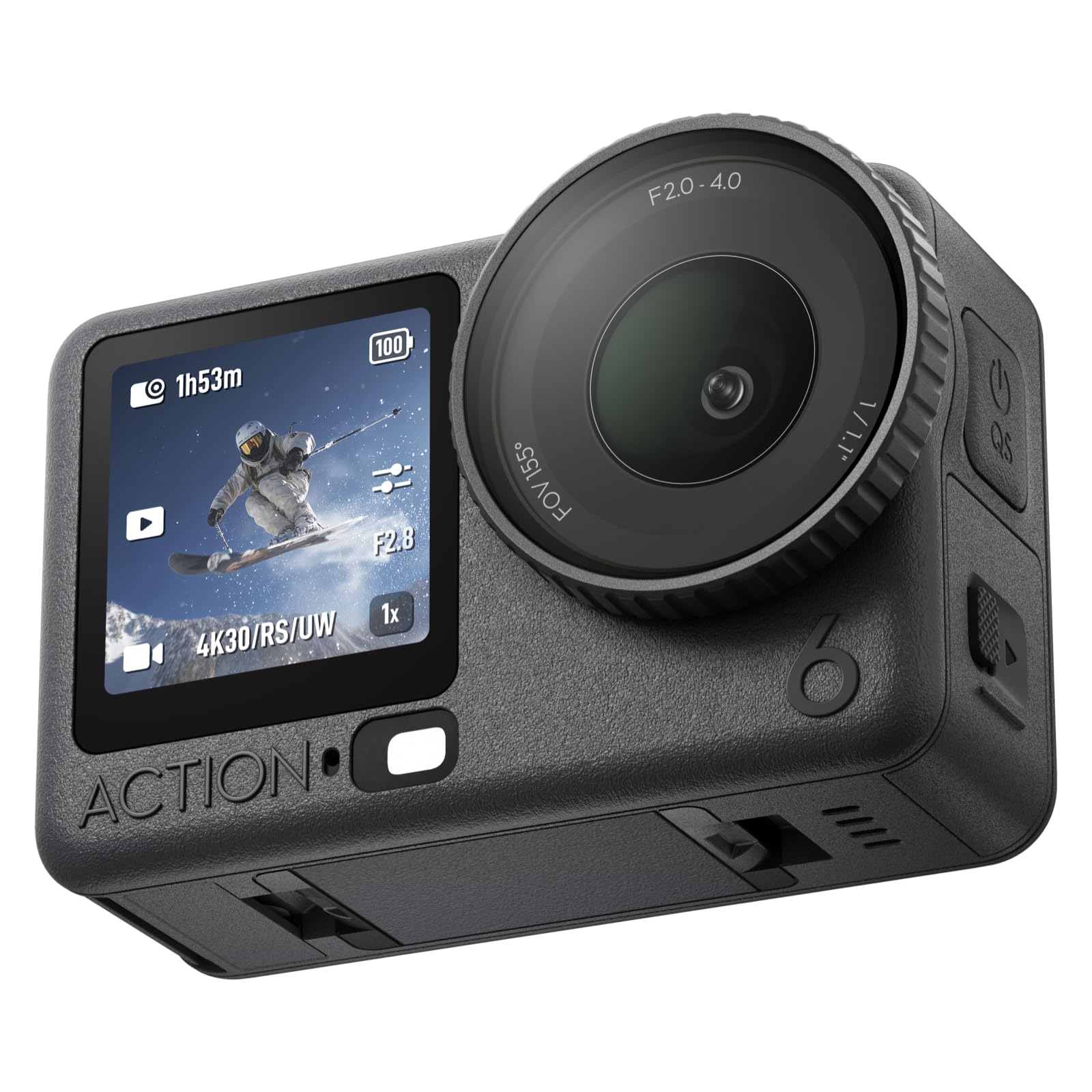
The DJI Osmo Action 6 pushes resolution to 8K and introduces a variable aperture (f/2.0 to f/4.0) — a first for the action camera segment — giving helmet shooters direct control over depth of field and exposure without relying entirely on electronic ND filters. The 1/1.1-inch square sensor captures 38MP stills and 8K video that retains enough resolution to crop into 4K social media formats while keeping the original helmet-wide perspective intact. RockSteady 3.0 stabilization handles the harsh vibrations of motorcycle fairings and off-road bicycle handlebars with near-gimbal smoothness.
The 4-hour battery life matches the Action 5 Pro, but the Action 6 adds 50GB of built-in storage, which is a game-changer for helmet use when swapping SD cards mid-ride is impractical. The gesture and voice control features let you start or stop recording without removing gloves — essential for firefighters, motocross riders, and anyone who can’t fumble with tiny buttons while focused on the task ahead. Dual microphone connectivity via DJI Mic 2 transmitters enables two-person interview audio without a receiver, which works for tandem ride documentation or training scenario debriefing.
Waterproofing to 20m without a case means the Action 6 survives direct pressure-washing after mud or saltwater exposure. The USB-C PD cable included in the box supports rapid charging between sessions. The Essential Combo skips the curved adhesive base to stay compact, but you’ll want to pair it with a third-party chin mount for full-face helmets — the Quick-Release Adapter Mount is included for that purpose. Wireless cloud upload gives peace of mind that your footage backs up before you even unpack your gear.
Why it’s great
- Variable aperture f/2.0–f/4.0 gives exposure control no other action camera offers
- 50GB built-in storage eliminates SD card swapping on long helmet sessions
- RockSteady 3.0 handles high-frequency vibration better than any previous generation
- Gesture/voice control works through heavy gloves for hands-free operation
Good to know
- Lacks GPS and accelerometer telemetry found in older Garmin action cameras
- Variable aperture is electronic — does not physically close the iris like a traditional camera lens
3. GoPro HERO13 Black

The GoPro HERO13 Black delivers best-in-class 5.3K60 video with 91% more resolution than 4K and 665% more than 1080p, which gives helmet editors enormous cropping room for reframing shots in post without visible quality loss. The HB-Series Lens system with auto-detection is what separates this from earlier GoPros — attach the Ultra Wide Lens Mod for the widest possible first-person perspective, or the Macro Lens Mod for up-close equipment inspection footage. The camera detects the attached lens and adjusts settings automatically, saving setup time between shooting scenarios.
HyperSmooth stabilization has reached the point where helmet footage shot on a bumpy trail or gravel road looks gimbal-mounted. The Burst Slo-Mo mode captures action slowed to 13x normal speed at lower resolutions — useful for analyzing technique or capturing dramatic crash footage frame by frame. Waterproof to 33 feet without a housing. The Enduro battery delivers about 79 minutes of continuous recording, which aligns well with a typical ride length but falls short of the 4-hour DJI competitors.
Low-light performance is solid but not class-leading — the smaller sensor shows more grain in shadow areas compared to the DJI Action 5 Pro’s 1/1.3-inch chip. The GoPro Quik app provides straightforward editing and cloud backup, but the HERO13 Black lacks the direct wireless microphone pairing that DJI offers; you will need a separate adapter for external mics. The Curved Adhesive Mount included in the box works for dome-style bicycle helmets but may need a separate chin mount for full-face motorcycle helmets.
Why it’s great
- 5.3K60 video provides massive reframing headroom for post-production cropping
- HB-Series Lens system with auto-detection adapts to ultra-wide or macro shooting instantly
- Burst Slo-Mo up to 13x normal speed catches split-second helmet POV details
- HyperSmooth stabilization makes aggressive head movement look gimbal-smooth
Good to know
- Battery life (~79 min at 5.3K) is significantly shorter than DJI competitors
- No direct wireless microphone pairing — external mic requires a separate adapter
4. Insta360 X4

The Insta360 X4 solves the fundamental problem of helmet POV shooting — you never have to aim. The 8K 360 capture records everything around you in a spherical video, and you reframe the shot in post using the Insta360 app or desktop software. The Invisible Selfie Stick effect produces drone-like third-person footage from a helmet mount, which is impossible with any traditional action camera.
FlowState Stabilization combined with 360° Horizon Lock keeps the horizon perfectly level through any combination of head rotation and vibration. The battery lasts 2.25 hours in 8K 360 mode, but you can drop to 5.7K60fps to extend that window. The removable lens guards are a practical upgrade — a scratched lens on a 360 camera ruins half the spherical capture, and being able to swap guards in the field extends the camera’s usable life significantly. Waterproof to 33 feet without a dive case, or 164 feet with the Invisible Dive Case.
The downside for helmet purists is that 360 footage requires post-production reframing — there is no instant “record and share” workflow unless you use the single-lens 4K wide-angle mode. The camera is also slightly larger and heavier than a standard action camera, which can affect mounting stability on lightweight bicycle helmets. The AI-powered app is excellent for automatic reframing but demands phone processing power that can lead to overheating during long export sessions. For creators who value flexibility over instant output, however, the X4 is unmatched.
Why it’s great
- 8K 360 capture means you never need to aim the camera — reframe any angle in post
- Invisible Selfie Stick effect delivers drone-like third-person shots from a helmet mount
- Removable lens guards protect the optical glass from scratches during rough use
- FlowState + Horizon Lock keeps level through any head rotation or vibration
Good to know
- 360 footage requires post-production reframing — no instant share workflow in spherical mode
- Heavier and bulkier than standard action cameras; may require sturdier adhesive mounts
5. GoPro MAX2
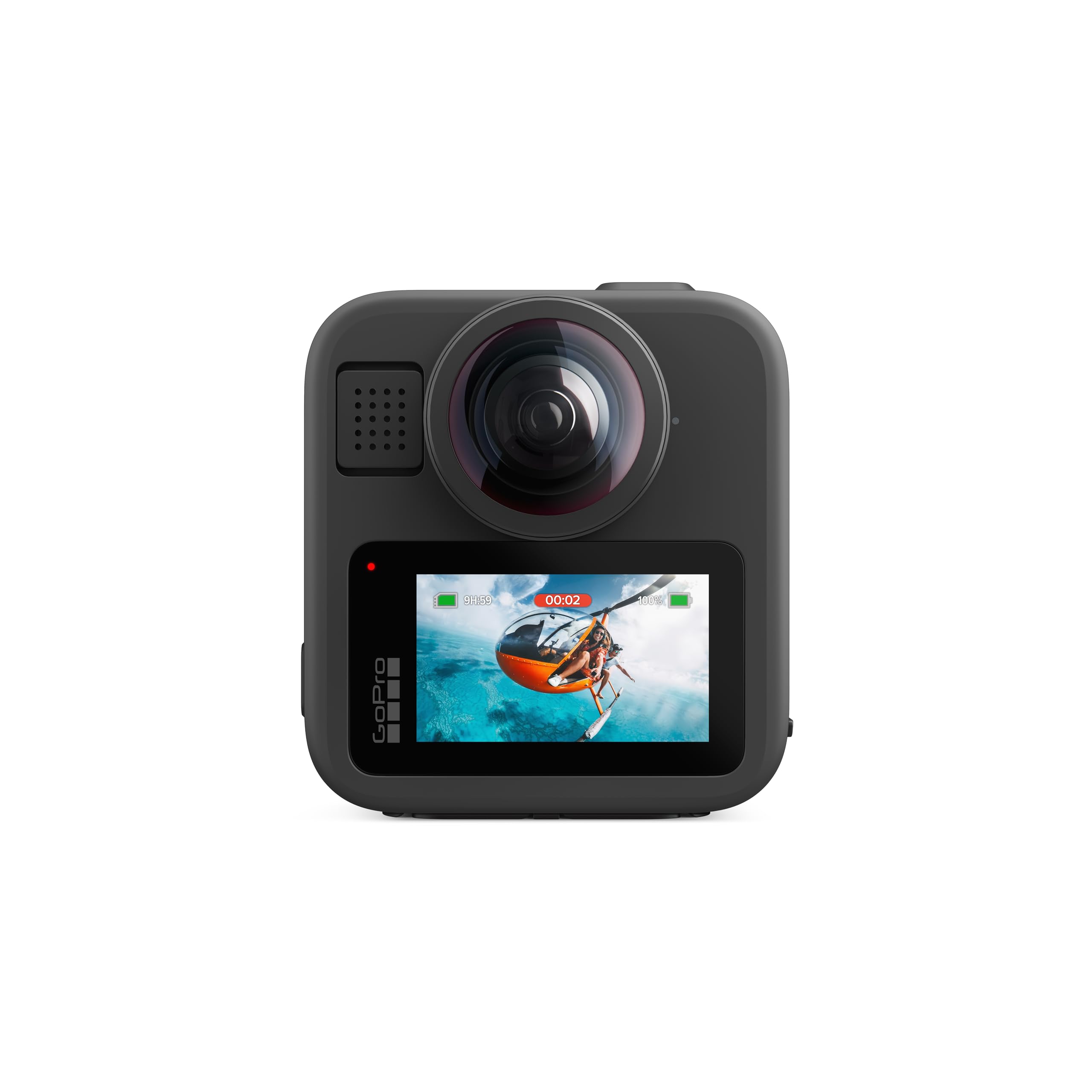
GoPro MAX2 delivers True 8K spherical video with 21% more resolution than the previous generation of 360 cameras, which means reframed 4K clips retain crisp texture detail rather than looking like upscaled 1080p. The replaceable glass lenses solve the single biggest point of failure for helmet-mounted 360 cameras — a scratch on the lens used to mean replacing the entire camera body, but now you swap just the damaged lens cap and continue shooting. The 1/4-20 mounting threads at the bottom give you compatibility with any standard tripod or extension pole, and the curved adhesive mount included in the box attaches securely to dome-style helmets and GoPro mounts.
The 6-microphone array captures ambisonic audio that shifts perspective with the viewer’s reframing — if you pan to the left side of the spherical video, the sound follows. Wind reduction is effective, especially when mounted on a motorcycle helmet at highway speeds. HyperSmooth horizon leveling locks the horizon during 360° spin shots, making creative Bullet Time-style captures around the helmet completely stable. The 1960mAh Enduro battery lasts roughly 50-60 minutes of 8K 360 recording, which is shorter than the Insta360 X4 but acceptable for a GoPro.
Heat management is the MAX2’s weak spot — some users report overheating during extended 8K recording in warm conditions, forcing a switch to 5.7K or lower resolutions to keep the camera running. The GoPro Quik app’s reframing tools are polished but require local storage for large spherical files — the cloud storage subscription adds a recurring cost. The 29MP 360 photos have excellent dynamic range and stitch seamlessly with no visible exposure step at the seam line, making them useful for virtual walkthroughs of training scenarios or event documentation.
Why it’s great
- True 8K spherical with 21% more resolution than previous 360 camera generations
- Replaceable glass lenses prevent a single scratch from destroying the entire camera
- 6-microphone ambisonic audio shifts perspective with the reframed view
- 1/4-20 threads and standard GoPro mount compatibility for universal helmet attachment
Good to know
- Heat management can force switching to lower resolution in warm ambient conditions
- Battery life (~50-60 min at 8K 360) is shorter than the Insta360 X4
6. Fire Cam Onyx 4K Helmet Camera
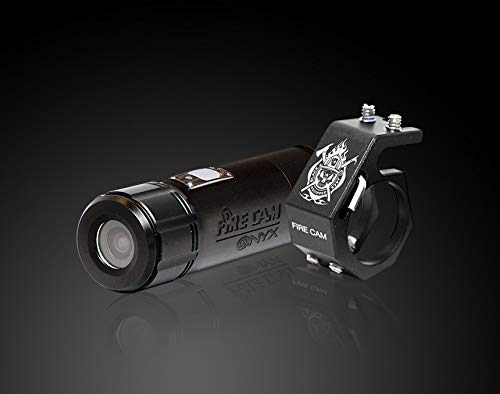
The Fire Cam Onyx 4K was built from the ground up for structural firefighting helmets — not adapted from a consumer action camera. It records 4K at 30fps with a wide-angle view that captures the full incident scene, and the low-light performance is specifically tuned for dark, smoke-filled environments where standard action cameras produce unusable black frames. The 5-hour battery life (measured at 1080p) means it can survive an entire shift without needing a recharge, and the included Fire Cam Mount clips directly to US-style fire helmets or any brim-style helmet without adhesive.
The button layout is designed for gloved operation — large tactile buttons that you can press through structural fire gloves without fumbling. The camera records in MP4, MOV, or AVI format and supports time/date stamp, time lapse, auto power-off, and auto power-on record settings that firefighters rely on for incident documentation. The 32GB U1 micro SD card included in the box provides immediate storage for multiple call recordings at 4K resolution. The waterproofing relies on O-rings that must be properly installed, and reviewers note that the button is still difficult to activate through the thickest structural fire gloves.
At 4K/30fps, the field of view captures enough context for training review and legal documentation without the file size explosion of 5.3K or 8K footage. The 8.3MP still photo mode grabs sharp incident photos for reports. The Onyx uses Program (P) exposure control, which automates most settings — ideal for users who cannot adjust camera parameters while managing an emergency scene. The included pocket clip provides secondary storage when the camera is not mounted. This is not a camera for cinematic vlogs — it is a durable, single-purpose tool for the fire service.
Why it’s great
- 5-hour battery life covers an entire shift without recharging
- Designed specifically for US-style fire helmets with a dedicated brim mount
- Low-light tuning delivers usable footage in smoke-filled environments
- Large tactile buttons operate through structural fire gloves
Good to know
- O-ring waterproof seal requires careful installation — not as forgiving as IP68-rated consumer cameras
- Button still difficult to press through the heaviest structural fire gloves
7. Fire Cam MINI1080 Helmet Camera

The Fire Cam MINI1080 is the entry point for helmet-mounted documentation, designed specifically for firefighting and industrial helmet use at 1080p/30fps or 720p/60fps. The compact body and included BlackJack Fire Cam Mount fit US-style fire helmets and brim-style helmets without needing third-party adapters. The camera is rated for underwater use down to 33 feet and handles the heat and moisture exposure typical of the fireground environment — specifications that consumer action cameras do not guarantee.
Video quality at 1080p is serviceable for training review, incident documentation, and evidence purposes. The 720p/60fps mode is useful for capturing motion detail in vehicle extrications or rapid-fire training drills. Adjustable settings include time/date stamp, auto power-off, audio record, loop record, and video quality selection. The 32GB micro SD card with adapter is included, giving you roughly two hours of 1080p recording out of the box. The battery life is limited to approximately 1 hour per charge, so an external charger is recommended for full-shift coverage.
Customer support from Fire Cam responds quickly — multiple reviewers report that a reformat of the SD card resolved camera issues within minutes after contacting support. The microphone audio can be quiet, making it harder to hear radio traffic or conversation playback. The WiFi version (reviewed as less reliable) should be avoided; the standard version is more stable. At its price point, the MINI1080 delivers essential helmet-camera functionality without the 4K or stabilization features of premium options, making it a practical choice for budget-constrained departments or volunteer firefighters.
Why it’s great
- Professional-grade heat and water resistance designed for fireground use, not adapted from consumer gear
- Includes 32GB micro SD card and dedicated fire helmet mount — ready out of the box
- 720p/60fps mode captures fast-moving incident detail without blur
- Responsive manufacturer customer support resolves common issues quickly
Good to know
- 1-hour battery life requires spare batteries or external charger for full-shift coverage
- Microphone audio is quiet — radio traffic and speech are harder to hear on playback
FAQ
Can I use any action camera on a motorcycle helmet?
How does 360 recording benefit helmet POV footage?
What mount is best for a full-face helmet?
Is battery life listed on the box accurate for helmet recording?
Final Thoughts: The Verdict
For most users, the best camera for helmet winner is the DJI Osmo Action 5 Pro Adventure Combo because it combines class-leading low-light sensor performance, the longest practical battery life with the three-battery Adventure combo, and 360° HorizonSteady stabilization that makes aggressive head movement look smooth. If you want to capture every angle and reframe after the fact without ever aiming the lens, grab the Insta360 X4. And for structural firefighting use where durability, gloved operation, and a dedicated brim mount are non-negotiable, nothing beats the Fire Cam Onyx 4K Helmet Camera.