
Our readers keep the lights on and my morning glass full of iced black tea. As an Amazon Associate, I earn from qualifying purchases.
Specs are compiled from manufacturer listings and verified buyer reviews and can change over time — please confirm the key details on the product page before buying.
Your PC’s audio jack often adds a quiet hiss and saps the life from your music or games. An amp for pc cleans that noise and boosts the signal, so your headphones or speakers sound punchy and clear. The hard part is picking one from the wall of specs — power in milliwatts, impedance in ohms, balanced versus single-ended. This guide cuts through that to match a real amp to your real problem: a constant hiss, low volume, or muddy detail.
I’m Min — the founder and writer behind Gadgets Feed. This guide is built by comparing the manufacturers’ published specifications and the patterns across verified customer reviews, so you get each pick’s real strengths and trade-offs instead of marketing spin.
This roundup covers the best options from budget-friendly to premium, each judged on clean power, connectivity, and real-world usability. You will find a portable dongle for high-resolution music, a desktop unit to drive power-hungry headphones, and everything in between.
Quick Picks
- FiiO K7 Desktop DAC and Amplifier — Top Performer
- FiiO K11 DAC and Headphone Amplifier — Compact Power
- Fosi Audio MC331 Tube Integrated Amplifier with DAC — Tube Stylist
- MOONDROP Dawn PRO 2 Decoder Headphone Amplifier — Pocket Hi-Fi
- Douk Audio U3 Headphone Amps, Mini Hi-Fi Amplifier — Class A Value
- Syba Sonic 24bit 96KHz USB DAC Stereo Headphone Amplifier SD-DAC63116 — Budget All-Rounder
- Joengoep AK50 Home Audio Amplifier, 400W 2.0 Channel Stereo Receiver — Budget Speaker Power
How To Choose The Best Amp For PC
You do not need to be an audiophile to buy the right amp. Most of the confusion comes from three things: output power (measured in milliwatts or watts), the connection type to your PC, and if you need a built-in DAC (digital-to-analog converter).
Output Power and Headphone Impedance
The most important spec is how much power the amp delivers and whether it matches your headphones. High-impedance headphones (like 150-ohm Sennheiser HD660s or 300-ohm Beyerdynamic DT880) need more voltage to sound loud and clear. Look for an amp with an output power measured in milliwatts (mW) at a given impedance. For most desktop use, 200mW or more into 32 ohms is enough; very powerful models push over 1000mW.
DAC or No DAC?
A DAC (digital-to-analog converter) is the chip that turns the 1s and 0s from your PC into an analog audio signal. Your computer has a cheap one built-in that often introduces noise. A DAC/amp combo replaces that whole chain with a cleaner path — one USB cable from your PC to the unit, and your headphones plug directly into it. If you already have a DAC, a standalone amp (without a DAC) is fine, but for most PC users a combo is simpler.
Connections and Features
Check what inputs the amp accepts. USB is the standard for PC. Some amps also add optical or coaxial connections for other source devices. A 3.5mm headphone jack is fine, but a 6.35mm (1/4-inch) jack is more durable. A 4.4mm balanced output can deliver more power and better noise rejection. Balanced output means you are using a cable wired with separate ground paths for left and right channels, which cancels interference — useful for long cable runs or sensitive headphones.
Quick Comparison
On smaller screens, swipe sideways to see the full table.
| Model | Best For | Output Power | Inputs | Headphone Output | Amazon |
|---|---|---|---|---|---|
| FiiO K7 | High-power desktop balanced setup | 2000mW (balanced) | USB, Optical, Coaxial, AUX | 4.4mm, 6.35mm, 3.5mm | $219.99Amazon |
| FiiO K11 | Compact all-in-one with display | 1400mW | USB, Optical, Coaxial, RCA | 6.35mm, 4.4mm | $142.99Amazon |
| Fosi Audio MC331 | Desktop speakers + headphones with tube sound | 105W x2 @ 4Ω | Bluetooth, USB, Optical, Coax, RCA | 3.5mm | $131.99Amazon |
| MOONDROP Dawn PRO 2 | Portable DAC/amp for IEMs on the go | 124mW (per channel) | USB-C | 3.5mm, 4.4mm | $59.99Amazon |
| Douk Audio U3 | Budget Class A headphone amp for high-impedance cans | 1300mW | RCA | 6.35mm, 3.5mm | $36.99Amazon |
| Joengoep AK50 | Budget home stereo amp with Bluetooth + FM | 400W (peak) | Bluetooth, USB, SD, AUX, FM, MIC | Speaker terminals | $35.99$39.99Limited time dealAmazon |
| Syba Sonic DAC SD-DAC63116 | Budget USB DAC/amp with mic passthrough | — | USB | 6.35mm, 3.5mm | $33.98Amazon |
In‑Depth Reviews
1. FiiO K7 Desktop DAC and Amplifier

Dual AK4493SEQ chips and THX AAA amps make this the endgame starter for most PC listeners.
Plugging your PC into the FiiO K7 gives you a clean slate free from computer noise. It uses two AKM AK4493SEQ DAC chips (the latest flagship digital-to-analog converters) and two THX AAA 788+ amplifier modules — the same amplification found in FiiO’s higher-end gear. In practice, that means a dead-quiet background so you hear only your music, not the faint electrical hum your PC usually adds. The K7 delivers 2000mW of stable output power through its 4.4mm balanced output — enough to drive nearly any headphone, including full-size high-impedance models (300-ohm and above). Two gain levels and three output modes give you fine control over volume matching, and the RGB indicator light changes color to show the sampling rate of whatever you are listening to.
Buyers report that the K7 is a mild but audible improvement over a good soundcard, and they praise the dedicated digital volume knob with its intentional mute zone — a safety feature that keeps you from accidentally blasting your ears on startup. Owners mention that balanced connections through the 4.4mm or 4-pin XLR really open up the soundstage (the spatial sense of where instruments are placed). The K7 supports USB, optical, coaxial, and AUX inputs, so you can connect your PC, game console, and CD player all at once and switch between them.
What makes it a top pick
- Massive 2000mW output power via balanced connection — drives anything short of electrostats (very high-impedance headphones)
- Dual AK4493SEQ DAC chips for clean, detailed sound
- Multiple inputs (USB, optical, coaxial, AUX) and outputs (4.4mm, 6.35mm, 3.5mm)
- Excellent build with an aluminum alloy chassis and smooth volume knob
One trade-off to consider
- No Bluetooth — wired-only connectivity
- Some users found the iFi Zen DAC V2 gave better vocal clarity and fuller bass at a similar price point
Best for PC users who want one powerful, clean desktop unit: If you have a pair of high-end headphones and want the cleanest possible signal path from your computer, the FiiO K7 is the balance for price versus performance.
Look elsewhere if: You need Bluetooth streaming or prefer a separate DAC — the FiiO K9 ESS is a meaningful upgrade in soundstage and dynamics if your budget stretches further.
2. FiiO K11 DAC and Headphone Amplifier

A slim desktop DAC/amp with a crisp VA screen and enough power for almost any headphone.
The FiiO K11 is smaller than it looks in photos — just over 9 inches wide and 2.3 inches tall — so it slips easily into a crowded desk. It delivers up to 1400mW of power, which is enough to handle headphones up to 350 ohms (impedance, or resistance to electrical flow) without breaking a sweat. The aluminum alloy body feels solid, and the 1.3-inch VA display (a type of LCD with wide viewing angles) shows sampling rate, volume level, gain setting, and output mode at a glance. That display is a genuine convenience: you can see whether you are listening to a standard 44.1kHz CD rip or a 384kHz/24-bit high-resolution file without guessing. The K11 supports USB, optical, and coaxial inputs, plus it has both 6.35mm and 4.4mm balanced headphone outputs, RCA line-out, and a coaxial output for feeding another amplifier.
Reviewers report that the K11 delivers clean, neutral, and detailed sound — a few noted that the built-in digital filters can sound a little compressed, with Filter 4 being the best setting for natural sound. One reviewer noted that adding a balanced cable to the K11 improved detail retrieval noticeably, bringing it closer to higher-priced units. The USB-C input powers the unit and handles data, so you only need a single cable to your computer.
Standout strengths
- 1400mW output drives demanding headphones up to 350 ohms
- High-contrast VA display clearly shows audio status
- Compact footprint fits any desktop
- Solid all-metal build with smooth volume knob
Things to weigh
- Digital filters can sound slightly compressed — switching to Filter 4 helps
- Lacks Bluetooth connectivity
- No remote control included
Pick this if: You want a clean, compact, all-in-one DAC/amp for your PC with a useful status display and balanced output — especially if your headphones are in the 32-350 ohm range.
Pass it by if: You need absolute neutrality or plan to use very high-impedance headphones above 350 ohms — the Topping DX3 Pro+ or the larger FiiO K7 will offer more headroom.
3. Fosi Audio MC331 Tube Integrated Amplifier with DAC
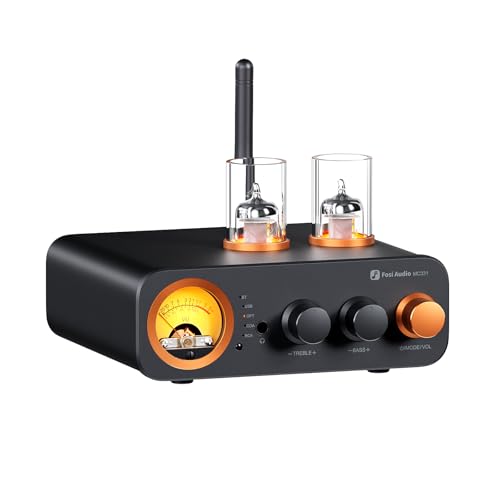
A tube amp with a retro VU meter that powers both bookshelf speakers and your headphones from one box.
This is a different breed of PC amp. The Fosi Audio MC331 is a fully integrated unit that combines a DAC (digital-to-analog converter), a preamp, a speaker amplifier, and a headphone amplifier in one compact chassis. It puts out 105 watts per channel into 4-ohm speakers, so it can drive a pair of bookshelf speakers in your office or living room at real listening levels — not just near-field desktop volumes. The visual centerpiece is the vintage-style VU meter (a meter that shows signal level) and two 5725W vacuum tubes that glow amber when powered on. The tubes add a subtle warmth and softness to the sound, particularly noticeable after a 15-20 second warm-up period. You get five input options: Bluetooth, USB-C, optical, coaxial, and RCA, so you can keep your PC, phone, CD player, and turntable (with built-in phono preamp) all connected and switch between them with the included remote.
Buyers are split on the remote control — they love having it, but note it has a 2-second latency and needs direct line-of-sight to work, which can be annoying from a listening chair. One buyer mentioned that the included vacuum tubes failed after three days, requiring a replacement set. The speaker posts only accept rigid banana plugs or very thin bare wire, so thicker cables can be a hassle. That said, users who swapped tubes report the MC331 sounds “incredible” — with new tubes it fills a 900-square-foot room with ease. The headphone output automatically disables the speakers when you plug in, which is convenient for late-night listening.
Why this one stands out
- All-in-one: DAC, speaker amp, headphone amp in a single unit
- Powerful 105W x2 @ 4Ω for real bookshelf speakers
- Replaceable vacuum tubes let you customize the sound signature
- Multiple inputs (Bluetooth, USB-C, optical, coaxial, RCA)
Honest drawbacks
- Remote control has noticeable 2-second delay and requires direct line-of-sight
- Included vacuum tubes may fail early — budget for replacements
- Won’t accept third-party higher-power power supplies; stuck with included 24V adapter
Ideal for: Anyone who wants a single desktop amp for both powered speakers and headphones, with the warm character and visual appeal of tube audio.
skip it if: You want a pure headphone amp — the tube failure rate is a known issue, and you would be paying for speaker features you do not need.
4. MOONDROP Dawn PRO 2 Decoder Headphone Amplifier
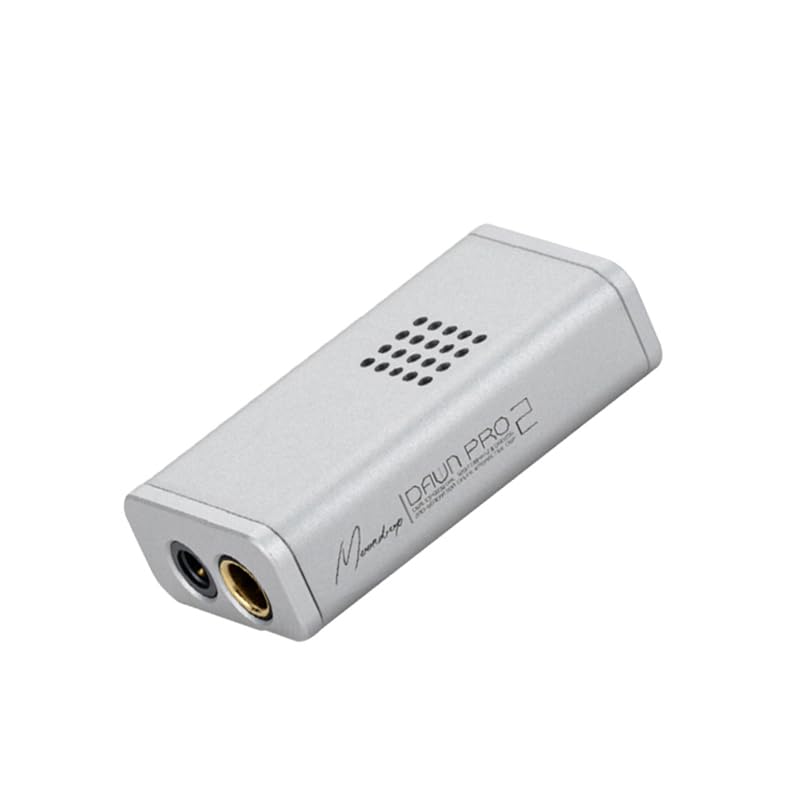
A thumb-drive-sized DAC/amp with dual flagship chips and a customizable EQ via your phone.
The Dawn PRO 2 is tiny — barely larger than a USB stick — but packs two Cirrus Logic flagship CS43198 DAC chips (digital-to-analog converters), one for each channel, to keep stereo separation clean and distortion low. It delivers 124mW per channel through its 4.4mm balanced output and 4Vrms output voltage. That is enough power for most in-ear monitors (IEMs) and many full-sized headphones, though you will want a desktop amp for high-impedance planars (headphones with a flat magnetic driver). The aluminum alloy body helps dissipate heat, and the vents are deliberately placed above the hot chips — a smart touch Moondrop borrowed from desktop HiFi gear. What really sets this DAC/amp apart is the 100-level lossless volume control that you manage independently from your PC or phone, plus the ability to customize a parametric equalizer through the Moondrop app with community-provided headphone frequency response data.
One owner reported that the 4.4mm balanced output is finicky — plugging the cable in all the way made audio quiet, and pulling it out slightly made the connection work properly, suggesting a tight tolerance in the jack. Buyers overwhelmingly praise the sound clarity improvement over any built-in audio, including the ROG Ally X headphone jack. The Dawn PRO 2 has a flat frequency response with a slight bass boost and clear treble, though a few reviewers found the treble a little “digital” or fatiguing on some IEMs. The app’s EQ settings reset whenever you unplug the device, which is annoying but not a deal-breaker for portable use.
Best for on-the-go PC use: If you switch between your laptop, phone, and desktop and want one DAC/amp that fits in your coin pocket, the Dawn PRO 2 delivers flagship-level DAC tech in a truly portable package.
Not for: Desktop use as a permanent station — it lacks the power and connectivity of a full-size unit, and the 4.4mm connection can be temperamental.
5. Douk Audio U3 Headphone Amps, Mini Hi-Fi Amplifier

A tiny Class A amp with a socketed op-amp that punches way above its price.
The Douk Audio U3 is a pure headphone amplifier — no DAC (digital-to-analog converter) inside. It takes an analog signal from your PC’s line-out or a separate DAC via RCA inputs and amplifies it using a Texas Instruments NE5532 op-amp (an operational amplifier chip that boosts voltage) driving a 1300mA output transistor that runs in Class A mode. Class A means the output stage is always conducting full current, which gives extremely low distortion at the cost of running warm — the U3 stays warm to the touch when powered on. It delivers 1300mW of output power, enough to easily drive high-impedance headphones like the Sennheiser HD600, HD650, and HD660S2, Beyerdynamic DT880, and AKG K701, K702, and Q701. The fact that the op-amp is socketed (you can pull it out and replace it) is a big deal for tinkerers: you can swap in a different op-amp chip to change the sound signature from warm to analytical without buying a whole new amp.
One reviewer reports that the U3 powers his Sennheiser HD660s (150 ohms) well at just 9 o’clock on the volume dial with clean power from an Apple USB brick. Another notes that if you power it from a computer’s USB port instead of a dedicated power adapter, you may hear a faint fizz on power-off. The stepped volume control clicks through about 1-2dB increments, giving precise left-right tracking — but it is not perfectly balanced until you turn it 4 steps up from minimum. The bright blue LED on the front panel is a common complaint; customers note it is too bright in a dark room. The U3 is compact at 0.37 pounds and fits easily on a crowded desk.
Why it scores high
- 1300mW Class A output drives high-impedance headphones with authority
- Socketed op-amp design lets you swap sound signatures on the cheap
- Compact size and excellent build quality for the price
- Accurate timbre with no coloration after 48-hour burn-in
The caveats
- RCA-only input — no USB or built-in DAC
- Bright blue front light can be distracting in a dark room
- Requires a clean USB power supply; computer USB ports may introduce noise
Reach for this if: You already own a DAC and want a high-quality, high-power headphone amp that you can mod by swapping op-amps — all for a budget price.
Look elsewhere if: You need a USB DAC/amp combo or want a dead-simple single-cable connection from your PC — the U3 needs a separate analog source.
6. Syba Sonic 24bit 96KHz USB DAC Stereo Headphone Amplifier SD-DAC63116

A USB DAC/amp with mic passthrough and three EQ toggles for under.
This is the simplest way to upgrade your PC audio in one step. The Syba Sonic connects to your computer via USB and acts as both a DAC (digital-to-analog converter, up to 24-bit/96kHz resolution) and a headphone amplifier. It uses a Cm6533 intelligent noise reduction chip to filter out the electrical hiss typical of PC motherboard audio, and a TI LM358 operational amplifier (a basic voltage-boosting chip) for the amplification stage. The front panel gives you a 6.35mm headphone jack (and a secondary 3.5mm jack that automatically cuts the big one), plus a mic input that works if your headset uses a TRRS (single plug that carries audio and mic) connection — otherwise you will need a splitter. The real star here is the 2-stage EQ switch with three settings: bass boost, treble boost, and neutral flat. That lets you tune the sound without any software, and the bass toggle reportedly reduces background static and buzz on sensitive headphones.
One buyer reports they have used this unit since 2019, calling it “perfect simple DAC,” but notes the only issue is that it failed and they had to buy another one in 2021. Reviewers point out it drives headphones like the Philips SHP9500 loud and clear, but caution that the volume knob only controls the unit itself, not your Windows system volume. The digital coaxial and optical outputs are present on the back, though one customer observed the optical output did not work in their setup. Included accessories: an RCA cable, the USB cable, and a user manual.
What you get for the money
- 24-bit/96kHz DAC cleans up PC audio noise
- Three EQ toggles (bass boost, treble boost, flat) for quick sound tuning
- Mic passthrough allows headset use without unplugging
- Includes RCA output and dual headphone jacks for flexible desktop use
Things to know
- Volume knob does not sync with Windows — you adjust on the unit only
- Build quality is “effective but cheap” per reviewers
- Share the same review as the product above
Who it suits: The no-hassle shopper who wants a single USB connection to solve PC audio hiss and get headphone amplification with basic EQ — for a minimal investment.
Who should pass: Anyone with high-impedance headphones needing real power — the Syba is designed for efficient headphones and IEMs, not 300-ohm pro headphones.
7. Joengoep AK50 Home Audio Amplifier, 400W 2.0 Channel Stereo Receiver
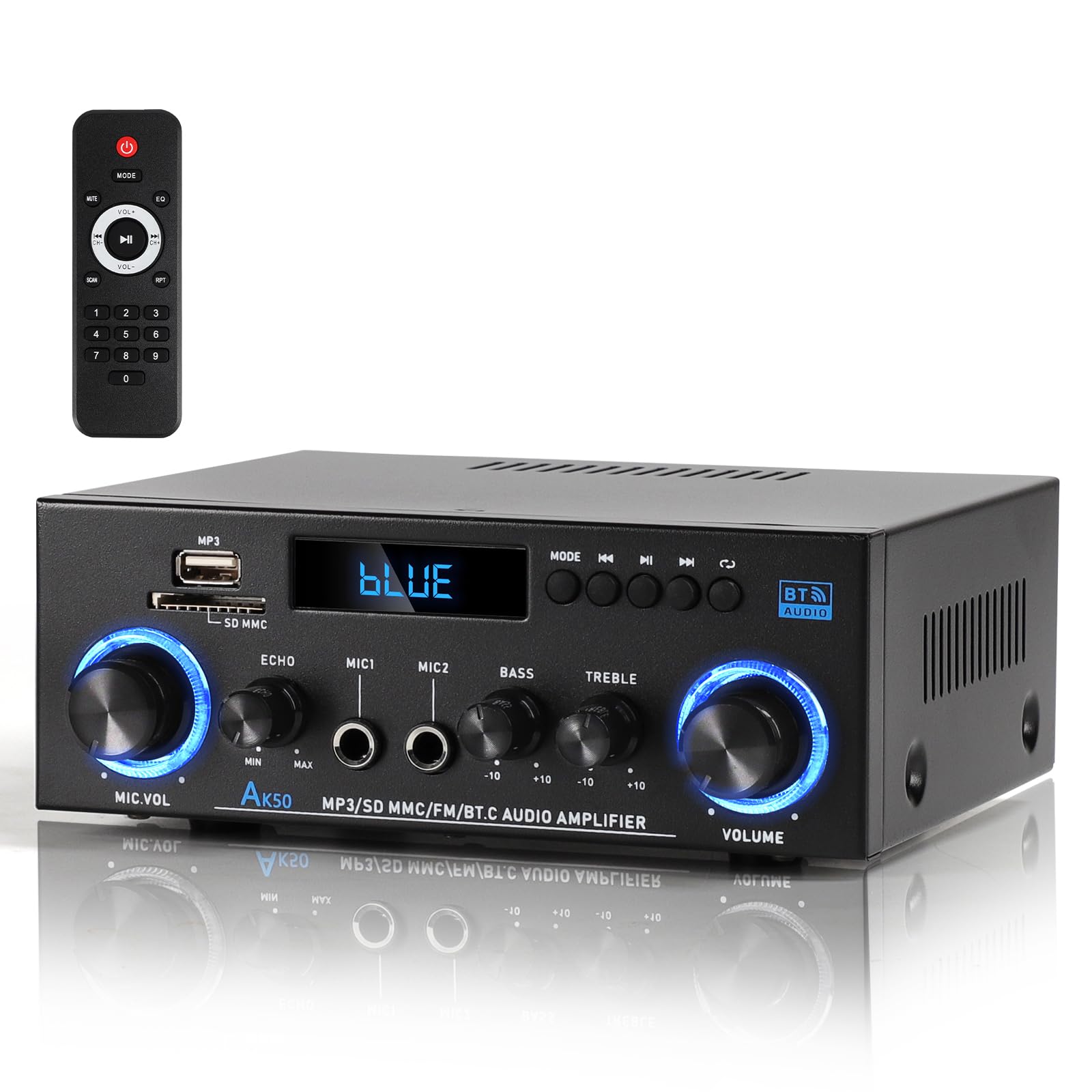
A tiny stereo receiver that adds Bluetooth, FM radio, and karaoke mic inputs to passive speakers.
If your PC setup uses passive speakers that need an amplifier (not powered speakers with their own amp built in), the Joengoep AK50 is a cheap, small solution. It claims 400W peak power — real-world clean output is lower but enough for bookshelf speakers in a small or medium room. The AK50 uses Bluetooth 5.0 for wireless streaming from your PC or phone, and shoppers say the Bluetooth connects up to 35 feet reliably. It also has USB and SD card slots for direct MP3 playback without any source device — just plug in a drive and press play. The radio function scans and stores FM presets automatically; no manual tuning needed. Two microphone inputs with independent echo and volume knobs make this a functional karaoke box if you have the mics.
One reviewer describes it as “what it is: a good low-cost, powerful radio/USB/line-in device to power your speakers.” They note the sound gets noisy above 75% volume with noticeable distortion, and the midrange EQ knob was non-functional on their unit. Another buyer found it, at just 2.55 inches tall, saves shelf space and requires a 1/4-inch to 3.5mm adapter for the microphone. The AK50 has independent bass and treble knobs, a master volume knob, and a remote control. It is not a substitute for a clean headphone amplifier — this unit is designed to drive speakers, not headphones.
Where it works well
- Compact size (7 x 5.5 x 2.55 inches) fits any desktop
- Bluetooth 5.0 paired quickly and works up to 35 feet
- USB/SD direct playback plus FM radio with auto-scan presets
- Dual mic inputs with echo control for karaoke or announcements
Real-world limits
- Amplifier becomes noisy and distorted above 75% volume
- Midrange EQ knob may be non-functional on some units
- Not a clean amplifier for critical music listening — described as “basic, penalized for EQ and high-level distortion”
Reach for this if: You have a pair of passive speakers sitting unused and want a budget-powered hub for Bluetooth streaming, FM radio, and occasional karaoke — all from a box smaller than a novel.
It is not for: Headphone listening or anyone who needs clean, distortion-free sound at high volumes — the AK50 is a utility amp, not a HiFi component.
Understanding the Specs
Output Power (mW and Watts)
This tells you how hard the amp can drive your headphones or speakers. For headphones, look at milliwatts (mW) — 200mW is comfortable for most, over 1000mW for high-impedance or power-hungry models. For speakers, it is measured in watts per channel (W/ch). Higher power does not equal better sound; it just means the amp can reach louder volumes without distorting. The catch is that an amp’s power rating is only valid at a specific impedance load (usually 32 ohms for headphones, 4 or 8 ohms for speakers), so compare ratings at the same impedance.
DAC vs. Standalone Amp
A DAC converts digital signals from your PC into analog audio. A standalone amplifier takes an analog signal and makes it stronger. If your PC audio sounds hissy or thin, a DAC/amp combo (like the FiiO K11 or Syba Sonic) is usually the better fix because it replaces the entire PC audio path. If you already use an external DAC, a pure amplifier (like the Douk Audio U3) is the right choice. Balanced outputs (4.4mm or XLR) split the ground path between channels to cancel electrical noise — useful for long cable runs or sensitive gear.
FAQ
Can I use a PC amp with my gaming headset’s built-in mic?
Will an amp make my cheap headphones sound better?
What does impedance mean for a PC amp?
Do I need a separate DAC for my PC?
Is more milliwatts always better?
What does balanced vs. single-ended mean?
Can I leave my PC amp on all the time?
Will a PC amp work with a gaming console?
Final Thoughts: The Verdict
For most PC users looking for a amp for pc, the winner is the FiiO K11 because it packs clean, powerful amplification (1400mW), a sharp status display, and balanced output into a compact aluminum box that connects to your PC over USB — all at a fair mid-range price. If you need the rawest power to drive hard-to-drive headphones, grab the FiiO K7 with its 2000mW balanced output and dual THX AAA 788+ amps. And for a pure, budget-friendly headphone amp that you can customize by swapping op-amps, the Douk Audio U3 is the clear value pick at a fraction of the cost of the others.
How We Picked
We do not accept paid placement, and we did not hands-on test every unit. Instead, we match each pick to a real buyer and use-case by comparing the manufacturers’ published specifications against the patterns in verified customer reviews — so you get each pick’s real strengths and trade-offs instead of marketing copy.
Sources & Methodology
Specifications: manufacturer listings and product documentation. Review insights: verified customer reviews, as of July 2026. Pricing: not shown on this page (it changes often); check the current price via the retailer link.
As an Amazon Associate, Gadgets Feed earns from qualifying purchases. This does not affect which products we feature.
Product prices and availability are accurate as of the date/time indicated and are subject to change. Any price and availability information displayed on Amazon at the time of purchase will apply to the purchase of this product. As an Amazon Associate I earn from qualifying purchases.
CERTAIN CONTENT THAT APPEARS ON THIS SITE COMES FROM AMAZON. THIS CONTENT IS PROVIDED "AS IS" AND IS SUBJECT TO CHANGE OR REMOVAL AT ANY TIME.
Amazon and the Amazon logo are trademarks of Amazon.com, Inc. or its affiliates.