
That spinning wheel of death on your video call, the frantic “Can you hear me now?” dance, or the complete blackout of service in your basement office—these aren’t just annoyances. They are the daily reality for millions living and working in areas where a cellular tower is distant, blocked by terrain, or buried under thick building materials. The fix isn’t switching carriers or buying a new phone; it’s installing a dedicated signal repeater that captures that faint whisper of a signal from outside and amplifies it into a roar for your entire indoor space.
I’m Min — the co-founder and writer behind Gadgets Feed. I’ve spent countless hours parsing cellular frequency bands, gain ratings, and FCC certification sheets to understand exactly why some boosters conquer dead zones while others barely register a blip on your status bar.
Whether you are battling signal loss in a sprawling ranch, a concrete basement, or a metal-roofed workshop, this guide breaks down the specs that actually matter to help you choose the very best amplificador de señal celular for your specific situation.
How To Choose The Best Amplificador De Señal Celular
Buying a cellular signal booster can feel like navigating a minefield of technical jargon. But the decision boils down to three core pillars: carrier compatibility, coverage area, and antenna configuration. Understanding these will prevent you from buying a paperweight that can’t talk to your phone.
Know Your Carrier’s Frequency Bands
This is the single most common point of failure. A booster supports specific frequency bands, usually listed as numbers like Band 12, Band 13, or Band 4. Verizon primarily uses Band 13 (700 MHz). AT&T and T-Mobile rely heavily on Bands 12 and 17 (also 700 MHz). If you buy a booster that only supports Band 13 and you are on T-Mobile, it will do nothing. Always check the booster’s supported bands against your carrier’s primary LTE/5G frequencies in your area before purchasing.
Match the Gain to Your Weak Signal Zone
Gain, measured in decibels (dB), dictates how much the booster amplifies the outside signal. A 65dB booster can often handle a small home with a weak but existing signal. A 70dB or 72dB model is better for larger spaces or very weak signals. However, too much gain in a small area can cause oscillation (the booster amplifying its own noise), so Automatic Gain Control (AGC) is a must-have feature to manage this automatically.
Antenna Type and Placement Is Everything
You need two distinct antennas: a directional outdoor antenna (like a Yagi) pointed at the nearest cell tower, and an indoor antenna (omnidirectional whip or panel) to broadcast the boosted signal inside. The secret is separation—the outdoor and indoor antennas must be physically distanced (often 30+ feet vertically or horizontally) to prevent the system from creating a feedback loop. The included cable length directly impacts where you can place the booster unit.
Quick Comparison
On smaller screens, swipe sideways to see the full table.
| Model | Category | Best For | Key Spec | Amazon |
|---|---|---|---|---|
| ZORIDA 5S Ultra | Multi-Room | Whole home for all carriers | 72dB Gain, 4500 sq ft | Amazon |
| HiBoost 10K | Large Home | Massive coverage & dual indoor antennas | 70dB Gain, 8000 sq ft | Amazon |
| ZORIDA Ace 5S | Compact/Office | Small homes & single rooms | 72dB Gain, 2000 sq ft | Amazon |
| subroad 5000 | Mid-Range | Large spaces with universal carriers | 65dB Gain, 5000 sq ft | Amazon |
| GAGBK Band 13 | Verizon Focus | Verizon/Straight Talk homes | 65dB Gain, 5000 sq ft | Amazon |
| F FREEQUEEN AT&T | AT&T/T-Mobile Focus | Bands 12/17 carriers | 65dB Gain, 4500 sq ft | Amazon |
| GAGBK AT&T | Budget AT&T | Entry-level for Band 12/17 | 65dB Gain, 4500 sq ft | Amazon |
In‑Depth Reviews
1. ZORIDA Cell Phone Booster 5S Ultra
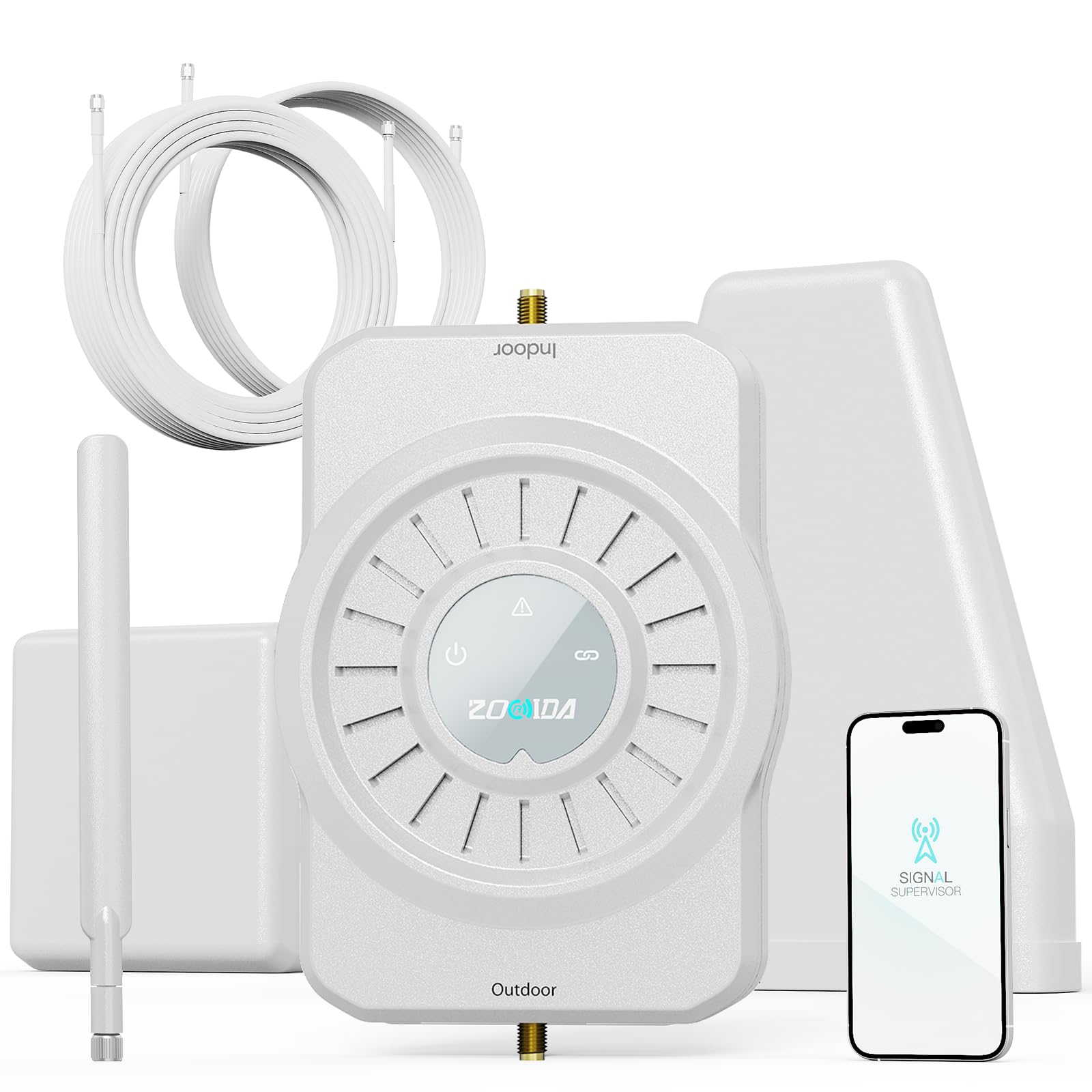
The ZORIDA 5S Ultra sets the standard for modern home boosting. Its 72dB max gain is at the top of the consumer market, and the multi-carrier support across Bands 2, 4, 5, 12, 13, 17, and 25 means it plays nice with Verizon, AT&T, and T-Mobile out of the box. The 4500 sq ft coverage target is realistic for a 3-5 room home, and the 5G compatibility ensures you aren’t buying into a dead standard.
Real-world performance is backed by the ZORIDA App, which provides step-by-step installation guidance and real-time signal data. Multiple users report going from 1-2 unstable bars to 5 solid bars, with download speeds in the 35-40 Mbps range even in challenging remote areas and campgrounds. The AGC and self-oscillation elimination features are critical for maintaining stable performance without manual tweaking.
The package includes a high-gain directional outdoor antenna and a 49.2-foot cable, which provides adequate separation for most installations. The off-white color and slim profile allow the indoor unit to sit discreetly on a shelf or table. This is the premium pick for anyone needing reliable, whole-home signal for a family with mixed carrier devices.
Why it’s great
- High 72dB gain for very weak signal zones
- App-assisted installation with excellent US-based support
- Works seamlessly on all major US carriers simultaneously
Good to know
- Coverage claims depend heavily on existing outside signal strength
- Requires careful antenna separation to avoid oscillation
2. HiBoost Cell Phone Signal Booster 10K

When your dead zone covers a sprawling ranch, a multi-story office, or a massive basement, the HiBoost 10K is the no-compromise solution. With an 8000 sq ft coverage rating and two indoor antennas (one built-in, one remote), this system is designed to blanket very large, obstacle-filled spaces with reliable signal. The 70dB gain ensures it can pull in a whisper of a signal from a distant tower.
The unit features a built-in LCD display and Bluetooth connectivity to the HiBoost App, allowing you to monitor gain settings, signal strength, and even troubleshoot oscillation in real-time. User reviews consistently highlight the exceptional US-based customer support, with technicians helping to reorient antennas for optimal performance in challenging terrain like forested valleys. The included 50-foot cable provides the necessary separation between the outdoor Yagi antenna and the indoor unit.
Frequency support covers Bands 2, 4, 5, 12, 13, 17, and 25, making it trivially compatible with all major US carriers. One user in a 2700 sq ft home with barely any outside signal reported a jump to 50+ Mbps on Verizon 5G inside the house. This is a serious investment for truly large or structurally problematic spaces where smaller boosters fail.
Why it’s great
- Massive 8000 sq ft coverage with dual indoor antennas
- Built-in LCD and Bluetooth App for real-time monitoring
- Top-tier US-based support for complex installations
Good to know
- Premium investment suitable for very large homes or offices
- Does not support Band 71 (600 MHz) for T-Mobile’s extended range
3. ZORIDA Cell Phone Signal Booster Ace 5S

The ZORIDA Ace 5S proves that you don’t need a massive footprint to get massive performance. Designed for smaller homes, apartments, single offices, or RVs, this unit delivers the same impressive 72dB gain as its big brother but in a much more compact form factor. The 2000 sq ft coverage is a realistic estimate for a couple of rooms or an open-plan living space.
This model shines in its simplicity. The indoor whip antenna attaches directly to the booster unit, meaning no complex ceiling-mounting for the indoor antenna. Setup involves placing the booster on a table or shelf, running the outdoor Yagi antenna cable through a window, and using the ZORIDA App to find the optimal antenna direction. Reviews consistently praise the customer support, with agents like Noah providing 1-on-1 guidance via the app.
It supports the same broad frequency range (Bands 12/17, 13, 5, 4, 2/25) as the larger model, ensuring compatibility across Verizon, AT&T, and T-Mobile. One user in Northern Lower Michigan saw their signal jump from 2 bars of 4G to a full 5G signal with clear calls after a simple install. It’s the ideal solution for targeted signal boosting without the complexity of a multi-antenna system.
Why it’s great
- 72dB gain in a compact, easy-to-place design
- One-tap installation with fantastic App support
- Effective for small to medium single-room zones
Good to know
- 2000 sq ft coverage may be tight for larger homes
- Performance is directly tied to the quality of the outdoor signal
4. subroad Cell Phone Signal Booster

The subroad booster hits a sweet spot for homeowners who need broad coverage across a large house without stepping into the highest price brackets. Its 65dB gain and 5000 sq ft rating are well-suited for typical suburban homes with moderate signal issues. The kit includes a high-performance indoor panel antenna and a directional outdoor Yagi antenna, providing a standard but effective hardware configuration.
A standout feature here is the Smart Auto-Gain Control (AGC) technology, which automatically detects signal strength and adjusts the booster’s output. This is crucial for preventing oscillation and maintaining consistent performance as environmental conditions change throughout the day. It supports multiple users and devices simultaneously, which is a must for a family home with multiple smartphones and tablets.
Compatibility is clearly focused on Bands 12, 13, and 17, making it a solid choice for AT&T, T-Mobile, and U.S. Cellular users. It is FCC certified and backed by a 3-year warranty. The auto-gain feature reduces the need for manual fiddling, making it a strong “set it and forget it” option for the average homeowner wanting a reliable signal boost across a large area.
Why it’s great
- 5000 sq ft coverage for large home spaces
- Smart AGC prevents oscillation without manual adjustment
- Solid 3-year warranty and FCC approval
Good to know
- Band support is limited to 12/13/17, not as broad as some others
- Indoor panel antenna requires wall mounting for best results
5. GAGBK Verizon Signal Booster

This GAGBK model is laser-focused on the Verizon and Straight Talk ecosystem, operating exclusively on Band 13 (700 MHz). For Verizon subscribers, this is a powerful advantage because the booster is tuned precisely to the primary frequency your phone uses for 4G LTE and 5G. This single-band focus often results in cleaner amplification and fewer compatibility headaches for those within the Verizon network.
The package includes a 12V 2A power supply and the necessary coaxial cables. Users report a significant improvement, with one reviewer noting they no longer had to go outside to make calls—a common pain point for those in fringe coverage areas. The 6500 sq ft coverage claim is generous, with practical performance more realistically landing around a 4000 sq ft home. The AGC feature helps manage signal fluctuations.
The installation does require careful antenna placement. Multiple reviewers emphasize the need for 24-30 feet of separation between the outdoor and indoor antennas to prevent feedback. The included pole brackets for the outdoor antenna are a useful touch. This is the best pick for a Verizon user who wants a simple, targeted solution without paying for multi-band hardware they won’t use.
Why it’s great
- Perfectly tuned for Verizon’s Band 13 network
- Effective for eliminating the need to go outside for calls
- Includes outdoor antenna mounting brackets
Good to know
- Only works with Band 13 carriers (Verizon/Straight Talk)
- Requires careful measurement for antenna separation
6. F FREEQUEEN AT&T Signal Booster
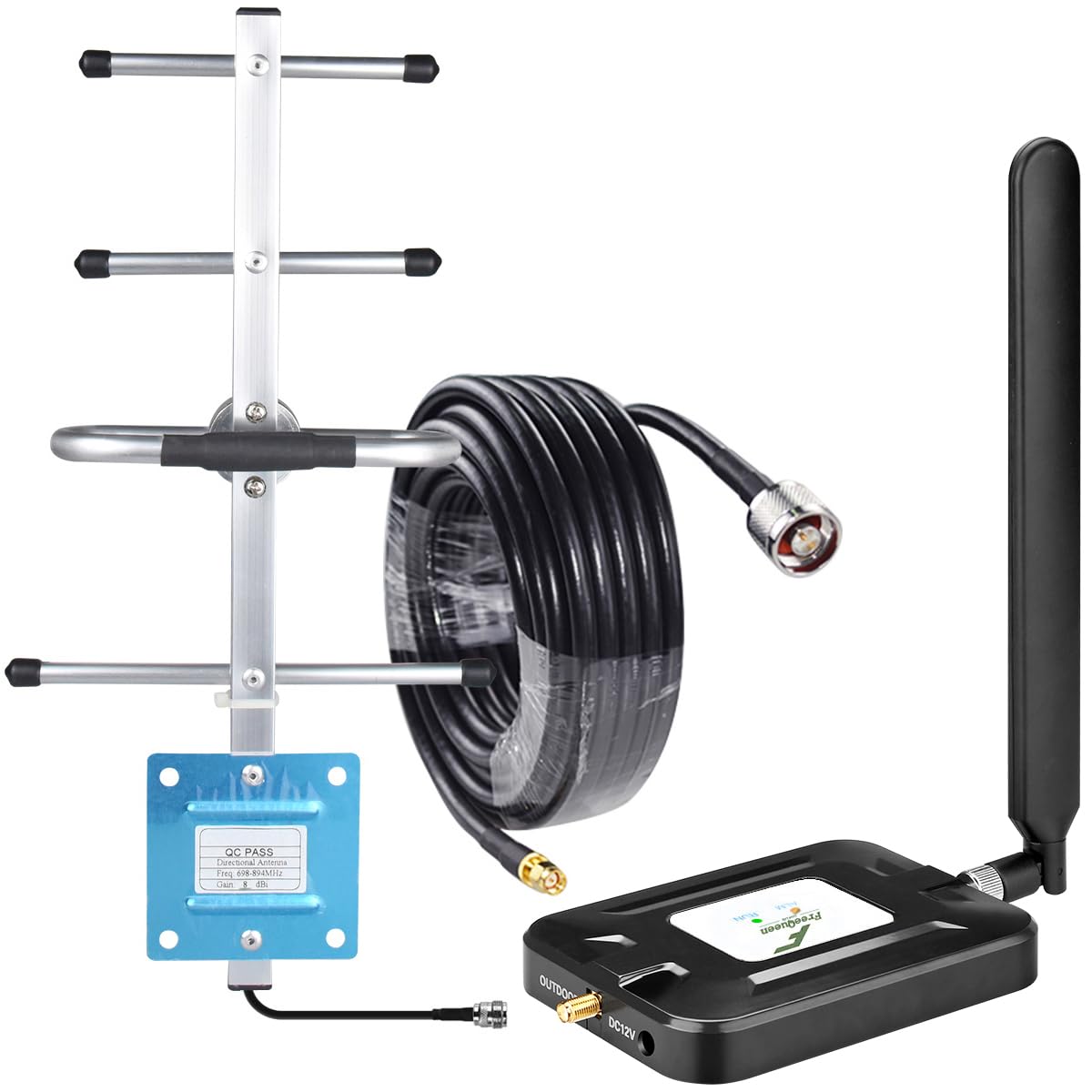
Aimed specifically at AT&T, T-Mobile, Cricket, and US Cellular subscribers, this booster focuses on the vital Bands 12 and 17. It offers a straightforward solution with a 65dB gain and a stated coverage of 4500 sq ft. The kit comes with a 50-foot N-SMA coaxial cable (extendable to 100 feet), a high-gain directional Yagi antenna, and an indoor omnidirectional whip antenna.
Features like AGC, sleep/inactivity mode, and low-noise amplification are standard and help maintain stable performance. The booster is compact and lightweight at just over 3 pounds, making it easy to mount on a wall or place on a shelf. The package is comprehensive, including U-bolts and screws for mounting the outdoor antenna.
It is critical to note that this unit’s core hardware is standard for its tier, but the brand’s customer reviews are a concern, with several user reports of the product arriving damaged or not functioning as expected. While the specs on paper are solid for the target carriers, the reliability feedback suggests a buyer should approach with caution and be prepared to leverage the 30-day money-back guarantee and 3-year warranty.
Why it’s great
- Targeted support for AT&T and T-Mobile Bands 12/17
- Comprehensive kit with extendable 50 ft cable
- Compact and lightweight design for easy placement
Good to know
- Mixed customer reviews regarding product reliability
- Some reports of units arriving damaged or non-functional
7. GAGBK AT&T Cell Phone Signal Booster

This GAGBK model mirrors the carrier-specific focus of its Verizon sibling but targets AT&T and T-Mobile on Bands 12 and 17. It offers a similar 65dB gain and 4500 sq ft coverage rating, making it a direct budget competitor for those on the AT&T/T-Mobile network. The feature set includes AGC, self-oscillation elimination, and an inactivity mode to save power.
The hardware is standard for this price tier, with a 50-foot cable and a directional outdoor antenna. The core electronics are designed to amplify the 700 MHz frequency range that is the backbone of 4G LTE and 5G for these carriers. It supports multiple devices and claims to boost signal strength up to 100X, turning 1-2 bars into a usable 4-5 bars.
However, like many entry-level options in this space, the user reviews indicate significant reliability issues, with multiple reports of defective units, poor USB-C port quality, and failures within months. The 30-day money-back and 3-year warranty are important protections here. This is the lowest-cost entry point for Band 12/17 boosting, but the higher risk of defects makes the slightly more premium options a safer long-term investment for reliable connectivity.
Why it’s great
- Lowest-cost option for AT&T/T-Mobile Band 12/17
- Includes AGC and self-oscillation features
- 3-year warranty for peace of mind
Good to know
- Troubling number of reports about unit defects
- Poor build quality noted for USB-C port
- May require extensive troubleshooting out of the box
FAQ
Does a signal booster work if I have zero bars outside?
Why do I need to separate the outdoor and indoor antennas?
Final Thoughts: The Verdict
For most users, the amplificador de señal celular winner is the ZORIDA 5S Ultra because it combines the highest gain (72dB) with carrier-agnostic support and an app that takes the guesswork out of installation. If you need to cover a very large home or commercial space, the HiBoost 10K with its 8000 sq ft rating and dual indoor antennas is unmatched. And for a focused, single-room solution with the same powerful amplifier core, the compact ZORIDA Ace 5S delivers immense value without the installation complexity.