
Our readers keep the lights on and my morning glass full of iced black tea. As an Amazon Associate, I earn from qualifying purchases.
An amplifier is the heart of any audio system, but choosing the wrong one means your speakers will never sound their best. The difference between a muddy, lifeless presentation and a wide, immersive soundstage comes down to how well the amp controls the speaker cones—this is measured in damping factor and distortion figures, not just peak wattage on the box.
I’m Min — the co-founder and writer behind Gadgets Feed. I’ve spent hundreds of hours analyzing amplifier circuit topologies, power supply designs, and real-world listening impressions across the entire price spectrum to separate meaningful spec sheets from marketing noise.
Whether you are building a serious two-channel setup or upgrading an existing system, this guide cuts through the clutter to help you find the best amplifier for audio that matches your speakers, your room, and your priorities.
How To Choose The Best Amplifier For Audio
Choosing the right amplifier means matching its electrical characteristics to your specific speakers and listening environment. The two most critical starting points are speaker sensitivity (measured in dB SPL at 1 watt at 1 meter) and nominal impedance (typically 4, 6, or 8 ohms). A speaker rated at 86 dB sensitivity needs significantly more clean power to reach the same volume as a 91 dB speaker, which is why pairing a low-sensitivity monitor with a low-powered tube amp can lead to audible distortion long before you reach satisfying listening levels.
Power Output and Clean Headroom
Look for RMS power per channel into 8 ohms with both channels driven — this is the honest spec. Peak power figures (like 800W from a budget receiver) are theoretical and only last milliseconds. A quality 35W amplifier like the Cambridge Audio AXA35 often sounds more dynamic and controlled than a noisy 100W receiver because of superior power supply regulation and lower total harmonic distortion (THD). The goal is enough clean power to handle musical peaks without clipping, typically 1.5 to 2 times your speaker’s continuous power handling.
Input Flexibility and Built-In Features
Modern amplifiers offer far more than just speaker terminals. If you own a turntable, a built-in phono preamp with moving magnet (MM) support saves rack space and cost. A built-in DAC (like the ESS Sabre chip found in many premium units) can replace a separate component when fed digital audio from a TV, CD transport, or media streamer. Wireless connectivity via Bluetooth 5.0 or higher is now standard, but optical and coaxial digital inputs remain superior for fixed multi-channel home theater sources due to lower latency and jitter.
Amplifier Topology and Heat Management
Class A/B amplifiers (like the Daytons and the Denon PMA-600NE) deliver warm, natural sound but generate more heat because they constantly draw current through the output transistors. They need ventilation — at least 4 inches of clearance above the chassis. Class D amplifiers (like the WiiM Amp Ultra and the AIYIMA A80) are vastly more efficient (typically over 85% efficiency versus 50% for Class A/B), run cool to the touch, and can be packed into much smaller enclosures without thermal throttling. The trade-off is that early Class D designs could sound harsh in the treble, but modern iterations with PFFB (Post Filter Feedback) circuitry now rival high-end A/B designs for clarity.
Quick Comparison
On smaller screens, swipe sideways to see the full table.
| Model | Category | Best For | Key Spec | Amazon |
|---|---|---|---|---|
| WiiM Amp Ultra | Streaming | All-in-one smart system | 100W/ch, ESS ES9039Q2M DAC | $529.00Amazon |
| Cambridge Audio AXA35 | Analog | Pure two-channel listening | 35W/ch into 8 ohms | $449.00Amazon |
| Marantz PM6007 | Integrated | High-detail analog soundstage | 45W/ch, toroidal transformer | $750.00Amazon |
| Denon PMA-600NE | Hybrid | Warm analog with digital convenience | 70W (4 ohm), AHC circuit | $599.00Amazon |
| Dayton HTA200 | Hybrid Tube | Warmth + high power (100W RMS) | 100W RMS/ch, Class A/B + tubes | $399.98Amazon |
| Dayton HTA100 | Hybrid Tube | Warm sound for mid-size rooms | 50W RMS/ch, tube preamp + VU | $299.98Amazon |
| AIYIMA A80 | Class D DAC | Compact desktop system | TPA3255 + ES9038Q2M, 0.006% THD | $229.99Amazon |
| MUSYSIC SYS-2000 | PA Amp | Live sound and passive PA speakers | 2000W peak, 10Hz–50kHz response | $149.99Amazon |
| Pyle PDA77BU | Budget | Multi-room karaoke parties | 800W peak, dual mic inputs | $126.99Amazon |
In‑Depth Reviews
1. WiiM Amp Ultra with Voice Remote 2
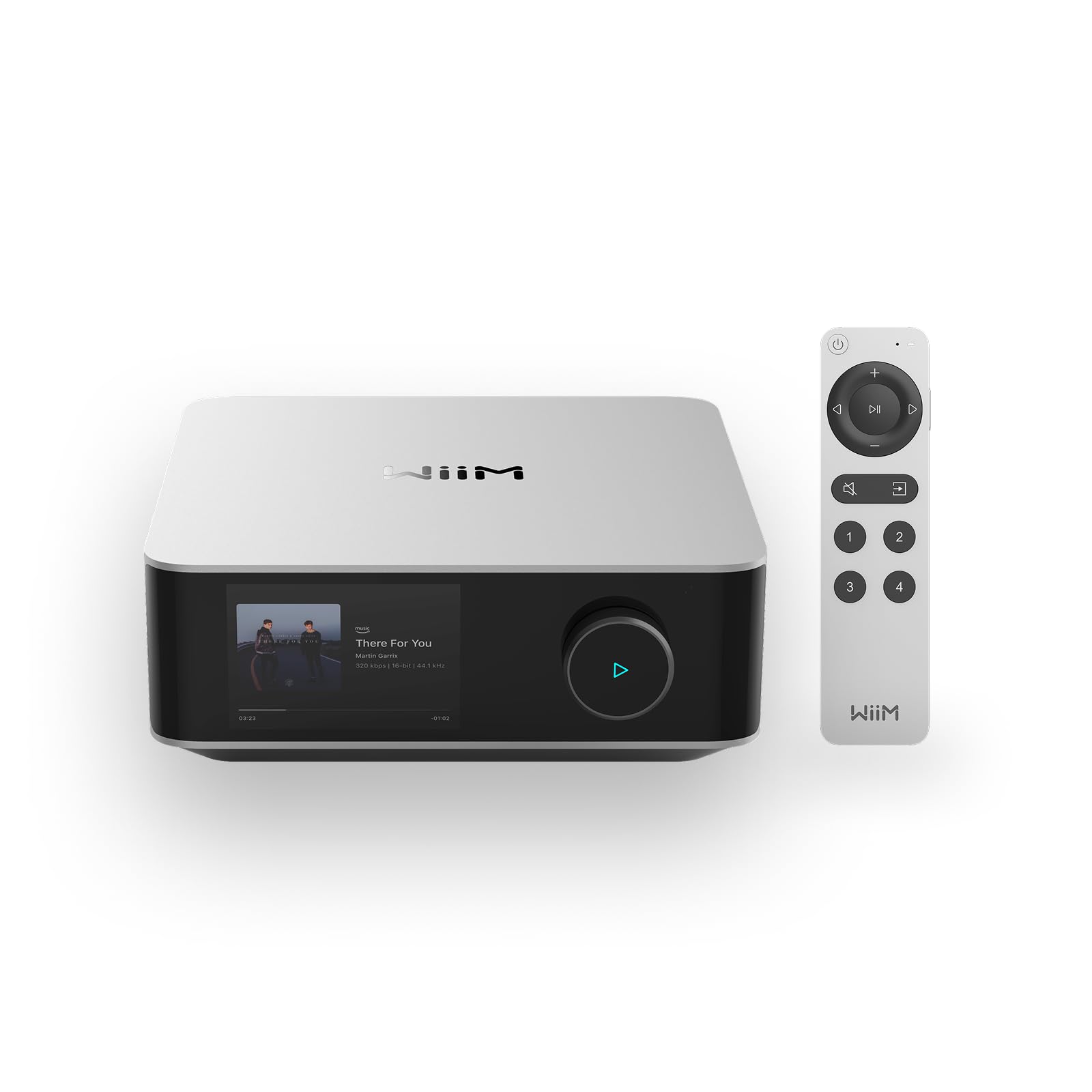
The WiiM Amp Ultra is the most complete single-box amplifier for a modern audio system. It delivers 100 watts per channel from dual TI TPA3255 Class D amps with PFFB technology, achieving a total harmonic distortion figure of -106 dB — effectively inaudible even at high listening levels. The ESS ES9039Q2M Sabre DAC handles streams up to 24-bit/192kHz, and the built-in Wi-Fi 6 and Bluetooth 5.3 with LE Audio mean wireless performance is genuinely indistinguishable from wired connections in controlled listening tests.
The standout feature is the RoomFit EQ algorithm, which uses the built-in microphone to analyze your room’s acoustics and automatically apply parametric EQ corrections. This removes mid-bass bloat from corner placement and tames harsh reflections that normally require expensive room treatment to fix. The 3.5-inch touchscreen displays album art and input status, while the HDMI ARC input integrates the amplifier into a TV-based home theater system as a high-quality stereo output — no separate streamer or DAC needed.
At this price point, the WiiM Amp Ultra competes with separates costing two to three times more. The only notable omission is Apple AirPlay compatibility; the unit is certified for Chromecast, Roon Ready, and Alexa but cannot receive direct AirPlay streams.
Why it’s great
- RoomFit auto-EQ removes the guesswork from speaker placement
- Dual TPA3255 amps with PFFB keep THD+N at -106 dB
- HDMI ARC integration makes it a flawless TV sound upgrade
Good to know
- No Apple AirPlay support in current firmware
- Bluetooth source switching takes 4-5 seconds
2. Cambridge Audio AXA35 Integrated Amplifier

The Cambridge Audio AXA35 strips away all digital processing to deliver what many listeners describe as the most honest analog presentation at its price tier. Its 35 watts per channel into 8 ohms come from a linear power supply with a toroidal transformer — the same topology found in amplifiers costing several times more. The resulting damping factor gives it exceptional control over speaker cone excursion, meaning tight, articulate bass that doesn’t blur into the midrange even during complex orchestral passages.
Input flexibility is intentionally analog-focused: four RCA line inputs, a dedicated moving magnet phono stage, and a front-panel 3.5mm auxiliary input for portable devices. There are no optical, coaxial, or USB inputs — this is a pure integrated amp. Reviewers consistently note that its phono stage breathes new life into vintage turntables, extracting detail from cartridges like the Stanton 500e that budget receivers flatten. The headphone output is genuinely usable, with enough current to drive 300-ohm Sennheiser HD6XX models to satisfying levels without the grainy character of receiver headphone jacks.
The design ethos here is no-drama reliability: a metal chassis, Alps volume potentiometer, and simple push-button source selection that won’t confuse guests. Users pairing it with Wharfedale Diamond bookshelf speakers or B&W 600 series towers report a sound that is warm, spacious, and detailed in equal measure. The only practical limitation is the lack of digital inputs, which means you will need an external DAC if you want to connect a TV or media streamer directly.
Why it’s great
- Toroidal transformer power supply delivers exceptional speaker control
- Phono stage reveals hidden detail from vintage and modern turntables
- Usable, clean headphone output drives high-impedance headphones
Good to know
- No digital inputs of any kind — pure analog only
- Front panel text difficult to read from more than 10 feet away
3. Marantz PM6007 Integrated Amplifier

The Marantz PM6007 proves that 45 watts per channel can sound far more powerful than the specification suggests, thanks to its Hyper Dynamic Amplifier Modules (HDAM) and massive toroidal power transformer. The HDAM technology — custom surface-mount discrete amplifier modules — replaces the monolithic op-amps used in most integrated amps, resulting in a soundstage that feels wider and more layered. Users upgrading from Yamaha A-S301 or Denon PMA-600NE units consistently report that the PM6007 projects instruments forward with greater separation and air around each note.
Digital connectivity includes two optical and one coaxial input driven by a built-in 192kHz/24-bit DAC, plus a moving magnet phono stage for vinyl playback. The DAC performance is excellent: fed via optical from a CD transport or TV, the PM6007 resolves micro-details without introducing digital glare. The phono stage is equally refined — quieter than many budget external preamps and perfectly matched to mid-range cartridges like the Ortofon 2M Red. The front-panel headphone output uses a dedicated amplifier circuit, not a cheap resistor tap, so high-impedance dynamic headphones retain their full dynamic range at low volumes.
Build quality is a clear step above competition from Denon and Yamaha at similar prices. The chassis uses dual-layer bottom plates to suppress vibration, the speaker terminals accept banana plugs or bare wire up to 10 AWG, and the relays click with satisfying precision. The PM6007 runs warm — expect temperatures around 45°C on top after an hour of moderate listening — so it needs about 6 inches of clearance above the chassis. It pairs best with speakers in the 86-91 dB sensitivity range, such as B&W 606 S2 Anniversary Edition or Wharfedale Denton 85th.
Why it’s great
- HDAM amplifier modules produce a wide, layered soundstage with excellent instrument separation
- Built-in DAC and phono stage eliminate need for separate components
- Toroidal transformer delivers clean, stable power to the output stage
Good to know
- No Bluetooth built-in — requires external streamer for wireless
- Runs warm; needs adequate ventilation above chassis
4. Denon PMA-600NE Bluetooth Stereo Amplifier

The Denon PMA-600NE occupies a unique sweet spot: it includes Bluetooth and a built-in DAC for convenience, yet retains the ability to disconnect all digital circuits entirely via the Analog Mode switch. When engaged, Analog Mode physically disconnects Bluetooth and digital input stages from the power supply, eliminating RF interference and letting the Advanced High Current (AHC) power amplifier section operate in pure isolation. The result is a clean, spacious sound with a warm midrange character that many listeners compare to vintage 1970s receivers — without the maintenance or noise floor.
The power stage delivers 70 watts per channel into 4 ohms and 45 watts into 8 ohms, which is more than adequate for most bookshelf and floor-standing speakers rated at 87 dB sensitivity or higher. The internal DAC handles optical and coaxial inputs up to 24-bit/192kHz, and the phono stage supports moving magnet cartridges with Decca-style RIAA equalization. The subwoofer output is a true pre-out, not a summed mono signal, making integration with an active subwoofer seamless.
Denon opted for a simple, no-frills front panel with a large volume knob and small source buttons. Reviewers note the warm, tube-like character pairs especially well with speakers that can sound bright on neutral amplifiers — the PMA-600NE tames hot treble without rolling off detail. The relay clicks on power-up are loud but signal a robust protection circuit. Remote control volume is laggy by modern standards, but for the core performance, this is an integrated amp that rewards patient system building.
Why it’s great
- Analog Mode disables digital stages for pure, interference-free playback
- Warm, tube-like character pairs well with bright speakers
- Built-in phono stage, DAC, and Bluetooth in one compact chassis
Good to know
- Remote control volume response is noticeably slow
- Relay clicks on power-on are unusually loud
5. Dayton Audio HTA200 Integrated Stereo Hybrid Tube Amplifier

The Dayton Audio HTA200 is the most powerful hybrid tube amplifier in this lineup, delivering 100 watts RMS per channel into 8 ohms from its Class A/B output stage. The tube preamplifier section uses dual 12AX7 and 12AU7 vacuum tubes to add subtle second-harmonic distortion — the type of warmth that makes vocals feel more present and cymbals less splashy. Unlike pure tube amps that produce only 10-20 watts per channel, the HTA200 combines that tube character with solid-state power to drive demanding speakers like dual 12-inch subwoofers or low-sensitivity floor-standers without audible clipping.
Connectivity includes two RCA line inputs, a moving magnet phono input, Bluetooth 5.0, USB DAC (24-bit/96kHz), and optical input. The front panel features classic illuminated VU meters that respond to audio in real-time, driven by a dedicated buffer circuit that does not affect the main signal path. The motorized volume knob is controlled by the included remote and moves smoothly through the Alps potentiometer. Users pairing the HTA200 with Triangle Borea BR03 speakers report a sound that is “rounder” than purely solid-state amplification — the tube preamp smooths digital streaming artifacts without smearing transient attack.
The HTA200 runs significantly cooler than its predecessor (the HTA100) thanks to a larger heatsink and a thermally-controlled fan that rarely activates under normal listening. The chassis is a brushed aluminum slab with exposed tube cages on top that glow amber during operation — a visual aesthetic that complements vintage turntables and modern walnut-finished speakers alike. The only notable compromise is the remote: the infrared receiver on the front panel requires line-of-sight and the buttons feel cheap compared to the rest of the build.
Why it’s great
- 100W RMS from hybrid topology — tube warmth with solid-state headroom
- Motorized volume knob with responsive remote control
- Runs cooler than HTA100; fan noise is negligible
Good to know
- Remote control quality does not match amplifier build
- USB DAC limited to 96kHz; no support for DSD playback
6. Dayton Audio HTA100 Integrated Stereo Hybrid Tube Amplifier

The Dayton Audio HTA100 offers the same hybrid tube-on-solid-state architecture as its larger sibling but at half the power — 50 watts RMS per channel into 8 ohms. This is still more than enough for most bookshelf speakers (87 dB sensitivity and above) in medium-sized rooms up to 300 square feet. The tube preamp provides the same warm, saturated character in the midrange that makes the HTA200 so engaging; the difference is that the HTA100 clips sooner when driving low-sensitivity speakers or demanding orchestral peaks.
Connectivity mirrors the HTA200: RCA line inputs, phono stage, Bluetooth 5.0, USB DAC (24-bit/96kHz), and optical input. The front VU meters are slightly smaller but equally responsive, and the headphone output on the front panel drives low-to-medium impedance headphones (up to 150 ohms) cleanly. Users report pairing the HTA100 with Sony SSCS5 bookshelf speakers and Pioneer BS22-LR towers with excellent results, describing the sound as “musical” — the tube preamp adds a richness to digital files that makes compressed streaming services sound less fatiguing than they do on purely solid-state products.
The HTA100 runs warmer than the HTA200 because its smaller chassis does not dissipate heat as efficiently. The Class A/B output stage can reach surface temperatures above 50°C after extended listening, so it must not be stacked inside a closed cabinet. The exposed tubes are protected by a metal cage that gets hot to the touch — keep curious hands and pets away. For the price, the HTA100 is a remarkable entry into tube sound for listeners who want analog warmth without the 10W limitation of full tube designs.
Why it’s great
- Affordable entry into tube sound with real hybrid topology
- Phono stage and Bluetooth connectivity in a single chassis
- VU meters add classic aesthetic to any listening space
Good to know
- Runs hot; inadequate ventilation risks thermal shutdown
- Tube cage gets very hot — not safe near children or pets
7. AIYIMA A80 Bluetooth Stereo Amplifier DAC
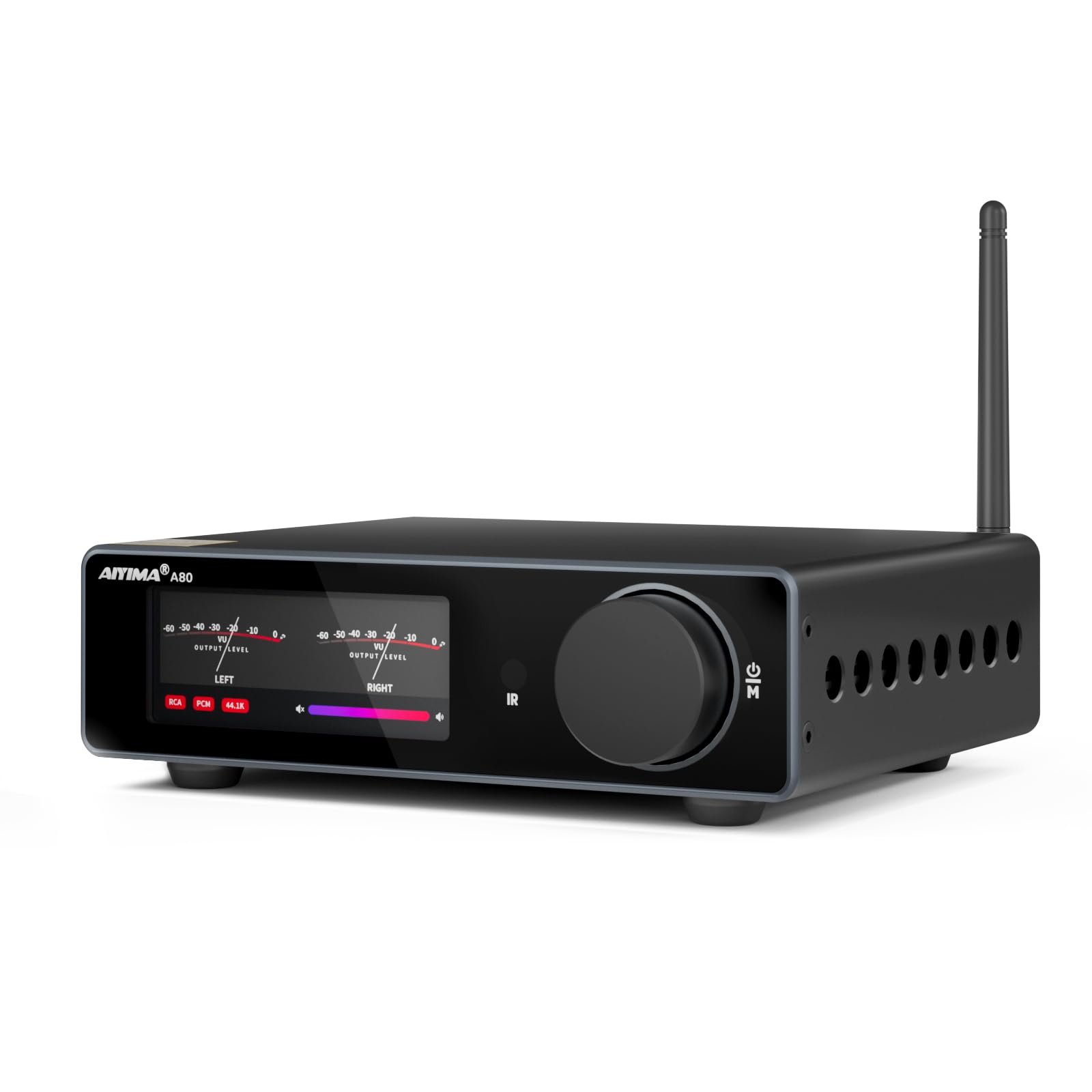
The AIYIMA A80 is a desktop-sized Class D amplifier that packs an integrated ESS9038Q2M DAC and TPA3255 amplifier chip into a chassis roughly the size of a paperback book. Its 600-watt maximum output power (300W per channel peak) is sufficient to drive speakers like the Martin Logan Motion 15i to room-filling levels, but the real story is the PFFB (Post Filter Feedback) circuitry that keeps total harmonic distortion at 0.006% — a figure that rivals full-size premium integrated amps costing four times as much. The signal-to-noise ratio of 109 dB SINAD means noise is completely inaudible even with high-sensitivity speakers.
The A80’s input selection is unusually generous for a compact unit: USB-B for PC audio (up to 24-bit/384kHz PCM and DSD512), optical, coaxial, Bluetooth 5.0, and — uniquely in this size class — professional TRS balanced inputs that reject common-mode interference from long cable runs. The digital VU meter display cycles through multiple modes: a classic needle swing, a spectrum analyzer, and a simple numeric readout showing codec and bit depth. The tone control knobs (bass and treble) are analog, not digital, so they affect the sound without introducing latency or quantized steps.
Users upgrading from the earlier AIYIMA A07 Max consistently note that the A80 sounds cleaner in the treble and has better channel separation — the ES9038Q2M DAC is a significant step up from the A07’s integrated Class D solution. The included DC48V 5A GaN power supply runs cool despite delivering significant current, and the aluminum enclosure doubles as a heatsink. The only caution is that the A80 is best suited for speakers with sensitivity above 86 dB; driving the KEF Q150 (86 dB) revealed early clipping at higher volumes in testing.
Why it’s great
- ES9038Q2M DAC with PFFB delivers studio-grade 0.006% THD
- TRS balanced inputs reject noise on long cable runs
- Digital VU meter with spectrum analyzer mode adds visual engagement
Good to know
- Underpowered for low-sensitivity speakers (below 86 dB)
- Runs hot under continuous high-volume use; ventilation needed
8. MUSYSIC Professional Power Amplifier SYS-2000
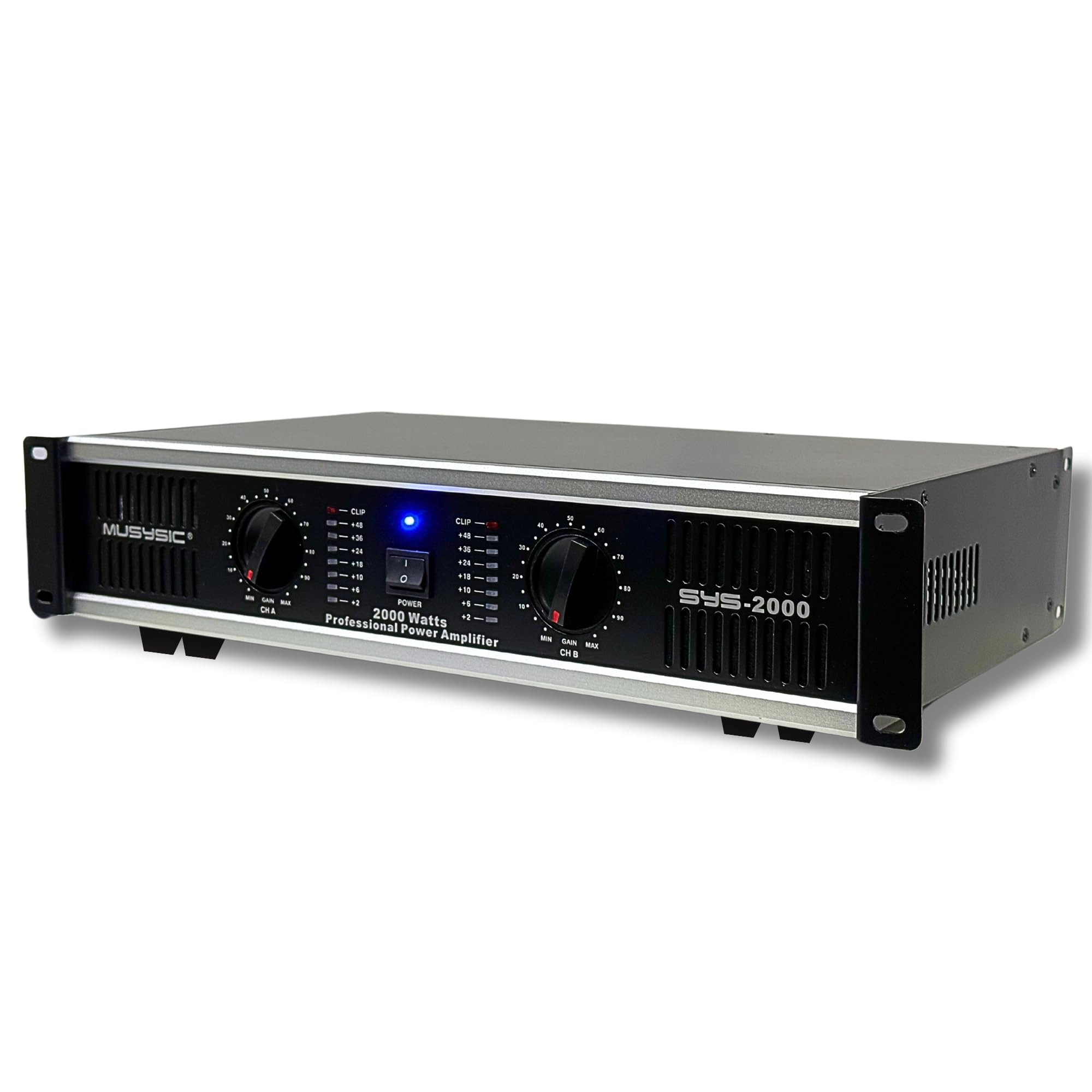
The MUSYSIC SYS-2000 is a professional 2-channel power amplifier designed for live sound reinforcement, DJ setups, and driving passive PA speakers. Its 2000-watt peak power output (1000W per channel) comes from an aluminum-chassis Class AB design with forced-air cooling — a fan that is audible during quiet music passages but acceptable in live environments. The frequency response extends from 10 Hz to 50 kHz within ±1.5 dB, which is wider than most hi-fi amplifiers and ensures deep sub-bass extension alongside airy treble detail.
Input connectivity is professional-grade: each channel accepts both XLR and 1/4-inch TRS balanced connections, plus unbalanced RCA inputs for consumer sources. The 0.77V input sensitivity means it will reach full output from a standard line-level source (like a mixer or audio interface) without requiring a preamp. The rear panel includes Speakon-compatible binding posts, though banana plugs and bare wire are also supported. Thermal protection circuits automatically shut down the amplifier if internal temperatures exceed safe limits, protecting both the amp and connected speakers.
This is not a unit for a bedroom listening setup. The MUSYSIC SYS-2000 weighs 13 pounds, measures 19 inches wide for rack mounting, and the fan noise measures approximately 35 dB at idle — audible in a quiet listening room. Instead, it belongs in a garage, warehouse, or live venue where its clean output and massive headroom prevent distortion at concert-level volumes. Users report exceptional performance driving 8-ohm passive PA cabinets and 15-inch subwoofers, with punchy transients and no audible hum or ground loop noise.
Why it’s great
- 2000W peak power drives demanding PA and subwoofer systems
- Professional XLR and TRS balanced inputs for noise-free long runs
- Thermal protection prevents failure during extended high-power use
Good to know
- Fan noise is audible — unsuitable for quiet home listening rooms
- Requires 19-inch rack or solid surface; large footprint
9. Pyle PDA77BU Bluetooth Stereo Receiver

The Pyle PDA77BU is a budget-friendly multi-channel receiver designed for versatility, not audiophile purity. Its 800-watt peak power rating is shared across four channels, which means roughly 50-60 watts RMS per channel into 8 ohms — enough for background music, karaoke parties, and casual TV viewing but not for critical two-channel listening at high volumes. The selling point is the feature set: dual 1/4-inch microphone jacks with independent volume, reverb, and delay controls make it a dedicated karaoke station out of the box.
Bluetooth 5.0 connectivity works reliably up to 30 feet, letting phones and tablets stream music without pairing issues. The front panel includes a USB-A input that plays MP3 files from flash drives, plus an SD card slot and FM radio tuner with digital display. For home theater setups, the PDA77BU can bridge up to four speakers in a multi-room configuration, each with individual volume control via the zone selector. The included remote control accesses all functions from across the room.
Sound quality is functional rather than refined. The amplifier lacks the damping factor needed for tight bass control — listeners report that lower frequencies sound less defined compared to dedicated integrated amps. The Bluetooth connection can drop briefly when reconnecting to a previously paired TV. However, for its price point and intended use case — parties, family rooms, and garage workshops — the PDA77BU is a practical, easy-to-set-up hub that includes everything except speakers in one box.
Why it’s great
- Dual mic inputs with reverb controls — ready for karaoke out of the box
- Four-channel output allows multi-room speaker configuration
- Bluetooth 5.0 with 30-foot range works reliably with smartphones
Good to know
- Bass control lacks definition; not suitable for critical listening
FAQ
What is the minimum wattage I need for home listening?
Does a built-in DAC always sound worse than a separate external DAC?
Should I buy a Class A/B or a Class D amplifier for my first hi-fi system?
Final Thoughts: The Verdict
For most users, the best amplifier for audio winner is the WiiM Amp Ultra because it combines streaming, room correction EQ, 100W of clean power, and a premium ESS DAC in a single compact chassis that outperforms separates costing twice as much. If you want pure analog character with the best phono stage in the class, grab the Marantz PM6007. And for a desktop-friendly system with studio-grade DAC specs and balanced inputs, nothing beats the AIYIMA A80.
Product prices and availability are accurate as of the date/time indicated and are subject to change. Any price and availability information displayed on Amazon at the time of purchase will apply to the purchase of this product. As an Amazon Associate I earn from qualifying purchases.
CERTAIN CONTENT THAT APPEARS ON THIS SITE COMES FROM AMAZON. THIS CONTENT IS PROVIDED "AS IS" AND IS SUBJECT TO CHANGE OR REMOVAL AT ANY TIME.
Amazon and the Amazon logo are trademarks of Amazon.com, Inc. or its affiliates.