
Our readers keep the lights on and my morning glass full of iced black tea. As an Amazon Associate, I earn from qualifying purchases.
Capturing a deep-sky object like the Orion Nebula or Andromeda Galaxy requires an optical system that can gather enough light and resolve fine detail, while a stable mount tracks the sky’s rotation over minutes. The difference between a passable snapshot and a stunning astrophoto often comes down to aperture size, focal ratio, and how well the mount handles the load and guides the camera.
I’m Min — the co-founder and writer behind Gadgets Feed. I’ve spent hundreds of hours analyzing optical designs, sensor compatibility, and mount payload capacities across dozens of models to help you match the right tube and tracker to your imaging goals.
Whether you are chasing planetary detail or wide-field nebulas, the best astro photography telescope balances aperture for light gathering with a stable, accurate mount that eliminates star trails and keeps your target centered through long exposures.
How To Choose The Best Astro Photography Telescope
Selecting an astrophotography telescope involves weighing optical design, aperture, focal ratio, and mount capability. A system that excels for lunar close-ups may frustrate you on wide-field nebula captures. Understanding these trade-offs upfront saves you money and frustration.
Aperture and Light Gathering
Aperture is the diameter of the main objective lens or mirror. Larger apertures collect more light, allowing you to capture fainter objects and resolve finer detail in shorter exposure times. For deep-sky imaging, a 100mm or larger aperture is generally recommended, while planetary work can still produce excellent results with 80mm to 127mm apertures.
Focal Ratio and Exposure Time
The focal ratio (f-number) determines how fast your optical system is. A lower f-number (f/5 or faster) concentrates light onto the sensor more quickly, reducing required exposure time and making it ideal for faint nebulas. Slower systems (f/10 or higher) are better suited for planets and the moon, where you want to magnify small details and can tolerate longer exposures.
Mount Stability and Tracking
Your mount is arguably more important than the telescope itself for astrophotography. An equatorial mount with accurate GoTo tracking and sufficient payload capacity (at least 50% overhead above the combined weight of your tube and camera) prevents star trailing during long exposures. A wobbly tripod or undersized mount ruins every frame.
Quick Comparison
On smaller screens, swipe sideways to see the full table.
| Model | Category | Best For | Key Spec | Amazon |
|---|---|---|---|---|
| ZWO Seestar S30 Pro | Smart Scope | Effortless deep-sky imaging | 4-element ED APO, 160mm f/4.5 | $699.00Amazon |
| DWARFLAB Dwarf 3 | Smart Scope | Portable grab-and-go astro | Dual-lens, 3lb total weight | $549.00Amazon |
| SVBONY SV503 102ED | Refractor OTA | Affordable ED doublet APO | 102mm f/7, S-FPL51 glass | $524.99Amazon |
| SVBONY MK127 | Mak OTA | Planetary and lunar imaging | 127mm f/11.8 Maksutov | Amazon |
| Sky-Watcher Star Adventurer 2i | Star Tracker | Wide-field DSLR imaging | WiFi app, 11lb payload | Amazon |
| Celestron NexStar 4SE | GoTo Mak | Entry-level GoTo imaging | 4-inch Mak, 1325mm FL | Amazon |
| Sky-Watcher Star Adventurer GTi | GoTo EQ Mount | Portable full GoTo tracking | 11lb payload, WiFi GoTo | Amazon |
| Celestron StarSense 10-inch | Dobsonian | Large-aperture visual & phone imaging | 254mm f/2.5 Newtonian | Amazon |
| Sky-Watcher EvoStar 100 APO | APO Refractor | High-end color correction | 100mm f/9, synthetic fluorite | Amazon |
| Sky-Watcher Flextube 300 SynScan | GoTo Dobsonian | Maximum aperture for budget | 12-inch f/4.9 collapsible | Amazon |
| Unistellar Odyssey PRO | Smart Scope | Premium all-in-one imaging | 85mm f/3.9, 5h battery | Amazon |
In‑Depth Reviews
1. ZWO Seestar S30 Pro
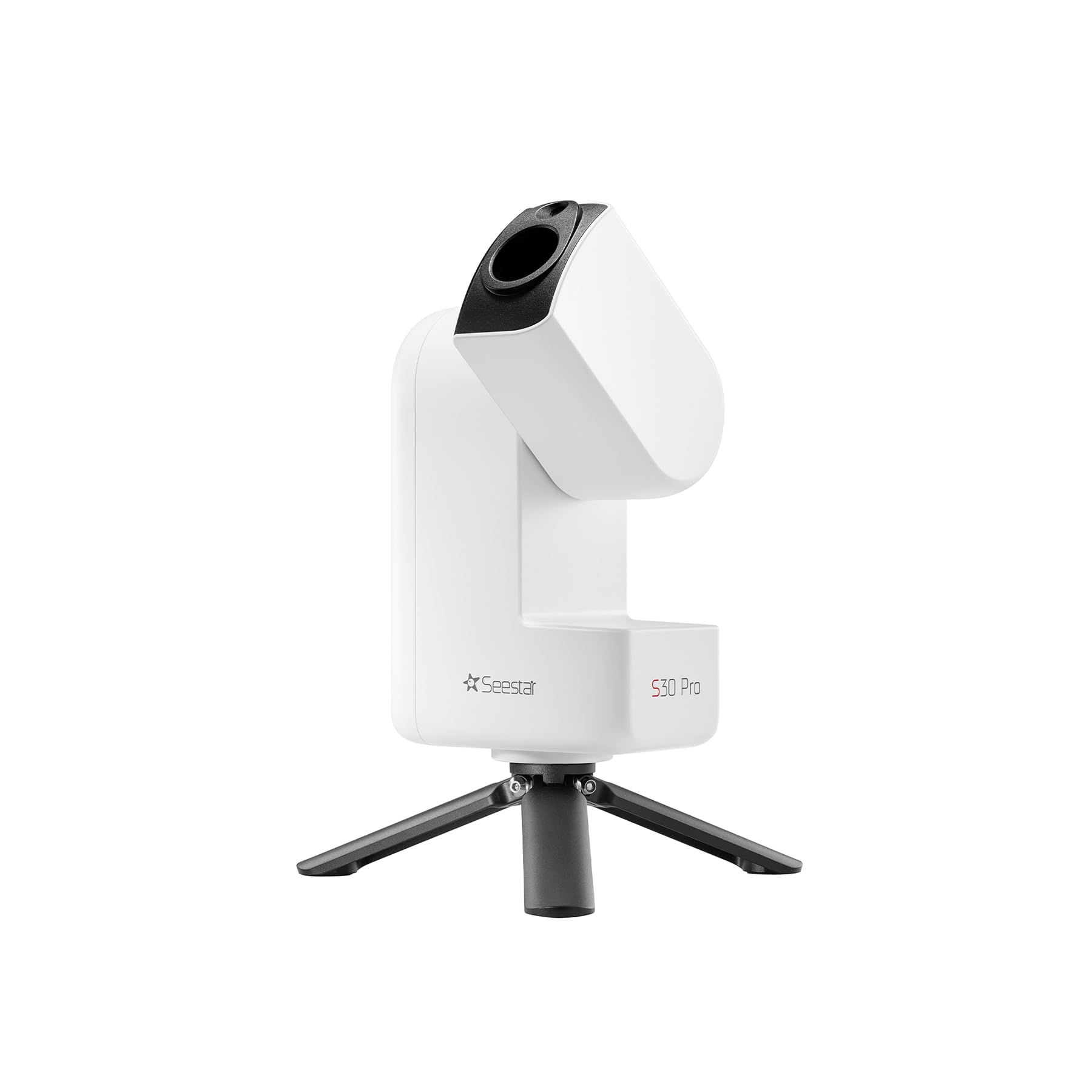
The ZWO Seestar S30 Pro is a fully integrated smart telescope that removes the complexity of traditional astrophotography setups. It pairs a precision 4-element apochromatic lens with a 4K IMX585 telephoto sensor and a wide-angle IMX586 camera, giving you the ability to capture detailed deep-sky objects and expansive Milky Way landscapes in a single session. The system handles automated GoTo targeting, autofocus, and image stacking internally.
Built-in 128GB storage and anti-dew protection allow for all-night imaging sessions without interruption. The advanced EQ mode improves tracking accuracy for longer exposures, and the one-tap Milky Way and star trail modes produce 8K stitched panoramas directly on the device. The app-controlled interface makes this accessible even if you have never used a telescope before.
Users consistently report producing gallery-worthy images of nebulas and galaxies within minutes of unboxing. The Seestar S30 Pro effectively eliminates the steep learning curve of mount polar alignment and guiding, making it the most straightforward path to excellent astrophotography results for beginners and experienced imagers alike.
Why it’s great
- Fully automated GoTo and autofocus for instant imaging
- Dual-camera system covers deep-sky and wide-field simultaneously
- 8K mosaic stitching and integrated 128GB storage
Good to know
- Not designed for heavy manual control or advanced guiding
- Target acquisition can be slower in heavily light-polluted skies
2. Unistellar Odyssey PRO

The Unistellar Odyssey PRO is the most refined all-in-one smart telescope on the market, combining an 85mm f/3.9 optical tube with a motorized Alt-Az mount, autofocus, and a built-in digital camera. Setting up takes under two minutes — power on, connect the app, and the telescope automatically aligns and slews to your chosen target from a 5,000+ object catalog linked to a 37-million-star database.
Unistellar’s exclusive eyepiece technology provides an immersive visual experience alongside digital capture, and the ability to export RAW and FITS files gives advanced imagers control over post-processing. The integrated 64GB storage and up to 5 hours of battery life enable extended imaging sessions in the field. The Odyssey PRO also supports NASA and SETI citizen-science campaigns, allowing you to contribute asteroid occultation or exoplanet transit data.
Reviewers note that the image quality from this system often exceeds what a traditional 4-inch refractor can achieve under light-polluted skies. The automatic collimation and focusing remove the two biggest friction points in traditional astrophotography, making it a powerful tool for both beginners and experienced observers.
Why it’s great
- 2-minute setup with automatic alignment and GoTo
- RAW/FITS export for serious post-processing
- 5-hour battery enables all-night sessions
Good to know
- Premium price point reflects the integrated design
- App-dependent operation limits manual fine-tuning
3. SVBONY SV503 102ED

The SVBONY SV503 102ED is an ED doublet refractor that delivers near-APO performance at a fraction of the cost of premium triplets. Its 102mm aperture and 714mm focal length (f/7) provide a versatile balance for both deep-sky imaging and planetary work. The S-FPL51 ED glass effectively minimizes chromatic aberration, producing sharp, color-true stars across the frame.
A 360-degree field rotator allows precise camera alignment without rotating the entire tube, and the smooth dual-speed 1:10 focuser with 90mm of travel accommodates heavy accessories like filter wheels and field flatteners. The retractable dew shield blocks stray light and helps prevent dew formation during humid nights.
Users report that the SV503 produces crisp lunar and planetary details and resolves faint nebulas with minimal false color. The build quality is all-metal, and the focuser holds alignment even with a heavy DSLR or dedicated astro-camera attached. For imagers wanting true ED performance without stepping into four-figure price territory, this is a standout choice.
Why it’s great
- S-FPL51 ED glass dramatically reduces chromatic aberration
- 90mm focus travel supports filter wheels and flatteners
- 360-degree rotator simplifies camera framing
Good to know
- Requires a sturdy EQ mount for optimal astrophotography
- No eyepiece or finder included in the package
4. Sky-Watcher Star Adventurer GTi

The Sky-Watcher Star Adventurer GTi is a compact GoTo equatorial mount that packs full automation into a portable package. It supports payloads up to 11 pounds, making it an ideal partner for a DSLR with a telephoto lens or a lightweight refractor like the SVBONY SV503. The built-in WiFi and SynScan app handle polar alignment, 2-star alignment, and GoTo slewing from your smartphone.
The mount head includes an illuminated polar scope, a counterweight bar with a 5-pound weight, and a tripod with pier extension for increased stability. Multiple tracking rates allow for everything from deep-sky imaging to lunar and solar tracking. Users report achieving 3-minute unguided exposures and 5+ minute guided exposures with careful balance and polar alignment.
Reviewers highlight that the GTi is a significant step up from star trackers like the Star Adventurer 2i, offering true GoTo capability that finds and tracks objects automatically. The portability makes it easy to bring to dark-sky sites, while the tracking accuracy supports serious imaging with small refractors.
Why it’s great
- Full GoTo capability in a lightweight, portable mount
- WiFi app control for polar alignment and slewing
- Supports up to 11lb payload for DSLR and small scopes
Good to know
- Battery compartment and polar scope cover have minor design flaws
- GoTo accuracy benefits from careful 2-star alignment at horizon
5. DWARFLAB Dwarf 3
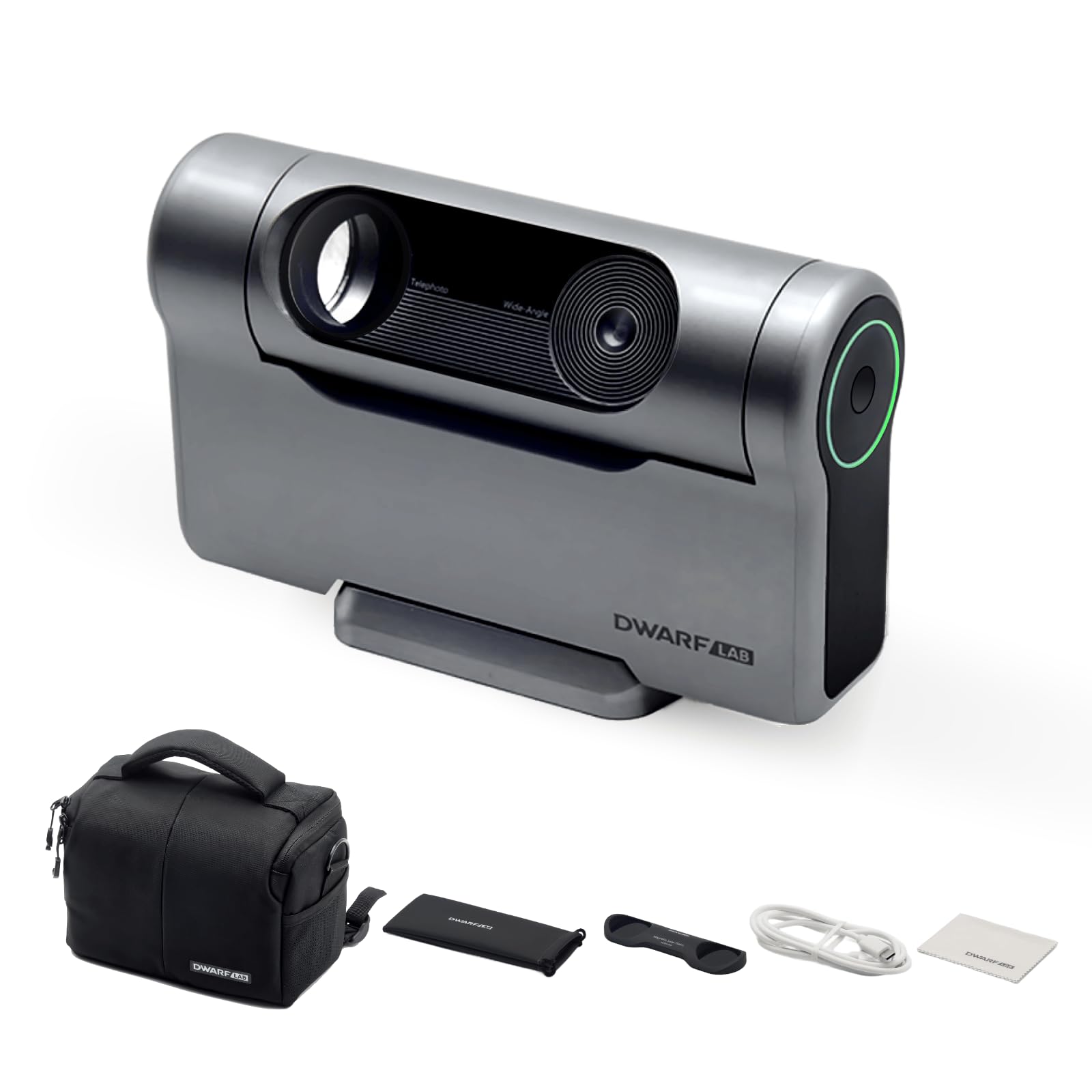
The DWARFLAB Dwarf 3 is a dual-camera smart telescope weighing just 3 pounds, making it the most portable serious astrophotography tool available. Its telephoto lens captures deep-sky objects and wildlife, while the wide-angle lens photographs the Milky Way and star trails. The AZ/EQ dual-mode mount provides automatic tracking and GoTo slewing controlled through the DWARFLAB app.
The 4K auto-tracking system locks onto celestial targets and follows them across the sky, while cloud-powered image processing within the app stacks frames and enhances final images without needing a laptop. The Dwarf 3 also functions as a long-range daytime camera for birding and landscapes, adding versatility beyond astrophotography.
Users praise the ease of use — setting up and capturing an image of a nebula can take under five minutes. The small form factor fits in a standard backpack, encouraging spontaneous imaging sessions. While the aperture is modest compared to larger scopes, the integrated processing and tracking produce surprisingly detailed results.
Why it’s great
- 3-pound design fits in any backpack for travel
- Dual imaging system for deep-sky and wide-field
- Cloud-based processing enables one-tap astrophotography
Good to know
- Small aperture limits faintest object detection
- App connectivity can occasionally need reconnection
6. SVBONY MK127
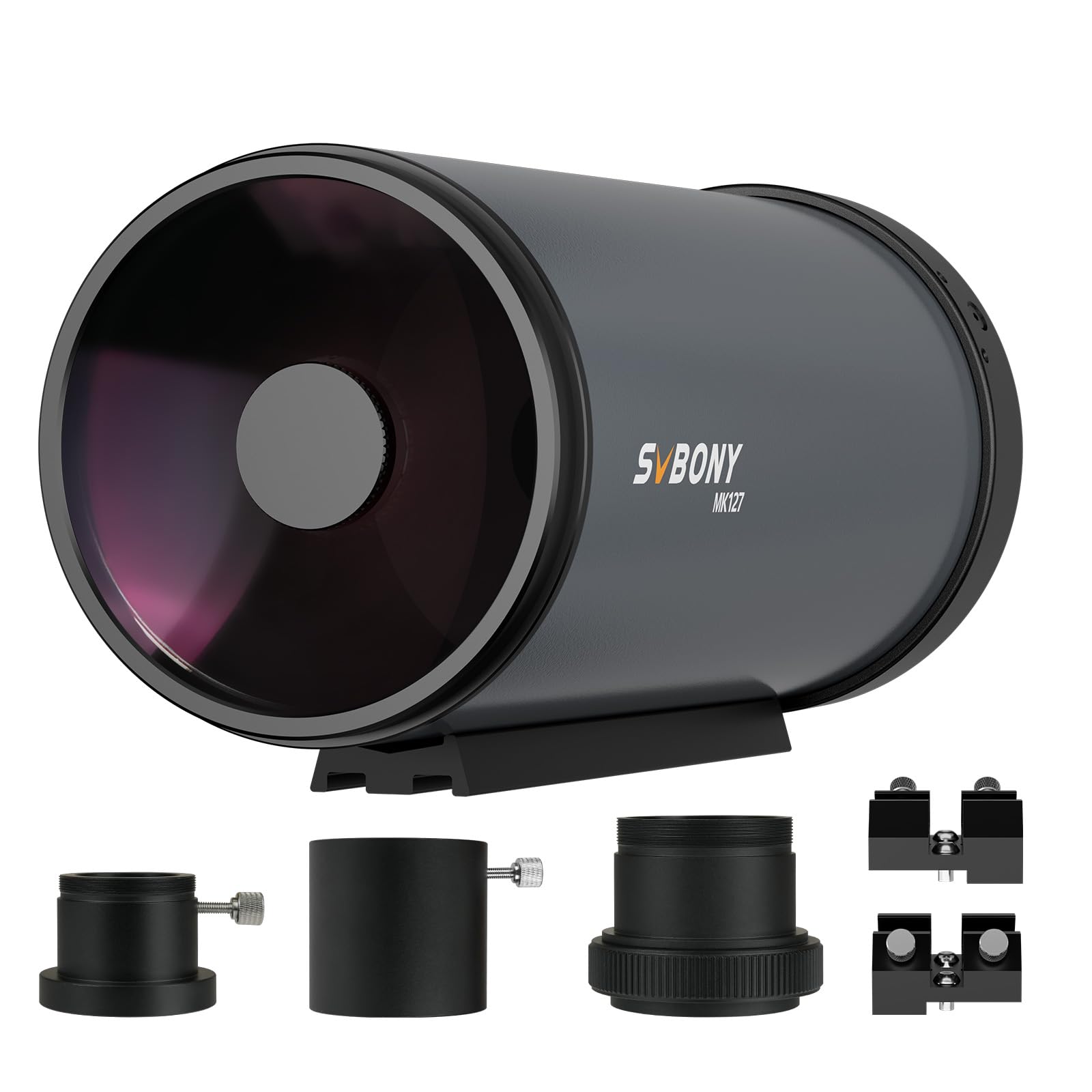
The SVBONY MK127 is a 127mm Maksutov-Cassegrain optical tube with a focal length of 1495.6mm (f/11.8), optimized for high-magnification planetary and lunar imaging. The Maksutov design delivers crisp contrast with minimal chromatic aberration, and the 99% reflectivity dielectric coatings maximize light throughput for faint deep-sky details.
The included 0.65x flat-field reducer brings the effective focal ratio down to f/7.7, making the MK127 more versatile for deep-sky imaging by widening the field of view and reducing exposure times. The dual-speed focuser provides coarse and fine adjustment, essential for achieving critical focus at high magnifications. The OTA accepts both 2-inch and 1.25-inch accessories via included adapters.
Users consistently rate the MK127 as an excellent grab-and-go planetary scope, with reviews noting sharp Saturn and Jupiter details at 300x magnification. The all-metal construction and smooth focuser inspire confidence, though the tube weight of 6.6 pounds requires a sturdy mount. For imagers focused on the moon and planets, this is a fantastic value.
Why it’s great
- Sharp planetary views with minimal chromatic aberration
- Included 0.65x reducer expands deep-sky capability
- Dual-speed focuser for precise high-magnification focus
Good to know
- No eyepiece, finder, or mount included
- Long focal length requires accurate tracking for DSOs
7. Sky-Watcher Star Adventurer 2i Pro Pack

The Sky-Watcher Star Adventurer 2i Pro Pack is a motorized equatorial star tracker designed specifically for DSLR and mirrorless camera astrophotography. It allows you to capture sharp, untracked-looking images of the Milky Way, star fields, and landscapes with exposure times up to several minutes. The Pro Pack includes a ball-head mount, counterweight kit, and equatorial base for perfect polar alignment.
Built-in WiFi connects to the free SAM Console app, giving you control over tracking speed and direction from your smartphone. The tracker supports multiple modes for wide-field astrophotography, time-lapse, and panoramas. The modular design attaches to any standard photo tripod, making it a lightweight addition to your camera bag.
Experienced users report achieving 3-minute exposures at 300mm focal length with proper polar alignment. The Star Adventurer 2i is the go-to solution for imagers who want to graduate from fixed-tripod nightscapes without committing to a large equatorial mount. Battery life stretches to around 40 hours, providing plenty of runtime for multi-night trips.
Why it’s great
- Lightweight and portable for travel to dark-sky sites
- WiFi app control and long 40-hour battery life
- Supports long exposures at up to 300mm focal length
Good to know
- Not designed for telescopes; optimized for camera lenses
- Polar alignment illuminator can be finicky with larger cameras
8. Celestron NexStar 4SE

The Celestron NexStar 4SE packages a 4-inch Maksutov-Cassegrain optical tube with a fully computerized GoTo mount, making it an accessible entry point for astrophotography and visual observing. The 1325mm focal length provides excellent magnification for the moon, planets, and bright deep-sky objects, while the StarBright XLT coatings boost contrast and light transmission.
The NexStar+ hand controller stores 40,000+ objects and uses SkyAlign technology — center any three bright stars even if you don’t know their names, and the telescope aligns itself in minutes. A built-in wedge allows polar alignment for long-exposure imaging, reducing field rotation compared to Alt-Az tracking alone.
Reviewers appreciate the compact, grab-and-go design and the sharp optics that outperform its price point. The mount tracks accurately enough for short exposure deep-sky images, and the GoTo system reliably finds objects. Beginners should budget for a power adapter (batteries drain quickly) and a few additional eyepieces to fully realize the telescope’s potential.
Why it’s great
- Sharp Mak optics with StarBright XLT coatings
- SkyAlign makes setup fast and frustration-free
- Built-in wedge enables polar alignment for imaging
Good to know
- Batteries drain quickly; a 12V adapter is recommended
- Stock eyepiece and finder benefit from upgrades
9. Sky-Watcher EvoStar 100 APO

The Sky-Watcher EvoStar 100 APO doublet refractor delivers exceptional color correction through a matched doublet objective containing one synthetic fluorite element. With a 100mm aperture and 918mm focal length (f/9), it produces tack-sharp images with zero false color, making it a reliable choice for serious deep-sky and planetary imaging.
The 10:1 dual-speed Crayford-style focuser allows micrometer-precise focusing, while the Metallic High-Transmission Coatings (MHTC) maximize light throughput. The package includes tube rings, a V-style dovetail, an 8×50 RACI finderscope, a 2-inch dielectric diagonal, 5mm and 25mm LET eyepieces, and a foam-lined aluminum hard case for safe transport.
Users highlight the EvoStar’s ability to split close double stars and reveal fine detail on Jupiter and Saturn without a hint of purple fringing. The OTA weight of 8.4 pounds requires a solid equatorial mount, but the optics reward that investment with professional-grade results.
Why it’s great
- Synthetic fluorite element provides near-total color correction
- 10:1 dual-speed focuser for critical sharpness
- Includes hard case, finder, diagonal, and eyepieces
Good to know
- Needs a sturdy mount due to tube length and weight
- Focuser can slip under heavy camera loads without tightening
10. Celestron StarSense Explorer 10-inch

The Celestron StarSense Explorer 10-inch is a Dobsonian telescope that uses your smartphone to navigate the night sky. Dock your phone in the StarSense dock, launch the app, and the patented sky recognition technology analyzes overhead star patterns to pinpoint your telescope’s position. You then follow on-screen arrows to locate any object in its 40,000+ database.
The 254mm Newtonian reflector with StarBright XLT coatings gathers four times more light than a 4-inch scope, revealing faint nebulas, galaxies, and star clusters in stunning detail. The 2-inch Crayford focuser and included 25mm eyepiece provide a good starting point, and the Dobsonian base offers smooth manual tracking once the target is centered.
Users praise the app’s accuracy in finding objects even under light-polluted skies. The 10-inch aperture resolves details in the Orion Nebula and Andromeda Galaxy that smaller scopes cannot touch. While the manual base limits long-exposure imaging, the StarSense Explorer excels for visual observation and casual smartphone photography through the eyepiece.
Why it’s great
- Huge 10-inch mirror gathers massive amounts of light
- StarSense app makes finding objects effortless
- Stable Dobsonian base for smooth manual tracking
Good to know
- Not designed for long-exposure deep-sky imaging
- Large and heavy setup requires space and transport care
11. Sky-Watcher Flextube 300 SynScan 12-inch

The Sky-Watcher Flextube 300 SynScan 12-inch Dobsonian combines the light-gathering power of a 305mm aperture with the convenience of a computerized GoTo mount. The collapsible truss design reduces the tube length for transport while maintaining optical alignment, and the SynScan hand controller gives you access to a 42,000+ object database with automatic slewing.
All-metal gearing on the DC servo motors ensures precise tracking, and the built-in WiFi allows control from a smartphone or tablet. The 94% reflective multi-coated borosilicate mirrors deliver bright, high-contrast views of deep-sky objects, while the 2-inch Crayford focuser and included 25mm and 10mm eyepieces get you started immediately. The mount handles up to 30-second guided exposures for basic deep-sky imaging.
Users report that the views through a 12-inch aperture are transformative — globular clusters resolve into thousands of stars, and nebulas show structural detail normally only visible in photographs. The GoTo system tracks accurately enough for quick imaging sessions, though the primary use case remains visual astronomy and bright-object imaging.
Why it’s great
- 12-inch aperture resolves extremely faint deep-sky detail
- Collapsible design improves portability for its class
- WiFi GoTo and 42,000-object database
Good to know
- Heavy setup; not suited for frequent transport
- Particle board base may feel less premium than the optics
FAQ
Is a GoTo mount necessary for astrophotography?
What is the difference between a refractor and a reflector for astrophotography?
What does APO mean and do I need it?
Can I use a Dobsonian telescope for astrophotography?
What is the most important spec for a beginner astrophotography telescope?
Final Thoughts: The Verdict
For most users, the best astro photography telescope winner is the ZWO Seestar S30 Pro because it combines excellent 4-element APO optics with fully automated GoTo, autofocus, and onboard image processing — eliminating the steepest barriers to entry in astrophotography. If you want maximum aperture for visual observation and casual imaging, grab the Celestron StarSense Explorer 10-inch. And for those who value portability and ease of use above all else, nothing beats the DWARFLAB Dwarf 3.
Product prices and availability are accurate as of the date/time indicated and are subject to change. Any price and availability information displayed on Amazon at the time of purchase will apply to the purchase of this product. As an Amazon Associate I earn from qualifying purchases.
CERTAIN CONTENT THAT APPEARS ON THIS SITE COMES FROM AMAZON. THIS CONTENT IS PROVIDED "AS IS" AND IS SUBJECT TO CHANGE OR REMOVAL AT ANY TIME.
Amazon and the Amazon logo are trademarks of Amazon.com, Inc. or its affiliates.