
The amplifier is the muscle and the brains of your home stereo system. It dictates everything from dynamic headroom and signal purity to the tonal signature of your speakers. Choosing the wrong amp leaves your expensive speakers under-driven, your listening room muddy, and your music flat. This guide cuts through the noise of wattage ratings and tube-vs-solid-state debates to focus on what actually determines sound quality for your specific setup.
I’m Min — the co-founder and writer behind Gadgets Feed. I’ve spent hundreds of hours researching power output specs, DAC implementations, chipset topologies, and customer feedback across the widest range of home stereo amplifiers to identify which models actually deliver measurable performance for their tier.
Whether you’re driving bookshelf speakers on a desk or full tower speakers in a dedicated listening room, finding the right amplifiers for home stereo systems means balancing power, connectivity, and sound signature to match your specific gear and room.
How To Choose The Best Amplifiers For Home Stereo Systems
Your choice of amplifier for your home stereo system depends on three non-negotiable factors: the power your speakers need, the source gear you already own, and the listening volume you expect. Ignore marketing hype about peak wattage and focus on continuous RMS power per channel at your speakers’ nominal impedance.
RMS Power and Speaker Matching
An amplifier’s RMS rating tells you how much continuous clean power it can deliver. Match the amp’s RMS output per channel at 8 ohms to your speakers’ recommended power range. Undersized amps clip at higher volumes, damaging tweeters. Oversized amps simply offer headroom — not a problem unless you have very sensitive speakers that hiss with excess gain.
DAC Integration and Digital Connectivity
Many modern integrated amplifiers include a built-in digital-to-analog converter. The quality of the DAC chipset — ESS Sabre, AKM, or TI Burr-Brown — directly impacts clarity, soundstage width, and noise floor from optical, coaxial, or USB sources. Bluetooth codec support (aptX HD, LDAC) also matters if you stream wirelessly as your primary source.
Phono Stage and Vinyl Compatibility
If you own a turntable, a built-in phono preamp saves you the cost and clutter of an external box. Not all phono stages are equal: moving magnet (MM) inputs are standard, but moving coil (MC) support is rarer and typically reserved for premium amplifiers. Check your cartridge type before buying.
Quick Comparison
On smaller screens, swipe sideways to see the full table.
| Model | Category | Best For | Key Spec | Amazon |
|---|---|---|---|---|
| Cambridge Audio CXA81 MkII | Premium | High-resolution two-channel listening | 80 WPC RMS, ESS Sabre DAC | Amazon |
| WiiM Amp Ultra | Mid-Range | Streaming-centric multi-room setups | 100 WPC, ESS ES9039Q2M DAC | Amazon |
| Denon PMA-900HNE | Premium | Whole-home streaming with HEOS | 85 WPC RMS, AHC Circuit | Amazon |
| Marantz MM7025 | Premium | High-power home theater / stereo | 140 WPC, Balanced XLR Inputs | Amazon |
| Denon PMA-600NE | Mid-Range | Analog purity with digital flexibility | 70 WPC, Analog Mode | Amazon |
| Dayton Audio HTA200 | Mid-Range | Hybrid tube warmth with A/B power | 100 WPC RMS, Tube Preamp | Amazon |
| Dayton Audio HTA100 | Mid-Range | Entry-level hybrid tube sound | 50 WPC RMS, Tube Preamp | Amazon |
| Rockville RPA9 | Budget | High-SPL PA / DJ applications | 800W RMS, XLR/SpeakON | Amazon |
| Fosi Audio MC351 | Budget | Compact 2.1 channel desktop systems | 165Wx2 + 350W, Dual TPA3255 | Amazon |
In‑Depth Reviews
1. Cambridge Audio CXA81 MkII

The Cambridge Audio CXA81 MkII delivers 80 watts per channel into 8 ohms through a Class A/B amplifier stage powered by a toroidal transformer — the same topology used in reference-grade separates. The ESS ES9018K2M Sabre32 DAC handles digital conversion for TOSLINK, coaxial, and USB audio inputs, supporting high-resolution PCM and DSD streams. This combination yields a sound that is warm-neutral: rich tonality without sacrificing instrumental separation or soundstage width.
Users driving Monitor Audio Silver 500 towers and KEF LS50 Metas report authoritative bass control and a soundstage that extends well beyond the speaker boundaries. Piano reproduction sounds lifelike, with correct harmonic decay. The inclusion of balanced XLR inputs allows cleaner connection to a dedicated streamer or preamp, reducing ground-loop noise in complex setups. Bluetooth aptX HD support covers high-quality wireless streaming, though some users note Bluetooth 4.2 can disconnect in dense 2.4 GHz environments.
The CXA81 MkII lacks a built-in phono stage, so turntable owners will need an external preamp. The remote is large and does not control Cambridge’s own CD transport. A two-day break-in period is commonly reported before the amplifier reaches its full sonic potential, with the sound smoothing out after roughly 20 hours of playback.
Why it’s great
- Delivers 80 WPC clean RMS power with excellent dynamic headroom for demanding speakers.
- ESS Sabre32 DAC provides high-resolution decoding with superb clarity and soundstage.
- Balanced XLR inputs reduce noise in complex signal chains.
Good to know
- No built-in phono preamp; external unit required for turntable use.
- Bluetooth 4.2 may experience dropouts in environments with heavy 2.4 GHz interference.
- Remote control is large and does not operate other Cambridge Audio components.
2. WiiM Amp Ultra
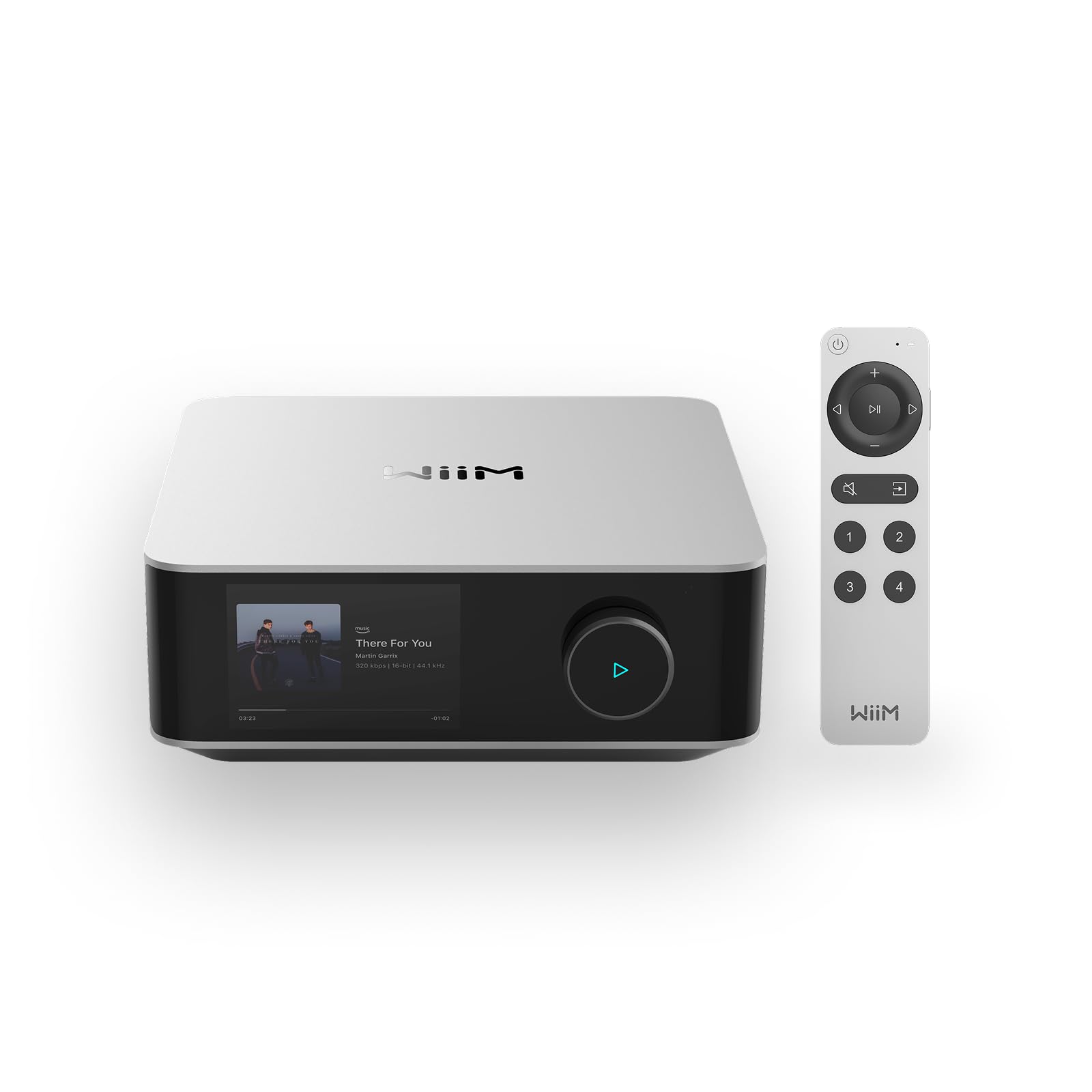
The WiiM Amp Ultra is a streaming-first integrated amplifier that pairs dual Texas Instruments TPA3255 Class-D amp chips with an ESS ES9039Q2M Sabre DAC. This combination outputs 100 watts per channel with a THD+N of -106 dB, meaning virtually no audible distortion at normal listening levels. The Wi-Fi 6 and Bluetooth 5.3 with LE Audio provide stable multi-room streaming support for Spotify, TIDAL, Qobuz, Amazon Music, and Roon, with up to 24-bit/192 kHz resolution.
The built-in RoomFit room correction auto-calibrates the frequency response to your specific room acoustics and speaker placement, a feature typically found in much more expensive processors. Users report that RoomFit dramatically improved the tonal balance of older speakers, tightening the bass and smoothing harsh peaks. The 3.5-inch touchscreen on the unibody aluminum chassis displays album art and system settings, while the included voice remote supports Alexa and Google Assistant.
HDMI ARC allows seamless integration with modern TVs, making this a viable all-in-one solution for both music and home theater audio. The amplifier runs cooler than equivalent Class A/B designs, fitting easily into tight cabinets. A minor inconvenience: switching between Bluetooth and Wi-Fi sources can introduce a brief delay, though this can be mitigated by removing Bluetooth as a selectable source in the app.
Why it’s great
- RoomFit room correction auto-calibrates sound for your specific listening space and speakers.
- ESS ES9039Q2M DAC with Class-D amps delivers ultra-low distortion and high resolution.
- HDMI ARC enables direct TV connection for a unified music/home theater system.
Good to know
- No coaxial digital input; limited to optical and HDMI ARC.
- Bluetooth-to-WiFi source switching can introduce a brief audio delay.
- Does not support AirPlay; requires third-party workaround for Apple ecosystem users.
3. Denon PMA-900HNE

The Denon PMA-900HNE merges a Class A/B amplifier stage delivering 85 watts per channel with HEOS multi-room wireless streaming. The Advanced High Current (AHC) circuit provides substantial current reserve for low-impedance dips, maintaining tight bass control and clear imaging even with challenging 4-ohm speaker loads. The ESS 9018K2M DAC handles all digital inputs, including three optical and one coaxial, supporting FLAC HD, ALAC, and DSD formats up to 24-bit/192 kHz.
The built-in phono stage supports both moving magnet (MM) and moving coil (MC) cartridges, a rare feature at this price tier. Users report excellent results with Ortofon 2M Blue and Denon DL-103 MC cartridges, with low noise floor and accurate RIAA equalization. The Pure Direct mode bypasses all tone and balance circuits for the shortest possible signal path, revealing the amplifier’s natural tonal balance. AirPlay 2 and Bluetooth streaming are built-in, with Wi-Fi capable of multi-room sync with other HEOS-enabled devices.
The subwoofer pre-out is fixed at 100 Hz, which limits integration flexibility for users who prefer a lower or adjustable crossover point. The amplifier runs warm during extended use, requiring adequate ventilation. HEOS app navigation can feel less intuitive than competitors, though Spotify Connect works flawlessly as an alternative streaming interface.
Why it’s great
- Both MM and MC phono inputs for vinyl playback without an external preamp.
- HEOS multi-room streaming with AirPlay 2 covers wireless audio across whole home.
- Pure Direct mode provides a completely unprocessed analog signal path.
Good to know
- Subwoofer crossover fixed at 100 Hz with no adjustment possible.
- Runs hot during extended high-volume sessions; needs ventilation space.
- HEOS app interface is less polished than dedicated streaming platforms.
4. Marantz MM7025

The Marantz MM7025 is a dedicated stereo power amplifier rated at 140 watts per channel into 8 ohms, with substantial current capability for 4-ohm loads. Unlike integrated amps, this is a pure power amplifier — it requires a separate preamp or AV processor with volume control. The front panel is a curved aluminum faceplate in classic Marantz champagne gold, with a depth under 14 inches that fits standard equipment racks.
The amplifier accepts both single-ended RCA and balanced XLR inputs, making it compatible with professional-grade preamps and AV receivers. The internal cooling fan is temperature-controlled and remains inaudible during normal listening. Users driving Klipsch R-820F towers report that the MM7025 brings those speakers to life with punchy dynamics and no audible hiss. The amplifier replaces a Classé CA200 in one critical listener’s system and produced tighter bass, cleaner midrange, and a wider soundstage.
Some critical listeners describe the MM7025’s sound as slightly less transparent at the micro-detail level compared to ultra-high-end separates from brands like Rotel or McIntosh. The banana clip speaker terminals are reported as less secure than competing designs, with some users preferring the binding posts on Schiit Vidar. This is a power amplifier only — there is no DAC, no phono stage, no volume control.
Why it’s great
- 140 WPC RMS delivers effortless headroom for demanding speakers and large rooms.
- Balanced XLR inputs provide noise rejection for long signal cable runs.
- Compact chassis fits standard 19-inch racks with silent thermal management.
Good to know
- No integrated preamp, DAC, or phono stage; requires external source controller.
- Speaker terminals use banana clips that some users find less secure than competitors.
- Micro-detail resolution trails ultra-premium brands like Rotel and McIntosh.
5. Denon PMA-600NE

The Denon PMA-600NE is an integrated stereo amplifier rated at 70 watts per channel into 4 ohms, powered by Denon’s Advanced High Current (AHC) push-pull circuit. The defining feature is Analog Mode: a physical switch that disconnects the digital input board and Bluetooth module from the amplifier’s power supply, isolating the analog preamp and power amp sections for the purest analog signal path. This reduces electrical noise and sharpens imaging when playing vinyl or external DAC sources.
The built-in DAC supports two optical and one coaxial input with 24-bit/192 kHz decoding. A phono input (MM) is included for direct turntable connection. Users describe the sound as warm and tube-like, with spacious imaging that rivals vintage Marantz receivers. The Source Direct mode bypasses tone controls entirely for the shortest signal path. Bluetooth streaming is available but can be disabled entirely via Analog Mode.
The PMA-600NE’s 30-watt RMS rating at 8 ohms is conservative — the power supply draws 185 watts, giving it real-world headroom for moderate listening levels with efficient speakers. LED indicators are dim and the relay clicks audibly when switching inputs. The remote is laggy and the headphone output lacks bass depth compared to dedicated headphone amps. No USB or HDMI inputs are provided.
Why it’s great
- Analog Mode completely isolates the digital section for a cleaner analog listening experience.
- Built-in DAC and MM phono stage cover most digital and vinyl sources.
- Warm, spacious sound signature similar to classic vintage receivers.
Good to know
- Relay switching clicks are audible when changing inputs or powering on.
- Headphone output is better for low-impedance headphones; bass lacks depth.
- No USB or HDMI connectivity; limited to optical, coaxial, RCA, and phono.
6. Dayton Audio HTA200

The Dayton Audio HTA200 hybrid tube amplifier combines a vacuum tube preamp stage with a Class A/B solid-state output stage delivering 100 watts RMS per channel. This hybrid topology gives you the warm harmonic saturation and midrange bloom of tube amplification while retaining the bass control and power of solid-state. The front panel features classic VU meters and a motorized volume knob controlled by the included remote.
Input flexibility is strong: RCA analog, optical digital, USB DAC, Bluetooth 5.0, and phono (MM) are all onboard. The tube preamp uses two 12AX7 vacuum tubes, easily replaceable for tube rolling if you want to tweak the tonal character. Users report that the HTA200 drives large speakers like Focal Aria 936s and dual 12-inch Cambridge subwoofers with no strain, producing a “rounder” sound than Class D amps, with excellent instrument separation on complex tracks.
The remote is widely described as sluggish and cheap-feeling, but the motorized volume knob on the unit itself is satisfying. The fan inside the HTA200 is temperature-controlled and reportedly never starts in normal home listening conditions, unlike the smaller HTA100. Bluetooth quality is adequate for casual listening but optical input provides noticeably clearer sound with better dynamic range. Despite the 200 in the name, input power consumption is closer to 200W, not 200W per channel.
Why it’s great
- Hybrid tube/SS design provides warm harmonic character with solid-state bass control and power.
- 100 WPC RMS easily drives large tower speakers and multi-subwoofer configurations.
- Replaceable 12AX7 tubes allow tonal customization through tube rolling.
Good to know
- Remote control feels cheap and laggy compared to amplifier build quality.
- Bluetooth audio quality is noticeably inferior to optical digital input.
- Motorized volume knob adds convenience but may be slow for rapid adjustments.
7. Dayton Audio HTA100

The Dayton Audio HTA100 is the smaller sibling in the hybrid tube lineup, delivering 50 watts RMS per channel through the same tube preamp and Class A/B output stage topology as the HTA200. The exposed vacuum tubes glow through the front panel, pairing with VU meters for a classic retro aesthetic that draws visual attention on any shelf. The all-metal chassis feels solid despite the compact size.
Inputs include RCA analog, optical, USB DAC, Bluetooth 5.0, and phono (MM) — the same versatility as the HTA200. Users driving Sony bookshelf speakers and Boston Acoustics CR8s report a warm, musical sound that beats pure Class D amps from Fosi and Aiyima, particularly in midrange presence and vocal warmth. The headphone output works well with both dynamic headphones (DT 880 Pro, HD6XX) and planar magnetic models, a rare feature in this price tier.
The HTA100 lacks headroom for large rooms or very inefficient speakers; near-field and desktop listening are its sweet spot. A user noted that the internal fan can become audible when the amp is driven hard for extended periods, unlike the cooler-running HTA200. Bass and treble tone controls with center detents let you shape the sound, though purists may prefer to leave them flat. Bluetooth streaming is functional but compresses dynamic range compared to wired connections.
Why it’s great
- Hybrid tube design delivers warm, musical sound at an accessible price point.
- Headphone output drives both dynamic and planar magnetic headphones well.
- Versatile inputs including phono, optical, USB, and Bluetooth cover all source types.
Good to know
- 50 WPC RMS limits usable volume in large rooms or with low-sensitivity speakers.
- Internal fan can become audible during sustained high-power operation.
- Bluetooth streaming compresses dynamics compared to wired optical or USB input.
8. Rockville RPA9

The Rockville RPA9 is a professional-grade power amplifier rated at 800 watts RMS (3000 watts peak) across two channels, designed for live sound reinforcement, DJ systems, and PA applications. The rugged metal chassis and rack-mountable form factor suit touring and mobile entertainment. Inputs include balanced XLR, 1/4-inch TRS, and RCA, while outputs support speakON and banana binding posts.
Dual variable-speed fans with a large heatsink keep the amplifier cool during extended high-output operation. Users report that the fans are audible in quiet home listening environments but acceptable in band rehearsal spaces or outdoor venues. The amplifier produces clean, clear sound when driving Mach2 160W speakers, with enough headroom for small to medium venue coverage. One user reports clear audio carrying over a quarter mile in an outdoor setting.
The power rating is widely acknowledged as overstated by users — real-world RMS output is estimated closer to 200-300 watts per channel rather than the advertised 800W RMS. This is still sufficient for most PA and home theater applications but not for high-SPL professional touring. The front-panel LED indicators for signal and clip are useful for gain staging. No DAC, phono stage, or wireless streaming is included — this is a pure power amplifier for pro signal chains.
Why it’s great
- Rugged rack-mountable chassis designed for touring and mobile pro audio setups.
- Multiple input formats (XLR, TRS, RCA) ensure compatibility with mixers and gear.
- Dual fan cooling system prevents thermal shutdown during extended high-output use.
Good to know
- Real-world RMS power is significantly lower than the 800W advertised rating.
- Cooling fans are too loud for quiet living room home audio listening.
- No DAC, phono stage, Bluetooth, or wireless streaming built in.
9. Fosi Audio MC351

The Fosi Audio MC351 is a compact 2.1-channel integrated Class-D amplifier using dual Texas Instruments TPA3255 chips rated at 165 watts per channel for the stereo pair plus 350 watts for the subwoofer channel. The all-aluminum-alloy CNC-machined chassis has no visible screws and a sandblasted matte finish. The front panel features a vintage-style analog VU meter with a dancing needle that responds to audio peaks.
Input selection covers Bluetooth, USB, optical, coaxial, and RCA — a complete digital input suite in a chassis roughly the size of a paperback book. Bass and treble controls with center detents allow tone shaping without coloration at the neutral position. An automatic standby mode kicks in after two minutes with no signal, saving power. Users report great sound quality for small to medium rooms, with crisp highs, punchy lows, and dynamic stereo separation from optical sources.
The MC351 lacks a headphone jack and the 165W per channel rating likely applies to peak power with sub-8-ohm loads rather than continuous RMS at 8 ohms. Bluetooth audio quality is noticeably compressed compared to optical input. The VU meter is described as fun but not accurate for absolute level monitoring. This amplifier is best suited for desktop near-field listening, small bookshelf speakers, or as a 2.1 TV system amplifier in a compact living space.
Why it’s great
- 2.1 channel architecture with dedicated subwoofer channel for full-range systems.
- Compact CNC aluminum chassis with vintage VU meter for visual appeal.
- Multiple digital inputs (USB, optical, coaxial) cover modern source gear.
Good to know
- No headphone output jack for private listening.
- Power ratings likely peak values; continuous RMS is lower than advertised.
- Bluetooth audio is compressed compared to wired optical or coaxial connections.
FAQ
Can I use a home stereo amplifier with a turntable?
What impedance speakers can my amplifier safely drive?
Do I need a separate DAC if my amplifier has one built in?
What is the difference between Class A/B and Class D amplifiers?
How do I match amplifier wattage to my speakers?
Final Thoughts: The Verdict
For most users, the amplifiers for home stereo systems winner is the Cambridge Audio CXA81 MkII because its 80 WPC Class A/B output, ESS Sabre DAC, and toroidal transformer deliver reference-level clarity and dynamics that scale across speaker upgrades. If you want seamless multi-room streaming with room correction, grab the WiiM Amp Ultra. And for vinyl enthusiasts who need both MM and MC phono support in a single box, nothing beats the Denon PMA-900HNE.