
That new TV you bought has no analog audio jacks, but your vintage amp or powered speakers only speak RCA. The gap between a modern flat screen’s digital-only output and older stereo equipment is a common frustration, solved by a single compact adapter that converts the signal without degrading quality.
I’m Min — the co-founder and writer behind Gadgets Feed. I spend my time comparing chipset specs, sampling rates, and connector standards across dozens of audio adapters so you can match the right converter to your specific TV, soundbar, or receiver setup without guesswork.
Whether you need to extract audio from an HDMI ARC port, convert a Toslink signal to RCA, or clean up a noisy USB stream from a computer, this guide breaks down the technical differences to help you select the best analog to optical converter for your home theater or desktop system.
How To Choose The Best Analog To Optical Converter
Picking the right converter hinges on three factors: your source device’s output type (HDMI ARC, optical, coaxial, or USB), your audio equipment’s input type (analog RCA or 3.5mm), and whether you need to decode multi-channel formats like Dolby 5.1 or just pass pure stereo PCM. Matching those three variables filters out most incompatible adapters immediately.
Source Connection: ARC vs. Optical vs. USB
If your TV has an HDMI ARC port and you want audio out to an older receiver, you need a dedicated HDMI ARC extractor — not a standard optical-to-RCA adapter. ARC carries both audio and control signals over a single HDMI cable, while a basic optical-to-RCA converter only works with a digital optical (Toslink) output from the source. For computer users, a USB-to-optical bridge with a dedicated re-clocking chip reduces jitter and electrical noise from the motherboard, delivering a cleaner signal to an external DAC.
Audio Format Support: PCM, Dolby 5.1, and DTS
Most budget-friendly converters handle two-channel PCM stereo without issue, but many cannot decode Dolby Digital or DTS 5.1 surround. If your TV outputs Dolby 5.1 and you want the converter to downmix it to stereo analog, double-check that the product explicitly states support for Dolby AC-3 and DTS decoding. Adapters that lack this decoder will produce silence or noise when fed a surround signal.
Build Quality and Chipset Reliability
Premium models use aluminum housings and branded chips (like the XMOS XU316) that offer lower jitter, higher supported sampling rates (up to 768kHz), and more stable signal locking. Plastic enclosures are lighter and cheaper, but can be more susceptible to static discharge and connector wear. For a permanent installation in a home theater rack, a metal-encased unit with a ferrite core on the power cable is a safer long-term investment.
Quick Comparison
On smaller screens, swipe sideways to see the full table.
| Model | Category | Best For | Key Spec | Amazon |
|---|---|---|---|---|
| Douk Audio U2PRO | USB Bridge | PC / Console audio clean-up | PCM 32bit/768kHz, XMOS XU316 | Amazon |
| StarTech.com SPDIF2AA | Optical/RCA | Reliable digital-to-analog | 2-channel stereo RCA output | Amazon |
| XPTSFDU 3-in-1 | Multi-input | TV with ARC + old stereo | HDMI ARC + Optical + Coax | Amazon |
| avedio Links 4K ARC | HDMI Extractor | 4K passthrough + audio out | HDMI 2.0, 4K@60Hz passthrough | Amazon |
| PROZOR 192kHz DAC | Optical/RCA | Connecting TV to old receiver | 192kHz DAC, 5.1CH downmix | Amazon |
| Unstincer ARC Cable | ARC Splitter | Simple ARC-to-optical cable | 1.05m integrated cable | Amazon |
| VPFET ARC Converter | ARC Extractor | ARC to optical + 3.5mm | Aluminum housing, 192kHz | Amazon |
In‑Depth Reviews
1. Douk Audio U2PRO USB to Optical Adapter
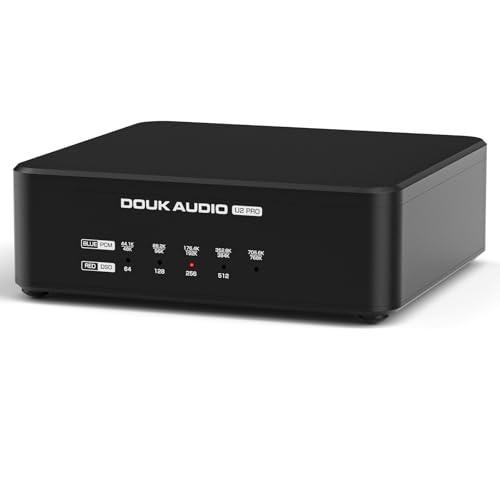
The Douk Audio U2PRO is a dedicated USB-to-optical bridge built around the latest XMOS XU316 chip, which re-clocks and isolates the digital signal from your computer before sending it to an external DAC. It supports PCM up to 32-bit/768kHz and DSD512, making it a serious tool for audiophiles who want to eliminate the electrical noise and jitter common with direct USB connections from a laptop or HTPC.
Three simultaneous digital outputs — optical, coaxial, and HDMI I2S — let you feed a classic DAC that lacks USB input. The UAC mode switch flips between plug-and-play compatibility (UAC 1.0 for PS5, Nintendo Switch) and high-resolution mode (UAC 2.0 for Windows/Mac), and the compact aluminum enclosure keeps RF interference low.
Users report a noticeable improvement in transparency, soundstage, and tonal smoothness when routing audio through the U2PRO versus a direct USB connection. The expandable oscillator bay also appeals to DIY enthusiasts who want to swap in an even higher-precision clock later.
Why it’s great
- Top-tier XMOS XU316 chip reduces jitter and noise floor
- Three output formats (Optical, Coax, I2S) for wide compatibility
- UAC 1.0/2.0 switch works with gaming consoles without drivers
Good to know
- Windows requires driver installation for full high-res support
- No analog output — requires a separate DAC for RCA or 3.5mm
2. StarTech.com SPDIF2AA Digital to Analog Converter

The StarTech.com SPDIF2AA is a no-nonsense digital-to-analog converter that accepts both Toslink optical and coaxial SPDIF inputs and outputs two-channel stereo RCA. It is built in a tough metal chassis that feels substantially more durable than the plastic alternatives, and it does exactly one thing — convert a pure 2-channel PCM stream to analog — without any unnecessary extras or complex setup.
Because it is strictly a 2-channel stereo converter, it will not decode or downmix Dolby Digital 5.1. If you feed it a surround signal, you will get silence. That makes it a perfect match for satellite receivers, older TVs with optical out set to PCM, or CD transports that need to connect to vintage integrated amplifiers with RCA inputs only.
Customer feedback emphasizes its reliability and simplicity. The unit locks onto the incoming signal quickly and stays stable, with no glitches or audio dropouts reported even over long listening sessions in a home theater rack.
Why it’s great
- Rugged metal housing resists wear and RF ingress
- Accepts both optical and coaxial digital inputs
- True plug-and-play — no software or drivers needed
Good to know
- Only supports 2-channel PCM — cannot handle Dolby/DTS 5.1
- No 3.5mm auxiliary output included
3. XPTSFDU 3-in-1 HDMI ARC Audio Converter
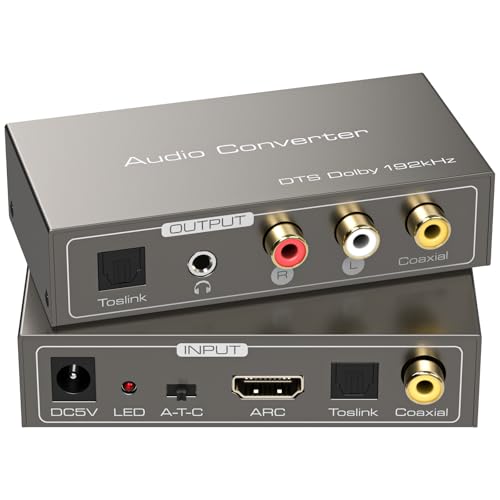
The XPTSFDU converter packs three input options (HDMI ARC, optical Toslink, and coaxial) into a single compact unit, with RCA and 3.5mm analog outputs plus optical and coaxial digital passthrough. A DIP switch on the side lets you toggle between input sources, and the built-in memory retains your last selection even after a power cycle — a small touch that saves reconfiguration each time the TV turns on.
Sampling rate support reaches 192kHz at 24-bit, and the converter accommodates Dolby AC-3, DTS, DSD, and LPCM formats. The optical and coaxial outputs carry the digital signal untouched for a secondary device, while the RCA and 3.5mm jacks output a downmixed stereo analog signal from any 5.1 source. This makes it an excellent hub for a TV that needs to feed both a soundbar (digital) and an older stereo amplifier (analog) simultaneously.
Some users experienced a loud pop at power-on, and the unit lacks CEC volume control — TV remote volume adjustment will pass through only if the amp supports it. Overvoltage protection is a nice safety addition for those plugging into unknown USB power adapters.
Why it’s great
- Three digital input modes cover ARC, optical, and coaxial
- Simultaneous digital passthrough + analog stereo output
- Power-off memory remembers your selected input
Good to know
- Some units produce a loud pop during TV power-on
- No CEC volume control via TV remote
4. avedio Links HDMI ARC Audio Extractor
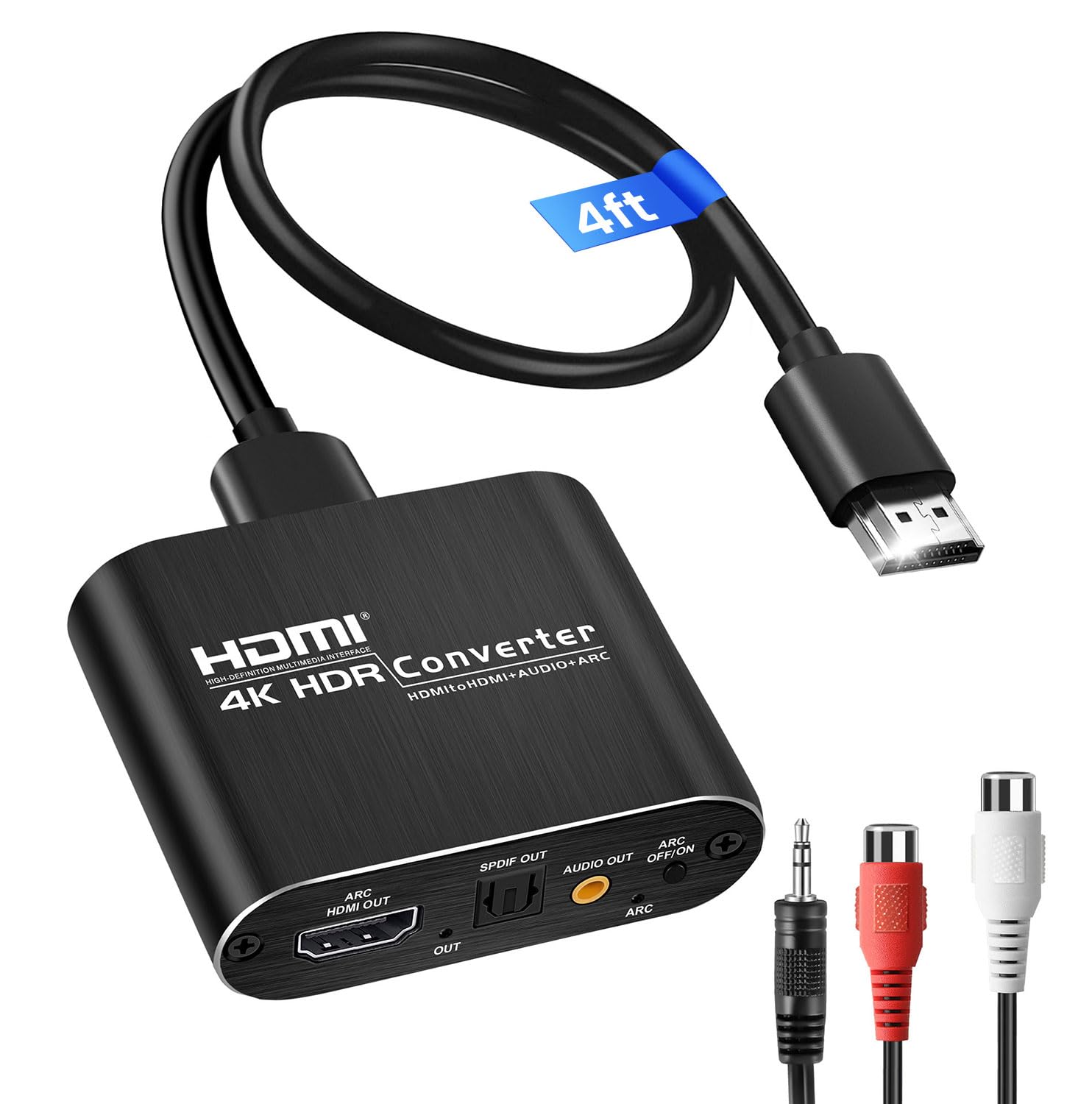
The avedio Links HDMI ARC Audio Extractor passes video through while extracting audio to optical Toslink or 3.5mm analog. It supports 4K resolution at 60Hz with HDCP 2.2 compliance, which means it works with streaming sticks, Blu-ray players, and game consoles without downgrading the video signal. The three mode settings (Pass, 2CH, 5.1CH) let you choose whether to send stereo PCM or pass full 5.1 surround to your sound system.
Unlike simpler ARC-only cables, this unit functions as a full HDMI switch and extractor: one HDMI input feeds an ARC-compatible TV or monitor, while the optical and 3.5mm outputs can drive a soundbar and headphones independently. The plastic shell is lightweight, but the connectors are solid and lock firmly with standard HDMI cables.
Compatibility is broad — it works with Apple TV, Fire TV Stick, PS4, PS5, Xbox, and PC setups. Some users reported intermittent HDMI handshake failures with certain graphics cards, but this is a known edge case with GPU EDID negotiations rather than a widespread flaw.
Why it’s great
- Full 4K@60Hz video passthrough with HDCP 2.2
- Three independent audio outputs (HDMI, Optical, 3.5mm)
- 5.1CH mode sends Dolby/DTS surround via optical
Good to know
- Plastic housing feels less robust than metal alternatives
- Occasional HDMI handshake instability with some GPUs
5. PROZOR 192kHz Digital to Analog Audio Converter
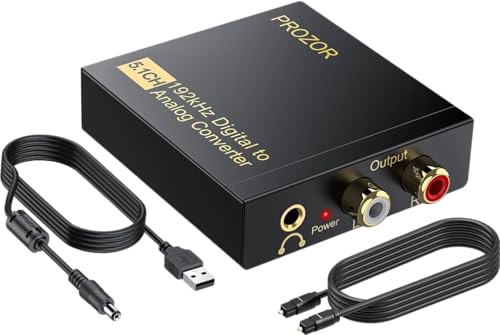
The PROZOR 192kHz DAC converter accepts optical or coaxial digital input and outputs analog stereo over RCA or 3.5mm jacks. It is specifically designed to downmix Dolby Digital and DTS 5.1 surround signals into two-channel analog, which is critical if your TV sends Dolby AC-3 but your powered speakers or vintage receiver only have RCA inputs.
A magnetic ring on the USB power cord reduces power-line noise, and the metal enclosure adds durability compared to many budget converters. The included optical cable and USB power cable mean you can get it running out of the box without a separate trip to the store. The sampling rate tops out at 192kHz at 24-bit, which covers all current streaming and broadcast audio standards.
Users report clean audio with no distortion or sync lag when the source is set to PCM. Dolby ProLogic II upmixing works to create a pseudo-surround effect from the stereo signal, though actual surround separation is limited by the two-channel output hardware.
Why it’s great
- Downmixes Dolby 5.1 and DTS to stereo analog
- Magnetic-ring power cord filters electrical noise
- Comes with optical cable and USB power cable
Good to know
- Requires a 5V/1A USB adapter (not included)
- Rear-channel performance is limited compared to true 5.1 systems
6. Unstincer HDMI ARC to Optical Audio Converter
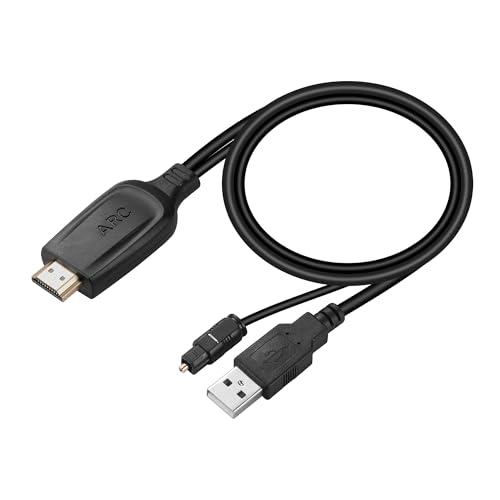
The Unstincer unit is a minimalist ARC-to-optical cable with a built-in converter dongle. Unlike box-style extractors, this one combines the HDMI ARC plug and optical output into a single 1.05-meter cable assembly. It is the simplest way to connect a TV with HDMI ARC to a soundbar or receiver that only has an optical input, with no separate power brick — the USB power tap draws from the TV’s own USB port.
Audio format support includes PCM, Dolby 5.1, and DTS 5.1, all at up to 192kHz sampling rate. Setup is truly plug-and-play: plug the HDMI end into the TV’s ARC port, connect the optical end to the soundbar, and power the converter via any USB-A port. There are no switches, buttons, or menus to configure.
Owners praise the zero-lag detection and clear audio pass-through. However, the integrated cables are very short — about 30 inches from end to end — which limits placement to devices within immediate proximity of the TV panel. The plastic housing is also more fragile than an external box.
Why it’s great
- All-in-one cable design eliminates clutter
- Supports Dolby 5.1 and DTS 5.1 passthrough
- USB powered directly from TV port
Good to know
- Cables are short — devices must be within 30 inches
- No CEC volume control via optical output
7. VPFET HDMI ARC Audio Extractor
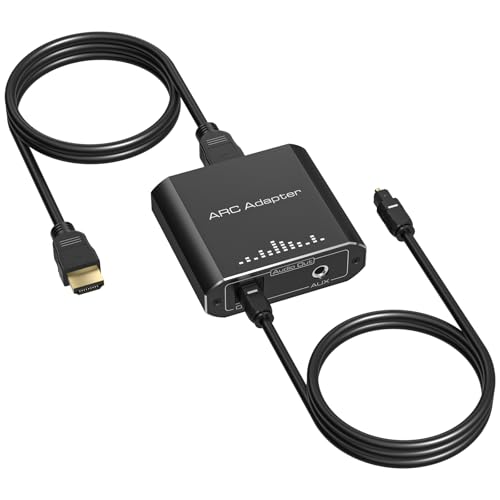
The VPFET HDMI ARC Audio Extractor converts the audio from a TV’s HDMI ARC port into both optical Toslink and 3.5mm analog outputs. The aluminum casing provides better heat dissipation and physical protection than typical plastic converters at this tier, and the included 19+1-pin HDMI cable ensures proper ARC handshake compliance. Sampling rates up to 192kHz at 24-bit preserve detail from streaming content.
A DIP switch-free design means the unit auto-detects the ARC signal, and the optical output supports Dolby and DTS formats while the 3.5mm jack outputs LPCM stereo. This makes it a straightforward solution for connecting a modern TV to an older amplifier or a pair of powered speakers — the 3.5mm output even works with headphones for private listening.
Many buyers successfully paired it with Samsung TVs and Klipsch or Bose audio systems. A notable limitation: some TVs do not recognize the adapter as an audio device through the ARC port, which can result in no sound output. This issue is specific to certain television firmware implementations rather than a defect in the converter itself.
Why it’s great
- Metal housing at a budget-friendly price point
- Optical + 3.5mm dual outputs for flexible connectivity
- Includes HDMI cable and optical cable in the box
Good to know
- Volume must be adjusted on the audio device itself
- ARC compatibility varies between TV brands and firmware versions
FAQ
Will an optical to RCA converter work with HDMI ARC?
Why is there no sound when I connect a Dolby 5.1 source to my converter?
Can I use a USB-to-optical converter to connect my PS5 to an old DAC?
Does optical audio support 4K video passthrough?
Final Thoughts: The Verdict
For most users, the analog to optical converter winner is the Douk Audio U2PRO because it delivers the cleanest digital signal from a computer or gaming console to any external DAC, with support for ultra-high-resolution audio formats. If you need a simple ARC-to-optical cable for connecting a modern TV to an older soundbar, grab the Unstincer ARC Cable. And for versatile multi-input compatibility — ARC, optical, and coaxial feeding both digital and analog outputs — nothing beats the XPTSFDU 3-in-1 Converter.