
Balancing supply registers, verifying duct static pressure, or diagnosing a weak zone in a mini-split system all come down to one number: the actual cubic feet per minute moving through the duct. Without an anemometer that’s built for HVAC work, you’re left guessing at filter changes or relying on a hand-held wind gauge that was never designed to read low-flow grilles or fit inside a supply boot. The difference between a tool that logs CFM data and one that just shows a gust speed on a sailboat is the difference between a real diagnostic and a rough estimate.
I’m Rikta — the co-founder and writer behind Gadgets Feed. I’ve spent hundreds of hours analyzing spec sheets, cross-referencing customer field-test data, and comparing measurement accuracy across dozens of HVAC airflow meters to isolate the models that actually survive the tool bag and deliver repeatable results. (And Homer 🐱 insisted on sitting inside the open carrying case of every unit before I was allowed to close the lid).
Whether you are a residential service tech balancing a two-zone system or a commissioning engineer verifying fume-hood face velocity, the right instrument will save hours per job. This guide breaks down seven of the best current options to help you choose the best anemometer for hvac that matches both your duct type and your budget.
How To Choose The Best Anemometer For HVAC
An HVAC anemometer isn’t a general-purpose wind meter. The duct environment — confined, turbulent, and often low-velocity — demands a unit that can average readings, store data, and calculate CFM from a duct’s cross-sectional area. Three factors separate a good HVAC tool from a weather toy.
Sensor Type: Vane vs. Hot Wire
Vane anemometers use a rotating impeller that spins faster as air velocity increases. They are rugged, affordable, and excellent for supply grilles and larger ducts where the airflow is relatively clean. Hot-wire anemometers heat a thin wire and measure the cooling effect of passing air. They are far more sensitive at low velocities (under 200 FPM) and excel at reading through diffusers and in-duct traverses where turbulence would stall a vane. For broad residential balancing, a quality vane unit like the BTMETER BT-846A works well. For low-flow commercial systems or fume-hood certification, a hot-wire model like the Fieldpiece STA2 is the correct tool.
CFM Calculation & Data Logging
The whole point of an HVAC anemometer is to convert velocity readings into volumetric flow. Look for a unit that lets you input duct dimensions (rectangular height/width or round duct diameter) and displays CFM directly. A meter that logs at least 100 data points with time stamps lets you traverse a register, record the average, and move on without juggling a notebook. Units with USB or Bluetooth export save a second trip back to the truck to transcribe readings.
Probe Length and Form Factor
A handheld meter with a fixed impeller is fine for balancing exposed supply grilles, but in-duct measurements require a telescoping probe. The standard minimum for reaching past a register boot into the duct itself is about 12 inches. The Fieldpiece STA2 extends 38 inches — essential for deep traverses in commercial ductwork. For service techs working on mini-splits or tight ceiling plenums, a compact hot-wire probe like the Testo 405i offers a 15-inch reach in a package that fits in a shirt pocket.
Quick Comparison
On smaller screens, swipe sideways to see the full table.
| Model | Category | Best For | Key Spec | Amazon |
|---|---|---|---|---|
| Fieldpiece STA2 | Hot Wire | In-Duct Commercial Traverse | 38″ telescoping probe | Amazon |
| Testo 405i | Hot Wire | Compact Bluetooth Probing | 15″ telescopic shaft | Amazon |
| BTMETER BT-846A | Vane CFM | Balancing Supply Grilles | 0.001–100 mph range | Amazon |
| AOPUTTRIVER AP-856A | Vane USB | PC Data Export | USB data transmission | Amazon |
| AOPUTTRIVER AP-846A | Pro Vane | High-Precision HVAC | 0.001 mph resolution | Amazon |
| BTMETER BT-100APP | Bluetooth Vane | Wireless Data Logging | Bluetooth 4.0 + App | Amazon |
| HoldPeak 866B | Entry Vane | Quick HVAC Checks | 0.67–67.1 mph range | Amazon |
In‑Depth Reviews
1. Fieldpiece STA2 In-Duct Hot Wire Anemometer
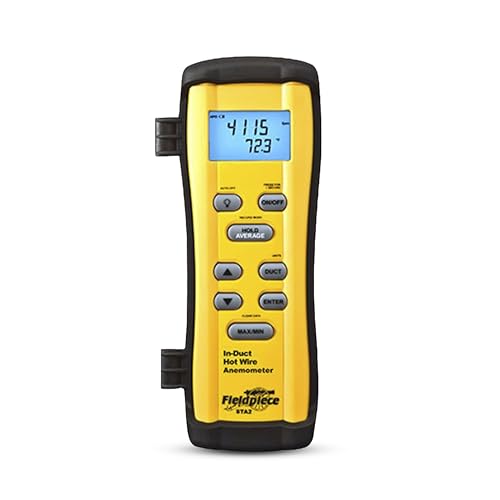
The Fieldpiece STA2 is the gold standard for HVAC technicians who spend their days balancing commercial systems where a capture hood won’t fit. Its hot-wire sensor reads low velocities — down to the range of 50 FPM — where vanes stall, and the 38-inch telescoping probe reaches deep into ductwork past the turbulence of the register boot. The dual display shows CFM, velocity, and temperature simultaneously, eliminating menu-toggling in the middle of a traverse.
A stabilizing cone and magnetic hanger let you set the probe in position and walk away while the averaging function builds a representative sample across the duct cross-section. The unit calculates CFM automatically once you input the duct dimensions. In field tests against a flow hood, experienced users report readings within 90 percent of the hood value, which is impressive for an in-duct traverse tool that fits in a standard tool bag.
The trade-off is the price point and the learning curve. The STA2 is the most expensive unit here, and new users consistently report needing a few hours of practice before their traverse technique produces stable numbers. The 9-volt battery is a minor annoyance in an era of rechargeable gear. For the professional who balances duct systems every week, however, the STA2 pays for itself in diagnostic speed and credibility.
Why it’s great
- Hot-wire sensor accurate at very low velocities where vanes stall
- 38-inch probe reaches deep into ducts past register turbulence
- Real-time CFM display after duct dimension input
Good to know
- Steep price — a significant investment for occasional use
- Requires practice to produce repeatable traverse readings
- Powered by a single 9V battery, not rechargeable
2. Testo 405i Hot Wire Anemometer

The Testo 405i delivers the sensitivity of a hot-wire sensor in a compact form that lives in your shirt pocket. Its telescoping shaft extends to 15 inches — enough to reach past most residential register boots and take a reading inside the duct. The Bluetooth 4.0 connection pairs instantly with the free Testo Smart Probe App, which displays air velocity, temperature, and calculated volume flow as live readings, graphs, or logged data exports.
Because the sensor element is a hot wire rather than a spinning vane, the 405i responds instantly to low-flow conditions that would not even register on a budget mechanical impeller. Users report it working beautifully for dust collection system balancing, fume-hood spot checks, and verifying filter loading by tracking CFM drop across a coil. The app lets you store and email reports right from the jobsite, which is a genuine time-saver for service techs who write up findings.
The limitation is that the probe is fragile — the thin wire element can accumulate buildup in dirty duct environments and may eventually need replacement. The 6,000 FPM maximum velocity is fine for HVAC but will not cover high-velocity industrial applications. Some users also wish for a hard mounting thread for fixturing, as the probe body is shaped primarily for hand-held use. For any HVAC professional who wants a Bluetooth-connected hot-wire probe without spending Fieldpiece money, the 405i is the sweet spot.
Why it’s great
- Instant Bluetooth connectivity with excellent smartphone app
- Hot-wire sensor reads low velocities accurately
- Compact enough for pocket carry between jobs
Good to know
- Sensor element can foul in dirty ducts over time
- Maximum velocity of 6,000 FPM limits high-speed use
- No threaded mount for fixed-fixture applications
3. BTMETER BT-846A Pro HVAC Anemometer
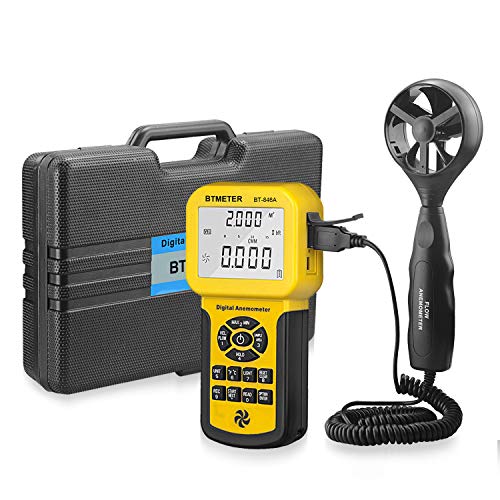
The BTMETER BT-846A is the unit that strikes the best balance between professional CFM functionality and a price that does not require a supervisor’s sign-off. It features a separate extendable vane sensor on a wire tether, which lets you place the impeller inside a duct or in front of a diffuser while keeping the main body and its large backlit display in your line of sight. The wind speed range extends from 0.001 mph up to 100 mph, with accuracy rated at +/- 3 percent of reading plus 0.2.
The CFM calculation is the headline feature for HVAC work. You enter the duct cross-sectional area, and the meter displays CFM in real time alongside CMM. It can store up to 600 data groups, covering current, max, min, average, and 2/3 max readings — more than enough for a full house-balancing session. The impeller is low-friction and responds to very light airflow, and the tether means you can prop the meter on a ladder while the sensor stays in place.
The most common complaint is that the battery compartment is secured with screws and a rubber O-ring — good for dust sealing, but annoying when you need to swap batteries quickly. The manual is also fairly bare-bones for new users. A few units have had USB port reliability issues. For any tech doing regular residential or light commercial air balancing on a moderate budget, the BT-846A is the smartest buy in the list.
Why it’s great
- Separated impeller sensor lets you read in awkward duct positions
- 600-group data log covers an entire day of balancing
- Wide 0.001–100 mph range with solid accuracy for the class
Good to know
- Battery cover requires screwdriver to open
- USB port reported as unreliable on some units
- Included manual provides minimal guidance for beginners
4. AOPUTTRIVER AP-856A Pro HVAC Anemometer

The AOPUTTRIVER AP-856A targets the technician who needs to document airflow readings for commissioning reports or maintenance records. It includes a USB cable and companion disc for exporting logged data to a PC, making it one of the few mid-range vane meters that offers a genuine data-transfer workflow rather than just manual transcription. The wind speed range and accuracy mirror the BT-846A (0.001–100 mph with +/- 3%+0.2 rdg), and the CFM calculation supports both rectangular and round duct area inputs.
Users who have cross-checked the AP-856A against a calibrated airflow hood report results within approximately 4 percent of the hood readings, which is excellent for a handheld vane meter at this price tier. The stretchable and adjustable blades are easy to deploy in tight spaces, and the large backlit display with MAX/MIN/Current modes gives you everything you need for a standard duct traverse. The 2-year manufacturer support is a meaningful warranty commitment that adds confidence.
The weak link is the documentation. Multiple users describe the manual as poorly translated and difficult to follow, particularly for the data-recording and PC-export functions. Some buyers have found the included software incompatible with modern Windows 10 and 11 systems. If you only need quick handheld reads, the AP-856A is a solid meter. If you specifically need USB data transfer, verify that your OS is supported before committing.
Why it’s great
- USB data export enables proper job documentation
- Tested accuracy within 4% of professional flow hoods
- 2-year manufacturer technical support included
Good to know
- Manual is poorly translated and hard to follow
- PC export software may not work with newer Windows versions
- No Bluetooth or wireless connectivity option
5. AOPUTTRIVER AP-846A Pro HVAC Anemometer

The AOPUTTRIVER AP-846A is essentially the same core vane anemometer platform as the AP-856A but without the USB data export hardware, which lowers the entry cost while keeping the same 0.001 mph resolution and 0.001–100 mph range. For technicians who only need handheld readings and do not require PC transfer, this model represents a cleaner buy — you get the same impeller sensitivity and CFM calculation without paying for a feature you will not use.
Like its sibling, the AP-846A allows you to input a duct cross-sectional area and display CFM or CMM readings in real time. The 1.69 x 2.3-inch backlit display is bright enough for dim mechanical rooms, and the stretchable blades make it easy to hold the sensor head in front of a grille while reading the screen. Users who have compared it against a calibrated hood report the same 4 percent accuracy delta as the AP-856A, which is consistent and reliable for HVAC balancing.
The same documentation complaint carries over — the manual is borderline unreadable. A few users have flagged the auto-power-off timeout (5 minutes) as too short for methodical traverse work. The AP-846A also lacks the averaging functionality that makes multi-point traverses faster on the higher-end units. For a straightforward vane meter that does CFM calculation without unnecessary extras, this is a solid mid-range choice.
Why it’s great
- Sensitive 0.001 mph resolution captures low airflow
- Real-time CFM display after duct area input
- Tested accuracy within 4% of professional flow hoods
Good to know
- Manual is poorly translated and unhelpful
- Auto power-off at 5 minutes interrupts long traverses
- No data recording or export capability
6. BTMETER BT-100APP Bluetooth Anemometer

The BTMETER BT-100APP brings wireless Bluetooth connectivity to the sub-fifty-dollar price bracket, and it is the only unit in this range that charges via USB-C rather than consuming disposable batteries. The companion app auto-pairs with iOS and Android devices and logs data as .xls or .txt files that you can email directly from the field. The 8-vane impeller and dual temperature sensors deliver the same sensitivity profile as the non-Bluetooth BTMETER models, covering 0.67 to 67.1 mph with a +/- 5 percent accuracy rating.
The Bluetooth range is surprisingly robust for a budget unit — users report stable connections through walls at over 30 feet, which means you can leave the meter positioned at a grille and watch the readings on your phone from the thermostat or the air handler. The tripod mount (1/4-inch metal thread) enables hands-free continuous monitoring, and the data log feature lets you set the meter up and collect a time-series sample without standing there holding it.
The app and the meter each have small irritations. Some users find the app interface sluggish, with the average function only working for temperature and not for airflow. A few units shipped with temperature readings off by about 3 degrees Fahrenheit, and the manual provides almost no guidance on the Bluetooth setup. For the price, the BT-100APP is a great entry point into wireless data logging, but treat it as a relative-delta tool for balancing rather than an absolute calibration standard.
Why it’s great
- Wireless Bluetooth logging with .xls/.txt email export
- USB rechargeable — skip the disposable battery hassle
- Solid Bluetooth range for remote monitoring at the grille
Good to know
- App interface can feel sluggish for real-time readings
- Temperature accuracy reported off by a few degrees on some units
- Manual provides minimal Bluetooth setup guidance
7. HoldPeak 866B Handheld Anemometer with Tripod

The HoldPeak 866B is the most affordable vane anemometer on this list, and it earns its place by offering a complete kit — meter, small tripod, wrist strap, and protective carrying case — at an entry-level price that makes it painless to keep one in every service vehicle. The 8-vane impeller measures wind speed from 0.67 to 67.1 mph with +/- 2 percent accuracy, which is tight for this tier, and the dual temperature sensors provide wind chill and ambient temperature readings.
The built-in stand and the included mini tripod give you several hands-free positioning options that are rare at this price. You can set the meter on a duct surface or mount it on the tripod for a stable traverse position. The backlit display and battery indicator are welcome touches. For quick HVAC checks — verifying that a supply register is moving air, rough CFM estimation, or balancing draft in a residential system — the 866B gets the job done without breaking the budget.
The compromises show up in durability and consistency. The included tripod is widely described as flimsy with threads too small for the meter, and the temperature sensor takes up to 30 minutes to stabilize if the unit was stored in a hot or cold environment. A few users have reported electromagnetic damage after placing the meter on top of an electric meter box, suggesting the internal microprocessor is not well shielded. Use the 866B as a reliable quick-check tool, not as a primary balancing instrument for critical jobs.
Why it’s great
- Complete kit with tripod and case at a very accessible price
- +/- 2% wind speed accuracy is strong for the budget class
- Built-in stand and tripod mount for hands-free use
Good to know
- Included tripod is poor quality with mismatched threads
- Temperature sensor needs 30 minutes to stabilize
- Microprocessor appears vulnerable to electromagnetic interference
FAQ
Do I need a vane meter or a hot-wire meter for HVAC work?
How do I calculate CFM with a duct traverse?
Can I use a weather anemometer for HVAC balancing?
Why does my anemometer show different readings at the same register?
Final Thoughts: The Verdict
For most users, the anemometer for hvac winner is the BTMETER BT-846A because the separated extendable vane sensor, 600-group data log, and accurate CFM calculation deliver real job-site value without crossing into Fieldpiece territory on price. If you need hot-wire sensitivity and Bluetooth data export in a pocket-sized probe, grab the Testo 405i. And for the professional balancing commercial ductwork every day, nothing beats the Fieldpiece STA2 for in-duct traverse accuracy and deep probe reach.