
A single electrostatic discharge you cannot feel can silently destroy a motherboard, a logic board, or a delicate microcontroller during a repair. The primary defense against this invisible threat is not a grounding bracelet alone—it is the surface you work on. An antistatic table mat dissipates that charge before it ever reaches your components, turning your workbench from a hazard into a controlled zone. Without a properly specified mat, every PC build, phone repair, or soldering session carries unnecessary risk.
I’m Min — the co-founder and writer behind Gadgets Feed. My research for this guide involved cross-referencing surface resistivity specs, grounding accessory compatibility, and heat tolerance ratings across dozens of models to separate genuine ESD protection from marketing claims.
Whether you are assembling a gaming rig, reflowing a laptop board, or sorting sensitive components, choosing the right surface matters. This analysis covers the most reliable best antistatic table mats on the market today, matched to real workflows and budgets.
How To Choose The Best Antistatic Table Mats
Antistatic mats are simple in concept but vary significantly in material science, grounding method, and size. Picking the wrong type means your sensitive electronics remain unprotected. Focus on three decisive factors before you buy.
Surface Resistivity and Material Composition
The primary job of an antistatic mat is to provide a controlled path for static charge to bleed away. The surface resistivity should fall between 10⁶ and 10⁹ ohms—low enough to dissipate charge quickly, but high enough to prevent a direct short. Two-layer rubber mats often achieve this with a dissipative top and a conductive bottom. Silicone mats can also meet this range, but verify the spec rather than assuming. PVC mats are common but offer less durability under soldering heat and solvents.
Heat Resistance and Chemical Tolerance
If you plan to solder directly on the mat, silicone is the clear winner with ratings up to 932°F (500°C). Neoprene and PVC mats will melt or deform under direct iron contact. For electronics repair involving flux, isopropyl alcohol, or solvents, a chemically resistant surface prevents the mat from degrading over time. Rubber excels here, while silicone handles most cleaning agents well.
Grounding Accessories Included
A mat without a grounding path is just a pretty placemat. Look for kits that include a ground cord with either a banana plug, alligator clip, or ring terminal, plus an ESD wrist strap with a built-in 1 MΩ resistor to protect you if you accidentally touch a live circuit. The mat itself should have a snap stud or conductive tab to attach the ground wire. Without these accessories, the mat cannot perform its primary function.
Quick Comparison
On smaller screens, swipe sideways to see the full table.
| Model | Category | Best For | Key Spec | Amazon |
|---|---|---|---|---|
| Kaisi Large Anti Static Mat | ESD Silicone | Full electronics repair station | Surface Resistivity 10⁶ Ω | Amazon |
| Weller ESD Mat | ESD Rubber | Pro workshop durability | 35.4 x 23.6 in. size | Amazon |
| RubberStat Dual Layer Kit | ESD Rubber | ANSI-compliant workstation | Dual-layer dissipative/conductive | Amazon |
| Hooandxk Extra Large Anti Static Mat | ESD Silicone | Spacious motherboard work area | 27.6 x 15.7 in. size | Amazon |
| StarTech.com Anti Static Mat | ESD PVC | PC building and general desk use | ANSI/ESD S4.1 compliant | Amazon |
| Kaisi Soldering Mat | Silicone | Soldering projects with part storage | Heat resistant to 932°F | Amazon |
| Performance Tool Neoprene Mat | Neoprene | General bench surface protection | 3 mm cushioned rubber backing | Amazon |
In‑Depth Reviews
1. Kaisi Large Anti Static Mat with Grounding Accessories
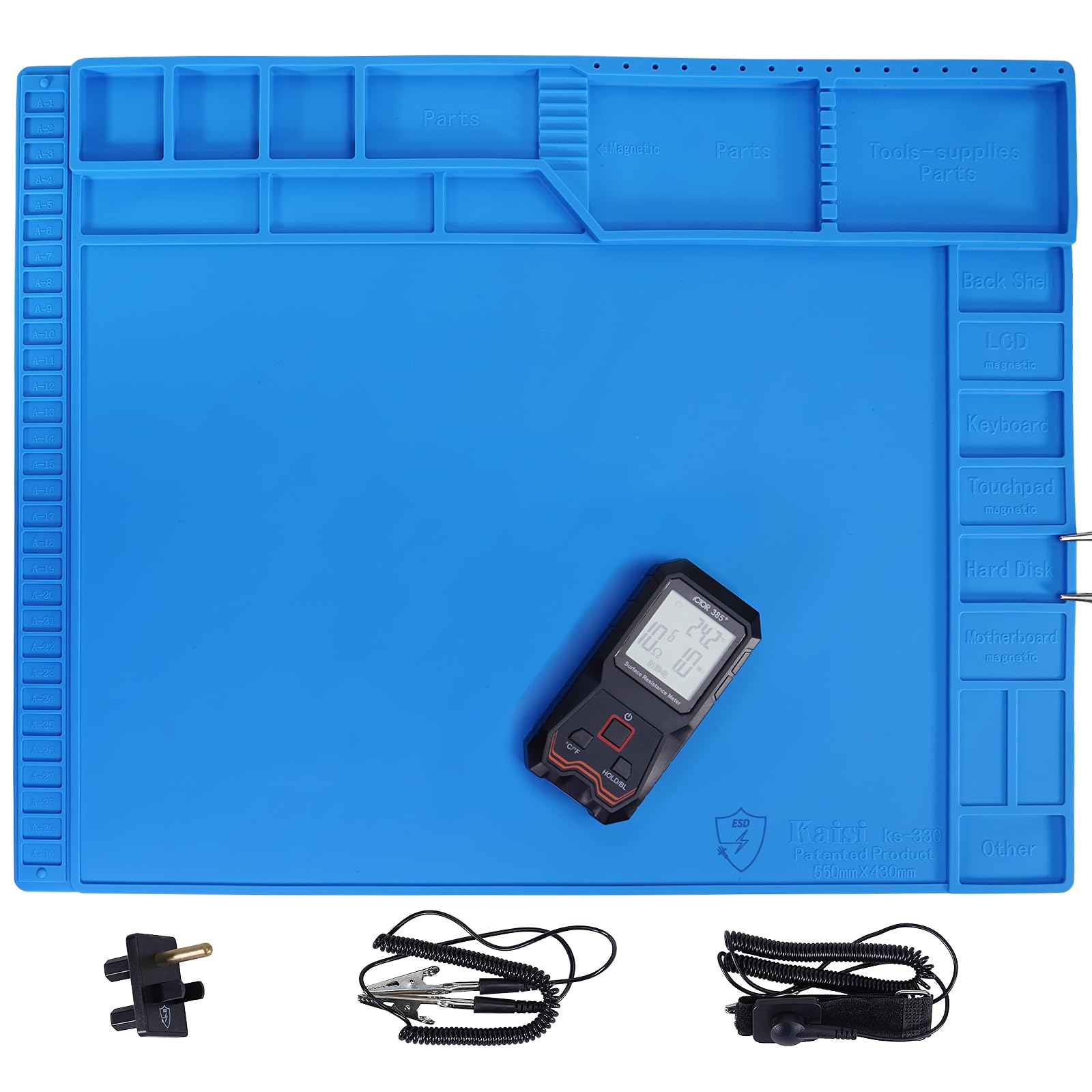
This Kaisi mat is built for serious electronics work, combining a legitimate 10⁶ Ω surface resistivity rating with a 21.6 x 16.9-inch silicone work area. The material withstands soldering temperatures up to 932°F without deforming, so you can place hot irons and hot air stations directly on the surface without worry. The 48 built-in parts storage positions keep tiny screws and capacitors segregated during complex repairs, which eliminates the frantic search across the bench after dropping a component.
The included grounding accessories set this kit apart from cheaper silicone alternatives. You get a grounding plug, a grounding wire, and an ESD wrist strap — everything needed to connect the mat to an earth ground and complete the protection loop. Multiple verified buyers confirmed the surface resistivity measures within spec, which is rare for mats in this price tier. The silicone material is soft enough to prevent components from sliding but firm enough to support heavy tools.
One trade-off is the 30-day return window, which is shorter than premium competitors. Some users also noted the mat arrived folded rather than rolled, though it flattened out after a short time under weight. For a mid-range investment that delivers certified ESD performance with full grounding hardware, this is the most complete package available.
Why it’s great
- Verified 10⁶ Ω surface resistivity with full grounding kit included
- Heat resistant to 932°F for direct soldering
- Large 21.6 x 16.9 in. area with 48 parts storage slots
Good to know
- 30-day warranty is shorter than premium alternatives
- Mat may arrive with fold creases that take time to settle
2. Weller ESD Mat, Blue 900 x 600

Weller brings decades of soldering tool expertise into this 900 x 600 mm ESD mat, making it the clear choice for professionals who need a large, durable surface. The mat measures 35.4 x 23.6 inches, providing enough room for a full motherboard, a soldering station, and hand tools simultaneously. The material is permanently elastic and abrasion-resistant, so it holds its shape even after months of daily use in a repair shop.
The mat includes two 10 mm press stud connectors, one on each side, so you can attach a wrist strap from either hand position. The underside is grippy and conductive, designed to sit on a metal workbench for direct grounding. Solder splatters do not damage the surface, and the material resists oils and soldering chemicals. One buyer reported using it on a metal table connected to earth ground via the second stud, achieving a solid dissipation path.
At the higher end of the price spectrum, this mat does not include a wrist strap or ground cord — those are sold separately. Some users felt the brand premium was noticeable but noted that equivalent generic mats can be found for less. If your work demands a proven brand with industrial build quality and maximum surface area, this Weller mat is built to last for years in a demanding environment.
Why it’s great
- Extra-large 35.4 x 23.6 in. surface for full motherboard work
- Permanently elastic and abrasion-resistant construction
- Two press studs for ambidextrous wrist strap connection
Good to know
- Wrist strap and ground cord sold separately
- Premium price reflects brand and build quality
3. RubberStat Dual Layer ESD Compliant Workstation Rubber Table Mat Kit

RubberStat’s dual-layer mat is engineered to meet ANSI/ESD S20.20 standards, making it a strong choice for workshops that require compliance documentation. The top layer is static-dissipative rubber while the bottom layer is conductive rubber, creating a clear path for charge to flow to the ground connection. The 24 x 24-inch size is practical for soldering stations and phone repairs without overwhelming a standard desk.
The kit includes an adjustable wrist strap and a 15-foot ground cord, so you have everything needed to set up a compliant workstation straight out of the box. Users measured point-to-point resistance around 3 MΩ and 6 MΩ with the strap connected, well within the ideal dissipation range. The rubber material resists soldering heat and solvents far better than PVC alternatives, and the grip on the bottom prevents shifting during use.
One downside is the snap for the ground connection is not pre-installed — you need to cut a small slit with a knife or punch a hole to attach it. Some initial batches also had a strong rubber odor that required airing out. For the price, getting a properly spec’d dual-layer rubber mat with full grounding accessories is a rare deal in this category.
Why it’s great
- ANSI/ESD S20.20 compliant dual-layer rubber construction
- Includes 15 ft ground cord and adjustable wrist strap
- Excellent resistance to soldering heat and solvents
Good to know
- Snap stud requires DIY installation with a knife or punch
- Strong rubber odor may need days to dissipate
4. Hooandxk Extra Large Anti Static Soldering Mat
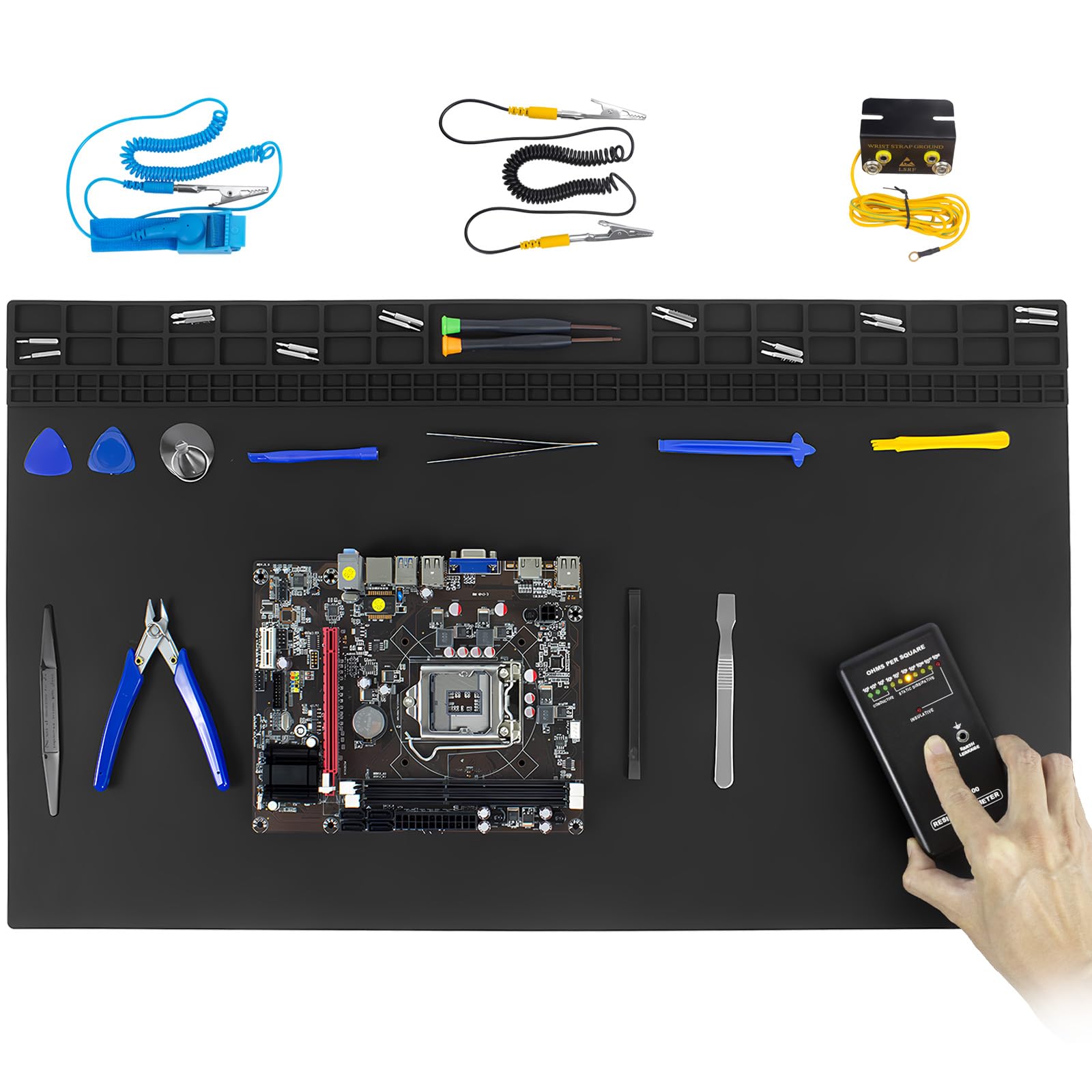
The Hooandxk mat prioritizes workspace coverage with a 27.6 x 15.7-inch silicone surface that fits full-size motherboards and laptop chassis without crowding. The material is rated for surface resistivity between 10⁶ and 10⁹ Ω, and multiple independent buyers verified the dissipation performance using testers. The silicone withstands 932°F soldering temperatures, so you can reflow connectors and replace components directly on the mat.
This kit also ships with a full grounding set: an ESD wrist strap with 1 MΩ resistor, a coiled ground cord, and a standard ground cord. The included components allow you to ground both the mat and yourself simultaneously. The silicone surface is foldable and portable, making it useful for technicians who move between workstations or bring gear to remote repair jobs.
The wrist strap is on the shorter side, which can be limiting if your workbench layout requires extra slack. Some buyers also noted that the silicone attracts dust and hair more readily than rubber mats. For the price, this is one of the largest certified ESD silicone mats available, offering a generous work area for complex builds.
Why it’s great
- Extra-large 27.6 x 15.7 in. work area for full motherboard builds
- Verified 10⁶–10⁹ Ω surface resistivity with full grounding kit
- Heat resistant to 932°F for direct soldering
Good to know
- Included wrist strap is shorter than ideal for some setups
- Silicone surface attracts dust and hair over time
5. StarTech.com Anti Static Mat, ESD Mat for Electronics Repair

StarTech brings TAA compliance and ANSI/ESD S4.1 certification to a compact 11.8 x 18.1-inch PVC mat designed for PC builders and general electronics work. The two-layer PVC construction includes a textured black bottom that grips the desk and a beige top that resists staining from incidental contact. The mat comes with a 6.6-foot grounding wire featuring a snap-on clip for quick connection, plus a banana plug for wall outlet grounding.
Users consistently praise how well it lays flat out of the box — no curling at the corners. The soft PVC surface prevents laptop feet from sliding and actually dampens typing noise when used as a desk cover. The mat is flexible enough to roll up for storage, making it a practical choice for hobbyists who need a portable ESD surface. Multiple reviews confirm the grounding wire works effectively and the alligator clip reaches several feet beyond the mat edge.
The key limitation is heat: PVC melts under direct soldering iron contact, so this is not suitable for reflow work. The white surface shows stains from flux and grease more readily than darker mats. For pure PC building, bench assembly, and component handling where soldering is minimal, this is a solid, certified option backed by a 3-year warranty.
Why it’s great
- ANSI/ESD S4.1 certified with 3-year warranty
- Lays perfectly flat with no curling out of the package
- Includes 6.6 ft grounding wire with banana plug and clip
Good to know
- PVC material melts under direct soldering iron contact
- Light beige surface shows stains from flux and grease
6. Kaisi Large Soldering Mat Heat Resistant with Anti Static Wrist Strap

This Kaisi soldering mat is built specifically for high-heat work, featuring a silicone surface rated up to 932°F that tolerates direct iron and hot air contact without damage. The 21.6 x 16.9-inch work area includes 48 molded slots for screws and small components, keeping every tiny piece from rolling away during a motherboard or laptop repair. The material is soft enough to protect delicate circuit boards from scratches while providing a stable base for precision work.
The kit includes an ESD wrist strap to reduce the risk of static damage, though the manufacturer explicitly notes this is not an antistatic mat — it is a heat-resistant silicone mat with a wrist strap. That distinction matters: if your primary concern is ESD protection, you need a mat with certified surface resistivity like the Kaisi Anti Static version. For soldering-focused work where heat resistance is the priority and basic wrist-strap grounding is sufficient, this mat delivers excellent value.
Buyers who use it for model building and electronics repair appreciate the organized parts layout and easy cleanup — spills wipe off without staining. The magnetic properties of the silicone help hold small steel tools in place. Some users found the 21.6-inch depth slightly cramped when spreading out a full tool set. For dedicated soldering stations where heat tolerance matters most, this is a well-designed silicone work surface.
Why it’s great
- Withstands direct soldering iron contact at 932°F without damage
- 48 built-in storage slots keep small parts organized
- Magnetic surface holds steel tools and prevents sliding
Good to know
- Not an ESD mat — no surface resistivity rating for static dissipation
- Some users find the 16.9-inch depth constraining with full tool sets
7. Performance Tool W88977 Neoprene Mat with Ruler and Reference Charts

The Performance Tool W88977 is a neoprene work mat designed primarily for bench surface protection rather than certified ESD performance. The 16 x 35.75-inch surface is large enough to cover a standard workbench section, with a 3 mm rubber backing that prevents sliding and cushions tools. The top thermo-fiber layer resists solvents, oils, and moisture, making it suitable for mechanical work, gun cleaning, or hobby painting where chemical spills are common.
Printed reference charts for SAE/metric conversions, fluid ratios, and a ruler add convenience for general shop tasks. The fully stitched edges prevent fraying, and the mat rolls up easily for storage. Buyers consistently report it lays flat out of the box (though some creases may persist for a while) and cleans up well with a brush or rag. The cushioned surface also dampens tool noise, which is a welcome benefit during long repair sessions.
This mat has no ESD rating and is not designed for static-sensitive electronics work. The neoprene material will not withstand direct soldering iron contact like silicone. For a general-purpose bench protector that handles chemicals and provides a clean, organized surface for mechanical projects, this is a solid entry-level option at a very accessible price.
Why it’s great
- Chemical-resistant neoprene protects benchtops from solvents and oils
- Stitched edges prevent fraying and extend mat life
- Printed reference charts and ruler add shop utility
Good to know
- No antistatic properties — not suitable for electronics ESD protection
- Neoprene will melt under direct soldering iron contact
FAQ
Can I use a silicone baking mat as an antistatic mat?
Do I need to ground the mat if I am only using a wrist strap?
How often should I test my antistatic mat surface resistivity?
Can I solder directly on a rubber ESD mat?
Final Thoughts: The Verdict
For most users, the best antistatic table mats winner is the Kaisi Large Anti Static Mat because it delivers verified 10⁶ Ω surface resistivity, includes a full grounding kit with wrist strap, and withstands soldering heat up to 932°F at a mid-range price. If you need maximum workspace for motherboard-level repairs, grab the Weller ESD Mat with its 35.4 x 23.6-inch surface. And for a certified ANSI-compliant kit that includes everything out of the box at a great value, nothing beats the RubberStat Dual Layer Mat Kit.