
Rope slippage under load is the single most dangerous moment in any ascent, whether you are working a big wall, saddle hunting from a tree, or conducting a technical rescue. A dedicated ascender for climbing converts that anxiety into a mechanical grip that only tightens as you pull — but choosing the wrong cam design or rope diameter match can turn a critical tool into a liability.
I’m Min — the co-founder and writer behind Gadgets Feed. My analysis of this category goes beyond spec sheets: I have stacked the cam profiles, rope compatibility ranges, and material choices of seven distinct ascender designs against real-world user feedback to separate marketing from actual bite.
The market offers everything from 35-gram emergency blocks to full chest-mounted systems, and selecting the right ascender for climbing means knowing where your rope diameter, cam material, and intended load frequency intersect.
How To Choose The Best Ascender For Climbing
An ascender is fundamentally a mechanical ratchet — a toothed or toothless cam that rotates freely in one direction and locks under load in the other. The entire buying decision boils down to matching that cam’s behavior to your rope construction, your use frequency, and whether you need a quick emergency block or a tool for long, repetitive ascents.
Match Cam Aggression to Rope Protection
Ascenders with sharp stainless steel teeth — like the Wild Country Ropeman 2 or the PETZL TIBLOC — provide immediate, almost instant grip even on wet or icy ropes. The trade-off is aggressive bite marks on your rope sheath, especially if you use the device repeatedly on the same section of line. A toothless cam design, such as the Notch Jet Step, eliminates sheath damage entirely by using friction geometry rather than metal teeth, but requires slightly more setup to engage correctly.
Know Your Rope Diameter Window
Every ascender specifies a rope diameter range — 8 to 11 mm, 8 to 13 mm, or 11 to 13 mm. Using an ascender on a rope outside its window either fails to grip (too thin) or jams the cam (too thick). If you use a skinny 8 mm static line for saddle hunting, the PETZL TIBLOC and the Kong Duck will work reliably. If you climb on thicker 12.5 mm dynamic ropes, the Wild Country Ropeman 2 or the PETZL Croll chest ascender accommodate that extra diameter.
Emergency Block vs Dedicated Ascender
A passive emergency ascender like the Kong Duck or PETZL TIBLOC is compact enough to live on your harness as a backup, but it is not designed for hundreds of feet of repetitive ascending. For sustained rope walking, tree work, or big-wall jugging, a hand ascender with an ergonomic handle (like the Paliston pair) or a chest-mounted system (the PETZL Croll) distributes the load across your body and saves your forearms from fatigue.
Quick Comparison
On smaller screens, swipe sideways to see the full table.
| Model | Category | Best For | Key Spec | Amazon |
|---|---|---|---|---|
| Wild Country Ropeman 2 | Premium Hand Ascender | Big wall & saddle hunting | 8–13 mm / 3.25 oz / CE EN567 | Amazon |
| PETZL Croll Chest Ascender | Premium Chest Ascender | Sustained rope ascents | 8–13 mm / stainless cam | Amazon |
| Notch Jet Step Foot Ascender | Premium Foot Ascender | Zero rope damage & rescue | 8–13 mm / toothless dual cam | Amazon |
| Paliston Hand Ascender (2-Pack) | Mid-Range Hand Ascender | Arborist & left/right setup | 8–12 mm / ergonomic handle | Amazon |
| PETZL TIBLOC Emergency Ascender | Mid-Range Emergency | Ultra-light backup & rescue | 8–11 mm / 35 g / stainless cam | Amazon |
| Kong Italy Duck Alu Alloy | Budget Emergency Block | Saddle hunting on 8–10 mm | 8–13 mm / 0.07 kg | Amazon |
| Kong Duck Rope Clamp (Green) | Budget Emergency Block | Multiuse belay & self-rescue | 8–13 mm / metal construction | Amazon |
In‑Depth Reviews
1. Wild Country Ropeman 2

The Ropeman 2 is the gold standard for a reason: hot-forged side plates drop the weight to just 3.25 oz while the stainless steel cam and axle resist corrosion through seasons of alpine grit and sweat. The 8-to-13 mm rope window covers everything from skinny 8 mm static lines to thick 13 mm haul ropes, making it the single most versatile ascender on this list.
Users report that the updated tooth geometry on the MK2 version provides exceptional bite under load, but that same aggression can leave visible wear marks on the rope sheath if you use it repeatedly on the same section. This is a trade-off that matters if you are climbing on expensive dynamic ropes — the Ropeman 1 was gentler, but its older design only worked on thicker lines.
The wire lock tab requires a deliberate palm-push to disengage, which some users find fiddly compared to a thumb trigger, but the safety benefit is clear: the cam cannot accidentally open under load. For saddle hunting and big-wall jugging, this ascender has earned its reputation as the first tool most climbers reach for.
Why it’s great
- Hot-forged side plates save weight without sacrificing strength
- Widest rope diameter range (8–13 mm) in a hand ascender
- Stainless steel cam resists rust and holds grip on wet ropes
Good to know
- Aggressive teeth can fray rope sheath under frequent use
- Wire lock tab requires two hands to disengage smoothly
2. PETZL Croll Ventral Chest Ascender

The PETZL Croll is the benchmark chest ascender for long, sustained rope ascents. By attaching to your chest harness via a dedicated slot, it keeps your body upright and reduces the forearm pump that comes from pulling on a hand ascender alone. The large version features a wider rope groove that minimizes friction on swollen or stiff ropes between 8 and 13 mm.
A stainless steel wear plate along the channel protects the body from the abrasive sawing of the rope, which extends the device’s lifespan significantly compared to all-aluminum competitors. The toothed cam includes a self-cleaning slot that sheds mud and ice — a detail that matters when you are ascending in alpine or wet conditions where grit normally contaminates the grip.
The integrated safety catch is designed to prevent accidental snagging on gear loops or webbing, and users report the one-handed opening is intuitive once you develop the muscle memory. The only consistent critique is the thumb release lever could be slightly larger for gloved hands, but this is a minor ergonomic point on an otherwise flawless device for vertical progression.
Why it’s great
- Keeps body upright for fatigue-free long ascents
- Self-cleaning cam slot sheds mud and ice reliably
- Stainless steel wear plate resists grooving from rope friction
Good to know
- Requires a compatible chest harness to function properly
- Thumb release is slightly small for work gloves
3. Notch Jet Step Foot Ascender

The Notch Jet Step solves a problem that plagues every toothed foot ascender: rope damage. Its unique dual-cam design uses gear-like teeth without sharp points, gripping the rope through friction geometry rather than biting into the sheath. For arborists and rescue professionals who ascend the same line repeatedly, this is the difference between retiring a rope after a few sessions or getting months of use out of it.
Rope entry and exit are genuinely tool-free — you simply pop the rope in and out of the slot without fighting a stiff spring. The lower spring tension reduces drag as you step upward, meaning the ascender self-tends more smoothly than any tooth-based competitor. Users who have compared it to the Climbing Technology Quick Step report that the Jet Step slides up stiff ropes without hesitation, whereas the Quick Step often hesitates or hangs.
The strap buckles are the weak point: they require two hands to cinch down tightly and the lower strap needs to be secured first before the upper strap. A few users have swapped the buckles entirely, but the cam mechanism itself is rated with a lifetime warranty and is made in the USA. If zero rope wear is your priority, this is the ascender to own.
Why it’s great
- Toothless cams cause zero rope sheath wear
- Low spring tension allows smooth, self-tending upward motion
- Ambidextrous design works on either foot without modification
Good to know
- Strap buckles are stiff and hard to adjust with one hand
- May not slide up rope without a hanging tail to tension it
4. Paliston Hand Ascender (2-Pack)
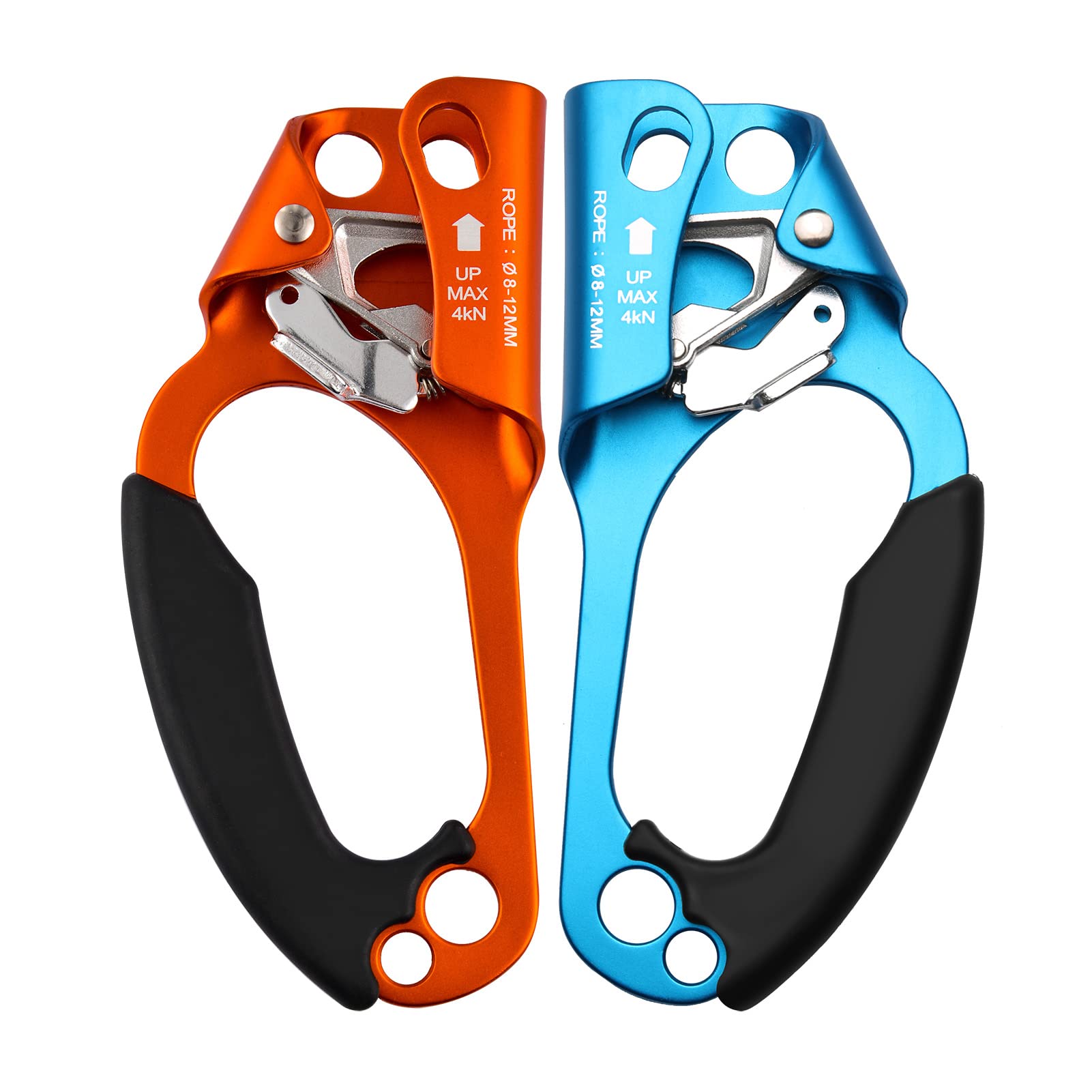
The Paliston 2-pack delivers something most rope climbers realize they need only after the first ascent: a dedicated left-hand and right-hand ascender. The ergonomic aluminum handle fits comfortably in the palm and includes a safety trigger that prevents the cam from accidentally releasing during a load transfer. The rope range of 8 to 12 mm works well with both thin saddle-hunting lines and standard dynamic climbing ropes.
The cam teeth slide up the rope smoothly and clamp down with authority when weighted. Users report that the grip is reliable even on 8.3 mm skinny ropes, though the same users note that name-brand ascenders from Petzl or Wild Country allow the bottom hand to manage slack rope more smoothly. For the price of a single premium ascender, you get a matched pair that equips both hands for efficient rope walking.
One limitation to be aware of: the oval top slot is designed to fit most carabiners, but some larger or angled carabiners may not seat cleanly. A few users have filed the slot into a rounder shape to accommodate their preferred hardware. If you are building a 2-ascender rope-walking system on a budget, this kit gives you the most bang per dollar.
Why it’s great
- Comes as a left-and-right pair for immediate rope walking setup
- Ergonomic handle reduces hand fatigue during long ascents
- Cam holds securely on 8–12 mm ropes with reliable bite
Good to know
- Oval top slot may not fit all carabiner shapes
- Slack rope sliding is less smooth than premium brands
5. PETZL TIBLOC Emergency Ascender

At 35 grams, the TIBLOC is the lightest ascender on this list by a wide margin. It is designed as an emergency block — something you leave clipped to your harness or buried in your pack for self-rescue, haul systems, or converting a 3:1 Z-rig. The automatic engagement system uses the carabiner gate to press against the rope, ensuring the teeth grip instantly rather than sliding across the sheath.
The stainless steel cam features angled teeth with a self-cleaning slot that sheds mud and ice, which is critical when the emergency happens in wet or frozen conditions. User reviews consistently praise its simplicity and reliability, with several wilderness SAR operators recommending it as a must-have in any rescue kit. It works best on ropes from 8 to 11 mm — notably, it will not accommodate thick 13 mm haul lines.
Because it is a passive device, the TIBLOC is not designed for sustained ascending like a hand ascender. It is a backup tool that lives on your harness until you need it. Some users have reported accidentally dropping it during use due to its tiny size, so attaching a keeper leash is strongly recommended.
Why it’s great
- Extremely compact at 35 g — disappears on a harness
- Instant grip engagement with automatic carabiner pressure
- Self-cleaning cam slot works in mud and ice
Good to know
- Not designed for sustained, repeated ascending
- Small size makes it easy to drop — attach a leash
6. Kong Italy Duck Alu Alloy Ascender
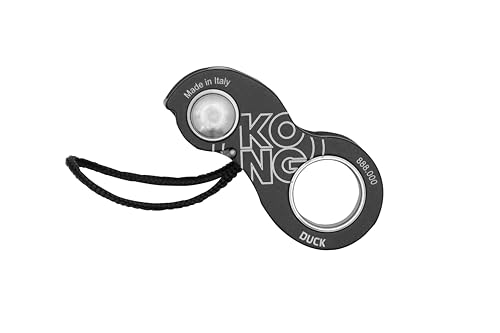
The Kong Duck in its alu alloy variant is the same proven emergency blocker design as the green version but in a lighter, all-black package. It functions as a rope clamp for self-rescue, progression on preserved lines, and as a regulator for daisy chains or webbing-based systems. The clamping action engages immediately under load, making it a popular choice for top-rope solo climbing systems.
Users report that it works flawlessly with both 8 mm tether ropes and 10 mm lineman belts in saddle hunting setups. The small form factor slips easily into a pocket or clips onto a gear loop without getting in the way. Multiple reviews note that they prefer the Duck over the Ropeman 1 for its slightly better price-to-performance ratio when used as a primary ascender on thin ropes.
The rigid blocking clamp opener could be more forgiving for one-handed operation, and some users have noted that the release mechanism requires deliberate pressure. For its weight and cost, this is a solid emergency block that punches above its price tier, especially if you are running 8 to 10 mm ropes.
Why it’s great
- Lightweight alloy body at just 0.07 kg
- Engages reliably under load on 8 mm and 10 mm ropes
- Small enough to leave on harness full-time
Good to know
- Rigid blocking clamp opener could be smoother
7. Kong Duck Rope Clamp (Green)

The green Kong Duck shares the same internal cam geometry as the alu alloy version but in a slightly heavier metal finish with a black-and-red colorway. It is marketed as a multiuse belay device, emergency locking tool, and progression regulator for daisy chains. The Italian manufacturing quality is evident in the clean machining and the precise cam-to-rope engagement.
Saddle hunters have gravitated toward this model because it makes adjusting the rope tether dramatically easier than fumbling with knots. The cam grabs instantly when weighted and releases cleanly when unloaded. Some users have noted that the device can be noisy when shifting in a saddle setup — a few wraps of tape on the metal surfaces quiet it down significantly.
The price point is notably higher than the alu alloy Duck despite a similar feature set, which has confused some buyers. If cost is a primary concern, the alu variant delivers identical performance for less. However, the green Duck’s availability and the slightly different finish appeal to users who want a dedicated backup that matches their kit’s color scheme.
Why it’s great
- Italian-machined cam engages cleanly on 8 mm ropes
- Multiuse design works as belay device and self-rescue clamp
- Fits easily into saddle hunting rig setups
Good to know
- Metal-on-metal contact can be noisy without tape
- Higher cost than functionally identical alu alloy version
FAQ
Can I use an emergency ascender like the PETZL TIBLOC for daily rope ascending?
Will an aggressive-tooth ascender damage my expensive dynamic rope?
What is the difference between a hand ascender and a chest ascender for rope climbing?
Can I use an ascender designed for 11–13 mm rope on a thin 8 mm static line?
Final Thoughts: The Verdict
For most users, the ascender for climbing winner is the Wild Country Ropeman 2 because it balances the widest rope diameter range, stainless steel durability, and a compact 3.25 oz design that disappears on your harness. If you want a chest-mounted system that eliminates forearm fatigue on long ascents, grab the PETZL Croll. And for zero rope damage during sustained tree work or rescue operations, nothing beats the Notch Jet Step foot ascender.