
Our readers keep the lights on and my morning glass full of iced black tea. As an Amazon Associate, I earn from qualifying purchases.
Specs are compiled from manufacturer listings and verified buyer reviews and can change over time — please confirm the key details on the product page before buying.
A leaky roof is a race against the next rainstorm, and the right asphalt roofing cement is what stands between a small drip and a costly ceiling stain. The best products here seal flashing, re-stick curled shingles, and fill cracks with a flexible bond that moves with your roof instead of splitting apart. This guide breaks down the top performers by what they actually do best — from thick, trowel-grade repair pails to self-leveling driveway crack fillers and brush-on rubberized coatings.
I’m Min — the founder and writer behind Gadgets Feed. This guide is built by comparing the manufacturers’ published specifications and the patterns across verified customer reviews, so you get each pick’s real strengths and trade-offs instead of marketing spin.
You’ll learn which formula fits your repair job, what the cure times really mean, and how to pick the asphalt roofing cement that survives sun, rain, and freeze-thaw cycles without re-cracking.
Our Picks at a Glance


How To Choose The Best Asphalt Roofing Cement
You need a different asphalt roofing cement for each repair, and the key is matching the formula’s thickness and how it cures. A gaping hole around a vent needs a heavy, fiber-loaded paste (a thick mix with fibers that bridge gaps), while a hairline crack in a driveway wants a thin, self-leveling liquid (a runny sealant that flows into the crack on its own) that seeps deep.
Match the consistency to the job
Thick, trowel-applied roof cement stays put on vertical surfaces and gaping openings, making it the go-to for flashing and shingle repair. Self-leveling fillers are the opposite — they’re runny enough to flow into cracks and spread flat, which is perfect for flat driveways but a problem on a sloped roof where gravity wins.
Read the cure time before you commit
Some formulas dry to the touch in a few hours, while others need a full 24 to 48 hours to harden completely. If rain is in the forecast, a fast surface-drying product gives you a much wider safety window, so check the tack-free and full-cure numbers before you start spreading.
Quick Comparison
| Model | Best For | Container Size | Item Weight | Core Formula | Amazon |
|---|---|---|---|---|---|
| Henry HE208042★ Best Overall | All-around roof leak sealing | 0.90 gal | — | Asphalt paste, wet-surface safe | Amazon |
| E-SDS Crack FillerBest Value | Budget driveway crack repair | 2.2 lb pouch set | 2.2 pounds | Self-leveling resin | Amazon |
| Henry HE208030Top Performer | Small spot repairs | 16 oz can | 16 ounces | Thick paste | Amazon |
| Black Jack All Weather | Big-area patching | 1 gallon | 8 pounds | Fiber-reinforced asphalt | Amazon |
| Wadities Crack Filler | Blacktop & concrete joints | 2.65 lb set | — | Self-leveling rubber | Amazon |
| Liquid Rubber Quart | Brush-on flat roof coating | 1 quart | 2 pounds | Water-based rubber | Amazon |
| DAP 6-Pack | Cartridge tube convenience | 6 x 10.1 oz | 10.1 ounces | Asphalt-based sealant | Amazon |
| Liquid Rubber 4-Pack | Professional-grade crack sealing | 4 x 10 oz | — | Self-leveling rubber | Amazon |
| Gardner-Gibson SBS | Whole-roof recoating | 4.75 gallon | 45 pounds | Rubberized SBS blend | Amazon |
In-Depth Reviews
1. Henry HE208042 Roof Cement
Our pick — 4.5★ from 600+ verified ratings; the strongest balance of quality and price.
The all-weather workhorse that bonds even on wet surfaces for stubborn leak fixes.
This is the pick for the homeowner chasing a persistent drip who wants a proven seal they won’t have to revisit next season. Its defining feature is that it adheres to wet surfaces, which means you’re not waiting days for a dry roof before you can patch a leak. The extra-thick paste is the reason owners describe it as “very thick, dries quickly and hardens fast” — it stays exactly where you trowel it, even on a sloped seam.
Effectiveness wins people over, and the proof is in the stories: nearly a year after patching a garage roof, the repair still holds with product left in the can. The same thick consistency that seals so well is also the catch — reviewers warn it’s hard to wash off, so rubber gloves and old clothes are non-negotiable, and preheating the can near a heater overnight makes it far easier to work with.
One owner notes a dented can on arrival with a lid that only fits in its original position, so inspect yours when it lands. There’s also a durability caveat in the review pattern — some report it cracking in the sun after a summer, which is why embedding screen fabric over large gaps is a trick the experienced hands swear by. At 0.90 gal (3.41L), it’s the balanced size between a tiny can and a contractor pail.
Why it leads the list
- Adheres to wet surfaces, so you can patch during a storm window
- Thick paste stays put on vertical seams and flashing
- Effectiveness is the top praise, with leak prevention a close second in owner feedback
- Single container covers multiple repair jobs over months
The honest trade-offs
- Hard to wash off skin and tools — wear gloves
- Can crack in direct sun after a full summer
- So thick it needs preheating for smoother application
Reach for this if: you need a dependable, all-purpose roof leak sealer and you’re comfortable troweling a heavy paste.
Think twice if: you’re chasing a hairline driveway crack — you want a self-leveling filler, not this thick paste.
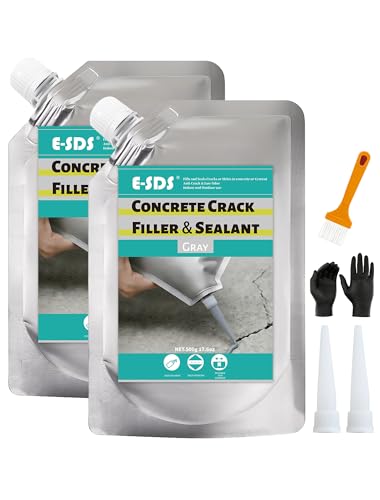
2. E-SDS Cement Crack Filler
A budget-friendly self-leveling pouch that pours into patio and driveway cracks without troweling.
This is for the person staring at a sun-cracked concrete patio who wants a fast, cheap fix that doesn’t require a caulk gun or a trowel. The self-leveling formula (a runny sealant that flows into cracks on its own) seeps deep and spreads evenly, then settles into a flat, smooth finish — and the resealable pouch means you squeeze out exactly what you need and save the rest for next season.
The material is a high-elasticity resin that stays flexible after curing, so it stretches and compresses with ground settling instead of pulling away from the crack edges. At just 2.2 pounds for the set, it’s a fraction of the weight of a gallon pail — a 3.6x gap versus the 8-pound Black Jack gallon — making it easy to handle one-handed. Buyers report it filled patio cracks well, though wider, deeper gaps were “still a bit spongy” even after curing, so give those big joints extra time.
One honest quirk: the cured filler can turn white and flaky on some surfaces, which defeats the invisible-repair goal on a dark driveway. And because it self-levels, you’ll want thin layers on a steep incline or it’ll just run downhill. The resealable pouch is a real plus — no wasted half-empty tube — but some found it a struggle to fully empty the container, getting about 95% out.
The value read: you get a flexible, easy-to-apply crack filler that handles most flat-surface jobs for a fraction of the cost of a big pail.
The color caveat: on some surfaces the cure turns white and flaky, so test a small spot before committing to a whole driveway.
3. Henry HE208030 Roof Cement
The precision patch for chimney crickets and small holes that need thick, stay-put cement.
This quart-sized can earns its place for the targeted repair — a leak at a chimney cricket, a gap around a vent, a few lifted shingles. The thick consistency is exactly what owners praise: “it stays where I put it,” one reviewer noted after sealing a stubborn chimney leak that had dripped for a while. That thickness is the whole point, keeping the cement in place on a sloped surface while it cures.
At 16 ounces, this is the smallest container on the list, and that’s both its strength and its weakness. It’s easy to store and perfect for one or two small jobs, but the review pattern is blunt about value — the size draws the most negative feedback by far, with owners calling it “a really tiny, overpriced can.” One buyer mentioned the photo makes it look larger than it is, so check the 16-ounce spec before you assume you’re getting a gallon.
The good news is it works on cold days, which is a real edge when you’re patching in early spring or late fall. It dries hard enough to paint over, and it’s black like tar — not white as some expect. For a homeowner who needs a small, reliable patch now, this is the one; for a big recoat project, you’ll want the gallon pail instead.
Grab it for: small, precise repairs where a thick paste that holds its position beats a runny liquid.
Look elsewhere if: you’re covering a large area — the 16 oz size runs out fast and the per-ounce cost is steep.
4. Black Jack All Weather Roof Cement

A fiber-reinforced gallon that sealed a neglected travel trailer’s multiple leaks in one layer.
This is the gallon-sized answer for the person with a big patch job — a leaky travel trailer, a section of roof with several problem seams, or shingles that lifted in a winter storm. It’s a true roofing cement, not a thin patch liquid, and one owner used it to glue down shingles lost in winter when the sun couldn’t provide the heat to re-stick them. The fiber-reinforced formula is what gives it the body to bridge gaps and hold.
Owners mention it sealed a 15-foot neglected travel trailer’s holes and seams with just one layer — high praise for coverage. The consistency is “perfect (thickness)” per one owner, with a great dry time, though the same review notes the adhesion “is not instantly adhesive nor very powerful,” so it’s about building a solid seal rather than instant stick. It weighs 8 pounds, which is 3.6x the E-SDS pouch set — you feel the heft of a real gallon pail.
The recurring tip from owners is that it needs constant stirring, as the material settles in the can. One buyer even used it to mend a hole in a maple tree, which the tree “loves” — a sign the flexible seal works beyond roofing. For the money, this is the volume play: one gallon of genuine fiber-reinforced asphalt cement that covers a lot of ground.
What you get
- Fiber-reinforced for bridging gaps and holding shape
- One layer sealed multiple leaks on a 15-foot trailer
- 8 pounds of material — real value for big repairs
- US country of origin
What to expect
- Needs constant stirring — the solids settle fast
- Not instantly adhesive, so it’s a build-it-up seal
Best for: covering large patching areas where a thick, fiber-loaded cement is worth the stirring effort.
Not for: tiny crack touch-ups — you’ll have a mostly full pail left over.
5. Wadities Asphalt Crack Filler
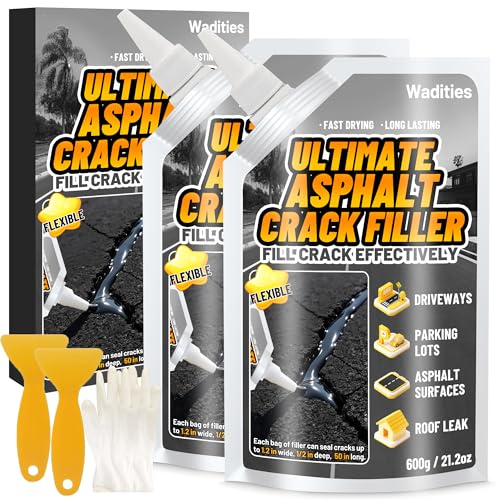
A self-leveling rubber filler that looks and feels close to fresh blacktop after it dries.
This pick is for the driveway owner who wants the repair to actually match the surrounding asphalt, not stand out as a grey scar. The cured look is the standout — customers note it looks and feels close to blacktop, and it dries fast with a smooth, flat surface. The self-leveling formula means you pour it in, smooth it with a tool, and it settles into the crack without the constant reapplying that thinner liquids need.
The high-elasticity rubber formulation is built to flex with ground movement, so it resists re-cracking where concrete would just split again. One buyer applied it to manhole cracks in a 10-minute job at a third of the labor cost, praising how it stays elastic instead of cracking like concrete. Two heavy rainstorms after application, the filler hadn’t washed away or disintegrated — a solid waterproofing result.
The surface drying time is 4 to 6 hours, with a full cure at 24-48 hours, so plan around a dry forecast. It comes as a 2pcs set totaling 2.65LB with a scraper and gloves included, which is thoughtful for a first-time DIYer. One owner reported a single package covers about one large crack, so measure your driveway’s damage before ordering and grab extra sets if it’s a long crack network.
The match game: if blending into blacktop matters more than anything, this is the filler that disappears into the surface.
Plan the quantity: one set handles roughly one large crack, so stock up for a full driveway.
6. Liquid Rubber Waterproof Sealant

A brush-on water-based rubber coat that flexes 950% without cracking, peeling, or smelling.
This is a different animal from the trowel-grade pails — it’s a brush, roll, or spray-on liquid rubber membrane for flat and low-slope roofs, gutters, and foundations. Its defining spec is the 950% elongation, meaning the cured film can stretch nearly ten times its length before failing, which is why it survives building movement and temperature swings without cracking. The water-based formula contains no VOCs or harsh odors, so it’s safe to use in confined spaces and won’t damage foam insulation.
Reviewers point out it sealed fountain cracks with 3 coats that held for 1.5 years, versus 6 months for a major TV brand after 7 coats — a durability edge that’s hard to argue with. It also fixed a greenhouse roof and a rain barrel with ease, drying in a reasonable time. One owner injected it with a syringe into tight spots between a cement wall and aluminum flashing, proving it works in awkward gaps, not just open roofs.
The catch is coverage: 1 gallon covers just 15 sq ft on standing-water surfaces with 3-4 heavy coats to reach a 60-80 mil membrane, so the quart size here is for small repairs, not a whole roof. It also stays tacky after curing and isn’t for walking surfaces, so keep it off walkways and decks. And some batches arrive closer to a PlayDough or tar-like consistency than a thin liquid, which takes effort to work into the surface.
Choose this for: a flexible, low-odor coating on flat roofs and gutters where tar smells and brittleness are deal-breakers.
skip it if: you need to patch a small hole with a thick paste — this is a membrane, not a filler.
7. DAP Roof Waterproof Asphalt Filler

A six-pack of caulk-tube convenience for flashing, shingles, and small leaks with zero pail cleanup.
This is the pick for anyone who wants the clean, controlled application of a caulk gun instead of wrestling a trowel through a pail. Each 10.1 oz cartridge is asphalt-based and sized for roof flashing, spotting shingles, and repairing minor roof leaks — the tube format means you squeeze exactly where you need it and there’s no leftover pail to store. A 6-pack gives you 60.6 fluid ounces total, so you have enough for several jobs or one bigger afternoon on the roof.
Owners are consistently impressed with the flexibility: the product “will not crack when it dries like other brands,” staying pliable in the center while drying on the weather side — that’s the sign of a seal that moves with the roof instead of splitting. It applies “perfectly” as a thick roofing tar, and one buyer even used it to fill driveway cracks, proving its versatility beyond the roofline.
The 4.6-star rating across dozens of owner experiences is among the highest on this list, with every single review landing at 5 stars — a rare clean sweep. The compact 1.9 x 1.9 x 11.25-inch cartridges fit standard caulk guns and store flat in a toolbox. For the homeowner who wants big-box-store quality without hunting for a specialty pail, this is the grab.
Clean and controlled: caulk-tube application means no pail, no trowel, no messy cleanup.
Flexibility that lasts: the cured seal stays pliable in the middle, so it bends with roof movement instead of cracking.
8. Liquid Rubber Driveway Crack Filler

A professional-grade self-leveling filler that works in damp cold down to 32°F and flows deep into cracks.
This is the pick for the driveway owner who’s fought reappearing cracks for years and wants a professional-grade solution that actually stops water intrusion. The self-leveling formula (a runny sealant that flows into cracks on its own) flows deeply for complete coverage, and the “won’t shrink back or pull away” promise is the key differentiator — it creates a permanent flexible bond rather than the temporary patches that fail after one winter.
Its standout edge is temperature and moisture tolerance: it works in damp conditions and temperatures down to 32°F (0°C), so you’re not stuck waiting for the perfect dry, warm weekend. Each 10oz tube covers approximately 22 linear feet at a 5/16″ bead, which makes the 4-pack a surprisingly cost-effective solution for a full driveway. Buyers who researched the chemistry report it’s “doing exactly what it is supposed to do” — no more fighting reappearing cracks.
The honest drawbacks: it’s “a bit expensive” per the reviews, and one owner felt it should perform better for the money. Full cure and longevity are still unproven for some, with one buyer noting “time will tell about the longevity, but i feel it will be years.” The included 4-pack at 40 total ounces gives you real coverage, and the simple clean-cut-apply-and-let-it-self-level process needs no special skills.
Choose this if: your driveway cracks keep reappearing and you want a self-leveling seal that works in cold, damp conditions.
Consider the cost: it’s the premium end of crack fillers — most owners find it worth it, some expect more for the price.
9. Gardner-Gibson Rubberized SBS Roof Coating

A 45-pound, 4.75-gallon rubberized coating that melts into shingles and reseals an entire roof.
This is the big one — the 4.75-gallon pail for a whole-roof recoat rather than a spot patch. It’s a rubberized SBS asphalt coating, a blend of rubber and reinforcing fibers that creates a strong, flexible, waterproof seal across large surfaces. At 45 pounds, this is serious volume for the homeowner tackling a full roof refresh or a badly weathered section that needs comprehensive coverage.
Owners describe it as “thick and melts into the shingles,” which is exactly the behavior you want from a recoat — it flows around granule loss and bonds with the existing asphalt instead of sitting on top. One buyer sealed off a damaged roof “really well,” and another called it the best of several brands they’d used. It spreads and covers nicely, making the large application less of a workout than you’d expect from a 45-pound pail.
The quality control is the honest caveat: a first can arrived bad, but the seller’s customer service was fast with a refund, and the replacement “went on nice and smooth.” That’s the kind of seller responsiveness that matters with a big-ticket item like this. For the DIYer with a whole roof ahead of them, this avoids the frustration of buying five small pails — one 4.75-gallon container does the job.
The volume answer: one 4.75-gallon pail replaces multiple small cans for a whole-roof recoat project.
Check it on arrival: the first can from one buyer arrived damaged — the seller’s fast refund made it right.
Understanding the Specs
Thickness and consistency
The texture of roof cement decides what jobs it can handle. Thick, trowel-grade paste stays put on vertical seams and gaping holes, making it essential for flashing and lifted shingles. Thin, self-leveling liquids flow into flat cracks and spread evenly — perfect for driveways but useless on a slope where gravity pulls them downhill. Match the thickness to the surface, not the brand.
Cure time and rain windows
Every formula has a tack-free time and a full-cure time, and they’re not the same. A product that dries to the touch in a few hours can still be soft in the core for 24-48 hours. If rain is coming, a fast surface-drying product gives you a wider safety window — check the numbers before you spread, and don’t assume “dry to touch” means “waterproof.”
FAQ
What is the difference between roof cement and asphalt crack filler?
Can I apply asphalt roofing cement on wet surfaces?
How long does roof cement take to dry and fully cure?
Why does my roof cement crack in the sun after a summer?
How much roof cement do I need for a small repair?
Is asphalt roof cement better than rubberized coating for leaks?
Can roof cement be used on driveways instead of crack filler?
How do I clean roof cement off my hands and tools?
Final Thoughts: The Verdict
For most people, the best asphalt roofing cement is the Henry HE208042 because it balances the thick, stay-put paste you need for real leak repairs with the rare ability to adhere to wet surfaces. If you’re fixing a flat driveway crack on a budget, the E-SDS filler is the value play that pours in and levels itself. And for a whole-roof recoat that needs serious volume, the Gardner-Gibson 4.75-gallon coating is the one to reach for — one pail, one weekend, done.
How We Picked
We do not accept paid placement. Every pick is matched to a real buyer and a real use-case; we do not hands-on test units.
Sources & Methodology
Specifications: manufacturer listings and product documentation. Review insights: verified customer reviews, as of August 2026. Pricing: not shown on this page (it changes often); check the current price via the retailer link.
As an Amazon Associate, Gadgets Feed earns from qualifying purchases. This does not affect which products we feature.