
Restoring a razor-sharp edge at home doesn’t require a professional’s workshop or expensive services, but the sheer variety of pull-through sharpeners, whetstones, diamond plates, and electric systems can paralyze any buyer.
I’m Min — the co-founder and writer behind Gadgets Feed. I’ve spent countless hours dissecting the abrasive grit types, motor speeds, and angle-guide precision that separate a quick touch-up from a genuine edge restoration, all to help you cut through the noise.
After analyzing seven top contenders across manual stone kits, diamond systems, and electric machines, this guide names the single best at home kitchen knife sharpener for every skill level and blade type you actually own.
How To Choose The Best At Home Kitchen Knife Sharpener
Selecting the right sharpener hinges on three factors: your knife steel, your tolerance for manual skill, and how often you want to sharpen. Kitchen knives with high-hardness steel (Rockwell 58+) benefit from diamond abrasives or slow-speed electric belts, while softer stainless steel works fine with silicon carbide oil stones or tungsten carbide pull-throughs.
Grit Progression and Abrasive Type
A coarse grit (200–400) repairs nicks and dull edges quickly. Medium grit (800–1500) refines the burr into a working edge. Fine grit (3000+) polishes to a shaving-sharp finish. Diamond electroplated plates cut faster and stay flatter longer than water-soaked whetstones, making them ideal for regular at-home use. Oil stones (Norton) offer a traditional feel but require honing oil and a steady hand.
Angle Control vs. Freehand Finesse
Pull-through sharpeners with tungsten carbide or diamond slots lock you into a fixed angle (typically 20 degrees), which works for most Western-style kitchen knives but can over-grind thin Japanese blades. Whetstone kits with an angle guide let you choose 14°, 17°, or 20° per side, matching the blade’s original geometry. Electric systems like the Work Sharp use adjustable belt guides (15–30°) for precision without freehand practice.
Speed of Use and Maintenance
Electric sharpeners (Chef’sChoice 15XV, Work Sharp Ken Onion) restore a dull knife in under one minute, but they remove more metal per session. Manual stones take 10–15 minutes but let you control exactly how much steel is ground away. Consider how many knives you sharpen per month: if it’s more than three, an electric system saves time; if you enjoy the process, a whetstone or diamond kit rewards patience.
Quick Comparison
On smaller screens, swipe sideways to see the full table.
| Model | Category | Best For | Key Spec | Amazon |
|---|---|---|---|---|
| Chef’sChoice 15XV | Electric | Fast, foolproof sharpening | 100% diamond abrasives, 3-stage, 15° edge | Amazon |
| Work Sharp Ken Onion | Electric Belt | Versatile blade reprofiling | Adjustable 15–30°, variable speed motor | Amazon |
| Norton IM200 | Oil Stone System | Traditional bench stone setup | 3 stones (100/150/320 grit) with oil | Amazon |
| Schaaf Tools Diamond Whetstone | Diamond Plate | Low-maintenance flat sharpening | 325/1200 grit diamond, honeycomb surface | Amazon |
| Goodjob Premium Whetstone Kit | Whetstone Kit | Complete beginner stone setup | Dual grit 400/1000 & 3000/8000 | Amazon |
| VN3 Grihot | Pull-Through | Quick edge restoration | Tungsten carbide, 3-action, stainless body | Amazon |
| Mercer Culinary Double Diamond | Manual Pull-Through | Simple two-stage honing | 100% diamond abrasives, arch-shaped edge | Amazon |
In‑Depth Reviews
1. Chef’sChoice 15XV

The Chef’sChoice 15XV sets the benchmark for electric home sharpeners with its brushed metal housing and 100-percent diamond abrasive plating across all three stages. Stage 1 re-profiles a standard 20-degree edge down to a 15-degree Trizor XV edge, Stage 2 hones it, and Stage 3 uses a flexible stropping disk to polish. At 5 pounds, it stays planted on the counter, and the spring-loaded guides automatically center each blade.
Users report reviving a 4-year-old chef’s knife to paper-cutting sharpness in about five minutes, and a completely blunt butcher’s knife in under 30. The 15-degree edge is noticeably sharper than factory edges, though it removes more metal per session than a manual stone. Noise output sits between 65–75 dB—quieter than most electric sharpeners in this class.
This unit handles straight-edge and serrated blades without requiring the user to adjust any angles manually. The trade-off is that it’s less forgiving for knives with very thin or brittle steel, and the proprietary diamond wheels will eventually need replacement after heavy use. For anyone who wants the fastest, most consistent path to a razor edge at home, this is the benchmark.
Why it’s great
- Restores extremely dull knives in under 60 seconds after initial setup
- Automatic angle guides eliminate guesswork for both straight and serrated edges
- Sturdy 5-pound metal housing prevents vibration during sharpening
Good to know
- Aggressive diamond abrasives remove more metal than manual stone methods
- Not recommended for thin-bladed Japanese knives under 15 degrees
- Can be difficult to find authentic replacement diamond wheels
2. Work Sharp Ken Onion Edition Mk.2

The Work Sharp Ken Onion Edition Mk.2 uses flexible abrasive belts driven by a variable-speed motor, giving you full control over sharpening aggressiveness from 15 to 30 degrees per side. The belt system runs at a consistent speed that doesn’t bog down under pressure, and the adjustable guide lets you switch between a coarse 80-grit belt for reprofiling and a fine 1000-grit belt for polishing.
Home cooks report that this machine saves hours compared to whetstone sharpening, especially when maintaining multiple knives and scissors. The included belt assortment covers everything from heavy edge repair to finishing, though belts wear out after roughly 10–15 sharpening sessions and cost extra to replace. The design is compact enough to store in a standard cabinet at 7.76 x 10.57 x 2.93 inches.
One standout feature is the ability to sharpen axes, serrated blades, and even scissors with the appropriate belt—making it the most versatile unit in this roundup. Beginners should practice on a cheap knife first because the belt can remove steel quickly if the knife is held at the wrong angle. The 3-year warranty adds confidence for daily use.
Why it’s great
- Adjustable angle range (15-30°) works for Western and most Japanese knives
- Variable-speed motor lets you slow down for delicate blades
- Sharpens scissors, axes, and serrated blades beyond standard kitchen knives
Good to know
- Belt replacement adds ongoing cost after 10-15 sharpening sessions
- Requires a learning curve to avoid gouging the edge with too much pressure
- Bulky footprint for counter storage despite relatively compact dimensions
3. Norton IM200 Knife Sharpener Oil Stone System

The Norton IM200 is a traditional oil stone system built around three 8-inch stones: a coarse 100-grit silicon carbide Crystolon for repair, a medium 150-grit Crystolon for sharpening, and a fine 320-grit aluminum oxide India stone for honing. The self-contained bench unit holds all three stones in a rotating axis inside a plastic reservoir that catches excess honing oil.
With a total weight under 2 pounds, this system is lighter than the electric contenders but still offers serious edge control. The angle guide is basic plastic and requires the user to maintain consistent freehand pressure, but the coarse stone cuts fast enough to reprofile a damaged edge in under 10 minutes. The fine India stone produces a polished edge suitable for slicing vegetables without tearing.
Norton’s reputation in industrial abrasives means the stones last for years with proper oil maintenance. The trade-off is that this system demands a honing oil—water won’t work—and the learning curve is steeper than pull-through or electric sharpeners. For the home cook who enjoys the ritual of sharpening and wants one system that never needs replacement belts or diamond wheels, the IM200 delivers timeless performance.
Why it’s great
- Three distinct grits (100/150/320) cover repair through honing in one unit
- Included honing oil and plastic angle guide reduce freehand error
- Industrial-grade silicon carbide and aluminum oxide stones last decades
Good to know
- Requires honing oil to function; water soaking does not work with these stones
- Angle guide is basic and less reliable than dedicated jigs
- 8-inch stone length is cramped for blades longer than 12 inches
4. Schaaf Tools Diamond Whetstone Complete Kit
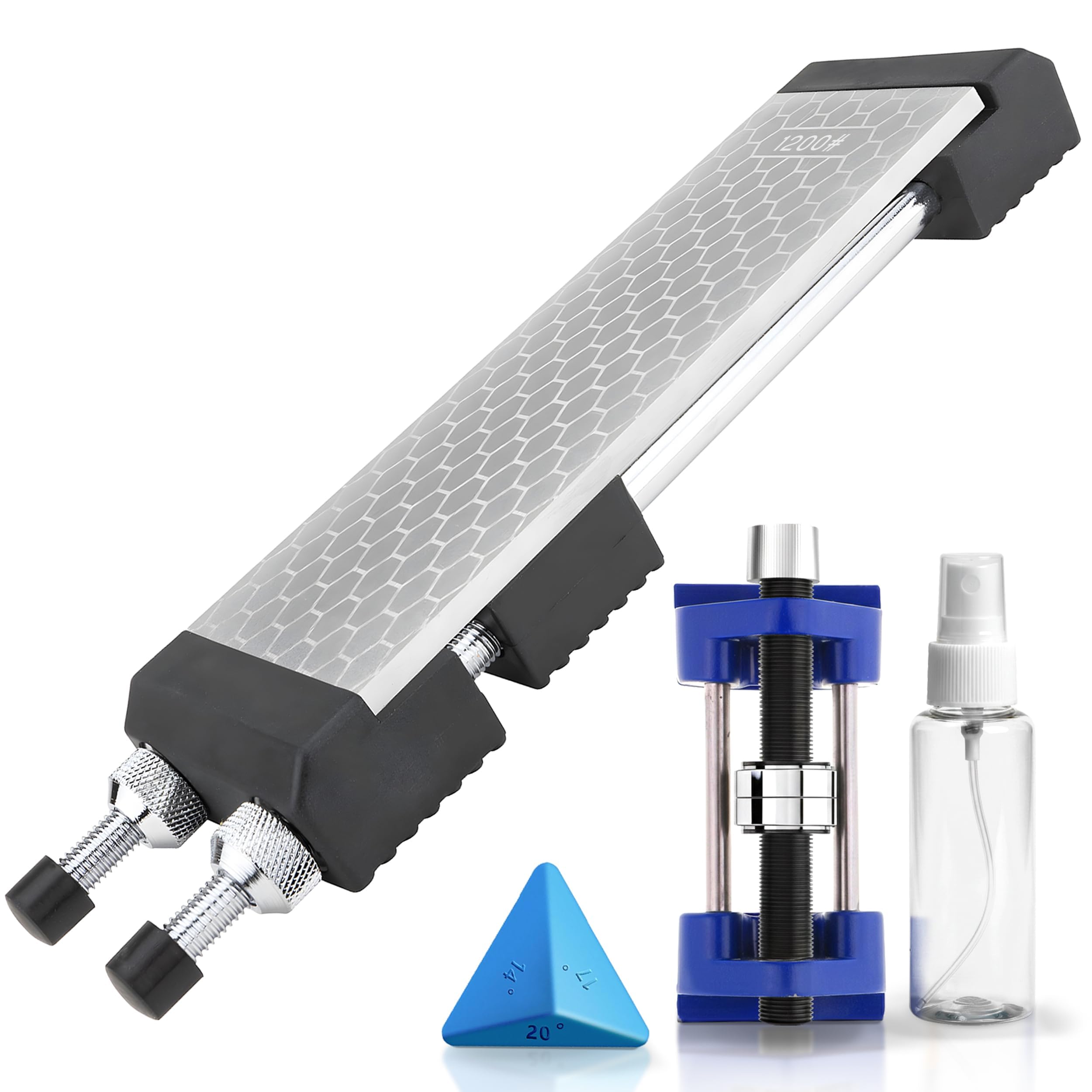
The Schaaf Tools Diamond Whetstone Kit centers on an 8-inch by 2.75-inch dual-grit diamond plate (coarse 325 / extra-fine 1200) electroplated onto solid steel. The honeycombed surface prevents swarf buildup and keeps the stone cutting flat, which is a common complaint with soft water stones. The adjustable base has non-slip rubber feet, and the included 3-sided knife angle guide offers 14°, 17°, and 20° options.
Users with woodworking chisels and plane irons appreciate the included chisel sharpening jig that accommodates blades from 1/8 inch to 1-7/8 inches. The diamond plate cuts aggressively during the initial break-in period but settles into a predictable speed after a few sharpenings. Unlike water stones, no soaking is required—just a light spray of water as lubricant.
This kit weighs 2.1 pounds, and the steel plate feels substantial. The 1200-grit side produces a working edge that’s sharp enough for most kitchen tasks without needing a separate strop, though enthusiasts will still want a finer finishing stone. The diamond construction also handles harder steels (Vg10, S30V) that wear out traditional whetstones quickly.
Why it’s great
- Diamond electroplating stays flat and cuts faster than oil or water stones
- Includes chisel jig and 3-angle guide for woodworkers and cooks
- No soaking required; ready to use with a spray of water
Good to know
- 1200-grit side may leave visible scratches on softer stainless steel
- Break-in period needed before diamond plate reaches consistent cutting speed
- 2.75-inch width is too narrow for very large chef’s knives
5. Goodjob Premium Whetstone Kit

The Goodjob Premium Whetstone Kit bundles two dual-sided stones—a 400/1000 grit and a 3000/8000 grit—giving you four distinct abrasive levels in one package. The stones are made from white corundum fired using Japanese Osaka production techniques, and the kit includes a bamboo non-slip base, a honing guide, an angle guide, cut-resistant gloves, and a leather strop with green compound.
At 16 ounces total item weight, this kit is lighter than diamond alternatives, but the bamboo base adds stability. The 400-grit side quickly removes nicks from damaged edges, while the 8000-grit side with the leather strop produces a mirror-polished finish. Several users noted that the manufacturer’s logo printed on the stone surface creates a slight texture bump that can be sanded down for smoother performance.
The learning curve is real—expect 15 to 20 minutes per knife initially—but the result is an edge that you tuned to your specific steel. The 1-year warranty covers manufacturing defects.
Why it’s great
- Four grit stages (400 through 8000) cover repair to mirror polish
- Includes cut-resistant gloves, angle guide, and leather strop with compound
- Bamboo non-slip base keeps stones stable during use
Good to know
- Logo embossed on stone surface may cause uneven texture; light sanding helps
- Stones must be soaked in water before each session
- Long learning curve for beginners compared to pull-through sharpeners
6. VN3 Grihot Professional Knife Sharpener
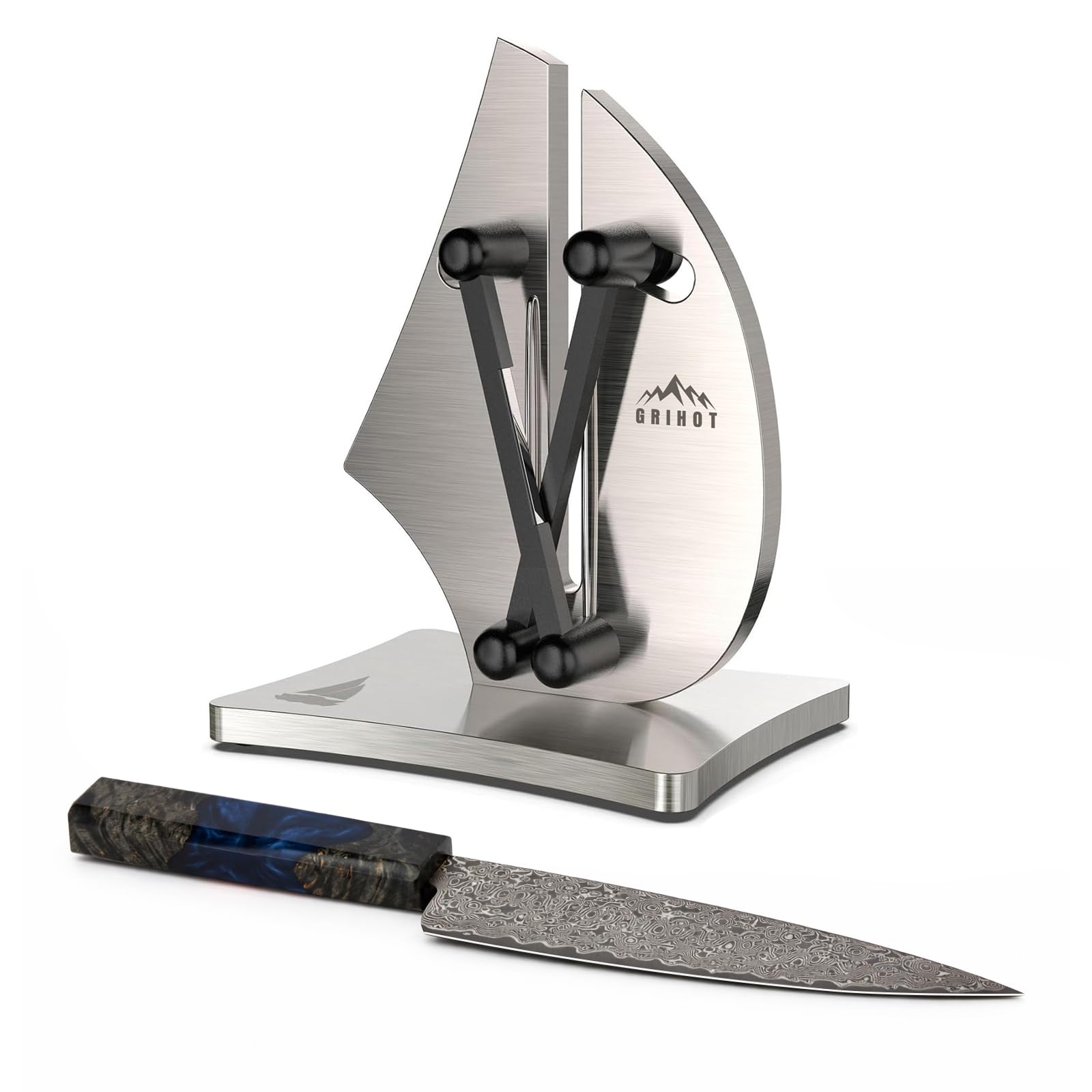
The VN3 Grihot features a sailboat-shaped stainless steel body with three independent tungsten carbide cutting heads for repair, restoration, and standard sharpening. Each head uses spring-loaded arms that automatically adjust to the blade’s existing edge angle, making it one of the few pull-through systems that self-adapts rather than locking into a single fixed angle.
At 1.93 pounds, the VN3 feels dense and solid—the 304 stainless steel and Himalayan tungsten carbide construction resists corrosion far better than plastic-bodied sharpeners. Users who have owned this unit for over two years report consistent razor-sharp edges with no loss of cutting performance from the carbide heads. The three-action base also handles serrated blades effectively, which is rare for pull-through guides.
The main consideration is that the spring-loaded arms require a steady, even pull speed; rushing the stroke can leave a rough burr. The design is compact enough to leave on the counter as a decorative tool, and the 60-month manufacturer warranty covers defects and premature wear. For those who want a manual pull-through that outlasts plastic competitors, this is the top contender.
Why it’s great
- Three independent heads for repair, restoration, and standard sharpening
- Stainless steel and tungsten carbide construction outlasts plastic units
- 60-month manufacturer warranty adds long-term confidence
Good to know
- Spring-loaded arms require consistent pull speed for clean edge
- Not suitable for ceramic or very thin Japanese-style blades
- Heavier and bulkier than standard pull-through sharpeners
7. Mercer Culinary Double Diamond Sharpener

The Mercer Culinary Double Diamond is a simple two-stage manual sharpener with 100-percent diamond abrasives in both the sharpening and honing slots. It produces an arch-shaped edge that balances sharpness with edge durability, and the polycarbonate body with textured handle provides a secure grip even with wet hands. At 0.25 kilograms (about half a pound), it’s the lightest model in this review.
Professional cooks who tested this unit report that it restores a dull chef’s knife to serviceable sharpness in three to four passes per slot, taking less than 30 seconds total. The diamond abrasives work on both straight-edge and serrated blades, though thick hunting or pocket knives struggle to fit the narrow guide slots. The angle is fixed at the factory, so there’s no adjustment possible.
For the entry-level price point, this is the fastest path from “I need a sharp knife right now” to a working edge. The trade-off is that it removes more metal per sharpening than a stone system, and the fixed arch shape means you can’t fine-tune the edge for specific cutting tasks. It’s ideal for the home cook who just wants knives sharp enough to cut tomatoes without crushing them.
Why it’s great
- 100% diamond abrasives cut fast without needing water or oil
- Ultra-light and compact for easy drawer storage
- Two-stage system (sharpening + honing) restores edge in seconds
Good to know
- Fixed arch-shaped edge prevents custom angle selection
- Narrow slots struggle with thick-bladed or heavy-duty knives
- Removes more steel per use compared to whetstone methods
FAQ
Can I use a diamond whetstone on ceramic knives?
How often should I sharpen my kitchen knives at home?
Do pull-through sharpeners ruin good knives over time?
Final Thoughts: The Verdict
For most users, the best at home kitchen knife sharpener winner is the Chef’sChoice 15XV because it combines three diamond stages with automatic angle guides, making professional-level sharpening achievable in under a minute. If you want the versatility to sharpen axes, scissors, and serrated blades alongside kitchen knives, grab the Work Sharp Ken Onion Edition Mk.2. And for the home cook who enjoys the traditional ritual of stone sharpening and wants a system that will last a decade, nothing beats the Norton IM200.