
That helicopter flyover in a blockbuster loses its magic when the audio stays flat at ear level. An Atmos soundbar’s entire mission is to trick your brain into hearing objects above the TV — rain on a roof, a plane passing overhead, footsteps from a second story. The difference between a mediocre bar and a great one is how convincingly it creates that ceiling layer without needing in-ceiling speakers.
I’m Min — the co-founder and writer behind Gadgets Feed. My approach to this guide involved cross-referencing DSP processing power, driver orientation, and real-world room calibration data across dozens of models to separate marketing claims from genuinely immersive height performance.
After hours of spec analysis and user experience research, I’ve built a curated list of the top contenders to help you find the right best atmos soundbar for your living room setup.
How To Choose The Best Atmos Soundbar
Not every soundbar labeled “Dolby Atmos” delivers true overhead audio. Some rely on psychoacoustic tricks to simulate height, while others physically bounce sound off your ceiling using dedicated up-firing drivers. Understanding this distinction — and the hardware that supports it — is the key to picking a system that actually transforms your listening experience.
Discrete Height Channels vs Virtual Processing
A soundbar with a 5.1.2 configuration has two physical up-firing drivers dedicated to height effects. A 5.1.4 or 7.1.4 configuration adds more, creating a wider and more precise overhead sound field. Virtual processing, on the other hand, uses beamforming and psychoacoustic algorithms to suggest height without dedicated drivers — it works best in rooms with low, flat ceilings, but rarely matches the immersion of discrete channels.
Room Calibration and the Ceiling Factor
Up-firing drivers depend on ceiling height, material, and geometry to reflect sound down to the listening position. Systems with automatic room calibration — like Dirac Live on the Klipsch Flexus Core 300, Trueplay on the Sonos Arc Ultra, or SpaceFit Sound Pro on Samsung’s Q-series — adjust delay, EQ, and channel levels to compensate for your room’s unique acoustic anomalies. Without calibration, even the best hardware can sound flat or misaligned.
Bass Management and Subwoofer Integration
Atmos isn’t just about height — the low-frequency effects channel (the “.1”) carries the rumbles, explosions, and ambient bass that anchor the 3D soundscape. A subwoofer that extends below 35 Hz ensures you feel the impact, not just hear it. Dual sub setups, like the Nakamichi Shockwafe’s dual 10-inch drivers, provide faster attack and more even low-frequency distribution across the room without localized hotspots.
Quick Comparison
On smaller screens, swipe sideways to see the full table.
| Model | Category | Best For | Key Spec | Amazon |
|---|---|---|---|---|
| ULTIMEA Skywave X40 | Mid-Range | Budget-friendly 5.1.2 Atmos | 530W GaN Amplifier, 35Hz Sub | Amazon |
| ULTIMEA Skywave X50 | Mid-Range | Wider 5.1.4 soundstage | 760W, 28Hz Sub, 4 Height Drivers | Amazon |
| Sony BRAVIA Theater System 6 | Mid-Range | Sony TV pairing, clean dialogue | 5.1ch, DTS:X, Voice Zoom 3 | Amazon |
| JBL Bar 500MK2 | Mid-Range | Punchy 10-inch sub, MultiBeam 3.0 | 750W, PureVoice 2.0, Easy Calibration | Amazon |
| Samsung HW-Q800F | Mid-Range | Samsung ecosystem, Game Mode Pro | 5.1.2ch, Q-Symphony, SpaceFit Sound Pro | Amazon |
| Bose Smart Ultra | Premium | All-in-one surround, AI dialogue | Dolby Atmos, A.I. Dialogue Mode | Amazon |
| Klipsch Flexus CORE 300 | Premium | Dirac Live room correction | 5.1.2ch, Dirac Live, 54-inch bar | Amazon |
| JBL Bar 1300X | Premium | Detachable battery-powered surrounds | 11.1.4ch, 1170W, 12-inch sub | Amazon |
| Sonos Arc Ultra | Premium | Ecosystem flexibility, 9.1.4 spatial audio | Sound Motion, Trueplay, AI Speech Enhancement | Amazon |
| Samsung HW-Q990C | Premium | All-encompassing 11.1.4ch setup | 11.1.4ch, Q-Symphony, SpaceFit Sound Pro | Amazon |
| Nakamichi Shockwafe 11.2.6 | Premium | Ultimate theater-scale Atmos | 11.2.6ch, Dual 10-inch Subs, 2300W | Amazon |
In‑Depth Reviews
1. Sonos Arc Ultra Soundbar

The Sonos Arc Ultra uses a completely new acoustic architecture called Sound Motion to pack nine channels (including four height channels) into a single bar without the bulk of previous generations. That counts as 9.1.4 spatial audio — the same Dolby Atmos channel count as systems that require separate rear speakers. The AI-driven Speech Enhancement mode detects human voice frequencies and lifts them above the soundtrack, so you catch every whispered line in a Nolan film without touching the volume.
Trueplay room calibration uses the microphone on your iPhone or iPad to measure how sound reflects off your walls, furniture, and ceiling, then adjusts EQ and delay for your specific room geometry. For Atmos specifically, this matters: ceiling height and angle directly affect how convincingly the up-firing drivers create the illusion of overhead sound. Without Trueplay, the height layer in a room with an 8-foot popcorn ceiling sounds totally different from a room with tall, angled ceilings.
Adding Sonos Sub and a pair of Era 300 rear speakers transforms this into a full 7.1.4 system with discrete rear height channels — at that point, the spatial bubble rivals dedicated home theater setups. The trade-off is cost: building the full ecosystem pushes the price well beyond a single-box solution. However, you can start with just the bar, which already outperforms most standalone soundbars in this price tier for music playback and vocal clarity.
Why it’s great
- Sound Motion delivers 9.1.4 without rear speakers
- AI Speech Enhancement makes dialogue incredibly clear
- Trueplay calibration optimizes height effects for your room
Good to know
- Premium price; best performance requires Sub and Era 300 rears
- App setup is mandatory — no physical remote tuning
2. Samsung HW-Q990C 11.1.4ch Soundbar

The HW-Q990C delivers a full 11.1.4-channel configuration out of the box, including wireless rear speakers with both up-firing and side-firing drivers. That means four discrete height channels — two from the main bar, two from the rears — creating a genuine overhead sound field that doesn’t rely solely on ceiling bounce from the front. With 11 front-facing drivers and a dedicated subwoofer, the system produces the most complete Dolby Atmos bubble in Samsung’s lineup.
Q-Symphony lets the soundbar work in tandem with compatible Samsung TV speakers, expanding the front soundstage without adding extra hardware. SpaceFit Sound Pro uses built-in sensors to analyze the room and automatically calibrate EQ and channel levels — useful when the bar is tucked inside a media console or mounted under a wall. Game Mode Pro automatically detects console input and switches to a 3D spatial audio mode optimized for directional cues like footsteps and gunfire.
Wireless Dolby Atmos eliminates the need for an HDMI cable between the bar and a compatible Samsung TV, simplifying placement. The included rear speakers connect wirelessly to the bar, requiring only power outlets. For movie and gaming immersion at this channel count, the Q990C delivers a seamless, high-output experience. Some users note the subwoofer lacks the deepest extension for music compared to dedicated audiophile subs.
Why it’s great
- 11.1.4ch with wireless rear height drivers included
- Q-Symphony syncs with Samsung TV speakers
- Game Mode Pro enhances directional 3D audio in gaming
Good to know
- Requires Samsung TV for full Q-Symphony benefits
- Subwoofer bass is punchy but not the deepest for music
3. Nakamichi Shockwafe Wireless 11.2.6 Ch Soundbar
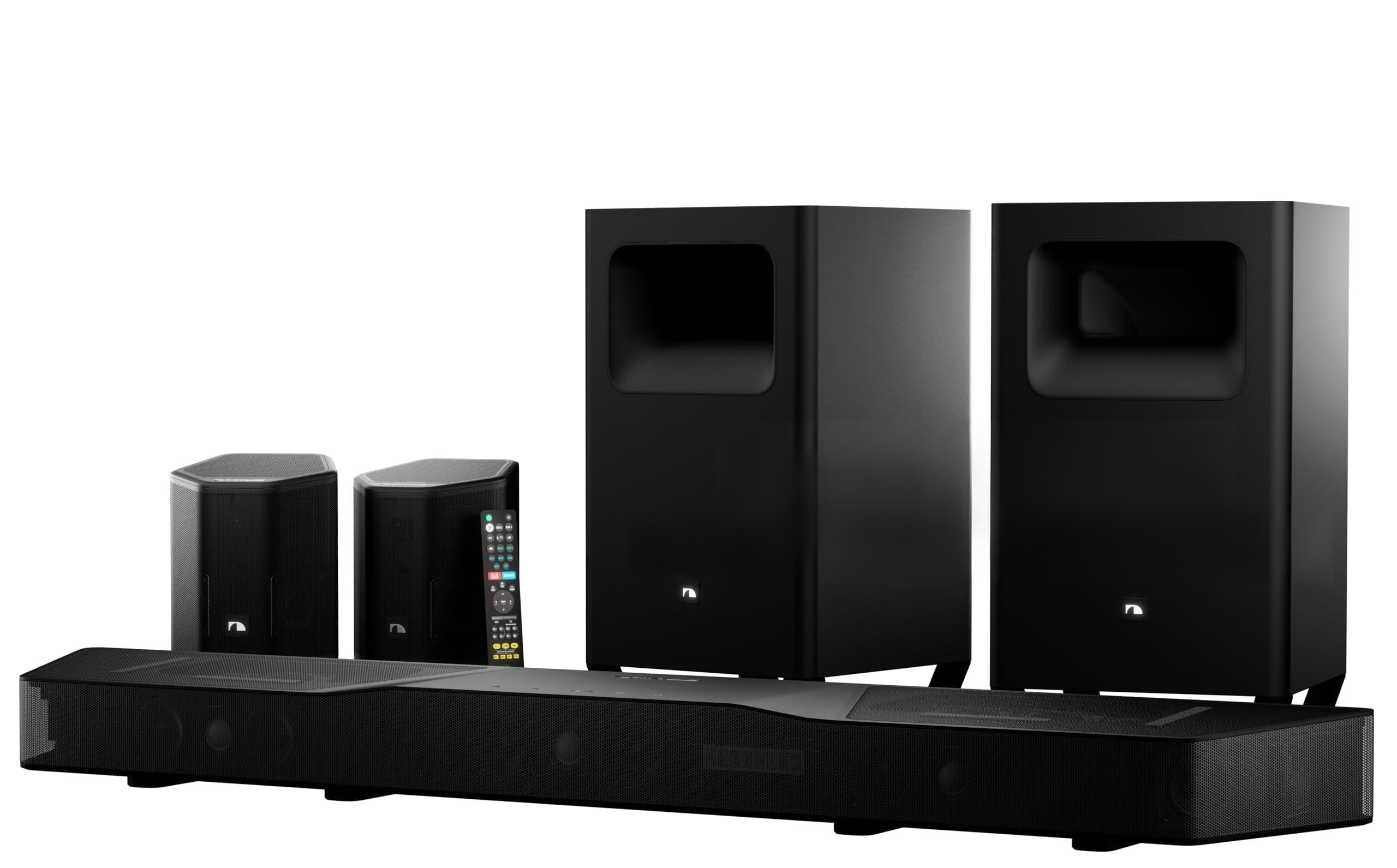
The Nakamichi Shockwafe Wireless 11.2.6 is a full-scale surround system disguised as a soundbar. Its 54-inch wide bar houses drivers for the front left, center, right, and front height channels, while the bipolar surround speakers fire sound from both sides and above — creating six discrete height channels total. That’s two more overhead channels than the 11.1.4 Samsung Q990C, and it directly translates to more precise object placement in the vertical plane when playing Atmos-encoded content.
Dual 10-inch wireless subwoofers are the secret weapon here. Two subs deliver faster attack and more even bass distribution across the room compared to a single sub, eliminating dead zones where low frequencies get canceled out by room modes. The flared port design moves air efficiently, so the low end stays clean and controlled at reference volume levels. For Atmos content that requires deep, sustained bass — think the opening of “Blade Runner 2049” — this system delivers chest-thumping authority without distortion.
The included HDMI 2.1 inputs support 4K 120Hz passthrough with Dolby Vision and HDR10+, so it’s fully compatible with PS5 and Xbox Series X. Wireless connectivity for the subs and surrounds is stable, and the backlit remote or companion app provide granular control over channel levels. The system ships in three boxes due to its size — the bar itself weighs 32.5 pounds. For buyers who want theater-scale Atmos without building a full AVR-based system, this is the ceiling.
Why it’s great
- Six discrete height channels create a genuine overhead bubble
- Dual 10-inch subs provide deep, even bass across the room
- HDMI 2.1 inputs with 4K 120Hz and Dolby Vision passthrough
Good to know
- Very large and heavy — requires dedicated space
- Premium price near ; not a casual purchase
4. JBL Bar 1300X 11.1.4-Channel Soundbar

The JBL Bar 1300X solves a common problem with soundbar-based Atmos: where do you put the rear speakers? This system uses two detachable battery-powered surround speakers that clip onto the ends of the main bar for charging, then you place them behind your listening position wirelessly. Each detachable unit contains an up-firing driver for rear height effects, bringing the total to six height drivers (four in the main bar, two in the rears) for a full 11.1.4-channel Dolby Atmos and DTS:X experience.
The 12-inch wireless subwoofer is the largest in this roundup by driver size. A 12-inch cone moves significantly more air than a 10-inch, resulting in deeper extension and more physical impact at lower listening levels. The 1170W total system power rating means headroom is abundant — the system stays clean even when you push the volume for an action-heavy sequence. MultiBeam technology uses beamforming arrays in the main bar to create virtual surround effects when the detachable speakers are docked, so you still get a wide soundstage in a single-bar configuration.
Built-in Wi-Fi supports AirPlay 2, Alexa Multi-Room Music, and Chromecast, giving you access to over 300 streaming services directly through the bar. The detachable speakers last several hours on a single charge and recharge automatically when reattached. Some users report that the “Smart Mode” resets on power-on and that dynamic range can be aggressive — loud scenes may require volume adjustments. For flexible placement without running wires to the rear, the 1300X is a unique solution.
Why it’s great
- Detachable battery-powered surrounds with up-firing drivers
- 12-inch subwoofer delivers deep, physical bass
- 11.1.4ch Dolby Atmos and DTS:X without permanent wiring
Good to know
- Detachable speakers need regular recharging
- Dynamic range can be aggressive; Smart Mode resets on power-on
5. Klipsch Flexus CORE 300 5.1.2 Channel Sound Bar
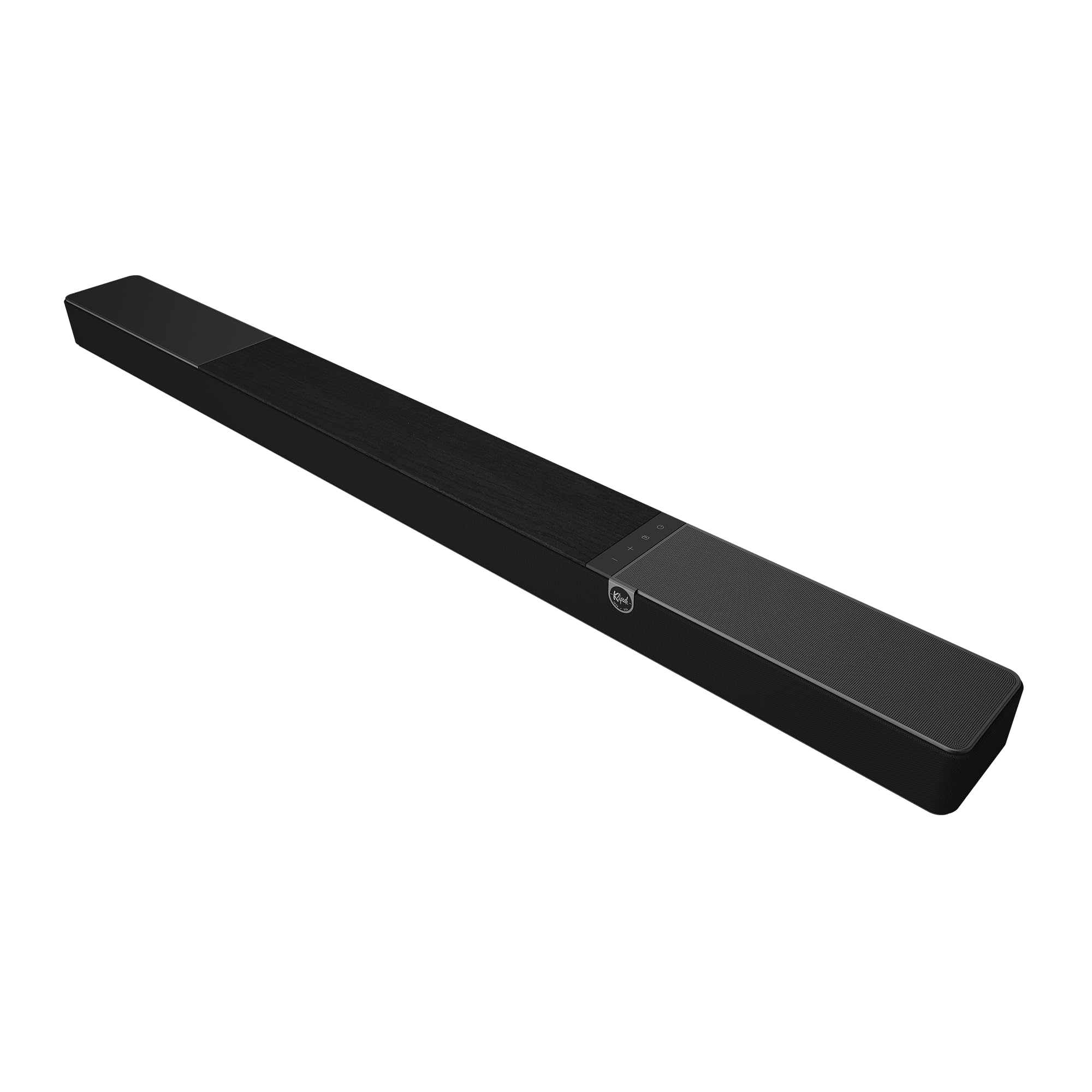
The Klipsch Flexus CORE 300 is the first soundbar to integrate Dirac Live room correction — a technology previously reserved for high-end AVR-based home theaters. Dirac Live uses a measurement microphone (included) to analyze your room’s acoustic anomalies across multiple listening positions, then applies filters to correct frequency response dips, peaks, and timing errors. For Dolby Atmos, this means the up-firing drivers’ reflections off the ceiling are phased and EQ’d precisely to your room geometry, not just guessed at with a generic algorithm.
The partnership between Klipsch (American loudspeaker design) and Onkyo (Japanese amplifier engineering) is evident in the build quality. The 54-inch bar uses a metal and aluminum enclosure with a silk grille, and the two built-in 2.254-inch elevation drivers and two 2.5-inch side-firing drivers create a wide, coherent front soundstage. The center channel performance is a highlight — dialogue clarity is exceptional, with natural vocal timbre that doesn’t sound artificially boosted or hollow.
The Dirac Live license included with the Core 300 is the basic version, which corrects frequencies up to 500 Hz. That covers the range where room modes cause the most damage to bass and lower midrange, but full-range correction requires a paid license upgrade. The bar lacks a built-in subwoofer that extends deep — it relies on an external sub (sold separately) for bass below ~50 Hz. For buyers who prioritize accurate, calibrated sound over raw channel count, the Core 300 offers unparalleled precision.
Why it’s great
- World’s first soundbar with Dirac Live room correction
- Exceptional center channel dialogue clarity
- Premium metal and aluminum build quality
Good to know
- Dirac Live basic license limited to 500 Hz correction
- Requires external subwoofer for deep bass extension
6. Bose Smart Ultra Dolby Atmos Soundbar

The Bose Smart Ultra Soundbar achieves its 3D sound field through Bose TrueSpace technology, which analyzes non-Atmos content and upmixes it to a spatial format using the bar’s six transducers — including two custom-designed upward-firing dipole speakers. Unlike systems that require physical rear speakers for full immersion, the Bose Smart Ultra creates a convincing surround and height effect from a single bar, though adding the optional Bose Surround Speakers 700 and Bass Module 700 takes it to another level.
A.I. Dialogue Mode is the standout feature for TV and movie watching. It continuously analyzes the audio track in real time, detecting human speech frequencies and boosting them relative to background effects and music. This is especially useful for modern content where soundtracks are mixed with wide dynamic range — no more reaching for the remote during quiet dialogue scenes in Christopher Nolan films. ADAPTiQ room calibration (performed with the included headset) tunes the bar to your specific listening position.
The soundbar includes built-in Amazon Alexa and Bose Voice4Video, which lets you control the TV and cable box with voice commands. AirPlay 2, Chromecast, and Spotify Connect are built-in for wireless music streaming. At roughly 27 inches wide, the bar is compact enough to fit in front of most TVs without blocking the screen or IR sensor. Some users find the app-centric setup frustrating — the remote alone cannot access advanced settings — but once calibrated, the sound quality is remarkably balanced and room-filling for its size.
Why it’s great
- TrueSpace upmixing creates convincing 3D sound from a single bar
- A.I. Dialogue Mode automatically clarifies speech in real time
- Compact size fits easily in most setups
Good to know
- App required for full setup and control
- Best Atmos performance needs optional surrounds and sub
7. Samsung HW-Q800F 5.1.2ch Q Series Soundbar
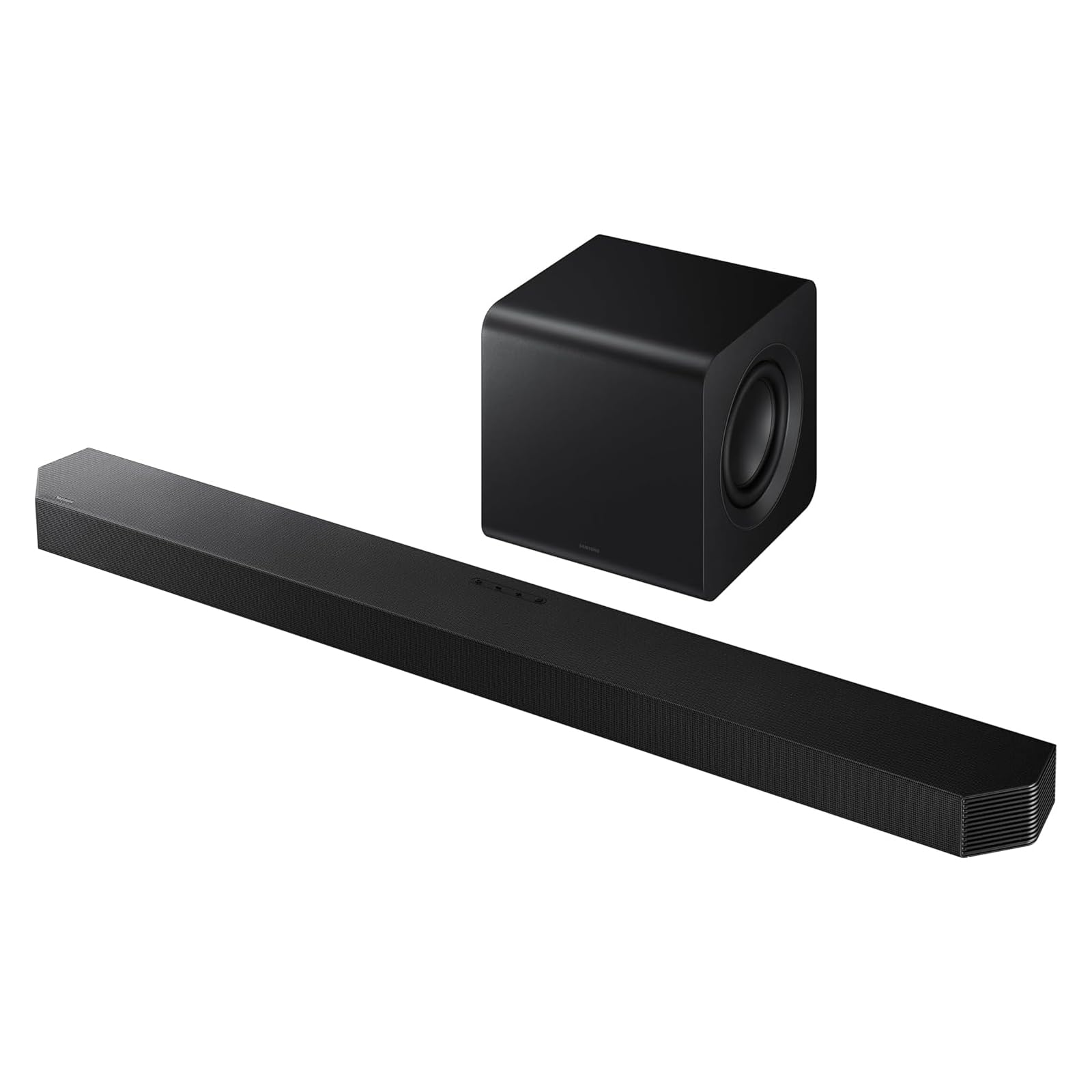
The Samsung HW-Q800F offers true 5.1.2-channel Dolby Atmos with side-firing and up-firing speakers built into the main bar, plus a wireless subwoofer featuring a 6.5-inch active driver paired with an 8-inch passive radiator. The passive radiator design allows the subwoofer cabinet to remain compact while still producing deep, articulate bass down to 40 Hz. For a mid-range system, the Q800F’s bass hits with surprising authority without overpowering the mid-range.
Q-Symphony allows the soundbar to synchronize with compatible Samsung TV speakers, effectively adding the TV’s drivers to the soundbar’s channel count for a wider, more immersive front soundstage. SpaceFit Sound Pro uses built-in sensors to analyze the room dimensions and furniture placement, then automatically calibrates the audio — including optimizing the subwoofer’s phase and crossover. This is particularly useful if the bar is tucked inside a cabinet or mounted close to a wall.
Game Mode Pro automatically activates when it detects a console input, applying dynamic 3D sound processing that emphasizes directional cues. This is a genuine competitive advantage for games like Call of Duty or Apex Legends, where hearing the exact location of footsteps or gunfire can determine the outcome of a round. Active Voice Amplifier Pro monitors ambient noise in the room and boosts dialogue levels accordingly. With only one HDMI eARC input, expansion options are limited.
Why it’s great
- Q-Symphony syncs bar with Samsung TV speakers
- Game Mode Pro enhances 3D directional audio for gaming
- SpaceFit Sound Pro auto-calibrates for room acoustics
Good to know
- Only one HDMI input limits source connections
- Best features require a compatible Samsung TV
8. JBL Bar 500MK2 5.1 Channel Soundbar
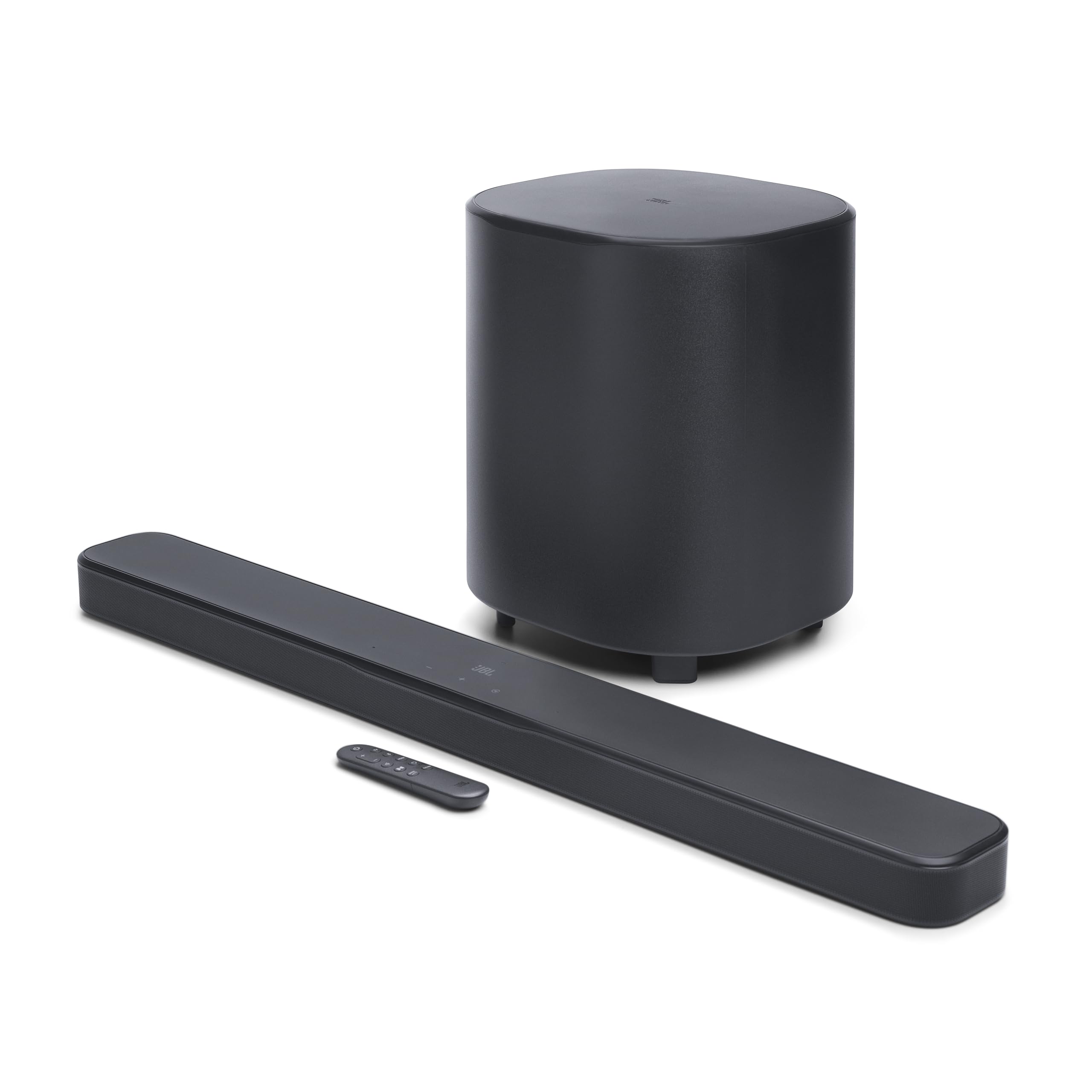
The JBL Bar 500MK2 delivers 750W of total system power with a dedicated 10-inch wireless subwoofer — the largest driver in the mid-range segment of this guide. A 10-inch sub moves enough air to produce impactful, chest-rattling bass for action movies and bass-heavy music, while the 5.1-channel configuration handles surround content through MultiBeam 3.0 beamforming. MultiBeam uses an array of drivers to create virtual surround speakers without physical rear channels.
PureVoice 2.0 is JBL’s latest dialogue enhancement technology. It automatically detects speech frequencies and optimizes them in real time based on both the ambient sound in the scene and the overall volume level of the bar. This means whispered dialogue remains intelligible even during loud action sequences, without the artificial, boosted sound of older dialogue modes. Easy Sound Calibration uses the bar’s built-in microphone to measure how sound reflects off your walls and furniture, then adjusts the MultiBeam steering for optimal surround imaging.
Connectivity includes HDMI eARC with 4K Dolby Vision passthrough, plus AirPlay 2, Google Cast, Spotify Connect, Tidal Connect, and Roon Ready for music streaming. The bar also works with voice assistant-enabled speakers for hands-free control. The overall sound signature is forward and energetic, with a slight emphasis on the upper bass and lower midrange that gives action scenes a visceral punch. For users who want robust bass and clear dialogue without adding rear speakers, the 500MK2 is a compelling value.
Why it’s great
- 10-inch subwoofer delivers deep, physical bass
- PureVoice 2.0 automatically optimizes dialogue clarity
- MultiBeam 3.0 creates wide virtual surround without rear speakers
Good to know
- Best value when purchased on sale
- No physical rear speakers for discrete surround effects
9. Sony BRAVIA Theater System 6 5.1ch Soundbar

The Sony BRAVIA Theater System 6 is a complete 5.1-channel solution that includes three front-firing drivers in the bar, a wired subwoofer, and two wired rear speakers with a wireless amplification box. It supports both Dolby Atmos and DTS:X formats, decoding the spatial metadata and rendering it through the 5.1 layout. While the system lacks dedicated up-firing height drivers, it uses Sony’s vertical sound engine to virtualize overhead effects — acceptable for casual viewers but not as convincing as discrete height channels.
The dedicated center channel speaker is the star of this system. Sony places a physically separate center driver in the bar, which anchors dialogue firmly on-screen. Voice Zoom 3, available when paired with a compatible BRAVIA TV, uses AI to analyze and isolate vocal frequencies, allowing you to boost dialogue without affecting the surround mix. The BRAVIA Connect app provides smartphone-based control for volume, sound profiles, and advanced settings.
Connectivity includes HDMI eARC and Bluetooth for wireless music streaming. The included subwoofer has a downward-firing 6.5-inch driver that produces tight, clean bass for a lower-mid-range system. Some users report audio dropouts over HDMI with certain Sony TV models, often resolved by switching to an optical cable. The wired rear speakers and subwoofer require cable management, which may be a consideration for minimalist setups. For buyers already in the Sony BRAVIA ecosystem, integration is seamless.
Why it’s great
- Dedicated center channel provides excellent dialogue anchoring
- Supports both Dolby Atmos and DTS:X
- Voice Zoom 3 with compatible BRAVIA TVs
Good to know
- No physical up-firing drivers — Atmos effects are virtualized
- Rear speakers and subwoofer require wired connections
10. ULTIMEA Skywave X50 5.1.4ch Soundbar

The ULTIMEA Skywave X50 steps up from the X40 with a 5.1.4-channel configuration — four height channels instead of two — delivered through wireless surround speakers and an 8-inch subwoofer. The dual 5GHz wireless transmission between the bar, surrounds, and sub minimizes interference and eliminates dropouts, which is critical for maintaining synchronized height effects during fast-paced Atmos scenes. The 760W peak power rating provides enough headroom for large rooms.
Gravus Ultra-Linear Bass Technology in the 8-inch subwoofer extends down to 28 Hz, deeper than the X40’s 35 Hz. The oversized waveguide and precision-engineered acoustic chamber maintain clean, distortion-free low frequencies even at high volume — important for LFE channels in Atmos soundtracks that demand sustained, deep bass. The GaN (gallium nitride) amplifier achieves up to 98% efficiency with 50% less heat than traditional silicon amps, ensuring stable performance during long listening sessions.
The NEURACORE multi-channel audio engine uses a triple-core DSP and dual-core MCU to process 24-bit/192 kHz audio with less than 0.5% total harmonic distortion. It supports up to 17 channels, allocating processing resources to the four height channels for precise overhead imaging. The metal grille, rose gold accents, and wood-crafted subwoofer cabinet give the system a premium aesthetic that doesn’t look out of place in a living room. Some users note the app’s EQ customization could be more intuitive.
Why it’s great
- 5.1.4ch with four discrete height channels
- GaN amplifier provides clean, efficient power
- Subwoofer extends down to 28 Hz for deep bass
Good to know
- App EQ customization could be more precise
- Atmos height effect window depends on ceiling height
11. ULTIMEA Skywave X40 5.1.2ch Sound Bar
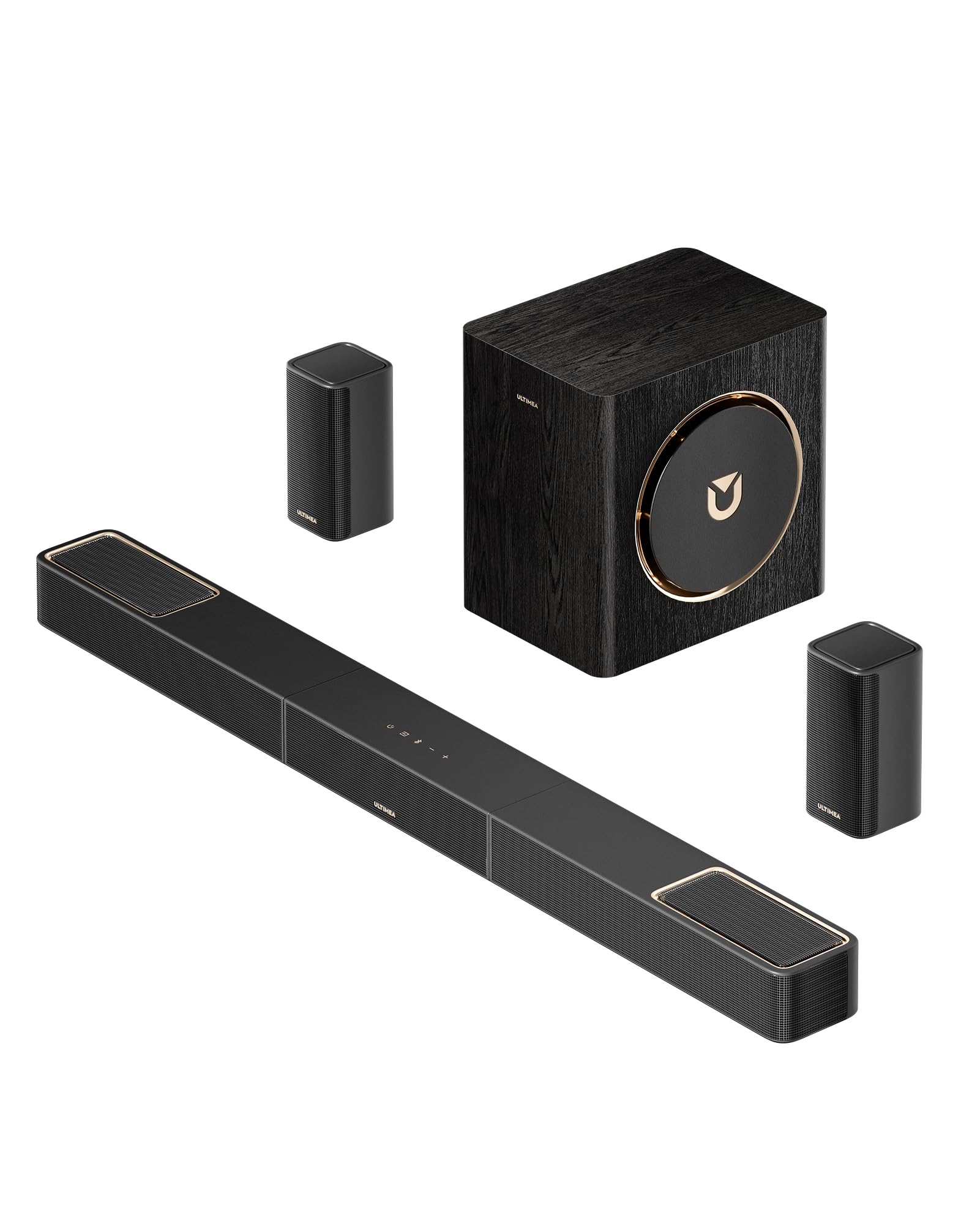
The ULTIMEA Skywave X40 delivers a true 5.1.2-channel Dolby Atmos experience — including wireless surround speakers, a 6.5-inch subwoofer, and two up-firing drivers in the main bar — at a price point that undercuts most competitors with similar configurations. The GaN amplifier provides 530W of peak power with 98% efficiency and 50% less heat than traditional silicon amps, allowing the bar to run loud and clean without thermal throttling. For buyers entering the Atmos ecosystem, this is a serious option.
The Gravus subwoofer extends down to 35 Hz, producing bass that fills small to medium rooms without distorting. The dual 5GHz wireless transmission ensures stable connectivity between the bar, surrounds, and sub — a critical feature for maintaining sync during fast-moving height effects. The NEURACORE audio engine processes 24-bit/192 kHz audio with less than 0.5% THD, handling up to 17 channels for precise placement of objects in the 3D sound field.
Setup takes about five minutes out of the box: plug in the speakers, connect via HDMI eARC, and the system auto-syncs. The wood-crafted subwoofer and metal grille add a premium look, and the built-in 4K HDR passthrough supports uncompressed video signals from your source to the TV. Some users note the rear surrounds are subtle in their effect — they contribute to ambient fill rather than discrete directional cues. For the price, the X40 offers a complete Atmos system that’s hard to beat.
Why it’s great
- Complete 5.1.2 Atmos system with wireless surrounds included
- GaN amplifier delivers clean power with low heat output
- Very fast and simple setup out of the box
Good to know
- Rear surround effects are subtle, not discrete
- Subwoofer depth is good, but not room-shaking
FAQ
What ceiling height works best for up-firing Atmos drivers?
Can I add rear speakers later to my Atmos soundbar?
Do I need a subwoofer for Dolby Atmos to sound good?
What is the difference between Dolby Atmos and DTS:X in a soundbar?
Does HDMI eARC make a noticeable difference for Atmos?
Final Thoughts: The Verdict
For most users, the best atmos soundbar winner is the Sonos Arc Ultra because it delivers 9.1.4 spatial audio from a single bar with industry-leading room calibration and AI-driven dialogue clarity. If you want maximum height channel count and theater-scale immersion without building an AVR system, grab the Nakamichi Shockwafe 11.2.6. And for the best value-to-performance ratio with complete 5.1.4 wireless surround, nothing beats the ULTIMEA Skywave X50.