
The gap between a flat TV speaker and a system that actually makes your favorite tracks breathe, your movie explosions land with weight, and your podcasts sound like the host is in the room—that gap is filled by a proper set of passive or powered speakers. The challenge isn’t finding a speaker; it’s cutting through the noise of wattage claims, driver sizes, and impedance ratings to land on the pair that matches your room, your amp, and the way you actually listen.
I’m Min — the co-founder and writer behind Gadgets Feed. I’ve spent hundreds of hours cross-referencing frequency response graphs, sensitivity specs, and real-world user measurements to separate the speakers that deliver on their spec sheet from the ones that leave your music sounding hollow.
This guide breaks down nine distinct options spanning powered bookshelf units, passive floorstanders, soundbars with Atmos, and wireless smart speakers to help you pinpoint the best audio speakers for home that align with your listening habits and budget.
How To Choose The Best Audio Speakers For Home
Home speakers live in vastly different categories: powered bookshelf models that include their own amplification, passive floorstanders that need a separate receiver, soundbars that simulate surround, and compact wireless units that prioritize convenience. Your choice depends on room size, whether you own an amplifier, and how much floor space you’re willing to sacrifice for stereo imaging.
Powered vs. Passive: The Amplifier Question
A powered speaker like the Edifier R1280T contains its own amp—you plug it into the wall and connect a source directly. A passive speaker like the Sony SS-CS5M2 or Polk ES20 has no amp; it requires a separate receiver or integrated amplifier to drive it. Powered speakers offer simplicity, while passive setups let you upgrade the amplifier independently for better control and future-proofing.
Impedance and Sensitivity: Matching the Amp
Most home speakers are rated at 6 or 8 ohms. An 8-ohm speaker is easier for most AV receivers to drive safely. Sensitivity, measured in decibels (dB), tells you how efficiently the speaker converts power into volume. A speaker with 94dB sensitivity (like the Klipsch R-610F) will play significantly louder on the same wattage than a speaker rated at 86dB. Lower sensitivity speakers need more amplifier power to reach the same volume.
Driver Configuration and Cabinet Design
A two-way bookshelf speaker uses one woofer for bass and one tweeter for highs. Three-way designs, such as the Sony SS-CS5M2, add a dedicated super tweeter for extended high-frequency detail. Woofer size directly impacts bass extension: a 5.25-inch driver produces tighter but shallower bass, while a 6.5-inch driver (found in the Polk ES20) moves more air and delivers deeper low-end. Bass reflex ports or passive radiators (like on the Polk XT60) also extend low-frequency response compared to sealed enclosures.
Quick Comparison
On smaller screens, swipe sideways to see the full table.
| Model | Category | Best For | Key Spec | Amazon |
|---|---|---|---|---|
| Sonos Era 100 SL | Wireless Smart Speaker | Multi-room streaming | Dual angled tweeters + midwoofer | Amazon |
| Marshall Stanmore III | Bluetooth Home Speaker | Stylish all-in-one bedroom audio | 5-inch woofer, 70% recycled build | Amazon |
| Klipsch R-610F (Pair) | Passive Floorstander | High-efficiency home theater | 94dB sensitivity, 340W peak | Amazon |
| Polk Signature Elite ES20 (Pair) | Passive Bookshelf | Reference-level stereo imaging | 6.5-inch woofer, Power Port design | Amazon |
| Polk Monitor XT60 (Single) | Passive Floorstander | Compact tower for smaller rooms | Two 6.5-inch passive radiators | Amazon |
| Sony SS-CS5M2 (Pair) | Passive Bookshelf | Nearfield listening with detail | 3-way, 5.12-inch woofer | Amazon |
| ULTIMEA Skywave F40 | Soundbar System | Dolby Atmos surround for TV | 5.1.2ch, up-firing drivers | Amazon |
| Edifier R1280T (Pair) | Powered Bookshelf | Desktop/PC audio on a budget | 42W RMS, 4-inch woofer | Amazon |
| Bose SoundLink Plus | Portable Bluetooth Speaker | Outdoor portability with big sound | IP67, 20-hour battery | Amazon |
In‑Depth Reviews
1. Sonos Era 100 SL
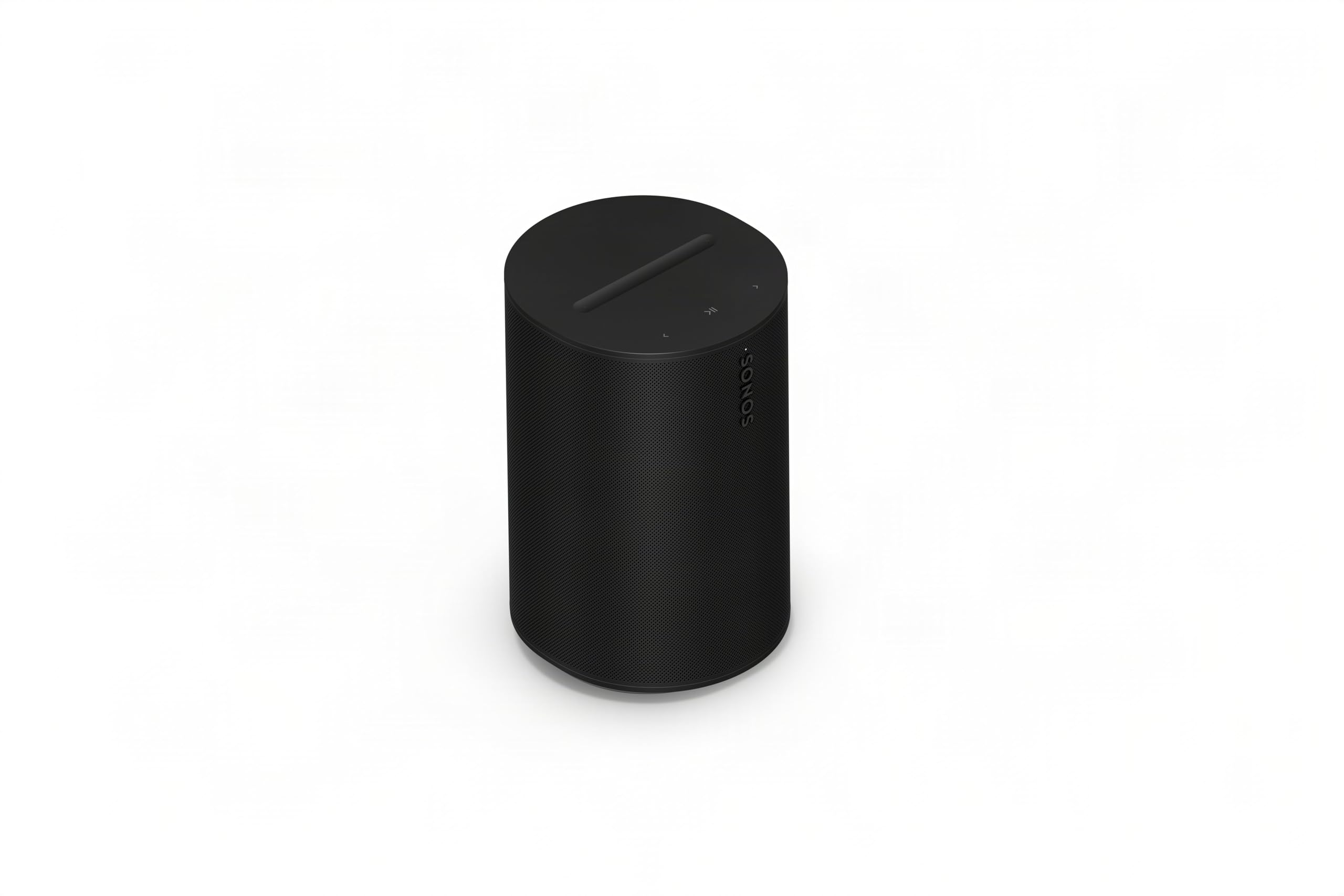
The Sonos Era 100 SL delivers the most polished all-in-one wireless experience in this lineup. Its dual angled tweeters create a noticeably wider stereo image than a single-driver speaker, and the dedicated midwoofer punches out bass that fills a living room without rattling. Setup takes minutes via the Sonos app, and Trueplay automatically tunes the speaker to your room’s acoustics by measuring how sound reflects off walls and furniture.
Streaming over WiFi means you bypass Bluetooth compression entirely, and the 100 SL supports both AirPlay 2 and Spotify Connect for direct app control. The microphone-free design (that’s what the “SL” means) appeals to privacy-conscious users who don’t need voice assistant functionality. It also accepts line-in via an adapter if you want to connect a turntable or other analog source.
The trade-off is that you’re locked into the Sonos ecosystem. Multi-room groups, stereo pairing, and software updates all require the Sonos app, and the Era 100 SL doesn’t support high-res codecs like LDAC over Bluetooth. But for sheer convenience paired with genuinely musical sound—wide soundstage, articulate mids, and bass that stays controlled—this is the one to beat for wireless listening at home.
Why it’s great
- Trueplay room correction optimizes sound for your specific space
- Dual tweeter array creates believable stereo separation from a single cabinet
- WiFi streaming preserves audio quality better than standard Bluetooth
Good to know
- No microphone means no voice assistant control built in
- Line-in adapter sold separately
2. Edifier R1280T (Pair)
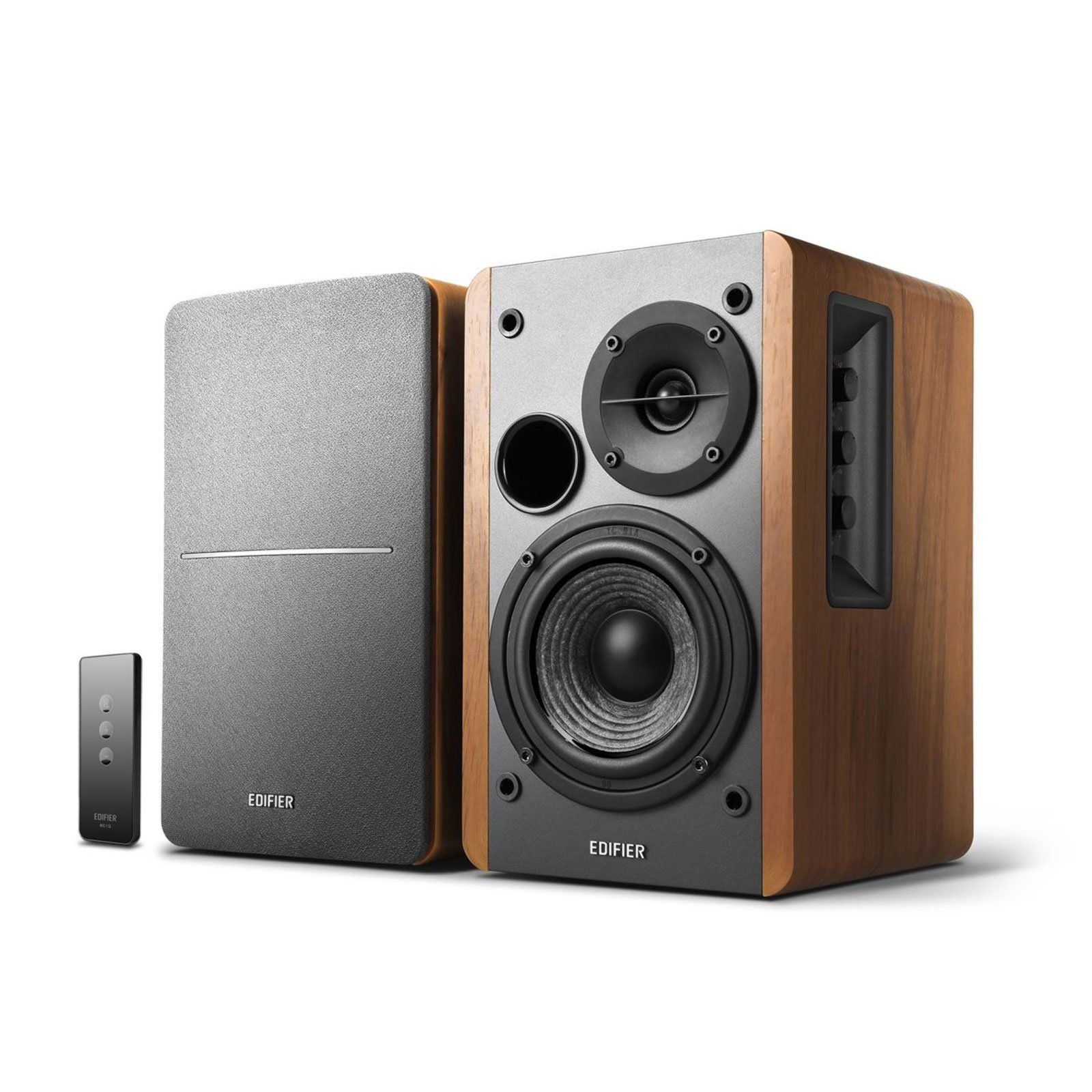
The Edifier R1280T has earned its reputation as the top-selling powered bookshelf speaker for a reason: it delivers genuinely enjoyable stereo sound without requiring any external amplifier. The 13mm silk dome tweeter and 4-inch full-range driver produce a warm, non-fatiguing sound signature that works well for casual music listening, YouTube, and TV dialogue. Bass is present and punchy for the driver size—it won’t shake walls, but it doesn’t sound thin either.
Connectivity is straightforward with dual RCA/AUX inputs, letting you keep a PC and a TV or phone connected simultaneously without swapping cables. The included remote controls volume and input selection, while the side-mounted bass and treble knobs let you tune the voicing to your room without digging into software menus. The wood-effect vinyl finish over MDF gives them a furniture-grade look that blends into most living spaces.
What you don’t get is Bluetooth, a subwoofer output, or any digital inputs like optical or USB. The 42-watt RMS power is modest, meaning they will start to distort if pushed near maximum volume in a large room. For a desktop setup or a small to medium-sized living room, however, the R1280T punches far above its entry-level price point and remains the benchmark for affordable powered speakers.
Why it’s great
- Silk dome tweeter delivers smooth highs without harshness
- Dual RCA/AUX inputs allow simultaneous connection to two sources
- Side-panel bass and treble EQ gives direct analog tone control
Good to know
- No Bluetooth or wireless connectivity built in
- Lacks a subwoofer output for expanding bass later
- Limited power output for filling larger rooms
3. Klipsch Reference R-610F (Pair)

Klipsch’s Reference R-610F towers deliver the highest sensitivity in this roundup at 94dB, meaning they produce serious volume with surprisingly little amplifier power. A modest 20-watt receiver can drive them to room-shaking levels, making them an excellent match for budget AV receivers that might struggle with lower-sensitivity bookshelf speakers. The 1-inch aluminum LTS tweeter mated to a 90×90 Square Tractrix Horn provides the crisp, detailed treble that defines the Klipsch house sound.
The dual 6.5-inch woofers, combined with the front-firing bass reflex port, deliver solid low-end extension down to 45Hz. They handle 85 watts continuous and 340 watts peak, so there’s headroom for dynamic movie soundtracks without audible compression. The MDF cabinets weigh 36 pounds each and include magnetic grilles for a clean aesthetic. Placement is forgiving thanks to the high sensitivity, though the horn-loaded tweeter can sound bright in overly reflective rooms.
At their price point, the R-610F competes directly with the Polk XT60 towers. The Klipsch offers higher sensitivity and a livelier top end, while the Polk uses passive radiators for a slightly warmer bass character. For home theater use where dialogue clarity and explosive dynamics matter most, the Klipsch towers are hard to beat—especially if you’re building a timbre-matched 5.1 system with other Reference series speakers.
Why it’s great
- 94dB sensitivity means massive volume from low-powered amps
- Horn-loaded tweeter produces exceptionally clear dialogue and vocals
- Dual 6.5-inch woofers deliver authoritative bass extension to 45Hz
Good to know
- Bright treble can be fatiguing in rooms with hard surfaces
- Included leg screws are low quality; plan to replace them
4. Polk Signature Elite ES20 (Pair)

The Polk Signature Elite ES20 represents a serious step up in passive bookshelf performance. Its 6.5-inch dynamically balanced woofer and 1-inch Terylene tweeter, combined with Polk’s patented Power Port technology, produce a soundstage that rivals much pricier towers. The Power Port—a flared port tube design—reduces turbulence and distortion at the port opening, resulting in bass that is 3dB louder than a conventional ported speaker of the same size, according to Polk’s measurements.
These speakers are 8-ohm nominal and 4-ohm compatible, giving you flexibility with a wide range of amplifiers and AV receivers. Sensitivity is a solid 88dB, meaning they need reasonable power (50-100 watts recommended) to shine but reward good amplification with clean, dynamic playback. The Walnut vinyl finish has a convincing wood grain texture, and the build quality—heavy MDF cabinets with internal bracing—feels substantial. Many users report a break-in period of 20-30 hours before the treble smooths out and the drivers loosen up.
Where the ES20 excels compared to the Sony SS-CS5M2 is in low-end weight: the larger 6.5-inch woofer and Power Port deliver noticeably fuller bass without needing a subwoofer for casual listening. The Sony has the edge in high-frequency air thanks to its dedicated super tweeter. For a stereo music setup where you want rich, room-filling sound from a bookshelf form factor without immediately adding a subwoofer, the ES20 is the stronger choice.
Why it’s great
- Power Port design delivers bass that belies the bookshelf size
- Sturdy MDF construction with internal bracing reduces cabinet resonance
- Terylene tweeter produces smooth, non-fatiguing high frequencies
Good to know
- Deep cabinet may protrude past a thin TV when placed on a media console
- Faux wood veneer finish looks less premium than real wood up close
5. Marshall Stanmore III
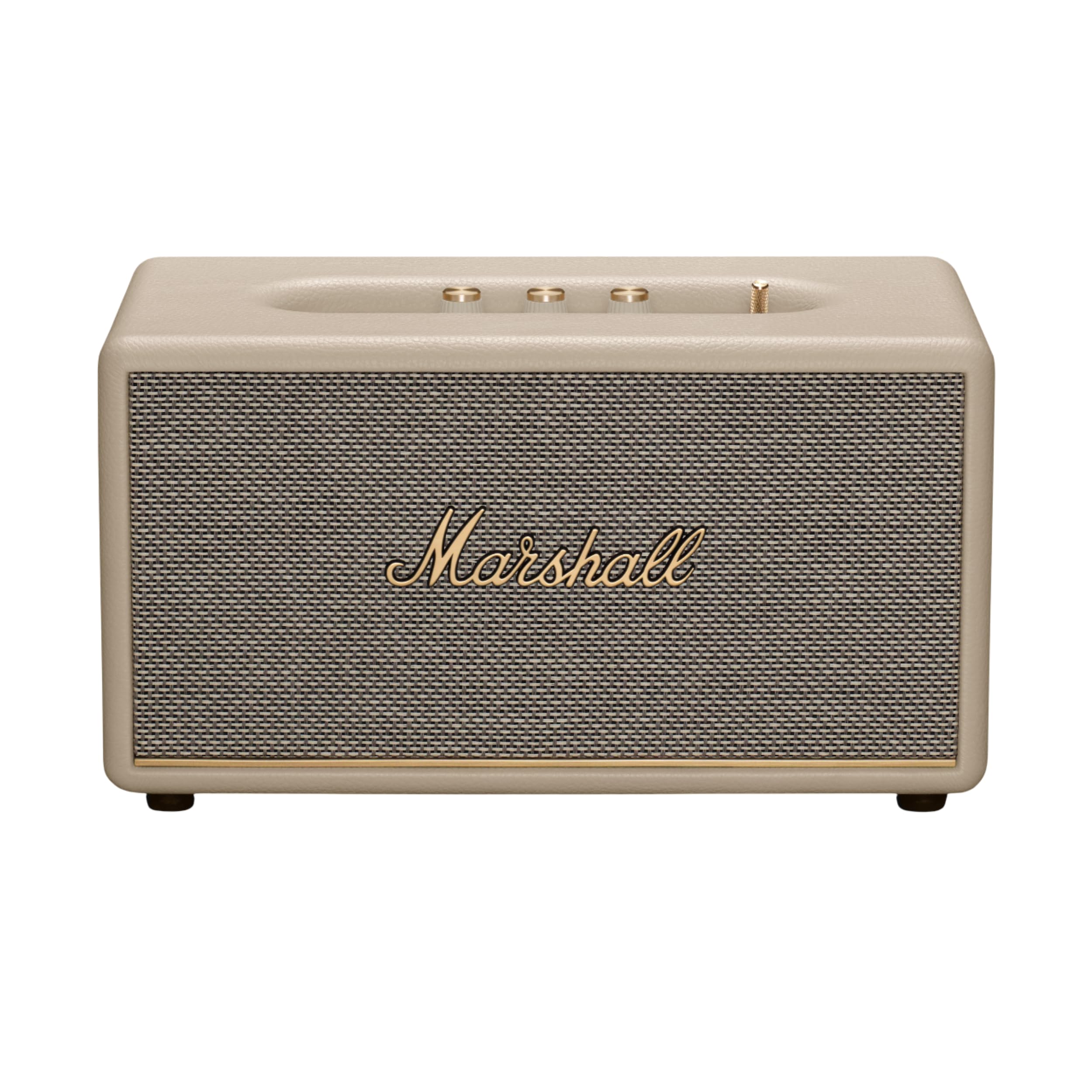
The Marshall Stanmore III delivers the iconic rock-and-roll aesthetic paired with genuinely impressive sound for a plug-in home speaker. The 5-inch woofer and dual tweeters produce a forward, lively sound signature with an emphasis on midrange presence—voices and guitar cuts through with clarity while bass remains punchy but controlled. The maximum volume is substantial enough to fill a large living room or open-plan space without audible distortion.
Connection options include Bluetooth 5.2 for wireless streaming, plus RCA and 3.5mm aux inputs for connecting a turntable or computer. The physical controls—a bank of analog knobs for volume, bass, and treble—offer immediate tactile feedback without needing an app, though the Marshall Bluetooth app does provide EQ adjustment if you prefer. The design is a conversation piece: cream vinyl covering, gold front plate, and the signature Marshall logo command attention in any room.
The Stanmore III is a single-speaker mono-stereo system, meaning it doesn’t provide the true left-right separation of a pair of bookshelf speakers. It’s also not battery-powered—it requires wall power, so portability is limited to moving it between rooms. For a bedroom, home office, or living room where you want one device that looks as good as it sounds and handles streaming from your phone effortlessly, the Stanmore III is the premium all-in-one pick.
Why it’s great
- Analog bass, treble, and volume knobs provide immediate physical tone control
- Bluetooth 5.2 offers stable, low-latency wireless streaming
- Award-winning rock-and-roll design that doubles as furniture
Good to know
- Single-cabinet design cannot produce true stereo separation
- Requires wall power; completely non-portable
6. Polk Monitor XT60 (Single)

The Polk Monitor XT60 rethinks the budget floorstander by replacing a conventional bass reflex port with two 6.5-inch passive radiators flanking the active 6.5-inch woofer. This unique design allows the speaker to move more air for bass output while eliminating the chuffing noise that ported speakers can produce at high volumes. The result is a clean, surprisingly deep low-end that competes with larger towers, especially when placed near a wall (passive radiators are less position-sensitive than ports).
The 1-inch tweeter handles highs with the same Terylene material used in Polk’s higher-end Signature series, producing clear dialogue and cymbal detail without excessive brightness. Hi-Res Audio certification confirms a frequency response extending beyond 20kHz. The XT60 is Dolby Atmos, DTS:X, and Auro 3D compatible, making it a viable front speaker in a surround system. The single speaker purchase model means you buy a pair for stereo—at their price point per pair, they undercut other towers significantly.
Compared to the Klipsch R-610F, the XT60 has lower sensitivity (around 88dB) and won’t play as loud on a low-power receiver. Its passive radiator design also means the cabinet is sealed, which can sound tighter but slightly less explosive than a ported design. For a home theater in a small to medium room where you want tower aesthetics and bass without a subwoofer, the XT60 delivers remarkable value per dollar.
Why it’s great
- Passive radiators eliminate port chuffing and reduce placement restrictions
- Hi-Res Audio certified for extended high-frequency playback
- Surprisingly deep bass output from a slim tower cabinet
Good to know
- Lower sensitivity requires 50+ watts per channel for lively playback
- Sold as single speaker—must purchase two for stereo
7. Sony SS-CS5M2 (Pair)

The Sony SS-CS5M2 is a rare breed in the budget bookshelf market: a genuine 3-way speaker with a separate woofer, tweeter, and super tweeter. The 5.12-inch mica-reinforced cellular cone woofer handles bass and lower mids, while the 1-inch high-precision tweeter and additional super tweeter split the high frequencies, allowing both drivers to operate in their optimal range. This design yields exceptional detail retrieval in the upper octaves—cymbal shimmer, vocal sibilance, and ambient micro-details emerge with a clarity that two-way speakers of similar size can’t match.
The frequency response extends from 53Hz to an extraordinary 50kHz thanks to the super tweeter, though the usable low-end in-room is more like 60-70Hz. Bass is articulate but not portly; these benefit from a subwoofer if you want chest-thumping low end. The impedance is 6 ohms with a sensitivity of 87dB, meaning they need a competent amplifier with decent current delivery. They pair well with Sony AV receivers but sound excellent with any neutral amp in the 50-100 watt range.
The SS-CS5M2 is best suited for nearfield listening—desktop use or a small listening room where the listener sits within 6-8 feet of the speakers. In that sweet spot, the 3-way driver array creates a holographic soundstage with precise instrument placement. Move too far off-axis or into a large room, and the bass thinness and lower sensitivity become more apparent. For critical listening in a small space, these are the most revealing speakers in this lineup.
Why it’s great
- 3-way driver design extracts more micro-detail than 2-way speakers
- Super tweeter extends high-frequency response to 50kHz for Hi-Res audio
- Mica-reinforced cone woofer produces clean, non-flabby bass
Good to know
- Requires a quality amplifier with good current output to sound their best
- Limited bass extension below 60Hz means a subwoofer is recommended
- Rear-firing port needs space from wall (6+ inches)
8. ULTIMEA Skywave F40
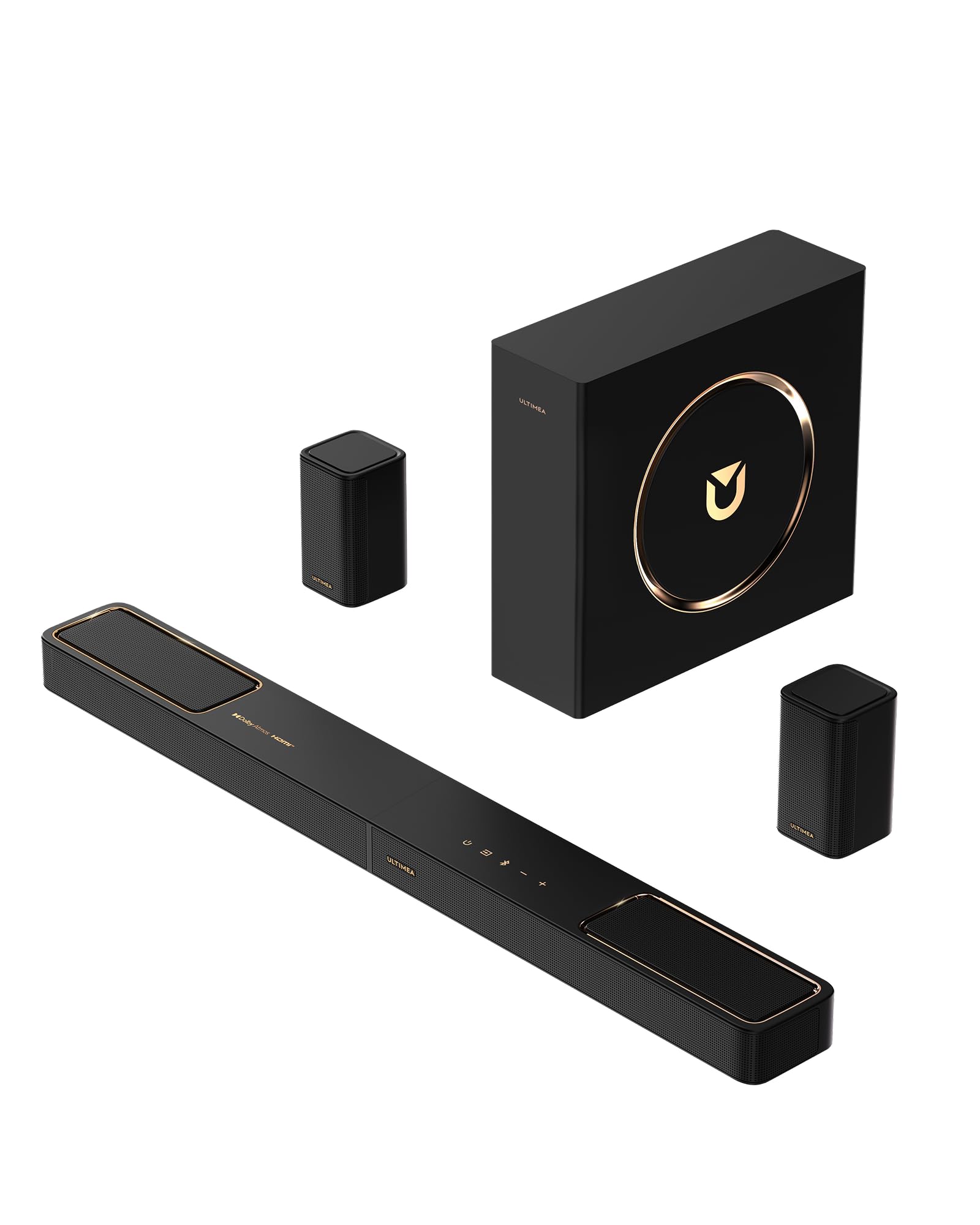
The ULTIMEA Skywave F40 brings genuine Dolby Atmos immersive audio to a price point that undercuts traditional receiver-and-speaker setups by a wide margin. The 5.1.2-channel configuration includes a soundbar with up-firing drivers, two wireless rear surround speakers, and a 5.25-inch wired subwoofer. The up-firing drivers use neodymium magnets and 18-core voice coils to project sound toward the ceiling, creating the overhead effect that defines Atmos—helicopter flyovers and rain feel genuinely three-dimensional.
Connection is handled via HDMI eARC, which supports lossless 5.1.2-channel audio up to 37Mbps bandwidth. This means you get the full uncompressed Dolby Atmos signal from streaming services and Blu-rays, unlike standard ARC which compresses the data. The Ultimea app offers deep customization: 13-step level adjustment for each channel, a 10-band graphic EQ, and 121 preset sound modes. Bluetooth 5.4 is also available for music streaming from your phone.
What you sacrifice compared to a traditional speaker setup is pure stereo music fidelity. The soundbar’s drivers are physically close together, so the front left-right separation is narrower than a pair of bookshelf speakers placed 6 feet apart. The rear surrounds are wireless but still require power cables, and the subwoofer is wired to the soundbar. For a TV-centric setup where you want true object-based surround sound without running speaker wire across the room, the Skywave F40 delivers an immersive experience that passive stereo speakers simply cannot replicate.
Why it’s great
- Up-firing drivers create genuine overhead Atmos effects
- HDMI eARC support enables lossless Dolby Atmos audio
- App-based 10-band EQ and 121 presets for precise tuning
Good to know
- Front soundstage width is limited by the soundbar form factor
- DTS content is not supported—Atmos and PCM only
9. Bose SoundLink Plus

The Bose SoundLink Plus is a portable Bluetooth speaker that sacrifices the last word in audiophile detail for extreme versatility and durable design. The IP67 rating means it is fully dust-tight and can survive submersion in a meter of water for 30 minutes—making it the only speaker in this roundup you can confidently take to the beach, poolside, or on a camping trip. The body is also shock and rust resistant, with a carrying loop for easy transport.
Audio performance is classic Bose: clean, articulate mids with a warm bass emphasis that avoids distortion even at high volumes. The speaker weighs over 3 pounds, which contributes to its authoritative sound—there’s enough cabinet mass and driver excursion to fill an outdoor patio or backyard without sounding strained. Battery life is rated at 20 hours, and the USB-C port doubles as a charge-out function so you can top up your phone from the speaker’s 4500mAh internal battery.
The Bose app provides EQ adjustment for bass, mid, and treble, and SimpleSync technology lets you pair the SoundLink Plus with compatible Bose soundbars to extend your home system outdoors. You can also stereo-pair two SoundLink Plus speakers or use Party Mode for synchronized playback. If your primary use is stationary home listening with critical stereo imaging, a powered bookshelf pair will outperform it. But if you need one speaker that works everywhere—kitchen, deck, trail, and living room—the SoundLink Plus is the most capable all-weather companion in the lineup.
Why it’s great
- IP67 dust and waterproof rating handles beach, rain, and poolside use
- 20-hour battery and USB-C charge-out keep your devices going
- Bose SimpleSync pairs wirelessly with compatible home soundbars
Good to know
- Single-cabinet design limits stereo separation
- Heavier than typical portable speakers at over 3 pounds
FAQ
Can I use a soundbar like the ULTIMEA Skywave F40 for music listening?
Do I need a subwoofer with bookshelf speakers like the Sony SS-CS5M2?
What’s the difference between a floorstanding speaker and a bookshelf speaker placed on stands?
How important is room placement for passive speakers?
Final Thoughts: The Verdict
For most users, the best audio speakers for home winner is the Sonos Era 100 SL because it blends room-filling stereo sound, effortless WiFi streaming, and automatic Trueplay room tuning into a single plug-and-play device that works for both music and TV. If you want the raw detail and soundstage control of a passive stereo setup, grab the Polk Signature Elite ES20 pair. And for a portable outdoor speaker that survives the elements while still sounding full and clear, nothing beats the Bose SoundLink Plus.