
If you’re reading this, you’re probably tired of tinny laptop speakers, soundbars that can’t separate a kick drum from a conversation, or home-theater-in-a-box kits that rattle at moderate volume. The gap between “loud” and “clean” is where most audio systems stumble — and where the real listening experience lives or dies. A properly chosen setup transforms not just how movies and music sound, but how they feel in the room, with imaging that places a singer dead-center and bass that hits your chest instead of your ears.
I’m Min — the co-founder and writer behind Gadgets Feed. I’ve spent hundreds of hours cross-referencing amplifier topologies, driver materials, DSP capabilities, and wireless codec support across hundreds of models to build this guide. Rather than reading marketing sheets, I dig into the measurable specs and real-owner feedback that separate a genuinely capable system from one that just looks the part.
Whether you need a minimalist bookshelf pair for critical near-field listening or a full 5.1.4 Dolby Atmos rig for cinematic immersion, this analysis of the best audio system across nine distinct contenders will help you match the right hardware to your room, your source material, and your budget without overpaying for features you’ll never use.
How To Choose The Best Audio System
Selecting an audio system is a balancing act between channel count, amplifier power, driver quality, and the physical constraints of your listening room. A massive 5.1.4 setup in a 10×10-foot bedroom will sound congested, while a pair of premium bookshelf speakers in a wide-open great room will lack the volume and dispersion needed to fill the space. Start with your room dimensions and primary use case — then evaluate the specs that actually matter.
Channel Configuration and Room Size
The number of channels (2.0, 2.1, 5.1, 5.1.4) dictates how immersive the soundstage can be, but only if your room can accommodate the speaker placement. For rooms under 200 square feet, a 2.1 system with a subwoofer is often more satisfying than a 5.1 system where rear speakers must sit only a few feet behind the listening position, collapsing the surround effect. For larger rooms, look for systems that specify a real speaker-to-listener distance of at least 6 to 8 feet for rear channels to produce a convincing wraparound bubble.
Amplifier Technology and Headroom
Continuous RMS power per channel (not peak wattage) determines how cleanly a system plays at moderate and high volumes before distortion sets in. Systems using GaN (gallium nitride) amplifiers, like the ULTIMEA Skywave X50, offer higher efficiency — typically 98% — and faster switching, resulting in less heat and lower distortion under load. Traditional Class-D and Class-AB designs can still deliver excellent clarity, but they typically need larger heat sinks and draw more standby power to achieve the same clean headroom.
Driver Composition and Crossover Design
The materials used in the tweeter, midrange driver, and woofer directly affect tonal balance and longevity. Silk-dome tweeters (used in the WiiM Sound) produce smooth, non-fatiguing highs ideal for long listening sessions. Planar magnetic tweeters (used in Edifier S2000MKIII) offer lower distortion and faster transient response, making them excellent for revealing micro-detail in acoustic and jazz recordings. For woofers, paper cones with proprietary coatings (WiiM) provide natural midrange warmth, while aluminum diaphragms (Edifier S2000MKIII) deliver tighter, more controlled bass but can sound brittle if the crossover isn’t well-implemented.
Wireless Protocol and Latency
Bluetooth versions and codecs matter, but for home theater, Wi-Fi-based multi-room protocols are more important. Systems supporting Google Cast, Apple AirPlay 2, and Spotify Connect (Edifier S1000W, WiiM Sound) allow gapless, CD-quality streaming without the compression artifacts inherent in Bluetooth. If you do use Bluetooth, look for aptX HD for 24-bit support at 576 kbps — standard AAC/SBC will leave audible gaps in the treble and bass. For video sync, latency below 50ms is critical; the WiiM Sound specifies a latency of 50ms, which is the boundary where lip-sync issues become noticeable.
Quick Comparison
On smaller screens, swipe sideways to see the full table.
| Model | Category | Best For | Key Spec | Amazon |
|---|---|---|---|---|
| Klipsch The One Plus | Tabletop Stereo | Office / Kitchen all-in-one | 4.5″ woofer + 2.25″ full-range drivers | Amazon |
| Bobtot 5.1ch System | Surround Sound | Budget home theater / party | 10″ subwoofer, 1200W peak | Amazon |
| WiiM Sound | Smart Speaker | Multi-room streaming / stereo pair | 1.8″ touch display, Wi-Fi 6E, 100W peak | Amazon |
| ULTIMEA Skywave X50 | Soundbar System | Cinematic 5.1.4 wireless surround | 8″ subwoofer, GaN amplifier, 760W peak | Amazon |
| Edifier S2000MKIII | Bookshelf Speaker | Audiophile near-field / vinyl rig | Planar tweeter, tri-amped 130W RMS | Amazon |
| Edifier S1000W | Wi-Fi Bookshelf | Hi-Res multi-room with AirPlay 2 | 5.5″ woofer, 24-bit/192kHz, 120W RMS | Amazon |
| Sony BRAVIA HT-S60 | Soundbar System | TV-centric 5.1ch with dialogue clarity | Dolby Atmos / DTS:X, Voice Zoom 3 | Amazon |
| Sonos Sub 4 | Subwoofer | Sonos ecosystem bass upgrade | Force-canceling drivers, dual-woofer enclosure | Amazon |
| Klipsch Reference Bundle | Floorstanding System | Dedicated home theater with Atmos | 6.5″ woofers, 12″ sub, 75W/ch AVR | Amazon |
In‑Depth Reviews
1. ULTIMEA Skywave X50 5.1.4ch Wireless Surround Sound System
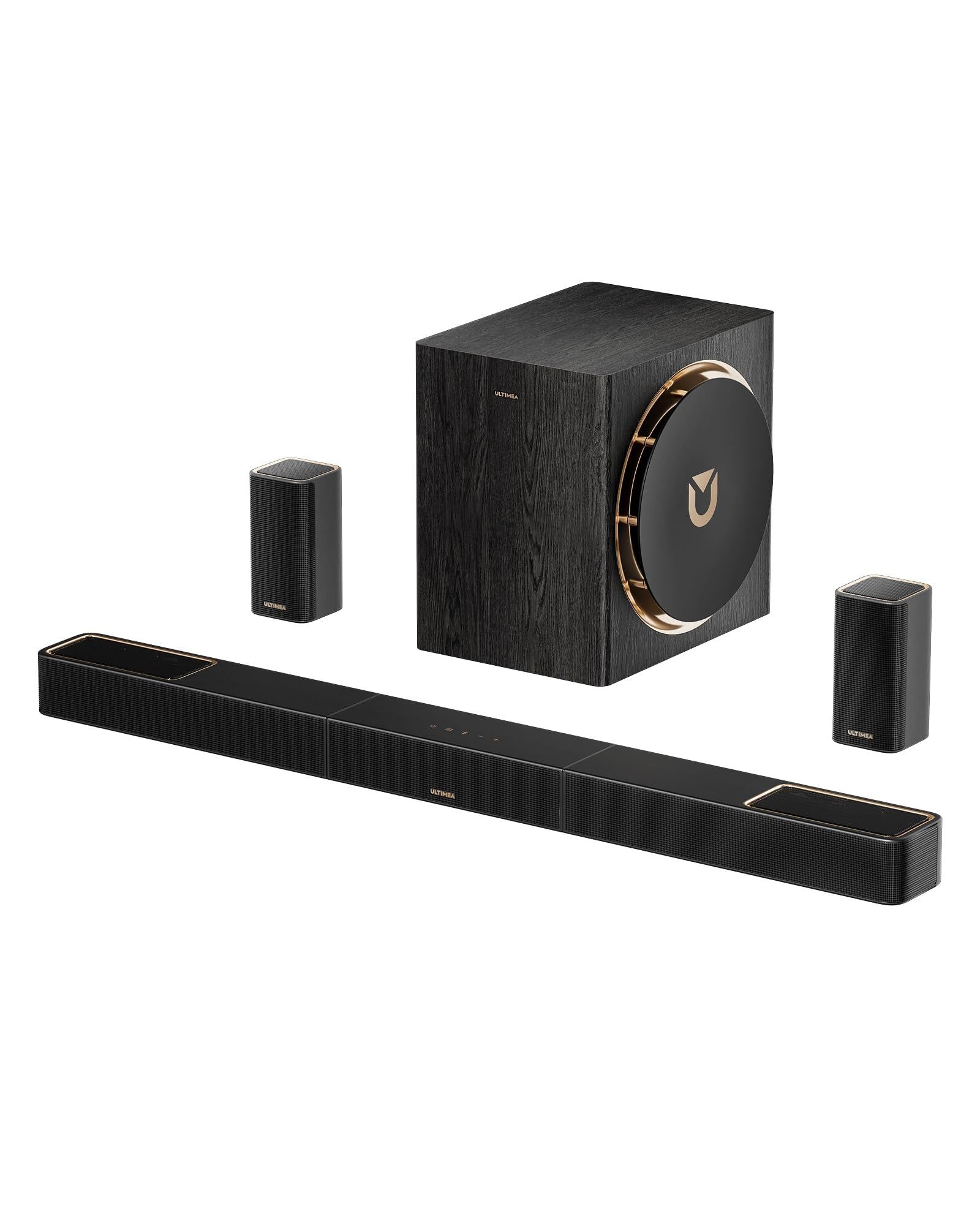
The ULTIMEA Skywave X50 is the most complete home-theater package in this roundup, delivering a true 5.1.4-channel layout with two wireless rear speakers, up-firing drivers for Dolby Atmos height effects, and a wood-crafted 8-inch subwoofer — all without a single speaker wire running across your room. What sets it apart is the GaN (gallium nitride) amplifier, which achieves up to 98% efficiency and 8x faster switching than silicon-based amps, producing 760W peak power with less than 0.5% total harmonic distortion. The NEURACORE multi-channel audio engine, driven by a triple-core DSP, processes 24-bit/192kHz signals and supports up to 17 channels for pinpoint surround imaging.
Owners consistently praise the plug-and-play setup — the rear speakers auto-sync to the soundbar without manual pairing — and the Gravus ultra-linear bass technology that extends sub-bass down to 28Hz. The bass can dominate dialogue, but the companion app includes a Dialogue Boost mode that lifts the center frequencies without muddying the low end. The 4K HDR passthrough preserves full video quality from source to TV, and the rose-gold metal grille gives the unit a genuinely premium aesthetic that doesn’t look like a black plastic box.
Compared to the Sony HT-S60, the Skywave X50 offers a more immersive height-channel implementation and true wireless rear speakers without requiring a wired subwoofer connection. Competitors at twice the price often lack the GaN amplifier’s heat management and transient speed. For anyone building a mid-range to premium home theater, the Skywave X50 delivers a level of cinematic authority and convenience that is hard to match without spending significantly more.
Why it’s great
- Fully wireless 5.1.4 with no rear speaker wires — uses dual 5GHz RF for stable, drop-out-free connectivity
- GaN amplifier keeps the system cool and clean even during long movie sessions at high volume
- Sub-bass extension to 28Hz provides tactile, chest-punching low end without port chuffing
Good to know
- Bass can overwhelm dialogue tracks; you’ll likely want to enable Dialogue Boost in the app
- Rear speakers are compact and can feel subtle for foley effects compared to larger floorstanding satellites
2. Edifier S2000MKIII Coaxial Bookshelf Speakers
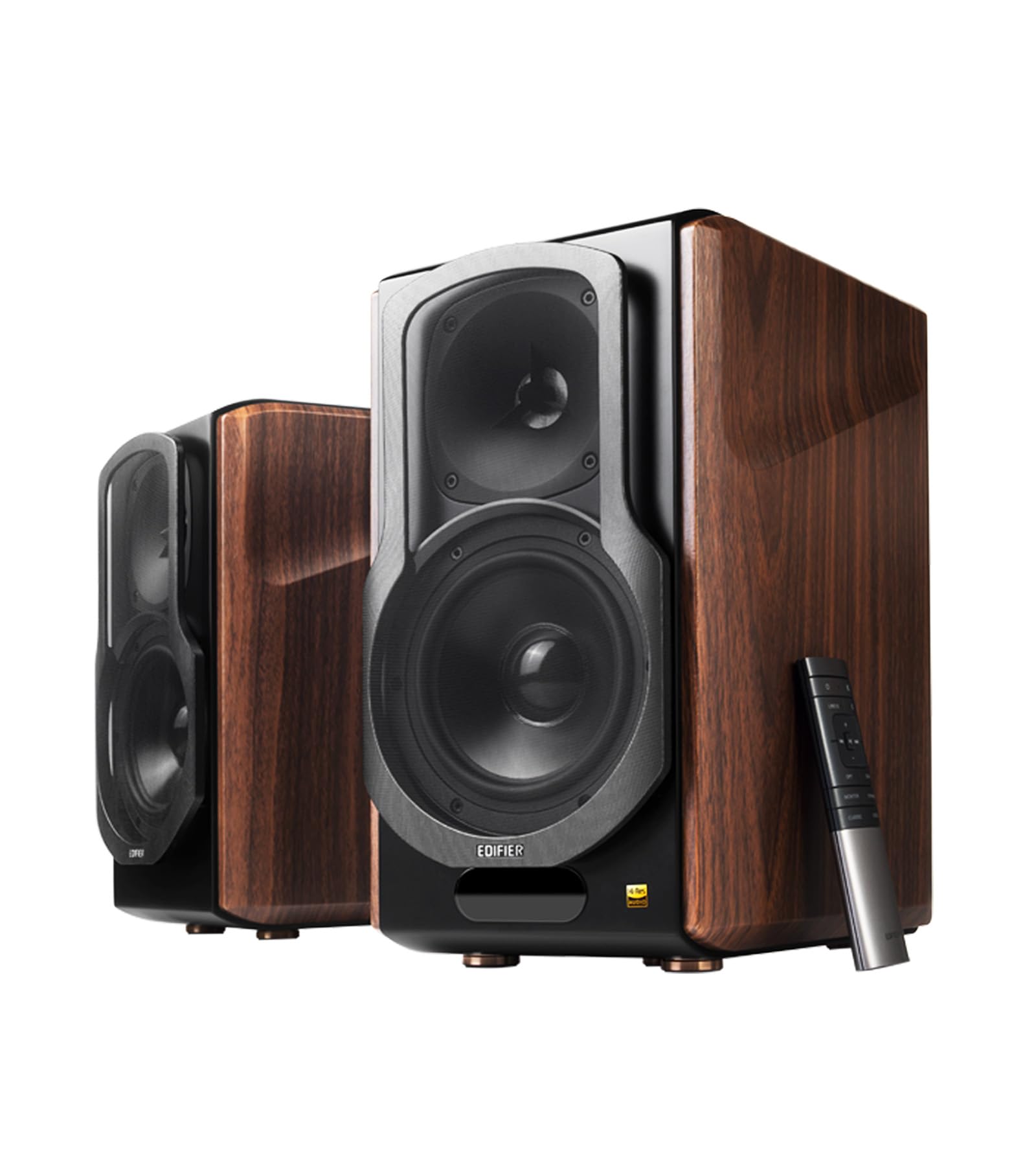
The Edifier S2000MKIII is a near-field reference speaker that punches well above its price tier, employing a planar magnetic tweeter mated to a 5.5-inch aluminum diaphragm woofer in a tri-amped configuration. Each driver gets its own dedicated amplifier stage — 15W for the tweeter, 50W for the midrange, and 65W for the woofer — for a total of 130W RMS, which eliminates intermodulation distortion that single-amp designs introduce at the crossover point. The planar tweeter offers exceptional transient response, making cymbal crashes and vocal sibilants sound airy and detailed without the metallic glare that some dome tweeters exhibit.
Owners report that the S2000MKIII reveals new layers in familiar recordings, with a soundstage that extends well beyond the physical width of the cabinets when speakers are placed 5 feet apart and toed in slightly. The bass response is tight and articulate enough that many listeners feel no need for a separate subwoofer, even in rooms up to 300 square feet. Bluetooth 5.0 with aptX HD decoding supports 24-bit streaming at 576 kbps, and the included remote allows switching between four DSP modes — Monitor, Dynamic, Classic, and Vocal — each of which alters the tonal balance noticeably.
Where the S2000MKIII falls short is in absolute output for very large rooms; the 5.5-inch woofers reach their excursion limit around 95dB, so if you need to fill a 500-square-foot great room at party levels, a subwoofer or larger floorstanders would be more appropriate. The remote also has symbols that are nearly impossible to read in dim light. Still, for critical listening at a desk or in a medium-sized living room, the S2000MKIII offers resolution and build quality that rival speakers costing twice as much.
Why it’s great
- Planar magnetic tweeter delivers ultra-low distortion and lightning-fast transient response for acoustic detail
- Tri-amped design removes intermodulation distortion at the crossover, keeping mids and highs clean even at higher volumes
- Built-in DSP modes (Monitor, Dynamic, Classic, Vocal) let you tune the tonal balance to your room and source material
Good to know
- 5.5-inch woofers will run out of headroom in very large rooms at high SPL levels
- Remote control symbols are unreadable in low light; you’ll memorize the buttons after a few days
3. Edifier S1000W WiFi Audiophile Active Bookshelf Speakers

The Edifier S1000W bridges the gap between passive high-end speakers and wireless multi-room convenience by integrating Wi-Fi streaming with AirPlay 2, Spotify Connect, and Alexa voice control — all while maintaining true audiophile-grade output through a 120W RMS bi-amplified design. Each speaker houses a 5.5-inch aluminum cone woofer and a 1-inch silk-dome tweeter, with the left speaker acting as the master that receives all inputs (optical, coaxial, RCA, Bluetooth 5.0) and powers the right speaker via a supplied cable. The Wi-Fi module supports 24-bit/192kHz Hi-Res streaming, which preserves the full dynamic range of high-resolution audio files from services like Tidal and Qobuz when streamed over your home network.
Reviews highlight the S1000W’s uncolored, natural sound signature — it neither hypes the bass nor sharpens the treble, making it an excellent reference for music production, vinyl digitization, or casual listening. Build quality is exceptional, with solid wood side panels and a weight of 45 pounds for the pair, which dampens cabinet resonance noticeably. Owners who have used them for over 8 years without issue report that the amplifier modules remain reliable, and the Bluetooth aptX connection to Amazon Echo devices works flawlessly for voice-controlled playback. The claimed frequency response extends to 48Hz, but independent measurements show usable output down to 37Hz at -3dB, which is impressive for a bookshelf design.
The primary downside is the remote control: it is small and easy to misplace, and switching between input sources requires you to be near the master speaker or the remote. The speakers also lack a subwoofer output, so adding a dedicated sub later requires a Y-splitter from your source. For anyone who wants a premium stereo pair with built-in network streaming and voice control, the S1000W delivers performance that competes with passive speakers and a separate amplifier at a lower total cost.
Why it’s great
- Built-in Wi-Fi with AirPlay 2 and Spotify Connect allows lossless streaming without Bluetooth compression
- Solid wood cabinetry and 45-pound total weight kill cabinet resonance for cleaner midrange reproduction
- Uncolored, natural sound signature makes them suitable for both music production monitoring and casual enjoyment
Good to know
- No dedicated subwoofer output — adding a sub requires an external Y-splitter at the source
- Remote control is small and easy to lose; input switching without it is cumbersome via rear-panel buttons
4. WiiM Sound Smart Speaker with 1.8″ Touch Display
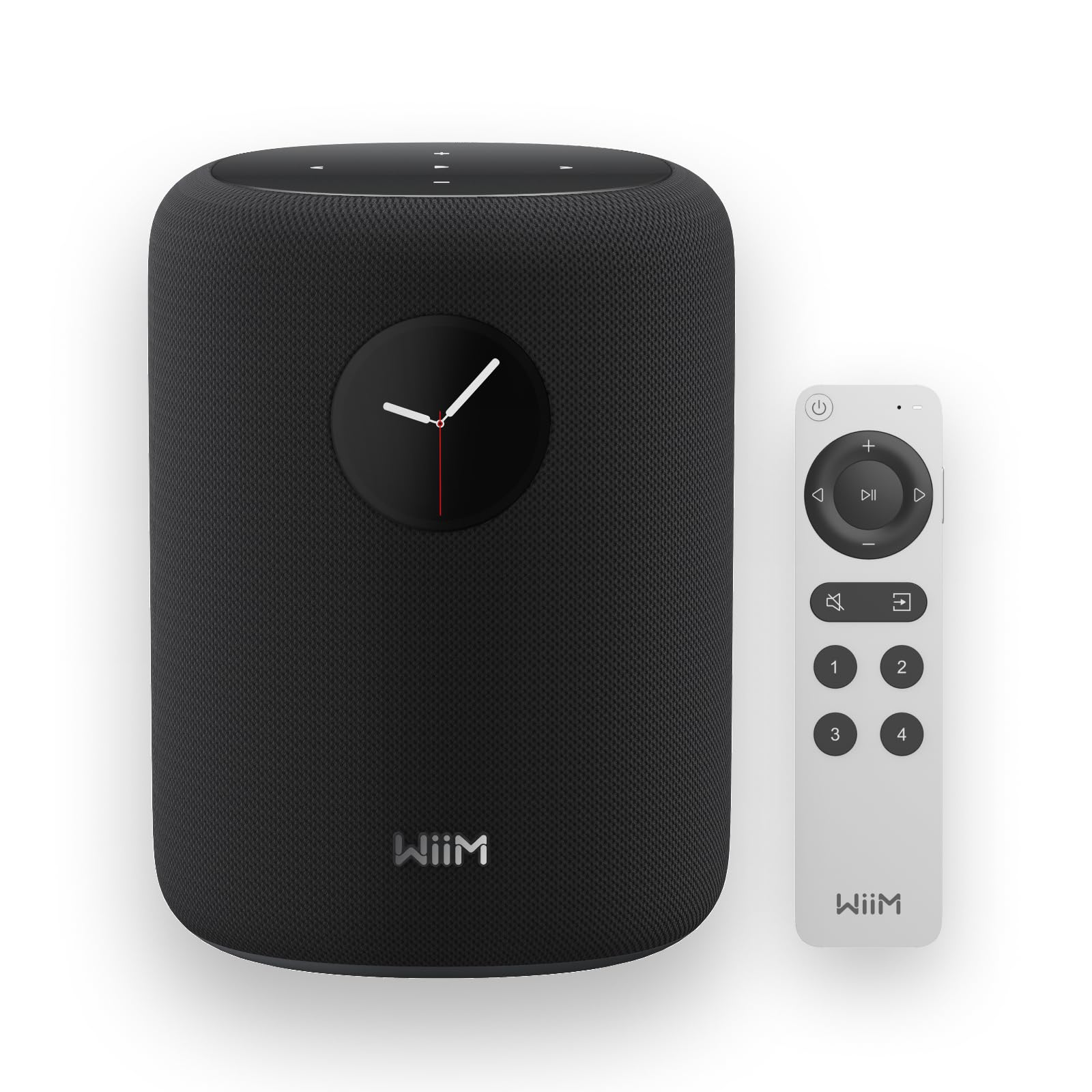
The WiiM Sound is the most versatile single-speaker system in this guide, combining a 100W peak amplifier with a 4-inch paper-cone woofer and dual 1-inch silk-dome tweeters in a compact chassis that supports Wi-Fi 6E, Bluetooth 5.3, Google Cast, Spotify Connect, Tidal Connect, DLNA, and Roon. The standout feature is the 1.8-inch circular touch display, which shows album art, track information, and clock, and provides on-device control for playback, source switching, and EQ presets without needing to pull out your phone. The AI RoomFit calibration uses the built-in microphone to analyze your room’s acoustics and apply EQ correction in under 30 seconds, balancing bass response and vocal clarity based on whether the speaker is on a shelf, in a corner, or in an open space.
User feedback consistently praises the WiiM Sound’s sound quality as “shockingly good for its size” — the bass is punchy and well-defined rather than one-note, and the silk-dome tweeters keep high frequencies smooth and non-fatiguing for hours of listening. The system supports true stereo pairing, and it can integrate with a WiiM Sub Pro or other WiiM components to build a modular multi-channel setup. The open platform means it works with almost every streaming service and multi-room ecosystem except Apple AirPlay 2 (a notable gap for iPhone-heavy households).
Compared to the Klipsch The One Plus, the WiiM Sound offers significantly more streaming versatility, room correction, and expandability, though the Klipsch has a larger woofer for deeper bass in a single-box solution. For someone building a multi-room audio network who wants a primary speaker capable of both background music and focused listening, the WiiM Sound is the most future-proof option in its class, with firmware updates adding features post-purchase.
Why it’s great
- AI RoomFit calibration adapts the speaker’s output to your specific room placement in one tap
- Open streaming platform supports Google Cast, Spotify Connect, Tidal Connect, DLNA, and Roon — no ecosystem lock-in
- Stereo pair and modular expansion with WiiM Sub Pro allows a path to a full system without starting over
Good to know
- No Apple AirPlay 2 support, which is a significant omission for iPhone and Mac users
- Single-speaker bass extension is impressive for its size but cannot match a dedicated subwoofer or larger enclosure
5. Klipsch The One Plus Premium Bluetooth Speaker System

The Klipsch The One Plus is a heritage-inspired tabletop stereo system that proves you don’t need a full-size receiver and separate speakers for high-quality sound in a small room. It uses a 2.1 bi-amplified configuration: two 2.25-inch full-range drivers handle mids and highs, while a 4.5-inch high-excursion woofer delivers the low end — all housed in a cabinet wrapped in real walnut wood veneer with tactile switches and knobs. Bluetooth 5.3 provides a stable 40-foot range, and the USB-C port supports both audio playback from a connected device and reverse charging. The Klipsch Connect App gives you a five-band EQ and preset management, which is rare for a speaker at this price point.
Owners describe the sound as “crisp highs, clean mids, and minimal muddiness” in rooms around 12×14 feet, with the ability to fill the space without strain. Multiple users note that the speaker improves noticeably after a 1-2 hour break-in period, with the bass becoming fuller and the treble smoothing out. The lack of voice assistant integration is a common complaint — this is a pure audio device with no Alexa or Google Assistant built in — and the lack of Wi-Fi means all streaming must go through Bluetooth, which caps quality at AAC/SBC unless your source device supports LDAC (which the Klipsch does not).
Against the WiiM Sound, the Klipsch trades streaming versatility for a warmer, more analog-feeling sound and a larger single-chassis bass response. If your use case is a dedicated music speaker in an office, bedroom, or kitchen where you primarily stream from a phone via Bluetooth, the The One Plus delivers a richer, more dynamic presentation than most smart speakers at its price. The luxury materials also mean it looks like a piece of furniture rather than a tech gadget, which matters when the speaker sits in a prominent spot.
Why it’s great
- Real walnut wood veneer and tactile knobs make it one of the best-looking tabletop audio systems available
- Bi-amplified 2.1 design with a dedicated 4.5-inch woofer produces room-filling bass from a compact footprint
- USB-C input supports both audio playback and reverse charging for connected devices
Good to know
- No Wi-Fi streaming or voice assistant support — relies entirely on Bluetooth 5.3 for wireless audio
- Sound quality improves significantly after a break-in period of 1-2 hours; may disappoint initially
6. Sony BRAVIA Theater System 6 (HT-S60)

The Sony BRAVIA Theater System 6 (HT-S60) is a 5.1-channel soundbar system designed specifically for TV-centric use, with a dedicated center channel speaker for dialogue clarity, two rear satellite speakers, and a wireless subwoofer. It supports both Dolby Atmos and DTS:X — not through physical up-firing drivers, but via Sony’s virtual sound field processing, which uses psychoacoustic algorithms to create the impression of overhead sound. The included wireless rear speakers are compact and connect to a wireless amplifier box, though the subwoofer itself requires a wired connection to the soundbar, which limits placement flexibility compared to fully wireless competitors like the ULTIMEA Skywave X50.
User reviews consistently highlight the HT-S60’s exceptional dialogue clarity, thanks to the physical center channel that separates vocal frequencies from the left/right stereo mix — a significant upgrade over 2.1 or virtualized soundbars where dialogue can get lost in busy action scenes. The bass is described as “powerful and clean” with enough output to carry through a house, making it less ideal for apartment dwellers who might disturb neighbors. The setup process is straightforward, with HDMI eARC and optical inputs, and the BRAVIA Connect app provides granular control over volume, sound profiles, and advanced settings.
The main drawbacks are the wired subwoofer connection (the sub must be plugged into the soundbar via cable) and the fact that the rear speakers, while wireless to each other, still need a power outlet. The virtual Dolby Atmos implementation is less convincing than systems with physical up-firing drivers, and some users report HDMI-CEC handshake issues where the sound cuts out briefly when using an external streaming device. For someone who already owns a Sony BRAVIA TV and wants seamless integration — including Voice Zoom 3 for dialogue enhancement — the HT-S60 is a natural pairing that delivers genuine 5.1 immersion in a package that doesn’t dominate the room.
Why it’s great
- Dedicated center channel speaker provides significantly better dialogue clarity than virtualized 2.1 soundbars
- Seamless integration with BRAVIA TVs enables Voice Zoom 3 and TV-menu control
- Supports both Dolby Atmos and DTS:X for full compatibility with modern streaming and Blu-ray content
Good to know
- Subwoofer requires a wired connection to the soundbar, limiting placement options
- Virtual Dolby Atmos lacks the overhead precision of systems with physical up-firing drivers like the ULTIMEA X50
7. Sonos Sub 4 — Wireless Subwoofer

The Sonos Sub 4 is not a standalone audio system — it is a wireless subwoofer designed exclusively for the Sonos ecosystem, pairing with Sonos soundbars (Arc Ultra, Arc, Beam) and speakers to add deep, dynamic bass to your home theater or multi-room music setup. Its defining engineering feature is the force-canceling acoustic architecture: two Sonos-engineered drivers face inward, canceling out cabinet vibration and distortion so that the physical enclosure stays silent while the bass energy is directed into the room. This allows the Sub 4 to be placed on its side, hidden under a sofa, or stood upright without compromising sound quality.
Users describe the Sub 4 as transformative for both movies and music, with one reviewer noting it “adds deep, cinematic bass for immersive home theater” and another calling it “essential for room-shaking, heart-thumping experience.” The setup is plug-and-play — a single power cable and the Sonos app handle pairing, and the sub automatically integrates with your existing Sonos components over Wi-Fi. The updated matte finish from Gen 4 reduces fingerprint visibility, and the sculptural design is genuinely attractive enough to keep visible in a living room.
The obvious limitation is ecosystem lock-in: the Sub 4 only works with Sonos products. You cannot pair it with a non-Sonos soundbar or use it as a stand-alone subwoofer for a passive stereo system. Additionally, at this price point, you are paying for the convenience of wireless integration and the force-canceling design rather than outright output — a wired subwoofer from SVS or Klipsch at a similar price will produce higher SPL and deeper extension. For anyone already invested in the Sonos ecosystem, however, the Sub 4 is the only way to get tight, articulate bass that integrates seamlessly without manual crossover configuration.
Why it’s great
- Force-canceling dual-driver design eliminates cabinet vibration and rattles, even at high volumes
- Wireless Wi-Fi connection to Sonos soundbars means no subwoofer cable — just power and app setup
- Can be placed horizontally under furniture or vertically as a design piece without sound degradation
Good to know
- Sonos ecosystem lock-in — the Sub 4 is useless with non-Sonos soundbars or receivers
- Output is refined rather than brutish; wired competition at the same price hits harder and deeper
8. Bobtot Home Theater System 5.1/2.1 Channel
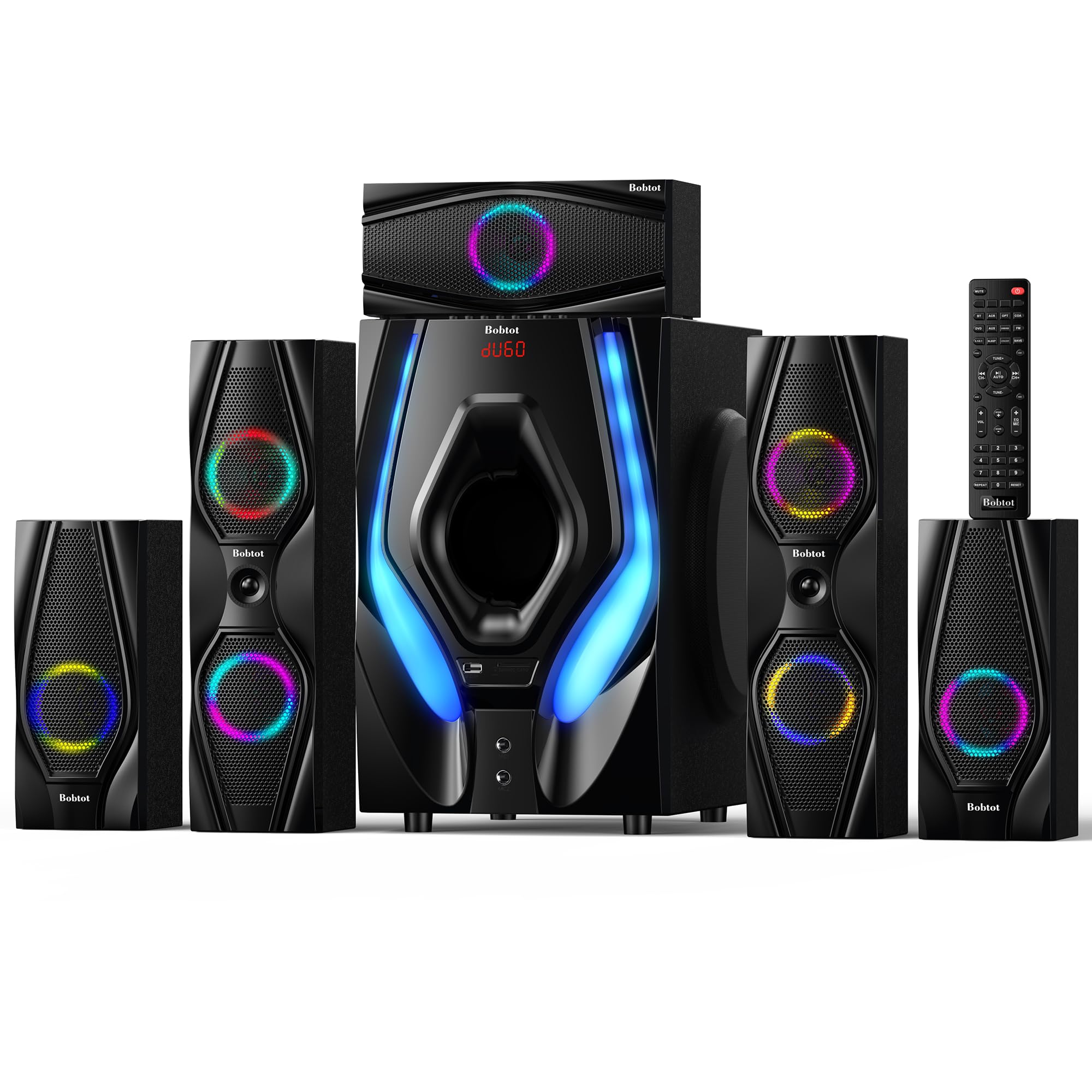
The Bobtot Home Theater System is a full 5.1-channel surround sound package built around a 10-inch subwoofer with a built-in receiver, delivering 1200W peak power and including five satellite speakers, a center channel, a digital display, FM radio, dual 1/4-inch microphone inputs with echo for karaoke, and LED lighting effects on the subwoofer.
Owner feedback is polarized but passionate. Positive reviews call it “amazing 5-star system” and “fantastic price for an awesome true surround sound system,” praising the thunderous bass, clear highs for the price, and the ability to drive a party or movie night with authority. The long built-in speaker cables — 13 feet for front, 31 feet for rear — give flexibility in speaker placement without needing to buy additional wire. The LED modes (blink to beat, solid on, spectrum EQ analyzer, off) add a visual element that kids and party guests enjoy.
The negative reviews, however, reveal reliability issues: subwoofer failures within 8 months, left-channel crackling, and reports that replacement units also exhibited connectivity problems with the wireless speakers (note: Bobtot satellite speakers are wired, not wireless — confusion in reviews may stem from a different model). Customer support is email-only from Asia, which can lead to long resolution times. For buyers who prioritize absolute maximum bass per dollar and accept the risk of QC variability, the Bobtot system delivers huge output for a low investment, but it is not a system for someone who values consistent reliability or precise audiophile voicing.
Why it’s great
- 10-inch subwoofer with 1200W peak power produces chest-thumping bass that exceeds expectations at this tier
- Dual microphone inputs with echo make this a ready-to-go karaoke system for parties
- Independent per-channel volume control via remote allows fine-tuning of the soundstage without a separate AVR
Good to know
- Reliability concerns surface in multiple reviews — subwoofer failures and channel crackling reported
- Customer support is email-only from Asia; warranty replacements can take weeks to process
9. Klipsch Reference Dolby Atmos Home Theater Bundle
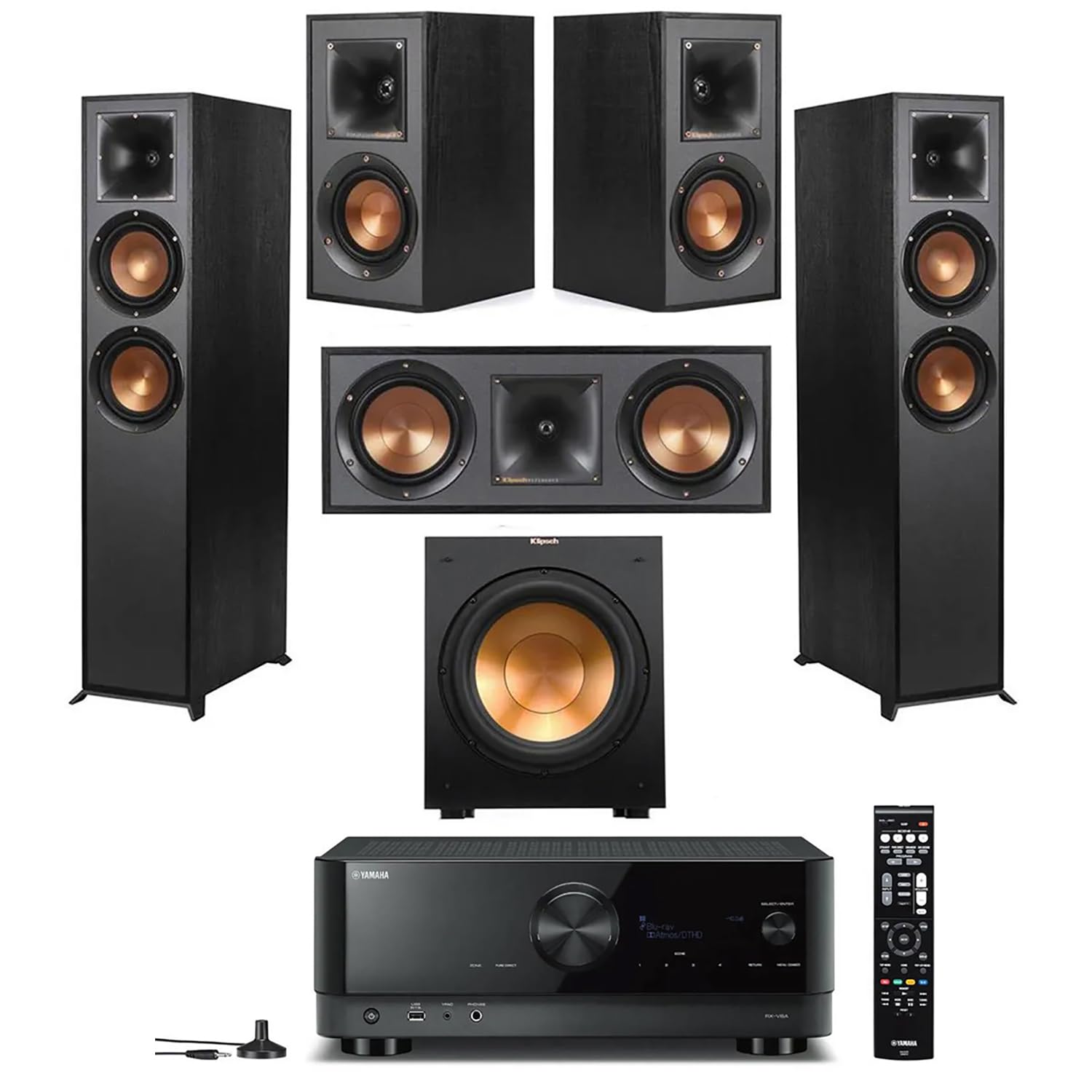
The Klipsch Reference Dolby Atmos Home Theater Bundle is a complete, no-compromise 5.1.2-channel setup for buyers who want a dedicated AV receiver and passive speakers rather than a soundbar or powered bookshelves. The bundle includes two R-625FA floorstanding towers with built-in up-firing Dolby Atmos elevation drivers, an R-52C center channel, a pair of R-41M bookshelf surrounds, an R-12SW 12-inch powered subwoofer with a 400W all-digital amplifier, and a Yamaha RX-V6 AV receiver (75W per channel, 7.2-channel surround, 8K video support, and YPAO room calibration). The entire system is wired, requiring speaker cable runs from the receiver to each speaker, but the integration of Atmos elevation channels directly into the front towers means no ceiling-mounted speakers are needed.
Users consistently describe the system as “excellent for movies” and note that the Klipsch Tractrix horn-loaded tweeters produce a very bright, detailed treble that makes dialogue and sound effects cut through dense mixes — though some find it fatiguing for music, especially with poorly mastered tracks. The 12-inch subwoofer is powerful enough to shake a 10×12-foot room and provides foundation for the towers, which themselves produce usable bass down to around 45Hz. The Yamaha AVR’s YPAO automatic room calibration tunes the system to your specific space, correcting for room modes and speaker distance, which is a critical feature for a multi-speaker wired system where placement is rarely perfect.
The main trade-offs are the space required (towers, center, surrounds, and a large subwoofer dominate a room) and the fact that the supplied tower feet screws are reportedly low quality — several owners advise pre-threading the holes with your own screws. The bright Klipsch signature, while excellent for cinematic impact, can sound harsh with bright pop recordings. For the dedicated home theater enthusiast who wants true Dolby Atmos with physical height channels and the expandability of a real AV receiver (future 7.2.4 upgrades, separate power amps), the Klipsch Reference Bundle is the most capable system in this guide by a wide margin.
Why it’s great
- Complete 5.1.2 Dolby Atmos system with dedicated up-firing drivers in the floorstanding towers for overhead effects
- Yamaha RX-V6 AVR provides 75W/ch, 8K passthrough, YPAO room calibration, and room to expand to 7.2.4 later
- 12-inch powered subwoofer and horn-loaded tweeters deliver reference-level cinematic impact and clarity
Good to know
- Bright Klipsch treble can be fatiguing for music listening; this system is optimized for movie soundtracks
- Tower feet screws are low quality — plan to replace them with hardware-store screws during assembly
FAQ
Do I need a subwoofer with bookshelf speakers like the Edifier S2000MKIII?
What is the difference between Dolby Atmos with up-firing speakers versus ceiling-mounted speakers?
Can I use the Sonos Sub 4 with a non-Sonos soundbar?
How much power do I really need for a 5.1 living room system?
Is there a noticeable difference between Bluetooth aptX HD and standard AAC for music streaming?
Final Thoughts: The Verdict
For most users, the best audio system winner is the ULTIMEA Skywave X50 because it delivers a true 5.1.4 Dolby Atmos experience with wireless rear speakers, a GaN amplifier for clean high-volume output, and a compact footprint that doesn’t require an AV receiver or speaker wire planning. If you want audiophile-grade two-channel resolution for music, grab the Edifier S2000MKIII — its planar tweeters and tri-amped design reveal detail that bookshelf speakers at twice the price often miss. And for the dedicated home theater builder who wants physical up-firing Atmos channels and the expandability of a real AV receiver, nothing beats the Klipsch Reference Dolby Atmos Bundle.