
Manually applying labels is a bottleneck that costs businesses time and precision. Whether you’re bottling hot sauce, sorting inventory, or printing service reminders, a machine that wraps a label perfectly every few seconds transforms your workflow. The right applicator eliminates air bubbles, crooked placement, and wasted materials that plague hand-labeling.
I’m Min — the co-founder and writer behind Gadgets Feed. I have spent countless hours analyzing product specifications, customer feedback, and real-world performance data across hundreds of industrial and commercial equipment listings to identify the machines that truly deliver on their promises for this specific category.
After comparing print heads, bottle diameter ranges, application speeds, and label material compatibility, this guide breaks down the best automated label applicator on the market for every production scale.
How To Choose The Best Automated Label Applicator
Selecting a label applicator means matching the machine’s physical capabilities to your container’s shape, your label’s material, and your production volume. The wrong choice leads to endless tweaking, wasted labels, and operator frustration.
Container Shape and Size Compatibility
Not every applicator handles every bottle. Semi-automatic models typically require a perfectly cylindrical bottle body with no protruding caps or uneven curves. Check the minimum and maximum bottle diameter — a machine rated for 15–120mm works for most standard wine and beverage bottles but fails on tapered cosmetic jars. The TAL-2100ER handles a 1–5 inch diameter range with an adjustable carriage.
Label Material and Application Speed
Opaque labels are the standard for optical sensors. Transparent labels often require an additional photo-eye sensor upgrade, or the machine cannot detect where the label ends. Application speed varies from 15 bottles per minute on manual-fed electric units up to 1200 per hour on semi-automatic models. For small batch production under 500 units per day, speed matters less than consistency and bubble-free placement.
Print-Apply vs. Standalone Applicator
A print-and-apply system like the Makeid D50 or McAuley RT200i lets you create custom labels on demand and cut them automatically before application. A standalone applicator like the Primera AP360 or Hanchen machine requires pre-printed label rolls. Choose a print-apply unit if you need variable data per label (dates, serial numbers, barcodes) and a standalone unit for high-volume runs of identical labels.
Quick Comparison
On smaller screens, swipe sideways to see the full table.
| Model | Category | Best For | Key Spec | Amazon |
|---|---|---|---|---|
| Primera AP362 | Premium | Dual-label front & back | 1200 containers/hour | Amazon |
| TAL-2100ER | Premium | High-volume precision | 5″ web capacity | Amazon |
| Primera AP360 | Mid-Range | Cylindrical container labeling | 5.3″ per sec speed | Amazon |
| Makeid D50 | Mid-Range | Print-and-label versatility | 300 DPI / 2600mAh | Amazon |
| McAuley RT200i | Mid-Range | Oil change sticker systems | Auto date/mile calc | Amazon |
| Hanchen Semi-Auto | Budget | Small enterprise bottling | 20-40 pcs/min | Amazon |
| ZONEPACK ZP-50W | Budget | Manual operation, no power | 15-30 bottles/min | Amazon |
In‑Depth Reviews
1. Primera AP362 Label Applicator

The Primera AP362 is a semi-automatic workhorse that applies one or two labels to the front and back of cylindrical containers at rates up to 1200 per hour. Users report flawless performance over runs of 1800 bottles, with the unit maintaining straight, bubble-free placement through hundreds of cycles. The dual-label capability makes it ideal for products requiring front-and-back branding without a second pass.
Setup is straightforward, though the rubber roller accumulates adhesive residue every 400–500 bottles and requires cleaning with alcohol or acetone to maintain grip. The unit handles standard opaque label rolls well and works with labels produced on Primera LX-series printers. Bottle diameter compatibility covers most common sizes from small test tubes to standard wine bottles.
Some units develop label-pulling issues after extended use, particularly when bottles have irregular surfaces. Support and parts availability have been noted as inconsistent after the warranty period. For production environments where consistency is critical, the AP362 delivers exceptional throughput, but operators should expect periodic adjustments and cleaning.
Why it’s great
- Dual-label application front and back without repositioning
- High speed of 1200 containers per hour saves significant labor
- Easy to set up and calibrate for most cylindrical bottles
Good to know
- Roller requires periodic cleaning to prevent adhesive buildup
- Struggles with imperfectly flat glass bottle surfaces
- Tech support and parts availability reported as inconsistent
2. TAL-2100ER Electric Bottle Label Applicator

The TAL-2100ER is an all-electric label applicator built for reliability. The operator places a bottle in the carriage, steps on a footswitch, and the machine wraps the label around the container at speeds of 15–20 bottles per minute. The unit handles bottles from 1 inch to 5 inches in diameter and is praised for its consistent placement and smooth start-stop operation compared to cheaper alternatives.
Unlike many semi-automatic models that rely on compressed air, the TAL-2100ER runs entirely on electricity, simplifying installation and reducing maintenance. The rewind mechanism handles cellophane backing without tangling, and the photo-eye stops precisely after one label. Owners report labeling 500 bottles in under an hour versus an entire day by hand, with perfect alignment even on metallic BOPP labels that cause issues for optical sensors on other machines.
Setup takes about 20 minutes, but the adjustment knobs for the carrier tray can loosen during extended runs. The brush assembly that holds the label against the bottle is reported to be slightly loose on some units. Designed for opaque labels only — transparent labels require an additional photo-eye purchase. For high-volume production, this machine delivers industrial-grade consistency.
Why it’s great
- All-electric operation eliminates compressed air requirements
- Consistent straight label placement even on finicky metallic labels
- High throughput — labels 500 bottles in under an hour
Good to know
- Adjustment knobs may vibrate loose during extended use
- Requires separate photo-eye upgrade for transparent labels
- Some units arrive with loose brush attachment
3. Primera AP360 Label Applicator 74291
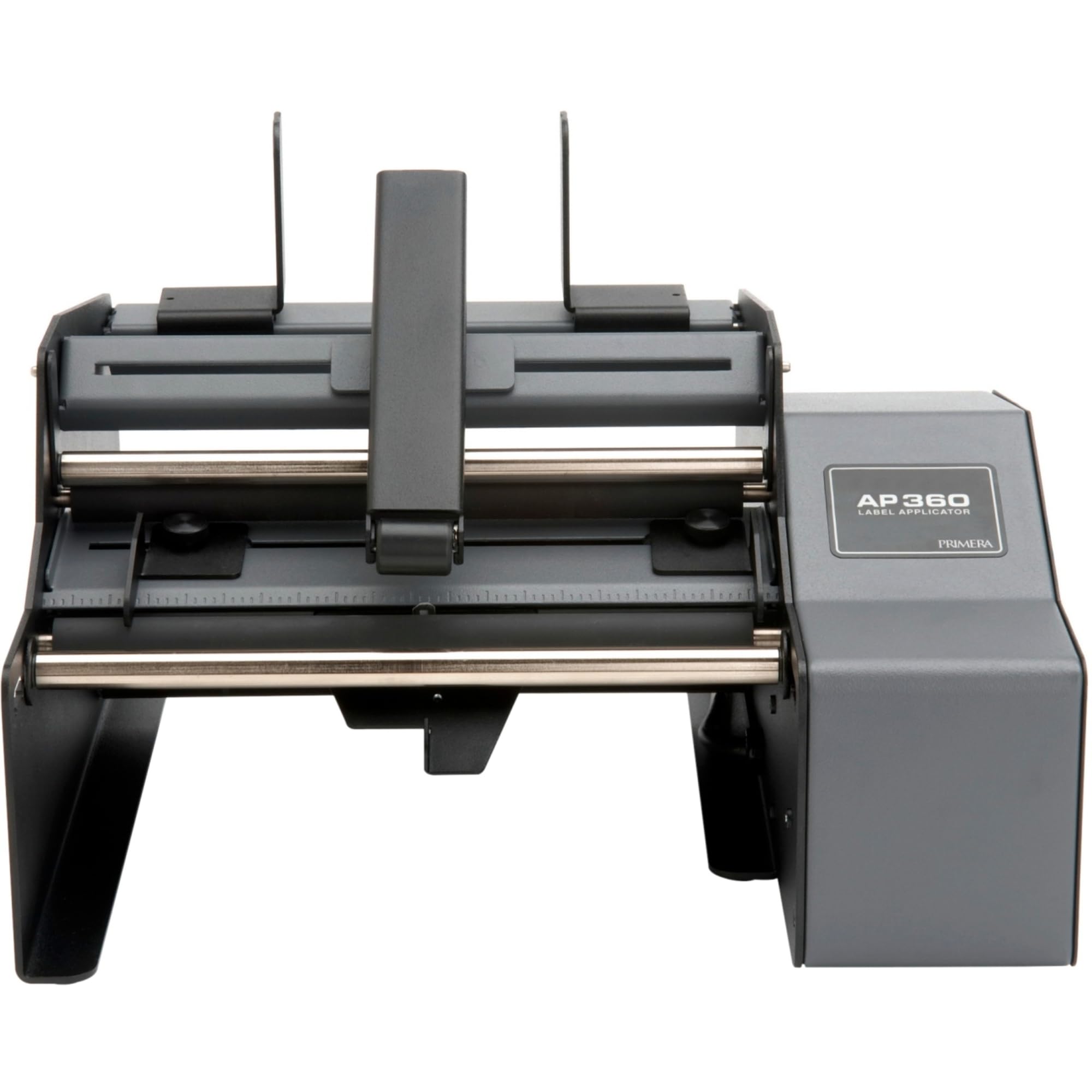
The Primera AP360 is a dedicated single-label applicator for cylindrical containers including bottles, cans, jars, and tubes. It applies labels at 5.3 inches per second, reaching up to 1200 containers per hour. The semi-automatic operation requires the operator to place the container against the label web and trigger the application, making it ideal for small to mid-size production runs.
The machine arrives fully assembled and works immediately out of the box. Users report that larger bottles (16–32 oz) may need a slower rotation speed adjustment, while smaller bottles (1–8 oz) run well at default settings. The error rate is approximately 0.5% compared to 10% by hand, representing a massive reduction in wasted labels. The unit handles tapered containers well thanks to the adjustable roller arm.
When the machine works correctly, it produces flawless labels without air bubbles. However, about 25% of the time, users experience issues with bubbles or wrinkles that require manual peeling and reapplication. Larger labels present more alignment problems. For small batch runs under 2000 units or odd bottle sizes, the AP360 is a significant upgrade from hand labeling if you are willing to accept occasional inconsistency.
Why it’s great
- Arrives fully assembled and ready to use out of the box
- Reduces label waste from 10% error rate to roughly 0.5%
- Handles tapered containers and various bottle diameters
Good to know
- Produces bubbles or wrinkles approximately 25% of the time
- Struggles with larger labels that require manual realignment
- Calibration needed when switching between bottle sizes
4. Makeid D50 Industrial Label Printer
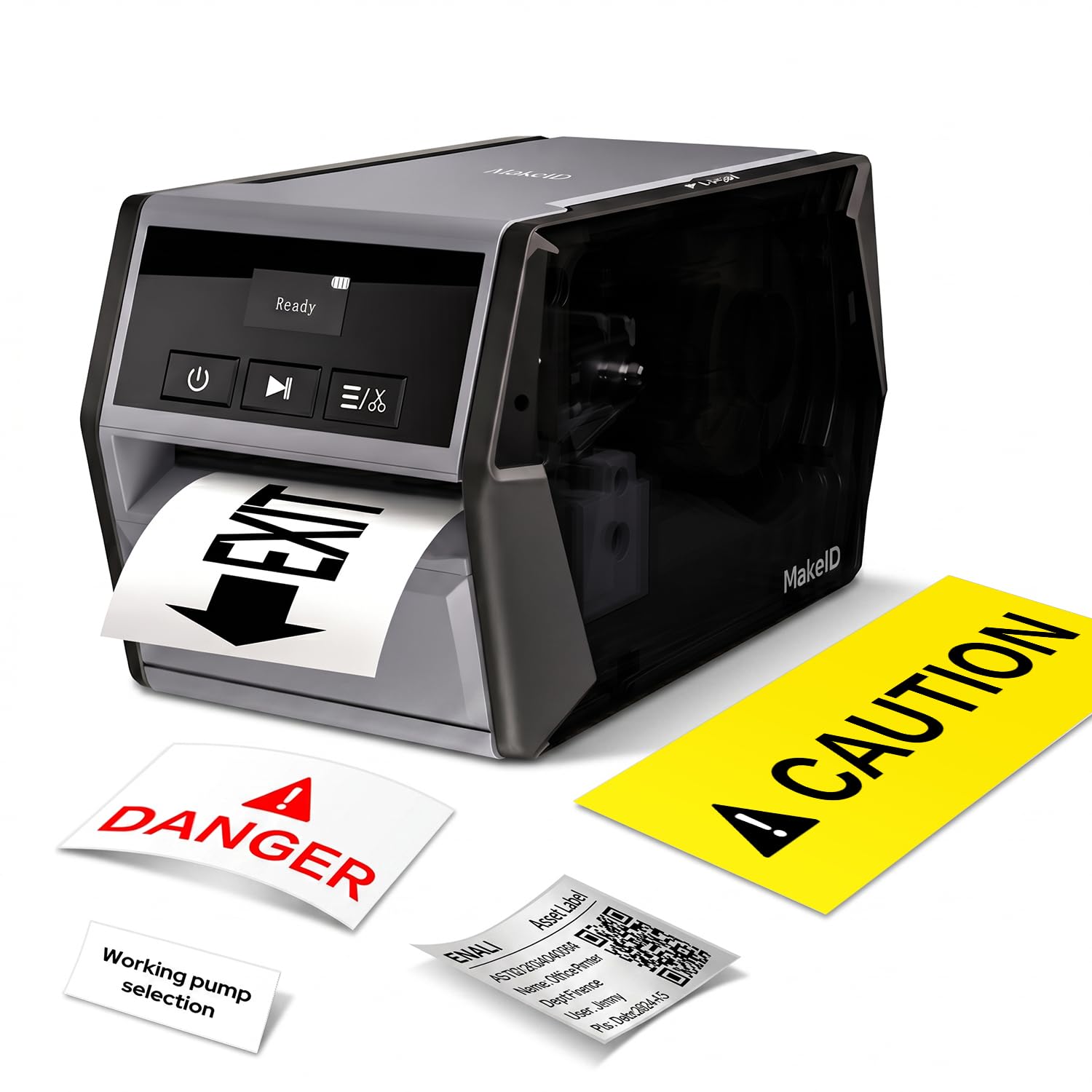
The Makeid D50 is not a standalone label applicator but a print-and-label system that excels in versatility. Its 2-inch print head delivers 300 DPI resolution using thermal transfer technology, ensuring barcodes and text remain sharp for up to five years. The integrated automatic cutter bulk-cuts labels, and the cartridge-based design swaps consumables in five seconds. The 2600mAh lithium-ion battery provides up to 90 days of standby.
The D50 supports mobile app printing and PC software with templates for barcodes, QR codes, and Excel data import. The acrylic adhesive labels stick firmly to rough, oily, and cold surfaces, making this unit ideal for job sites, cable marking, asset tracking, and warehouse labeling. Users report that the compact build feels premium and that the 300 DPI output is sharp even on 10mm labels.
The primary limitation is that the D50 is a printer, not a wrapper — it does not automatically apply labels to containers. It is best for users who need on-demand label creation with automatic cutting and strong adhesion in industrial environments. The software interface has been described as slightly limiting, and there is no laptop Bluetooth connectivity, requiring a USB-C connection to the PC.
Why it’s great
- 300 DPI thermal transfer prints sharp, long-lasting barcodes
- Automatic cutter and 5-second cartridge swap boost workflow
- 2600mAh battery offers true portability for job sites
Good to know
- No Bluetooth connectivity for laptop users
- Software interface has limited customization options
- Not a bottle wrapper — label output requires manual application
5. McAuley Labels Godex RT200i Oil Change System
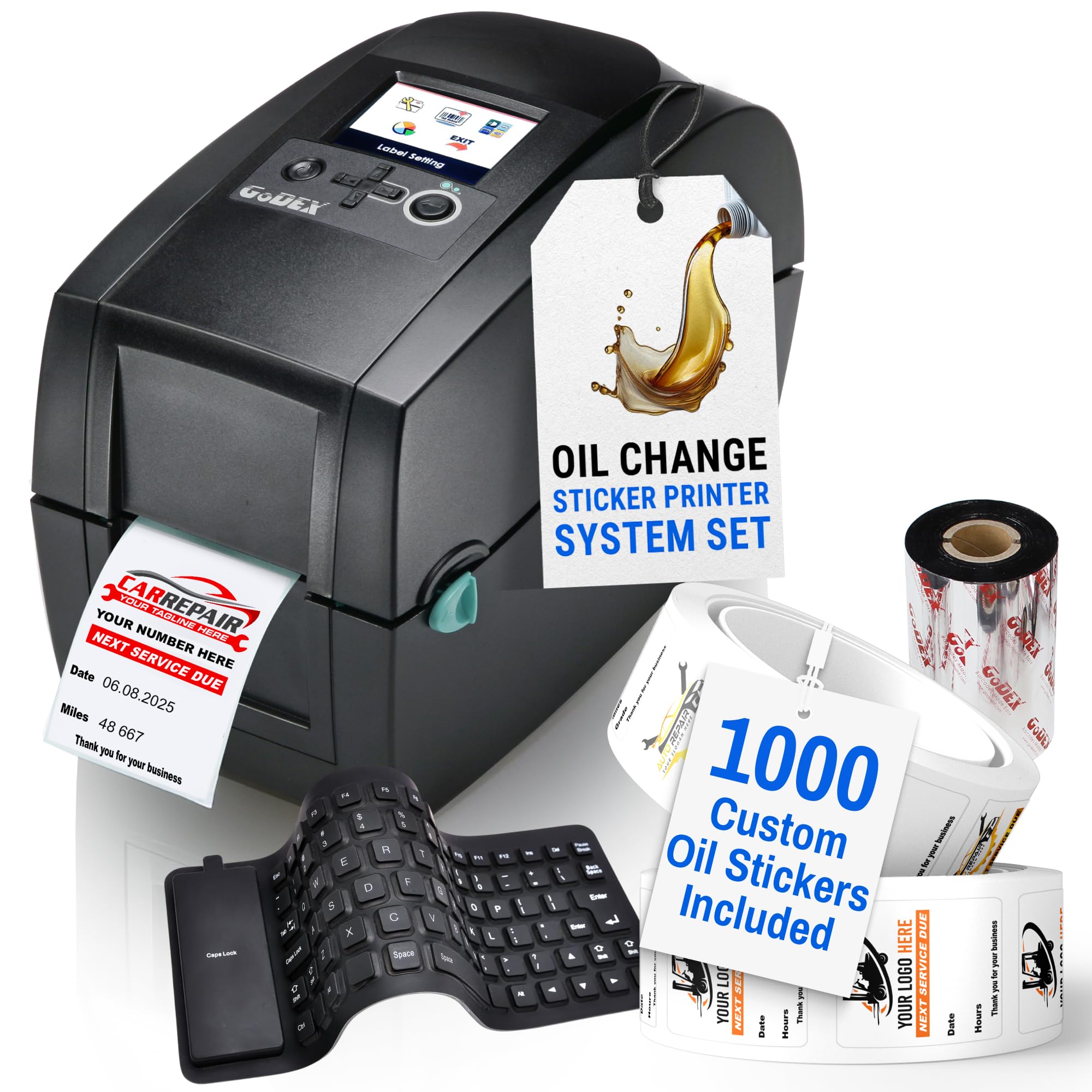
The McAuley Labels Godex RT200i is a fully programmed print-and-apply system designed specifically for oil change reminder stickers. The package includes the printer, 1000 custom labels with your shop logo, a ribbon, and a flexible waterproof USB keyboard. The color LED screen allows computer-free operation, while the pre-programmed setup calculates the next due date and mileage automatically.
Fade-resistant, smear-resistant, and scratch-resistant ink ensures that the stickers remain legible through months of exposure under a car hood. Users report that the custom label proofing process is seamless and that the final output looks professional. Customer service is noted as exceptionally responsive, resolving issues almost instantly. The small footprint takes up minimal counter space in a service bay.
This system is highly specialized and not intended for general product labeling. It works best for automotive shops wanting to create branded, professional reminder stickers without manual handwriting or generic alternatives. The initial connection setup may require a brief call with support. For any business performing oil changes, this dedicated solution eliminates the hassle of generic sticker rolls.
Why it’s great
- Pre-programmed for instant setup with auto date/mileage calculation
- Includes 1000 custom labels with your shop logo and artwork
- Exceptional customer support with quick issue resolution
Good to know
- Specialized for oil change stickers only — not a general label applicator
- Minor connectivity issues may occur during initial setup
- Relatively high cost justified only for dedicated auto shop use
6. Hanchen Semi-Automatic Round Bottle Labeling Machine

The Hanchen semi-automatic labeling machine is built around an automatic optical eye sensor that detects the label edge for accurate placement. The pure aluminum alloy body and thickened swing arm provide rigidity for long-term use. The unit handles bottles with a bottom diameter of 0.6–4.7 inches and labels up to 5.9 inches wide, at a rate of 20–40 pieces per minute. An internal paper-receiving wheel collects waste backing automatically.
The machine is designed for small enterprises stepping up from manual labeling. Users who successfully configure it report that it works well for labeling tubes and bottles. The optical eye technology reduces label waste by preventing missed or delayed application. The compact footprint fits on a benchtop and does not require permanent installation.
The included instruction manual is widely criticized as incorrect and confusing, with diagrams that do not match the actual machine parts. Operators must invest time in trial-and-error learning to calibrate the rollers and sensor. The machine loses alignment over time and can produce bubbles. Gold, silver, or transparent labels are not supported by the standard sensor. Expect a steep learning curve before achieving consistent output.
Why it’s great
- Optical eye sensor improves placement accuracy over manual methods
- Sturdy aluminum alloy construction for long-term durability
- Internal paper take-up wheel keeps the workspace clean
Good to know
- Instruction manual is incorrect and causes setup confusion
- Tends to lose alignment during extended runs
- Incompatible with gold, silver, or transparent label materials
7. ZONEPACK ZP-50W Manual Labeling Machine

The ZONEPACK ZP-50W is a manual tabletop label applicator that requires no electricity. It handles label widths from 0.39 to 6.29 inches and label lengths from 0.39 to 11.81 inches, accommodating bottles with diameters of 15–120mm and heights up to 340mm. The operating speed is 15–30 bottles per minute, making it a viable option for micro-batch production where power outlets or compressed air are unavailable.
The desktop design is compact and modular, allowing easy maintenance and lower repair costs. Users who have fine-tuned the machine report that it applies full wrap-around labels without air bubbles. The adjustable holder accommodates various bottle sizes, and the machine works with transparent stickers. Some owners find the build quality to be sturdy and thoughtfully designed for the price point.
Consistency is the main issue. The pressure bar does not always sit flush with the bottle, the springs can stretch, and label placement can be highly variable. Users report that achieving two perfectly aligned labels in a row is rare without constant manual adjustment. For professional use requiring consistent placement, this machine falls short. It is best suited for hobbyists or very small operations where perfect alignment is not critical.
Why it’s great
- No power source required — works anywhere
- Wide label width range up to 6.29 inches
- Compact and modular design for easy maintenance
Good to know
- Inconsistent label placement requires constant manual adjustment
- Springs and pressure bar can lose tension over time
- Not suitable for professional labeling where consistency is key
FAQ
Can an automated label applicator handle transparent labels?
How many bottles per hour can a mid-range label applicator achieve?
What causes air bubbles in label application and how can I prevent them?
Final Thoughts: The Verdict
For most users, the best automated label applicator winner is the Primera AP362 because it combines dual-label application, high throughput, and reliable semi-automatic operation that suits small to medium production lines. If you want an all-electric machine with industrial precision, grab the TAL-2100ER. And for on-demand printing with automatic cutting, nothing beats the versatility of the Makeid D50.