
Relying on an old analog tube to measure rainfall is a game of chance—you either brave the downpour to read it, or discover the scale has warped and your reading is a guess. An automated rain gauge eliminates both hassles, giving you precise, recorded data without stepping outside.
I’m Min — the co-founder and writer behind Gadgets Feed. My research focuses on the technical accuracy of environmental sensors, from tipping-bucket mechanisms to wireless transmission protocols, ensuring you get a gauge that tells the truth, not a story. (And Homer 🐱 has vetoed any gauge that didn’t survive his pounce test on the lawn).
This guide breaks down the actual measurement specs, connectivity options, and weatherproofing that separate a useful tool from a frustrating toy, helping you choose the best automated rain gauge for your home, garden, or hobby farm.
How To Choose The Best Automated Rain Gauge
You need more than a fancy display. The core of any automated rain gauge is its measurement mechanism, its ability to keep working through winter, and how it gets that data to you.
Accuracy and the Tipping Bucket Mechanism
The vast majority of consumer automated rain gauges use a tipping bucket. Rain funnels into one side of a seesaw; when it fills, the bucket tips, dumping water out and recording a single unit of rainfall. The precision depends on the funnel’s splash resistance and the bucket’s calibration. Most good units achieve ±1mm accuracy for rainfall under 15mm—enough for any gardener or weather hobbyist.
Wireless Range and Data Access
Range matters if your sensor is mounted far from your house. Basic models offer 100-150m line-of-sight transmission to a dedicated console. Step up to Wi-Fi models to push data directly to an app, allowing remote monitoring and historical tracking. Be aware that 5GHz Wi-Fi is rarely supported; most sensors use 2.4GHz for its superior range and wall penetration.
Freeze Protection and Self-Emptying
A self-emptying bucket is standard on most digital gauges—the tipping action drains water automatically. The real killer is freezing rain. Look for units with a heated base or a design that sheds ice before it jams the mechanism. A “freeze proof” rating means the internal components won’t crack when trapped water expands. Without it, your gauge becomes a decorative ice cube after the first hard frost.
Quick Comparison
On smaller screens, swipe sideways to see the full table.
| Model | Category | Best For | Key Spec | Amazon |
|---|---|---|---|---|
| Ambient Weather WS-1965 | All-in-One Sensor Array | Smart home integration & remote monitoring | 16-second update interval; 915 MHz wireless | Amazon |
| Sainlogic Smart WiFi SA6 | Wi-Fi Station with App | Long-term data analysis & alerts | ±1mm accuracy (<15mm); 2-year data export | Amazon |
| VEVOR 7-in-1 Wi-Fi (B0FM3CVKNL) | Solar-Powered Multi-Sensor | Off-grid operation & SmartLife app control | 150m transmission; 7.5″ VA display | Amazon |
| VEVOR YT60234 7-in-1 | Solar-Recharged Sensor Array | Complete weather parameters on a budget | 150m range; IPX6 waterproof; solar panel | Amazon |
| Sainlogic 12-in-1 SA6 (No WiFi) | Professional-Grade Console | High-accuracy rainfall measurement | ±1mm accuracy; 6.5″ color display | Amazon |
| ECOWITT WN1700 | Compact Wireless Kit | Simple, reliable rainfall data | 48-second update; FSK wireless transmission | Amazon |
| BIUWING Wireless Rain Gauge | Indoor Console with Backlight | Budget-friendly entry-level monitoring | 8 rainfall measurements; freeze proof | Amazon |
In‑Depth Reviews
1. Ambient Weather WS-1965

The Ambient Weather WS-1965 is the gold standard for integration. Its all-in-one sensor array measures temperature, humidity, barometric pressure, wind speed, wind direction, and rainfall, pushing updates to the display every 16 seconds—not minutes. The tipping bucket rain gauge is reliable, but the real draw is the Wi-Fi connectivity. You can set up IFTTT triggers, feed data to Weather Underground, and control your smart home based on hyperlocal conditions.
Setup is more involved than a simple gauge—the 45-page manual is a clear sign this is a serious instrument. You must perfectly level the sensor array for accurate rain readings, and the internet setup requires browser configuration, not just an app. The 915 MHz transmission ensures strong range, but the pole-mount bracket is sold separately. One reviewer noted a rain-reading glitch on the first day that self-resolved after calibration.
The color LCD display is compact and clear, but a bit small for reading from across the room. Build quality is reassuring, with a polycarbonate sensor housing that handles UV exposure well. For the weather enthusiast who wants to automate their environment and share data with the global weather community, the WS-1965 offers a level of polish and community support (Ambient Weather Network) that cheaper stations can’t touch.
Why it’s great
- Very fast 16-second sensor update interval
- Robust smart home integration (IFTTT, Alexa, Google Home)
- Access to the world’s largest personal weather network
Good to know
- Requires browser-based internet setup (not app-only)
- Pole mount bracket is an extra purchase
- Display is relatively small for distance viewing
2. Sainlogic Smart WiFi Weather Station (B0G8K2NRVZ)
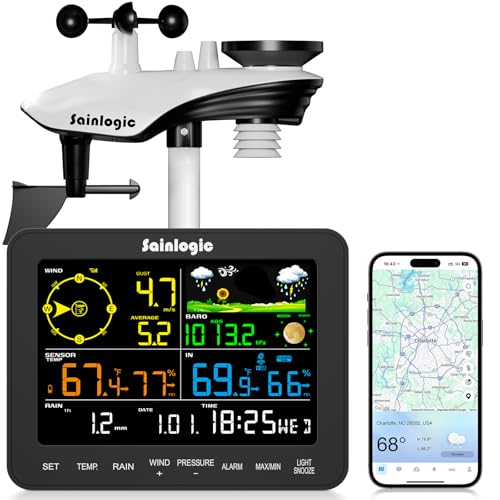
Sainlogic’s smart station offers the best feature-per-dollar ratio we found. The rain gauge is rated at ±1mm accuracy for rainfall under 15mm and ±7% beyond—professional-grade figures. Where it really shines is data retention: the Weatherseed app supports two years of historical data exportable to Excel, making it a tool for serious gardeners and farmers who track seasonal patterns.
The operation is straightforward: mount the sensor bracket, sync to the 6.5-inch display, and connect to 2.4GHz Wi-Fi via the app in three steps. The bold fonts on the LCD are genuinely senior-friendly, and the app provides AI-driven weather alerts for temperature, humidity, and barometric pressure changes. However, connectivity can be finicky—multiple user reports mention periodic disconnects requiring a manual reset, and the wind speed sensor has been noted as inaccurate by some users.
Build quality is solid ABS plastic, but the sensor array is not as wind-rugged as the Ambient Weather unit. U.S. phone support is available weekdays, which is a rarity at this price point. If you prioritize long-term rainfall analytics and don’t need super-fast update intervals, this Sainlogic is a compelling choice.
Why it’s great
- Excellent ±1mm accuracy on light rainfall
- 2-year data export to Excel for deep analysis
- Large, bold display ideal for low-vision users
Good to know
- Periodic Wi-Fi disconnects reported
- Wind speed sensor may be inaccurate
- App connectivity is not always plug-and-play
3. VEVOR 7-in-1 Wi-Fi Weather Station (B0FM3CVKNL)
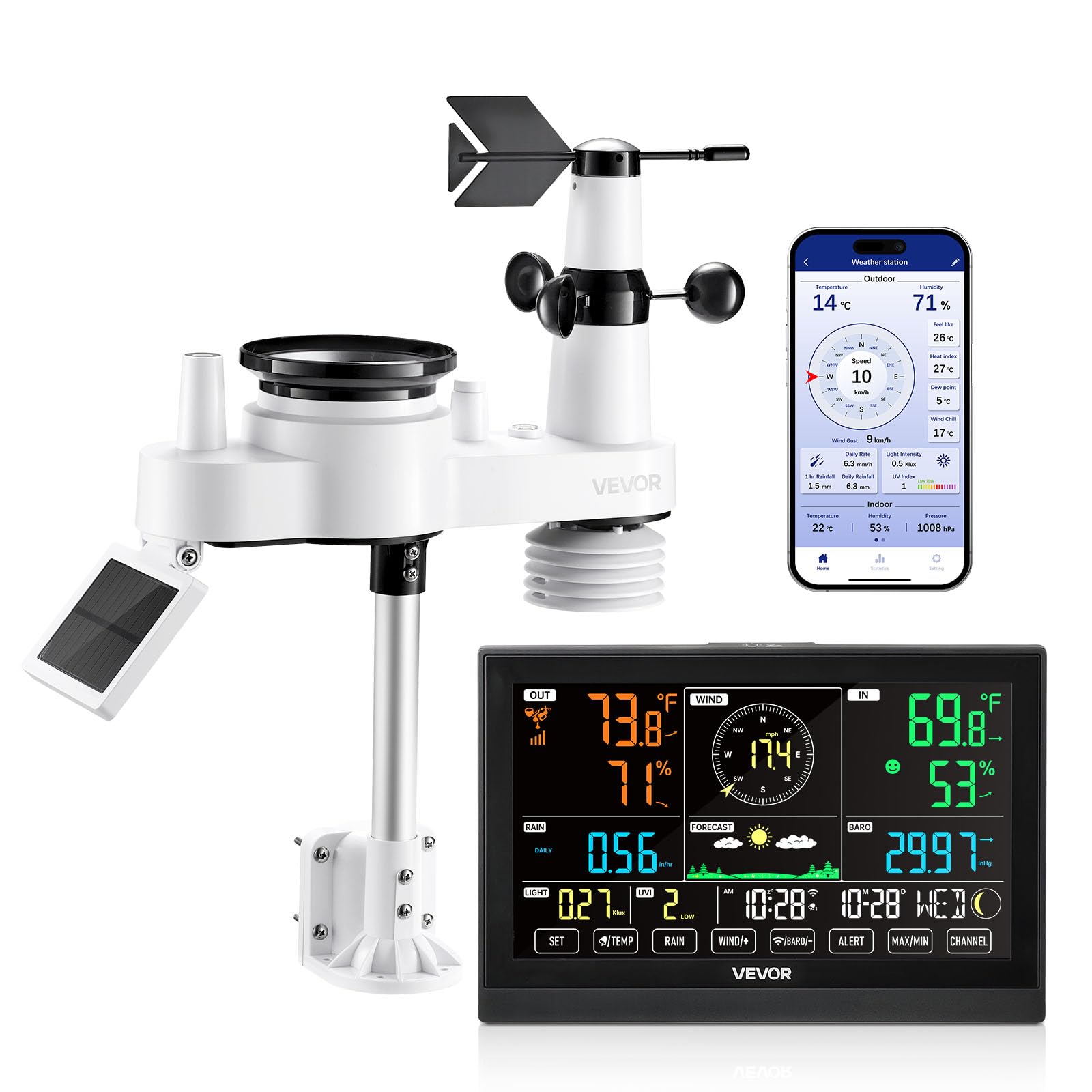
VEVOR’s latest 7-in-1 is a significant upgrade over its predecessor, with four key improvements: better internal waterproofing, NiMH battery charging support, the SmartLife app (no forced weather website registration), and simplified installation. The 150m transmission range is genuine in open areas—one user reported strong signal at several hundred feet—and the 7.5-inch VA display offers four brightness levels.
The solar panel is large enough to keep the NiMH batteries charged on sunny days, cutting down on battery swaps. The SmartLife app provides real-time data with history graphs, and there are no ads or hidden fees. However, the app is not Weather Underground compatible, which may disappoint users who want to share data publicly. The anemometer has a known vulnerability: some users report the moving parts freeze up after rain when temperatures drop below freezing.
Assembly is straightforward with the included aluminum alloy bracket and screwdriver. The touch-screen interface on the display is responsive, and the vendor provides an updated manual upon request. For those who want a solar-recharged, app-controlled station without paying for a brand name, this VEVOR delivers exceptional value—as long as you live in a climate that doesn’t test its freeze limits often.
Why it’s great
- Large solar panel with NiMH battery charging
- Ad-free SmartLife app with graphs and history
- Easy assembly and strong 150m wireless range
Good to know
- Anemometer can freeze after rain in sub-freezing temps
- Not compatible with Weather Underground
- Vendor support can be inconsistent for warranty claims
4. VEVOR YT60234 7-in-1 Weather Station

The VEVOR YT60234 is a solar-recharged 7-in-1 station that punches well above its tier. The integrated rain gauge is a tipping bucket design, and one user found that after correcting a reversed seesaw magnet, the unit accurately measured 1.86 inches of rainfall. It syncs with both Weather Underground and WeatherCloud, a feature usually reserved for stations costing twice as much.
The 7.5-inch color display is easy to read from across the room, with a 4-level dimmer (100%-60%-30%-0%) that works well in a bedroom. The solar panel (100x70mm) keeps the sensor running during the day; NiMH batteries handle night duty. The 150m transmission range holds up well, though interference with First Alert wireless smoke detectors has been reported—a frequency overlap to be aware of if you have those devices.
Build quality is mixed. The aluminum alloy mast and sensor bracket feel robust, but the internal sensor battery is soldered, and the warranty process can be painful if something fails—one user was told to buy a replacement battery elsewhere after the unit died. For the price, the weather data gathered is impressive, but long-term reliability is not guaranteed. This is a great entry into the hobby, not a set-it-and-forget-it solution.
Why it’s great
- Weather Underground and WeatherCloud compatibility
- Large, adjustable-brightness color display
- Solar-recharged sensor reduces battery waste
Good to know
- May interfere with First Alert wireless smoke detectors
- Warranty support is reported as poor
- Internal battery is soldered, hard to replace
5. Sainlogic 12-in-1 Weather Station SA6 (No WiFi)

If you don’t need Wi-Fi and want the most accurate rainfall data possible from a consumer gauge, the Sainlogic SA6 (non-WiFi model) is a standout. Its professional-grade rain sensor boasts ±1mm accuracy for rainfall under 15mm and ±7% up to 9999mm, recording hourly, daily, weekly, monthly, and total accumulation. The 6.5-inch color LCD is high-contrast with oversized fonts, making it the most legible display on this list.
The wireless transmission is stable across large properties—orchards and farms are specifically cited in testing—with no signal drops through moderate tree cover. The sensor measures 12 parameters including wind chill, dew point, feels-like temperature, and moon phase, all displayed on a screen that is easy to navigate despite some initial setup confusion reported by users. There is no companion app, which is a deliberate omission: all data is on the console.
Build quality is ABS plastic with a lacquered finish, and users note it feels good but may not survive years of intense desert UV. Two real drawbacks: the instructions are disorganized, and if something goes wrong with the solar panel in the sensor unit, one user had to request a replacement—though Sainlogic’s support came through. This is for people who want a weather station, not a connected gadget, and value reading accuracy above all else.
Why it’s great
- Professional-grade ±1mm rainfall accuracy
- Exceptionally clear and large 6.5″ display
- Stable wireless signal through structures
Good to know
- No Wi-Fi or app connectivity
- Instructions are poorly organized
- Plastic build may fade under constant UV exposure
6. ECOWITT WN1700 Rain Gauge Kit
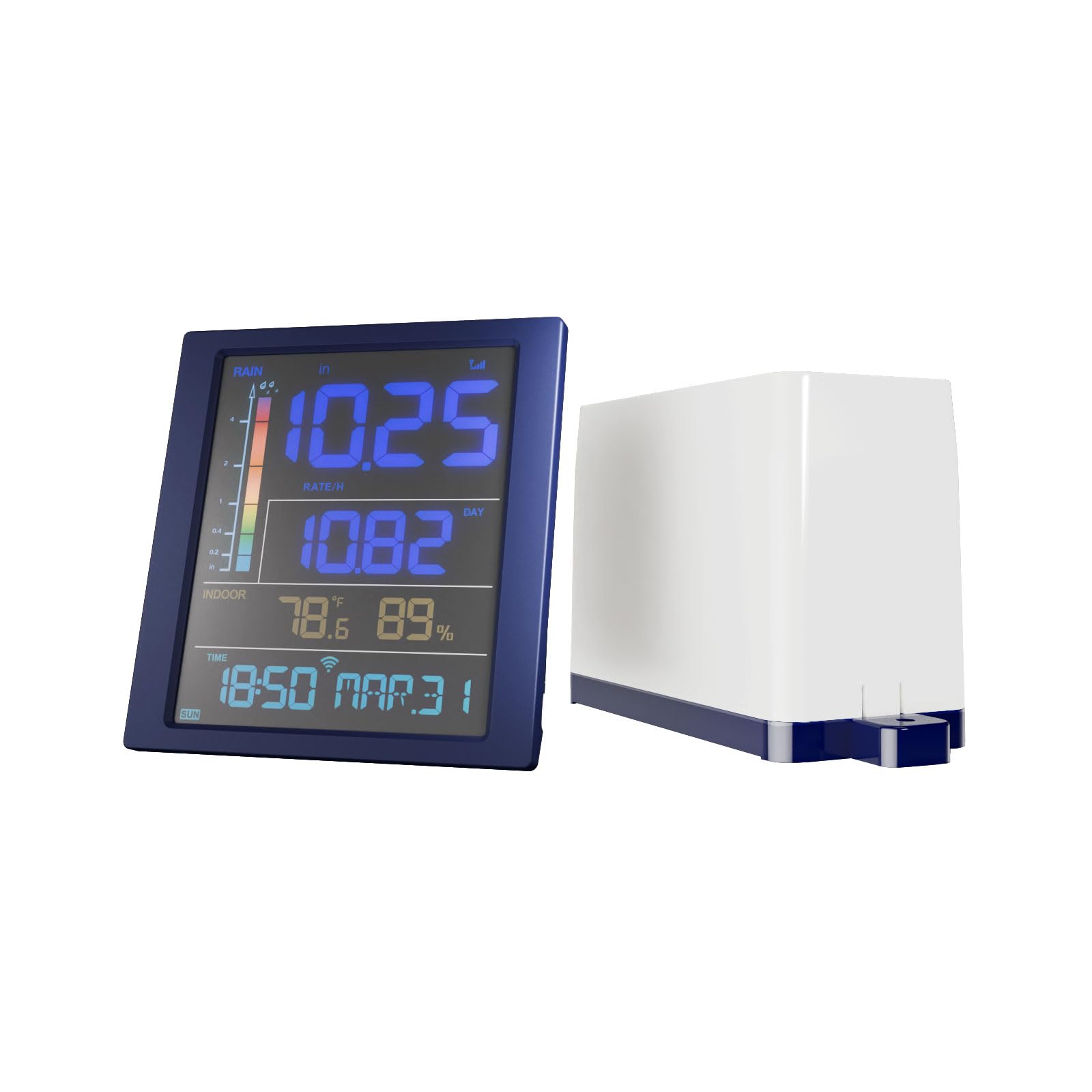
The ECOWITT WN1700 takes a minimalist approach: a dedicated rain sensor and indoor console, nothing more. Its high-sensitivity tipping bucket uses FSK (Frequency Shift Keying) wireless transmission for interference-free data every 48 seconds. The splash-resistant funnel is carefully designed to reduce water loss, a common issue in cheaper gauges. One long-term user reported zero false readings even in 25+ mph winds—a testament to the build.
The sensor can sit flat on a surface or be mounted with screws into wood. A dedicated pole bracket is available separately. The indoor console includes a clever feature: the antenna houses an indoor temperature and humidity sensor that becomes more accurate when extended for airflow. The display is simple and functional, showing current rainfall rate and accumulation. However, the console does not show outdoor temperature directly from this sensor—you’d need to add additional ECOWITT devices to the ecosystem for that.
Setup is genuinely plug-and-play for most users, though one 30-year IT professional couldn’t get registration working due to DMARC email blocking—a rare edge case. The build quality is fine for the price, but the plastic feels lighter than the VEVOR or Ambient units. If your only need is rock-solid rainfall data without frills, the WN1700 is a focused, reliable performer.
Why it’s great
- Very reliable tipping bucket with splash-resistant funnel
- Fast 48-second update with interference-resistant FSK
- Easy setup with no complicated network registration
Good to know
- Does not show outdoor temperature on console
- Pole mount bracket sold separately
- Limited to rainfall data only (no wind, pressure)
7. BIUWING Wireless Rain Gauge

The BIUWING Wireless Rain Gauge is the entry-level champion, offering eight different rainfall measurements (now, 1-hour, 24-hour, today, 7-day, month, year, total) plus indoor/outdoor temperature via a self-emptying, freeze-proof design. The indoor console features a soft blue backlight that stays on for 15 seconds when triggered—enough to check the reading at night without a flashlight.
Setup is famously easy: insert batteries into the outdoor sensor and indoor console, and they pair instantly. The console auto-sets the time via WWVB radio signal. The display is large and clear, and a built-in bubble level on the sensor helps with accurate placement. Some users noted the outdoor temperature reads high because the dark sensor housing absorbs sunlight, so mount it in partial shade for accurate temp data. The rain history button is on the back of the console, awkward to access if the unit is wall-mounted.
Build is adequate for the price—the glass portion of the funnel is noted as fragile in freezing conditions, so the “freeze proof” claim may be relative. One user reported that water frozen inside the glass caused it to crack. For the gardener who wants a step up from a manual tube without spending much, this BIUWING delivers useful data. Just be aware that long-term durability in harsh winters is a question mark.
Why it’s great
- Very affordable entry into digital rain monitoring
- Instantly auto-pairs and sets time via radio signal
- Eight measurement history modes for tracking
Good to know
- Glass funnel can crack if water freezes inside
- Outdoor temp reads high in direct sunlight
- Rain history button on back is hard to reach
FAQ
How do I prevent my rain gauge from freezing and breaking in winter?
Can I connect my automated rain gauge to a smart home system?
Why does my outdoor temperature reading seem too high on sunny days?
Does a self-emptying rain gauge still store my total rainfall data?
Final Thoughts: The Verdict
For most users, the best automated rain gauge winner is the Ambient Weather WS-1965 because of its fast update intervals, robust smart home integration, and access to the global Ambient Weather Network. If you want long-term data analysis and alerts, grab the Sainlogic Smart WiFi. And for a budget-friendly entry point that still offers multiple measurement histories, nothing beats the BIUWING Wireless Rain Gauge.