
Our readers keep the lights on and my morning glass full of iced black tea. As an Amazon Associate, I earn from qualifying purchases.
That persistent drone from your tires on coarse asphalt, the rattle of loose trim over every bump, and the booming bass bleed from your door panels are all symptoms of one thing: insufficient automotive sound deadening material. The right butyl-based mat or closed-cell foam liner doesn’t just quiet the cabin; it transforms the driving experience by adding mass to vibrating panels and blocking thermal transfer from the engine and exhaust.
I’m Min — the co-founder and writer behind Gadgets Feed. I’ve spent hundreds of hours cross-referencing butyl thickness ratings, adhesion performance on different substrates, and coverage-area calculations to determine which automotive sound deadening materials deliver measurable noise reduction without blowing your budget.
If your daily driver sounds more like a tin can than a sanctuary, upgrading to the best automotive sound deadening material is the single most effective modification you can make for cabin comfort.
How To Choose The Best Automotive Sound Deadening Material
Selecting the right sound deadener isn’t just about grabbing the thickest mat on the shelf. You need to match the material type—constrained-layer damper (CLD) vs. closed-cell foam—to the specific panel you’re treating. A door skin needs mass to kill resonant panel vibration, while a floorboard benefits from a decoupler that also insulates against heat. Understanding the “mil” rating, the adhesive quality, and the total coverage your vehicle requires will save you from buying twice.
Thickness & Density: The 50 Mil vs. 200 Mil Decision
Thinner 50-80 mil butyl mats (like the CANOPUS and KILMAT) are ideal for vertical panels like doors and rear quarter panels where weight savings matter and space is tight. Thicker 120-200 mil materials (like the Siless Max and VEVOR) provide greater mass loading, which is more effective at dampening low-frequency boom on large flat surfaces like the floor pan, roof, and trunk floor. For a complete build, many enthusiasts layer a 50-80 mil CLD on the metal and then top it with a 200 mil closed-cell foam liner for thermal and acoustic decoupling.
Adhesive Quality & Application
A sound deadener is only as good as its bond to the panel. Professional-grade butyl mats use a pressure-sensitive adhesive that requires firm pressure from a roller to activate fully. If the adhesive fails, the mat will sag in hot weather or peel off over time. All products reviewed here use a self-adhesive backing, but the best ones—like the Siless and KILMAT—have a reputation for extreme tackiness that sticks to painted metal without off-gassing or odors.
Coverage Area & Vehicle Fitment
One 36 sqft pack is generally sufficient for the outer door skins of a sedan, but a full van conversion might require 65-100 sqft or more. Always measure the panels you plan to treat and account for a 10-20% waste factor when cutting around curves and window regulators. The KILMAT at 36 sqft is a great starting point, while the VEVOR at 25 sqft offers a thicker, more dense alternative for targeted applications.
Quick Comparison
On smaller screens, swipe sideways to see the full table.
| Model | Category | Best For | Key Spec | Amazon |
|---|---|---|---|---|
| Siless Hybrid 3in1 | Premium 3in1 | One-layer full coverage | 200 mil / 5mm thickness | $79.95Amazon |
| KILMAT 80 Mil | Mid-Range CLD | Doors & weight-sensitive panels | 36 sqft coverage | $69.95Amazon |
| Siless Max 120 mil | Premium CLD | Floor & trunk floor damping | 120 mil / 3mm butyl | $74.95Amazon |
| VEVOR 200 mil | Heavy-Duty | Vans & large flat panels | 200 mil / 5.1mm butyl | $50.90Amazon |
| CANOPUS 50 mil | Budget CLD | Entry-level door quieting | 50 mil / 1.27mm butyl | $27.99Amazon |
| CHAOGANG 200 mil Foam | PE Foam Decoupler | Heat insulation & decoupling | 200 mil / 5mm PE foam | $44.97Amazon |
| DYNAMAT Dynaliner | Premium Foam | Thermal barrier under carpet | 1/8″ closed-cell rubber | from $84.95Amazon |
In‑Depth Reviews
1. Siless Hybrid 3in1 200 mil 25 sqft

The Siless Hybrid 3in1 is the smartest multitasking solution in the sound deadening world, combining three layers—a butyl mastic dampener, PE foam decoupler, and mass-loaded butyl membrane—into a single 200 mil sheet. This composite structure attacks vibration, low-frequency road noise, and exhaust heat simultaneously, eliminating the need to buy separate CLD and foam products. At 5mm thick, it provides the mass of a traditional 200 mil damper with the thermal insulation of a closed-cell liner built directly in.
Installation is straightforward with the peel-and-place backing, though the material’s thickness means it requires more effort to conform to complex curves compared to a thinner 80 mil mat. Users report dramatic cabin noise reduction on large vans like the Chevy Express and compact cars like the Fiesta ST, with some noting the exhaust note becomes barely audible inside. The 25 sqft coverage is best suited for smaller sedans or targeted areas of a larger vehicle rather than a full van conversion.
The three-in-one design simplifies a traditionally two-step process, saving both time and the cost of buying separate foam liners. Its flexibility at room temperature makes it easier to cut and shape than some stiffer competitors, and the adhesive is reported to be strong enough to allow repositioning without residue. For anyone wanting a complete sound and heat solution in one pass, this is the definitive package.
Why it’s great
- All-in-one CLD, foam, and barrier in a single 200 mil sheet
- Dramatically reduces low-frequency exhaust and road noise
- Strong adhesive bonds to painted metal without off-gassing
Good to know
- 25 sqft may not cover an entire large SUV or van
- Thicker profile can be harder to press into tight corners
2. KILMAT 80 Mil 36 sqft

KILMAT’s 80 mil alubutyl sheet hits the sweet spot for weight-conscious builds where every pound matters, such as doors and rear quarter panels. At 0.5 lbs per square foot, it provides a significant mass loading effect without overburdening the panel’s opening force or gas struts. The embossed aluminum foil surface serves a dual purpose: it reflects radiant heat and provides a visual indicator that the material is fully bonded—when the embossing is rolled smooth, you know adhesion is complete.
Professional installers and DIYers alike praise the aggressive tack of the butyl adhesive, which sticks tenaciously to painted metal and even forms around compound curves when warmed slightly. The 36 sqft pack offers generous coverage, enough to do the outer door skins and some of the floor on a mid-size sedan, or the complete interior of a smaller hatchback. Users on a Lexus RX350 reported that the doors went from hollow to solid-sounding after a single-layer application.
While it lacks the integrated foam layer of the Siless Hybrid, KILMAT’s 80 mil thickness is nearly double that of budget 50 mil mats, delivering a noticeable improvement in mid-range vibration control. The material is slightly stiffer than some competitors, meaning it benefits from being warmed with a heat gun in colder climates for easier molding. For those layering a separate decoupler, this remains the benchmark for mid-weight constrained-layer dampers.
Why it’s great
- Optimal 80 mil thickness for doors without excessive weight
- Embossing serves as a visual bond-verification indicator
- 36 sqft provides ample coverage for a full sedan door set
Good to know
- Foil edges can be sharp during handling
- Requires firm pressure to fully activate the adhesive
3. Siless Max 120 mil 30 sqft

SILESS MAX VIBRO at 120 mil splits the difference between lightweight 80 mil mats and super-thick 200 mil sheets, offering a dense butyl compound that excels at dampening the heavy panel vibrations of floor pans and trunk floors. The 3mm thickness provides enough mass to kill resonant boom without the installation difficulty of a 5mm material. It uses a “Bmastic” formulation that the manufacturer claims is more advanced than standard butyl, though in practice the key differentiator is the balance of stickiness and pliability.
Users transitioning from Dynamat report that Siless Max is easier to cut with standard scissors and conforms better to complex floor contours at room temperature. The 30 sqft coverage is a practical size for completing the entire floor pan and firewall of a subcompact or compact car, with enough leftover for trunk work. Owners of a base-model Civic stated that a complete treatment transformed the cabin to Lexus-like quietness, also noting an effective thermal barrier effect that reduced air conditioning workload.
The adhesive is extremely tacky and requires careful placement the first time, but it bonds aggressively to painted metal without needing primer. The lack of a foam layer means you’ll still want to add a closed-cell decoupler over the floor for thermal insulation, but for pure vibration damping performance, the 120 mil thickness is the most cost-effective option in the mid-weight category. A roller is essential for proper installation to avoid air pockets.
Why it’s great
- 120 mil provides excellent low-frequency damping for floors
- Easy to cut with scissors at room temperature
- No off-gassing or odor after installation
Good to know
- 30 sqft may not be enough for large SUVs or vans
- Requires a separate foam layer for heat insulation
4. VEVOR 200 mil 25 sqft

VEVOR’s 200 mil butyl mat is built for the heavy lifting of van conversions and large panel damping, where the mass of a 5.1mm thick material is necessary to cancel the booming resonance of thin sheet metal. The three-in-one composite structure—80 mil butyl surface, aluminum foil, and 120 mil high-density foam—overlaps functionality with the Siless Hybrid but uses a distinct layer arrangement. The 24 pre-cut sheets (9.76″ x 15.39″) make installation modular and less wasteful than trimming a large roll.
Owners of Mercedes Sprinter and Ford Transit camper vans report that 50% coverage on panels (with double coverage on wheel wells) is sufficient to drastically reduce interior drone, and the foam layer provides noticeable heat insulation that keeps the cabin cooler in direct sun. The adhesive is strong and odor-free, though the material’s density makes it more challenging to conform to deeply curved surfaces. A heat gun is strongly recommended for winter installations to soften the butyl.
The 25 sqft coverage is smaller than many alternatives, but the sheer thickness per square foot means you need less material to achieve the same mass loading effect. For someone building a camper van or a full-size SUV who wants the thickest possible single-layer solution without going to a separate barrier, the VEVOR delivers substantial mass and heat-blocking properties in a manageable sheet format. The trade-off is a weight penalty and reduced flexibility in tight spaces.
Why it’s great
- 5.1mm thick for maximum mass loading on large panels
- Pre-cut sheets simplify installation planning
- Integrated foam layer provides dual sound and heat insulation
Good to know
- Very dense material is harder to form around curves
- 25 sqft is relatively small for a full van build
5. CANOPUS 50 mil 10 sqft
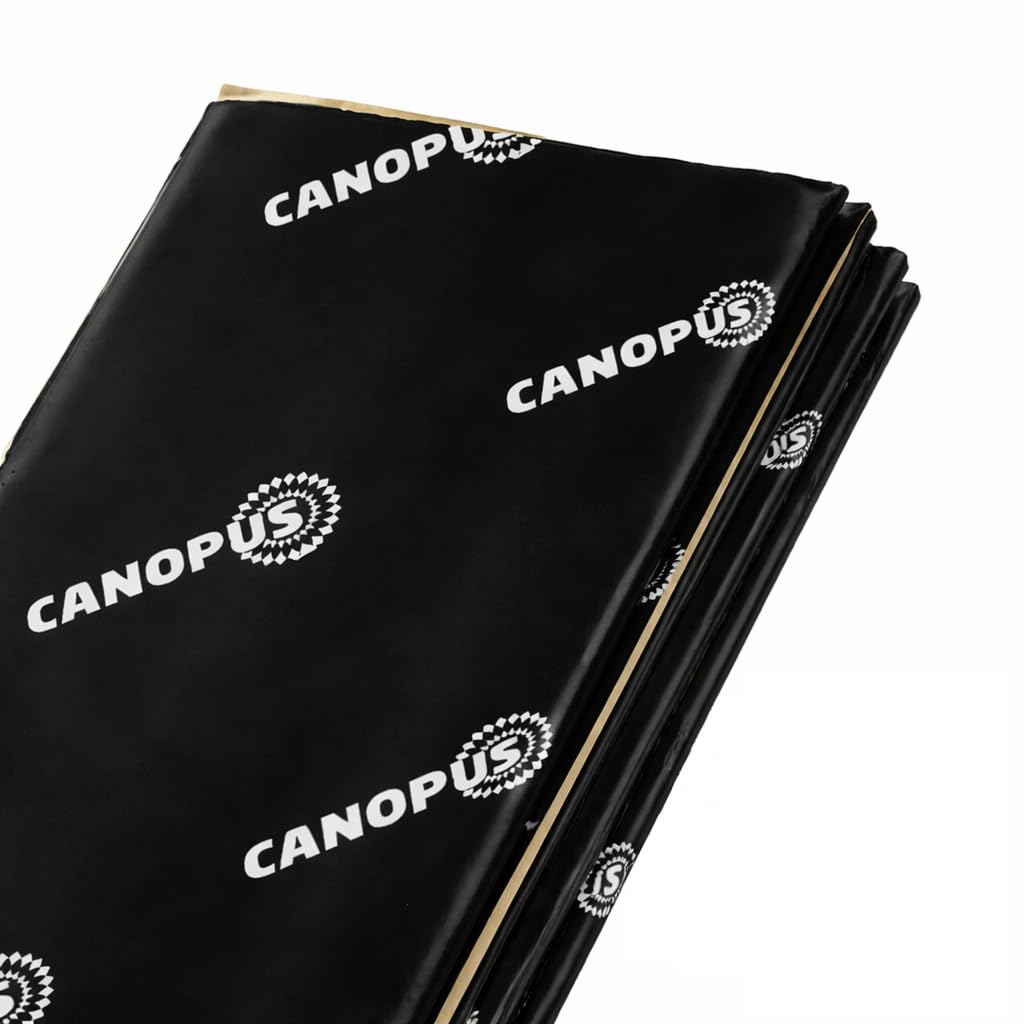
The CANOPUS 50 mil mat is the entry point into the world of automotive sound deadening, offering a functional butyl-and-foil sheet at a cost that allows beginners to experiment without a major investment. At 1.27mm thick, it is best suited for reducing panel resonance on door skins, trunk lids, and small areas where space is tight—such as the inside of a hood or behind a license plate. Its lightweight nature makes it ideal for applications where adding mass could strain gas struts or hinges.
Customer feedback highlights its clean installation with no odor, and the ability to cut it with standard utility scissors or a razor knife. The adhesive is reported to be very sticky and bonds well to clean, dry painted metal. Some users note that on a car like a VW Golf GTI, the 50 mil thickness alone won’t transform cabin noise—it stops vibration and speaker buzz, but you need a closed-cell foam overlay for significant airborne noise reduction.
The 10 sqft pack is compact, offering enough material to treat two doors and a small trunk well on a compact car. For a first-time DIYer wanting to test the improvement before committing to a full vehicle treatment, this is a low-risk starting point. However, experienced users should be aware that multiple layers or a thicker product will be needed for noticeable results on larger panels and floor surfaces.
Why it’s great
- Low cost allows experimentation for first-time users
- Clean, odor-free butyl adhesive
- Easy to cut and install on door skins
Good to know
- 50 mil provides limited mass loading for floors and trunk
- 10 sqft is a small quantity; large builds will need multiple packs
6. CHAOGANG 200 mil PE Foam 36.16 sqft

This CHAOGANG product is not a butyl mass damper but a closed-cell polyethylene (PE) foam with a premium aluminum foil facing, designed specifically as a decoupler and thermal barrier. At 200 mil / 5mm thick, it excels at blocking radiated heat from the exhaust, transmission, and firewall, while also compressing under carpet to reduce airborne road noise. The 5A-grade aluminum foil resists oil and water, making it suitable for under-hood and wheel well applications where exposure to moisture is common.
Installers report that the material cuts easily with a carpet knife and the adhesive is strong when applied to clean dry surfaces. Users on a Ram 1500 combined this foam liner with butyl rubber matting on the floorboards to achieve near-inaudible road noise at highway speeds. The 36.16 sqft roll provides generous coverage for the entire floor pan of a full-size truck or the walls and ceiling of a small van conversion.
However, this is a foam product and cannot replace the mass-loading function of a butyl mat. For effective sound deadening, it must be used as a second layer over a CLD like the KILMAT or Siless Max. The foam is also somewhat fragile; it can tear if pulled aggressively, and the adhesive, while adequate, is not as tenacious as butyl mastic. It is the right tool for the insulation job, but not a standalone sound deadener.
Why it’s great
- Excellent thermal barrier for floor and firewall heat
- Large 36.16 sqft roll covers full truck floors easily
- Closed-cell structure does not absorb moisture
Good to know
- PE foam does not provide mass loading for vibration damping
- Must be used over a butyl CLD for comprehensive sound deadening
7. DYNAMAT Dynaliner 1/8″ 12 sqft

DYNAMAT Dynaliner is the gold standard for closed-cell foam decoupling, trusted by professional custom builders since 1989. This 1/8-inch self-adhesive rubber foam is denser and more durable than generic PE foam, providing nearly double the thermal resistance of standard insulators. Its closed-cell structure means it will never absorb water, preventing rust and mildew that open-cell under-carpet fillers promote. When paired with a CLD like Dynamat Xtreme, it creates a two-layer system that stops vibration and kills airborne noise simultaneously.
Owners of luxury vehicles like the BMW X5 and Mercedes SL report that adding Dynaliner over a butyl layer dramatically improves cabin silence and reduces heat soak in desert climates. The foam is flexible enough to conform to transmission tunnels and floor ribs, and the self-adhesive backing holds firmly when applied to a clean substrate. The 12 sqft sheet (54″ x 32″) is large enough for a single-layer floor treatment on a compact car, but multiple sheets are needed for full-coverage SUV applications.
The primary consideration is cost per square foot, which is higher than generic foam liners. Additionally, Dynaliner is a decoupler and barrier, not a vibration damper—it cannot replace a butyl mat on vibrating panels. For the best results, it should be applied on top of Dynamat Xtreme or equivalent CLD on metal surfaces. The 1/8-inch thickness is perfect for under-panel applications where panel clearance is limited, such as in door shells.
Why it’s great
- Premium closed-cell rubber with superior heat resistance
- Won’t absorb water, preventing mold and corrosion
- Trusted brand used in high-end hot rod and custom builds
Good to know
- Higher cost per square foot than generic foam alternatives
- Must be paired with a butyl CLD for comprehensive damping
FAQ
Is 50 mil thick enough to make a noticeable difference on car doors?
Can I use PE foam alone instead of butyl for sound deadening?
How do I calculate how much sound deadening material I need?
Does automotive sound deadening material increase heat inside the car?
Will thick 200 mil material prevent my door panels from fitting properly?
Final Thoughts: The Verdict
For most users, the automotive sound deadening material winner is the Siless Hybrid 3in1 because its three-layer composite design delivers vibration damping, heat insulation, and noise blocking in one 200 mil sheet, saving the cost and labor of buying separate CLD and foam layers. If you want a lightweight CLD perfect for door panels without straining hinges, grab the KILMAT 80 Mil. And for a full van conversion where maximum mass and thermal protection are required, nothing beats the VEVOR 200 mil for its sheer density and pre-cut convenience.
Product prices and availability are accurate as of the date/time indicated and are subject to change. Any price and availability information displayed on Amazon at the time of purchase will apply to the purchase of this product. As an Amazon Associate I earn from qualifying purchases.
CERTAIN CONTENT THAT APPEARS ON THIS SITE COMES FROM AMAZON. THIS CONTENT IS PROVIDED "AS IS" AND IS SUBJECT TO CHANGE OR REMOVAL AT ANY TIME.
Amazon and the Amazon logo are trademarks of Amazon.com, Inc. or its affiliates.