
Chasing an intermittent electrical gremlin under a dash with a standard multimeter is a slow, two-handed nightmare. An automotive test light transforms that hunt into a one-handed, instant-feedback check, telling you instantly if power is present, if a ground is solid, or if a circuit is broken.
I’m Min — the co-founder and writer behind Gadgets Feed. I’ve spent countless hours dissecting the technical specs, customer feedback, and real-world performance data on dozens of circuit testers to separate the tools that deliver reliable diagnostics from those that cause more confusion than clarity.
This guide cuts through the noise to help you find the absolute best automotive test light for the specific jobs you face daily, whether that’s fuse box interrogation, component activation, or deep-dive computer-safe circuit tracing.
How To Choose The Best Automotive Test Light
Picking the right test light comes down to matching the tool’s capabilities to the complexity of your electrical diagnostics. A simple bulb tester for fuse checks is a different beast than a full-featured power probe for component activation.
Traditional vs. Power Probe
The classic test light with a sharp probe and a ground wire is excellent for checking for power at a fuse or connector quickly. However, it draws current through its bulb, which can damage sensitive control modules. A modern power probe includes a relay and a polarity indicator—often with LED color coding and a buzzer—and can also supply power or ground to activate a component (like a fuel pump or cooling fan) directly, offering a far more versatile diagnostic session.
Quick Comparison
On smaller screens, swipe sideways to see the full table.
| Model | Category | Best For | Key Spec | Amazon |
|---|---|---|---|---|
| Topdiag P60 | Power Probe | Advanced diagnostics & component activation | 0.3-70V range, LCD display, diode test | Amazon |
| OTC 3633 | Classic Tester | High reliability, tight access, computer safe | Replaceable bulb, 12-foot cord, needle probe | Amazon |
| ITEQ Circuit Probe | Power Probe | Long reach, component activation on budget | 157-inch test cable, 7A overload protection | Amazon |
| CMTOOL AY-29 | Power Probe | Budget-friendly power probe with component test | 4-meter test lead, polarity buzzer, 7A overload | Amazon |
| JASTIND Digital LED | Digital Tester | Wide voltage range (3-72V) & digital readout | Digital display, 0.1V resolution, 142-inch wire | Amazon |
| OEMTOOLS 25886 | Classic Tester | Durable incandescent bulb & long coiled cord | Low current (~30mA), 12-foot coiled cord, spare bulb | Amazon |
| Astro Pneumatic 7760 | Cordless/Body | No-ground testing for quick power checks | Cordless, body ground, 3-28V DC, computer safe | Amazon |
In‑Depth Reviews
1. Topdiag P60 Power Circuit Probe
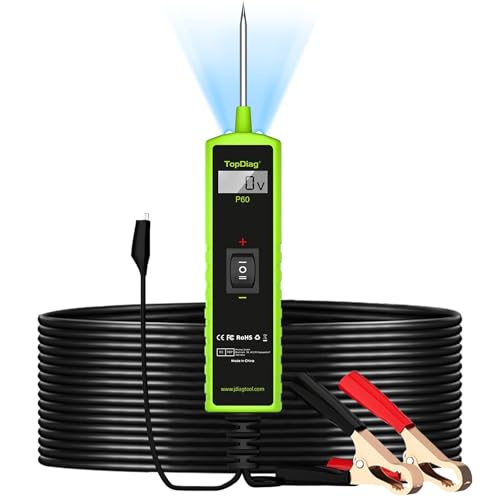
The Topdiag P60 is the smartest tool on this list, cramming more than nine diagnostic functions into one probe. It doesn’t just test for power; it includes an LCD screen for precise voltage readings, a component activation function to directly test fuel pumps or cooling fans, and a dedicated diode detection mode that most entry-level probes lack. The ability to switch between providing power and ground makes it a genuine shortcut for chasing down a dead component.
What sets the P60 apart is its lab-scope style functionality for the price. It can test AC voltage, frequency, and even duty cycle, which is incredibly useful for diagnosing crankshaft and camshaft position sensors without a dedicated oscilloscope. The built-in LED light on the tip mitigates the annoyance of working in a dark engine bay, though the ground cable is notably short and some users add weight to the handle for better tactile feel during one-handed operation.
For a technician diagnosing complex intermittent issues, the P60 offers a massive step up in capability relative to a traditional test light. The value proposition here is off the charts, providing a scope, a continuity tester, a short finder, and a component activator in one handheld unit. Just be mindful that the ground wire length may require you to keep the test point close to your battery connection or use an extension.
Why it’s great
- Integrated LCD voltage display with high 0.3V minimum threshold
- Component activation & diode testing for advanced diagnosis
- Includes pulse-width modulation (PWM) and frequency measurement
Good to know
- Ground cable is shorter than ideal for full-vehicle reach
- Handle feels light; some users add weight for better feedback
- May be overkill for simple fuse checks
2. OTC 3633 Mini-Coil Cord Circuit Tester

The OTC 3633 stands as a testament to the enduring value of a properly made traditional test light. It features a high-intensity replaceable incandescent bulb, not an LED, which is a critical distinction. An incandescent bulb draws a low current (around 30mA), making it inherently computer-safe for back-probing sensor and ECM circuits where an LED tester might cause a false reading or even damage. The needlepoint stainless steel probe is threaded, allowing you to screw on the included alligator clip for hands-free probing.
Its ergonomic, slim clear handle is perfectly designed for the tight confines of a modern fuse box or under the steering column. The 12-foot heavy-duty coiled cord extends to a useful length for reaching from the battery to the tail lights without dragging on the ground. The build quality is exceptional, with many users reporting that the OTC feels more substantial and precise than the more common “Snap-on” equivalent, at a fraction of the cost.
If you work on modern cars with sensitive electronic control units, the OTC 3633 is the safest and most reliable test light you can buy. It doesn’t have the bells and whistles of a power probe, but for the core job of checking for power, ground, and shorts, it is a masterpiece of simple, durable design. The replaceable bulb ensures the tool isn’t disposable, and the needle point excels at piercing wire insulation cleanly.
Why it’s great
- Computer-safe incandescent bulb with low current draw
- Premium build quality with replaceable bulb and needle probe
- Compact handle and 12-foot coiled cord for versatile reach
Good to know
- No component activation or voltage readout feature
- Bulb can be less visible in direct sunlight compared to LED
- Does not test for continuity without power
3. ITEQ Power Circuit Probe Tester

The ITEQ probe is a serious contender for anyone who needs the diagnostic depth of a power probe combined with an exceptionally long reach. Its standout feature is the 157-inch extended test cable, which allows you to connect directly to the battery and then roam the entire length of the vehicle without needing to move your ground connection. This is a massive convenience for checking trailer lights, rear taillights, or any circuit at the back of a long pickup truck.
It performs all the standard power probe duties: polarity identification via red/green LED and a buzzer, continuity testing, and component activation. The overload protection, which automatically disconnects the circuit at 7A with a buzzer alert, is a valuable safety net when activating a high-draw component like a radiator fan. The included storage bag and electrical tape show attention to detail often missing in this price range, and the alligator clip is large enough for a secure one-handed connection.
For the price, the ITEQ offers power probe functionality that would have cost several times as much a few years ago. The wire gauge and quality feel robust, not fragile, and the tool has a reassuring heft that suggests durability. It is a fantastic entry point into power probe diagnostics if the standard short ground cable of other budget models has been your complaint.
Why it’s great
- Exceptionally long 157-inch test cable for full-vehicle reach
- Polarity identification with color-coded LED and audible buzzer
- Automatic 7A circuit breaker for overload protection
Good to know
- Voltage range limited to 6-24V DC
- No digital voltage readout, only LED indicators
- Heavier than a traditional test light
4. CMTOOL AY-29 Power Circuit Probe

The CMTOOL AY-29 is a budget-friendly power probe that punches well above its weight. For an entry-level price, it gives you the core functionality of a premium diagnostic tool: polarity identification, component activation, and a short circuit finder. The 4-meter test lead is generous for its price class, allowing you to trace wires from the fuse box under the hood back to the cabin without strain.
The probe uses a clear LED system—red for positive, green for negative—and an audible buzzer that confirms ground quality. If the tip touches a good ground, the LED turns green and the buzzer sounds; if the ground is faulty or non-existent, the LED stays red and the buzzer is silent. This makes it incredibly fast to diagnose a corroded ground connection that a simple test light might miss. The overload protection at 7A is also present, a solid safety feature for the price point.
While it lacks the digital display and advanced features of the Topdiag P60, the CMTOOL AY-29 is the perfect tool for the DIYer or weekend mechanic who wants to move beyond a simple test light without a large investment. Its performance in component activation and voltage polarity testing is reliable, and the extended wire makes it practical for full-size cars and SUVs. It is the benchmark for value in the power probe segment.
Why it’s great
- Excellent value for a full-featured power probe
- 4M test lead for extensive reach across the vehicle
- Audible ground test and overload protection
Good to know
- Plastic housing feels less premium than metal probes
- No digital voltage readout
- Minimum voltage threshold of 6V limits use on some circuits
5. JASTIND Digital LED Automotive Test Light

The JASTIND tester is a unique hybrid that bridges the gap between a traditional test light and a handheld multimeter. Its headline feature is the LED digital display that shows the exact voltage down to 0.1V with a claimed accuracy of ±0.2V. This is a massive advantage over a simple lamp tester, as it tells you not just that voltage exists, but if it is a healthy 12.6V or a weak 10.5V that points to a bad connection or battery.
The wide 3-72V DC range is also unusual, making it suitable for everything from low-voltage circuits on motorcycles to higher-voltage systems on heavy equipment or solar installations. The tool includes auxiliary lighting LEDs that illuminate the test area, a thoughtful touch for night work. The bidirectional voltage test means you can attach the clamp to either the positive or negative terminal and the probe will correctly identify the polarity with a buzzer and LED.
This tester is best suited for the diagnostic enthusiast who wants more data than a “yes/no” answer from a bulb. The digital readout takes the guesswork out of voltage drop testing. The build quality is solid, with a stainless steel probe and a heavy-duty spring wire, although some users note the probe is a bit bulky for extremely tight terminal blocks. The anti-lost probe cover is a practical safety addition that prevents accidental pokes.
Why it’s great
- Digital voltage readout provides precise 0.1V resolution
- Wide 3-72V test range for diverse vehicles and systems
- Built-in LED work light and audible polarity feedback
Good to know
- Not a power probe; does not supply power/ground
- Probe body is slightly larger than standard test lights
- May not be as durable as industrial-grade tools
6. OEMTOOLS 25886 Circuit Tester

The OEMTOOLS 25886 is a robust, no-nonsense traditional circuit tester that delivers a bright incandescent bulb for excellent visibility even in direct sunlight. It is designed for 6-24V systems, making it versatile for cars, trucks, and some marine applications. The 12-foot heavy-duty coiled cord is oil and heat resistant, and the strain relief at the probe end is molded to withstand years of pulling and bending.
The sharp stainless steel wire piercing probe is a defining feature, capable of penetrating wire insulation cleanly for back-probing. It is a tool that respects traditional diagnostic methods. The bulb is replaceable, and the unit even includes a spare, extending its lifespan considerably. The heavy-duty ground clamp is large and springy, providing a solid connection on battery terminals or other unpainted metal surfaces.
Where the OEMTOOLS shines is its low current draw. At approximately 30mA, it is safe for use on computer circuits where a standard high-draw test light could cause issues. This makes it a solid alternative to the more expensive OTC for technicians on a budget who need to diagnose modern ECUs. The incandescent light provides a cleaner indication than a pulsing LED, especially when checking fast-switching circuits.
Why it’s great
- Low current draw (30mA) for computer-safe diagnostics
- Bright incandescent bulb visible in direct sunlight
- Includes spare bulb and has oil/heat resistant cord
Good to know
- No component activation or voltage readout
- Clamp may require soldering for more permanent wire connection
- Bulb is slightly less durable than some military-grade options
7. Astro Pneumatic 7760 Cordless Circuit Tester

The Astro Pneumatic 7760 is the most unique tool in this lineup because it requires no ground cable whatsoever. Instead, it uses the user’s own body as the ground path. You simply hold the metal portion of the tester in your hand, touch the sharp V-tip to a live circuit, and the tool lights up and beeps if voltage is present. This is an incredible timesaver for quick checks under the dash where a ground clip is hard to attach or keep on.
It is safe for use on sensitive electronics like ECMs, transducers, and airbags because it draws very little current. The V-tip is designed for safe and centered wire piercing, reducing the chance of damaging the wire. It operates on a 3-28V DC range, covering everything from low-voltage signal circuits to standard automotive power. It is incredibly light at just 0.1 pounds and fits easily in a shirt pocket.
However, this tool is strictly a “power present” checker. It cannot test for ground quality, continuity, or a short to ground. It also won’t apply power to a component. As one reviewer noted, it excels at checking fuses and power at connectors quickly, but its diagnostic depth is limited. It is the perfect specialized tool for the mechanic who values speed and convenience over exhaustive circuit analysis, particularly for chasing power along a harness.
Why it’s great
- Completely cordless; uses body as ground for one-touch testing
- Computer-safe for ECM, airbag, and sensor circuits
- Extremely lightweight and pocketable at 0.1 lbs
Good to know
- Cannot test for grounds, continuity, or short circuits
- Does not provide power to activate components
- Requires bare hand contact with tester and a ground source
FAQ
Can I use any test light on a modern car’s computer circuit?
What does the ‘power probe’ function actually do?
What is the advantage of a cordless test light?
Final Thoughts: The Verdict
For most users, the best automotive test light winner is the OTC 3633 because it offers professional-grade build quality, a computer-safe incandescent bulb, and a compact ergonomic design that excels in the tight confines of modern engine bays. If you want a power probe that can also display voltage readings and perform lab-scope functions, grab the Topdiag P60. And for pure speed and convenience in checking fuses, nothing beats the cordless Astro Pneumatic 7760.