
Your CB radio’s range is only as good as the coax cable feeding the antenna. A weak or incorrectly matched cable turns a powerful 4-watt transmitter into a whisper, wasting every dollar you spent on the radio itself.
I’m Min — the co-founder and writer behind Gadgets Feed.
This guide covers the three cable types dominating the market — Mini-8, RG58, and RG8X — and reveals exactly where each best cb radio coax cable wins for its specific length and power-handling need.
How To Choose The Best CB Radio Coax Cable
Selecting the right coax for your CB setup means matching the cable’s impedance, shielding percentage, connector type, and physical length to your specific antenna and radio. The wrong match can elevate your SWR, reduce transmit efficiency, or allow corrosion to silently degrade your connection over months.
Cable Type and Loss at 27 MHz
RG58 is the thinnest common option — fine for runs under 12 feet but introduces measurable loss beyond that. Mini-8 uses a fatter dielectric to reduce loss while staying flexible. RG8X is thicker still, with lower loss per foot and better power handling for longer runs. For a typical 18-foot CB run, RG8X or Mini-8 is the sweet spot; RG58 works but leaves performance on the table.
Connector Quality and Weather Sealing
PL-259 connectors are the standard for CB. Look for gold-plated center pins for corrosion resistance and nickel-plated brass bodies for a secure fit. Molded weather boots at both ends prevent moisture ingress — a leading cause of SWR drift after installation. Removable FME connectors offer installation flexibility but require periodic retightening.
Shielding and Conductor Material
Double shielding — a copper braid plus aluminum foil — blocks RF interference better than a single braid alone. Pure copper inner conductors conduct more efficiently than copper-clad aluminum, though CCA is lighter and acceptable for shorter runs. For base station or long-term outdoor use, prioritize 95-100% shield coverage and solid copper center conductors.
Quick Comparison
On smaller screens, swipe sideways to see the full table.
| Model | Category | Best For | Key Spec | Amazon |
|---|---|---|---|---|
| XRDS KMR 400 18FT | Premium | Ultra-low loss base station | KMR400, 0.41 in conductor | Amazon |
| G-PLUG 15FT RG8X | Mid-Range | Low-loss base/mobile use | Double shielded RG8X | Amazon |
| Ullnosoo 18ft RG8x | Mid-Range | Waterproof outdoor installs | 17AWG pure copper core | Amazon |
| MOOKEERF 6FT KMR400 | Mid-Range | Short jumper / extension | KMR400, 95% shield | Amazon |
| K40 K4018FME 18ft | Mid-Range | Removable FME routing | 95% shield, molded ends | Amazon |
| Rydocyee 18ft RG58 | Budget | Short-run budget builds | 100% copper, double shield | Amazon |
| Astatic 302-10267 18ft | Budget | Entry-level Mini-8 install | 95% shield, 4-point boot | Amazon |
In‑Depth Reviews
1. XRDS 18FT KMR 400 UHF Coaxial Cable

The XRDS KMR 400 leaps past the RG58 and RG8X crowd by using a 0.41-inch copper-clad aluminum conductor. That larger diameter yields significantly lower loss per foot — real testers report just 1 watt of loss over 25 feet at 80 watts output. For a CB base station running 18 feet, that translates to nearly full power delivery to the antenna.
The PL-259 clamp connectors are a step above the typical crimp-on style. Each connector gets a 2.2-inch adhesive-lined heat shrink tube that seals the junction against moisture. The entire assembly is built to withstand 20 years of outdoor UV exposure. Users running the cable with an A-99 antenna achieved flat 1.0 SWR across 1-40 channels.
The one trade-off is stiffness: the thicker KMR400 construction makes it less suitable for mobile installations where the cable must bend around tight corners or follow moving mounts. This cable is a fixed-installation specialist.
Why it’s great
- Ultra-low loss at CB frequencies — negligible power drop over 18 feet
- Clamp-style PL-259 connectors with adhesive heat shrink for permanent weatherproofing
Good to know
- Very stiff cable — not ideal for tight-bend mobile runs or rotor applications
2. G-PLUG 15FT RG8X Coaxial Cable

The G-PLUG RG8X uses a pure copper core with double shielding — a copper braid plus aluminum foil — to minimize RF interference and signal leakage. At CB frequencies, the loss is under 1 dB for a 15-foot run, making it a strong choice for both base stations and mobile rigs where the cable path is mostly straight.
The PL-259 connectors feature gold-plated center pins and nickel-plated brass bodies. Multiple users reported passing TDR tests even after pulling the cable through walls, confirming the mechanical integrity of the crimp and solder joints. The PVC jacket is rugged enough for outdoor roof mounting while remaining flexible enough for typical routing.
One buyer measured 0.85 dB loss per 100 feet at 2 MHz and 9.6 dB at 450 MHz. That confirms this cable is optimized for HF and lower VHF — perfect for CB and 10-meter ham, but noticeably lossy for UHF applications like GMRS at 30-foot runs.
Why it’s great
- Pure copper core delivers excellent conductivity and low loss at CB/10m frequencies
- Survived physical wall-pull and TDR testing without signal degradation
Good to know
- Not recommended for longer VHF/UHF runs — loss climbs significantly above 100 MHz
3. Ullnosoo 18ft RG8x Coaxial Cable

The Ullnosoo RG8X uses a 17AWG pure copper inner conductor — thicker than the 20AWG found in typical RG58. This thicker gauge directly reduces resistive loss, which matters when running 18 feet from radio to antenna. The double shielding (copper braid plus foil) keeps noise from nearby vehicle electronics out of the signal path.
The fully molded nickel-plated PL-259 connectors include gold-plated pins. The jacket is a flexible PVC rated for both indoor and outdoor use. Users specifically praised its performance in Jeep Wrangler CB installations, where exposure to moisture and vibration is constant. Good SWR readings were reported across multiple installs.
At this price point, the Ullnosoo competes directly with basic RG58 cables while offering lower loss and better shielding. The 17AWG center conductor is a meaningful upgrade for anyone pushing 10-12 watts or running a longer feed line.
Why it’s great
- Thicker 17AWG pure copper conductor reduces loss compared to standard RG58
- Flexible PVC jacket holds up well in mobile and outdoor environments
Good to know
- Connector molding quality is good but not as robust as premium clamp-style connectors
4. MOOKEERF 6FT KMR400 UHF CB Coax Cable

This 6-foot KMR400 cable from MOOKEERF is purpose-built for short jumper runs between equipment — radio to SWR meter, meter to antenna, or radio to amplifier. The KMR400 construction uses a copper-clad aluminum center conductor with bonded aluminum foil and tinned copper braid for 95% shield coverage. At 6 feet, loss is effectively immeasurable at CB frequencies.
The connectors use copper nickel-plated outer shells with brass gold-plated inner pins. Teflon dielectric in the connector body handles higher temperatures and resists breakdown over time. Users reported achieving flat 1.0 SWR on multiple bands (1, 20, 40) when paired with an A-99 antenna, and one ham noted excellent results with a Chameleon MPASv2 vertical.
Because this is KMR400, the cable is physically stiff. It works perfectly as a fixed jumper but is not designed for sharp bends or mobile routing. At 6 feet, the stiffness is manageable for most radio desks and base station racks.
Why it’s great
- KMR400 construction delivers near-zero loss in short jumper applications
- Gold-plated pins and nickel-plated bodies resist corrosion in humid environments
Good to know
- 6-foot length limits this to jumper duty — not suitable as a primary antenna feed line
5. K40 K4018FME 18ft Super Mini-8 CB Antenna Cable

The K40 uses a Super Mini-8 design (thicker than standard Mini-8) with 95% shielding and a removable FME connector at the radio end. The FME tip allows you to unscrew the connector body for easier routing through tight vehicle firewall grommets and dashboard openings — a major convenience for truck and SUV installations where pre-assembled PL-259 cables can’t fit.
The molded weatherproof boots at both ends protect against moisture, dust, and corrosion. Users noted the cable sheathing feels high quality and not overly stiff, making it manageable in confined spaces. When properly grounded — including scraping paint for metal-to-metal antenna mount contact — the cable delivers clean SWR readings.
One recurring note: the Mini-8 FME connection can vibrate loose over time in rough truck environments, causing intermittent SWR spikes. Periodic tightening with pliers is recommended. This is not a set-and-forget cable for off-road use.
Why it’s great
- Removable FME connector simplifies routing through tight spaces in vehicles
- Molded weather boots protect ends from moisture and corrosion
Good to know
- FME connector may vibrate loose on rough roads — requires periodic retightening
6. Rydocyee 18ft Solid Copper CB Coax Cable
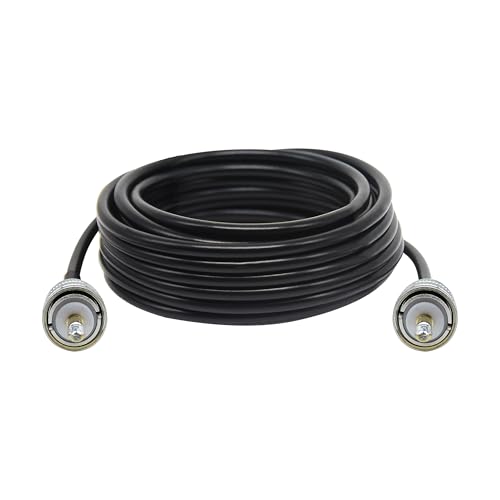
The Rydocyee coax uses 100% pure copper for both the center conductor and the braided shield, plus an aluminum foil layer for double shielding. Pure copper is more conductive than copper-clad aluminum, which helps offset the inherent higher loss of RG58 compared to RG8X. For an 18-foot CB run, the loss difference versus RG8X is small but measurable.
The PL-259 connectors have nickel-plated brass bodies and gold-plated center pins. The PE insulation and PVC jacket provide basic environmental protection. One user specifically bought this for an SWR meter and appreciated the flexible 2-foot length option — the cable is supple and easy to position. Multiple long-term users reported it working well with no degradation after months of use.
The main limitation is that RG58 has a thinner center conductor than RG8X. At 18 feet, this cable will work fine for standard 4-watt CB operation, but if you plan to run an amplifier or extend the run further, the loss becomes more significant.
Why it’s great
- 100% pure copper conductor and braid for maximum conductivity at a budget price
- Very flexible cable makes routing and positioning easy in tight spaces
Good to know
- RG58 gauge means higher loss than RG8X on runs over 12 feet, especially with amplifiers
7. Astatic 302-10267 Gray 18 Foot Mini 8 Coaxial Cable
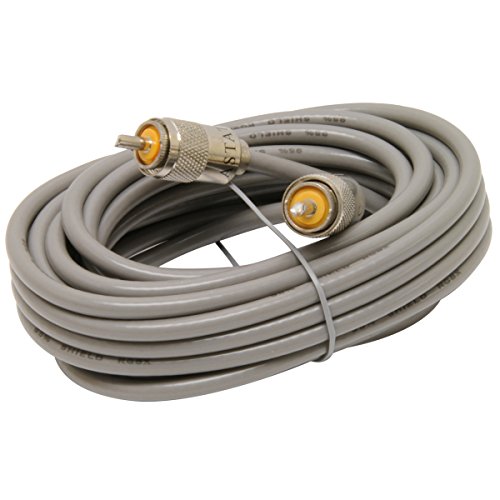
The Astatic Mini-8 cable is a no-frills entry-point into CB coax. It uses 95% shielding and features 4-point molded weather-resistant boots at both PL-259 connectors — a solid moisture barrier for outdoor antenna mounts. The gray jacket is standard Mini-8 thickness, which balances flexibility with lower loss than RG58.
The cable comes pre-assembled with two soldered PL-259 connectors for plug-to-plug installation. Users reported good basic performance: solid SWR readings out of the box. The Astatic brand has a long history in CB accessories, and the cable matches the quality of their microphones. One user mentioned the cable measured 18 feet 4 inches instead of the expected 18 feet 8 inches, which matters if your run is already tight.
This cable is adequate for a basic CB setup but lacks the double shielding and thicker conductor of RG8X options. One user with an MFJ-259 CM meter measured R=35 and X=9 instead of the ideal R=0 and X=0, suggesting some impedance mismatch at certain frequencies. For critical installations, the premium options above are a safer bet.
Why it’s great
- Molded 4-point weather boots provide good basic moisture protection at the connectors
- Soldered PL-259 connectors are ready to use out of the package with no assembly
Good to know
- Impedance mismatch has been reported by users with antenna analyzers
FAQ
Can I use a 75-ohm TV coax cable for my CB radio?
Does a longer coax cable always mean more signal loss?
What does the shielding percentage mean for a CB coax cable?
Final Thoughts: The Verdict
For most users, the best cb radio coax cable winner is the XRDS KMR 400 18FT because its ultra-low loss KMR400 construction delivers near-zero power drop and permanent weather-proof clamp connectors. If you want the best balance of low loss and flexible routing for mobile use, grab the G-PLUG 15FT RG8X. And for a tight-budget build that still outperforms basic RG58, nothing beats the Ullnosoo 18ft RG8x.