
A multimeter that only shows resting voltage tells you a battery is alive — it cannot tell you whether that battery will crank an engine on a freezing morning. The real diagnostic gap is between a surface reading and a conductance-based health assessment, and that is exactly where a dedicated automotive voltage meter earns its place in your toolbox. Without load testing or internal resistance analysis, a simple voltage check is just a guess.
I’m Min — the co-founder and writer behind Gadgets Feed. I’ve logged hundreds of hours cross-referencing datasheets, interpreting real customer test results, and weighing the trade-offs between budget-focused readers and advanced conductance algorithms to build this guide around real-world diagnostics, not marketing claims.
Whether you need a quick pass/fail on a dying alternator or a precise CCA reading to preempt a winter breakdown, this guide to the best automotive voltage meter breaks down the only specs that actually matter for keeping your vehicle on the road.
How To Choose The Best Automotive Voltage Meter
Picking the wrong voltage meter means you will chase phantom parasitic drains or miss a failing battery until it leaves you stranded. The key is understanding that modern vehicles demand more than a simple voltage readout — they require a tool that can measure internal resistance, evaluate starting system performance, and accurately assess battery capacity under real electrical load.
Understand Conductance vs. Load Testing
An analog load tester physically draws a high current (often 100A or more) to stress the battery. It is brutally honest but generates heat and must be used in short bursts. A conductance-based digital tester sends a small AC signal through the battery and calculates internal resistance — it is safer for sensitive electronics, faster, and gives you SOH and SOC without draining the battery. For most modern cars, conductance is the smarter, cleaner approach.
Review the CCA and Voltage Range
A good automotive voltage meter should cover at least 100–1200 CCA to handle everything from a small motorcycle battery to a heavy-duty diesel truck. The operating voltage range matters too — a 12V-only tool is fine for most cars, but if you work on older 6V systems or large 24V commercial rigs, expandable range becomes essential. Always confirm the minimum and maximum voltage the unit can measure before you buy.
Check Display Quality and Interface
A backlit LCD that is readable in direct sunlight or under a dark hood saves you from constant squinting. Color screens improve readability of graphical waveforms, but they can wash out in bright conditions. Look for a tester with a clear, large font and intuitive navigation — if you have to dig through a manual to run a basic test, the interface is failing you.
Quick Comparison
On smaller screens, swipe sideways to see the full table.
| Model | Category | Best For | Key Spec | Amazon |
|---|---|---|---|---|
| KONNWEI KW600 | Premium Digital | Full diagnostics with waveform | 2.4″ color screen, 100-2000 CCA | Amazon |
| Clore SOLAR BA9 | Premium Digital | Quick conductance check | 4-line LCD, 40-1200 CCA | Amazon |
| Klein Tools MM420 | Premium Multimeter | Versatile electrical troubleshooting | True RMS, 600V AC/DC, 50 MOhms | Amazon |
| Battery Tender Load Tester | Mid-Range Analog | Heavy-duty load testing | 100A load (12V), 50A load (6V) | Amazon |
| ES Peak DVA Adapter 640 | Mid-Range Specialty | CDI and stator diagnostics | Peak voltage capture adapter | Amazon |
| OBDResource BR502 | Budget Digital | Entry-level battery health check | 1.8″ screen, 100-2000 CCA | Amazon |
| Gardner Bender GMT-318 | Budget Analog | Basic voltage and continuity | Analog display, 500V AC/DC | Amazon |
In‑Depth Reviews
1. KONNWEI KW600 Car Battery Tester

The KONNWEI KW600 is the only unit on this list that pairs a 2.4-inch intelligent color screen with a waveform graph of real-time voltage, giving you oscilloscope-like insight into starter motor draw and charging ripple. It calculates SOH, SOC, internal resistance in milliohms, and CCA across a 100-2000 CCA range, covering everything from a lawn tractor to a diesel pickup. The STM-32 main chip processes each test in about two seconds.
Users consistently report >99% correlation with professional diagnostic gear, catching failing AGM batteries in modern hybrids and identifying 2% SOH UPS batteries that simple voltmeters would miss. The firmware is updateable via the included Mini-USB cable, which extends its relevance as battery chemistries evolve. The bright screen is its single weak point in direct sunlight, but the data density justifies the trade-off.
If you are serious about preemptive battery replacement and want to see the actual waveform of your starting system under load, this is the diagnostic tool that eliminates guesswork. It is the most complete single-device solution for the DIY mechanic who treats battery health as data, not intuition.
Why it’s great
- Color screen with waveform display for starter/alternator analysis.
- Measures internal resistance and SOH with high accuracy.
- Firmware updateable via USB.
Good to know
- Screen can be hard to read in direct sunlight.
- User must input CCA rating manually for each test.
2. Clore Automotive SOLAR BA9

The Clore SOLAR BA9 uses conductance testing to evaluate a battery’s true CCA capacity without applying a heavy thermal load. Its 40-1200 CCA range covers most automotive SLA, AGM, spiral-wound, and gel cell batteries, and it works across a 7-15V operating window. The four-line LCD is readable in direct sun — a practical advantage over single-line LED alternatives in the same family.
Real-world user data shows this unit detected a failing 750 CCA battery at 695 CCA in a 2020 vehicle well before the driver noticed slow cranking. It displays resting voltage, measured CCA, SOH, SOC, starting voltage drop, and charging system voltage in a single quick test sequence. The unit is lightweight at 9.6 ounces and requires no internal battery to operate; it draws power directly from the battery under test.
For the mechanic who needs a fast, repeatable pass/fail assessment without decoding complex graphs, the BA9 delivers professional-grade conductance analysis in a simple, no-nonsense package. The base-level CCA floor of 40 makes it genuinely compatible with smaller batteries that other testers cannot read.
Why it’s great
- Conductance testing is safe, fast, and repeatable.
- Covers batteries as low as 40 CCA.
- Displays SOH, SOC, starting, and charging data in one run.
Good to know
- Small manual text is hard to read in the field.
- No data logging or waveform output.
3. Klein Tools MM420 Digital Multimeter
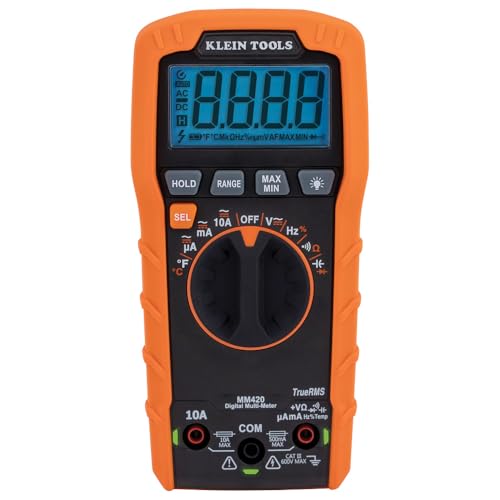
While not a dedicated automotive battery tester, the Klein MM420 is the most versatile electrical diagnostic tool in this roundup. It measures AC/DC voltage up to 600V, AC/DC current to 10A, resistance up to 50 MOhms, plus temperature, capacitance, frequency, and diode continuity. Its auto-ranging True RMS circuitry delivers accurate readings on non-sinusoidal waveforms — essential for modern vehicle electronics.
The MM420 includes a pair of LEDs on the meter face that confirm correct test lead placement, reducing the risk of error when probing live circuits. It can survive a 6.6-foot drop onto concrete, and the backlit LCD is crisp in low-light conditions. Users have reported using it to diagnose an EGO lawn mower controller, trace intermittent shorts in truck trailer wiring, and measure charging system ripple.
If your needs extend beyond battery voltage into full electrical system diagnosis — including parasitic drain hunting, sensor testing, and ground loop verification — this multimeter replaces an entire drawer of single-purpose tools. It is the right choice for the comprehensive troubleshooter who values drop durability and measurement breadth.
Why it’s great
- True RMS ensures accurate AC readings on modern electronics.
- Lead-Alert LED indicators prevent probe placement errors.
- Drop-rated to 6.6 feet with a rugged housing.
Good to know
- Not a dedicated battery conductance tester; no SOH/SOC display.
- Form factor is larger than dedicated battery testers.
4. Battery Tender Load Tester 026-0020
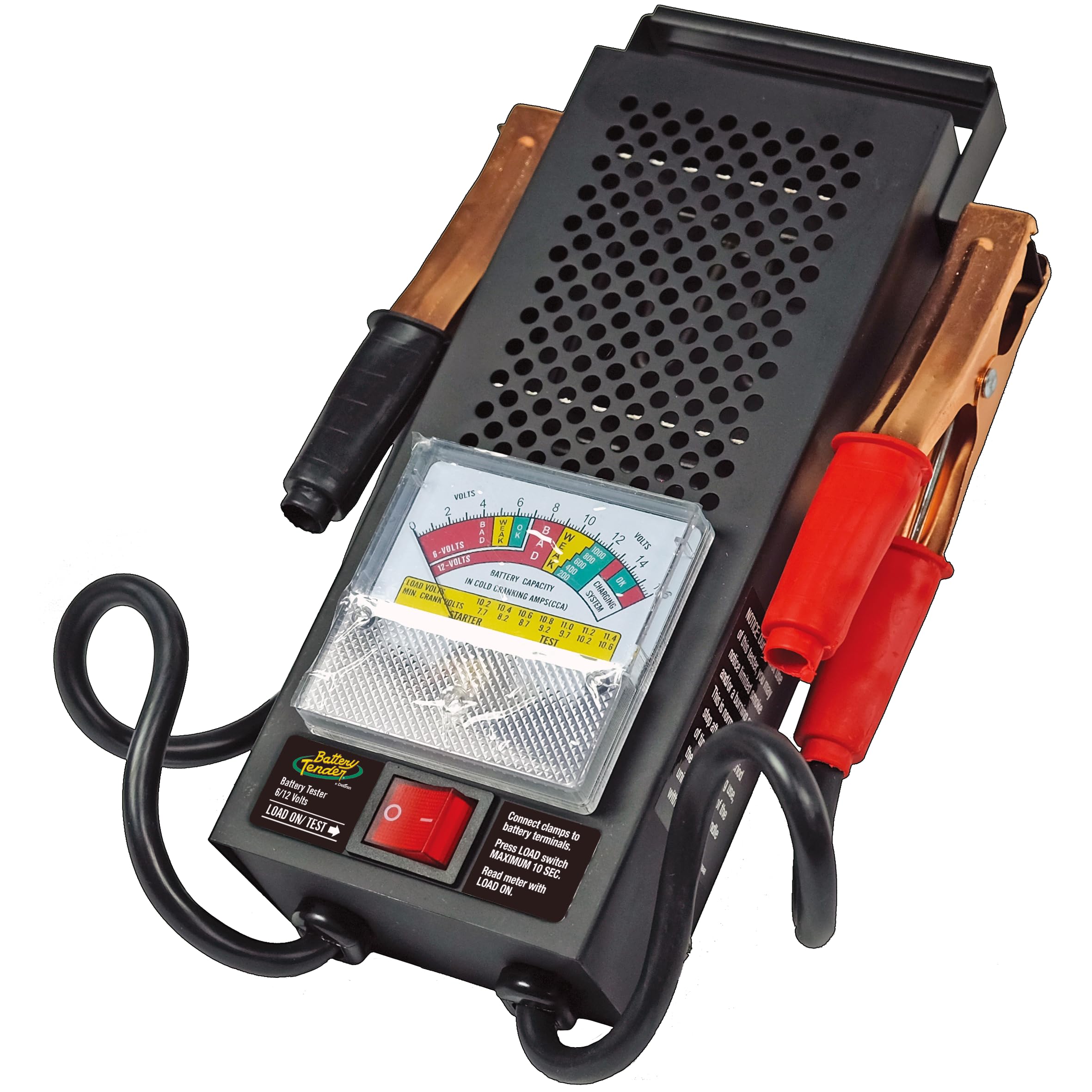
The Battery Tender Load Tester is a pure analog instrument that applies a real 100-amp load to 12V batteries or a 50-amp load to 6V batteries. There is no conductance algorithm or software interpretation — the needle on the color-coded gauge directly reflects the battery’s physical ability to sustain current under stress. This is the tool you reach for when you want to burn off surface charge and see a true voltage sag.
The rubber-insulated handle and heavy-duty color-coded alligator clamps are built for repeated under-hood use, and the single toggle switch keeps operation simple. Users report that it reliably identified a failing battery that a digital conductance tester called “good,” simply because the battery could not hold load. It also doubles as a starter draw test tool when you watch the needle drop during cranking.
This is the right tool for anyone working with older vehicles, deep-cycle batteries, or situations where you need to physically stress the battery to expose a weak cell. Just remember to follow the run/cool duty cycle to avoid overheating the internal coil.
Why it’s great
- True 100A resistive load reveals weak cells conductance testers can miss.
- Color-coded analog gauge is instantly readable.
- Heavy-duty clamps and insulated handle for safe use.
Good to know
- Must observe duty cycle to prevent coil burnout.
- No digital readout for precise voltage logging.
5. Electronic Specialties Peak DVA Adapter 640

The Electronic Specialties 640 is not a standalone meter — it is a DVA (Digital Volt Adapter) that converts your existing digital multimeter into a peak-reading voltmeter for capacitive discharge ignition systems. This is the specific tool you need to test stators, CDI boxes, and trigger coils on 2-stroke outboards, motorcycles, and small engines where conventional DC voltage readings will not capture the high-voltage pulses.
The adapter includes high-quality test leads with screw-on/off alligator clips and is built entirely in the USA. It captures peak voltage during cranking and running conditions, giving you dynamic data that bench resistance checks cannot provide. Users report using it to accurately diagnose a failing CDI on a Mercury outboard where the stator resistance spec was within range but the output voltage under load was far below spec.
If you work on power sports or marine engines with CDI ignitions, this adapter is the missing link between your multimeter and a functional ignition diagnosis. It occupies a narrow niche, but within that niche, it is irreplaceable.
Why it’s great
- Enables peak voltage capture for CDI ignition systems.
- High-quality leads with secure alligator clips.
- Compact redesign is half the size of previous version.
Good to know
- Requires a separate digital multimeter to function.
- Applicable only to CDI/stator testing.
6. OBDResource BR502 Car Battery Tester

The OBDResource BR502 is a 1.8-inch digital conductance tester that covers 6V, 12V, and 24V systems with a CCA range of 100-2000 and a capacity range of 2Ah-220Ah. It tests SOH, SOC, internal resistance, and voltage, then issues a plain-language recommendation — Good, Normal, or Poor — making it genuinely beginner-friendly. The polarity reverse protection prevents damage if you connect the clamps backward.
Customer reports confirm that this unit accurately flagged a battery with acceptable voltage but degraded CCA output, prompting a replacement before a winter failure. The test takes under two seconds, and the unit is self-powered by the battery under test. The 100 CCA floor means it cannot test very small UPS or lawnmower batteries, but for standard automotive use, it performs well above its cost tier.
This is the ideal entry point for a driver who wants real battery health data — not just voltage — without spending premium-tier money. The simple interface and broad vehicle compatibility make it a strong candidate for glove-box storage in every household car.
Why it’s great
- Tests 6V, 12V, and 24V systems.
- Plain-language results are easy for beginners to interpret.
- Reverse polarity protection prevents user error damage.
Good to know
- 100 CCA minimum excludes very small batteries.
- Accuracy is rated at ~99.6%, not lab-grade precision.
7. Gardner Bender GMT-318 Analog Multimeter
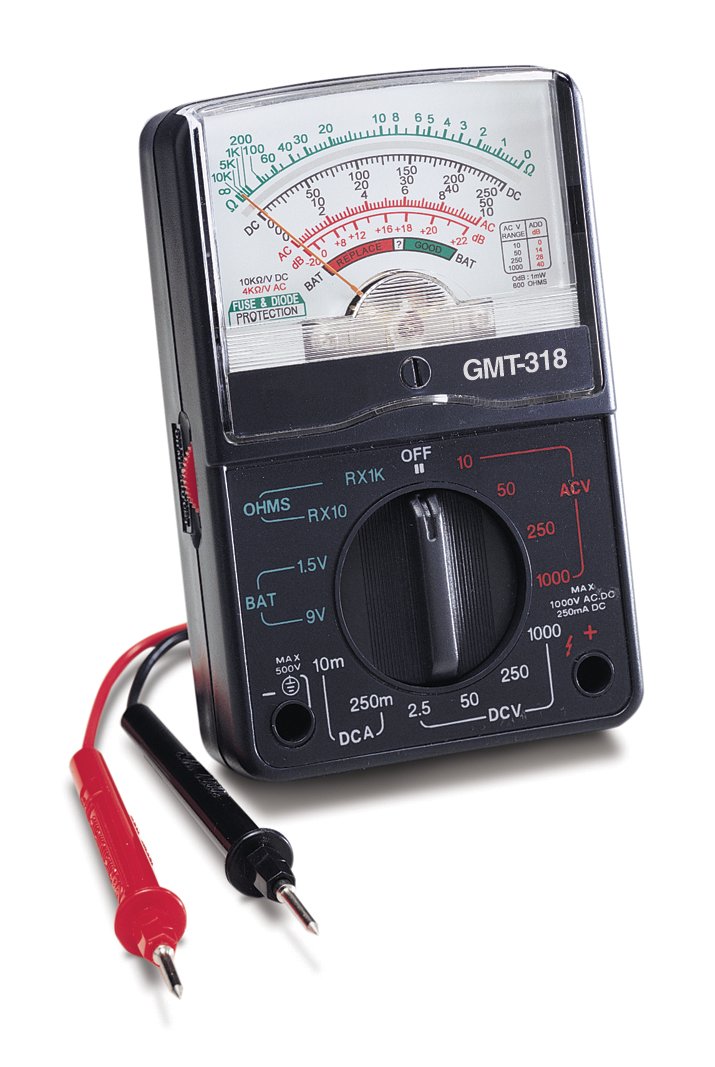
The Gardner Bender GMT-318 is a traditional analog multimeter with 6 functions across 14 ranges, measuring AC and DC voltage up to 500V, DC current, resistance, and battery testing. Its analog needle is less prone to the aliasing and noise artifacts that cheap digital meters display on variable-frequency signals, making it a legitimate tool for basic circuit diagnosis where signal shape is uncertain.
The unit is agency-approved with fuse overload protection, and users consistently praise its compact dimensions (4.25 x 2.75 x 1.25 inches) for tossing into a truck toolbox or glove compartment. The manual includes a known error in the continuity test section (it incorrectly suggests testing continuity with power on), so experienced users should rely on standard electrical safety practices. The battery compartment is tight and may not accommodate rechargeable AA cells without modifying the positive terminal.
This meter excels as a cheap, reliable backup for voltage checks and continuity tracing on non-sensitive circuits. It will not replace a conductance-based battery tester or a high-end digital multimeter, but for occasional voltage verification, it gets the job done at a minimal investment.
Why it’s great
- Analog needle avoids digital noise on dirty signals.
- Compact size fits easily in glove box or tool roll.
- Fuse overload protection for basic safety.
Good to know
- Manual contains an error about continuity testing with power on.
- Battery compartment is too tight for many rechargeable AAs.
FAQ
Can I use a standard multimeter to test battery health?
What is the difference between a conductance tester and a load tester?
What does SOH and SOC mean on a battery tester display?
Final Thoughts: The Verdict
For most users, the best automotive voltage meter winner is the KONNWEI KW600 because it combines a color waveform display, high CCA range, internal resistance measurement, and SOH/SOC tracking in one upgradeable device. If you want a fuss-free conductance check with professional-grade accuracy, grab the Clore SOLAR BA9. And for full electrical system diagnosis beyond the battery, nothing beats the Klein Tools MM420.