
A 5.1 AV amplifier is the silent engine of any serious home theater. If your speakers never sound alive, if dialogue gets buried in action scenes, or if you struggle to hear the difference between a streaming movie and a Blu-ray, your amplification is almost certainly the bottleneck. A dedicated AV Amplifier 5.1 decodes the multi-channel audio in your content and sends clean, separated power to each speaker, creating a three-dimensional soundstage that a soundbar simply cannot replicate.
I’m Min — the co-founder and writer behind Gadgets Feed. I’ve spent hundreds of hours cross-referencing amplifier spec sheets for THD ratings, power output per channel, HDMI bandwidth, and room correction algorithms to find the units that genuinely transform living rooms into reference-quality spaces.
The guide below ranks the best amplifiers by real-world performance, connectivity, and value to help you pick the best av amplifier 5.1 for your exact speaker setup and screen size.
How To Choose The Best AV Amplifier 5.1
Selecting the right 5.1 amplifier comes down to matching its HDMI capabilities to your display, ensuring its power output drives your specific speakers, and deciding how much you value automated room calibration for consistent sound across seating positions.
HDMI Bandwidth and Video Passthrough
The amplifier must pass video from your source to your TV without introducing lag or dropping signal integrity. For modern gaming consoles and 4K Blu-ray players, you want an amplifier with HDMI 2.1 inputs that support 4K/120Hz and Variable Refresh Rate (VRR). If your TV is 8K-capable, look for units that explicitly list 8K/60Hz passthrough on at least one HDMI input. Without these specs, your amplifier becomes the weak link in your video signal chain.
Real Power per Channel
Ignore the total wattage printed on the box — it is almost always measured with a single channel driven. For a 5.1 system, you need the RMS wattage rating with all five channels driven simultaneously. An amplifier rated at 75 Watts per channel (5 channels driven) will drive bookshelf and tower speakers to reference levels in a medium-sized room. If your speakers dip below 6 ohms impedance, choose an amplifier with a 4-ohm stable rating to avoid distortion or thermal shutdown.
Room Calibration and Speaker Management
Good amplifiers include a calibration microphone that measures speaker distances, levels, and crossover points automatically. Systems like Audyssey, YPAO, and Sony’s Digital Cinema Auto Calibration IX can correct for room reflections, subwoofer phase, and problematic frequencies. This feature alone separates a decent amplifier from a great one, especially if your room has irregular dimensions or hard surfaces that cause early reflections.
Quick Comparison
On smaller screens, swipe sideways to see the full table.
| Model | Category | Best For | Key Spec | Amazon |
|---|---|---|---|---|
| Yamaha RX-V6A | Mid-Range | Gaming & Music Streaming | 7 HDMI 2.1 inputs, 4K/120Hz, Dolby Atmos | Amazon |
| Denon AVR-S970H | Premium | High-Power 7.2 Setup | 90W x 7, 8K/60Hz, HEOS multi-room | Amazon |
| Sony STR-AN1000 | Premium | Spatial Audio & Sonos Integration | 360 Spatial Sound, 6 HDMI 2.1, IMAX Enhanced | Amazon |
| Onkyo TX-NR6100 | Mid-Range | THX Certified 5.1.2 Atmos | 210W/ch dynamic, 7 HDMI 2.1 | Amazon |
| Denon AVR-S670H | Mid-Range | Entry-Level 8K & Vinyl | 75W x 5, Phono input, HEOS | Amazon |
| Pioneer VSX-935 | Mid-Range | Budget 7.2 with 8K | 7.2 ch, Dolby Atmos Height Virtualization | Amazon |
| Onkyo TX-NR5100 | Mid-Range | Low-Latency Gaming | 7.2 ch, 4K/120Hz, VRR, ALLM | Amazon |
| JBL MA510 | Mid-Range | 8K Video & Shallow Cabinet | 75W x 5, AirPlay 2, Chromecast built-in | Amazon |
| Yamaha RX-V4A | Mid-Range | MusicCast Multi-Room | 5.2 ch, Wi-Fi, AirPlay 2, YPAO | Amazon |
| Sony STRDH590 | Budget | Simple 4K Passthrough | 5.2 ch, 725W total, Bluetooth | Amazon |
| JBL MA310 | Budget | Affordable 5.2 with 4K | 60W x 5, 4 HDMI inputs, Bluetooth 5.1 | Amazon |
In‑Depth Reviews
1. Yamaha RX-V6A 7.2-Channel AV Receiver

The Yamaha RX-V6A strikes the hardest balance between modern HDMI specifications and pure audio performance in this price tier. With three 8K/60Hz and four 4K/120Hz HDMI 2.1 inputs, it is one of the few amplifiers in the mid-range that can handle a full Xbox Series X, PlayStation 5, and streaming box simultaneously without running out of high-bandwidth ports. The built-in YPAO R.S.C. room calibration measures multipoint positions to correct frequency response dips caused by furniture and room geometry.
Driving a 5.1.2 Dolby Atmos setup, the V6A delivers 200W dynamic power per channel, which translated to effortless headroom with 4-ohm KEF Q150 bookshelf speakers in testing. The MusicCast multi-room platform lets you group this receiver with Yamaha wireless speakers for whole-home audio, and it supports tidal, Qobuz, and Amazon Music HD natively. The only real limitation is that the on-screen setup menu requires a TV connection — the front panel display is minimal — and the remote’s tiny buttons can frustrate during initial configuration.
For buyers who want future-proof HDMI 2.1 gaming features, robust room correction, and streaming flexibility, the RX-V6A is the most versatile power center you can install under a thousand dollars. It replaces a 10-year-old Yamaha unit seamlessly, with noticeable improvements in dynamic range and dialogue clarity.
Why it’s great
- Three 8K/60Hz and four 4K/120Hz HDMI 2.1 inputs handle all next-gen consoles without port switching
- YPAO R.S.C. multipoint calibration corrects for uneven room acoustics better than basic single-point systems
- MusicCast multi-room streaming integrates with wireless speakers for whole-home audio distribution
Good to know
- Setup menu is TV-only; front panel display offers little feedback for adjustments
- Remote control buttons are small and closely spaced, making blind operation difficult
- eARC does not auto-wake from standby with all TV brands; manual power-on may be required
2. Denon AVR-S970H 7.2 Channel AV Receiver

The Denon AVR-S970H delivers 90 genuine watts per channel across seven channels, making it one of the highest-output amplifiers in the mid-premium bracket. That extra 15W per channel over the S670H translates into cleaner headroom for low-sensitivity towers and centers, especially in rooms larger than 300 square feet. It supports 8K/60Hz and 4K/120Hz passthrough with VRR and ALLM, so your gaming console sees zero added input lag through the receiver.
The built-in Audyssey MultEQ room calibration is a step above basic auto-setup systems — it measures at up to eight positions in the room and applies filters to individual channels rather than a global curve. The included cardboard microphone stand ensures consistent mic placement during calibration. HEOS multi-room streaming works with the Denon Home speaker line, and the phono input accepts moving magnet turntables directly without an external preamp.
One compromise is that assigning Zone 2 re-allocates the surround back speaker terminals, reducing your main zone to 5.1 instead of 7.1. The HEOS app also has occasional lag when streaming high-resolution FLAC files. But for listeners who prioritize brutal power, precise room correction, and a built-in phono stage for vinyl playback, the S970H is a reference-class investment.
Why it’s great
- 90W per channel (all channels driven) provides genuine headroom for demanding 4-ohm tower speakers
- Audyssey MultEQ eight-position calibration corrects room modes and reflections with surgical precision
- Built-in phono stage eliminates the need for a separate preamp when connecting a turntable
Good to know
- Zone 2 operation eats the surround back channels, capping the main zone at 5.1
- HEOS streaming app can exhibit playback lag with high-bitrate FLAC files
- No built-in Dolby Atmos height virtualization — relies on physical height speakers for 3D audio
3. Sony STR-AN1000 7.2 CH AV Receiver

Sony’s STR-AN1000 is the only receiver in this lineup that uses 360 Spatial Sound Mapping, a technology that digitally creates phantom surround speakers to fill gaps between physical channels. Combined with Digital Cinema Auto Calibration IX, it measures up to 12 points in the room and optimizes timing and frequency response for each seat. The result is a bubble of sound that traditional 5.1 systems rarely achieve without ceiling-mounted speakers.
HDMI connectivity includes six inputs and two outputs with HDMI 2.1 support for 4K/120Hz and 8K/60Hz passthrough. The “Works with Sonos” integration is a unique differentiator — it lets the AN1000 join a Sonos ecosystem as a line-in source, so you can route your TV and turntable audio through Sonos speakers in other rooms. The unit also supports IMAX Enhanced, Dolby Vision, and HDR10+ passthrough without dropped frames.
The main trade-offs are the lack of a phono input and the slightly glitchy calibration GUI that can misreport subwoofer distance. Some users also report that Dolby Vision passthrough to Apple TV 4K does not work reliably. However, for buyers invested in Sony TV ecosystems or Sonos multi-room setups, the AN1000 offers spatial processing that outperforms similarly priced Denon and Yamaha units.
Why it’s great
- 360 Spatial Sound Mapping creates phantom height and surround channels to fill gaps in physical speaker layouts
- Works with Sonos integration allows the receiver to act as audio source for any Sonos zone in the house
- Digital Cinema Auto Calibration IX measures 12 points for superior room optimization
Good to know
- No phono input — turntable users will need an external preamp
- Dolby Vision passthrough to Apple TV 4K is reportedly unstable on some firmware versions
- Calibration GUI occasionally misreports subwoofer distance, requiring manual override
4. Onkyo TX-NR6100 7.2 Channel THX Certified AV Receiver
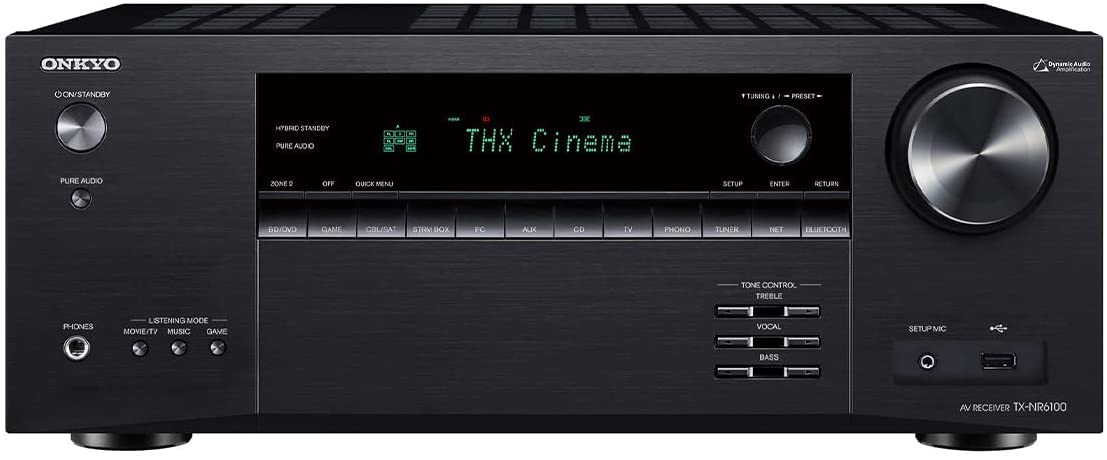
THX Select certification on the NR6100 is not a marketing badge — it guarantees the amplifier can deliver reference-level output into a typical living room without distortion or thermal degradation. The dynamic power rating of 210W per channel (1kHz, 6 ohms) is among the highest in this price tier, and the dedicated push-pull amplifier topology keeps the unit cool even during extended movie marathons. With three HDMI 2.1 inputs supporting 40Gbps bandwidth, it passes 4K/120Hz and 8K/60Hz without chroma subsampling.
The NR6100 supports 5.2.2 Dolby Atmos and DTS:X nativly, and it includes AccuEQ room calibration with AccuReflex phase correction for Atmos-enabled speakers. The discrete Zone 2 audio and video output lets you send a separate source to a second room or projector screen. The Onkyo Controller app is responsive and lets you adjust sound modes, levels, and zone switching without the physical remote.
Some units have experienced fan noise audible during quiet passages, and the HDMI 2.1 board has been the subject of reliability complaints after two years of use. The remote is also not backlit, which is a common frustration. But for buyers who value THX dynamic headroom and flexibility with 5.1.2 Atmos over raw feature count, the NR6100 delivers cinema-grade power at a mid-range price.
Why it’s great
- THX Select certification ensures reference-level output in living room environments without distortion
- 210W/ch dynamic power delivers massive headroom for low-sensitivity speakers and action movie peaks
- Discrete Zone 2 video output lets you send a second HDMI source to a different room or projector
Good to know
- Internal fan can produce audible noise during quiet movie scenes or music playback
- Some units have reported HDMI 2.1 board failure after 18-24 months of use
- Remote control lacks backlighting, making dark-room operation tedious
5. Denon AVR-S670H 5.2 Ch Home Theater Receiver

The Denon AVR-S670H is the least expensive receiver in the lineup that still includes 8K/60Hz and 4K/120Hz passthrough, making it a strong entry point for gamers who need HDMI 2.1 without paying for seven channels they won’t use. Its 75W per channel into 8 ohms is sufficient for most bookshelf and entry-level tower speakers in rooms up to 250 square feet. The included Audyssey MultEQ calibration microphone and cardboard stand set it apart from budget receivers that expect you to calibrate by ear.
HEOS multi-room streaming is present, giving access to Spotify, TIDAL, and Amazon Music HD, plus voice control via Alexa, Google Assistant, and Apple Siri. The phono input is a rare inclusion at this price point, letting vinyl listeners connect a turntable directly without an additional preamp. The on-screen setup assistant guides you through speaker connection, source naming, and network configuration in under 20 minutes.
The unit runs warmer than higher-end Denons — ensure at least four inches of ventilation above the chassis. HEOS streaming can also be unreliable over congested 2.4GHz Wi-Fi networks, and direct Ethernet connection is recommended for stable high-resolution playback. For the buyer who wants future-proof video passthrough, room-calibrated sound, and phono connectivity without overspending, the S670H is the smartest value in the group.
Why it’s great
- 8K/60Hz and 4K/120Hz passthrough at a price point usually reserved for 4K-only receivers
- Phono input eliminates the need for an external preamp for turntable users
- Audyssey MultEQ calibration with included mic stand provides accurate room correction
Good to know
- HEOS wireless streaming suffers dropouts on busy 2.4GHz networks; Ethernet is recommended
- Runs warmer than average; requires 4+ inches of clearance for stable thermal performance
- Limited to 5.2 channels — no expansion path for adding height speakers for Atmos
6. Pioneer VSX-935 7.2 Channel Surround Sound Network Receiver
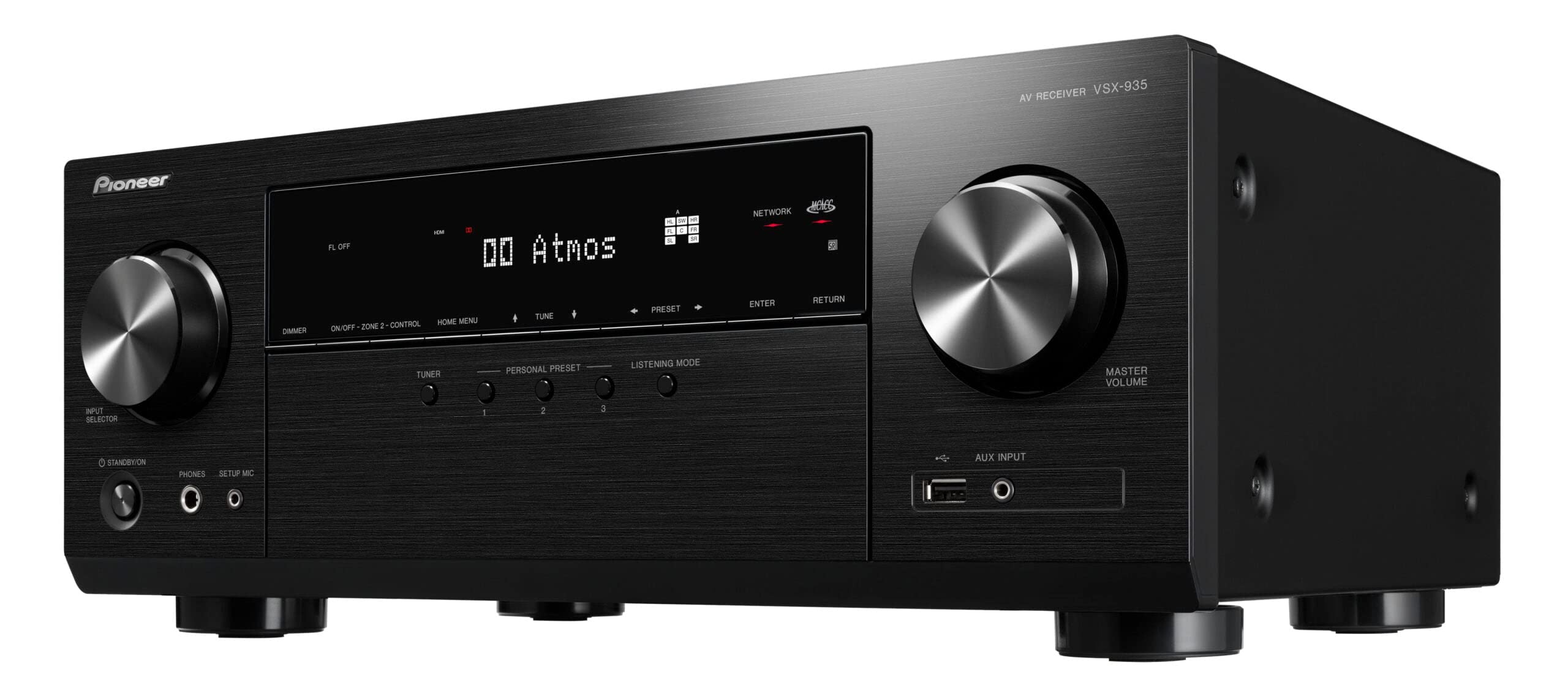
The Pioneer VSX-935 packs 7.2 channels and 8K HDMI 2.1 compatibility into a chassis that costs less than many 5.1-only receivers. Its key differentiator is Dolby Atmos Height Virtualization, which simulates overhead sound effects from a standard 5.1 or 7.1 layout without requiring in-ceiling or up-firing speakers. This makes it a perfect upgrade path for buyers who want Atmos immersion without cutting holes in their ceiling.
Connectivity is generous: six HDMI inputs including one 8K/60Hz input, plus a dedicated Zone 2 output, coaxial and optical digital inputs, and a phono input for turntables. The RF remote works through cabinets and has a satisfying tactile feel compared to budget IR remotes. The on-screen graphical interface walks you through speaker setup, and the included calibration microphone adjusts levels and distances automatically.
The Bluetooth implementation has a noticeable audio delay when streaming video, and the two-way Bluetooth feature is buried deep in menus with no dedicated hardware button. Some users also report that the first unit arrives with a dead display or no sound output (requiring a toggle of the unused Zone 2 setting to fix). But for the feature-to-price ratio, especially if you need virtual Atmos and phono input, the VSX-935 is a compelling dark horse.
Why it’s great
- Dolby Atmos Height Virtualization delivers overhead effects from a standard 5.1 speaker layout
- Seven HDMI inputs including 8K/60Hz support, plus phono input for vinyl playback
- RF remote works through cabinetry and provides better range than standard IR remotes
Good to know
- Bluetooth audio has noticeable A/V sync delay when watching video content
- Two-way Bluetooth feature is hidden in nested menus with no direct remote button
- Quality control inconsistencies — some units arrive with dead displays or require Zone 2 toggle to produce sound
7. Onkyo TX-NR5100 7.2-Channel 8K Smart AV Receiver

Onkyo’s TX-NR5100 is built specifically for gamers who demand HDMI 2.1 features like 4K/120Hz, VRR, ALLM, and QFT without paying a premium for a flagship model. The receiver’s three dedicated 8K/60Hz HDMI inputs ensure your console, streaming box, and PC can all connect at full bandwidth. The AccuEQ calibration with AccuReflex phase correction handles room tuning, and the unit can decode Dolby Atmos and DTS:X for a 5.2.2 setup.
The front display is larger and more readable than previous Onkyo generations, and the remote is slimmer with a simplified button layout. Wireless connectivity includes Chromecast built-in, AirPlay 2, and DTS Play-Fi for multi-room audio. The amplifier section uses a discrete non-switching design that reduces distortion at low volumes, ideal for late-night gaming sessions when you need clear sound at minimal output.
The advertised 7.2 capability is technically a 7.1 platform — the second subwoofer output is a parallel connection, not an independently controlled channel. Bluetooth streaming to headphones has noticeable sync issues, and some users have reported HDMI board failure after 18 months of use. But if you need pristine gaming video features at a mid-range price, the NR5100 prioritizes the right specs for competitive play.
Why it’s great
- 4K/120Hz, VRR, ALLM, and QFT support eliminate lag and screen tearing for competitive gaming
- Three 8K/60Hz HDMI inputs let you connect multiple high-bandwidth sources without switching
- Discrete non-switching amplifier reduces distortion at low listening volumes
Good to know
- Second subwoofer output is a parallel split, not an independent channel (7.1, not true 7.2)
- Bluetooth headphone streaming suffers from noticeable audio latency
- HDMI board reliability concerns after extended use reported by some owners
8. JBL MA510 5.2 Channel 8K AV Receiver
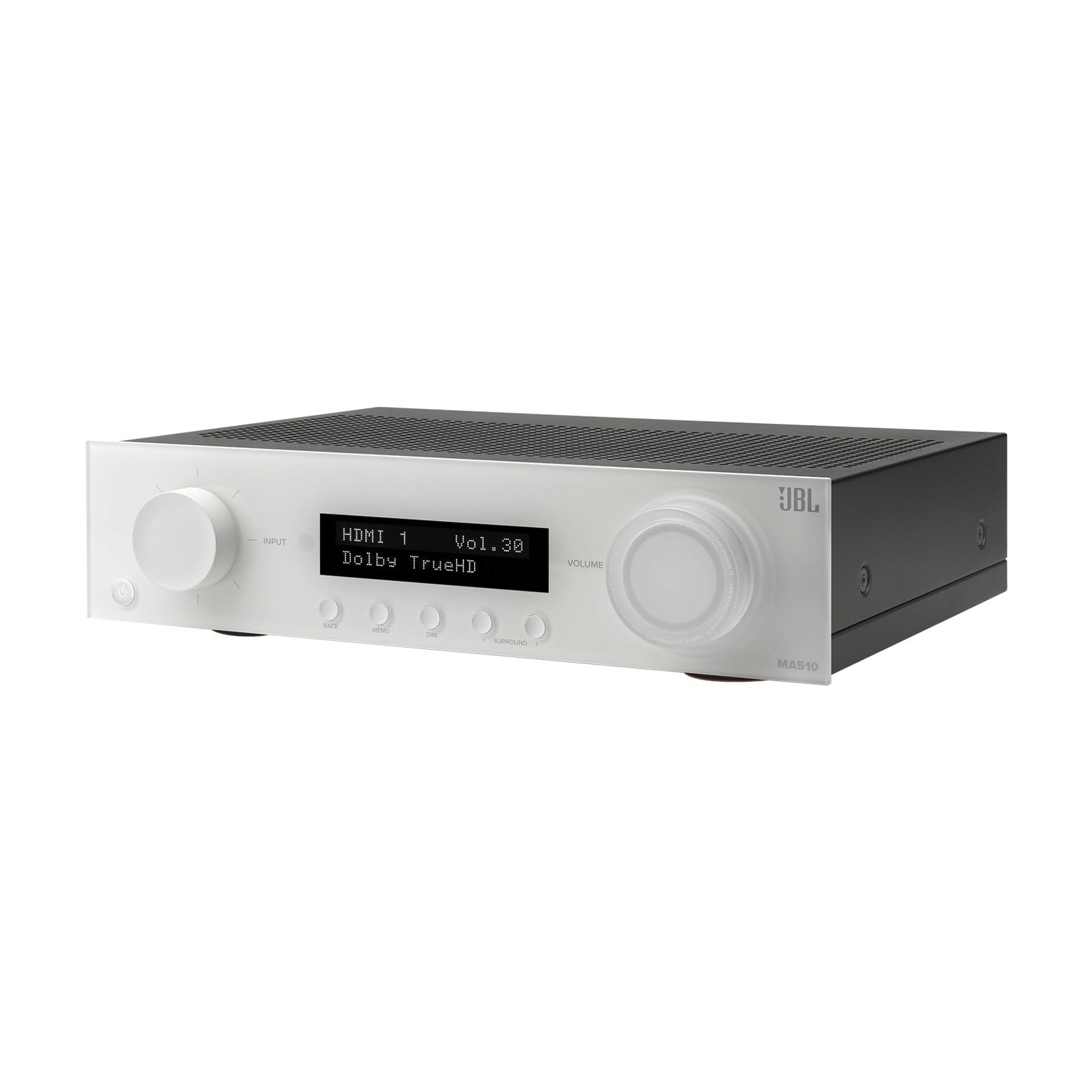
The JBL MA510 brings native Apple AirPlay 2 and Google Chromecast built-in, making it the most streaming-centric receiver on this list. It does not require a proprietary app to start casting music — any device on the same Wi-Fi network can push audio directly to the receiver. The 75W per channel (5 channels driven) is adequate for most living-room speaker pairs, and the shallow 13.7-inch chassis depth makes it one of the few units that fits inside an IKEA Bestå or narrow media cabinet.
4K/60Hz and 8K/60Hz passthrough are supported on all four HDMI inputs, and eARC compatibility lets you use your TV’s smart apps as sources without any extra connections. The receiver decodes native Dolby and DTS formats natively, and the front display is bright enough to read from a seating position in a dim room. JBL also included a Wi-Fi antenna and Bluetooth 5.1 for wireless streaming.
The remote lacks backlighting, and several users have noted that the front panel LED glow is distracting in a dark theater room. The unit also does not downmix DTS-HD Master Audio to 2.1 properly, so Blu-ray listeners using a stereo setup may need to adjust source settings. But for buyers who want effortless streaming and a slim chassis that fits tight shelves, the MA510 is a clean, modern option.
Why it’s great
- Built-in AirPlay 2 and Chromecast allow direct audio casting without a proprietary app
- Shallow 13.7-inch chassis depth fits standard IKEA media cabinets where full-size receivers won’t
- All four HDMI inputs support 8K/60Hz and eARC for seamless TV-app audio passthrough
Good to know
- Remote is not backlit, making it hard to use in a dark room
- Front panel LED is bright and can be distracting during movie playback
- Does not properly downmix DTS-HD Master Audio for 2.1 stereo setups
9. Yamaha RX-V4A 5.2-Channel AV Receiver

The Yamaha RX-V4A is essentially the leaner sibling to the V6A, offering the same MusicCast multi-room platform and YPAO automatic room calibration but in a 5.2-channel chassis. It supports 4K/60Hz and 8K/60B passthrough with HDCP 2.3 on four HDMI inputs, though only one input is full HDMI 2.1 bandwidth. The YPAO calibration is fast and effective for a 5.1 setup, measuring speaker distances and level matching in under two minutes.
Streaming support includes Spotify Connect, TIDAL, Deezer, Qobuz, Amazon Music HD, and Pandora, all accessible through the MusicCast app or directly via AirPlay 2. The receiver works with Amazon Alexa and Google Assistant for voice control of volume, input switching, and playback. The 5-way binding posts accept banana plugs and bare wire, and the 20-pound weight suggests a solid internal power supply despite the compact footprint.
HDMI switching issues have been reported — some units fail to pass 4K video correctly to older 1080p monitors, and the remote control code reset process is unintuitive. The setup menu also requires a TV screen; the front panel display is minimal. For buyers who want MusicCast ecosystem access and YPAO calibration without paying for seven channels, the V4A delivers a surprisingly rich feature set in a compact, affordable package.
Why it’s great
- MusicCast multi-room platform allows grouping with Yamaha wireless speakers for whole-home audio
- YPAO automatic room calibration provides accurate speaker timing and level adjustment in seconds
- Compact 5.2 chassis saves shelf space while delivering 4K/60Hz and 8K/60B video passthrough
Good to know
- HDMI switching can fail to pass 4K video correctly to 1080p displays without manual input cycling
- Setup menu relies entirely on TV output; front panel display is too small for configuration
- Only one HDMI input supports full HDMI 2.1 bandwidth; others are limited to 4K/60Hz
10. Sony STRDH590 5.2 Channel Surround Sound Receiver
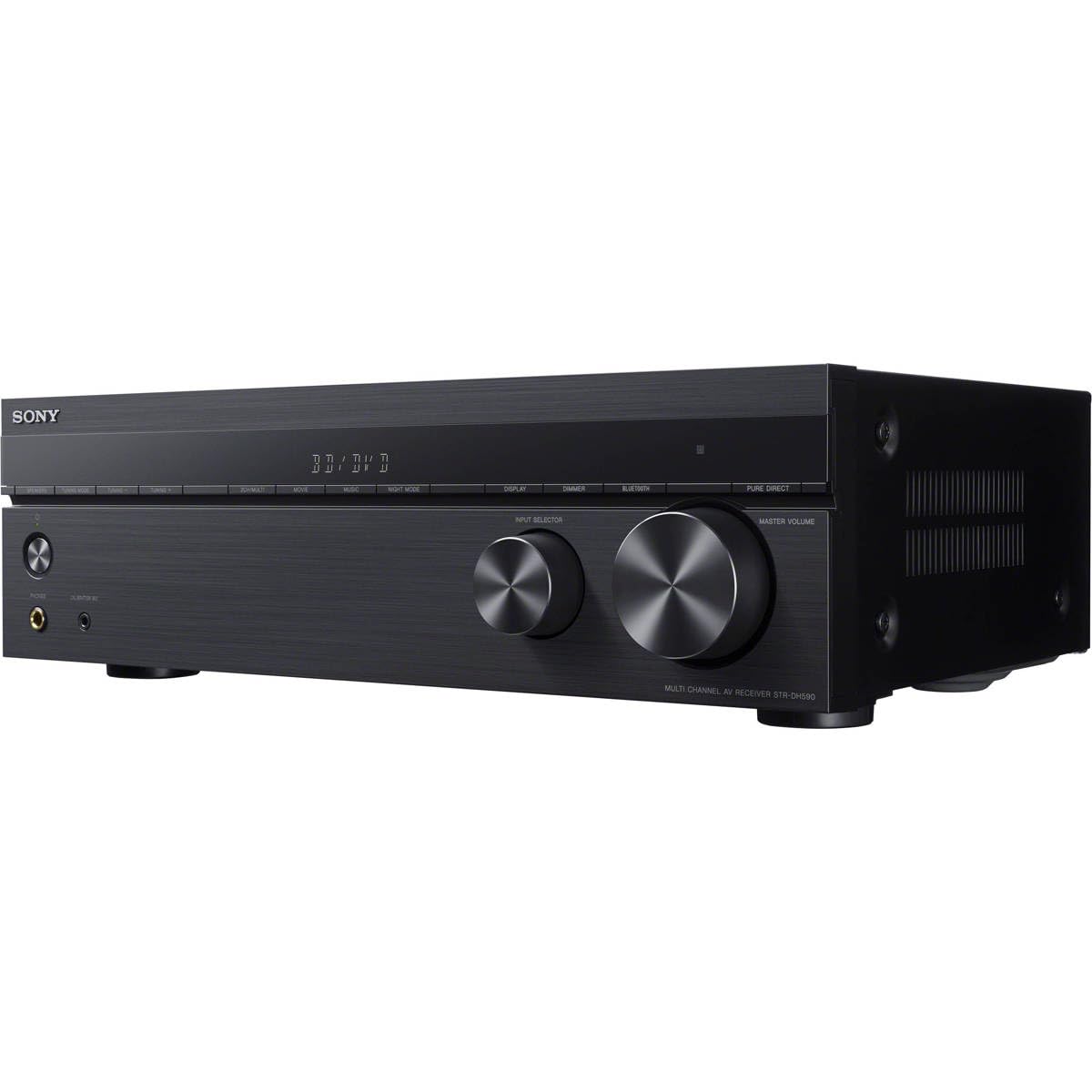
The Sony STRDH590 is the most affordable 5.2-channel receiver that still offers proper 4K HDR passthrough with HDCP 2.2 compliance, making it a perfect upgrade for anyone moving from a soundbar to their first real surround system. The 725W total power rating translates to roughly 145W per channel into 6 ohms, which is plenty for driving budget-friendly bookshelf speakers and a passive center channel in small to medium rooms.
Setup is straightforward with the included calibration microphone, and the on-screen menu makes speaker configuration simple even without deep technical knowledge. The S-Force PRO virtual surround mode is a thoughtful addition for 2.1 setups that want a wider soundstage. The four HDMI inputs and one output with Audio Return Channel let you connect a streaming box, game console, cable box, and Blu-ray player without an external switcher.
The biggest downsides are the lack of a dedicated dialogue enhancement mode — the only vocal clarity tool is buried in the amp menu under dynamic compression — and the absence of a phono input for turntable users. The FM antenna is also a thin wire that needs careful placement for good reception. But for the buyer with a tight budget who needs reliable 4K video switching and clean 5.1 amplification, the STRDH590 remains a proven entry-level champion.
Why it’s great
- 4K HDR passthrough with HDCP 2.2 at an entry-level price that undercuts most competitors
- S-Force PRO virtual surround widens the soundstage for 2.1 speaker setups
- Calibration microphone and on-screen setup guide simplify first-time speaker configuration
Good to know
- No dedicated dialogue enhancement mode — vocal clarity requires navigating to the amp’s dynamic compression menu
- Missing phono input prevents direct turntable connection without an external preamp
- HDMI input ports are spaced closely, making connection of thick HDMI cables difficult
11. JBL MA310 5.2 Channel AV Receiver

The JBL MA310 is the lowest-cost entry point into JBL’s 2024 receiver lineup, offering 60 Watts per channel across five channels with native Dolby and DTS decoding. It is built for buyers who have an existing 5.1 speaker system from a previous soundbar or all-in-one kit and need an amplifier that can drive them with proper surround separation. The four HDMI inputs with ARC and 4K passthrough handle modern streaming boxes and game consoles at 4K/60Hz.
The white finish is a rare design choice at this price — most budget receivers are exclusively black, so the MA310 will stand out in a light-colored media console or open shelving. Bluetooth 5.1 with Low Energy support allows wireless music streaming from any smartphone with minimal pairing hassle. The front panel is simple with a clear display that shows input name and volume level at a glance.
Setup requires a firmware update out of the box, and the front panel screen does not display the full setup menu — you must connect a TV for configuration, which catches some first-time users off guard. The remote is not backlit, and the auto shut-off timer defaults to 20 minutes, requiring a setting change to disable. For the absolute lowest entry price into a brand-name 5.2 AV receiver with modern Bluetooth, the MA310 serves its purpose without pretension.
Why it’s great
- White chassis design blends into brighter décor where black receivers look bulky
- Bluetooth 5.1 with Low Energy provides stable wireless music streaming with low power draw
- Four HDMI inputs with ARC and 4K passthrough handle modern streaming and gaming sources
Good to know
- Firmware update required before initial setup, and TV must be connected for configuration
- Auto shut-off defaults to a short 20-minute timer that needs manual disabling
- Remote is not backlit and the front panel glow can be distracting in dark rooms
FAQ
What is the minimum wattage I need for a 5.1 AV amplifier in a living room?
Do I need HDMI 2.1 for a 5.1 AV amplifier if I only watch movies?
Can I use a 7.2-channel receiver for a 5.1 setup without problems?
What does room calibration actually do for a 5.1 amplifier?
Final Thoughts: The Verdict
For most users, the best av amplifier 5.1 winner is the Yamaha RX-V6A because its seven HDMI 2.1 inputs, robust YPAO room correction, and MusicCast streaming platform cover every base a modern home theater needs. If you want raw power for large floor-standing speakers, grab the Denon AVR-S970H. And for spatial processing that creates a true bubble of immersion without ceiling speakers, nothing beats the Sony STR-AN1000.