
Lifting a dead car battery out of a cramped engine bay without a proper handle is a one-way ticket to pinched fingers, strained wrists, and cracked battery cases that leak acid onto your frame rails. A reliable battery strap carrier transforms that cringe-inducing wrestle into a controlled, one-handed lift by clamping directly onto the battery’s horizontal ridges or side posts, distributing the load evenly so you don’t have to hug the battery with your chest or risk dropping a 40-pound lead-acid slab on your foot.
I’m Min — the co-founder and writer behind Gadgets Feed. I’ve analyzed hundreds of hours of user feedback and spec sheets across every major battery carrier on the market to isolate which designs actually deliver a secure grip without damaging terminal posts or slipping when you need them most.
Whether you’re a weekend DIY mechanic pulling a group 34 from a sedan or a professional fleet tech cycling batteries in tight engine bays daily, this guide breaks down the specific clamping mechanisms, jaw widths, and build materials that separate a smart buy from a garage-drawer regret. Use this analysis to find the best battery strap carrier for your specific vehicle access and lifting frequency.
How To Choose The Best Battery Strap Carrier
The battery carrier market splits into two distinct philosophies: the clamp-style lift tool that grabs the battery’s width, and the strap-style carrier that loops under the case or wraps around the top ridge. Picking the wrong style for your battery type and access angle is the fastest way to waste .
Jaw Width Range and Battery Group Size
Most standard passenger-car batteries (Group 24, 34, 35, 48, 94R) measure roughly 6.75 to 7 inches across the top. A carrier that adjusts from 5 to 7 inches covers nearly every common size, but if you work on oversized truck batteries (Group 31) or compact lawn-tractor batteries, verify the maximum jaw opening before buying. A carrier that won’t open wide enough forces you to lift at an angle which can crack the case along the seam.
Grip Surface: Rubber Pads vs. Metal Teeth
Rubber pads distribute clamping force across the battery’s plastic top, reducing the risk of cracking an older or cold-brittle case. Metal teeth or serrated jaws provide a more positive lock on batteries with oily or dusty top surfaces, but they can scrape or gouge the casing. For delicate side-post batteries or sealed AGM units, rubber-padded carriers are the safer daily choice.
Handle Ergonomics and Weight Distribution
A straight, rigid handle transfers the entire load directly to your palm and wrist — fine for occasional swaps. A contoured or offset handle lets you keep your wrist neutral and center the load over the battery’s balance point, which matters when you’re lifting a group 31 deep-cycle battery that pushes 60 pounds. If you perform multiple battery swaps per shift, an ergonomic handle reduces cumulative fatigue.
Quick Comparison
On smaller screens, swipe sideways to see the full table.
| Model | Category | Best For | Key Spec | Amazon |
|---|---|---|---|---|
| OTC 4620 Universal | Mid-Range | Daily pro use, side-terminal | Teeth + vinyl strap, 10.85 oz | Amazon |
| OEMTOOLS 25283 | Mid-Range | Rubber grip, 5–7 inch range | Rubber pads, plastic handle | Amazon |
| QWORK 2-Pack | Budget | Multi-vehicle household, 2-pack | Rubber pads, 5–7 inch, 2.66 lb | Amazon |
| Lang Tools B-600 | Premium | Heavy trucks, rugged use | Zinc-plated steel, 1.4 lb | Amazon |
| Thyrm CellVault | Premium | CR123/AA/AAA storage, MOLLE | Waterproof IPX7, 1.0 oz empty | Amazon |
| Thyrm CellVault-21 | Premium | 21700 flashlight battery carry | Polycarbonate, IPX7, 16 oz | Amazon |
| NOMATIC McKinnon | Premium | Camera battery organization | Magnetic closure, 0.08 kg | Amazon |
In‑Depth Reviews
1. OTC 4620 Universal Battery Carrier

The OTC 4620 is the gold-standard answer to the question “which battery carrier works every time without slipping?” Its core innovation is a set of hardened metal teeth on the jaws that bite into the top ledge of the battery, combined with a non-conductive vinyl strap that transfers lifting force into a pure squeeze — not a pry. At a mere 10.85 ounces, this tool is lighter than most dedicated battery wrenches, yet it handles group 51 all the way up to group 27 batteries with zero jaw-width adjustment required.
Fleet techs and roadside service pros consistently report that this model does not damage battery casings the way claw-style lifters do, partly because the jaws grab the battery at its structural ridge rather than digging into the side-wall. The strap is resistant to battery acid and electrically non-conductive, which matters when you are lifting a battery that may have a cracked top or corroded terminals. Reviewers who work as AAA service professionals note they use this tool daily without a single failure, and their colleagues order their own after seeing how quickly it cycles.
The only tradeoff: the locking mechanism requires you to position the jaws squarely over the top ridge — if you grab too shallow, the claws can catch the top lid and lift it slightly. But once you develop the muscle memory to seat it fully, it is the fastest and most reliable battery extraction tool under . For anyone performing even occasional battery swaps, the OTC 4620 is the benchmark.
Why it’s great
- Metal teeth deliver a positive bite on top-post and side-post batteries without slipping
- Very lightweight (10.85 oz) and compact, stores easily in a road kit
- Acid-resistant strap won’t conduct electricity, improving safety
Good to know
- Jaws must be centered perfectly on the battery ridge to avoid lifting the top lid
- Not designed for batteries wider than 7 inches or group 31 heavy-truck units
2. OEMTOOLS 25283 Battery Carrier
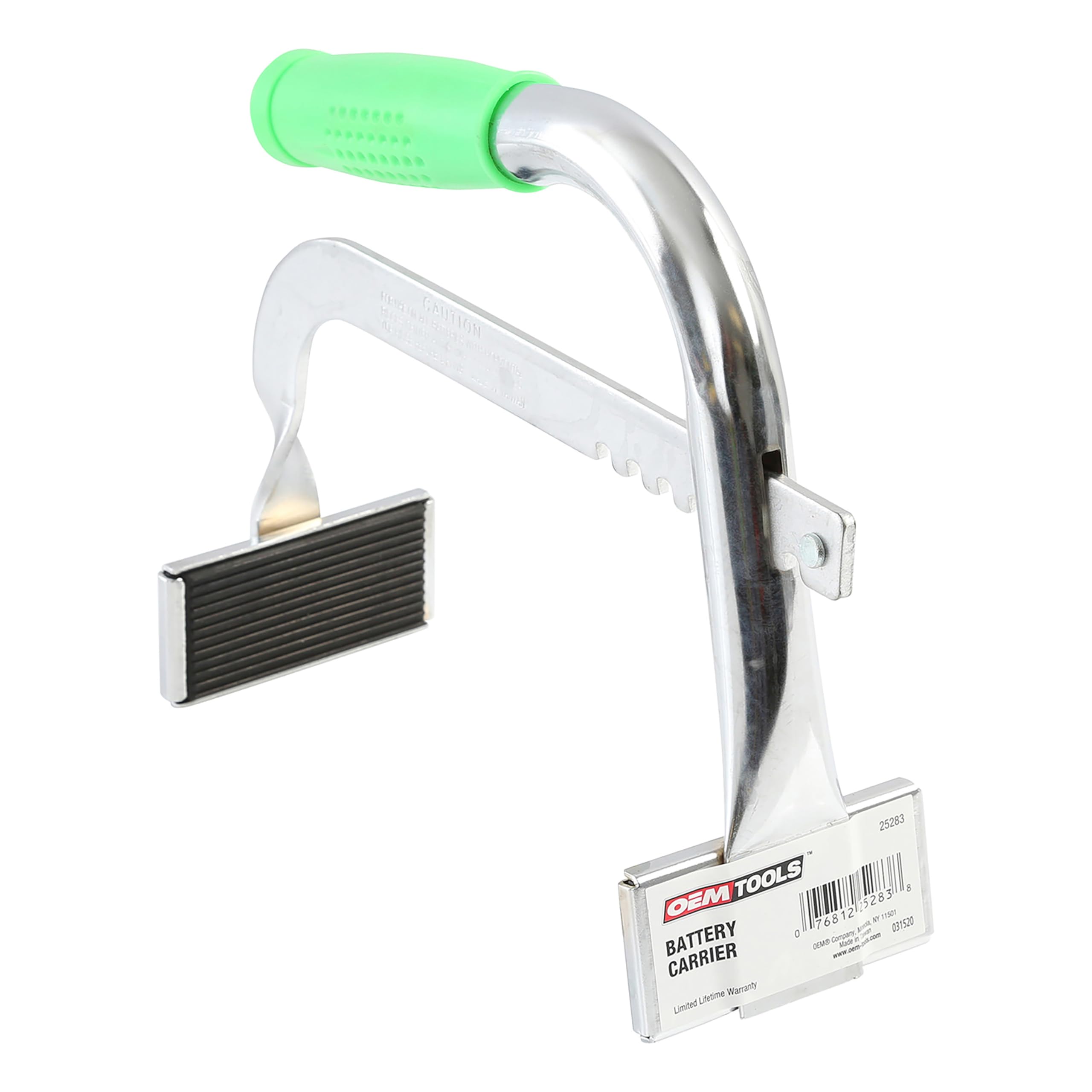
The OEMTOOLS 25283 earns its spot as a consistently recommendable mid-range carrier by solving the two biggest complaints about cheap plastic handles: the rubber pads actually stay bonded to the tongs, and the adjustable jaw survives repeated tightening without stripping. The adjustment mechanism slides from 5 to 7 inches and locks with a simple over-center clamp that requires no tools, making it easy to switch between a compact lawn-tractor battery and a full-size 94R in seconds.
The plastic handle is generously contoured and wide enough that the contact pressure spreads across your palm rather than digging into a narrow ridge. This ergonomic shape is particularly noticeable when you have to hold a battery at an awkward angle while disconnecting terminals — the handle doesn’t want to roll in your grip. Reviewers consistently mention that this tool “makes removing batteries from tight engine bays easy” and that they “wish they had bought it years ago,” which is the classic signal of a well-matched design for the weekend DIY crowd.
Where the OEMTOOLS falls short of the OTC is in absolute bite reliability on extremely oily or dusty battery tops. The rubber pads provide excellent protection for the battery casing, but they can slide if the battery surface is contaminated with grease. For the typical home garage car with a clean battery top, this is the perfect balance of cost and function.
Why it’s great
- Rubber pads protect the battery case from scratches and stress cracks
- 5-to-7-inch adjustment covers most car, truck, and equipment batteries
- Ergonomic handle reduces palm strain during extended lifts
Good to know
- Rubber grip slips on heavily greased or oily battery tops
- Plastic construction may not survive long-term daily professional use
3. QWORK Battery Carrier 2-Pack

The QWORK 2-pack is the pragmatic choice for the person who has multiple vehicles, a boat, and a riding mower — each with a different battery configuration. Getting two carriers for the price of one single-unit competitor means you can leave one carrier in the car and stow another near the ATV batteries without worrying about misplacing the tool when you need it. Each carrier adjusts from 5 to 7 inches and features rubber pads similar to the OEMTOOLS design, targeting the same occasional-use audience.
Build quality is better than the price suggests. The plastic handle feels dense and the rubber pads are bonded securely to the metal jaw tips — no peeling reported in reviews. The clamping mechanism uses a threaded adjustment knob that provides more precise width control than the slide-lock on some competitors. One review specifically noted that these carriers work well with US Battery SpeedCaps, which require extra clearance across the top of the battery, indicating the jaw profile was thoughtfully designed.
The most common criticism is that the clamps are slightly too short for the largest group 31 batteries, causing an awkward carry angle where the battery tips forward. For standard group 24 to group 48 batteries, the carriers are perfectly proportioned. If you primarily work on passenger cars and small equipment, this 2-pack is the most economical way to have a carrier at every battery location.
Why it’s great
- Two carriers allow dedicated placement in multiple vehicles or toolboxes
- Threaded adjustment knob gives precise width control for a secure fit
- Rubber pads hold well on clean battery tops and protect the casing
Good to know
- Jaws are slightly too short for the largest group 31 batteries, causing an angled lift
- Plastic construction may not hold up to heavy daily professional abuse
4. Lang Tools B-600 Heavy Duty Battery Carrier
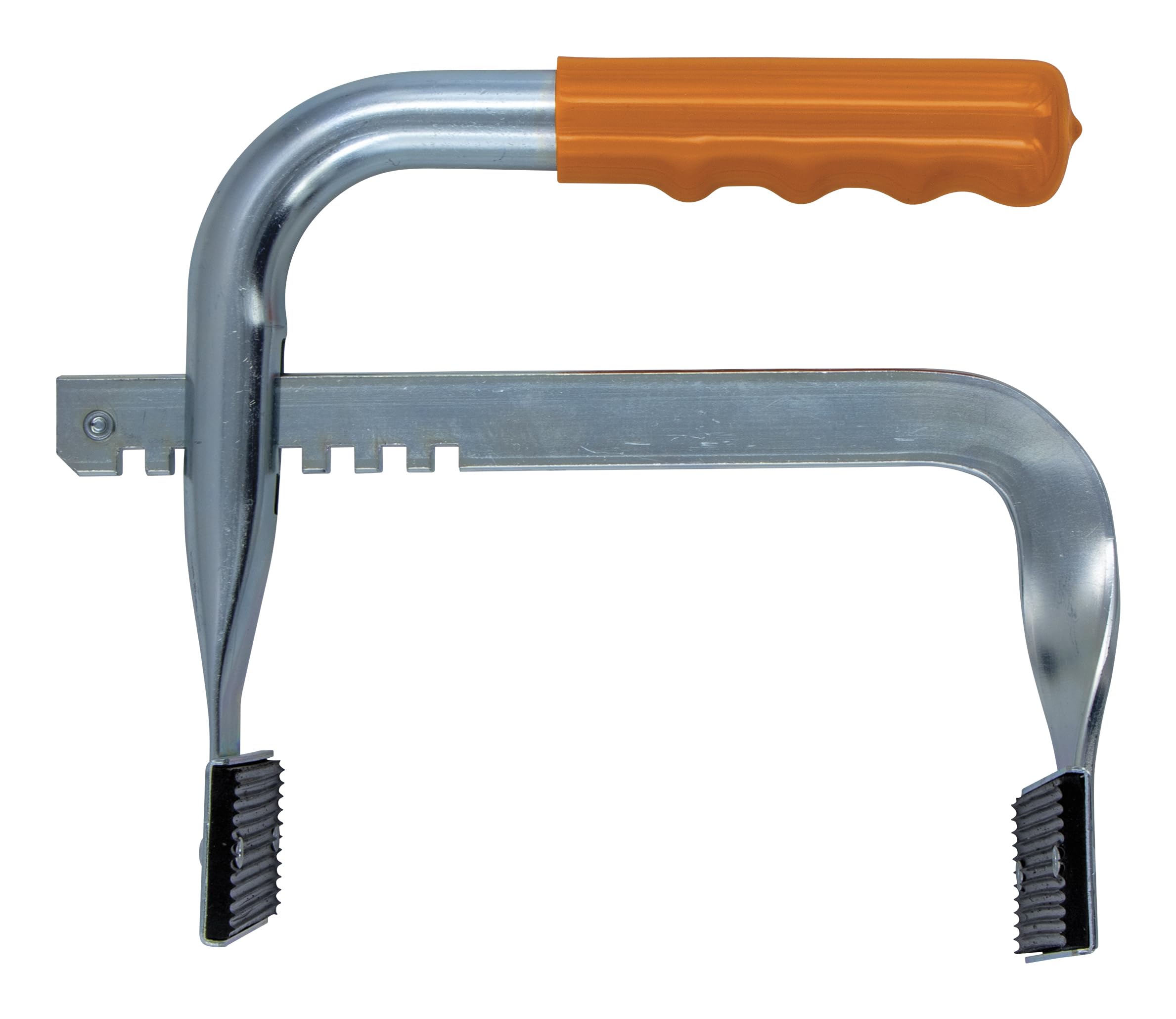
The Lang Tools B-600 is the only all-steel carrier in this lineup, and it feels like it the moment you pick it up. At 1.4 pounds, it is heavier than the plastic-handled competitors, but that weight comes from a full zinc-plated steel frame that will outlast plastic carriers by decades if not generations. This tool is designed for the heaviest batteries — group 31 deep-cycles, marine batteries, and large commercial truck units — where a plastic handle would flex or risk cracking under the load.
The clamping design uses a simple scissor action with a locking slide that positions the jaws securely. There are no rubber pads to wear out; the steel jaws grab the battery’s horizontal ridges directly. This works well on batteries with pronounced raised ribs, but on smooth-side cases the grip relies entirely on the teeth’s bite force. Reviewers who use the B-600 on their Silverado 3500 and heavy pickup trucks report that it makes extracting even awkwardly positioned batteries a one-person job, eliminating the need for a helper to steady the battery while it swings free.
The key limitation is the same feature that makes it tough: the steel jaws can scratch or dent the plastic battery case if you are careless. For a homeowner who changes a battery once every three years, that cosmetic damage may not matter. For a meticulous show-car owner, the rubber-padded carriers are a better match. But for sheer mechanical advantage and long-term durability, the B-600 is the professional’s pick.
Why it’s great
- Zinc-plated steel construction is virtually indestructible in normal use
- Handles oversize group 31 and truck batteries without flexing
- Simple scissor lock action is fast to engage and release
Good to know
- Steel jaws can scratch or dent plastic battery cases
- Heavier than plastic alternatives, which may matter for kit portability
5. Thyrm CellVault Battery Storage Case

Shifting from lift tools to carry storage, the Thyrm CellVault redefines what a battery strap carrier can be. Rather than clamping the battery itself, this case holds spare CR123, AA, or AAA cells and attaches to MOLLE webbing, backpack straps, or belts via a slim clip. Its oval cross-section creates an intentional friction fit: when the tube is inverted, the batteries stay put unless you squeeze the sides — a deliberate design choice that prevents them from rattling or dumping out during movement.
The o-ring seal provides genuine waterproof and dustproof protection for the cells inside, which is critical for tactical users, summer hikers, or anyone storing spare batteries in an open truck bed or emergency kit. The packed volume is only 1.9 cubic inches, yet it holds 3 CR123s, 4 AAAs, or 2 AAs. You can also use the empty space for small survival items like matches, iodine tablets, or a folded compass, making it a dual-purpose piece of field gear rather than a single-function holder.
The one real nuance is the retrieval technique: because the oval design holds fresh CR123s so snugly, you have to pinch the tube to release the bottom battery, then pinch again to capture it at the midpoint — an extra step that feels awkward at first. Users with smaller hands may find it finicky. For everyone else, it is a small price to pay for a case that refuses to let your batteries go when you don’t want them to.
Why it’s great
- O-ring seal keeps batteries dry and dust-free in harsh conditions
- Oval friction-fit design prevents battery rattle even with partial loads
- Attaches to MOLLE, webbing, or lanyards for hands-free carry
Good to know
- Snug fit for CR123s requires a pinch technique to release; feels unusual at first
- Expensive compared to basic plastic battery storage boxes
6. Thyrm CellVault-21 Rechargeable Battery Case
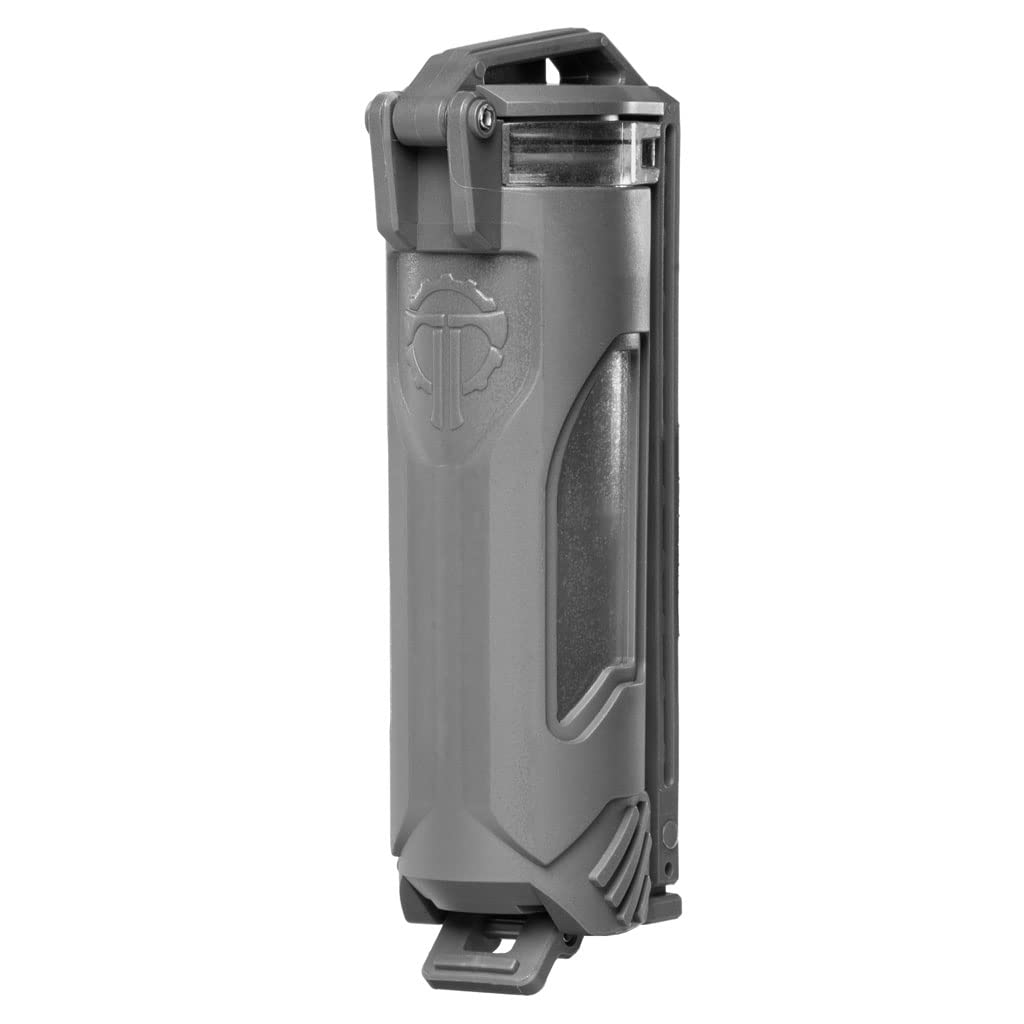
Powerful tactical flashlights and vape mods increasingly rely on 21700 lithium-ion cells, which are too large for standard battery cases and too dangerous to carry loose in a pocket where they can short against keys or coins. The CellVault-21 solves this with a dedicated tube rated to IPX7 (submersion in 2 meters of water for 30 minutes) and a silicone foam shock absorber at the base that cushions the cell and reduces rattling sound during movement.
The metal latch system attaches securely to MOLLE/PALS webbing, backpack straps, belts, and chest rigs. Thyrm includes a secondary security pin that prevents the latch from opening inadvertently under extreme movement — a feature that matters to police, search-and-rescue operators, and military users who may be running or climbing while carrying the case. The polycarbonate side windows let you verify the battery type without opening the case, which helps avoid fumbling for the right cell in low-light conditions.
This is a premium case designed for a specific audience: users who carry high-drain 21700 flashlights professionally and cannot risk a loose cell. If you are a civilian who charges a flashlight once a year, the cost is hard to justify. But if you rely on a premium light for work or wilderness survival, the CellVault-21 is the only case built to that standard of security and environmental sealing for this exact cell size.
Why it’s great
- IPX7 waterproof rating protects 21700 cells from rain, mud, or full submersion
- Metal latch with security pin prevents accidental opening during high-movement activity
- Polycarbonate windows let you see battery type without opening the case
Good to know
- Expensive relative to basic plastic cell holders
- Only holds a single 21700 cell — not suitable for multiple batteries or different sizes
7. NOMATIC McKinnon Battery Case

For photographers juggling multiple camera batteries on a shoot, the NOMATIC McKinnon case solves a specific pain point: telling a charged battery from a depleted battery without opening the pouch. The case comes with sticker indicators for “Full” and “Empty” so you can mark each slot at a glance, and the magnetic closure is completely silent — no loud Velcro rip that draws attention during a quiet ceremony or event.
The slim nylon profile (2.76 x 0.98 x 5.98 inches) fits inside a camera bag’s accessory pocket without wasting the vertical space that a rigid plastic case would consume. The three separate compartments hold standard DSLR and mirrorless batteries snugly, and the magnetic flap stays closed securely enough to survive being tossed in a gear bag but opens easily with one hand — important when you need to swap batteries quickly while holding a camera with the other hand.
The obvious tradeoff: this is not a heavy-duty protective case. It won’t survive being run over or submerged in water. It organizes batteries inside a bag; it does not protect them from crushing or extreme elements. Leica users confirm it fits the typ 246 battery dimensions perfectly, and the silent magnetic closure is a real upgrade over Velcro-based pouches that wear out over time. If your priority is quick-access organization for camera batteries rather than rugged field storage, this is the right tool.
Why it’s great
- Magnetic closure is silent and easy to open with one hand during a shoot
- Sticker indicators let you track which batteries are charged and which are depleted
- Slim nylon profile wastes no space inside a camera bag pocket
Good to know
- Not waterproof or crushproof — it organizes batteries, it does not ruggedly protect them
- Designed specifically for standard camera batteries; odd-sized cells may not fit securely
FAQ
Can a battery strap carrier damage my battery terminals or case?
What is the difference between a battery carrier and a battery strap?
Will a carrier fit top-post and side-post batteries the same way?
Final Thoughts: The Verdict
For most users, the best battery strap carrier winner is the OTC 4620 Universal Battery Carrier because its metal teeth and ultra-light vinyl strap provide the most reliable bite across standard car and truck batteries without damaging the case or slipping under load. If you want gentler rubber-padded jaws that protect older or AGM batteries, grab the OEMTOOLS 25283. And for heavy-duty lifting of oversized commercial batteries where plastic handles flex, nothing beats the all-steel Lang Tools B-600.